The Top Ten List of the Best Books I’ve Read in 2009

This has been another very good year of reading for me in which I made a conscious effort to read a wide variety of novels and collections of stories by many different authors. My reading has been influenced by the many fine book sites which I monitor as well as various book reviews.
Here goes.

‘Every Man Dies Alone’ (‘Alone in Berlin’) by Hans Fallada – an utterly convincing depiction of the nightmare of the Nazi reign for average ordinary Berliners.

‘The Spare Room’ by Helen Garner – a book about the minor aggravations and the huge rewards of a really good friend during the toughest times in our lives.

‘The Secret Scripture’ by Sebastian Barry – A very traditional, but new, and powerful novel from and about Ireland.

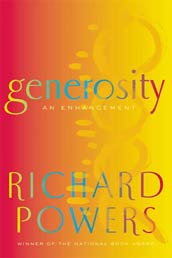
‘Generosity’ by Richard Powers – an intelligent passionate novel about gene research and our quest for happiness.

‘Both Ways is the Only Way I Want It’ by Maile Meloy – Modern cutting edge stories about life in the United States today.

‘Snow’ by Orhan Pamuk – an involving novel of the situation in modern Turkey with the main character being Orhan Pamuk himself.

‘My Cousin Rachel’ by Daphne du Maurier – A strong mystery-romance from this classic suspense writer.

‘How the Light Gets In’ by M. J. Hyland – the story of a female high school exchange student from Australia living in the home of Chicago suburbanites.

‘The Post-Office Girl’ by Stefan Zweig – A shattering story of a young woman in Austria during the 1920s.

‘What I Loved’ by Siri Hustvedt – A novel about two couples operating in the New York art world.

    Happy Holidays, EveryOne !

“Await Your Reply” by Dan Chaon

    The circumstances of life –
    The events of life –
    The people around me in life –
    Do not make me the way I am.
    They reveal the way I am.

For the first one hundred pages of “Await Your Reply”, I was about as enthusiastic about this novel as I have been about any book I’ve read this year. I have read Dan Chaon’s previous novel “You Remind Me of Me” and his collection of stories “Among the Missing”, both of which I liked very much. Chaon has a way of making ordinary life seem strange and wondrous which reminds me of Anne Tyler, high praise indeed.

Dan Chaon was born in Nebraska and lives near Cleveland, Ohio. Scenes of the novel take place in both of these states as well as many other places.

The novel sets up three small groups of characters very vividly, and I was eagerly waiting what Chaon would do with these characters. My problem with “Await Your Reply” is almost entirely with the plot. The plot is about how these three groups of people become involved with computer identity theft.

Now I’m sure identity theft and computer fraud are huge problems, and I have no reason not to believe as this novel implies that there are teams of people hacking across the computers of the world trying to break into people’s accounts on the computer in order to defraud them out of huge amounts of money. And I have no reason not to believe that sometimes things get very violent between these teams of computer criminals, which this novel also implies. I do think if computer account fraud were commonly occurring, none of us would ever enter our credit card numbers into Amazon or any of the many other places where we purchase items over the computer. Also every local paper in the country would be filled with the forlorn victims of Internet fraud. I think what happened is that a couple of years ago Internet fraud was threatening to get out of control, and these software companies like Amazon, etc., spent hundreds of millions of dollars to develop the software necessary to protect us from the computer hackers. If they hadn’t, these companies would have been pretty much out of business by now. Then again, these same companies are probably trying to minimize any publicity concerning Internet fraud.

The novel “Await Your Reply” does not at all attempt to point out the implications of Internet fraud for us. This is the opposite approach from Richard Powers who keeps us constantly aware of the importance of the issue he is dealing with in his novel “Generosity”. Instead identity fraud in “Await Your Reply” is just a plot device to move the action along.

I suppose in an action novel, moving the plot and the action along are very important. I guess the bottom line is I don’t see Dan Chaon as an action adventure novelist. I see Dan Chaon more as a character novelist, along the lines of Anne Tyler. For me, the somewhat contrived plot of “Await Your Reply” got in the way, and the characters were not allowed to grow, develop, and interact as I was hoping they would.

I probably will continue to read Dan Chaon since I really enjoy his writing style, but for me “Await Your Reply” was somewhat of a misfire.

Some Insights into Blogging and a few words about Twitter

Blogging about books can be a wretched business.

You can spend weeks reading that 437-page small print novel. The novel starts out really quite good, just as special as you heard it to be, so you keep reading it. But by page 186, you find the newness of the book has worn off, and the scenes and the characters and the writing are rather mundane. You find yourself nearly dozing off while reading. Whereas at the beginning of the novel, you would read thirty or forty pages in one sitting, now you find it difficult getting through three or four pages at a time. But you continue to slog through, because you need this book for a future blog entry.

Thankfully, you finally reach the last page, the end. Now you are ready to write your blog entry. How do you make a lukewarm review of a book interesting? You can’t write with too much enthusiasm, or people might mistakenly think you really liked the book. Besides you’ve over-used the ‘enthusiastic’ ploy too many times before. You can’t really trash the book, because it really wasn’t that bad, you’ve read many worse. You spend hours crafting a well-written review considering the finer points of this so-so novel.

Now you are ready to post your blog entry. You try to post it at a time when it will have the most impact, not like your last entry which had no impact whatsoever.

Then on to Twitter. You time your tweet for the entry so that also will have the most impact. The other people on Twitter are merciless. If they get one whiff that you are not the next big thing, they’ll drop or un-follow you like yesterday’s half-eaten sandwich.

You try to write your tweet, so people will come to your site. You don’t write “A So-So Novel by a Mediocre Writer”, so instead you refer to the plot of the novel in the hopes that will spur some interest. “Minister’s wayward son returns home to joyous parents”. One can only hope your tweet will not get lost in the crowd.

You monitor the blog stats which are like the heart monitor in a hospital emergency room. You watch for any tiny blip of activity. The more you watch the statistics, the less they change.

After a few days, it is time for another blog entry. This time you scribble something down, or I should say, the modern day equivalent to scribbling. It takes about ten minutes to write and post. Praise be, this will be your most popular blog entry ever.

I’m going to keep going with this fool’s game, this blog, because I kind of enjoy it.

What are your thoughts on blogging and Twitter? Please leave a comment.

Experiments in Fiction

Recently I started to read a novel called “The Interrogative Mood : A Novel” by Padgett Powell.  This novel is unusual, because every sentence in this book is a question.  I’d read good things about this book, and it seemed like a fascinating idea for a novel.  The novel is entirely a collection of random questions.  Here is an example from the book.

  • Do you regard living with routines as liberating or shackling?
  • Will you wear rain gear or do you prefer just getting wet?
  • If your survival depended on it, do you think there are things you would not eat?
  • Do you sympathize with the outlaw?

These questions draw you in as you think what your answers would be.  But after about twenty pages, I tired of these random questions and wanted some kind of story, some kind of progression.  Then I gave up on the novel.  It would have been a good thing if the author, instead of just asking random questions, would have attempted to tell a story via questions.  That would be a worthy goal which could probably be accomplished.

“The Interrogative Mood” would be called an experimental novel.  Sometimes I want more out of fiction than just another realistic family saga or another historical pageant.  I’ve read way too many novels about the bishop, the bishop’s wife, and their wayward children.  Some of my greatest reading experiences have been so-called experimental novels.  In Don Quixote, Cervantes puts himself in as a character in his own story.  In Canterbury Tales, Chaucer himself is the bumbling tour guide for his group of pilgrims.  In Ulysees, James Joyce celebrates one day in the life of Leopold Bloom in as many different ways as possible over the course of 930 pages.

One novel which I’m meaning to read soon is “A Void” by Georges Perec.  This 300-page novel was written without ever using the letter ‘e’.  A worthy goal.

One of my favorite experimental novelists is David Markson.  Three of his novels which I have read are “This is not A Novel”, “Wittgenstein’s Mistress”, and “The Last Novel”.  Markson describes his novels as “literally crammed with literary and artistic anecdotes” and “nonlinear, discontinuous, collage-like, an assemblage.”  Each of the entries in these novels stands on its own, yet together they meet the requirements for telling a story.  I read the entire “This is not a Novel” on a flight to Europe.  The literary anecdotes were fascinating, the short entries did not require undue attention, and all of them somehow fit into a convincing narrative.   For something completely different, try David Markson.

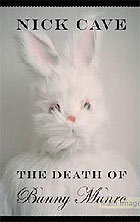
“The Death of Bunny Munro” by Nick Cave

“The Death of Bunny Munro” by Nick Cave”

Nick Cave’s “The Death of Bunny Munro” has no redeeming moral values whatsoever, but it is a playful sexy romp of a novel.
Bunny Munro is the kind of guy who does not ask himself the tough questions such as the following. Does sharing cocaine with your friends in the living room while your nine year old son is in the adjacent bedroom good parenting? Is calling your wife on the cell phone while the prostitute you are with is using the hotel room bathroom being a good husband? Is trying to have sex with and usually succeeding with every female you meet respecting women? Is keeping your nine year old son waiting in the car for hours on cold nights while you’re having sex with these women being a good father?
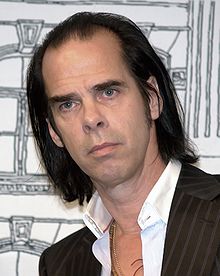
Bunny Munro is a door-to-door skin cream salesman, so you can imagine the possibilities in Bunny’s never-ending quest to seduce women. In a way, this book reminds me of the late 1970s, that wide open disco era when just about anything went. To trace the novel’s origins even farther back, I suppose you could say Bunny Munro is the Tom Jones (the hero of the novel, not the singer) of today. Today the only people still living this wild sexy life are probably mostly rock stars. And guess what? Nick Cave, the author, is a rock star from Australia. I was not familiar with Nick Cave’s music before, but lately have been listening to and enjoying his album Nocturama. Cave has also co-composed the soundtrack to the new movie “The Road”.

One of the main characters of this novel is Bunny Junior, Bunny’s nine year old son. There are hints here of the Cute Kid Syndrome that plagues so many novels, but Bunny is not above using Bunny Junior as a prop for his seductions. Fortunately for the novel’s sake, Bunny Junior does not redeem Bunny Munro as a character. Bunny Munro is unredeemable.

The writing in this novel is clear and always held my interest. I don’t think the story that is here warrants such a long book (278 pages). Some of Bunny’s seduction scenes begin to feel repetitive.

While I was reading this book, early on an ending for the story was very clearly telegraphed. I was eagerly waiting for the novel to turn in this direction. However the novel never did turn this way, and the disappointing ending that is here feels lame and tacked on. One of the main recurring characters of the novel, the horned red devil serial killer with the trident, is wasted. I wish I could have talked to Nick Cave before he completed this novel, so he could have changed the story to have the strong ending to which it was naturally headed.

As far as Nick Cave’s music goes, this year I have several Nick Cave albums on my Christmas wish list.
.

A Triumvirate of Alcoholic United States Writers

Recently, on my commutes, I’ve been listening to “The Stories of John Cheever”. If ever there was a writer to read between watching episodes of “Mad Men”, it is John Cheever. Cheever was the first great writer about suburban living in the United States.

These suburban men take the commuter train or bus to their offices and get into all sorts of trouble during the day at their offices and during the late afternoon and into night in bars after work, sometimes not making it back home until the next day. The women are home alone in their big houses waiting for whoever happens to show up at their door. Depending on who shows up at the door, the women may also be getting into trouble.

Every home is equipped with a full bar in the dining room to make cocktails after work, before dinner, and maybe after dinner. Everyone is watching to make sure the maid or the cook is not secretly taking drinks and watering down the alcohol in the bottles. After dinner is served and eaten, the husband and wife will each have a cigarette at the table before dessert is served. The children may or may not be around, no one really notices.

The evenings consist of a continuous round of neighborhood parties where the husbands and wives probably will get into even more trouble. And then another day.

One of John Cheever’s stories called “The Five Forty-Eight” is about just such a guy who takes the commuter train downtown to his office. He notices one of the young women who works for him and invites her out. She suggests they go back to her place for drinks. He ends up staying the night. A few days later the man fires the young woman to avoid any further complications. Things continue fine for a few months, but the man is a little worried in the back of his mind. Then one night as he is returning home from work on the commuter train, the young woman gets on the train and sits down beside him. She claims she has a gun, and he better not try to move to another part of the train or she will shoot him. I won’t give away any more of the story, but that is the story. I kid you not.

“The Stories of John Cheever” is a fine book and one of the best selling collections of short stories ever. Late in his life Cheever, a severe alcoholic who frequently was drunk by noon, gave up drinking and acknowledged his bisexuality late in his life.

In the just-published book, “Raymond Carver, A Writer’s Life” by Carol Sklenicka, there is a story about John Cheever and Raymond Carver. Both Carver and Cheever were teaching at an Iowa writers’ workshop where they became drinking buddies. “He and I did nothing but drink,” Carver said of that 1973 workshop. “I don’t think either of us took the covers off our typewriters.” Twice a week they made their regular run to the liquor store as soon as it opened in the morning in Carver’s car, because Cheever had no car.

At that time in 1973, Raymond Carver was an out of control alcoholic who habitually ran out on the check in restaurants. One time he hit his first wife on the head with a wine bottle severing an artery and nearly killing her. By 1977 both Carver and Cheever were able to swear off alcohol for their few remaining years.

Another issue is raised in this new biography of Raymond Carver. Apparently Carver’s editor, Gordon Lish, heavily edited the stories in Carver’s most famous books “Would You Please Be Quiet Please?” and “What We Talk About When We Talk About Love”. Now both Carver’s original versions of these stories and the versions after Lish’s heavy editing have both been published, and there are huge differences. This matters, because these stories have become iconic in modern literature under the category of “dirty realism”.

If anyone captured the spirit of Mad Men as much as John Cheever, it would be Richard Yates. Probably his most well-known novel now is “Revolutionary Road”. Not only was Richard Yates alcoholic; he also suffered from bipolar disorder. Yates was a four pack a day smoker of cigarettes, and one time was responsible for a fire in his apartment that destroyed his apartment and several others. Yates’ drinking and psychotic outbreaks caused him to be committed to mental institutions several times. One time he threatened to kill Gordon Lish when the editor rejected him.

Yet Richard Yates remained prolific as a writer. For many years, Richard Yates was my favorite writer. I’ve read every one of his novels and all of his stories. Yates’ novels that I would strongly recommend are “The Easter Parade”, “A Good School”, as well as “Revolutionary Road”. He also was a great short story writer, and both his story collections, “Eleven Kinds of Loneliness” and “Liars in Love” are exceptional.

These three alcoholic but very perceptive writers are among the most significant writers in the United States since World War II.

Moving Stories from Australia

“The Persimmon Tree and other Stories” by Marjorie Barnard

photo16

To appreciate a short story fully, one must get into the rhythm of the story. Frequently I will read a few pages of a story to get a sense of the characters and of the scene of a story and then will start over again so that I can feel the rhythm and understand what the author is trying to do. This is especially true of the stories in “The Persimmon Tree”. These stories are very short, and they are meant to be read slowly and savored.

One of the stories in this book, “The Wrong Hat”, is only three pages long. “The Wrong Hat” is a moving emotional story about a woman, who has recently lost her husband, shopping for a hat.

Marjorie Barnard’s method is the classic story method where a seemingly insignificant scene is described, but the scene resonates through the lives of the characters in the story, especially the main character. In the story “Beauty is Strength”, a trip to the beauty parlor causes a woman to reflect on the state of her marriage. In another story, “Sunday”, a man who is trying to become a writer goes to Sunday dinner at the house of his parents who want him to lead a more conventional life. I could describe each story in this book with a short sentence like the above, but I won’t. All these stories capture the ultimate importance of everyday events in each person’s life. If you like to read moving stories about daily life, you will probably enjoy this book.

A month ago, I had never heard of Marjorie Barnard. But I’m always on the lookout for new unfamiliar writers. So when Whispering Gums ( http://whisperinggums.wordpress.com/ ) strongly recommended this book, I latched on to it immediately. Unlike novelists, some of the finest short story writers are scarcely known.

Marjorie Barnard was born in Sydney, Australia in 1897. She graduated from the University of Sydney, and she was offered a scholarship to Oxford but her father refused to give her permission to go to Oxford. After that, her relations with her father were strained; she became a librarian. Later she formed a literary partnership with Flora Eldershaw. Together they wrote five novels under the name M. Barnard Eldershaw. I have my doubts about creating fiction as a partnership, but their science fiction novel “Tomorrow and Tomorrow and Tomorrow” is now quite well known. However “Tomorrow and Tomorrow and Tomorrow” originally was severely censored by the Australian government for its pacifist views in 1947 when it was published, and the novel in hacked up form was poorly received. “It was just murdered,” Barnard said, “I was heartbroken.” After that, Barnard concentrated on writing history. This novel was not published in its original entirety until 1983 and it has become highly regarded. She died in 1987. Besides Wikipedia, another good source for information on Marjorie Barnard is http://www.nla.gov.au/pub/nlanews/2004/aug04/article3.html

At the same time as the literary collaboration with Flora Eldershaw was going on, Marjorie Barnard was also writing short stories and getting them published in magazines. These stories were collected and published as “The Persimmon Tree and Other Stories” in 1943. This one little book of moving stories is a lasting legacy of Marjorie Barnard.

There is one story in this book, “Dry Spell”, which is an exception, because it is an apocalyptic story similar to “The Road”. For a detailed analysis of this story go to this location:
http://goliath.ecnext.com/coms2/gi_0199-1799873/Dampening-incendiary-ardour-the-roots.html

“Beauty is Strength” by Marjorie Barnard Anatomy of a Perfect Short Story

“Beauty is Strength” is a short story in the book “The Persimmon Tree and Other Stories” by Marjorie Barnard.  A more complete discussion of this book will appear in a later entry at this site. All of the quotes in boldface are taken verbatim from the story.

This story begins with a woman going to the beauty salon for her regular appointment.

    “The locks lay dank against her head.  A sleepless night always took the life out of her hair.  It was part of the weariness of being over forty that you daren’t have any emotions, they took it out of your looks too much.  A month at the beach hadn’t done her hair any good either.”

It hadn’t been a good holiday.

    “She would rather, after all, have stayed home with Ced.  When he had urged her to go she’d taken it for granted that he was being generous as he always was.”

While the girl in the beauty salon adjusts the hair dryer, the woman sees herself in the mirror.

    “It was from moments like these, when you saw your face isolated, that you learned the truth about it.  Her mouth looked hard and disappointed, and round each corner there was clearly discernable, in this impartial light, a little bracket of wrinkles….Her cheek bones looked high and stiff and on her throat, where age first shows itself, the working of the muscles showed too clearly, and the skin under the chin was ever so puckered.“

The woman begins to question why her husband sent her away on this month-long holiday and thinks of the suspicious tell-tale signs she found when she returned from the holiday to home.

    “Three dress shirts.  And he’d said he’d been nowhere…He always grumbled at getting into a dress shirt but he looked his best in evening dress…To see those three new-laundered shirts was like picking up a bird’s feather bright with the tell-tale mating colors.”

The woman remembered a letter addressed to her husband lying on the table when she returned from the holiday.

    “She recognized Viola’s handwriting at once large, eager, rather unformed.  It was bulky; even in Viola’s sprawling script, a long letter.  She had weighed it speculatively and put it by with an open mind.  She wasn’t, she often told people – particularly Ced – a jealous  wife, nor would she be but for the possessive streak as strong in her as instinct in an animal…Why exactly had Ced stayed behind when she went to the beach?  All she could remember was something vague about business.”

The woman’s salon session continues.

    “She stared at her grotesque image.  There was a bright red spot on either cheek.  Her spirits plunged even lower…She never imagined he’d let her down.  What if he were serious and he wanted her to divorce him?  Her mind widened in horror.  That would take everything from her, her home, her background,, her position.  A woman could only divorce successfully if there was another man waiting for her. She would have to make a new life.  She was too tired, TOO OLD.”

But then her hair styling was done.

    “For a moment she forgot her troubles.  It was a beautiful wave, her head never looked better   She began to make up her face, rediscovering all its lost virtues…She, not he, was in the strong position.  If he wanted to be a fool, he’d have to pay for it.  She bent forward and looked into her own eyes, bright once more under the influence of eye shadow and mascara – and then she would win him back again.  While she had her looks she could do anything.  She had been through an ordeal but now she felt secure again.  She wasn’t even very angry.  She had put on again the whole armor of sophistication.  If anyone was going to look foolish it was Ced and Viola—especially Viola.”

A List of Disappointing, Annoying, Unmemorable Novels

Sarah of Sarah’s Books http://sarahbbc.wordpress.com/ writes “You are recommending too many must-reads. How is one to keep up?! This one sounds intriguing, but I am not sure that I could take all that undiluted happiness.”

Yes, this is a reviewer’s quandary. I try to read only books I think I’ll like, and so the majority of them are going to get positive reviews. But how many times can one reviewer use the words ‘wonderful’, ‘great’, ‘amazing’, ‘impressive’, ‘stunning’, etc, without losing all credibility with the audience and all self respect?

So here I’m putting down a list of novels in no particular order which I have found disappointing, annoying, or unmemorable. I want to prove to Sarah that I can be just as pernicious as the next person.

First, one disclaimer. A bit of indigestion, a sleepless night, a grueling day at work can make any novel seem like a useless trial. I’m not saying the books below are bad books. All I’m saying is that I reacted badly to them at the time.

Nobody Move by Denis Johnson- Denis Johnson went slumming on this one, and it shows. One hundred lesser talented novelists than Denis Johnson could write this story in their sleep better than he did.

The Savage Detectives by Roberto Bolano – A group of South American young people hanging together for literature. Sounded promising, but they were still hanging after 143 pages, not saying anything interesting, so I quit. Others have said it gets better after that.

We Were the Mulvaneys by Joyce Carol Oates – When Joyce Carol Oates is obsessed about something, she can make you feel as terrible about it as she does. I felt terrible for 474 pages.

Oliver Twist by Charles Dickens –  I hate cute kids in novels.

The Road by Cormac McCarthy –  I hate cute kids (“Papa!”) in novels.

Stanley and the Women by Kingsley Amis – I’ve read several pathetic novels by Amis in my futile quest for another “Lucky Jim”.

The Deportees by Roddy Doyle – His condescending attitude toward new immigrants of Ireland put me off Irish literature for a couple of years.

My Life as a Man by Phillip Roth –  This novel was on the top of my worst list until another, see below, replaced it.

Breakfast of Champions by Kurt Vonnegut – Perhaps my worst all-time read.   Something about this book irritated me tremendously. It’s like Vonnegut was having a dispute with his publisher, and he intentionally wrote a lousy book to get even. Perhaps it was his line, “This is an asshole”, repeated an infinite number of times, each with an illustrative drawing.

Silas Marner by George Eliot – No one can be as cloying and sickeningly sentimental as George Eliot is in Silas Marner. The same is also true of her “Janet’s Repentance”.

Can’t Pay, Won’t Pay, a play by Daniel Fo – I usually try to read Nobel literature prize winners, even when they are this bad.

The Wings of the Dove, The Sacred Fount, The Ambassadors, and The Golden Bowl by Henry James – I haven’t been able to read past page 30 in any of Henry James’ later major novels without falling into a deadened stupor.

Do you have any novels you really disliked or detested?  Tell me about them with a comment.

“Generosity” by Richard Powers – The Happiness Gene

“Generosity” by Richard Powers

The novel “Generosity” is about the near fact that each person’s happiness is a result of the individual genes that each of us carries.  Louise Brown, the world’s first test tube baby, was born in Manchester, England, in 1978.  Now there are hundreds of thousands of babies that are being conceived in test tubes each year.  Soon parents of test tube babies will be able to select the genes which their baby will have.  These parents will be able to avoid congenital diseases such as epilepsy and diabetes by selecting certain chromosomes for their baby.  They also will be able to select chromosomes to avoid conditions such as bipolar disorder and schizophrenia.  Scientists are already working to isolate the “happiness gene” which will cause the bearer to be all-around happier than the average person.
Richard Powers Richard Powers
photo © Jane Kuntz

I hope I can adequately convey the pleasure (happiness?) I obtained from reading “Generosity” by Richard Powers.   This novel is one of my favorite reads of 2009, because it contains a moving story with striking new ideas which I have not encountered before.  All is presented in dramatic and thought-provoking fashion.

This novel is about genomics.  Genomics is the study of the DNA sequences that comprise individual life. You might think, “A novel about genomics? How very boring.” and you would be completely wrong.  This is a very human moving story that we don’t read about every day.

The story starts with a guy, Russell Stone, teaching a community college night course in journal writing.  One of his students, a young woman, is an immigrant from Algeria.  Her father was murdered in the continual political violence in Algeria, and her family has been uprooted and is now spread out around the world.  Yet this young woman, Thassa Anzwar, is preternaturally happy.   She lights up the entire class, and everyone wants to be her friend. She is one of those people who becomes friends with everyone she meets, even people she meets on elevators.  Circumstances lead her to meet a genomics researcher who is looking for the happiness gene.

    Hyperthymia – a personality type or temperament characterized by happiness, high energy levels, extroversion, productiveness, and creativity.

GenerosityRichard Powers, a writer from Illinois, is a strong stylist, and he can make the most complicated ideas understandable and dramatic.  I’ve read two other Richard Powers novels, “Galatêa 2.2” and “Gain”, both of which are impressive.  He has developed his own unique style of writing which conveys the story powerfully.   Powers also won the US National Book Award in 2006 for his novel “The Echo Maker”.  “Generosity” is another powerful novel which I highly recommend.

Having read perhaps a thousand novels that deal solely with the past, I find it hugely exhilarating to read a writer who writes with honesty and intelligence about our future, who faces tomorrow and the day after tomorrow in a humane and empathetic way.  Richard Powers is one of my favorite writers.

.

Amelie Nothomb – A “Must Read” Author

You may as well get on the Amelie Nothomb bandwagon now rather than later. She has already written 13 novels and has received about as much critical acclaim as one writer can stand. She is technically from Belgium and writes in French. Her father having been a Belgian diplomat, she was actually born in Kobe, Japan and has lived in China, New York, Bangladesh, Burma, Coventry, and Laos.
Amélie NothombI discovered Amelie Nothomb about four or five years ago through reading about her in the Complete Review http://www.complete-review.com/main/main.html, that comprehensive and trusted source for world literature. Here are the grades that the Complete Review has assigned to her novels so far.

  • Anti-Christa    B-
  • The Book of Proper Names     B
  • The Character of Rain    A-
  • Cosmetique de l’ennemmi     A-
  • Fear and Trembling     A-
  • The Life of Hunger    A
  • Loving Sabotage      A+
  • Mercure      B
  • Pep’lum     B+
  • The Stranger Next Door      B
  • Sulphiric Acid    B
  • Tokyo Fiancee     B+

Anyone who has read the Complete Review realizes that the grade of A+ for “Loving Sabotage” is virtually unheard of in the annals of the Complete Review. I have read six of her novels : “The Character of Rain”, “Fear and Trembling”, “The Life of Hunger”, “Loving Sabotage”, “The Stranger Next Door”, and her latest, “Tokyo Fiancee”.

How to describe her writing? Amelie Nothomb is the most cosmopolitan and autobiographical of novelists, yet her novels are light and amusing as a souffle’. Her novels are usually quite short, no longer than they need to be, very direct and simple. “Fear and Trembling” is about a young woman / girl just out of high school working for a Japanese company She writes about the unique attitudes and behaviors that are part of business in Japan, but only as part of the story she is relating. Much of the novel is quite mercilessly humorous about the Japanese business culture. “Loving Sabotage” is about a young 7-year-old child living in China in the 1970s, told from the perspective of an adult. “The Character of Rain” is the story of a baby’s first three years of life inside the infant brain. “Tokyo Fiancee” is a light novel about the romance between a young Japanese guy and a western girl who lives in Japan.

In a way, Amelie Nothomb reminds me somewhat of the Dutch writer Michel Faber. Neither of these writers can be pinned down to any one country; they belong to many countries. Both Nothomb and Faber write wonderful short novels or novellas.

Amelie Nothomb is already widely popular in France, and she is each year gaining more readers in the English speaking countries. If you start to read her books, you will continue to read her books.

Teaching Your Dog to Speak

“The Dogs of Babel” by Carolyn Parkhurst
I usually steer clear of best selling books, although I have read and much liked “Cold Mountain” and “Girl with a Pearl Earring”, both best-sellers of their time. Also I’m a huge admirer of Anne Tyler and read all her books, even though her novels sell like hot cakes.
“The Dogs of Babel” received very positive reviews and was a best-seller. The book has been out for six years, but in the next few months there will be renewed interest in the book, because it is being made into a major movie.
The story is about a married couple, Paul and Lexy, and their dog Lorelei. Since Lexy dies in the first sentence of the book, much of the book is told in flashbacks. Only Lorelei witnessed the death of Lexy, and an early plot line is Paul’s efforts to teach the dog Lorelei to speak, so Paul can figure out what happened to Lexy.
One of the many nice things about this book is the originality of its plot. I’ve never encountered any story remotely similar to this story. Many of us can identify with the idea of pets being always around, seeing everything that goes on, but not being able to talk about it in any way.
The story is told in the first person in the voice of the husband, Paul. It is always a difficult task for a novelist to create a believable narrator of the opposite sex, and Parkhurst pulls it off quite well. I did feel that Paul was perhaps a little too idealized, but for the most part believable.
One of the real strengths of Carolyn Parkhurst as a novelist is that she tells the story simply and directly, and her style does not get in the way of the speeding plot. This is quite an accomplishment for a first-time novelist. I can easily see why this novel was selected for a movie treatment, because the plot is striking and the scenes vivid. It is also a very emotional story. And who can resist a lovable dog?
For a reader like me who reads literature for breakfast, lunch and dinner, the book was perhaps a bit too simplistic, but overall I enjoyed it very much and will never forget the plot.

Two Short Books, Two Short Reviews

“Something Special” by Iris Murdoch
“Lady Macbeth of Mtensk” by Nikolai Leskov

“Something Special” is a short story by Iris Murdoch which was published in book form in 2000 as a tribute to her the year after she died. She actually wrote the story in 1957. It is very short, 51 pages, with a lot of very good wood carving illustrations by Michael McCurdy. It is about a young man and woman walking the streets of Dublin on a cool summer evening. First they walk by the seaside, then over to the Liffey, and then stop at a couple bars. But the real story is how the interaction between two people can be mysterious and unexplainable. This story was written when Iris Murdoch was still a young writer. It is simple and direct; it is indeed something special.

“Lady Macbeth of Mtensk” was written by Nikolai Leskov in 1865.
This story is about a spirited young woman born in poor circumstances forced into a marriage of convenience with a dull rich middle-aged man. The young woman pines away until she meets a playful young man. By the story’s end, the young woman Katerina Livovna Izmailovna makes Lady Macbeth seem like Mother Theresa in comparison. The title of this novel is indicative of the importance of Shakespeare to Russian literature. The works of Shakespeare were translated into Russian early in the nineteenth century, and it is not just a coincidence that the great flowering of Russian literature occurred soon after and lasted for about eighty years. This short novel is a good read. It made me nostalgic for all of the Russian writers of this era from Pushkin to Gogol to Turgenev to Dostoevsky to Chekhov to Tolstoy to Bely.

A Classic Dublin Tragedy by Sean O’Casey

“Juno and the Paycock” – A Play by Sean O’Casey, 1924
I understand that St Patrick’s Day in Ireland is a religious rather subdued holiday. In the United States, with the huge parades, green beer, and men and women dressed as leprechauns, St Patrick Day, even though it isn’t a work holiday, is anything but subdued. Here are some comments from a few residents of Hoboken, New Jersey on their St. Patrick’s Day celebration.

    “St. Patty’s Day 2009 was a complete and utter atrocity and should never be allowed to occur again!!!!! If you all have to get that inebriated and belligerent, and end up breaking in to people’s apartment buildings to urinate and defecate in their hallways and stairs, than you are all losers! I will be more than happy to sign a petition to NOT ALLOW ST. PATTY’S DAY IN HOBOKEN TO EVER EVER BE PLANNED AGAIN!”


    “The parade is an excuse to get wasted and try and get laid….let’s be honest here. you don’t like to get laid? you don’t like to party? get your life together and stop being a little bitch.”


    “Tons of drunk 20 somethings all over the street. Bars have lines out the door starting at noon.”

Sometimes at my least charitable, I look at the cringe-worthy cheap sentimentality of St Patrick’s Day perhaps best exemplified by the song “The Unicorn” by the Irish Rovers. What’s so special about the Irish? It just seems reasonable that the family, the ancestry, the nationality of every person in the world is just as valid as anyone else’s. Except for billionaires; they don’t count. During some years I’ve even avoided Irish books just so I won’t encounter any of the cheap sentimentality.
So what does St. Patrick’s Day have to do with Sean O’Casey’s play? Despite the above, I’ve read many Irish writers who far transcend sentimentality. Many great reading experiences have been with Irish writers, writers like James Joyce, Maeve Brennan, Flann O’Brien, Bernard MacLaverty, Edna O’Brien, Mary Lavin, William Butler Yeats, and, yes, Sean O’Casey. A current superior Irish writer is Sebastian Barry whose books “A Long, Long Way” and “The Secret Scripture” are excellent.
O’Casey’s “Juno and the Paycock” takes place when the Irish were fighting each other, the Republicans versus the Free-Staters. I know less than nothing about Irish politics, but this was at a time when men in the same apartment building could be at war with each other. What I’m trying to say is that sentimentality in “Juno and the Paycock” is well-earned because the conditions of this family’s life, the poverty and the violence, are so terrible these people deserve an interlude from their current circumstances by reminiscing about the past.

Continue reading

Some of my Favorite Short Story Collections by Woman Writers

Recently I’ve been thinking about writer Mary Ladd Gavell.  Originally from Texas, she was managing editor of Psychiatry magazine in Washington D.C.  In her spare time, just for fun, she wrote short stories.  Psychiatry magazine didn’t print fiction, so she just kept them in a drawer. She died in 1967 at the quite young age of 47.  After her death, her colleagues at Psychiatry magazine ran her story “The Rotifer” in the magazine as a tribute.  So months after her death, she finally became a published fiction writer.  That story was selected for “The Best Short Stories – 1968”.   Her husband then tried to get the University of Texas to publish more of the stories without success.

Then, at the turn of the century, 2000, John Updike selected “The Rotifer” for one of “The Best Short Stories of the Century”.  He called the story a “gem” and “feminism in literary action”.  Then in 2002, sixteen of Gavell’s stories were collected in the book “I Can Not Tell A Lie, Exactly”.  The book met with near universal acclaim.  I read the book then, and many of the stories are as fine as “The Rotifer”.

Here is a list, in no particular order, of some of my favorite collections of short stories by woman writers.

A Dedicated Man by Elizabeth Taylor I consider this English writer the real Elizabeth Taylor.  She was also a great novelist.  Having read at least a dozen of her novels and all her stories, I feel qualified to say that.

The Springs of Affection by Maeve Brennan an Irish writer and regular contributor to The New Yorker, she had a long, sad ending.  She was re-discovered four or five years ago – a personal favorite.

Dictation – A Quartet  by Cynthia Ozick her stories are intelligent and unique.

Both Ways is the Only Way I Want It  by Maile Meloy – A young United States writer.  Very impressive.

The Darts of Cupid  by Edith Templeton Re-discovered in 2002, she is in danger of being forgotten again.  Her novel “Gordon” was banned in England

I Am No One You Know  by Joyce Carol Oates Some of her novels are enchanting (“You Must Remember This”, “I’ll Take You There”), and some are exasperating (“We Were the Mulvaneys”).  However, her short stories are uniformly strong.

Tigers Are Better Looking  by Jean Rhys A legendary writer of the twentieth century.

Throws Like A Girl   by Jean Thompson A Chicago writer with several fine collections.

I Can Not Tell A Lie, Exactly  By Mary Ladd Gavell Perhaps the secret to writing a great story is to not think about publishing at all.

Little Black Book of Stories  by A. S. Byatt An excellent writer in both short and long form.

Bad Characters  by Jean Stafford Former wife of insane but brilliant poet Robert Lowell.  Her novels are fine too.

Perfect Strangers  by Roxana Robinson I am always on the lookout for new books by this United States writer.

Birds in America  by Lorrie Moore A quirky, humorous storyteller, justly famous.

The Moons of Jupiter  by Alice Munro Why even mention her?  Everybody already knows she is a great writer.  Cynthia Ozick calls her “our Chekhov”.

Any short story writers you would like to mention?

“The Cry of the Sloth” by Sam Savage

“The Cry of The Sloth” by Sam Savage

    Continue reading

Funny Fiction – An un-Bleak List

Starting at 12 years old, I began reading Mad magazine.  Every issue had the “What, Me Worry?” kid, Alfred E. Neuman, on the cover with his gap-toothed smile.  Every issue of Mad magazine contained “assorted rubbish from the usual gang of idiots”, which was the publishers’ slogan.  There were other humor magazines such as “Crack’d”, “Sick”, and “Panic”, but Mad was always consistently the funniest.  I was so dedicated to Mad, I’m sure the magazine shaped my entire attitude toward life.  They still sell Mad magazine but most places that sell magazines are way too respectable and reputable to carry something so smart, creative, and anarchic as Mad magazine.

Today, we also do have “The Onion”, a fake newspaper with outrageous headlines like “Pepsi to Cease Advertising”.  Most of the articles in The Onion are more relevant than those in the real newspapers.  I’ve noticed that after the first few humorous pages, “The Onion” has some of the best reviews anywhere.

After college I mostly switched to humorous novels instead of humor magazines.

Kimbofo at  Reading Matters recently listed the ten bleakest novels ever.  Most of these novels were very dark.  Now, as an antidote, I will print my personal list in no particular order of the funniest novels ever.

  • Lucky Jim  by Kingsley Amis      an English college riot
  • Confederacy of Dunces  by John Kennedy Toole     Masterpiece of “slob” literature
  • Catch-22 by  Joseph Heller      Military forces awry
  • Gulliver’s Travels  by Jonathan Swift    Travel to some very unusual places
  • At Swim-Two-Birds  by Flann O’Brian     A wild Irish tale
  • Candide  by Voltaire     an eternal French optimist
  • Don Quixote  by Miguel de Cervantes    “a hopeless romantic” or “romantic and hopeless”?
  • Cold Comfort Farm  by Stella Gibbons    Way down on the farm
  • The Good Soldier Schweik  by Jaroslav Hasek   the funny side of World War I
  • The Groves of Academe  by Mary McCarthy     Why is college so funny?
  • Pictures from an Institution  by Randall Jarrell    Is humor academic?
  • Oblomov  by Ivan Goncharov   a lazy Russian aristocrat
  • Scoop  by Evelyn Waugh      outlandish African news reporting
  • Firmin – Adventures of a Metropolitan Lowlife  by Sam Savage     autobiography of a literary rat
  • The Apprenticeship of Duddy Kravitz  by Mordecai Richler    Young man on the make in Montreal

As you can see, no writer appears on this list twice.  Which writer came closest to appearing twice?  It probably would be Evelyn Waugh whose “The Loved One” is a fall-down hilarious putdown of the funeral business.  Honorable mention also goes to Peter De Vries who wrote many humorous novels including  “The Tunnel of Love” and *The Tents of Wickedness”.

I’m sure there are some great humorous novels I’ve missed.  I want to know what I’ve missed. What humorous novels should I also include?

Two Novels by Hans Fallada

Little Man, What Now?”  by Hans Fallada, translated by Eric Sutton

“Every Man Dies Alone” by Hans Fallada, translated by Michael Hofmann

These two fine novels by Hans Fallada could well serve as bookends describing the Nazi era in Germany.  “Little Man, What Now?” was published in 1932, the year before Hitler took full power in Germany.   “Every Man Dies Alone” (in many places, called “Alone in Berlin”) was written in 1946, the year after Hitler committed suicide, and World War II ended.

“Little Man, What Now” describes the young marriage and early family life of Johannes Pinneberg and his wife Bunny.  Although they have to struggle to get enough money to make ends meet, this young couple is quite happy due to the strong attraction between them.  In both novels, Fallada is very good at describing happily married couples.  Bunny can’t cook, and Johannes wastes money on these grand gestures like buying a big dressing table for his wife while they rent and live in a hovel, but due to their strong affection for each other, they get along just fine, even after they have the baby.  Later they face enormous difficulties which they face because they have each other.  One of Fallada’s major strengths as a novelist is describing everyday life of ordinary people in an accurate and intense way.

Johannes works as a salesclerk in a men’s clothing store for most of the novel, and he barely makes enough money for him and Bunny and baby to get by.   But they are helped by several eccentric people around them, and in many ways “Little Man, What Now?” is a playful, happy novel about this young family.

Where are the Nazis in “Little Man, What Now?”     They are around.  Anti-Semitism is everywhere in the streets.  The Nazis are on the rise.  In the novel, there is only one minor character Lauterbach who is a young Nazi.  He works with Pinneberg on one of Johannes’ early jobs.  Lauterbach is proud of his Nazi badge, and every night he and his Nazi friends go out in the streets harassing Jews and getting into street fights with them and anyone else they don’t like.

But for much of the book, “Little Man, What Now?” is a pleasant family story centering on the young husband and wife.  Hollywood grabbed the story up quickly, and by 1933 “Little Man, What Now?”  was already a movie.

The scene in “Every Man Dies Alone” is completely different, a nightmare. Berlin in 1940.  Now the Nazis have totally taken over.  All of the exotic eccentric people have disappeared from Berlin.  Everyone is in fear that their Nazi neighbors will report them to the Gestapo and then they too will be dragged away to prison.  Groups of Nazi neighbors living in the same apartment house as the Quangels, the main characters of this novel, terrorize the life and apartment of an elderly Jewish woman who lives there.  Her husband has already been sent away to a concentration camp. If anyone else is friendly toward or tries to help this woman, they too will be reported and hauled away by the Gestapo.

The story in “Every Man Dies Alone” also centers on a married couple, this time a middle-aged couple called Otto and Anna Quangel.  They are a quiet couple until their only son “Ottochen” gets killed on the Russian front during World War II.  Then Otto starts writing notes with messages denouncing the Nazis and leaving them anonymously in public buildings where people can find them.  His wife is in on this futile campaign and completely supports her husband in his efforts.  The Quangels are another strong supportive couple, but here there is nothing to be playful about.  There are Nazis under every toadstool in Berlin terrorizing their neighbors in the early 1940s.  One of the many strengths of this novel is that it paints a very clear picture of the oppressive life of ordinary people in Berlin during the Nazi era.   Until now, we did not know how terrible life was for the average Berliner during the Nazi era.   Of course,  these Germans suffered less from the Nazis than millions of other people throughout Europe.

“Every Man Dies Alone” is a powerful novel.  I consider it the best book I’ve read this year so far.  I will remember details from this novel long after I forget the whole stories of other novels I’ve read this year.  “Little Man, What Now” is also a very good novel, but it does not have the intensity of “Every Man Dies Alone”.  Hans Fallada put his heart and soul into his last book, and he died in 1947, the year after it was written.

Over the past few years the world has discovered or re-discovered many European novelists from this terrible era – Joseph Roth, Stefan Zweig, Irene Nemirovsky,  Irmgard Keun, and now Hans Fallada.  What a spectacular group of writers!

Will an era like the Nazi era ever happen again?  Given human nature, I expect it will.  I don’t think it will have the same trappings as the Nazis did or the same slogans or symbols.  It will try to sell itself as something completely new and different.  It will probably occur in a completely different place.  But it will have one thing in common with the Nazis.  There will be street gangs beating up and harassing the people they don’t like, and the police and government authorities will not only condone it; they will encourage it.

Thank You for Sam Savage, John Self

One of the book sites I always read is John Self at http://theasylum.wordpress.com/ because it is a great place to get new leads for wonderful works of fiction.  Last year John Self at Asylum introduced me to Sam Savage.  Sam Savage happens to be a novelist from my former beloved hometown of twenty one years, Madison, Wisconsin.  Based on John Self’s review, I read Savage’s  “Firmin, The Adventures of a Metropolitan Lowlife”,  a story about a rat which was one of the highlights of my reading in the year 2008.  Apparently now nearly everyone knows that Asylum is one of the best book places on the Internet.  I have just received Sam Savage’s new novel, “The Cry of the Sloth – The mostly Tragic Story of Andrew Whitaker being his collected, final, and absolutely complete Writings”.  Now if only I can read and review “The Cry of the Sloth” before John Self does.

So now this virtually unknown book blogger, me, is hitching his wagon to John Self, one of the stars of the Internet book world.  Shameless.

Re-Evaluations – Graham Greene and William Faulkner

A long time ago, I read “The Power and the Glory” by Graham Greene.  For some reason, I hardly remember why, I disliked it and wrote it off as a spy novel, a thriller, a best seller.  So for the next many years I avoided reading Graham Greene while reading just about every other literary writer in the world.   Then finally about five years ago, after having read some good things about “The End of the Affair” and “A Burnt-Out Case”, I decided to read these novels.  This time I really appreciated Greene’s straightforward style.  There was nothing flashy about his writing, but he had these wonderful plots that kept me completely involved.  But the real turning point was reading “Brighton Rock”, an early Greene novel.  I loved this story about these young punks driving around Brighton, England.  This was the best novel I had read in years.  So for the next few years, I read nearly everything Graham Greene wrote.  Every book by Greene I read captivated me.  Now, unfortunately, I’ve run out of Graham Greene novels to read.

As a child, I was not interested in literature at all.  The only books I really appreciated as a boy were “Tom Sawyer” and “Huckleberry Finn” by Mark Twain.   At college, even though I was majoring in mathematics, I decided to take a course in Contemporary Literature.  One of the books we were assigned was “Absalom, Absalom” by William Faulkner.  This over 400 page novel is notorious for containing some of Faulkner’s most convoluted page-and-a-half long sentences.  No matter how hard I tried, I could not get through this novel.  I had to drop the Contemporary Literature course, because of “Absalom, Absalom”.  The next semester, I again enrolled in Contemporary Literature.  This time “Light in August” was the Faulkner novel on the reading list.   “Light in August” was much more reasonably written without the long run-on sentences, and I actually enjoyed reading it.  I completed the Contemporary Literature course successfully.  After that, William Faulkner was my favorite author.  I read and enjoyed most of Faulkner’s novels in the next few years after that.

A few months ago, after having not read Faulkner for many, many years, I decided to listen on  my drives to and from work to the audio CD of  “Light in August” which I still considered William Faulkner’s finest novel.  This time the novel just completely hit me the wrong way.   This time all of Faulkner’s deep and dark ponderings and reckonings about the possibility that his character Joe Christmas might have “mixed” blood seemed like little more than ill-disguised racism to me.    I suppose one could excuse Faulkner because he wrote these novels in the 1930’s in the deep South.  But already by the 1930s, there were many people who had more progressive racial attitudes.  And I am not about to forgive Faulkner for these Southern attitudes and their deliberate ignorance, after these have done so much damage to the United States during the last ten years.

Have any of you had your opinion of an author drastically change? Please let me know.