“Troubles” by J. G. Farrell – Winner of the Lost Booker

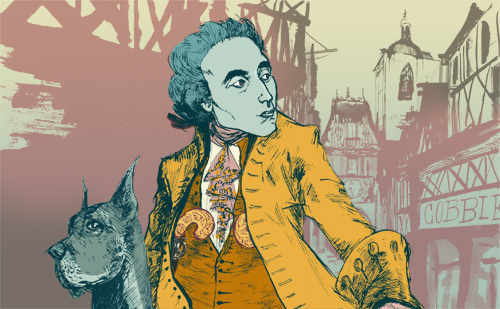
“Troubles” by J. G. Farrell (1970) – 446 pages

“Troubles” is not at all what I expected;  the novel turned out to be a fun romp at a dilapidated English hotel in Ireland in 1920.  I expected another eloquent if over-earnest account of the troubles in Ireland after World War I.  Everyone knows this was a tragic time, so how was Farrell able to frame this story as a comedy?  Let me explain.
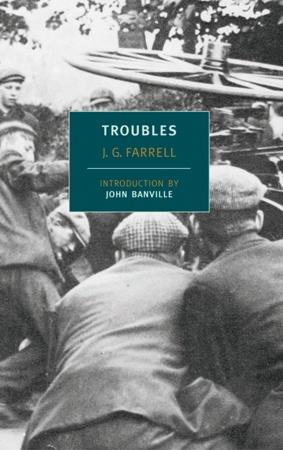
The main character, Major Brandon Archer, ‘The Major’, visits a hotel, the Majestic, on the coast of Ireland where he is supposed to meet his fiancé.  The Major has just fought in World War I and spent several months in the hospital recovering from shell shock.  The Majestic which once was a luxury hotel is now in severe decline.  Most of the remaining guests are elderly British women who have nowhere else to go.  Huge areas of the hotel are overrun with cats and rats, and occasionally pieces of plaster fall from the walls and ceiling.   Guests move from abandoned room to abandoned room trying to find a room that is habitable.  The hotel’s aristocratic English owner, Edward Spencer, has pretty much lost interest in the hotel.  He’s upset about Sinn Fein and other Irish groups which are working for Irish independence.   The Major soon realizes that Edward Spencer is a pompous fool, and the fun begins.

“Troubles” was the winner of the Lost Booker this year, getting 38% of the popular vote.  The Lost Booker was an award for 1970 novels, because that was the year that got missed when the annual Booker switched from an award for novels published the previous year to novels published the current year.  Among the novels competing against “Troubles” was “The Vivisector” by Patrick White.  Although “Troubles” is a very humorous book, there is no way that it has the artistic ambition and vision, the narrative sweep, of  “The Vivisector”.  The Lost Booker was a popular vote.  Imagine if  Shakespeare’s “Hamlet” were to compete against John Clease’s “Fawlty Towers” which “Troubles” resembles more than a little.  I suspect in a popular vote “Fawlty Towers” would win every time over Hamlet.  That’s about the same contest we have putting “The Vivisector” up against “Troubles”.

Not that “Troubles” is a bad novel.  For Booker winners, it probably is above average.  It does have many virtues just as “Fawlty Towers” has many virtues, first and foremost being extremely funny.    Probably the novel that “Troubles” most closely resembles is “Cold Comfort Farm” where someone travels to a place where all the people are fools, but to be a fool is normal and not being a fool makes you abnormal.
The Major in “Troubles” is an English army officer yet his attitude toward the British presence in Ireland is decidedly not pro-British.  His attitude is more in line with these words from another character in the novel.

    “There’s a new spirit in Ireland; I can feel it you know and see it everywhere. The British are finished here. The issue hasn’t been in doubt, hasn’t been for the last twenty years…I’ve no sympathy for them, they’ve lived here for generations like cocks in pastry without a thought for the sufferings of people. Now it’s their turn, and I’ll shed no tears for them.”

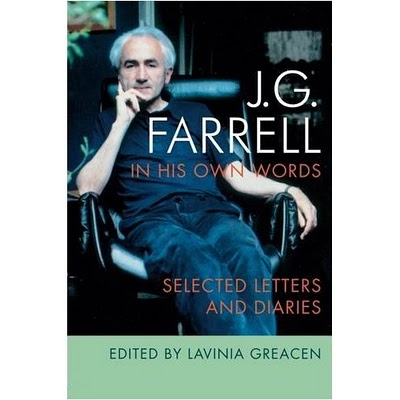
Certainly no tears are shed for the British in this novel unless they are tears from laughing so hard.   This is the first novel of Farrell’s Empire trilogy which also included “Singapore Grip” and “The Siege at Krishnapur”, both of which I read but have little memory of except both also being excellent. Farrell also won the Booker for “The Siege at Krishnapur” in 1973.  J. G. Farrell drowned in a fishing accident in southwestern Ireland in 1979 at the age of 44.

So “Troubles” is a fine novel just as “Fawlty Towers” is a fine TV show.  At the risk of sounding also like a pompous fool, I think the lost Booker lost an opportunity to award the prize to probably the finest novelist of the twentieth century, Patrick White.

“The Lost Daughter” by Elena Ferrante

“The Lost Daughter” by Elena Ferrante (2006) – 125 pages

Much of the novel “The Lost Daughter” by Elena Ferrante takes place on an Italian beach near Naples.  A woman in her late forties goes to the beach nearly every day and there meets an extended family who are set up near her.  The extended family includes two sisters, their husbands, and one of the sisters’ little three-year old girl Elena whose most precious possession is her doll Nena. 

This is the first Elena Ferrante novel I’ve read.  I heard about her in Frisbee’s Book Journal.  Elena Ferrante is rather a mysterious figure in Italian literature who has so far kept her identity concealed, and it even has been suggested that Elena Ferrante is actually a pen name for male Italian writer Domenico Starnone.  There is a lot of speculation on the Internet regarding this, most of it in Italian.

Whoever she or he is, Elena Ferrante is a fine writer.  She brings a bluntness of action and emotion to this story that reminds me of the great Italian novelist Alberto Moravia.  The woman that is the lead character in “The Lost Daughter” is a highly educated woman who had the possibility of a spectacular academic career before her, but she also had a husband and two daughters.    Twenty years ago, while her daughters were still very young, she left her home and her family and did not come back for three years.  Now she is still trying to reconcile her walking out on her family.   The fact that she was highly educated and successful did not make it any easier for her to accept the responsibility of being a full-time mother; it actually made it more difficult.  The daughters are now grown up and living away from Italy in her divorced husband’s country of Canada.    

The woman identifies strongly with the young mother she meets on the beach, and this bond causes the woman to do something quite irrational and surprising around which the story is built.

It is refreshing to have an intelligent character in a novel look back on their own actions with maturity and honesty which allows them to accept responsibility for what they did.  Ferrante has found the perfect and surprising objective correlative for telling this story of a mature woman passing on an important lesson learned to a younger woman.   This is a short but powerful novel that contains several well-drawn characters and a very dramatic plot.

Some Nearly Forgotten 1950s Novels that are Exceptionally Good

The Fifties are known as an unquestioning conformist time, so I’ve picked some really good offbeat unconventional books written in the Fifties.  Four of the books below also ended up as offbeat movies.

“Absolute Beginners” by Colin MacInnes (1959) – Set in 1958, this novel shows that the youth culture in London was way cool even before the Sixties.  It was the second book of MacInnes’ London Trilogy, but it surpassed the other two books in popularity.  Julien Temple made “Absolute Beginners” into a super fine movie in 1986 (I own the DVD) which contains the song “Absolute Beginners” sung by David Bowie.

“Wise Blood” by Flannery O’Connor (1952) – Most famous for her short stories, O’Connor also wrote this ‘comedy of grotesques’ about a would-be itinerant preacher and his hapless followers.  This novel is a rich example of Southern Gothic.  It was made into a good movie by John Huston in 1979.

“Contempt” by Alberto Moravia (1954) – Alberto Moravia is one of my very favorite writers.  I must have read about ten of his novels, most of which were made into movies.  I like Moravia’s bluntness here, because this really is a novel about a woman’s contempt for her husband.  Brigette Bardot played the woman in Jean Luc Goddard’s 1963 movie based on ‘Contempt’, and it probably was her best role.

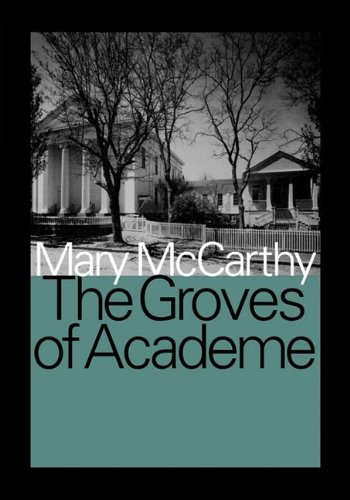
“The Groves of Academe” by Mary McCarthy (1952) –  If you want a novel written by a woman that you can laugh yourself silly to while reading it, this is it. It is about Henry Mulcahy, a literary instructor and James Joyce expert.   He describes his colleagues thusly.  “Possibly they were all very nice high-minded scrupulous people, with only an occupational tendency toward back-biting and a nervous habit of self-correction”.  As far as I know, this novel has never been made into a movie, but it could make a great one even today.

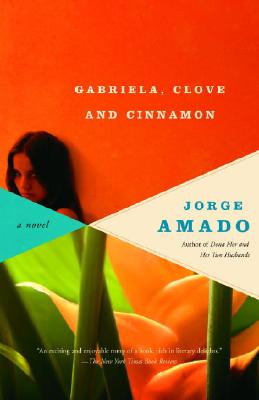
“Gabriela, Clove and Cinnamon” by Jorge Amado (1958) –  Jorge Amado was a writer who wrote colorful stories about the people of Brazil.  I never get tired of his novels.  ‘Gabriela’ is one of his finest, a romantic comedy masterpiece by Amado who wrote several masterpieces.  It was made into a movie in the Eighties starring Sonia Braja.

“A Visit from the Goon Squad” by Jennifer Egan – The Rock and Roll Life

“A Visit from the Goon Squad” by Jennifer Egan  (2010)  – 274 pages, but one of the stories is a 75-page PowerPoint slide show presentation with a lot of white space and only a small amount of actual writing which only counts for about 10 pages of actual story, so the effective number of pages is only about 209 pages.

This summer has been an excellent summer for me for reading new North American stories with first “Ether” by Evgenia Citkowitz which has edgy stories about people in the movie business, then “The Imperfectionists” by Tom Rachman which has satisfying stories about people in the newspaper business, and now “A Visit from the Goon Squad” by Jennifer Egan which has unique stories about people in the rock-and-roll business.  The stories in “Ether” are separate stories and a novella, the stories in “The Imperfectionists” are separate stories all about people who work at one newspaper office, while the stories in “A Visit to the Goon Squad” are truly linked stories that together form a complete novel.   I had not read Evgenia Citkowitz and Tom Rachman before, but I discovered Jennifer Egan early in her career with “The Invisible Circus” and “The Emerald City”.  From these early works, I knew that Jennifer Egan was a formidable talent, and I’ve followed her career closely. A recent review at The Mookse and The Gripes reaffirms this view. 

Dealing with the rock and roll business, ‘A Visit from the Goon Squad’ is a wild and woolly book.  I give Jennifer Egan a lot of credit for keeping her writing cool while dealing with these wayward rock and roll people.  The rock and roll era she deals with was a quite decadent era in the late Seventies and early Eighties, and her characters fully take part.  The book is not only about the musicians but also about the producers, the PR people, and the families. 

The book starts with two quotes from Marcel Proust’s “In Search of Lost Time”, one of which I think captures what Jennifer Egan is getting at in this novel.

    “The unknown element in the lives of other people is like that of nature, which each fresh scientific discovery merely reduces but does not abolish.” – Marcel Proust

It is this unknown element in people that is not reducible to science that “A Visit from the Goon Squad” is about.  This unknown element gives these stories their mystery.  Although I have no musical talent, rock and roll interests me, and I really enjoyed these devastating stories.  While contemplating a quote from the novel itself, I considered several, a couple of which were quite risqué, but finally settled on the following atypical off-hand comment on language and the Internet.

    “Her new book was on the phenomenon of word casings, a term she’d invented for words that no longer had meaning outside quotation marks. English was full of these empty words – ‘Friend’ and ‘real’ and ‘story’ and ‘change’ – words that had been shucked of their meanings and reduced to husks. Some like ‘identity’, ‘search’, and ‘cloud’ had clearly been drained of life by their Web usage. With others, the reasons were more complex; how had ‘American’ become an ironic term? How had ‘democracy’ come to be used in an arch mocking way?”

A few weeks ago, I was wondering what ever would I do for a Top Ten reading list this year.  Now my concerns are how will I fit all these books in and how can I possibly rate one of these books over the others.    

In my review of ‘”Ether”, I described those stories as edgy.  I would characterize the stories in “A Visit from the Goon Squad” as spiky.  Don’t ask me what the difference between edgy and spiky is.

“Reality Hunger – A Manifesto” – Why I disagree with David Shields

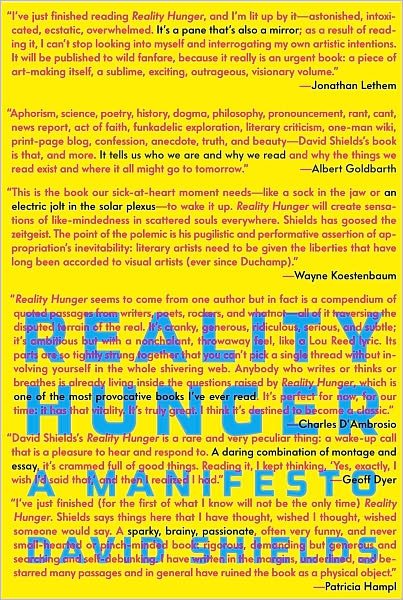
“Reality Hunger – A Manifesto” by David Shields (2010) – 205 pages

In this discussion of David Shield’s new book “Reality Hunger – A Manifesto”, I will start with the first sentence in the book. 

    “Every artistic movement from the beginning of time is an attempt to figure out a way to smuggle more of what the artist thinks is reality into the work of art.”

This quote would be OK, if the word “true” were substituted for “reality”.  Reality is often mundane – look at reality TV shows.  I know that Shields is struggling to bring something more important into his manifesto, but reality TV has pretty much trivialized and tarnished the word ‘reality’.

Here are some of Shields’ thoughts on fiction and novels

    “Increasingly the novel goes hand in hand with a straitjacketing of the material’s expressive potential. One gets so weary watching writers’ sensations and thoughts get set into the concrete of fiction that perhaps its best to avoid the form as a medium of expression.”
    “My medium is prose, not the novel.“
    “Plot is a way to stage and dramatize reality, but when the presentation is too obviously formulaic, as it so often is, the reality is perceived as false.”

The idea that fiction writers are straitjacketed into writing a certain way for the sake of the novel is just silly.  From Cervantes to Chaucer to Jane Austen to Malcolm Lowry to present-day writers, writers have been free to do and have done whatever they want with the novel.  The word “novel” itself means new and different.   

Shields advocates something called the lyric essay in place of fiction

    “The lyric essay doesn’t expound, is suggestive rather than exhaustive, depends on gaps, may merely mention.”

The lyric essay sounds terribly joyless and self-centered to me.  Whereas a novel can be filled with many different kinds of characters interacting, an essay is usually just one person’s perceptions.  One could also say that there have been lyric essays for a long time – they are called poems.  I’m all in favor of poetry.  David Shields should explain how his lyric essay is any different from a poem.  A lyric essay doesn’t sound as interesting as a poem.

Then there is Shields’ take on Hamlet.

    “The entire play is the Hamlet Show, functioning as a vehicle for Hamlet to give his opinion on everything and anything, as Nietsche does in ‘Thus Spoke Zarathustra’. The play could easily be broken into little sections with headings like “Hamlet on Friendship”, “Hamlet on Sexual Fidelity”, “Hamlet on Suicide”, “Hamlet on Gravediggers”, “Hamlet on the Afterlife”. Hamlet is more than anything else Hamlet talking on a multitude of different topics…I find myself wanting to ditch the tired old plot altogether…”

I love the story of Hamlet, this angry young prince who finds out that his uncle murdered his father,and married his mother.   What Shields is recommending would be very similar to googling ‘Hamlet quotes’  It is only within the contest of the play that most of the quotes have any significance..  And what about Polonius and Ophelia?  Admittedly, the last act of Hamlet is mostly dead bodies piling up on the castle floor, but the first two acts are magnificent. 

In a couple of places, Shields speaks admiringly of Anne Carson as if she were in his camp.  With her translations of the ancient Greek tragedies, I don’t think there is anyone who appreciates the power of fiction more than Anne Carson.   Certainly Anne Carson is very creative in all her work, but I think she gains her power from her appreciation of these ancient works of fiction.  Maybe David Shields should translate a few ancient plays so he could get some insight into fiction.

Shields also admires David Markson’s collage novels.  I wrote an appreciation of David Markson and very much enjoy his work, because it is new and different, unique.  But even in Markson, I miss the rich context that fiction provides.   I generally only read non-fiction that is written by writers whose fiction I admire such as Robert Graves, Primo Levi, and Dawn Powell. These writers I can trust to not be dishonest and self-serving which are the major faults of non-fiction. 

Shields also argues that copyright laws should be reduced or eliminated, because all works that have been written before are just artifacts to be “sampled” by all those lyric essayists of the future. 

But the proof is in the pudding.  Maybe in the next few years there will be some lyric essays by a variety of writers that are so wonderful to read that even I will read them over fiction.  I’m not holding my breath.

“Shiloh” by Shelby Foote – A United States Civil War Battle Re-enactment

“Shiloh” by Shelby Foote (1952)  –  226 pages

Shiloh, a two day battle which started on April 6, 1862, was one of the largest battles of the U. S. Civil War.  The North had had much success in early 1862, driving its army into southern Tennessee almost to Mississippi.  Before the Shiloh battle, the South saw an opportunity to attack and drive the Northern Army up against the Tennessee River and then destroy them.  Much of the fighting took place at Pittsburg Landing on the Tennessee River.

“Shiloh” by Shelby Foote is an account of the battle from the first person perspective of seven different characters who participated in the battle.  These seven characters are well-placed as adjutants, etc., so they can relate the back stories of the major generals who participated in the battle including Grant, Sherman, A.S. Johnston, Beauregard, and Forrest.   At the same time, they are out on the battlefield so they see the fighting, the twisted bodies of the dead soldiers lying in the fields and woods, the makeshift sawing off of legs and arms of wounded soldiers.   In one memorable scene in the novel, our observer sees the contorted bodies of a dead Union soldier and a dead Confederate soldier across a dirt road from each other.  Apparently they aimed and pulled the trigger on their guns at exactly the same moment shooting each other in the forehead.

Usually I don’t read too much war fiction, but even in such literary classics as ‘War and Peace’ and “A Farewell to Arms” large sections are devoted to battle scenes.  One of the innovations of Shelby Foote is to tell the story of the battle from the point of view of the soldiers on the ground rather than the grand strategies of the generals which usually don’t translate to the ground anyhow.  One of the major themes of “Shiloh” is the confusion about orders on the ground especially for the Confederate soldiers.  The Confederates’ top general A. S. Johnston was killed early in the battle.  His death caused those under him to not know for sure what to do next.  Thus Nathan Forrest, the Confederate cavalry officer, knew that Union re-enforcements were soon to arrive, and that the Confederates better attack quickly.  However he could not convince the other officers who had not received such orders to attack at night.

Foote does not question war, the usefulness or uselessness of two groups of men murdering and maiming each other.  He takes this for granted.  In the Shiloh battle, the North had 13,047 casualties (1,754 killed, 8,408 wounded, and 2,885 missing or captured) and the South had 10,699 casualties (1,728 killed, 8,012 wounded, and 959 missing or captured).

Shelby Foote is interested only in telling the real story of the “Shiloh” battle, not about any of the characters.  The characters are pretty much interchangeable voices, except the Southern soldiers talk with a southern accent, and the Northern soldiers talk with a northern accent.   I suppose there is also a tendency in war fiction for a soldier character to be ‘Every Soldier’ and thus have only minimal individual traits.  This lack of character individuality is carried to an extreme in “Shiloh”.  This book could almost be called a re-enactment rather than a novel.   I could see how groups doing actual re-enactments of Shiloh could use this book as a blueprint.

I probably would have preferred a novel with more individual characterization.  However for anyone who wants to get the full story of what happened in the battle of Shiloh, this book is an excellent source.

“The Imperfectionists” by Tom Rachman

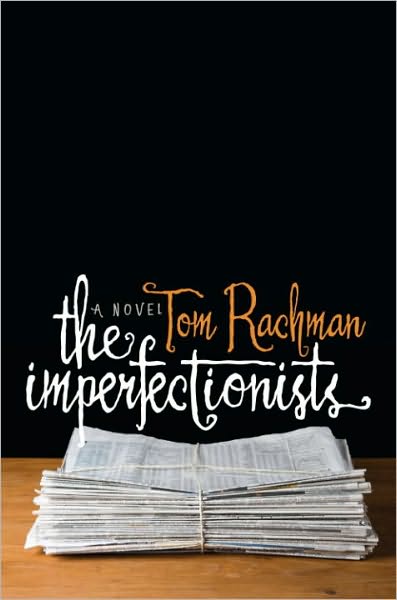
“The Imperfectionists” by Tom Rachman   (2010)  – 272 pages

“The Imperfectionists” – what a perfect name for a novel. 

This novel consists of linked short stories about an English-speaking newspaper that publishes from Rome. In each of the stories one of the people who works for the newspaper is the main character such as corrections editor Herman Cohen, copy editor Ruby Zaga, or business reporter Hardy Benjamin.

Tom Rachman brings a jaunty style to each of these stories as he tells us about these less than perfect people.  It’s quite obvious that Rachman loves the newspaper business and has all the compassion in the world for these men and women who work there.   After reading only a few pages of the novel, I knew I could settle in and just have fun reading these vivid stories.  Each story’s title is a clever newspaper headline such as “”Global Warming Good for Ice Creams”.   Each story is a combination of the main character’s work life and home life which usually intermix.  The main character in one story will frequently show up as a minor character in another story.

The newspaper which is the backdrop of these stories was started by an American millionaire from Atlanta in the early 1950s.   In little sections at the end of each story, Rachman tells us the history of the newspaper through the years.     

I’ve read several of these novels which are actually a group of linked short stories.  Two other fine examples are “Miguel Street” by V. S. Naipaul and “Olive Kitteridge” by Elizabeth Strout”.    What these novels of linked stories say to me is that, yes, each of us has our own set of damn problems, but, wait, let’s go over there and see what kind of damn problems that guy or gal across the street or across the office aisle has. 

Tom Rachman has a light touch, and these stories are exuberant as well as poignant.  According to the author’s notes, Rachman was born in London, raised in Vancouver, graduated from the University of Toronto, and lives in Rome.  In other words, he is another of those authors hard to pin down to any one country.

Somewhere I read a review talking about the similarity in tone of “The Imperfectionists” to “Then We Came to the End” by Joshua Ferris.   However I myself much preferred “The Imperfectionists” to the other book, because I sensed a certain amount of disdain that Ferris had for his characters.

“The Imperfectionists” has been my fun read of the year.  Other books have been deeper and more challenging, but this is the book I have enjoyed the most so far this year.

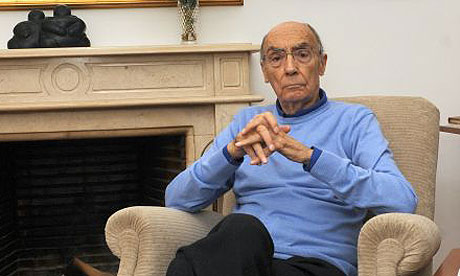
Jose Saramago (1922 – 2010) Creator of Wild and Powerful Allegories

    “Inside us there is something that has no name, that something is what we are.”

Imagine if the Iberian Peninsula, containing Spain and Portugal, broke off from Europe and drifted all over the Atlantic Ocean.  That is just what Jose Saramago imagined in his novel “The Stone Raft”.

Saramago, one of the giants of modern literature, died  recently. 

Jose Saramago wrote sustained allegories.  Many of us are familiar with his wonderful novel “Blindness” which is about a mysterious epidemic of white blindness that paralyzes a major city. 

    “I think we are blind. Blind people who can see, but do not see.”

I first discovered Jose Saramago in the early 1990s.  The first novel of his that I read was “The Year of the Death of Ricardo Reis” which some critics consider his finest work.  Although Saramago’s sentences would sometimes go on for more than a page, I had no difficulty following him, loved this novel.  That novel also introduced me to another of the Portuguese literary giants, Fernando Pessoa, because Ricardo Reis was one of Pessoa’s alter-egos for his poems.  Actually there have been a triumvirate of Portuguese literary giants :  Jose Maria Eca de Quieroz, Fernando Pessoa, and Jose Saramago.  I’ve already written on Fernando Pessoa, I am writing now on Jose Saramago, and sometime soon I will write on Jose Maria Eca de Queiroz who was the first nineteenth century Portuguese literary giant. 

After initially reading Jose Saramago, I knew I had to read more of his work.  I read “Baltazar and Blimunda”, “The History of the Siege of Lisbon”, “The Gospel According to Jesus Christ”,  and “The Stone Raft”.  All were allegories; all were excellent.  By this time, Jose Saramago was one of my very favorite writers.  Then he won the Nobel Prize in 1998, one of the few times that the Swedish Academy got it right.  The Swedish Academy praised his “parables sustained by imagination, compassion, and irony”.

The only disappointment I’ve ever had reading Saramago was his very short novel “The Tale of the Unknown Island”.  Here was an allegory I couldn’t figure out.  Perhaps I should give it another try.

In the early 2000s, I moved on to other writers and did not keep up with Saramago.  He published several books during that time.  Finally the buzz surrounding his novel “Blindness” was so loud I could not ignore it. “Blindness” is an incredible novel, another powerful allegory.   As in most of Saramago’s allegories, the details of the specific situation are so precise and feel so right that you buy into the most outlandish story lines.  “Blindness” is a triumph, and now I intend to read Saramago’s other recent novels. 

Saramago left Portugal to live in the Spanish Canary Islands because the Portuguese government would not let his work “The Gospel According to Jesus Christ” compete for the European Literary prize arguing it offended the Catholic community.  Saramago’s  translator Margaret Jull Costa hailed his “wonderful imagination” and his focus on the “dignity of the ordinary man”.

I would like to end with three more quotes from Jose Saramago.

    “Liking is probably the best form of ownership, and ownership the worst form of liking.” – The Tale of the Unknown Island”
    “We all have our moments of weakness, just as well that we are still capable of weeping, tears are often our salvation, there are times when we would die if we did not weep. – “Blindness”
    “We never consider that the things dogs know about us are things of which we have the faintest notion. – “Death with Interruptions”

The last two Saramago novels, “The Elephant’s Journey” and “Cain”, have not yet been published in English translations, but can be expected soon.  “Cain” is – what else? – an allegory of the Old Testament from the point of view of Adam’s son Cain.

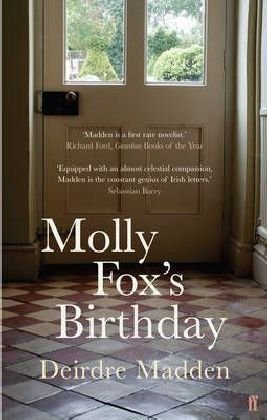
“Molly Fox’s Birthday” by Deirdre Madden

“Molly Fox’s Birthday” by Deirdre Madden (2008) – 221 pages

There are so many new authors that I have not read before that I would like to read, it is difficult to decide which ones to actually read. I chose the novel “Molly Fox’s Birthday” by Deirdre Madden. It was a finalist for the 2009 Orange Prize award given to the best novel written in English by a woman. Deirdre Madden had also been a finalist for this award in 1997. Perhaps it was time that I became acquainted with this author. What finally made me decide to read this book was a blurb on the back cover by Sebastian Barry, nearly my favorite living Irish author, which said, “Equipped with an almost celestial compassion, Madden is the constant genius of Irish letters.” After reading Barry’s introduction to the work of Jennifer Johnston who actually is my favorite living Irish writer, I am willing to read any author that Sebastian Barry recommends.

In the novel, Molly Fox is an actress and the novel is told from the point of view of her best friend who is a playwright. Molly Fox has appeared in several of the playwright’s plays, and thus they have become good friends. The unnamed woman playwright is having difficulty writing her next play which she is trying to write while staying at Molly Fox’s house while Molly is away in New York. Even though I’ve never acted in a play myself but have seen many plays, I enjoy novels about the theatre. There is something about the excitement of people performing before an audience and the goings-on backstage that intrigues me. The scenes in this novel taking place in the theatre and about writing were my favorites, and I think Madden should consider writing an entire novel set in the theatre.

The word I would use to describe this book is ‘seamless’. The book is so seamless there aren’t even chapter breaks – just one long continuous story. The book I read previous to this book was “Ether” by Evgenia Citkowitz which was extremely edgy with very short chapters, a lot of disruptions, and abrupt discontinuities. I can’t imagine two books more different from each other than “Ether”’ and “Molly Fox’s Birthday”. “Molly Fox’s Birthday” is a very straightforward story about the traditional Irish families of the three main characters. Maybe it is a little too traditional. There is a young man involved in the Irish troubles and his brother who studies constantly to stay out of the troubles. The narrator’s brother is a priest. I tend to see Irish priests as rather stock characters, and I don’t think the priest in this novel entirely escapes that fate. This is probably rather cruel to say, but just as theatre people intrigue me, priests rather bore me. I’m not sure how a writer could present a priest that would hold my interest.
But I don’t want to create the wrong impression. I much enjoyed “Molly Fox’s Birthday”. It is a story about friendship of various kinds.  The playwright comes to the conclusion “that so much social interchange is inherently false, and real communication can only be achieved in ways that seem strange and artificial.” Thus there’s the need for the theatre and stage productions which are artificial but where the communication can be honest.

The point I wanted to make earlier was that even though “Ether” and “Molly Fox’s Birthday” are as different as can be, both of these books are pleasurable on their own terms. The story in “Molly Fox’s Birthday” flows along, and while I was reading it I became quite involved with the characters. I don’t want to read variations of the same novel over and over, so I appreciate the wide variety of styles in different novels.

I would like to mention a small coincidence. The entire novel “Molly Fox’s Birthday” takes place on one day, June 21. It just so happened that I was reading the book on June 21.

Critics – Fools Rush in where Angels Fear to Tread

An Essay on Criticism by Alexander Pope  (1709)

    “True ease in writing comes from art, not chance,
    As those move easiest who have learned to dance.
    Tis not enough no Harshness gives Offence,
    The Sound must seem an Echo to the Sense.”

Over three hundred years ago, Alexander Pope wrote the poem “An Essay on Criticism”.  He was barely twenty one years old at the time.  In the poem, he clearly expresses the faults and wrong-headed attitudes of some literary critics and at the same time he lays out the path for those who want to write meaningful effective criticism.

While Pope wrote mainly about good writing (which he called Wit) and the role of the critic, there are several lines in the poem that are still widely in circulation.

    “A little knowledge is a dangerous thing.”

    “To err is human; to forgive divine.”

    “Fools rush in where angels fear to tread.”

    “Pride, the never-ending vice of fools”

    “For Fools Admire, but Men of Sense Approve.”

What attitudes did Pope fault in critics?

Self pride

    “Some valuing those of their own state of mind,
    Still make themselves the measure of mankind:
    Fondly we think we honor merit then,
    When we but praise ourselves in other men.”.

Cliches

    “Where-e’er you find the cooling Western Breeze,
    In the next Line, it whispers thro’ the Trees;
    If Chrystal Streams with pleasing Murmurs creep,
    The Reader’s threaten’d (not in vain) with Sleep”

Repeating of the general opinion

    “Some ne’er advance a Judgment of their own,
    But catch the spreading Notion of the Town;
    They reason and conclude by Precedent,
    And own stale Nonsense which they ne’er invent.

    Some judge of Authors’ Names, not Works, and then
    Nor praise nor blame the Writings, but the Men.”

Being too verbose

    Words are like Leaves; and where they most abound,
    Much Fruit of Sense beneath is rarely found.

According to Pope, who is the ideal critic?

    “Unbiased, or by favor, or by spite;
    Not dully prepossessed, nor blindly right.
    Though learned, well-bred, and though well-bred, sincere;
    Modestly bold, and humanly severe.
    Who to a friend his faults can freely show,
    And gladly praise the merit of a foe.
    Blessed with a taste exact, yet unconfined;
    A knowledge both of books and human kind;
    Generous converse; a soul exempt from pride;
    And love to praise, with reason on his side.”

I can’t help but think that Alexander Pope got severely burned by a critic sometime before he wrote these lines.  He comes down awfully hard on bad critics, and his Ideal Critic is way too good to be true. 

Finally, I want to end with some of Pope’s insights into writing itself.

    “Nature’s Chief Masterpiece is writing well.”
    “Music resembles poetry, in each
    Are nameless graces which no method can teach,
    And which a master-hand alone can reach.”

There are many other insights and good lines in the 745-line poem “An Essay on Criticism”.  These are just some of my highlights from the poem.

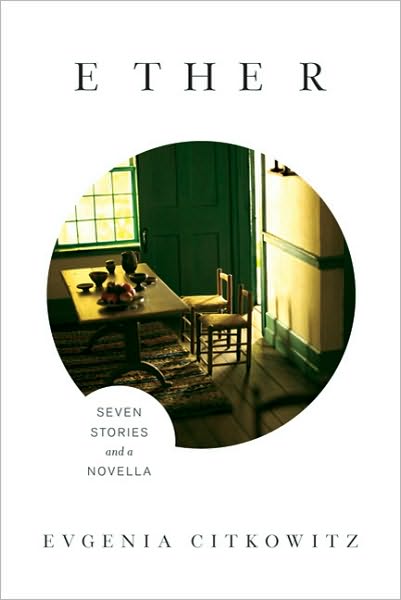
“Ether” Seven Stories and a Novella by Evgenia Citkowitz

“Ether”  Seven Stories and a Novella  by Evgenia Citkowitz (2010) – 243 pages

When I see the word ‘strange” in a book review, that usually makes me want to read the book.  Not vampires or zombies, those are corny strange.  What interests me is the strangeness and wonder of our real lives.  Some of the people in our lives are relatives close or otherwise, some are friends met along the way, some we would

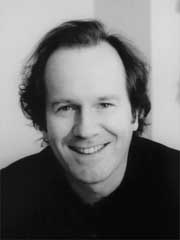
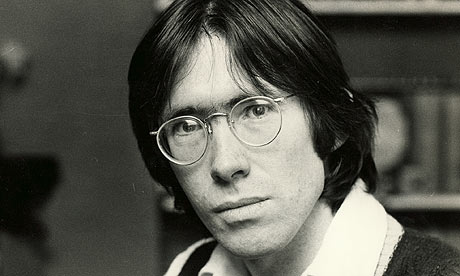
Author photograph by Suzanne Tenner

rather not have to contend with.  Others may have to contend with us.  We may or may not have had clear career and family goals when we were younger, so how did we wind up doing what we’re doing now?   If there are children, do we remember the time when they were born or adopted?  Looked at one way, each day of our lives is the result of all the random and not-so random events that have happened to us since we were born and even before. 

I hope I can convey to you how special and strange this book “Ether” is.  Each of these stories and the novella is a slice of exotic erratic life.    The stories usually take place in New York, California, and/or London.  Several of the stories are about people writing or acting for a living or the conjunction of the two, screenwriting.   Many of the people are rich enough to live in big houses or mansions and can afford to hire nannies for their kids or personal trainers or yoga instructors.  They can buy the best antique furniture, the pricey-est art work for their houses.  Beyond the outer accoutrements, these people’s lives are a mess with overuse of alcohol and prescription drugs, loveless marriages frequently ending in divorces, and unfulfilling affairs.  But no matter how screwed up their own lives are, these people have profound insight into the other mixed-up people around them.

Evgenia Citkowitz has a way of telescoping the events that occur in these stories down to their interesting bizarre essentials.  You can tell that she cares deeply for all of her characters, wishes them the best no matter how much things go awry.   The stories are not at all straightforward, but are told with a severe slant so they can not be summarized.  The writer is aiming for and achieving something deeper than just a point.  The following quote from the book about one of her characters is a good description of the Citkowitz method.

    “His experience in fiction writing, limited to a handful of stories in short form, told him that writing was a discovery, a path that could be revealed only as he progressed.”

Citkowitz captures the locales of her stories perfectly.  She makes some interesting comparisons between New York and California.   She says that there are rich people in both places, but in New York you see the hard work they had to do to earn their money while in California the money and the big houses appear unearned.  Here is a description from the book of New York City after 9/11.

    “There was only so much he could take, month after month. Although he would never say it, he was sick of September 11. If the reactionary political climate didn’t sicken, the air that smelled of combustion, chemical, electrical, and human certainly did. He wanted to forget the loss and the suffering that made that smell.”

And here is California.

    “Our best recyclers are in California. That sadly includes its writers.”

Citkowitz is also very good about the Internet.  When a quite famous actress moves, Citkowitz mentions “her new abode could be seen on Google Earth and viewed from the comfort of any home computer.”  My favorite Internet quote of Citkowitz is in her story ‘Baby Charmer’.

    Managed to get in six episodes out of the Trekkie marathon with William Shatner, not the bald one who looks like part of the male anatomy. That wasn’t my line – it’s from the chat room where everyone was fighting over the captains. Shatner versus The Bald One (one of the nicer comments). I have to agree with kirklover@bigfoot.com that the captain of the Starship Enterprise cannot be someone you want to sleep with. He has to be someone you trust.

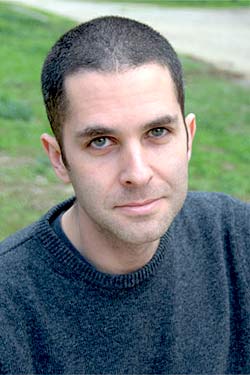
Evgenia Citkowitz comes from a famous family.  Her mother was Lady Caroline Blackwood, a novelist herself, and  her father was a famous pianist, Israel Citkowitz.  For a short time her stepfather was Robert Lowell.  I haven’t read any of Blackwood yet.  Evgenia Citkowitz herself has been married to actor Julian Sand for twenty years.  It says in the author notes of ‘Ether’ that she is currently writing the screenplay for a movie version of  “The House in Paris” by Elizabeth Bowen.  

“Ether” is the strongest debut of a writer I’ve read in a long time.  I can well imagine her next writing a  California, New York, or London novel which is actually a group of inter-related stories.   Whatever she writes next, I will read it.    Evgenia Citkowitz is a writer to read and watch as her career develops.

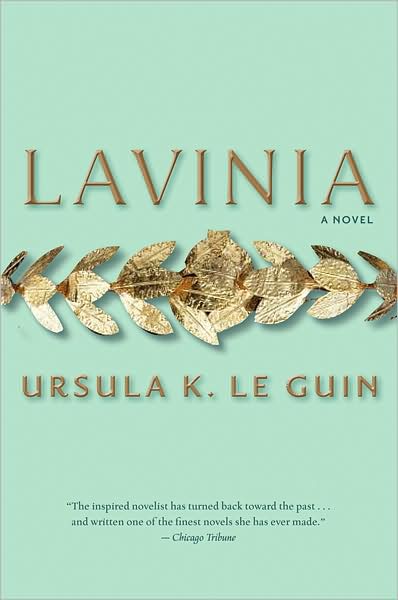
“Lavinia” by Ursula Le Guin

“Lavinia” by Ursula Le Guin –  (2008)    279 pages

The woman Lavinia is taken from “The Aenied” by Virgil.  In that epic poem Lavinia is a minor character only appearing a small number of times and never speaks a word.  The novel “Lavinia” by Ursula Le Guin allows Lavinia to tell her own story.

The story in this book is mostly about what happens to Lavinia and her family in Italy both before and after the Trojans Aeneas and his people arrive.  It tells about Lavinia’s sylvan childhood, the war between Aeneas and her other suitors after he arrives, and the events thereafter.  I wanted very much to like this book a lot better than I did, but I had several problems with it.

First, we’ll set up the story from the Aenied.  I haven’t read the Aenied yet, but can summarize the story.  The Greeks at the end of the Trojan War have overrun Troy and are destroying the city.  A portent tells Trojan Aeneas to gather up his family and his neighbors and leave the city of Troy by ship before they are destroyed.  Aeneas does this and after seven years and after his wife dies and a memorable stay with Queen Dido of Carthage, Aeneas and his group arrive on the east coast of Italy.  By that time Lavinia a young princess of Latium has received a portent that she will marry a foreigner who will arrive by ship.  Aeneas conveniently arrives at that time.   There is no historical basis that anyone from Troy ever traveled to Italy in ancient times, so this story can be considered a Roman myth although there are no gods, only humans, in this myth.

As I’ve mentioned, I did have some problems with this book.   First the language seemed quite stilted to me.  It may as well have been etched in stone.  I would have preferred more variety and a livelier approach to the language.

Another problem I had with this book is that there is very little mention about the huge differences there would be between these Trojan strangers that sailed from thousands of miles away and the local Italians.  Lavinia gets the portent that she will marry Aeneas, and that’s it.  All of a sudden she’s Aeneas’ gal, her father becomes allies with Aeneas against his own neighbors, they have no problems speaking, and they might as well have been childhood friends.  Maybe portents can take the place of a believable plot.

My last problem with “Lavinia” is that she is fiercely loyal to the people closest to her and believes they can do no wrong.  Thus her father Latinius, her husband Aeneas, and her son Sylvius are perfect, and other people are always at fault.  A couple of times, Lavinia bemoans the fact that men are so quick to go to war.  I would say that Lavinia’s attitude toward her own family is one of the prime causes of war. Sorry ladies, you are not off the hook on this issue of war. If you bring your children up to think they can do no wrong, that their family, their nation can do no wrong, of course they are going to fight other people who think themselves, their families, their countries are perfect.   It is supreme ignorance to inculcate your children with the belief they are perfect, and other people are at fault somehow.  The beginning of wisdom is for all men and women to question themselves, to have some self doubt which allows them to see the value of other people different from themselves.  Child psychologists may disagree, but some self doubt is a good thing.  Also when a writer has perfect major characters in her novel like Latinius, Aeneas, and Sylvius are here with no human faults whatsoever, it gets to be rather a bore.  You might as well have populated your book with stick figures.

I have read a lot of Greek myth and find it endlessly fascinating.  In Greek myths, the gods have a lot of the same faults as do humans and those that are half gods/half humans.  Thus you get a strong sense of the richness and strangeness of life.  Everyone has their own lists of virtues; everyone is messed up in their own unique way.  My experience with ancient Roman literature is quite limited, but from my limited reading I’ve found it to lack this rich complexity.  In the Roman works, the good people are too good and the evil people are too evil without the ambiguity.  Although “Lavinius” is by no means a Roman work, it has this lack of ambiguity that causes the work to be narrow and stilted and less effective.

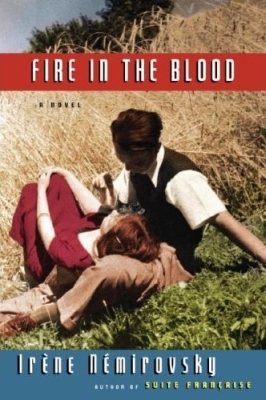
“Fire in the Blood” by Irene Nemirovsky

“Fire in the Blood” by Irene Nemirovsky – 129 pages

“Fire in the Blood” by Irene Nemirovsky is a novel which is indirectly about arranged marriages.  Nemirovsky describes how once a year in the small villages in central France there would be a dinner party where all the women eligible for marriage and all the men wanting to get married would congregate.  All of the marriage-eligible women would be recognizable by their dresses which would be some shade of pink. The parents of the eligible women would be their also.

The parents wanted what was best for their daughters.  Some of the men who would show up for the dinners would be quite old, either widowers or quite old bachelors.  Some of these older men would be quite well off, having established solid careers.  Some of the parents thought that they could settle their daughters into very comfortable circumstances.  The daughter would have a fine house, perhaps a little land, and none of the financial worries the parents themselves may have had.  So the marriage would be agreed upon and would take place soon thereafter, and the daughter would be comfortably settled.  The only thing that the parents did not take into consideration is ‘fire in the blood’.

There would always be a few young men in the neighborhood ready to prey on exactly these circumstances, a young woman stuck with an older man.  That is really the subject of Nemirovsky’s novel.   The focus is not only on the young woman and these preying men, but also on the parents.  By the age of forty or fifty, these parents may have settled into a life that is pleasant and placid, everyone seeming to have forgotten that they too had been young and they too had ‘fire in the blood’. 

I, like most of the rest of the world, discovered the novelist Irene Nemirovsky when her novel ‘Suite Francaise’ was published.  That novel was written by Irene Nemirovsky just before she was sent to Auschwitz and murdered in 1942 at the age of 39.  That powerful novel was written under extreme circumstances as the Nazis began their occupation of France.

 “Fire in the Blood” is completely different, a sunny rural and small town story set in central France.   The story is told by an outsider, a middle-aged male friend of the family who always just happens to be at the right place at the right time as the events in the story unfold. 

Isn’t it funny how the making and breaking of literary reputations occurs?  First there are those writers who establish themselves at a young age, and everyone pays attention to each new book they release.  These writers have one kind of pressure, the pressure of having to live up to an early success.  Some of these writers are important up until they quit writing, and then they fade into obscurity.  Then there are writers who labor in near obscurity their entire writing lives and remain in obscurity thereafter.   Then there are writers like Dawn Powell and Irene Nemirovsky and Stefan Zweig and others who were somewhat famous during their lives, but either slowly or suddenly are rediscovered and soon their reputations far surpass many of the established writers of that era.  In Irene Nemirovsky’s case, her daughter discovered her unpublished original manuscript for ‘Suite Francaise’ in a box, finally realized its importance, and did what was necessary.  Thus the literary history of bygone eras is constantly changing, and hopefully finally some justice is achieved.

‘Fire in the Blood’ is a spirited novel of French country life, Irene Nemirovsky at her best.    I am very much looking forward to reading the book of her stories which was recently released, “Dimanche and other Stories”.

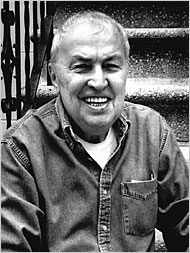
David Markson – An Appreciation

David Markson (1927 – 2010)

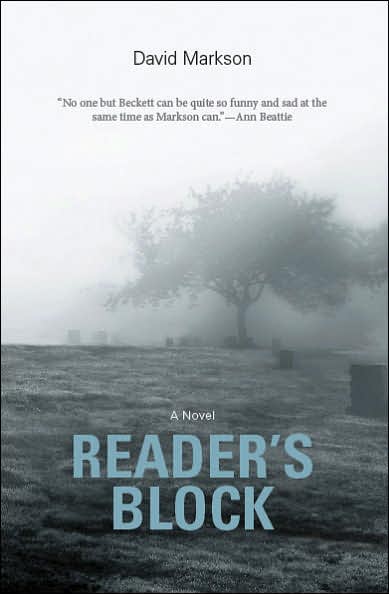
I first read David Markson on a flight from New York to London in 2002.  The book was ‘Reader’s Block’.  ‘Reader’s Block’ was the perfect book for a long flight across the Atlantic.  Reading this book, I did not have to deal with intricacies of plots, settings, or characters while I was in flight.  All these items which are usually considered essential were missing from this 194-page novel.  What was there instead?   For one thing, it contains some of the wildest true items about novelists and other famous people I had ever read.  Here are some examples from his various books.

“Tolstoy to Chekhov: You know I can’t stand Shakespeare’s plays, but yours are worse.”  – Reader’s Block

 “From the earliest biographical note on Rembrandt:
He could read only the simplest Dutch. And that haltingly.  Rembrandt. ” – Vanishing Point

“Remembering that Bizet’s Carmen is based on a novel by Prosper Merimee.
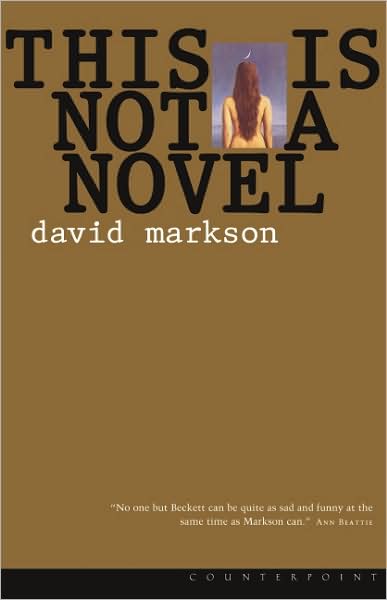
Not remembering that the Merimee is in turn based on a narrative poem by Pushkin.”  – This is Not a Novel

“Tennessee Williams choked to death on the plastic cap of a nasal spray.”  – The Last Novel 

“I’ve had it with those cheap sons of bitches who claim they love poetry but never buy a book. Growled Kenneth Rexroth.” – The Last Novel

“By his own admission, William Butler Yeats, at twenty-seven, had not yet ever kissed a woman.” –  Vanishing Point

David Markson himself defined ‘Reader’s Block’ as “Nonlinear. Discontinuous. Collage-like. An assemblage… A novel of intellectual reference and allusion, so to speak minus much of the novel.”   The entire novel was seemingly a random collage of these short fascinating samplings of  gossip about famous people.  I wondered where Markson found all these items, because they were not the usual encyclopedia fare.  In many cases you wouldn’t think even an in-depth biography would include these items that frequently reflect poorly on the famous person.  As I remember, I read the entire book during that flight.   

Interspersed with these biographical notes, there were notes from the Author himself.

”Author has finally started to put his notes into manuscript form.” – Vanishing Point

“Author had been scribbling notes on three-by-five-inch index cards. They now come close to filling two shoebox tops taped together end to end.” – Vanishing Point

David Markson died this week.  He wrote experimental fiction which appeals to people who don’t usually like experimental fiction.  He was lucky in his career as a novelist, because his first novel, “The Ballad of Dingus Mcgee”, which was an anti-Western was made into a movie called ‘Dirty Dingus McGee’ starring Frank Sinatra.  The money from this movie supported him for several years.    I have now read all of the last books he wrote: “Reader’s Block”, “This is Not a Novel”, “”Vanishing Point”, and “The Last Novel”.  Each book stands alone and can and should be read separately.  I found each of these books entirely fascinating.    The feature these four books share is the fact-collage technique.  I am a trivia aficionado and loved these not-so-flattering stories about authors, artists and others.   Besides these books are fun and easy to read. 

What was Markson trying to accomplish with these books?  Many of the items concern the gruesome details of the deaths of these famous people.   Other of the items show that outside their chosen areas, many of these famous people are just as messed up in their attitudes and thinking as the rest of us are.  Many were anti-Semitic; many hated some other famous person for no justifiable reason.   The point seems to be, no matter how sanitized the lives of these famous persons have been presented, they were just as erringly human and died just as terrible deaths as the rest of us.   This is an important lesson.  

There have been quite a few appreciations of David Markson these last few days on the Internet, and I am pleased to add my own.  From reading all these tributes, I’ve learned that I have still to read one of his best-considered books, “Wittgenstein’s Mistress”.  If it is as good as the Markson books I’ve read so far, I’m in for a treat.

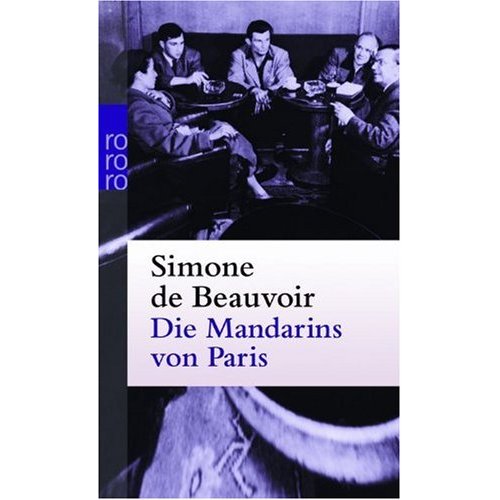
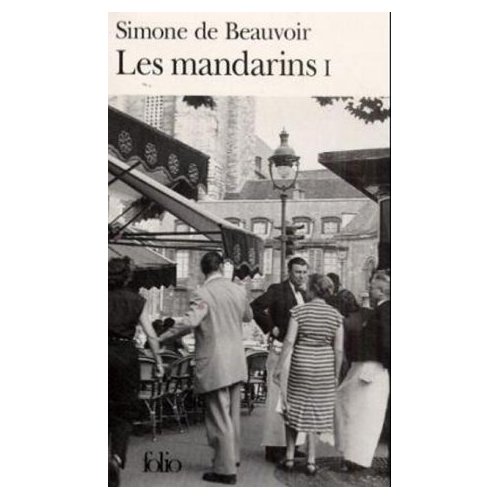
“The Mandarins” by Simone de Beauvoir – The Wrap-up

“The Mandarins” by Simone de Beauvoir (1954) – 610 pages

After being immersed for several weeks in post-World War II Parisian night life and home life as well as the political and journalistic intrigue and infighting of that time, I have finally completed “The Mandarins” by Simone de Beauvoir.  It has been quite a ride.  This passionate, psychologically acute story held my interest throughout, and I now have a vivid picture of French life after the war.  Simone de Beauvoir’s writing is straightforward and appealing. 

“The Mandarins” is a good novel, not a great novel.  In this book I read more about the details of the political situation in France then than I ever needed or wanted to know.  My opinion is that this novel could  have been considerably tightened up.  “War and Peace”, “Ulysees”, and “Middlemarch” are also long books with many pages, but all three of these novels are at their appropriate length. I wouldn’t shorten any of these books at all.    I think the story of “The Mandarins” could have been tightened, shortened by about two hundred pages without losing anything. 

One story in the novel is the romance between the Simone de Beauvoir character in the novel and the Nelson Algren character.  When someone talks about their mostly happy love affair incessantly, they risk sounding insipid.  This love affair in the novel does not entirely escape this problem.  There are too many romantic sunsets and locales.  The sad truth for novelists is that details of unhappy romantic affairs are more interesting than details about happy affairs.

Still there are some fascinating stories in this book.  At one point, the Albert Camus character’s play is being produced, and he helps choose the lead actress for the play.  After choosing the woman to be the lead actress, he starts dating her immediately.    Later he finds out that this woman’s mother had all her hair cut off by the Resistance after the war for cavorting with the Nazi officers during the Occupation.  Then he finds out that the lead actress herself had a serious relationship with a Nazi officer during the Occupation.  This information about the actress is about to be released to the public, thus destroying her career.  Only by lying to the investigators does the Camus character stop the information from being released.   If there is a hero in “The Mandarins”, it is the Camus character, so for Beauvoir to include this compromising story shows the complexities that Beauvoir deals with here.

Simone de Beauvoir is not a natural-born fiction writer.  You get the sense that she doesn’t make anything up.  Instead she always relates things that actually happened.  Thus it is difficult for her to shape her stories by changing what happens. 

Earlier I read “When Things of the Spirit Come First”, an early work by Beauvoir.  I was completely enchanted by these stories.  That book is one of my favorites for the year.  I got the impression that these stories were also taken directly from real life by Beauvoir.  However there in order to fit those stories into the short story format, she had to really take control of her material and mold it.  “The Mandarins” could have used more of this molding and shaping.

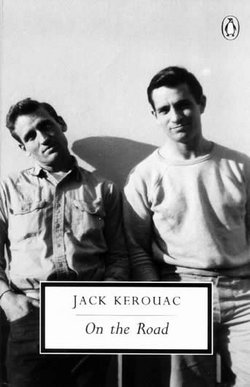
“On the Road” by Jack Kerouac

“On the Road” by Jack Kerouac (1957) – 307 pages

    “What is that feeling when you’re driving away from people and they recede on the plain till you see their specks dispersing? — it’s the too-huge world vaulting us, and it’s good-by. But we lean forward to the next crazy venture beneath the skies.”

I finally got around to reading “On the Road” by Jack Kerouac.  Probably one of the reasons I had never read the book before was Truman Capote’s famous dismissal of ‘On the Road’, “That’s not writing, that’s typing.”  Capote was put off by the spontaneity of the writing, the lack of planning or plot or editing or revision.

Jack Kerouac wrote the first version of ‘On the Road’ in three weeks way back in 1951.  He had a unique method of writing the novel.  He put together a 120-foot scroll of paper for his typewriter, so he didn’t have to change sheets of paper.   Today Kerouac’s original scroll of “On the Road” is touring libraries throughout the United States so that people can go to see it for themselves.  I suppose in a few years, Kerouac’s original scroll will be as popular a museum piece as the Dead Sea scrolls.

There really is no plot to ‘On the Road’.  It is about two young men, Sal Paradise and Dean Moriarty, traveling across the country and back, meeting lots of people, going to jazz clubs, drinking, taking drugs, having sex with young women they meet, and generally having a wild good time.   They travel from New York to Denver to San Francisco, back to New York to New Orleans to Texas back to San Francisco, once again to New York, and so on.  One of the things that surprised me about the book is that the events take place in 1947, much earlier than I assumed.  ‘On the Road’ has always been considered a harbinger of the hippie era, and I always thought it would have taken place in the 1950s.   Even though Kerouac wrote the book in 1951, it was rejected by publisher after publisher until Viking Press published it six years later in 1957.   It’s ironic that after being rejected by all these publishers who you would think knew what they were doing, the book made a ton of money    Considering they put out Fortieth Anniversary and Fiftieth Anniversary editions of ‘On the Road’, the book is still bringing in a ton of money.

‘On the Road’ is another one of those novels that really isn’t fiction.  Most of the stuff in the book really happened to Jack Kerouac (Sal Paradise) and his friend Neal Cassady (Dean Moriarty).   Sal Paradise is the narrator of ‘On the Road’, and Dean Moriarty is the wild guy who defines the book.  What gives ‘On the Road’ its appeal to readers is its energy, it s exuberance, the freedom of the open road.   It certainly isn’t the intricacies of its plot.

Early in the book, their main means of transportation is hitchhiking, getting rides from strangers on the road.   Hitchhiking pretty much disappeared in the United States by about the late 1970s or the early 1980s, a victim of the mutual distrust and suspicion of both the drivers and the hitchhikers.   In the 1960s, there was a lot of hitchhiking.

That’s sort of the way I look at ‘On the Road’.  It is a celebration of a time in the United States that is gone, a wild time for sure, a time of immense personal freedom.   The book probably shouldn’t win any prizes as literature, but it is a valuable document describing a lost age.

    “I shambled after as I’ve been doing all my life after people who interest me, because the only people for me are the mad ones, the ones who are mad to live, mad to talk, mad to be saved, desirous of everything at the same time, the ones that never yawn or say a commonplace thing, but burn, burn, burn like fabulous yellow roman candles exploding like spiders across the stars and in the middle you see the blue centerlight pop and everybody goes ‘Awww!'”

Nearly Forgotten Novels from the 1980s that are Exceptionally Good

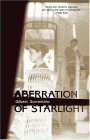
Aberration of Starlight by Gilbert Sorrentino (1980) – Although Gilbert Sorrentino, who died earlier this year, wrote the post-modernist classic “Mulligan Stew”, he also wrote some sweet emotional realistic novels. This is my favorite, A date in New Jersey is described from four different points of view. It is humorous, sad, and moving.
                                     .
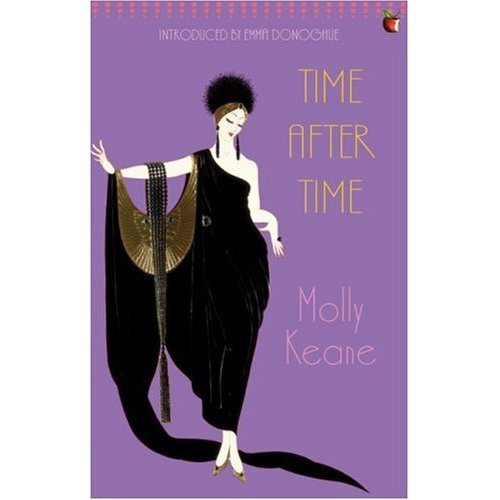
Good Behaviour (1981) and Time After Time (1983) by Molly Keane  – First she was M. J. Farrell and wrote 10 novels from 1928 to 1961 when her husband died. She stopped writing for twenty years, then came back gloriously as Molly Keane.  ‘Good Behaviour’ was shortlisted for the Booker in 1981 losing to Rushdie’s ‘Midnight’s Chil;dren’.  I doubt either of these two Keane novels is forgotten by anyone who has read them. Molly Keane was in her mid-seventies when these books were published. These books are sharply written dark comedies about self-destructive aristocratic Irish-Anglo families who live in manors.
 
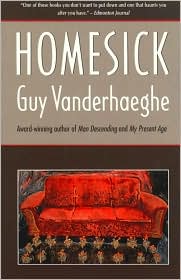
‘My Present Age’ (1985) and ‘Homesick’ (1989) by Guy Vanderhaeghe There are few authors whose next book I look forward to with more anticipation than Guy Vanderhaeghe, the Saskatchewan, Canada novelist. I tuned into Vanderhaeghe early on with these two novels and also his book of short stories ‘Man Descending’. I’ve read everything he’s published and have never been disappointed. Each of his novels is an adventure. Here is a quote from “My Present Age”.
    “Embrace one another with courage. Search each other’s hearts for hidden suffering and never flee what you discover! That’s the ticket!”

Sweetsir by Helen Yglesias (1981) – A novel about a woman’s “justifiable” murder of her husband with a carving knife. Helen Yglesias tells the detailed story starting with the girl in high school to her romance with Morgan Sweetsir to their marriage and early passion to his increasing violence against her. This is a novel that is based on the newspaper headlines, realistic but not at all melodramatic. Instead of a polemic, this is a human story.

An Ice-Cream War by William Boyd (1982) and ‘The Comfort of Strangers’ by Ian McEwan (1981) – How I miss the comic novels that William Boyd wrote early in his career and the short macabre novels that Ian McEwan wrote early in his career. Perhaps it was a good thing for these two novelists to mature and become well-rounded, but I really do miss their early work.

“The Grifters” by Jim Thompson

“The Grifters” by Jim Thompson   (1963)  –  187 pages

    “Roy Dillon lived in a hotel called the Grosvenor-Carlton, a name which hinted at a grandeur that was wholly non-existent.”

You go up to a clerk who is real busy, distracted with a lot of other customers.  You buy something small like a pack of gum or a candy bar.  You fumble in your pockets trying to find the exact change while the clerk is waiting for you, and the other customers are clamoring for his help.  You finally give up and hand him a twenty.  The clerk lays your change on the counter, and goes off to help the other impatient customers.  You discreetly pick up the money and keep fumbling for change.  You find the change and interrupt the clerk while he is dealing with another customer.  You say, ‘I found it.  Just  give me back my twenty, and I’ll give you the exact change.’  The clerk gives you back the twenty, you give the clerk the exact change, and you leave. 

This is known as ‘the twenties’ which is a short con.  Does it work?  Yeah, if the clerk is distracted enough.   Of course if you do it enough times, one of your victims might beat your stomach in with a baseball bat which is what happens to our ‘hero’ in “The Grifters”.

The only experience I have had which is at all similar to the above was when I went into a bakery, a place I had never been in before, picked out a pastry and handed the woman clerk a twenty.  She said, “Sir, I’m afraid that I don’t have change for a twenty.  There’s a bank two doors down where they’ll change your twenty for you. “ I said, “OK” and started to leave.  Then the woman clerk said, “While you’re there would you mind getting me some change too?”  She hands me two twenties from the register.  What a trusting soul!  I had never seen this clerk before.  I took the two twenties she handed me, went off to the bank, got the change for her twenties and my twenty, and, honest person that I am, returned to the bakery.

What with credit and debit cards and so on, I don’t know how many con artists are working out there today.  There doesn’t seem to be too much room for the small time con artist any more.  The only con artists most of us encounter today are realtors, and there the cons are usually long cons rather than short cons.    

Jim Thompson was a hard-boiled crime fiction writer.  “The Grifters” was one of three of his novels that were made into movies.    This is not the type of fiction I usually read, but I’ve heard a lot of good things about Jim Thompson.  I must say I enjoyed this book.  It had enough turns and twists to keep me interested.  Even a lot of the sentences had twists and turns in them like the first sentence in this blog above.  Jim Thompson’s style has a lot of no-nonsense energy.  The sentences are short without much decoration.  Subject, verb, object, next sentence.   For me, it was a refreshing change from the many literary novels I read.  I like to read many different types of fiction.  I won’t restrict myself to crime fiction going forward, but I’ll come back to Jim Thompson when I want that sort of break.  I’ve read Dashiell Hammett, James Cain, Raymond Chandler, tough guys all.    

Somewhere I read that the average bartender takes enough from the bar to make his car payments.  In bars selling liquor and other consumables, there really is no good way to prevent some of the cash from walking away.  So all a bar owner can do is try to keep a lid on things.  So the bar owner will only hire bartenders who drive modest cars where the payments aren’t so high.  But if that bartender trades in his modest car for a fancy sports car or an SUV, watch out!

That’s the kind of thinking that goes on in a Jim Thompson book.

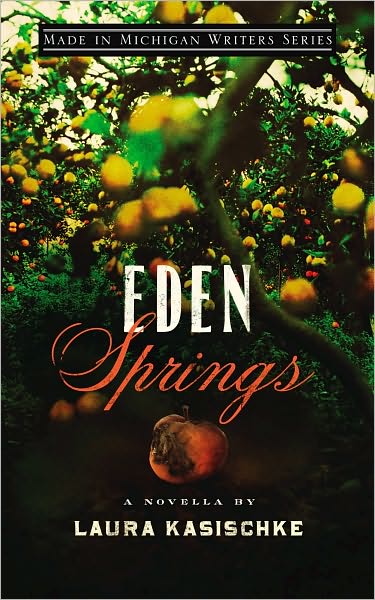
‘Eden Springs’ by Laura Kasischke

‘Eden Springs’ by Laura Kasischke (2010)    –  144 pages

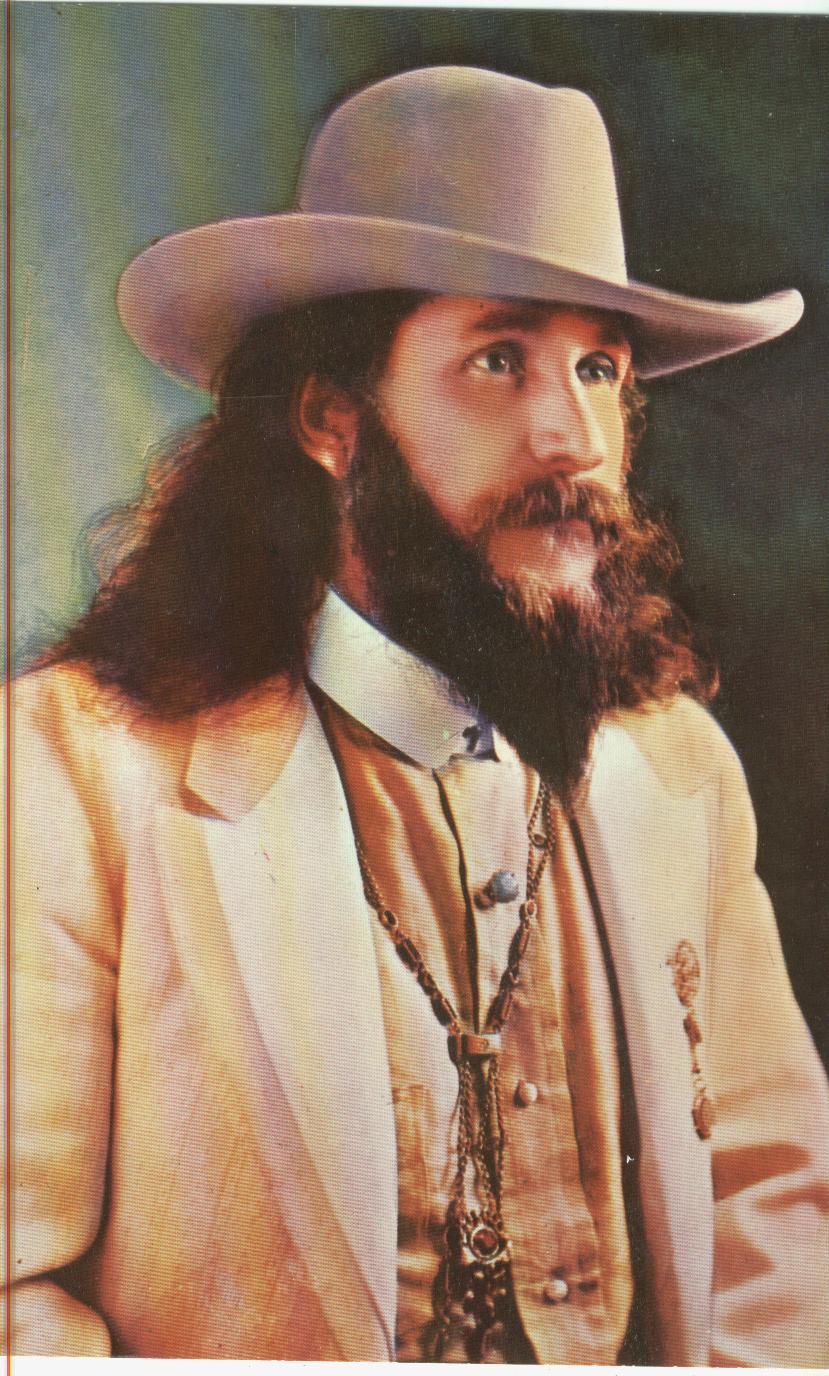
“Eden Springs” is a short novella about a fascinating little-known true American story.  It is the story of  “Father Benjamin” Purnell and his followers who operated the religious colony called the House of David in Benton Harbor, Michigan starting in 1903.  In Benton Harbor, their community prospered because being close to Lake Michigan, they planted orchards and vineyards and soon they were shipping fruit around the world.

The members of the House of David were told not to cut their hair, not to eat meat, and not to engage in sexual relations.   ‘Father Benjamin” himself was a handsome,  charming, charismatic man, and ladies would sometimes faint when he passed them.  In turn “Father Benjamin” displayed a great affection for his female followers. 

The House of David, unlike some religious communes, was not a grim place.  In 1908, they opened the Eden Springs amusement park which became a major tourist attraction of the Midwest with its zoo, aviary, miniature train, beer garden, and musical and vaudeville acts performed in the amphitheater.  Also the community was known for its great amateur softball teams.  There are many pictures of these softball teams, all members with long hair and full beards.

Soon groups of people, numbering into the thousands, from all over the United States, Canada, and as far away as Australia were coming to Benton Harbor to join the House of David.

About ten years ago, I read Laura Kasischke’s novel ‘Suspicious River’, and I was so impressed with that edgy novel, I’ve been on the lookout for more books by Laura Kasischke ever since.  ‘Suspicious River’ was later made into a movie as has another of Kasischke’s novels, ‘The Life Before my Eyes’.  Thus when I heard of this novella “Eden Springs”, I grabbed it quickly.

Laura Kasischke’s style is understated and powerful. Her sentences have a simple eerie quality that conveys more than what is actually on the page.  Her style is so flexible it can convey warmth and mystery at the same time.

“Eden Springs” is a quick read.  It is interspersed with pictures of the community, quotes from various people connected with the community, and, with its very short chapters, plenty of white space amongst its 144 pages.

There are a couple of unexpected surprising twists at the end of the story.  I can’t imagine how a movie producer could resist this story and not make a movie of it.  It has everything, picturesque scenery, a charming male lead, groups of young women dressed in white, a mysterious death, a surprise ending.   

The House of David religious community lasted all of the way into the 1970s.

I hope that the various literary awards committees this year realize that a novella with a lasting impact is at least as significant a literary event as  the many thicker books that will be published.  This is the best United States novella I’ve read, with the possible exceptions of one or two of Phillip Roth’s short books, since Cynthia Ozick’s “The Shawl”.

‘The Mandarins’ by Simone de Beauvoir

‘The Mandarins’ by Simone de Beauvoir (1954)   Part 1

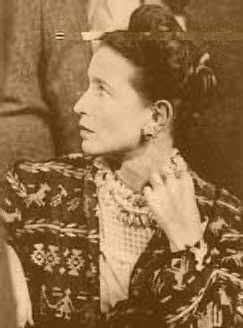
Clearly ‘The Mandarins’ by Simone de Beauvoir is a roman a clef, that is a novel that describes real life under the facade of fiction.  Thus when one reads this novel, one thinks “that character is Jean-Paul Sartre, that character is Albert Camus, that character is Nelson Algren, that character is Arthur Koestler,and, oh yes, that character is Simone de Beauvoir herself’”.    Apparently Beauvoir even put her young female lover at the time into the novel as the main characters’ daughter Nadine.  I suppose many novels are veiled biography, but “The Mandarins” is more thinly veiled than most.   This novel won the top literary prize of France, the Prix Goncourt, in 1954.

At the start of ‘The Mandarins’, World War II has ended, and the Germans have finally left France.  The small group of Parisian journalists, writers, and intelligenzia can once again live and breathe freely.  Many of their group have been murdered in the streets or sent to concentration camps never to be heard or seen again.  Some of this group have been secretly working for the Resistance.   What happens now?  That is the question that ‘The Mandarins’ addresses.  It was written in 1954 and covers the years immediately after World War II.

First it becomes quite clear that people can’t just pick up where they left off before the war.  Too much has changed; there has been too much physical and psychological devastation.   The worst of the collaborators with the Nazis are clandestinely taken care of.  One major question is what kind of government for France now?  Communism looks attractive to some, but rumors are circulating that the Communists have their own camps similar to concentration camps.  The United States is a good example to many, but some look askance because the United States has allowed right-wing fascist dictators to remain in power in Portugal and Spain in order to get permission to build military bases in those countries.  

“The Mandarins” is a call to the intelligenzia not to stand off to the side while the most important issues of society are being decided.  Up until then, they had let the politicians decide governmental matters, and that had led to fascist or Communist dictators, World War II, and the Holocaust.  Now it was time for the intelligenzia to stand up and not let their countries slide into fascism or Communism again.    After the Nazi occupation, the only possible government for France is liberal democracy.

Many people don’t appreciate the tremendous success liberal democracy has achieved for northern Europe, the remainder of the British empire, and the United States.  We have had sixty five years of relative peace and prosperity, and at the same time the rights of most people have been respected and protected and nearly everyone in these countries has had the freedom of movement and opportunity.  Yet today some people sneer with contempt at the idea of liberal democracy, even though it has proven itself to be the most just and successful form of government in human history.

But enough.  ‘The Mandarins’ is a novel; it contains much about human relations besides political intrigue.     As one would expect in a Beauvoir novel, the female characters are strong, independent, daring, and aggressive. Simone de Beauvoir does not make up either characters or scenes from whole cloth.  You get the feeling that everybody in the book is a real person and that every scene in the book really happened.   At the same time, she takes such a vital interest in all her characters and deals with them with such intelligence and sensitivity, that  the novel is entirely compelling.  One can understand why later in her career, de Beauvoir gave up writing novels and wrote non-fiction only. 

As many of you know, I read ‘When Things of the Spirit Come First’ earlier this year.   Except for the fact that the two books are written with the same Simone de Beauvoir intensity, the two books are very different from each other.   ‘The Mandarins’ is the more mature work dealing with the complexities of adult life, politics, and family life,  while the stories in  ‘When Things of the Spirit Come First’ have a youthful charm and exuberance.  Both books are enhanced by the fact  that  Simone de Beauvoir cannot write a dull sentence.  In the next section of ‘The Mandarins’ which I will soon read, the character in the novel who is Simone de Beauvoir travels to the United States and meets the character who is Nelson Algren, and they have an intense love affair.  I can hardly wait.