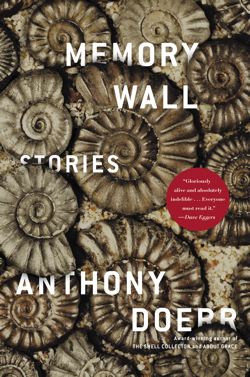
“Memory Wall” by Anthony Doerr

“Memory Wall” by Anthony Doerr (2010) – 242 pages

    “There were times when I was happy and times when I was not.”  continues Alma, “like anyone.  To say a person is a happy person or an unhappy person is ridiculous.  We are a thousand different kinds of people every hour.”

I read a couple of positive reviews of “Memory Wall” and also recalled some of the acclaim his first book of short stories, “The Shell Collector”, had received, but I still had no idea.   I never did get around to reading that first book, but after reading these stories in “Memory Wall”, I am quite certain that Anthony Doerr is a major talent, a force to be reckoned with.
For one thing, sentence for sentence, Doerr has a distinctive writing style.  He writes in very short sentences which are direct and at the same time can carry a lot of feeling.  Here is a fairly typical example of Doerr’s style from the opening of his story “The River Nemunas”.

    “My name is Alison.  I’m fifteen years old.  My parents are dead.  I have a poodle named Mishap in a pet carrier between my ankles and a biography of Emily Dickinson in my lap.  The flight attendant keeps refilling my apple juice.  I’m thirty six thousand feet over the Atlantic Ocean and out my smudgy little window the whole world has turned to water.“I’m moving to Lithuania.  Lithuania is in the upper right corner of Europe.  Over by Russia.  On the world map at school, Lithuania is pink.”

This bit really does sound like a fifteen year old girl to me, a quite observant and intelligent fifteen year old girl.   She is the narrator of the entire story, and you never tire of her voice.  These short sentences hold a lot of detail as well as underlying emotion.

The above also shows another quality of Anthony Doerr’s stories;  the plots are like nothing you have read before.   The six stories of “Memory Wall” take place on four different continents, and each has its own unique situation.  The stories do share a common theme.  Each of these stories is about “memory” or “memories”.  But such a focus restricts Anthony Doerr not at all in his choice of original plots.  I won’t even go into the individual plots of these stories, because I want you to discover them for yourself.  These stories are among the most dramatic and compelling I’ve read in a long time.  If you read one of these stories you will be hooked, you will read all of them.

Suppose you had the choice of reading either “Freedom” by Jonathan Franzen or “Memory Wall” by Anthony Doerr.  Now “Freedom” is a smooth highly-readable  interesting novel.  However I would urge you to read “Memory Wall” first;  Anthony Doerr’s stories will still be read long after Franzen has been forgotten.

What else would you expect from the Writer-in-Residence for the State of Idaho? 
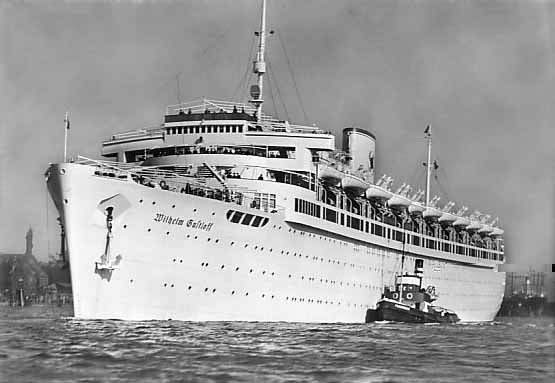
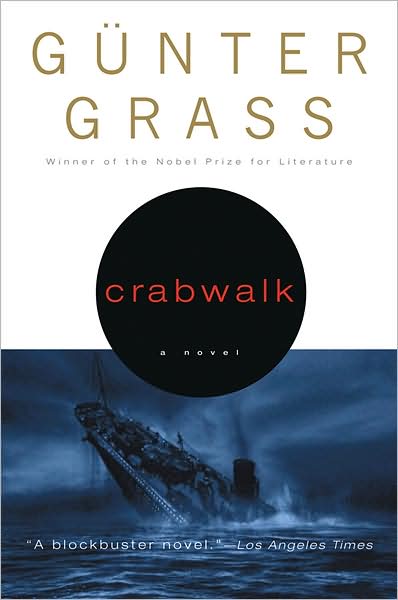
“Crabwalk” by Gunter Grass – The Sinking of the Wilhelm Gustloff

“Crabwalk” by Gunter Grass – (2002) 234 pages

In Dresden, Germany on February 13 of this year, about 5,000 neo-Nazis gathered to stage a ‘mourning march’ to protest the Allied bombing of Dresden 65 years ago.  However, there were over 10,000 other counter demonstrators there whose purpose was to stop the far-right sympathizers from staging their march.  The demonstrators were able to stop the neo-Nazi march by forming a human chain to block the route.  Police informed the right-wing marchers that they couldn’t guarantee their safety if they went ahead with it.  The march was ultimately called off.

“Crabwalk” by Gunter Grass is mostly about two subjects, the sinking of the Wilhelm Gustloff ship in 1945 and neo-Nazism in modern Germany.

The largest ship disaster of the Twentieth century was not the Titanic, not the Lusitania, not the SS Andrea Doria.  It was the sinking of the German ship Wilhelm Gustloff torpedoed by a Russian submarine in 1945 near the end of World War II.  The ship was being used to evacuate German refugees from East Prussia which was surrounded by the Red Army.  No one knows exactly how many people were on the ship when it sunk, and estimates of the number of people killed range from 6,000 to 10,000.  The torpedoing of the Wilhelm Gustloff is somewhat controversial as most of the people who drowned were women and children, although there were military personnel aboard the ship.

As is usually the case in Gunter Grass novels, Grass personalizes the history.  In  “Crabwalk”, a woman named Tulla gives birth to the novel’s narrator Paul after she has been moved from the sinking ship to a rescue boat.

As I mentioned before, there are two main parts to the novel.  One part is the history of the Wilhelm Gustloff which started as a cruise ship for Hitler’s ‘Strength through Joy’ program on which our narrator Paul’s grandparents take their first real vacation.  The history of the ship ends with the dramatic telling of the ship’s sinking.   The details of the sinking are only Grass’s way to move sideways, to ‘crabwalk’ toward his real subject which is modern neo-Nazism.  Paul discovers a website devoted to the “martyr” Wilhelm Gustloff and the “atrocity” of the sinking of the ship.  Paul discovers to his horror that it is his son Konrad who is running the website.  Konrad is very close to his grandmother Tulla and adopts some of her pro Nazi or at least pro World War II Germany leanings which he puts up on his Internet web site.  Konrad’s father looks askance at these Internet outpourings of his son, but there isn’t much he can do about it, especially since his son is not living with him.

I’ve read Grass’s “Danzig Trilogy” (“The Tin Drum”, “”Cat and Mouse”, and “Dog Years”) and consider the complex and disturbing trilogy one of the greatest accomplishments in modern literature.  Gunter Grass is definitely deserving of the Nobel Prize for Literature which he won in 1999.  I urge everyone to read all three of these novels.  What about “Crabwalk”?  I don’t see it as a work on the same level as the Danzig Trilogy.  It held my interest throughout, but I did not find it as exciting, compelling, or urgent as the trilogy.  The sinking of the ship is told in workman-like dramatic fashion, and the Internet story was also quite interesting.  However I see this work as more of a minor work by a literary master.

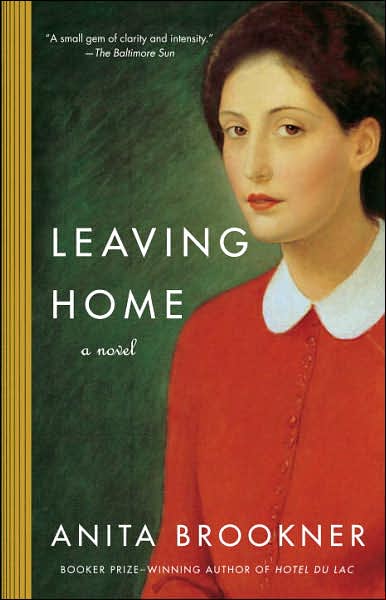
“Leaving Home” by Anita Brookner – Emma’s Solitary Shuttle between London and Paris

“Leaving Home” by Anita Brookner  (2005) – (212 pages)

“Leaving Home” is the novel where the critical knives of the Guardian (Maureen Freely) and the New York Times Book Review (Caryn James) came out in full force against Anita Brookner.  Here are some quotes from their reviews.

    “It is almost as if Brookner has chosen to go over old ground for the umpteenth time because she wants to be absolutely sure, before she’s through, that she’s demolished all signs of life in it.” – Maureen Freely
    “Now a musty smell wafts from each Brookner book, a stale whiff that arises partly because she has tweaked the same novel 23 times in 24 years.” – Caryn James
    “Instead we get a meandering and unfocused lament…” – Maureen Freely
    “With Emma Roberts, the heroine of “Leaving Home,” Brookner may finally have gone too far. In many ways, Emma is a typical Brookner character: bookish, meek, all but devoid of sexual passion. But she also displays a wide streak of self-pity that makes it difficult for a reader to like her nearly as much as Brookner does.” – Caryn James
    “Yet Emma’s whining tone undermines our sympathy.” – Caryn James

I was quite surprised by the vehemence of these reviews, since I have admired the elegance, style, and insight of Anita  Brookner’s writing going back to “Look at Me” and the Booker prize winning “Hotel du Lac”.  Over the years, I’ve read about eight of her novels. I happened to read these two negative reviews about one-third of the way through reading “Leaving Home”, and these reviews could not help but affect my reactions to the work.

The heroines of Anita Brookner’s novels always value their own solitude even when it leaves them isolated and lonely.  Somehow I can’t imagine very many young women considering their own solitude when making their life choices; otherwise there would be few marriages, fewer families.

Emma, the heroine of “Leaving Home”, does have a couple of relationships with men.  First there is Michael who goes with her to museums and public gardens on Sundays.  Then there is Phillip, an older doctor, who goes out to lunches with her, usually smoked salmon.   Both relationships go nowhere, although Phillip may stick around as a platonic friend.   That’s it, no passion whatsoever.  Yet as always the language of the novel is exquisite.  I think the difference between “Leaving Home” and the other Anita Briikner novels I’ve read is that while the other novels were cheerful and diverting, a feeling of cheerlessness crept into “Leaving Home”.  This woman has planned her solitary life so carefully, she can do nothing to escape the resulting loneliness.  Maybe that is the point. 

It is difficult to accept that Anita Brookner is already 82 years old.  Of course she didn’t publish her first novel until she was 53.  I keep thinking she is younger.   I expect I will continue to read Anita Brookner novels, because it has become a habit over the years.

    “Problems of human behavior still continue to baffle us, but at least in the Library we have them properly filed.” – Anita Brookner

“Freedom” by Jonathan Franzen

“Freedom” by Jonathan Franzen  (2010) – 562 pages

It was time to get away from genre and historical fiction and read a book that deals with real life as it is lived now.  Jonathan Franzen, in his novel “Freedom” again captures the spirit of our times.

Walter Bergland in “Freedom” has the extreme misfortune of being a principled environmentalist during the George W. Bush administration, while the administration and its cronies looked upon all efforts to preserve nature or protect the environment with contempt.   George W. Bush as President was a cross between Glenn Beck and Sarah Palin, and then there was the sinister Vice President Dick Cheney in the background perhaps controlling everything.    In “Freedom”, Franzen also deals with the massive corruption of United States businesses during the administration especially among contractors of the Iraq War, much of it at the expense of United States soldiers serving there.  Franzen has a good analogy for the Bush administration.  For most of us, it was like a monster truck or SUV tailgating us to within an inch of our lives at 80 miles an hour.  If you’ve ever been tailgated, you know what that is like.

“Freedom” is mostly about the Bergland family, husband and father Walter, wife and mother Patty, daughter and sister Jessica, and son and brother Joey.  Much of the novel takes place in Minnesota, but also in Virginia, West Virginia, and New York. Much of the novel is narrated by Walter’s wife Patty.  She relates the entire story of Walter and Patty’s courtship which isn’t always pretty, but this is real life.

    “There are few things harder to imagine than other people’s conversations about yourself.”

I always race through Jonathan Franzen’s long novels, reading them much faster than other books.  I was never less than fascinated by the stories in “Freedom”, and couldn’t wait to find out what would happen next to these characters.  Jonathan Franzen has perfected that rarity, the smooth literary best seller.

Is “Freedom” a masterpiece, the book of the century?  I’m hoping there will be more authors with the courage and the insight to write about real life during these years.  Some of these novels may not be as smooth as “Freedom”.  They may be spiky and much more difficult to read, but they may be deeper and more profound.  For now, “Freedom” is a good place to start to come to terms with this era.

Rosamond Lehmann and the Publication of “Dusty Answer”

Rosamond Lehmann was only 26 years old when her first novel “Dusty Answer” was published in 1927. She had sent the manuscript unsolicited to the publishers Chatto and Windus, and within three weeks they wrote back to tell her that all three of their readers agreed that the work showed “decided quality” and they wished to publish it.

The novel was a succes de scandale, a huge popular and literary success. Since I have read and still very much admire “Dusty Answer” as well as many of Rosamond Lehmann’s other novels, I was keenly interested in what she had to say about the publication of “Dusty Answer” in her memoir “The Swan in the Evening”. Jonathan Franzen has nothing on Rosamond Lehmann as these excerpts show.

    “’Dusty Answer’, my first novel uncorked a torrent of letters, literally hundreds of letters – chiefly from America in the beginning, later chiefly from France – explaining I had written their own unhappy love story: how could I have possibly known or guessed it! More than one Lesbian lady urged me to abandon my so obviously frustrated heterosexual life and share my hearth and home. One young Frenchman withdrew to a mountain-top and there typed out a two hundred thousand word sequel to “Dusty Answer”, accompanied by photographs and letters designed to prepare me for our joint future, when he would teach me love. And so it went on, with twists and variations which it might be tedious to multiply. It was one of those curious, unaccountable explosions of the zeitgeist.”
    “It seems comical in retrospect that this impassioned but idealistic piece of work should have shocked a great many readers: but it did. It was discussed, and even reviewed, in certain quarters as the outpourings of a sex-maniac.”

Then some words about her own situation:

    “Unhappily married, childless, separated, wishing for a divorce; and now all at once, good heavens, one of the new post-war young women writers, product of higher education, a frank outspeaker on unpleasant subjects, a stripper of the veils of reticence; a subject for pained head-shaking; at the same time the recipient of lyrical praise, of rapturous congratulation, of intense envy, of violent condemnation, in the contemporary world of letters: a world I had burst into unawares.”

Rosamond Lehmann explains her own literary background.

    ”In those days I knew no other female writers, young or old; with the exception of May Sinclair whose novels excited me, I was singularly ill-read in fiction published in the twentieth century. With the Victorians I was well acquainted. I thought of the nineteenth century literary giants as my great ancestresses, revered, loved, and somehow intimately known. So I remembered how acutely they had suffered from censorious and sententious critics…Also I thought with yearning of the androgynous disguises, the masculine masks they had adopted for the sake of moral delicacy.”

Frances-Partridge-three-004Much of the remainder of “The Swan in the Evening” is about the death of Lehmann’s daughter Sally at age 24 in Jakarta, Indonesia in 1954. Sally’s death was sudden and unexpected, and Rosamond Lehmann never completely recovered from it.

With all her husbands and lovers and would-be-lovers, Rosamond Lehmann’s real life has probably over-shadowed her fiction. Yet her fiction is never less than compelling and entertaining. This is one writer you have got to read. Of her novels that I have read, I highly recommend “Invitation to the Waltz”, “The Weather in the Streets”, “A Note in Music”, “The Ballad and the Source”, and, of course, “Dusty Answer”.

“As You Like It” by William Shakespeare – Romance in the Woods

“As You Like It” by William Shakespeare (1599)

I’ve read, listened to, and watched William Shakespeare’s four major tragedies – Hamlet, MacBeth, King Lear, and Othello – so many times that I’ve grown weary of them, grown weary of all the dead bodies piled up on the castle floors.  So then I turn to the historical plays, some of which including Henry IV Parts 1 and 2 and Henry V are quite excellent.  However Shakespeare was a notoriously untrustworthy historian always portraying those folks from the house of Tudor as the heroes even when they behead their wives and always depicting those from the house of York as evil villains even when they have a permanent deformity like Richard III.   

Then there are the Shakespeare comedies.  “With a hey and a ho, and a hey-nonny no”.  “As You Like It” is one of Shakespeare’s comedies.  It is the story of the romance between Rosalind and Orlando.  The play starts out in the town, but Rosalind is banished to the forest of Arden where she disguises herself as a man called Ganymede.   The confusion that results from a woman dressed up as a man was always a crowd pleaser for Elizabethan play-going audiences, probably still is today.   Rosalind takes along her cousin Celia, the daughter of the Duke, to the forest.    Soon nearly everyone is in the forest, and there is romance in the air.  For the men, Shakespeare throws in some wrestling and some deer hunting.   Of course Rosalind first notices Orlando while he is wrestling, so the wrestling might be for the ladies too.  Couples bump into each other at will and exchange playful lines.  And always in the woods, there are minstrels ready to break out in song with the least provocation.    The play is high-spirited or to use the nearly archaic word, merry.

I first learned to appreciate Shakespeare’s comedies when I saw the wonderful Kenneth Branagh-Emma Thompson movie, “Much Ado about Nothing”.  “As You Like It” has the same merry outdoor spirit as Much Ado.

“As You Like It” does contain the following famous Shakespeare lines.

    All the world’s a stage,
    And all the men and women merely players;
    They have their exits and their entrances,
    And one man in his time plays many parts,
    His acts being seven ages.

At the end of “As You Like It”, we have the marriages of four couples.  The Shakespeare comedies usually end with a mass of marriages. The Shakespeare dramas always end with a mass of murders.  It all depends on which you prefer.

Some Nearly Forgotten 1930s Novels that are Exceptionally Good

  Here are a few excellent novels from the 1930s that are in danger of being forgotten.

“Young Man with a Horn” by Dorothy Baker (1938) – This novel is a fictional biography of Rick Martin whose life is similar to the short life of the real-life jazz music sensation Bix Biederbecke who died of alcoholism in 1931 at age 28.  This story is about the high price of public adulation for music heroes.  Dorothy Baker was certainly not a one-hit wonder – she also had another excellent novel in 1962 called “Cassandra at the Wedding”. I’ve read both, and both are well worth reading.  “Young Man with a Horn” was made into an excellent movie starring Kirk Douglas, Lauren Bacall, and Doris Day in 1950. 

“I, Claudius” by Robert Graves (1934) – This story of the early Roman emperors shows just how incompetent and flat out crazy even leaders of the most powerful country in the world can be.  I see the story of Caligula, Nero, Tiberius, and Livia as a cautionary tale.  “I, Claudius” was a wonderful read, but I still haven’t been able to read the sequel “Claudius the God” although I’ve tried.  Supposedly they are planning to make a new movie of “I’ Claudius” possibly starring Leonardo DeCaprio.

    “If I were a girl, I’d despair. The supply of good women far exceeds that of the men who deserve them.” – Robert Graves

“Voyage in the Dark” by Jean Rhys (1934) – I suppose there is little chance of Jean Rhys being forgotten now, since there are many of us who consider her one of the supreme novelists of the Twentieth century.  This is a novel that contrasts the Caribbean with England, and thus is a good place to start with Jean Rhys.  It is based on Rhys’ own experiences as a chorus girl.

    “Reading makes immigrants of us all. It takes us away from home, but more important, it finds homes for us everywhere.” – Jean Rhys

“Obscure Destinies” by Willa Cather (1930) This book is probably my favorite of all of Cather’s many delightful books.  It’s not really a novel, since it is three long stories all which take place in Nebraska; it is definitely one of her finest works.  Cather herself insisted that these three stories are thematically related,

    “The stupid believe that to be truthful is easy; only the artist, the great artist, knows how difficult it is.” – Willa Cather

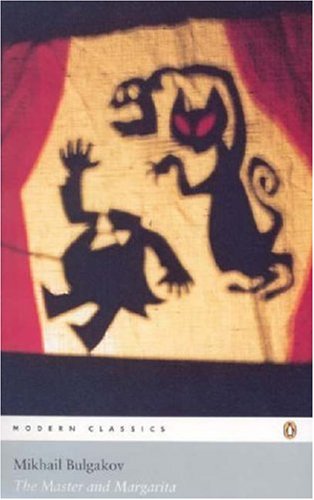
“The Master and Margarita” by Mikhail Bulgakov (1936) Although this novel was written in the Thirties, because it was critical of Stalin it did not get officially published until 1966.   The novel begins with Satan visiting Moscow in the 1930s, joining a conversation between a critic and a poet debating the existence of Jesus and the Devil.  This is a humorous classic which has lasted and will continue to last long after Stalin is long gone.

A Remarkable Novel from Australia – “Harp in the South” by Ruth Park

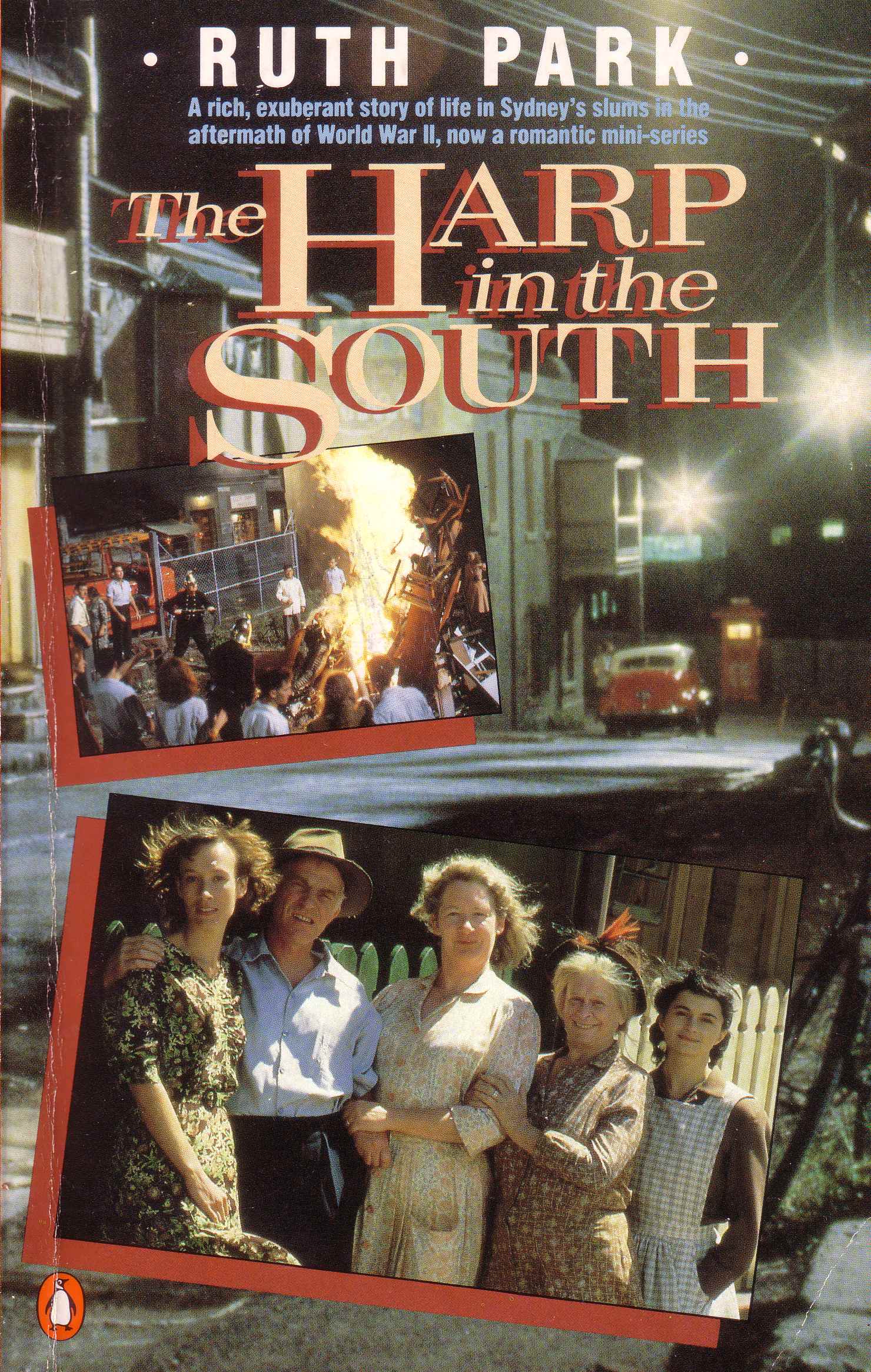
“Harp in the South” by Ruth Park  (1948) – 301 pages

When I picture Australia, nearly the last thing I would picture is city tenement slums.  Yet I suppose every large city in the world has tenement slums.   And if there is anywhere in the world a writer who could capture life in the slums in honest, moving, and pitch-perfect words, it would be in Australia.

 I first heard about “Harp in the South” from Whispering Gums and ANZ Litlovers Litblog.  Although there are quite a few writers from Australia who have become world-famous, Ruth Park is still Australia’s well-kept secret.

Perhaps the most famous writer of the urban slums is Charles Dickens.  He frequently wrote dramatically of the London slums in the mid-nineteenth century, if a touch over-theatrical for my taste.  In the twentieth century, Henry Roth captured the slums of New York in “Call It Sleep”, while Richard Wright in “Native Son” and Nelson Algren in “Never Come Morning” caught the slums of Chicago. John Steinbeck depicted the tough lives of the Mexicans working in the canning industry in California in “Cannery Row”.  “Harp in the South” stands with and in several ways surpasses these other fine novels of the slums.

“Harp in the South” takes place in the tenement neighborhood of Surrey Hill in Sydney, Australia.  If it weren’t for bad luck, the people there would have no luck at all, and much of the bad luck is their own fault.  This novel centers on the Darcy family.  Father Hughie Darcy is a steady worker and a family man, but like any good sport he goes to the local bar and gets fall-down drunk every Saturday afternoon.  He also stops at the bar after work on Fridays, and he frequently picks fights.  His wife Mumma is a saint making sure her kids have a good upbringing; Mumma has been getting fatter as the years go by.  Then there are the two daughters Roie (Rowena) who is about seventeen and Dolour who is about ten.  There also was a son Thady who would have been about fifteen, but he mysteriously disappeared on the streets ten years ago.   Also Mumma’s mother Grandma moves in with them, and she can pick a fight just as well as Hughie.

Ruth Park pulls no punches in her depiction of life in the slums.  Life is as bad as you would expect it to be.  Terrible things happen to the Darcy family, but the family has resilience, mostly due to Mumma, to bounce back from the most dreadful occurrences.

The Darcy’s are Irish as are many of their neighbors.  There are many nationalities living in the slums including Italians, aboriginals, Jews, Chinese, and Dutchmen (Germans).  About the only nationality that’s missing from the Sydney slums of Surrey Hill are the English.

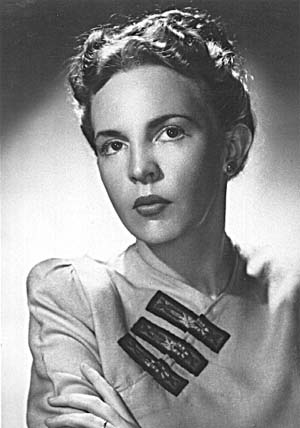
Ruth Park at age 26

Living in a tenement building, you really get to know the peccadilloes of the people living across the hall or up the stairs.  In the Darcy’s’ building, across the hall is Patrick Diamond who is a frequent drinking buddy of Hughie Darcy, except on St. Patrick’s Day.  On that day, Mr. Diamond who is an orange Irish Protestant, loathes all Catholics.  Yet the next day he’s back to being a drinking buddy of Mr. Darcy.   Upstairs is Miss Sheily who the Darcy girls think might be a witch and is as mean as can be until a gentleman admirer starts to call on her.

    “I tell you, he comes nearly every night,” said Patrick Diamond. “And the poor coot thinks the world of her. He’d give her the eyes out of his head to play marbles with.”
    “And she’d do it too,” agreed Hughie, “for she’s just like them old dames who used to sit around the guillotine waiting for the heads to fall so that they could cart them off to make soup of them.”
    “Now, you’re wrong there, Hughie man,” protested Patrick, to whom the breath of life was returning. “Sure there’s no one in the world, not even the French, who would make soup of a human being’s nob.”
    “Miss Sheily’s that sort,” said Hugh decisively.

Did I tell you that this novel is also extremely humorous?  The exchanges of dialogue in this novel are some of the sharpest I’ve encountered.

“Harp of the South” is one of those novels which are so well-written sentence for sentence you want to slow down and appreciate each line.  As I read this novel, the Darcy family and their horrible lows and reaffirming highs became a part of my life    I have added “Harp in the South” to my list of Best Australian Novels at its appropriate place.

Note :  I have here the original 1948 edition of “Harp in the South”.  It does not have the word “The”  in front of “Harp”.  I suppose the “The” was added when the book was turned into a TV mini-series in the 1980s.

“Tinkers” by Paul Harding

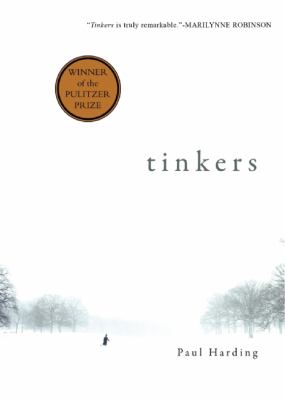
“Tinkers” by Paul Harding (2010) – 191 pages

“Tinkers” is a novel about George Washington Crosby, an eighty year old man living in New England. The novel covers the eight last days of his life as well as his reminiscences from when he was a child. As such, this busy, busy novel has not much of a detectable plot.

What is there instead of plot? There are sensory pictures of New England, its slate quarries, its fishing ponds, it quaint rugged little farms, its wildflowers. There is so much homey nostalgic imagery of New England one might have thought this book was written by the New England Tourist Bureau, but even they would have toned it down a little. All the pet horses, cats, and dogs in the book are given cute names like Prince Edward the Horse, Buddy the Dog, and Russell the Cat, and their doings are discussed at length even when they have next to nothing to do with the plot. Perhaps plot is not so important when you are setting the mood, the atmosphere. All of the other characters in the novel besides George, his father Howard, and his grandfather Samuel, are only there to be part of the local color.

There is one moving story in this novel. It is the story of George’s father Howard and his family’s struggle with Howard’s epilepsy. Set inside this crisp, cool, clean New England atmosphere, the severe impact of Howard’s struggle with epilepsy becomes even more affecting.

Howard is a tinker, and carrying on that tradition George fixes clocks in his spare time. There is much about the intricate inner workings, the springs and gears, and pulleys, of a clock. One supposes there is an analogy between when the workings of a clock go wrong and when a person gets epilepsy or some other terrible disease. I don’t find that analogy very convincing, but I’m the world’s worst mechanic.

After this moving story about Howard, we go back a further generation to when Howard himself was a boy and his father Samuel is a minister. Samuel starts to have problems giving his sermons because he is losing his mind. To me, this story struck me as the author going to the same well twice, first with Howard’s epilepsy and then with Samuel’s mental deterioration. I found this second story a pale imitation of the first story.

Since the first line in the novel is “George Washington Crosby began to hallucinate eight days before he died.”, there is no suspense about what happens to George. George is on his deathbed, and “Tinkers” is an exercise in New England nostalgia. George’s own family is only more of the local New England color.

Even though my own opinion of this novel is that it is not that good, I could see how some other readers, especially readers from New England, could love this book.

Clive James – Three Essential Essays

As of This Writing – The Essential Essays (1962 – 2002)

The great majority of my reading is fiction, plays, or poetry, but every once in a while I will encounter a writer whose non-fiction is irresistable.  In previous posts, I’ve discussed my admiration for Martin Seymour Smith and Camille Paglia; there are a few others who will be covered in due time.  Today I would like to discuss a few essays by the latest non-fiction writer whose work is irresistable, Clive James.

James first won me over with his book and TV series “Fame in the 20th Century”.  Last year I put his book of essays “As of this Writing” on my Amazon wish list, and, wonder of wonders, I received the book as a present last Christmas.  The three essays I will be discussing were picked out from this book by me using a somewhat random but not too random method. 

Theodore Roethke – On his Collected Poems (1968)

I picked out this and the following essay, because lately I’ve been considering reading Theodore Roethke’s poetry.  In this essay, James takes the stance that only a few of Roethke’s love poems are good, and that the great majority of his collected poems are just mimicry of his influences such as Auden, Eliot, Dylan Thomas, and Yeats.  James ends the essay with :

    “Now that Roethke’s troubled life is over, it is essential that critics who care for what is good in his work should condemn the rest before the whole lot disappears under an avalanche of kindly meant, but effectively cruel, interpretive scholarship.”

James’ reasoning is why I generally avoid poets’ collected poems, and usually read their selected poems instead. 

Theodore Roethke – On his Selected Letters (1970)

By the time he wrote this essay, Clive James had progressed to an active dislike of nearly all of Theodore Roethke’s poetry.

    “If this sounds rough, perhaps its best to get the gloves off early. I don’t like much of Roethke’s poetry, and the little of it I do like I don’t like intensely. I like this book of letters scarcely at all. A biography that spills all the beans could well tip the balance towards active loathing.”

James main complaint was that sometimes Roethke would mimic another poet’s work, then send it to that poet to get some praise which Roethke would pass along to his would-be publishers.  This is poetry as a career rather than as poetry. 

In  1992 which was 22 years after writing this essay, James was still concerned that he may have been too rough on Roethke.  James then added a Postscript in which he writes :.

    “Certainly the vocabulary was too harsh: “condemn”, ”contempt”, “loathing” are strong words springing from a weak conception of the critical task, which is not that of a vigilante.”

But he pretty much stood by his original negative verdict on Roethke.

As for me, so much for reading Roethke…

Les Murray and his Master Spirits  (1996)

I picked this essay to read, because I admire Les Murray’s verse novel “Fredy Neptune”.  In this essay James discusses one of Murray’s anthologies of poetry “FiveFathers”.  One of the nice things about this essay is James’ remembrance from Sydney University which Clive James, Les Murray, and Robert Hughes were all attending at the same time.

    “At Sydney University in the 1950s, most of the young poets were men but would haunt the cafeteria of the Women’s Union, Manning House. The reason was simple: in Manning House you could linger over a single coffee cup for hours without getting thrown out, whereas from the Men’s Union ejection followed precipitately upon the first gurgling of the dregs.”

James writes in regard to Les Murray :

    “At his own table in Manning House, Murray always looked as if he was dug in to stay. A boy from the country for whom Sydney was exotic enough…”

James considers Les Murray to be the ideal editor for Australian poetry anthologies because of Murray’s huge interest in Australian poetry.  The FiveFathers of this anthology are the following forefathers of Australian poetry : Kenneth Slessor, Roland Robinson, David Campbell, James McAuley, and Frances Webb.  For each of these poets, James has his personal remembrances and opinions.

My favorite poem of those that James quotes is from the poet whom James considers the most shallow of these poets, the colonialist dandy David Campbell.

      The cruel girls we loved
      Are over forty,
      Their subtle daughters
      Have stolen their beauty;
      And with a blue stare
      Of cruel surprise
      They mock their anxious mothers
      With their mothers’ eyes.

At one point Clive James says as an aside, “in the 1950s we were male chauvinist pigs almost to a man, but none of us were going to argue with poets Gwen Harwood or Judith Wright.”  In this essay, as opposed to the other essays, James has a very positive view of Les Murray and Australian poetry.

“The Surf Guru” by Doug Dorst

“The Surf Guru” by Doug Dorst – stories (2010) – 275 pages

Certainly the New Yorker magazine is the most prominent publisher of individual stories in the United States.   I have read and enjoyed many stories that were originally published in the New Yorker, but there are quite a few other reviews and magazines that publish fiction.  Early on while reading “The Surf Guru”, I checked to see where each individual story was originally published.  StoryQuarterly, Ploughshares, Cutbank, ZYZZYVA, Epoch, McSweeney’s, Five Points, Five Chapters, Gulf Coast, Politically Inspired:Fiction for Our Time.  Though I have nothing against New Yorker fiction, I still find this fact that not one of these stories was first published in the New Yorker tremendously encouraging. 

In the well-written stories of “The Surf Guru”, very little time is spent by the main characters on introspection or self doubt.  In the first three stories, the main character is an entrepreneur.  In the first story the main character is a designer and manufacturer of surfing equipment and accessories for his company called GOO-ROO.   In the second story the main character is the woman owner of Kacy’s Kitchen, which creates wedding cakes for society weddings.  In the third story the main character is the owner of a taco stand in Mexico.  It has been my experience that entrepreneurs are nearly the least introspective people in the world.  The people in these stories are people operating in the real world, not us more meditative literary types.   From the above you get a sense of the wide variety of stories in this collection.  Besides these, there is a story about Van Gogh, a few stories about young adults partying,  and a story about a young man charged with guarding the chopped off head of an enemy.   

In a certain sense, these stories are more adventurous in spirit and form than the typical New Yorker story.   The story “The Surf Guru” is divided into very short sections each with its own heading.  The long story “Splitters” reminded me very much of the Roberto Bolano biographical sketch novel “Nazi Literature in the Americas”.  “Splitters” consists of short biographical sketches of a group of botanists, and the humor is broader than Bolano’s.

Though the form of some of these stories is somewhat experimental, Doug Dorst is a solid story teller, and even in the experimental stories the qualities of a good story are there.    These stories make me want to read Dorst’s novel “Alive in Necropolis”.

“Comedy in a Minor Key” by Hans Keilson

“Comedy in a Minor Key”  by Hans Keilson (1947)  – Translated by Damion Searls – 135 pages

Wim and Marie are a young couple living in what was called Holland during World War II.  The Germans have just conquered and are occupying Holland.  The Nazis are rounding up all the Jews, robbing them of all their possessions, and putting them on cattle trains bound for concentration camps.  Wim and Marie decide to hide a Jewish man in their house.  Why?  “Patriotic duty.”  “A purely humane act.”  “Almost everyone is doing it.”  “Christian charity for the persecuted.”  “It’s the only way we can fight back, the only way we can do anything at all to show that it is not right.  Civil disobedience.”

Nico is a middle aged man, a former perfume salesman, a Jew.  The Holland underground places him in Wim and Marie’s house.   At first as you can imagine, it is a somewhat clumsy situation, having a stranger living in your house, a stranger that must be hidden at all times.

A perceptive study of ordinary people resisting the Nazi occupation, this novella is probably the lightest read of any book I’ve ever read about the Nazi era.  For one thing there are no Nazis in the book, except their looming presence.  The main reason this is a light read are the personalities of Wim, Marie, and Nico.  All of the dialogue is very natural, mostly in very short sentences, just as people would talk in this situation.  Wim and Marie make a well-matched couple, and Nico fits in as best he can.  “Comedy in a Minor Key” is a fast-paced vivid read with its share of scary moments.

The author of this novella, Hans Keilson, started out as a German, a Jew, but also hid out in the Netherlands during World War II.  He actually wrote the first fifty pages of this book while he was in hiding from the Nazis.  However the character who is hiding in this novel, Nico, is not Hans Keilson, because Nico is somewhat older than Keilson would have been at that time.  “Comedy in a Minor Key” is dedicated “to Leo and Suus, in Delft”, the couple that sheltered Keilson while he was hiding.

The dust is finally beginning to settle around the World War II literary scene, and we are discovering or re-discovering just who the exceptional authors were.   So far, we have discovered Stefan Zweig, Irene Nemirovsky, Hans Fallada, Dawn Powell, and Hans Keilson.  Someday hopefully another generation will figure out who the great writers of the early 2000’s actually were.

Hans Keilson turned 100 years old eight months ago.

“Stoner” by John Edward Williams

“Stoner”  by John Edward Williams (1965) – 274 pages

No novel has been treated with as much reverence and adoration by book reviewers and bloggers during the last three years as “Stoner” by John Edward Williams. Spurred on by an appreciative introduction by the recent master of quiet realism, John McGahern,  first the book reviews fell all over themselves calling the novel ‘masterly’, ‘stellar’, ‘a classic’, ‘powerful’.  Then the book bloggers got into the act heaping praise on “Stoner”.  After all of that acclaim, I just hate, hate to be the one to burst the bubble, to be the fly in the ointment. 

The genre of this novel is what I would call “dismal realism”.   You are born in pain, you grow old or maybe not, and you die.  You somehow escape the hardscrabble family farm into the academic life, only to have almost your entire career destroyed by academic politics which are nearly as harsh and brutal as private company office politics.  Along the way, some enchanted evening you meet a stranger across a crowded room, you marry her, and she turns out to be your worst nightmare for forty years.  Then you have a family that is irretrievably damaged in the warfare between husband and wife.

Usually when an unhappy marriage is depicted in a novel, it is set up so that either both the husband and the wife share the blame, or the husband is completely to blame.  In Stoner’s point of view, it is the wife who is completely to blame by her erratic and willful behavior, while he himself is long-suffering.  Yet from the description of the wife in the novel, it is difficult to figure out what is so terrible about her. The same is true of the academic politics in the novel.  Stoner does the right thing, so he is severely punished by the evil department chairman.  If there were a trace of wit in the novel, these attitudes would be easier to take.  However both “Stoner” the novel and Stoner the person are essentially humorless.   

Out of the 274 pages of the novel, there are about 20 pages of relative happiness when Stoner has an affair with a younger female colleague.  Stoner’s marriage is so miserable, his fooling around seems almost pure and redemptive in comparison.  Whereas Stoner’s wife is a disturbing troll whom Stoner somehow tolerates, his young lover is the idealized perfect woman.   

It’s hard to imagine that Williams was writing this somber realistic novel at the same time that Phillip Roth was writing his whacked-out “Portnoy’s Complaint”.  It was the wild crazy Sixties; no wonder “Stoner” was ignored.  Yet there was another realist writing at this same time.  That would be Richard Yates.  Some of Yates’ novels are at least as dismal as “Stoner”, the main difference being that the male characters in Yates’ novels are usually mostly responsible for their own miseries rather than someone else getting the blame.  Somehow I can identify with Yates’ faulty male protagonists more closely than with Stoner.   Probably my favorite realist novel of all time is Theodore Drieser’s “An American Tragedy” where the male ‘hero’ pushes his fiancée off his small boat and she drowns, so he can pursue his relationship with a new girlfriend.  At least this guy is not too good to be true.

I suppose the point of “Stoner” is that there is glory and beauty in persevering through a miserable pointless life.   I’m not sure I want to read about it though.

The War Between Rhyme and Un-Rhyme – Nicholson Baker

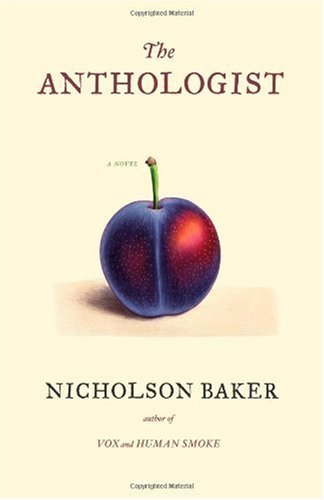
“The Anthologist” by Nicholson Baker (2009) – 245 pages

    “I’m hoping that people will come away from the book and think poetry is wasteful and inefficient and there’s a lot of bad poetry.  On the other hand, I want them to see that there’s a kind of greatness to (poetry) that you can’t get anywhere else.”
                                                                             Nicholson Baker

I listened to “The Anthologist” on audiodisk during my long commutes to and from work.  “The Anthologist” is one book where listening is clearly superior to reading.  Nicholson Baker himself reads the book on the audiodisk, and it’s more of a performance than a reading. At times he recites poetry, at times he sings, and at all times he’s revealing his quirky amusing personality.  If it were a videodisk, Baker would probably be dancing.     

The fictional narrator in “The Anthologist” is Paul Chowder, a poet who is trying to write an introduction to a poetry anthology called “Only Rhyme” but making little progress.  Early on, Chowder says, “My life is a lie.  My career is a joke.  I’m a study in failure.”  Yet within his rambling narration is one of the most fascinating personal talks on poetry I’ve ever come across.  Somehow he makes informal connections from the futurist philosophy of Marinetti to fascism to poetry that doesn’t rhyme – think Ezra Pound.  There are amusing and moving personal anecdotes of many twentieth century poets such as Louise Bogan, Theodore Roethke, James Fenton, Sara Teasdale, Mary Oliver, and Howard Moss.

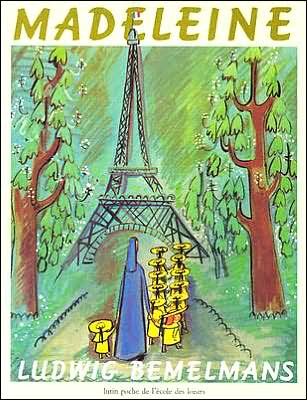
Chowder does not have much use for the poetic form iambic pentameter, the idea of the five beat line.  He thinks this has led to a lot of bad poetry.  Chowder prefers the four beat line.  I’ve frequently tried to count beats in poetry lines with little success.  Chowder says that you must also count the rests.  I tried this out on the simple lines from “Madeleine” which are actually quoted in the book, and it worked perfectly.

    In the middle of the night
    Miss Clavell turned on her light
    And said, “Something is not right!”.

Each line is seven syllables and a rest, thus each line is four beats,   So I experienced my first ever triumph in counting poetry beats using Chowder’s method and these lines from a children’s book.

The fictional plot of “The Anthologist” is skimpy beyond all measure.  A few times, Chowder bemoans the fact that his girlfriend Roz has moved out.  He mentions his neighbor Nan a few times.  Other than that, there isn’t any fictional plot at all, beyond Chowder mowing his lawn once in a while.  But who cares, when you have a monologue this interesting and amusing?  Where else will you have a narrator compiling a list of “People I’m jealous of”?  I think the tent of fiction is big enough to contain a fine book like this.   

Nicholson Baker has said about his fiction, “It’s important to get the voice right.”  On this audiodisk Baker has done just that.

Graham Greene – Amiable Writer for All Seasons

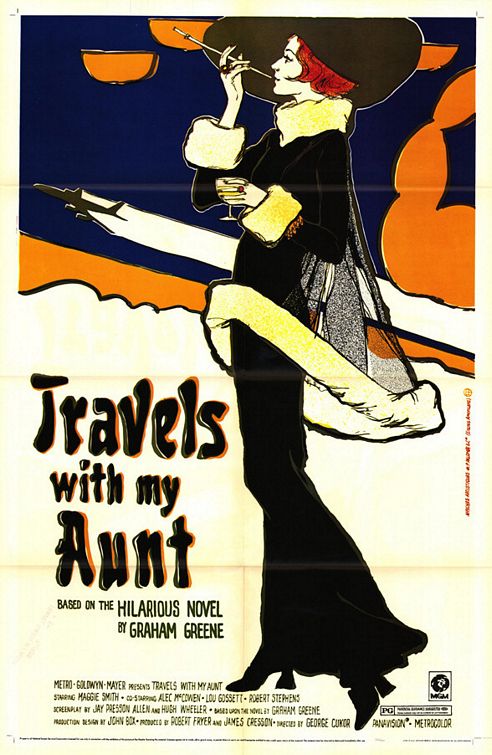
“Travels with My Aunt” by Graham Greene (1969) –  254 pages

“When we are not sure, we are alive.”

                                         Graham Greene  

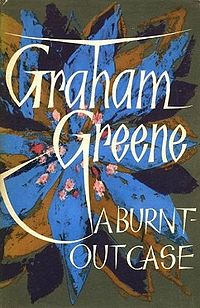
 During the past six years, I’ve developed a full-scale addiction to the writing of Graham Greene.  The book that hooked me completely on Greene was one of his early works, “Brighton Rock”.  This story of a young hoodlum and the woman who is chasing him tooling around Brighton, England in their big old motor cars completely captivated me.  From then on, I read novel after novel by Graham Greene.  “The End of the Affair”, “The Heart of the Matter”, “Our Man in Havana”, “A Burnt-Out Case”, “The Quiet American”, “The Comedians”, and several more.  Each of these books was special and only fed my desire to read more Graham Greene.

The secret to Graham Greene’s style is that he has no style.  Or I should say his style is that of a steady amiable fellow telling an interesting story as clearly as possible.  I suppose that is every writer’s aim, but Greene makes it look so easy it seems almost effortless.   In a Greene novel, your attention is not on the author’s technique but on the story itself where it belongs.

“Travels with my Aunt” was written during a joyful period of Greene’s life.  He had just moved to France to stay with his mistress and companion, Yvonne Cloetta.  He dedicated “Travels with my Aunt” to her with the inscription, “For H.H.K / who helped me more than I can tell”.  “H.H.K. stood for “healthy, happy kitten”. 

The story of “Travels with my Aunt” is that of a middle aged stick-in-the-mud ex-bank executive, retired early to care for his dahlia garden, who meets his exotic carefree Aunt Augusta who turns his life upside down and gets him involved in all sorts of adventures with many different shady figures.  During the novel they travel the Orient Express to Turkey and sail by ship to Paraguay.

This is Greene at his most amiable.  It was a good read, but for me the story wasn’t quite as strong as many of his other novels.  For anyone just starting to discover Graham Greene, I would recommend reading one of the novels I list in the first paragraph rather than “Travels with my Aunt”.  I always think it right to start with the best when discovering a new author. 

“Travels with my Aunt” does have its many pleasures.  There is a secret in the novel which I figured out at about page 60 and I suppose the average reader would have figured out at page 40, but our slow-witted stick-in-the-mud ex-bank executive protagonist does not latch on to until nearly the end of the novel.

Graham Greene novels are usually called thrillers, but they are more than that.  Some of his books are dark like “Brighton Rock”, some are satirical like “Our Man in Havana”. Nearly all his novels are suspenseful, but all are told by this good-natured reliable narrator, Graham Greene.

Some Questions for Tony

What is a novella?
A novella is a novel that is less than 150 pages.
A novel has 150 or more pages.
A long novel has 400 or more pages.
A damn long novel has 500 or more pages.

Should a novella be eligible for major literary prizes?
Yes, definitely
In fact, I would give the world literary prize for perfection to just the following three lines I learned when our daughter was young.

    In the middle of the night
    Miss Clavell turned on her light
    And said, “Something is not right!”

“Madeleine” by Ludwig Bemelmans

Why are some novels given dull bland titles like “The Archivist” or “The Anthologist”?
It’s almost like they are daring you to read the book. I prefer more clever titles like “Both Ways is the Only Way I Want It” or “The Imperfectionists”. But next year there surely will be a novel called “The Sociologist” or “The Proctologist”.

How come a month ago did it seem there were only one or two novels that might qualify for the Man-Booker, but now all of a sudden there are thirteen novels on the longlist?
The committee must have made up the titles and author names of the other eleven longlisters.

What is the penalty during the next two months for reviewing a novel that is not on the Man-Booker longlist?
Solitary Confinement on the Internet.

Which novel is going to win the Man-Booker this year?
Is there a novella on the longlist? I’d like to read that.

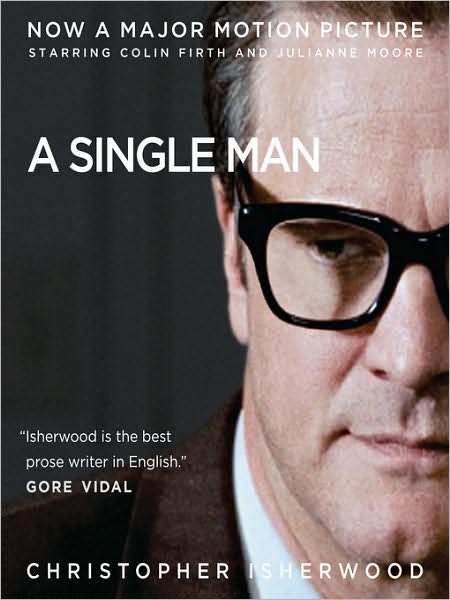
“A Single Man” by Christopher Isherwood

A Single Man” by Christopher Isherwood (1964) – 186 pages

“A Single Man” is a ‘day in the life’ novel like Ulysees or Mrs Dalloway or Ivan Denisovich.

A long time ago, I read Christopher Isherwood’s two collections of short stories from the Thirties, ‘Goodbye to Berlin’ and ‘Mr. Norris Changes Trains’ which were combined into ‘Berlin Stories’ that became the basis for the play and movie ‘Cabaret’.  These short stories captured the decadent and jaunty feel of Berlin just before the Nazis took over.  After reading these two collections, I couldn’t find another notable book by Isherwood to read.   Many of his books from the Forties and Fifties were about eastern religion which was not of interest to me.  Then in 2009, movie producer Tom Ford rescued Isherwood’s 1964 novel ‘A Single Man’ from semi-obscurity and turned it into a fine movie. 

Christopher Isherwood was born in England, lived in Berlin from 1929 to 1933, then emigrated to the United States in 1939 with his good friend W. H. Auden.

The ‘day in the life’ in “A Single Man” is that of George, a college professor at a small Las Angeles college.  The day occurs in December, 1962.  George is 58 years old.  He lives near the ocean in a cabin-like house that used to be part of a somewhat artistic community, but now has been overrun with suburban families.  George is still mourning the death of his younger roommate and lover for sixteen years, Jim, who was killed in a car accident.   George’s mind still flashes back to their time together.  Their love affair was just as romantic, sentimental, fulsome, and mundane as any heterosexual love affair.

One particular thing I enjoyed was George’s indulgent eye on his hetero neighbors.

    “Every weekend there are parties.  The teenagers are encouraged to go off and dance and pet with each other, even if they haven’t finished their homework; for the grownups need desperately to relax, unobserved…And two or three hours later, after the cocktails and the guffaws, the quite astonishing dirty stories, the more or less concealed pinching of other wives’ fannies, the steaks and the pie, while The Girls – as Mrs Strunk and the rest will continue to call themselves and each other if they live to be ninety – are washing up, you will hear Mr Strunk and his fellow husbands laughing and talking on the porch, drinks in hand, with thickened speech.”

No wonder there is so much Mad Men nostalgia now for the early Sixties.

One of the strong points of the novel is the crisp clear dialogue which also carries Isherwood’s philosphy, as this quote from the flirtatious repartee between George and his student Kenneth shows.

    “The point is you came to ask me something that is really important….You want me to tell you what I know…oh Kenneth, Kenneth, believe me – there’s nothing I would rather do!  But I can’t.  I quite literally can’t.  Because don’t you see, what I know is what I am.”

“What I know is what I am.”  Isn’t that true of each of us? We emanate what we know by who we are.

After reading the novel, I watched the movie.  I enjoyed the performance as George of Colin Firth, who is an actor whom I’ve admired in several previous movies, especially in “Love Actually”.  It was interesting to see what was cut from the novel and what additions were made to the movie. 

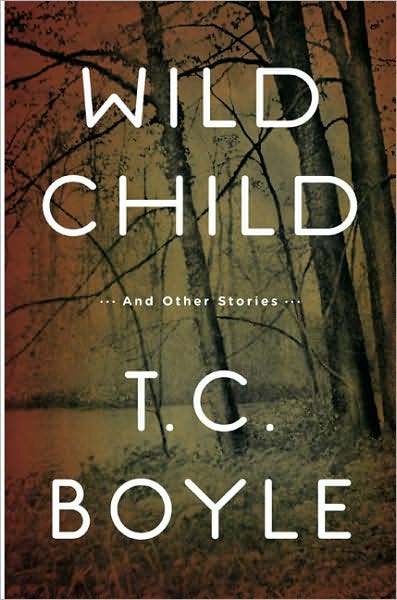
“Wild Child” – stories by T. Coraghessan Boyle

“Wild Child” by T. Coraghessan Boyle (2010) – 304 pages

Reading T. Coraghessan Boyle is my way of keeping up with California.  Not everything Boyle writes is about California, but he always writes with a California state of mind.  To me,  T. Coraghessan Boyle is just as California as the Beach Boys.  This is especially true of his short fiction.  In his latest collection, “Wild Child”, there are quite a few California stories about such things as mud slides in the suburbs, freeway driving, dating your plastic surgeon, and supposedly spontaneous brush fires. 

I am going to describe in detail the setup for one of the stories, “Admiral”,  because this story is both a quintessential T. Coraghessan Boyle story and a quintessential California story.  I will only describe the setup, so I won’t spoil the story for those who want to read it.  A young woman, Nisha, has graduated from college and is now “living back home after a failed attempt at life”.  She gets a call from her neighbors the Strikers, Gretchen and Cliff, for whom she had worked as a dogsitter for their Afghan dog ‘Admiral’ for four years while she was in high school.  The two Strikers each drive a matching black BMW.  Nisha goes to their house and asks about Admiral.  Gretchen Striker replies that Admiral got run over by a car.  It turns out that after Admiral died, they had him cloned at a cost of $250,000 and now the couple has the cloned baby puppy Admiral II.  The Strikers want to bring up Admiral II exactly like Admiral was brought up, so they want very much to hire Nisha again as dogsitter for Admiral II.  They are willing to pay her $25 an hour as well as provide medical and dental care for her to dogsit.   Only in California…

The opening quote for this story collection is the following :

    “In Wildness is the Preservation of the World.”

                                    Henry David Thoreau, Walking

This is an appropriate quote for this story collection.  Most of these stories are about nature out of control whether it be mudslides, thirteen hundred rats, or an animal-like child.

The above kind of humor is what Boyle is known for, the reason I always want to read his books.  “Wild Child” is a strong story collection where every story is good.  Ocassionally a Boyle novel is disappointing.  He has written twelve novels.   His last novel about Frank Lloyd Wright, “The Women”, got very mediocre reviews.  I read it anyhow, and it was indeed disappointing.   Other of his novels including “Riven Rock”, “Drop City”, “World’s End”, and “The Road to Wellville” have been extremely good.  His story collections are usually excellent. 

Lately the publishers have abbreviated the name of  T. Coraghessan Boyle to T. C. Boyle.  I much prefer T. Coraghessan Boyle, because it better fits his colorful stories.  A T. Coraghessan Boyle story usually does not have any socially redeeming value.  That is one of Boyle’s strong points as an author.

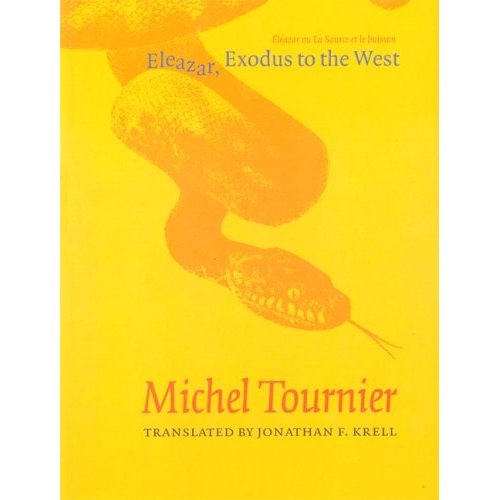
Read Michel Tournier, but skip his “Eleazar, Exodus to the West”

“Eleazar, Exodus to the West” by Michel Tournier (1996) – 89 pages – Translated by Jonathan F. Krell

    “From one book to the next, [Tournier] has been developing and extending a set of themes that are radically at odds with the common views of Western society…. This is his crime. In another age he would have been burned at the stake.” – Sven Birkerts

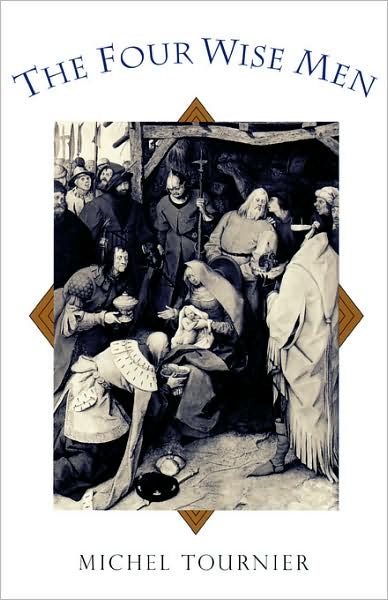
By all means, read Michel Tournier.  He has written more than a few of the most provocative, fascinating, and controversial novels such as ‘Friday” which is a re-imagining of the Robinson Crusoe story and “The Four Wise Men” which is a re-imagining of the birth of Jesus.  From these novels, one could conclude that Tournier is an inspired recycler of mythical, biblical, and other stories.  Tournier has also written more original powerful novels such as “The Ogre” and “The Golden Droplet” and “Gemini”.  I have read all these novels, and no matter what controversy these novels engender among Christians and other audiences, from a literary standpoint all these novels are superb.   They are deep imaginings which could not have been written by any other writer.  Michel Tournier is unique among living novelists because of the deep philosophical underpinnings of his books.  But don’t let that scare you away.  The novels are so richly imagined, they are easy to follow and understand.
I discovered an interesting discussion about “The Four Wise Men” among four Christian writers on the Internet.  Of course with the novel having the name “The Four Wise Men”, it would be of interest to these four Christians.  Three of the Christian writers argued that the novel was an anti-Christian work that sought to undermine Christianity, while the other Christian writer argued that it was a Christian novel.  The arguments were quite deep and perplexing, so I won’t go into the details.  This is just an example of the controversy Tournier’s work usually causes.  Tournier never shies away from the perverse or the wayward.   Tournier’s writing is often strange, rich, distorted, and cruel.

Where should a reader begin when reading Michel Tournier?   The novels “Friday” and “The Four Wise Men” are very accessible, because they are based on familiar stories.  Another good place to start is “The Ogre” which won the Prix Goncourt by unanimous acclaim in 1970.  “The Ogre” is Tournier’s perverse masterpiece about the Nazi era.   

I have read all of Tournier’s major works and still wanted to read more, so recently I read “Eleazar, Exodus to the West”.  This short novel did not work for me.  It was supposed to be a retelling of Moses and the Exodus story with the main protagonists being an Irish family immigrating to the United States and crossing the west to California.  All this occurs in 89 pages along with a quite a lot of philosophical speculation on fire and water, etc.  It all comes across as terribly sketchy, with none of the special qualities I have come to associate with Tournier.  Tournier obviously has no understanding of crossing the great American western prairie and these scenes have no credibility whatsoever.  In fact, I consider this novella so poor, it almost detracted from my opinion of Tournier generally.  Sooner or later, if you keep reading an author, usually you’ll encounter some of these lesser works that just don’t have the quality of their major work. 

So if you are interested in an intense reading experience with one of the greatest living authors read “The Ogre”, “The Four Wise Men” or “Friday”, but avoid “Eleazar, Exodus to the West” at all costs.

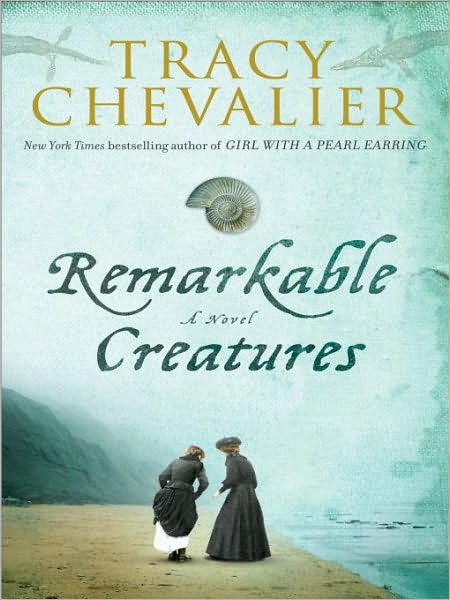
“Remarkable Creatures” by Tracy Chevalier

“Remarkable Creatures” by Tracy Chevalier (2010)  – 303 pages

    “Your Miss Austen would never allow such a marriage to take place in her novels you so love.” I went on. “If it can’t happen in fiction, surely it won’t happen in life’”

I, like many others, discovered Tracy Chevalier with her 1999 historical novel “Girl with a Pearl Earring” about Johannes Van Meer and the girl in his famous painting.  ‘Girl with a Pearl Earring’  became a huge best seller in spite of or because of this quiet domestic story.    She has had several novels since then.  This year Chevalier has published another historical novel, “Remarkable Creatures”, which is about Mary Anning, “the greatest fossilist the world ever knew”. 

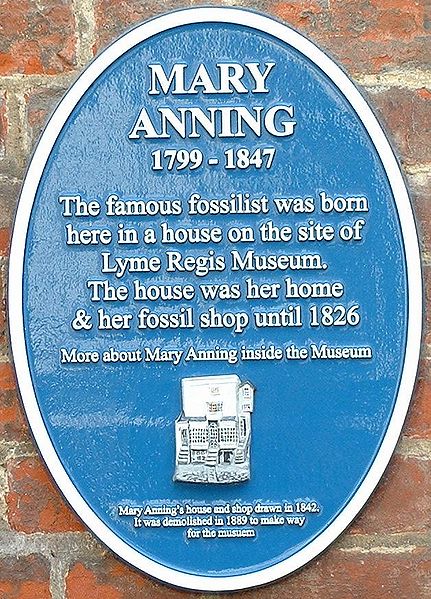
Mary Anning lived in Lyme Regis which is on the south coast of England in the early nineteenth century.  Her father was an amateur fossil hunter, but he died at an early age, and Mary carried on the fossil hunting even before she was a teenager to help support her poor family.  The cliffs by the ocean near Lyme Regis were a rich spectacular source for fossils.    Mary helped discover some of the earliest icthyosaur and pleisiosaur skeletons.  Early on everyone called these skeletons ‘crocs’ and ‘monsters’ only later to learn that they were entirely unknown species of dinosaurs.

The two main characters in “Remarkable Creatures” are Mary and a somewhat older upper class single woman named Elizabeth Philpot who also collected fish fossils for a hobby.  Elizabeth Philpot takes the role as protector for Mary and her family by making sure that they got a fair price for Mary’s specimens and that Mary Anning got proper credit for her finds.  There were always some well-to-do Englishmen willing to buy the specimens from Mary at as low a price as they could get away with, attach their own name to the specimens, and take all the scientific credit for them.

Once again Tracy Chevalier has taken a rather quiet commonplace story and turned it into something fascinating.  A lot of the story concerns the domestic lives of these two women.   I was particularly drawn to the comments about Jane Austen who was living at the same time as the events in this novel take place which would be from about 1805 to 1820. 

    “This was the sort of situation that she read about in the novels she favored, by authors such as Jane Austen, whom Margaret was sure she met long ago at the Assembly Rooms the first time we visited Lyme. One of Miss Austen’s books even featured Lyme Regis, but I did not read fiction and could not be persuaded to try it. Life itself was far messier and didn’t end so tidily with the heroine making the right match. We Philpot sisters were the embodiment of that frayed life. I did not need novels to remind me of what I had missed.”

Another facet of this novel is a dramatization of the effects the discovery of these fossils on the prevailing religion which believed in an infallible God who could not possibly have created species that had gone extinct hundreds of thousands of years ago.  But do not expect a thorough discussion of the clash between religion and dinosaurs, as this is only a minor theme of the book.

I found “Remarkable Creatures” a satisfying historical novel which made events about which I knew virtually nothing interesting to me.  It is scheduled to be made into a movie soon.

Tracy Chevalier was born and raised in Washington DC and now lives in London.