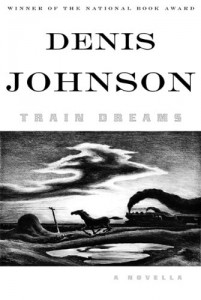
“Train Dreams” by Denis Johnson

“Train Dreams” by Denis Johnson (2011) – 116 pages

It is a good thing when one of our most noted writers presents us with a novella. One gets an opportunity to encounter a writer quickly and painlessly. For me, the immediate pleasure is knowing that I will not have to carry around a heavy tome.

“Train Dreams” is a western that mostly takes place in the narrow Idaho panhandle which borders Canada. The book is not one of those westerns that have a lot of characters interacting with each other. In fact most of the novella is consumed with one character, Robert Granier, who is very much a hermit and a loner. Robert Granier does not interact with people very much, so each small meeting with another person assumes vast importance. There is also an element of magical realism in “Train Dreams”.

I’ve read several books by Denis Johnson starting with “Angels” which I consider an edgy masterpiece. Another excellent book of his is “Jesus’ Son” which is a collection of linked stories about drug-demented troubled drifters. I want to read ‘Tree of Smoke’ which is one of those over 600 page tomes I mentioned above and won all kinds of awards. Denis Johnson writes about madness, losing oneself, and redeeming oneself like no one else. He writes as one who lived through it, having battled alcohol and drug addiction for much of his life.

“Train Dreams” is a much more austere story than Johnson’s previous work. This novella focuses nearly exclusively on the loner’s thoughts and actions.

Most of the reviews I’ve read of this novella approach this book with near total adoration. I don’t share their enthusiasm for “Train Dreams”. I did think it was perhaps an above average story, but it was too plain, sparse, and dry to captivate me, to always hold my interest. I hope Johnson is not falling in to the Cormac McCarthy school of spare novel writing. That would not be good.

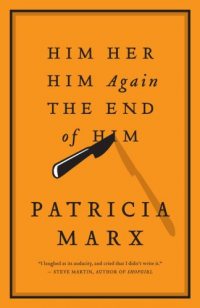
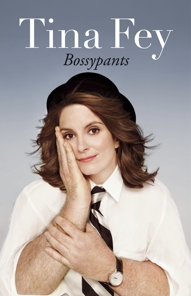
“Him Her Him Again The End of Him” by Patricia Marx and “Bossypants” by Tina Fey

“Him Her Him Again The End of Him” by Patricia Marx (2007)
“Bossypants” by Tina Fey (2011)

 I’m combining the reviews of these two books, because these two authors share something in common.  They are both former writers for Saturday Night Live.

 More importantly Patricia Marx was also a writer for ‘The Rugrats’ which was the funniest show on television while it was producing new shows.  Marx has also been a regular contributor to the New Yorker since 1989.  Quoting the Huffington Post, “Patricia Marx writes comedy because she is too shallow to do anything else.” 

 There is one joke in “Him Her Him Again The End of Him” that absolutely broke me up and put a smile on my face for days whenever I thought about it.  See what you think.      

    I did some more stone kicking. “Do you know that book ‘Seven Types of Ambiguity’?” I said referring to a book they had made me read in school. I had a vague hunch it was relevant to what Eugene was talking about. I needed Eugene to think that I was smart.

    Eugene nodded. “William Empson”, he said.

    “Don’t you think that a better title would have been ‘Seven or Eight Types of Ambiguity”?

 I realize I’m committing a cardinal sin of book blogging writing about an author’s previous book just when they’ve released a new book, because Patricia Marx has just released “Starting From Happy”.  So be it.    The second funniest joke in Marx’s novel is that during a funeral, the music that is playing is that jazz classic, ‘Don’t Get Around Much Anymore’ by Duke Ellington. 

 “Him Her Him Again The End of Him’ is a ‘ boy meets girl, boy breaks up with girl, boy gets back together with girl after he’s married’ novel all told from the girl’s point of view.  Marx has a Greek chorus of the girl’s friends tell her what they think of this guy, but she is usually too love-struck to follow their advice.  The style is conversational, not at all formal, as if the girl is talking to us readers.

 I think Marx was still learning the basics of character and scene development in novel-writing when she wrote this novel.  Some of the scenes read more like skits rather than being fully developed. The girl, the first-person narrator, comes across as a real person, but the main male character comes across as an unbelievably pompous stick figure. 

 “Bossypants” by Tina Fey is not a novel. It is a series of comedy routines, most of them relating to Fey’s memoirs growing up with her family and working at various jobs she has had up until this time. A lot of the humor is self-deprecating, and it contains much low-key advice.   Listening to the gentle pleasant humor of “Bossypants” is a good way to pass a long road trip.  I probably would have preferred her humor to be edgier, sharper, and meaner, but that will have to wait for a future book.  At this point, Tina Fey’s goal is to win us over, and in this she succeeds.   

Finally here are two quotes from “Bossypants”.

    “Photoshop is just like makeup. When it’s done well it looks great, and when it’s overdone you look like a crazy asshole.”

    “You have to remember that actors are human beings. Which is hard sometimes because they look so much better than human beings.”

  .

“The Leftovers” by Tom Perrotta

The Leftovers” by Tom Perrotta (2011) – 355 pages

 My favorite realistic humorous writer about down-to-earth suburban life, Tom Perrotta, has now written a post-apocalyptic novel.   But Perrotta hasn’t strayed far from his other writing, because the apocalypse in the “The Leftovers” takes place in the typical United States suburb of Mapleton.

In the novel, the Rapture occurred three years ago removing a large number of the residents of Mapleton as well as all over the world.  These people just vanished immediately from their homes and families never to come back.  The people who weren’t taken away are “The Leftovers”.  This Rapture is not the same Rapture as the evangelical Christian Rapture where only the most Christian faithful are taken up to Heaven.  The Rapture in this novel was an indiscriminate Rapture that took away people of all faiths, nationalities, races, etc.  This Rapture took away the people randomly leaving some families intact like the mayor of Mapleton Kevin Hardy’s family and taking three out of four members of the family of Nora Durst.

Even the intact families like the Hardy’s have been affected profoundly.  Kevin’s wife Laurie has left their home and joined a cult called the ‘Guilty Remnant’, and his son Tom dropped out of college and is travelling around the country following an itinerant apocalyptic guru/preacher.

What we get in “The Leftovers” is the story of how all these suburban people, most of who are connected to the mayor’s family one way or another, continued on with their lives after The Rapture.  There are many characters and plot lines in the novel.  I suppose one could argue that there are too many characters and plots, but at the same time all of the activity in the novel keeps things interesting.   The book shines when Tom Perrotta gets down to writing the details of these suburban people’s lives.

This concept of The Rapture is  a rather dismal backdrop for the prosaic events in this suburban novel, and it squelches much of the potential humor.  I think Perrotta would have been better off not even using the term  The Rapture.  A lot of people associate The Rapture with that lunatic holier-than-thou evangelical notion that only showed that Christians are just as susceptible to crazed Right-Wing delusions as Muslims.  These evangelicals were aided and abetted by many opportunistic politicians who used The Rapture as their justification for spoiling life for people here on Earth.

I longed for a more everyday suburban story.  Ultimately Perrotta is able to impart the ordinary lives of these left-over people with the empathy and humor he is justly famous for, but by that time the novel was nearly over.  In the last few chapters Perrotta is able to hit his story-telling stride, but up until then too much of the story had the grim aspect of survivors’ stories.

“The Big Clock” by Kenneth Fearing plus a Couple of Poems by Fearing

“The Big Clock” by Kenneth Fearing (1946) – 174 pages

 Poet / Writer Kenneth Fearing hit the jackpot with his suspense thriller novel “The Big Clock” in 1946.  Up until that time, Fearing was most widely known as a poet, and we all know how much or how little money poets make.  Just to keep himself and his family afloat, he wrote pulp and mystery novels.  But “The Big Clock” is no ordinary mystery novel; it has one of the most original and suspenseful plots ever devised.  The plot of “The Big Clock”, could be called a whodunit-in-reverse. I won’t describe it any further, because the plot’s structure is such a thing of beauty I want you to discover it for yourselves.   

 The publishers and the movie executives recognized right away the value of “The Big Clock”, and in 1946 Fearing made $10,000 in book royalties and $50,000 for the movie rights. These $60,000 dollars in 1946 would be worth over a million dollars today, and the Fearings should have been set for life.  However Fearing was a poet not a deal maker, they spent the money extravagantly, and Fearing, an alcoholic for most of his adult life, was near broke again by 1951.  

 “The Big Clock” as a novel is just as fresh, powerful and original today as it was in 1946.  New York Review Books (NYRB) republished “The Big Clock” along with another of his novels, “Clark Gifford’s Body”, in 2006.  I don’t read many suspense thrillers, but this one I thoroughly enjoyed; I loved its jaunty debonair style.

 Kenneth Fearing was very much on the side of the common man.  In the Red Scare years of the early 1950s, the FBI rounded him up and asked him the question, “Are you a member of the Communist Party?”  Fearing answered, “Not yet.” 

 As I researched this article, I discovered that Fearing left behind some strong poetry too.   Here are some excellent lines from his poem ‘1-2-3 was the Number he played, but Today the Number Came 3-2-1’.

 ”And wow he died as wow he lived,
going whop to the office and blooie home to sleep and
biff got married and bam had children and oof got fired,
zowie did he live and zowie did he die,”

 I’m going to end with a complete poem by Kenneth Fearing which I only discovered today, and already I can’t help but think this poem is one of my favorite poems of the twentieth century.

 Love 20¢ The First Quarter Mile

 All right. I may have lied to you and about you, and made a few
pronouncements a bit too sweeping, perhaps, and possibly forgotten
to tag the bases here or there,
And damned your extravagance, and maligned your tastes, and libeled
your relatives, and slandered a few of your friends,
O.K.,
Nevertheless, come back.

Come home. I will agree to forget the statements that you issued so
copiously to the neighbors and the press,
And you will forget that figment of your imagination, the blonde from Detroit;
I will agree that your lady friend who lives above us is not crazy, bats,
nutty as they come, but on the contrary rather bright,
And you will concede that poor old Steinberg is neither a drunk, nor
a swindler, but simply a guy, on the eccentric side, trying to get along.
(Are you listening, you bitch, and have you got this straight?)

Because I forgive you, yes, for everything.
I forgive you for being beautiful and generous and wise,
I forgive you, to put it simply, for being alive, and pardon you, in short, for being you.

Because tonight you are in my hair and eyes,
And every street light that our taxi passes shows me you again, still you,
And because tonight all other nights are black, all other hours are cold
and far away, and now, this minute, the stars are very near and bright

Come back. We will have a celebration to end all celebrations.
We will invite the undertaker who lives beneath us, and a couple of
boys from the office, and some other friends.
And Steinberg, who is off the wagon, and that insane woman who lives
upstairs, and a few reporters, if anything should break.
Some Nearly Forgotten Novels from the 1970s that are Exceptionally Good

The Seventies was that time after the Hippies and before Reagan; it was the time of disco and the Eagles.  Here are six excellent novels from that time. 

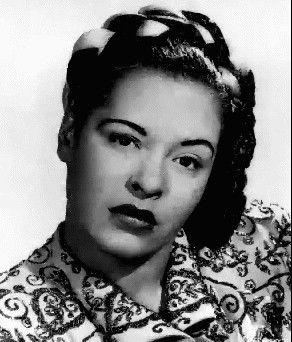
“Listening to Billie” by Alice Adams (1977)   –  Seeing and hearing Billie Holiday sing in a New York nightclub when she was young in the 1930s and 1940s must have been an incredible experience, because Billie’s live performances have made their way into several novels.  In “Listening to Billie”, the scenes with Billie Holiday are almost magical.  I still remember them vividly.  Billie Holiday singing in New York in 1938 even made it into another excellent novel I read recently, “Rules of Civility” by Amor Towles.  Adams was one of the best short story writers as well as an excellent novelist.  Alice Adams is probably the United States writer most worthy and due for a strong revival.

 “The Ballroom of Romance” by William Trevor (1972) – Speaking of short stories, if you like William Trevor’s recent novels and stories, you really should read these early stories.  I’ve noticed Trevor’s writing has gotten more sparse, rural, and somber as the years have gone by.  I prefer his early works which are busy and happy and usually take place in the city, often about young office guys and gals getting together.    

– 

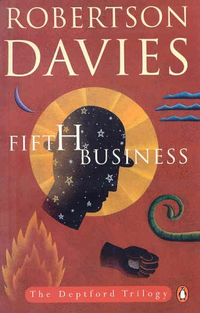
 “Fifth Business” by Robertson Davies (1970) –  This novel, the first of the Deptford Trilogy, probably spurred my early interest in fiction more than any other novel.   “Fifth Business” led me to realize that there were wonderful novels by writers I had never heard of out there, not written by the usual over-praised suspects.  The entire Deptford Trilogy is excellent.

“There is no nonsense so gross that society will not, at some time, make a doctrine of it and defend it with every weapon of communal stupidity.”

                                                                                       Robertson Davies

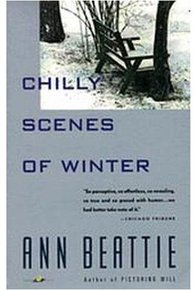
 “Chilly Scenes of Winter” by Anne Beattie (1976) – I had already read some of the minimalist stories of Raymond Carver, but “Chilly Scenes of Winter” was my first minimalist novel.  “Chilly” is one of those books that picks you up and enchants you until the last page.   Anne Beattie is sometimes considered the voice of the post-hippie generation that came of age in the 1970s. 

“Quite often my narrator or protagonist may be a man, but I’m not sure he’s the more interesting character, or if the more complex character isn’t the woman.” – Anne Beattie

 “The Dogs of March” by Ernest Hebert (1979) –   a rural regional realistic novel from New Hampshire that is several cuts above most rural regional novels. This novel is like that junked old car that sits in the backyard rusting, broken windows with flat tires or no tires.  Back in its day that car might have been the scene of a lot of exciting times. 

 “Searching for Caleb” by Anne Tyler (1975) – I doubt Anne Tyler will be forgotten, but I must mention “Searching for Caleb”.  Anne Tyler was almost like a religion for me.  Her characters go their own ways. They usually succeed despite or because of their eccentricities.  “Searching for Caleb” is among Tyler’s best.  I still keep up with her work.  After reading several of her novels in the early Eighties, I went back and read her early work like “A Slipping-Down Life” (1970) which is crude but powerful.

“Northwest Corner” by John Burnham Schwartz

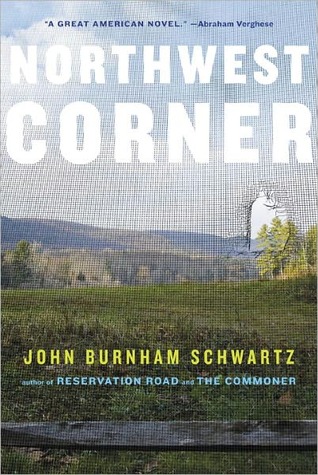
Northwest Corner” by John Burnham Schwartz (2011) – 285 pages“

There are heroes, and there are the rest of us.”

                                      John Burmham Schwartz, Reservation Road

 Twelve years ago lawyer Dwight Arno got into major trouble.  He ran over a child with his car and drove off from the scene of the accident, and the child died.  Dwight’s nine year old son Sam had been asleep in the back seat of the car at the time of the accident.  Upon being released after spending several years in prison, Dwight relocated from Connecticut all the way to southern California making a new life for himself alone.  After several years, he now has a decent sales job and a few friends in his new life.  Then one day his son Sam shows up at his door now also in trouble.  In a fit of rage Sam had hit another guy in the stomach with a baseball bat in a bar fight, and now this guy is just barely hanging on to life.

 Family history repeats itself. 

“There’s a doorbell too, but he (Sam) doesn’t try it. He stands frozen. It’s drawing on him in painful stages how his running all the way here is a pathetic tracing of his father’s running from his crime twelve years ago. There is no place in the world as ‘away’”.

 It has been a long time since I read the novel ‘Reservation Road’ which is the story of the father Dwight’s original trouble.  ‘Northwest Corner’ is the story of the son’s trouble.   Not remembering that first novel very well did not impede my appreciation of ‘Northwest Corner’, because the plot of the first novel is elaborated in this novel..

 “Northwest Corner’ is divided into many very short chapters, telling the story from the eyes of various characters including the father Dwight, the son Sam, the mother Ruth, the son’s girlfriend Emma (who happens to be the sister of the child that had been run over), and the father’s potential girlfriend Penny.  I found this technique of short chapters effective in getting a full emotional check-in with each of the main characters without dwelling on any one character too long.  The constant shifts in point-of-view keep your interest sustained.    

 But there is a downside to these short chapters.   These emotional check-ins don’t advance the plot beyond the basic details which I stated above.  Not much happens in the novel beyond that.  Each of these short chapters captures the particular emotional state of that character at that time and not much else.  Sometimes the emotions seem overwrought, and they are often expressed in a grandiose style.

 The subject of ‘Northwest Corner’, that of a young man who in a violent few seconds may very well have ruined the rest of his future life, is similar to another novel I read this year, “This is How” by M. J. Hyland.  Aside from the subject however, these two novels are very different from each other.  Whereas ‘Northwest Corner’ is rather high-flown and wears its emotions on its sleeve, ‘This is How’ is understated and restrained.  Whereas ‘Northwest Corner’ only covers a few weeks in its characters’ lives, ‘This is How’ covers many years with a multitude of plot occurrences.  I probably prefer the understated approach of ‘This is How’ to the over-heated approach of ‘Northwest Corner’, but there are potentially many who would prefer the John Burnham Schwartz approach.

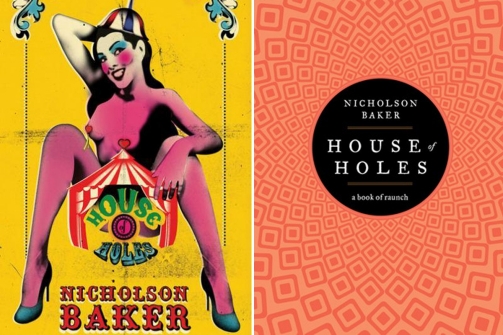
Adjectives that Describe “House of Holes” by Nicholson Baker

“House of Holes” by Nicholson Baker (2011) – 262 pages

Pornographic  Yes indeed, this is a book of raunch as the subtitle indicates.

Explicit  This is not a novel for the easily embarrassed or offended or the faint of heart .

Equal Opportunity  The House of Holes is a sex clinic run by Lila and her staff. She offers at least as much for the ladies as she does for the guys, beginning with Dave’s Arm and the Hall of Penises.

Courteous  The men and the women always ask their would-be partner or partners politely if it is OK before doing any intended sex act, and the partners usually accept. One woman, Betsy, even calls her husband up to make sure it is OK with him before she proceeds with any act.

Sexy  When you get caught up in the spirit of the goings on, yes, it is sexy and erotic.

Over-the-Top   quoting “… Luna, the fullness, the brimmingness of your breasts, there’s more of you and more of you, you are so good with your hot boobfat, I can feel the salad bowls in your beautiful knocker-jug-bosom-boobs, that’s what I need. Mmmmmm, Thank you, thank you, thank you. “

Good-natured  The men and women happily oblige each other, and there is no guilt or shame.

Repetitive  Interchangeable people, interchangeable body parts, which is similar to most pornography (I’m told).

Expensive  Lila charges a lot for her clinic’s services. It is expensive, but most of the customers find it well worth it.

not Misogynistic  The women are at least as much helped by the services of the House of Holes as the men.

Tiresome  There are only so many holes and so many appendages. One story was pretty much like another. Two hundred pages would have been sufficient.

Maybe next time Nicholson Baker will pick a subject that is really interesting like quantum physics or analytical geometry.

“A Wild Sheep Chase” by Haruki Murakami

A Wild Sheep Chase” by Haruki Murakami  (1989) – 352 pages

Haruki Murakami, before becoming a writer, owned a jazz club called Peter Cat in Tokyo for about eight years.  I believe his owning a jazz club as well as his deep lifelong interest in Western literature are the main reasons that Murakami’s fiction is so accessible to western readers.  His work is more accessible to western readers than that of many western writers.  Yet at the same time Murakami has millions of Japanese readers.  Among certain groups of people, discussing which is your favorite Murakami is a popular parlor game.   As the following quote shows, the qualities of music greatly influence his fiction.    

    “Whether in music or in fiction, the most basic thing is rhythm. Your style needs to have good, natural, steady rhythm, or people won’t keep reading your work. I learned the importance of rhythm from music — and mainly from jazz. Next comes melody — which, in literature, means the appropriate arrangement of the words to match the rhythm. If the way the words fit the rhythm is smooth and beautiful, you can’t ask for anything more. Next is harmony — the internal mental sounds that support the words. Then comes the part I like best: free improvisation. Through some special channel, the story comes welling out freely from inside. All I have to do is get into the flow. Finally comes what may be the most important thing: that high you experience upon completing a work — upon ending your “performance” and feeling you have succeeded in reaching a place that is new and meaningful. And if all goes well, you get to share that sense of elevation with your readers (your audience). That is a marvelous culmination that can be achieved in no other way.”

    Haruki Murakami in an essay called “Jazz Messenger” in the New York Times Sunday Book Review, July 8, 2007

 My favorite books by Murakami are ‘Norwegian Wood” and his book of stories, “Blind Willow, Weeping Woman”.  His work is surreal, poignant, and humorous 

 Lately there has been a lot of talk about Haruki Murakami as a contender for the Nobel Prize in literature.  I think he would make a great Nobel Prize choice.  Giving the award to so popular a writer as Murakami would energize the award creating a lot of interest and publicity.  I also do think that the literary quality of his novels and stories make Murakami justly deserving of the award.

 The book I just read, “A Wild Sheep Chase”, is not one of my favorite Murakami favorites.  It is actually the least favorite of his works that I’ve read so far.   The novel is exactly what its title suggests, “A Wild Sheep Chase”, or as we used to call these pointless efforts, a wild goose chase.  The novel starts out strong enough, when a nameless young Tokyo advertising executive finds out that a former lover has died in a traffic accident.  Then we find out that the executive’s marriage has fallen apart and he takes up with a professional ‘ear’ model whose ears are so well formed they are used in advertisement photographs.  At this point in the novel, I still had high expectations for the novel.  Then the wild sheep chase to Hokkaido in northern Japan begins.

 During the wild sheep chase we are given a lot of detail information about sheep and sheep farming.  That is when I lost interest in the story.  I know, I know, it’s Murakami‘s riffs that count, not the specific details.  It’s almost as if Murakami is challenging himself to make even a story about chasing after a sheep interesting.  I just did not get into the spirit of the thing; it may have been my fault.  We get introduced to all these new characters up in northern Japan who really have little or no ties to the main character, and it’s all about finding this one sheep with a star on its back.  This all seemed so inconsequential; I just couldn’t find it in my mind or heart to care about it.

 Even my favorite authors have one or two books that I don’t consider up to their best.  I won’t hold ‘A Wild Sheep Chase’ against Murakami, because there are many positive reviews for this novel.  It just didn’t work for me.  I still think that Murakami is worthy of the Nobel.   

 Murakami’s latest highly-anticipated two-volume novel; 1Q84, is due out in the United States this October.

 Now for a little-known fact about Murakami.  He has run the Boston Marathon six times.

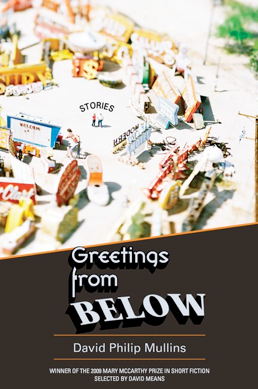
“Greetings From Below” by David Philip Mullins

“Greetings From Below” by David Philip Mullins (2011) – 167 pages

 Can a guy be too honest, too truthful?  If so, it might apply to Nick Danze, the main character in David Phillip Mullins’ debut short story collection, “Greetings from Below”.  These linked stories revolve around Nick’s lifelong sexual education which is mostly outside of and apart from his established relationships.   Nick’s sexuality takes many unexpected twists and turns which make him feel guilty, but there doesn’t seem to be much he can do about it.   


 Most of the stories take place in Nick’s hometown of Las Vegas, Nevada, which is described as the city with more churches per capita than any other and twice the suicide rate.  In this story collection, you get an insider’s view of Las Vegas, not only the old casinos, the new Disneyized ones, the assorted sleazy bars, and the swing clubs.  You also get to view the spectacular natural scenic phenomena of the area, the desert and canyons outside the city.

 “Greetings from Below” is not a cheerful book, far from it.  There is a lot of pain.  But we’ve all read way too many books where the main characters are portrayed as far better than people really are.  It’s refreshing to have a character face up honestly to his dark, offbeat side.  This book reminded me of a little known excellent novel from the Seventies called “The Demon” by Hubert Selby Jr.  Selby is more famous for his novel “Last Exit to Brooklyn”, but “The Demon” may be his most powerful work.  “The Demon” is about a young businessman who could be successful, but is possessed by lust.  He chooses his own destruction, is destroyed from within by his self-loathing and spiritual sickness.

 There is a lot of self-loathing in Nick Danze.  He has a loving girlfriend in Annie, but he can’t get himself to love her back. At the same time as we get Nick’s story, we get the story of his family.  His father died of a debilitating lung disease when Nick was still in his teens.  This has had a profound effect on both Nick and on Nick’s mother.  Nick’s mother goes through a series of addictions, first to shopping, then to gambling, and then to eating.  Nick rushes back to Las Vegas ostensibly to help his mother with her addictions, but usually winds up feeding his own addictions.   During these trips back to Vegas, Nick leaves Annie to fend for her self.

 “Greetings from Below” is the winner of the 2009 Mary McCarthy Prize in short fiction. 

 If you are looking for a bright cheerful book, do not read “Greetings from Below”.  If you are looking for a powerful book of stories that is honest and real, you might consider “Greetings from Below”.

“Poem Strip” by Dino Buzzati, A Graphic Novel

“Poem Strip” by Dino Buzzati (1969) – 218 pages        Translated by Marina Harrs

 Like many others, I’ve learned to trust the books that New York Review Books (NYRB) selects for their re-prints.  It seems today that most of the books of fiction that I read are either new books that have gotten strong reviews or New York Review Book re-prints.  “Poem Strip” by Dino Buzzati is another NYRB book.  It is different from most of the NYRB books in that it is a graphic novel.  


Usually NYRB has a strong introduction to their re-prints, but “Poem Strip” has no introduction.  I can understand why NYRB made this decision, because the last thing you want is to clutter up a graphic novel with extra writing.  Besides I was able to find the background information for the book using Google searches. 

 Dino Buzzati actually achieved fame as a novelist, not as a graphic novelist.  Apparently his novel “The Tartar Steppe” is well regarded.  He was also a skillful painter and illustrator, so it was only natural that he would write a graphic novel.

 “Poem Strip” is very much a work of the late Sixties, that sexy wild psychedelic time. It is about Orfi, a popular rock singer in Milan, Italy, and his girlfriend Eura.  These names have their significance, because this story is actually the re-telling of the ancient Greek myth of Orpheus and Eurydice.  In “Poem Strip”, Eura gets deathly sick and is taken down into the Underworld.   Orfi goes down into the Underworld hoping to use his great singing talent to convince the leader of the Underworld, who is depicted as the headless Excellent Jacket or Guardian Demon, to allow Eura to leave the Underworld and come back with Orfi.  The leader of the Underworld offers Orfi any woman of his choosing other than Eura, but Orfi has his heart set on his girlfriend.  Then the Excellent Jacket asks Orfi to

“…sing about the things that you
still know, that we have lost
the beloved mysteries”

 The dead people of the Underworld have everything they could possibly ask for, except they lack  “the most important thing, the freedom to die.”  Without the fear of death, some of life’s most powerful feelings do not exist.    

 The artwork in “Poem Strip” is surreal and extraordinary, as the examples I’ve included here show. Most of the women in both the world and the Underworld are depicted as naked.   Some readers may wonder why; others may ask ‘Why not?’. The rating would probably be a soft ‘X’.  This is the swinging Sixties after all. I will let you discover those pictures for yourselves.  

  “Poem Strip” is a fun book, a quick read.  The story is clear and coherent, and I liked that it was based on an ancient Greek myth.   This book is a high-quality graphic novel, not a comic book, a strong antecedent for Art Spiegelman’s Maus series and Marjane Satrapi’s Persepolis series and Posy Simmonds’ graphic novels.

 Do any of you have any suggestions for other graphic novels?

“Gilead” and “Home” by Marilynne Robinson

These people who can see right through you never quite do you justice, because they never give you credit for the effort you’re making to be better than you actually are, which is difficult and well meant and deserving of some little notice.” – Gilead


Marilynne Robinson’s three novels affect me on a deeper level that most novels do.  Yet originally I resisted their hold on me.  These novels about ministers in the small town of Gilead, Iowa, seemed far removed from my own life.  But now I’ve read all three once and the second book “Gilead” twice.

At first glance, Robinson’s novels seem so aggressively out of fashion.  If one were going to write about Christian religion at all today, wouldn’t one write about the right-wing evangelicals who seem to hold such sway in our country today?  Yet Robinson’s novels focus on liberal churches and ministers.  Certainly she is swimming against the tide?

When I completed the third book “Home” two years ago, my original reaction was one of rebellion, ‘Enough of this churchly stuff”.  Both “Gilead” and “Home” are told from the point of view of elderly ministers.  I felt suffocated by this extreme dose of Protestant religion.

Yet there is one character who appears in both novels that entirely intrigues me.  This is the prodigal son, Jack  Boughton.  Originally I thought with disdain “It wouldn’t take much to be a prodigal son in a preacher’s family”.  However, it turns out that the son Jack has really done some mean and wrong acts in his life.   As a boy, he is mischievous, and he keeps getting into serious trouble well into adulthood.  Now Jack is in his forties and lives far away from home perhaps as a form of penitence.  When he decides to visit home, his father is overjoyed.  His father’s best friend Reverend Ames knows all about the damage Jack caused to others in town, can’t forgive him, and actively dislikes him.     .

 Actually “Gilead” and “Home” are the same story told from two different perspectives.  “Gilead” is told from the perspective of Reverend Ames who dislikes Jack.  “Home” is the same story told from the perspective of the overjoyed father Reverend Boughton who is happy to have his son home.

A lesser novelist than Robinson would have softened Jack the prodigal son, made him rakish and loveable.  What gives these novels their power is that in them we are dealing with the real evil that Jack has done.  Jack has to live with it, his family has to contend with it, and the rest of the town is looking on.

In summary, “Gilead” and “Home” are powerful moral novels which deal with personal wrongdoing.

Church and Me

My grandfather on my mother’s side said when I was a young child that I had the makings of a church minister. He probably said that because I was  totally useless on the farm, and I did get good grades at school.

Burr Oak Lutheran Church

My father didn’t have much use for church. He would only go to church on Christmas and Easter, for weddings and funerals. That was it for him. But my mother tried her best to bring us three boys up as upstanding members of her family church in Burr Oak, Wisconsin. On Sunday morning she would try to herd us boys together to get us all to Sunday school. But we were our father’s sons, and we balked at eating breakfast, dressing up for church. Precious time passed. My mother was truly a wonderful woman, but she did tend to get hysterical in impossible situations. By the time she finally got us in the car we would be at least five minutes late even if she drove fast, and she would be screaming and crying.

By the time we finally did make it to the church, we would have to straggle in late to Sunday School classes which had already started. The sons and daughters of the church elders, the church Ladies Auxiliary, and the choir would already be settled in their seats, dressed in their full suit and tie or in proper dresses. Did these regular Sunday School members look at us with disdain or was that just my imagination? Of course, we’d show up in our plastic windbreaker jackets, no tie, and in my case, probably with one or both shoes untied.

Our Sunday school teacher would pause in mid-sentence whatever beneficent lesson she was teaching to allow us late-comers to get seated. She over-compensated for her irritation by treating us too kindly you could tell

Despite all this, some of the religion I got as a child apparently stuck to me as an adult, because several times as an adult I’ve started attending a church only to wind up going erratically or not at all.

Probably the closest I’ve come to becoming a regular church member occurred when I first got married at age 27. My new wife got me to attend her family church in Madison, and surprisingly I was happy to go. Since I can’t sing and am no good doing any of the handy work every church needs, I was rather a useless appendage, but I did attend regularly. I became on speaking terms with all six ministers on the staff of this quite large church. For two and one-half years I attended church regularly, promptly. Then my wife went into the hospital to have our first baby. The baby, a baby girl, was delivered fine, and they sent me off to the baby room with the baby. As I was going back, a nurse came out of the delivery room to tell me that my wife had had an aneurysm of the brain toward the end of the delivery. My wife died less than two days later.

I heard that the minister at our church had put our specific situation in the  sermon that week. He came to visit me several times during those first weeks while I was still numb. He didn’t say much, what can you really say in that situation? But I did develop a true appreciation for ministers who must deal with circumstances like these often.

Many years later now, I’ve reverted back to my usual habit of going to church infrequently or not at all.

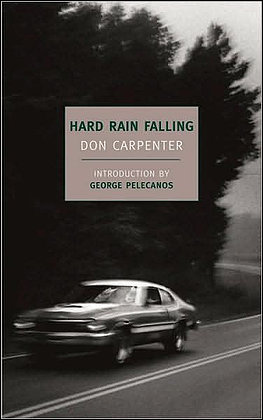
Don Carpenter and “Hard Rain Falling”

“Hard Rain Falling” by Don Carpenter (1966) – 308 pages

 This is the story of an author and his novel “Hard Rain Falling”.

 Don Carpenter was born in Berkeley, California in 1931 and spent most of his life in California.   He published his first novel “Hard Rain Falling” in 1966, and the book received high praise from critics and fellow writers although it didn’t sell that many copies.  This was a continuing theme in Carpenter’s career as a writer. 

 Soon after this, Carpenter went to Hollywood to work as a screen writer.  First he wrote TV scripts, a script for ‘High Chaparral’ and one for ‘The Outsider’ as well as others.  Then he turned to the movies, writing the script for a movie called ‘Pay Day’ starring Rip Torn as a country singer.  As with his novels, the movie got good reviews but didn’t sell many tickets.  Carpenter wrote three novels based on his Hollywood screenwriting experiences.  I read one of those novels, “A Couple of Comedians” a long time ago.  I remember liking it a lot, but don’t remember any details.  Carpenter wrote 8 novels and a couple of short story collections during his career. 

 In the early Eighties, Carpenter contracted a particularly severe form of tuberculosis and there were other serious medical problems as well.   He continued to write, but was losing his eyesight.  In 1995 at the age of 64, he killed himself with a bullet to the chest.  All of his novels were out of print at the time of his death. 

 That could have been the end of the story.  However, “Hard Rain Falling” was re-issued in 2009 by New York Review Books (NYRB) with an introduction by George Pelecanos as part of its Classics series .

 I recently read “Hard Rain Falling”.  It is about two young guys, Jack Levitt and Billy Lancing, who meet in a pool hall in the early Fifties.   When Jack Levitt was a baby, neither of his parents wanted him; besides they both were dead within a few years of his birth.  So he was brought up in an orphanage, later spent much of his teenage years in a reform school. In reform school, a warden punishes him by locking him in the Hole for three months of solitary confinement. Here is a description of Jack.

    “He had penetrating, flat, almost snakelike blue eyes which ordinary citizens found difficult to look into…even when he smiled there was too much ferocity in his expression to relax anyone.”

 Billy Lancing, light-skinned but definitely black, is a pool hustler, one of the best around the Portland, Oregon area where much of the story takes place, Billy is a smart young guy navigating a world of racists. 

 They both inevitably get into trouble with the law, maybe due to high spirits more than anything else.  Jack passes out drunk at a party at a rich guy’s house he and his friends have broken into, later gets a statutory rape charge which he probably could have gotten out of if he could have afforded a decent lawyer.  Billy is one of the few pool-shooters with money until his luck runs out.    They both wind up in prison in San Quentin and become roommates.

 So “Hard Rain Falling” is a tough novel about two guys who are outside society, outside the law.  Don Carpenter gets all the details right.  This is no ‘social problem’ novel where these guys are over-sentimentalized, and society is blamed for all their problems.  These guys are actually enjoying the things they can grab in this world, and we enjoy them along them.  Sure Jack and Billy are foolish sometimes, but aren’t we all?  At the same time, “Hard Rain Falling” is not one of those tough guy novels where the characters are tougher and meaner than people really are, so tough you can never get inside their minds.  Carpenter’s achievement is that he has complete empathy for these guys who are living pretty much on the street and in prison.   

 When you read the novel, you live life along with Jack and Billy, and you encounter all their ups and downs.  This novel is not for the faint of heart

 Where does Don Carpenter fit in United States fiction?  “Hard Rain Falling” is a work of detailed psychological realism.  I would put Don Carpenter in the following continuum. Theodore Dreiser to John Steinbeck to Nelson Algren to Don Carpenter to Richard Price.   I admire all of these authors, and Don Carpenter is worthy to be included.

Did the Man Booker Prize take a Hard Right Turn?

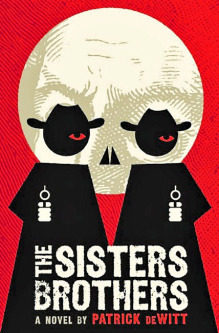
“The Sisters Brothers” by Patrick DeWitt (2011) – 325 pages

Looking at the Man Booker prize winners for the last three years, it makes one wonder where it’s headed. “The White Tiger’ by Aravind Adiga, the winner in 2008, had the traditional deeply conservative viewpoint of a large segment of the Indian population. In 2009, I suppose one might forgive the Man Booker for the continuing endless fascination with royalty, palace intrigues, and all its trappings, specifically of that most ridiculous and obnoxious of all the English kings, Henry VIII. Although I wasn’t impressed by the book, “Wolf Hall” by Hillary Mantel was probably a reasonable choice for the Man Booker. However the awarding of the prize in the following year to the not-very-good ultra right-wing “The Finkler Question” by Howard Jacobson which was supposedly a humorous novel but was actually a grim extreme political diatribe, seems inexcusable. It makes one think that the Murdochs must have taken over the Man Booker award along with everything else in Britain and turned the Man Booker into a hard-right political award rather than a literary award.

Which brings us to our book of the day, the western “The Sisters Brothers” by Canadian author Patrick DeWitt which is long-listed for the Man Booker this year. The Sisters Brothers are hired killers out west in California during the Gold Rush. There is no frontier justice in the Sisters Brothers world; it is a ‘kill first or be killed’ world. As the novel begins, the brother Charlie has just been promoted by his boss, the Commodore, to the team lead position of the two brothers over his brother Eli. That means Charlie will get more money and Eli will get less money. Charlie has exactly the same cruel brutal view of the world as the Commodore which Eli apparently lacks.

The whole novel is from Eli’s jaded resentful point of view which is quite humorous. Not only has Eli been demoted; he has started to have human feelings which are totally unacceptable in a hired killer. Instead of selling his crippled horse Tub for horse meat, he nurses the horse along, even when the horse needs to have an eye removed. We get a lengthy graphic account of the removal of the horse’s eye. Eli even develops some meaningful relationships with women who are not prostitutes.

In a comic novel about paid killers, there is probably little room for character subtleties. The farther up in the command chain you go in the novel, the more vicious, violent, and self-serving the characters get. The few women in the novel are sketchily drawn.

Overall “The Sisters Brothers” was an enjoyable comic read, a humorous account of a reasonable man, Eli, living an unreasonable life. I found the novel worthy of its place on the Man Booker longlist. However when I compare “The Sisters Brothers” with another American western written by a Canadian, “The Last Crossing” by Guy Vanderhaeghe, I found I much preferred “The Last Crossing” even though that novel did not even make the Man Booker long list when it was published in 2002. I suppose liking a novel for its subtlety and humane approach is old-fashioned; so be it.

However, “The Sisters Brothers” with its ‘Kill first or be killed’ and ‘Take all you can get as long as you can get away with it’ mentality might be exactly what the Murdochs are looking for in a novel or in a political statement.

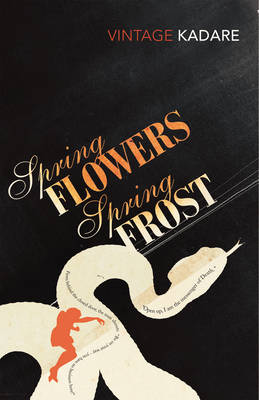
“Spring Flowers, Spring Frost” by Ismail Kadare

“Spring Flowers, Spring Frost” by Ismail Kadare (2000) – 182 pages

    “They were really flowers
    But March was gone
    Or else it was March
    But the flowers were not real”

It is hard to believe, but it has been more than 20 years since the Great Awakening of Eastern Europe when the Communist regimes fell in many of these countries including Albania. We all remember the tremendous jubilation and celebrations in these countries at that time, but what has happened in these countries since then? Spring is the time when Nature re-awakens after the long cold winter, and Ismail Kadare uses “Spring” as a metaphor for the re-awakening of Albania after the long cold Communist winter. As the title “Spring Flowers, Spring Frost” suggests, there have been some good things that have occurred in Albania since the Communist regime was deposed and some not so good.

“Spring Flowers, Spring Frost” takes place several years after the Communist downfall. Mark Gurabardhi, the main character of the novel, works as an artist. His specialty is nude figure painting, and his girlfriend is his main model. He has total artistic freedom. Later a bank robbery occurs which was unheard of in mostly small-town Albania until recently, another sign of the modernization and westernization of Albania

At the same time the ancient ways are now returning after having been outlawed by the Communists for many years. The Kanun, the archaic Albanian Mafia-like system of blood feud and vendetta, is returning. Men mysteriously disappear. Some of these blood feuds between families go back hundreds of years.

Although parts of “Spring Flowers, Spring Frost” held my interest, I did not find the novel at all compelling. The stories were disjointed with a lot of potential plot lines brought up but none of them developed fully. The main characters were sketched rather than fully drawn, and I found it difficult to care one way or another about any of them. The novel seemed more of a checking-in on the current state of Albania in fragments rather than a completely developed story. Later I found out that the English translation was actually based on the French translation rather than the original novel, and that may have been part of the problem.

I have read another of Kadare’s novels, “Palace of Dreams”, which was written during the Communist era and was banned by the Communists for its portrayal of a tyrannical dictatorship which was strikingly similar to the Hoxha regime in Albania at the time. “Palace of Dreams” is a strong novel, and I would recommend you read that book instead of “Spring Flowers, Spring Frost”.

Ismail Kadare was the first winner of the Man Booker International Prize in 2005, and he is frequently mentioned among those who could win the Nobel Literature Prize. However I would recommend you skip “Spring Flowers, Spring Frost” in favor of one of Kadare’s other novels.

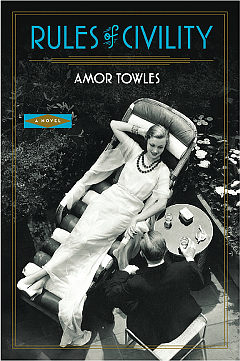
“Rules of Civility” by Amor Towles

Rules of Civility” by Amor Towles (2011) – 337 pages

 This is the time of year when people are trying to figure out which of the Man Booker longlisters will make it to the coveted short list.  This year, for a change, there is even some excitement among book people in the United States mainly due to a debut novel written by a 46 year-old money manager at an investment firm, Amor Towles.  “Rules of Civility” is already moving up the bestseller lists, quite an accomplishment for a literary novel.

 “Rules of Civility” is a special novel, a throwback to a more elegant time and place. 

 Most of “Rules of Civility” takes place in New York City during 1937 and 1938, and it centers on a young woman, Katie Kontent, and her friends and acquaintances.  When the novel starts out, Katie is living in a dorm-like apartment building for young women and working in an office as a typist.  She befriends Eve Ross, and they become roommates in the dorm.  On the last night of 1937, Katie and Eve go out to a jazz club called The Hotspot, where they meet the clearly well-to-do young man Tinker Grey. 
 

    “Eve saw him first. She was looking back from the stage to make some remark, and she spied him over my shoulder. She gave me a kick in the shin and nodded in his direction. I shifted my chair.

    He was terrific looking. An upright five foot ten, dressed in black tie with a coat draped over his arm, he had brown hair and royal blue eyes and a small star-shaped blush at the center of each cheek. You could just picture his forbear at the helm of the Mayflower—with a gaze turned brightly on the horizon and hair a little curly from the salt sea air.

    –Dibs, said Eve.”

 Soon Tinker is taking both working girls to the finest restaurants and night clubs in New York City.   One of the many charms of “Rules of Civility’ is seeing the jazz clubs, the expensive restaurants, and New York City through Katie’s eyes.  The short, snappy, sharp one-liner dialogue between Katie and Eve is humorously diverting.  Amor Towles provides all the stylish sensuous details of the late Thirties.   Even though ‘Rules of Civility’ takes place in a completely different era than ‘Mad Men’, both of these works caused me to look at our own time in comparison and find it wanting in style.  Many of the characters in “Rules of Civility” are well-to-do, and they are polite, amiable, and deeply interested in art, music, and literature.  This is not at all like today when most of the rich people seem like vicious ignorant Tea Party blowhards. 

 The title of the novel comes from the “110 Rules of Civility and Decent Behavior in Company and Conversation” which sixteen year-old George Washington wrote out by hand.  The first rule is “Every Action done in Company ought to be with some Sign of Respect to those that are Present.”  The rules are all about being polite and getting along well in society.  The character in the novel, Tinker Grey, adopted these rules as his own.   Perhaps in real life these “Rules of Civility” might be even more important than any list of moral precepts.  All 110 rules of civility are listed at the end of the novel.

 About the only thing that doesn’t work in the novel is the framing device with the novel starting out at an art show in a museum in the 1960s, and then flashing back to 1937.  There just did not seem any good reason for the Sixties scenes except as a device for Katie to look back on her younger days with fond memories.  But maybe that was enough reason.    

 How long has it been since you have read a smart stylish elegant novel?  If you are interested, “Rules of Civility” is the ticket.         


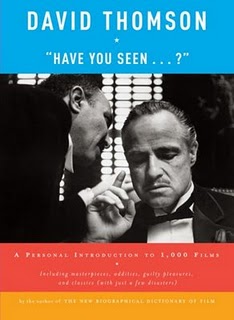
“Have You Seen…” – A Personal Introduction to 1,000 Films by David Thomson

“Have You Seen…” – A Personal Introduction to 1,000 Films by David Thomson (2008)  1002 pages

“Have You Seen …” is an encyclopedic book of film in which David Thomson describes in detail the circumstances of 1,000 movies he considers essential. These movies are not in all cases his favorites; in the short one-page articles for each movie, Thomson expresses his opinions about each movie freely. These opinions are about the direction, the actors, the writing, the staging, the camerawork, the lighting, etc. The movies range from the year 1895 to the year 2008 when this book was written.

Thomson has described his film writing as “personal, opinionated, unfair, capricious,” However his detailed knowledge of the making of each of these movies is so wide-ranging, Thomson is entitled to his strong opinions. It is that opinionated capriciousness that makes his writing so interesting and so much fun.

In my own movie watching, I have reached the point where the oldness of a movie does not impede my selection of it as a movie to watch. The modern technical razzle dazzle has no effect on me whatsoever. In fact I much prefer watching many of the older films over watching still another comic book movie whether it is a so-called drama, comedy or indeed a comic book. There are still good movies being made, but you need to hunt for them. Of the movies of 2010, I actually preferred “The Fighter” over “The King’s Speech”.

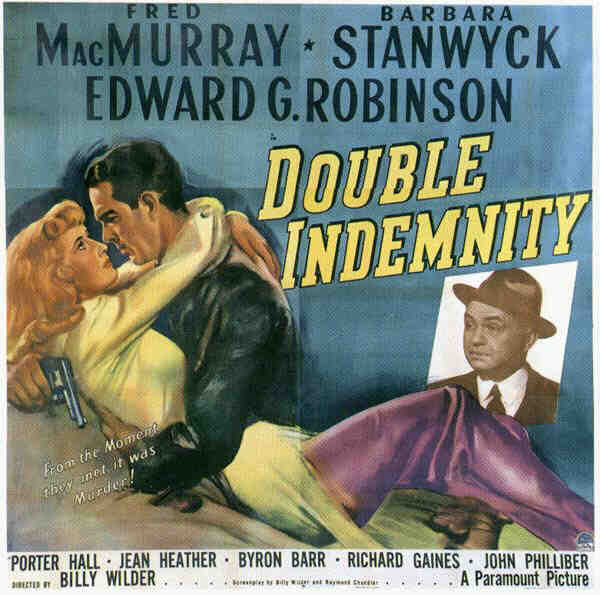
Next, I’m going to quote two somewhat long excerpts from “Have You Seen…” about the movie “Double Indemnity” that will indicate the sweep of David Thomson’s knowledge as well as the quality of his insights.

“When Phyllis (Barbara Stanwyck) comes downstairs she is dressed, and she wears that anklet that catches Walter’s (Fred MacMurray) eye the way a hook gets a fish. Very soon they’re into this counterpunching flirtation that isn’t in the novel and that you could easily attribute to Wilder’s co-writer Raymond Chandler. But everything you get here is part of Wilder’s grinning fascination with nasty, sexy people and his huge respect for Cain’s basic story.”

““The casting is of a kind that changed Hollywood. Stanwyck was a little reluctant to be so nasty, but then she saw that it made her. Fred MacMurray simply looks a better and better actor as the years pass, and there are volumes to be said about a man who hates himself even while he is trying to look so good. But still, it’s Keyes who holds the film in place, and Edmund G. Robinson is a fussy little treat, nagging away at detail and looking for his matches.”

Every movie entry in “Have You Seen…” is filled with these fascinating insights into the movie being discussed. This is an excellent movie compendium.

Lastly I will leave you with one last excerpt from the book about the movie “The Sound of Music”.

“Yes, you’re right: I am a very sick, vicious old man, but writing 1,000 of these little recommendations can drive you crazy, especially when I come to a picture that I loathe but which — unquestionably — has to be in the book, if only because millions of the stupid and aggrieved will write in to the publisher, ‘Where was The Sound of Music?’ if it is not. It is here.”

From who else can you get candor like that?

Based on the write-up in “Have You Seen…”, my wife and I recently re-watched “The Right Stuff” which was fine and probably, as Thomson writes, should have won the Best Movie Oscar in 1984 over “Terms of Endearment”.

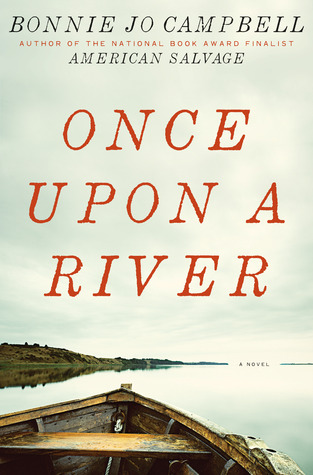
“Once Upon a River” by Bonnie Jo Campbell

Once Upon a River” by Bonnie Jo Campbell (2011) – 346 pages

 In 2010, 697,529 people purchased a deer hunting license in Michigan, of which 9% were females.  Doing the math that means there were 62,777 females who purchased deer hunting licenses just in Michigan.


So maybe the teenage heroine of ‘Once Upon a River’, Margo Crane, is not all that unique.  But Margo not only shoots the deer, she skins them, and cuts them up for frying or cooking.  She is proud of her sharp shooting skills, and her idol is Annie Oakley – ‘Little Miss Sure Shot’.  Margo can shoot a cigarette out of a man’s mouth from ten feet away. 

The story in “Once Upon a River’ is about Margo’s survival hiding out along two rivers, the Stark and the Kalamazoo, in western Michigan.  Circumstances have turned Margo into a loner, living on her grandfather’s boat, The River Rose.  Sometimes she must rely on men who she doesn’t know to help her.   For Margo, it is a tough mean old world, and if she doesn’t stand up for herself, no one else is going to stand up for her.  The story here is brutal and fatalistic.  There are many novels that are grim and murderous, nearly all of them written by men.  This one is unique in that it is written by a woman with a female lead.  This is the coming of age story of the teenager Margo fighting for survival in wild nature and coming up against that most brutal of all forces, human nature    

I have read reviews of “Once Upon A River” comparing it to “Huckleberry Finn” which is also a story about a young person living on the river.   I don’t quite see the similarity with “Huckleberry Finn”.  “Once Upon a River’ is much darker and more menacing than Twain’s story.  The novel to which I found “Once Upon A River” closest in spirit is “Deliverance” by James Dickey.  Both novels are about trips on the river in the semi-wilderness, ‘Deliverance’ in rural Georgia and ‘Once Upon a River’ in rural Michigan.  A large part of the story in both novels is about the threatening grotesque people in the semi-wilderness that are encountered along the way.  Certainly there are differences between the two novels, with “Deliverance” being about male bonding and “Once Upon a River” being about a teenage girl’s growing up.  However I found the brutal grotesque river settings in the novels similar.  

Not all the people Margo meets are threatening.  Some help her along the way; sometimes she has humorous and warm encounters.  This is one of those novels where you see the entire world through the lead character’s eyes and you wish for her the best.

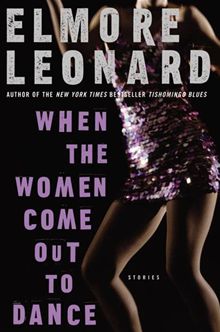
“When the Women Come Out to Dance” by Elmore Leonard

“When the Women Come Out to Dance” by Elmore Leonard (2002) – 228 pages

Here, in short form, are Elmore Leonard’s 10 Rules of Writing from his book by the same name and the New York Times article, “Easy on the Adverbs, Exclamation Points and Especially Hoopdedoodle”. You’ve probably seen these before, but I like these rules anyhow.
1. Never open a book with weather.
2. Avoid prologues.
3. Never use a verb other than ‘said’ to carry dialogue.
4. Never use an adverb to modify the word ‘said’.
5. Keep your exclamation points under control.
6. Never use the words ‘suddemly’ or ‘all hell broke loose’.
7. Use regional dialogue patois sparingly.
8. Avoid detailed descriptions of characters.
9. Don’t go into great detail describing places and things.
10. Try to leave out the part readers tend to skip.

My most important rule is one that sums up the other 10: If it sounds like writing, re-write it.
 –                   Elmore Leonard

By my count Elmore Leonard  has had at least twenty novels and stories made into movies.

The stories in “When the Women Come Out and Dance” are about people who usually don’t make it into more literary fiction. These include guys who apply for jobs at casinos, ex-strippers, neo-Nazi skinheads who belong to violent militias, part-time insurance investigators, Hollywood stunt doubles.

As you can tell from the above rules, Leonard doesn’t waste his readers’ time with a lot of description. He keeps things moving. My favorite story is probably the title story, “When the Women Come Out to Dance” in which the wife of a doctor in southern Florida hires a young Columbian widow to be her personal maid but has some other business in mind.

I’ve read my Henry James, my Marcel Proust, plenty of Edith Wharton, my Robert Musil, so I doubt I’m the typical Elmore Leonard reader. While listening to these stories, I sometimes ran out of patience with the characters’ limited means of expressing themselves, their shallowness, their uniform baseness. However it is refreshing to re-discover there is a real world out there with authentic people.. I won’t make a steady diet of this kind of gritty, grubby fiction, but once in a while I will indulge.

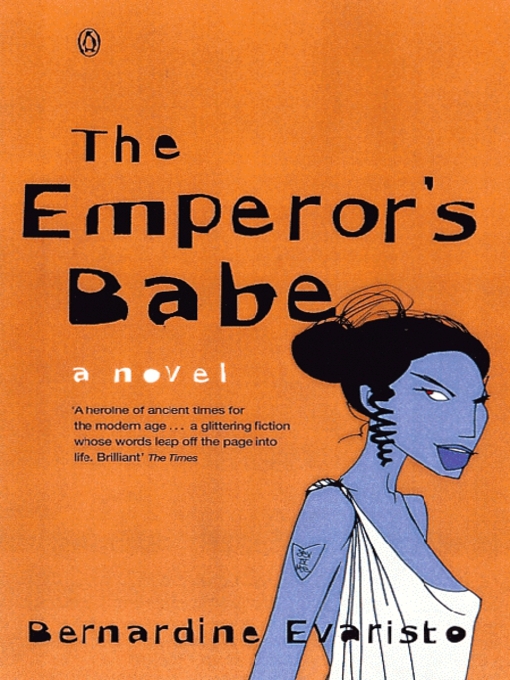
A Light Verse Novel about Partying in Londinium (London) back in Roman Times

“The Emperor’s Babe” by Bernardine Evaristo (2001) – 253 pages

I’m always on the lookout for good verse novels, so when I read that “The Emperor’s Babe” was selected by the Times as one of the “100 Best Books of the Decade”, I decided to read it. This novel is a playful decadent romp told by a teenage girl named Zulieka who roams the streets of London and lives it up with her wild friends until her father arranges a marriage for her with a middle-aged Roman nobleman in London on business. The girl’s family goes from being poor to being well-off, but Zulieka is stuck in a huge villa with her horny old man. She misses her old friends and the street and club life.

Here is an example of the light verse from the novel.

      one minute it’s hopscotch in bare feet
      next you’re four foot up in a sedan in case

your pink stockings get dirty. No one
prepared me for marriage. Me and Alba

were the wild girls of Londinium,
sought to discover the secrets

of its hidden hearts, still too young
to withhold more than we revealed,

to join the merry cast of actors.
she was like a rag doll who’d lost its stuffing:

spiky brown hair kept short ‘coz of nits;
everyone said she was anorexic

or had worms, but Alba was so busy
chasing the dulcis vita that she just burnt

everything she ate before it turned to fat.

Don’t read “The Emperor’s Babe” expecting to learn anything important about Roman history. It ain’t that kind of book. Here are some of the words that could be used to describe “The Emperor’s Babe” :sassy, audacious, sexy, erotic, tragic, glittering, dazzling, seductive, outrageous. The verse doesn’t rhyme which is just fine with me.

This book is great to read on a traveling holiday which I did, because it demands little concentration, yet every time you pick it up you have fun with the chaotic and inventive verse. If you are easily offended by the risqué, don’t touch this book with a ten-foot pole.

      We’d prowl the darkened alleyways, our noses
    Sniffing out the devastating odor of sex.