Archive for February, 2014

A Descent Due to Alcohol

The Drinker’ by Hans Fallada (1950) – 282 pages

Translated by Charlotte and A. L. Lloyd

10726669

There are two distinct sides to German writer Hans Fallada. In ‘Every Man Dies Alone’ (also called ‘Alone in Berlin’), he wrote what Primo Levi called “the greatest book ever written about German resistance to the Nazis”. That is a wrenching powerful account of what Berlin was like for working class people during the Nazi era. Fallada wrote it soon after the end of World War II shortly before he died.

‘The Drinker’, another of his novels, captures the other side of Hans Fallada. It was written in an encrypted notebook by him while he was locked up in an asylum for the criminally insane in the early 1940s. He was locked up, because he had made drunken threats with a gun against his ex-wife during an alcohol-fueled nervous breakdown.

‘The Drinker’ tells the story of one man’s descent due to alcohol. While it certainly is fiction and written as a novel, one gets the sense while reading that this is very much Fallada’s own story. The first part of the novel is about the drinking taking over this man’s life, and the second part is about life in the asylum.

“This place was horrible with its filth and meanness and envy, but that is how it was, and what was the use of rebelling against it? We prisoners, we patients, were not worth it.”

Lately the subject of American writers and alcohol has been up for discussion due to the recent book, ‘‘The Trip to Echo Spring: On Writers and Drinking” by Olivia Laing. The case of Hans Fallada would suggest that alcoholism is a problem not only for American writers.

‘The Drinker’ very much reminded me of the novel, ‘Disturbing the Peace’, by American writer Richard Yates. Like Han Fallada, Richard Yates had a form of alcoholism that went well beyond the fashionable. His alcoholism was also mixed in with bouts of psychosis and depression. At age 34, he spent one weekend in the Men’s Violence Ward of Bellevue Hospital in New York. He put that weekend into his novel ‘Disturbing the Peace’.

‘Disturbing the Peace’ was the first novel by Richard Yates that I read, so this searing account of an alcoholic has always had a special place in my memory. Since then I’ve read all of Richard Yates’ fiction. Recently I came across a critic saying that ‘Disturbing the Peace’ is one of Yates’ lesser novels, and I don’t believe that critic for a second.

falladaThe style of ‘The Drinker’ is much different from the style of ‘Disturbing the Peace’; they are very different writers. ‘The Drinker’ captures a bit of the humor of the drinking episodes, while ‘Disturbing the Peace’ is more heartfelt and sincere. What Hans Fallada and Richard Yates share is a brutal accuracy about themselves. Perhaps that honesty gave them the empathy and insight into the plights of other people so they could get beyond their walls and deceptions and reach the real story.
Staying Alive – Real Poems for Unreal Times

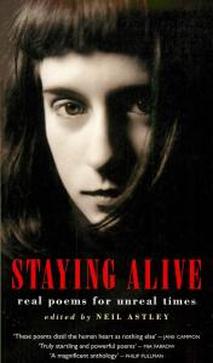
‘Staying Alive – Real Poems for Unreal Times’, a poetry anthology edited by Neil Astley (2002) – 496 pages

9553821

 ‘A good poet is someone who manages, in a lifetime of standing out in thunderstorms, to be struck by lightning five or six times; a dozen or two dozen times and he is great.’  – Randall Jarrell  

‘Publishing a volume of verse is like dropping a rose-petal down the Grand Canyon and waiting for the echo.’ – Don Marquis


I finally discovered a poetry anthology that works for me, ‘Staying Alive’ which is edited by Neil Astley,  I admit I’m late to the party, since this book was published way back in 2002 and has already sold over 200,000 copies in Great Britain alone.  However this book of poems is so powerful, I consider myself fortunate to have discovered it even now at this late point, better late than never.

Too many anthologies seem to be written more for the poets who appear in their pages rather than for the people actually reading the poems.  I’ve read anthologies where none of the poems hits home.  If I don’t discover even one poem which strikes me or stays in my mind, that anthology is a failure for me.

‘Staying Alive’ takes a different approach which can best be summed up by its subtitle: ‘Real Poems for Unreal Times’.  The focus here is on the reader.  These are contemporary poems written since 1900.  Many of the poets are justly famous like Robert Frost, T. S Eliot, Elizabeth Bishop, and Philip Larkin.  Yet there are many other lesser known poets as well. The amazing thing is that many of the poems by the less famous poets rival the classics.  This anthology gives a good sense of the continuation of poetry from the early twentieth century until now.  It may have been helpful to know the year each poem was first published, but in this book the emphasis is on the words of the poem itself.    

Neil Astley founded his poetry publishing house Bloodaxe Books in England in 1982.  At least since then he has been devoted to finding and publishing other people’s good poems. He has played a fundamental role in getting new poets published and in increasing the audience for poetry.

‘Staying Alive’ is divided into twelve sections with such section names as ‘Body and Soul’, ‘Roads and Journeys’, and ‘Bittersweet’.  Each section starts with a short explanatory note from Astley. Of course the poems don’t always fit neatly in to their categories or fit into more than one category,

I’m not going to quote individual poems here, but I will list a few from the book which particularly impressed me.

 ‘Wild Geese’ by Mary Oliver (Page 28)         (This poem has a place of honor in the book as the first poem and the only poem that is outside of all of the twelve sections of the book.)

‘And the Days Are Not Full Enough’ by Ezra Pound (Page 130)

‘I, Too’ by Langston Hughes (Page 326)

‘The Moose’ by Elizabeth Bishop  (Page 87)

   ‘The Door’ by Kapka Kassabova (Page 70)

‘Consider the Grass Growing’ by Patrick Kavanaugh (Page 455)

‘Staying Alive’ is a book that I will pick up occasionally whenever I want to discover another good poem or poems or to reread an old poem I particularly like.  It was followed by two more major anthologies also edited by Neil Astley, ‘Being Alive’ and ‘Being Human’, both of which I’ve added to my future gift wish list.

I would recommend ‘Staying Alive’ to anyone who already has an appreciation for poetry and wants to discover more poems or anyone who wants to develop a taste for poetry.

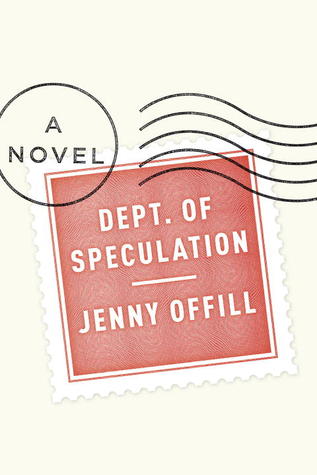
‘Dept. of Speculation’ by Jenny Offill

‘Dept. of Speculation’ by Jenny Offill  (2014)  – 177 pages

 ‘’Up until the seventeenth century, it was widely believed that magnets had souls.  How else could an object attract and repel?”  

17402288If you are looking for a traditional novel with a structured plot and endearing characters, avoid ‘Dept. of Speculation’ by Jenny Offill like the plague.  But if you can handle more modern offbeat fare, ‘Dept. of Speculation’ might be just the novel for you.

This novel is a collage type work with short paragraphs containing as the title indicates speculation, brief images and insights, facts, and literary tidbits on the order of ‘Speedboat’ by Renata Adler or the works of David Markson.  It is a slim novel, and I found it well worth the little time spent.

Take the following lines from ‘Dept. of Speculation’:

“What Keats said: No such thing as the world becoming an easy place to save you soul in.” 

Many people really do not care what Keats said. However I found this line and the many others like it fascinating. 

There is a story here about the birth and young childhood of a daughter and then a marriage unraveling.  Fortunately the patchwork of bits in ‘Dept of Speculation’ do add up to a coherent story, not like some of David Markson’s later novels which seem to have no point beyond the fascinating quotes and facts themselves.

 “There is a picture of my mother holding me as a baby, a look of naked love on her face.  For years, it embarrassed me.  Now there is a picture of me with my daughter looking exactly the same way.”

One of her definitions struck a little too close to home.  “Art monsters only concern themselves with art, never mundane things.  Nabokov didn’t even fold his own umbrella.”  ‘Art Monster’ fits the person I am a little too close for comfort.

I suppose ‘Dept. of Speculation’ would be classified in the category of Post-Modernism.  Some people reject even the modern, let alone the post-modern, out of hand.  All I can say is that I found ‘Dept. of Speculation’ original, insightful, and rewarding     

‘Battleborn’ by Claire Vaye Watkins

‘Battleborn’,  stories by Claire Vaye Watkins   (2012) –  283 pages

img-battleborn_152017296466.jpg_article_singleimage

What do we know about Nevada?  There’s the legal gambling, Las Vegas and Reno, and the accompanying shiny sleaze.  The huge desert and the mountains make a large part of the state breathtakingly beautiful but nearly uninhabitable.   The Comstock Lode in western Nevada was the first major discovery of silver ore in 1859.  It made some people rich but left a lot of others cursing their luck.

‘Battleborn’ is a collection of stories in which Claire Vaye Watkins captures the beauty and the desolation as well as the crassness of this place Nevada.

By now you probably know the story of Claire Vaye Watkins herself.  Her father was Paul Watkins who was a member of the Manson family, in fact at one point Charlie Manson’s right hand man and a new member recruiter for the family.  Later he became a key witness for the prosecution in the murder trials providing the Helter Skelter motive for the Manson crimes.

Of the fiction writers who write about the western United States, the one that Watkins most resembles is Denis Johnson.  Both Johnson and Watkins have that unflinching stark quality to their writing that indicates they are willing to write the truth about anything even if it reflects poorly on them selves.  

Although there are several strong stories in ‘Battleborn’, one story, ‘The Past Perfect, the Past Continuous, and the Simple Past’, stands out as particularly devastating for me.  A young guy Michele, an Italian tourist, shows up at the Cherry Patch Ranch, a brothel somewhere near Las Vegas.  His traveling companion wandered off into the desert and is missing.  Michele spends a lot of time waiting at this whorehouse for word from the police about his friend, because if the friend isn’t found in seven days, he’s probably dead.  Michele gets to know the women who work there, especially Darla, as well as the gay manager pimp Manny who also has his eyes on the young guy.  In this story, Watkins captures the desolate sleazy atmosphere inside this brothel so well, it is nearly unforgettable.   The characters here come alive, as real as real can be. This is a classic story. 

The first story in the collection, ‘Ghosts, Cowboys’, has the Manson family in it.  It features a girl called Razor Blade Baby, because Charlie Manson supposedly delivered her as a baby himself using a razor blade.

Well, these stories are like those of Denis Johnson but from the female perspective.   The world always needs more woman writers who are willing and able to deal with the seamy underside of life.

‘1914’ by Jean Echenoz – World War I for the Soldiers of France

‘1914’ by Jean Echenoz   (2012) – 109 pages    Translated by Linda Coverdale

Echenoz21

French novelist Jean Echenoz writes historical fiction the way I like it to be written.  His novels are not long epics.  ‘1914’ consists of short concise snapshots of what the war was like.   It is a pure distillation of what World War I meant for the French soldiers who fought in the war.

World War II was the worst war ever for civilians, but for the fighting soldiers themselves no war was more terrible than World War I, ‘that sordid stinking opera’.  All the gruesome particulars are in this short novel.  Here Echenoz, in two sentences describes in vivid detail what a direct hit of a troop unit was like:

“That’s when the first three shells that had flown too far exploding uselessly behind the lines, were followed by a fourth and more carefully aimed 105-millimeter percussion fuse that produced better results in the trench: after blowing the captain’s orderly into six pieces, it spun off a mess of shrapnel that decapitated a liaison officer, pinned Bossis through his solar plexus to a tunnel prop, hacked up various soldiers from various angles and bisected the body of an infantry scout lengthwise.   Stationed not far from the man, Anthime was for an instant able to see all the scout’s organs – sliced in two from his brain to his pelvis, as in an anatomical drawing – before hunkering down automatically and half off balance to protect himself, deafened by the god awful din, blinded by the torrent of rocks and dirt, the clouds of ash and debris, vomiting from fear and revulsion all over his lower legs and onto his feet, sunk up to the ankles in mud.”

The sentences in this short novel are not short themselves, but instead powerfully convey the precise effects of what is happening

As in most wars, at the beginning of World War I the soldiers go off to the battleground expecting that they will be gone only for a few weeks after which they will resume their places in society.  Here we follow a group of five soldiers.  A few are the lucky ones.  They get a ‘good wound’, the loss of an arm or a leg which means they can no longer fight and thus get sent home.  Most of the rest are not so lucky.  They either get killed or severely wounded by enemy fire or they run away and get shot for treason by French gendarmes.

 “Mowed down by your own side rather than asphyxiated, burned to a crisp, or shredded by gas, flamethrowers, or shells – that could be a choice.”

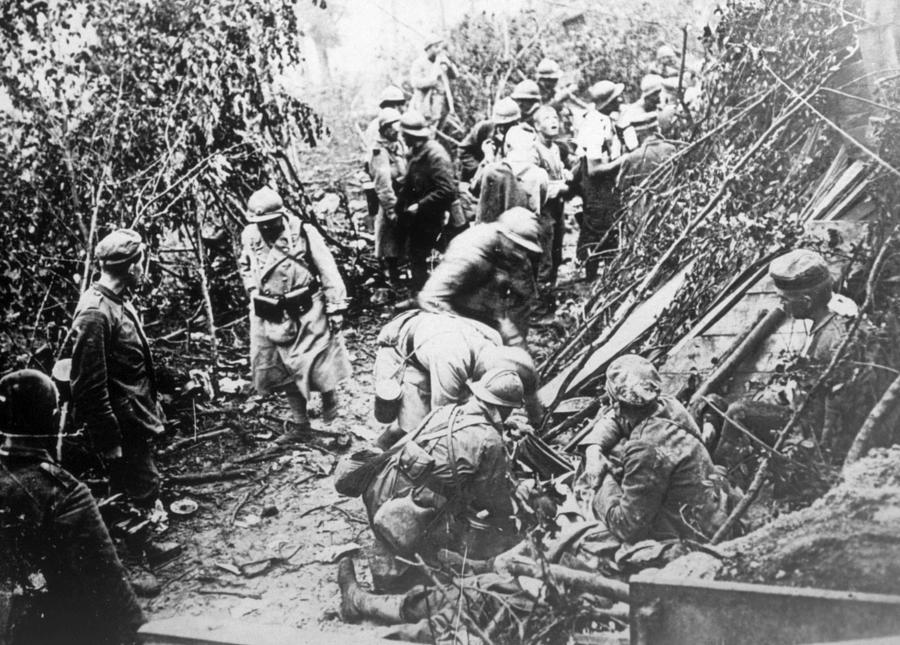
The Battle of the Marne - 1914

The Battle of the Marne – 1914

‘1914’ is up there with the best novels I have read about this awful World War I.  Other excellent World War I writings I have read are ‘The Wars’ by Canadian writer Timothy Findley, ‘The Good Soldier Schweik’ by Czech writer Juroslav Hasek, ‘In Parenthesis’ by English poet David Jones, and the memoir ‘Goodbye to All That’ by English writer Robert Graves.  Do you have a favorite World War I novel?

This is the second novel I have read by Jean Echenoz, the first being ‘Lightning’ which is a mostly non-fiction  biography of Nikola Tesla, the man who out-smarted Thomas Edison.  Echenoz is fast becoming one of my favorite writers.  He gives to historical people and situations the delicious qualities of fiction.  Very soon I will be reading more of his novels.

William Makepeace Thackeray – Cruel to be Kind

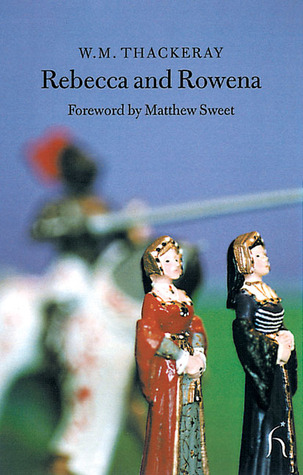
‘Rebecca and Rowena’ by William Makepeace Thackeray (1850) – 88 pages

 “The wicked are wicked, no doubt, and they go astray and they fall, and they come by their deserts; but who can tell the mischief which the very virtuous do?”  – William Makepeace Thackeray,  ‘Vanity Fair’ 

1061562

Relax.  I am not going to tell you that you must read ‘Rebecca and Rowena’ by William Thackeray.  Your lists of novels to be read are probably already bulging at the seams, and I can think of no compelling reason why you should read this book.

Not that ‘Rebecca and Rowena’ is a bad book.  There are just so many other books that deserve to be read ahead of it.  William Thackeray wrote this bright shiny little bauble of a book as a Christmas book to spur sales during the holiday season.  Thackeray’s wife Isabella had suffered severe depression after the birth of their third child, so she had to be institutionalized for the rest of her long life, and Thackeray had to pay the costs.

Thackeray wrote ‘Rebecca and Rowena’ about two years after his satirical masterpiece ‘Vanity Fair’ which came out in 1848.  ‘Vanity Fair’ had established Thackeray as Charles Dickens’ main competition for writing of serialized novels for the magazines which was a lucrative business at the time.  At this point the public was ready to read just about anything Thackeray wrote.

28‘Rebecca and Rowena’ is also a satire.  Thackeray wrote it as a parody sequel to the chivalric novel ‘Ivanhoe’ which was written by Sir Walter Scott in 1820. ‘Ivanhoe’ takes place in the time of knights in 12th century England.  At the end of ‘Ivanhoe’, Ivanhoe has courageously and soundly defeated the enemy and married the beautiful Christian Lady Rowena.  Ivanhoe is only 30 years old at the end of ‘Ivanhoe’, and Thackeray imagines what happened to Ivanhoe after that.  Does he re-encounter the bewitching Jewess Rebecca who had nursed him back to health after one of his severe battle injuries? Thackeray has great fun spoofing the conceits of this romantic novel of the Middle Ages, ‘Ivanhoe’.

‘Rebecca and Rowena’ is a humorous little read but nothing more than that.   If you like to read about knights and battles and such, you might like it.

images (2)But before we leave William Thackeray for good, there is one thing of which you should be aware.   I read ‘Vanity Fair’ about twenty years ago and consider it along with ‘Middlemarch’ by George Eliot the two finest English-language novels of all time.  Originally called ‘A Novel Without a Hero’, ‘Vanity Fair’ is set in Napoleonic times, and no novel has ever captured its tumultuous time better.  Leo Tolstoy was influenced by ‘Vanity Fair’ when he wrote ‘War and Peace’.   The cynical social climber Becky Sharp in ‘Vanity Fair’ is one of the liveliest female characters in all of fiction.   If you like biting but clever lines and wicked but loveable characters, you will love ‘Vanity Fair’ like I did.

No, I’m not going to urge you to read the 88-page ‘Rebecca and Rowena’. Instead you really must read the 800+ page ‘Vanity Fair’.  


‘Perfect’ by Rachel Joyce

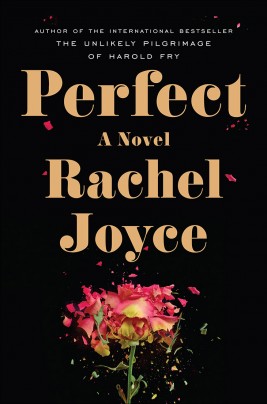
‘Perfect’ by Rachel Joyce  (2013) – 385 pages

JOYCE_Perfect

‘Perfect’ is the second novel by English writer Rachel Joyce. Usually I get a little leery of an author’s second novel especially after their first novel was a giant success like ‘Harold Fry’.  But after reading it, I don’t see any sophomore slump here with ‘Perfect’ even though it is much different from Joyce’s first novel.

That first novel, ‘The Unlikely Pilgrimage of Harold Fry’, was a rouser, a crowd pleaser.  Reading that novel, we are all pulling for Harold as he walks from the south of England to the north of England in order to save his friend Queenie.  Deep down we know that this rare act of kindness can do nothing to stop the cancer, but we cheer Harold along for every step of the way on his long trek.

‘Perfect’ is a different kind of novel. It is like a firecracker with a long fuse.  It starts out slowly as the situation is laid out in methodical fashion.   Then the story finally explodes, leaving the reader stunned and touched.

There are two parallel story lines in ‘Perfect’.  The first story line is told from the point of view of 12-year-old Byron Hemmings.  It takes place in 1972, and it concerns his mother Diana, his father Seymour, his sister Lucy, his best friend James, and their home on Cranham Moor in England. In 1972 two seconds were added to the world clock as a necessary time adjustment.  That adjustment plays a significant role. The other story line takes place over forty years later – today – and is told from the point of view of an older man known only as Jim who lives in a campervan and who earns his livelihood by cleaning up in a restaurant.

Although ‘Perfect’ is not at all similar to ‘Harold Fry’, the same qualities of storytelling make both novels successful.  There is one item in the background of Rachel Joyce that goes a long way to explain her success as a novelist.   Before she began writing novels, Rachel Joyce wrote over twenty radio plays for BBC Radio Four.  I can think of no better training for an aspiring novelist than writing radio plays.  First radio plays require framing scenes with words and sound effects only without any recourse to visuals to establish the locale.  Except for the sound effects, novelists must do the same.  Second each character in a radio play must be sharply defined based solely on the sound of their voice and the words the character is saying.  Third it goes without saying that a successful radio play requires spectacular dialogue.   Finally I suspect that a radio play gets immediate feedback, so the writer of them can quickly determine which plots work and which don’t.

Different as ‘Perfect’ and ‘Harold Fry’ are, the reader winds up in the same place with both novels, tremendously moved.  It is difficult to read either of these novels without tears forming at some point.  Some reviewers are distrustful of novels that affect the emotions too directly; they consider them manipulative.  However for me the possibility of being honestly moved is one of the main reasons I read novels in the first place. 

Coming up in October of this year, Rachel Joyce will be releasing another novel, ‘The Love Song of Queenie Hennessy’.  Given the title, this looks to be a tie-in with ‘Harold Fry’.  You really can’t blame them for cashing in on the great success of ‘Harold Fry’, but after reading ‘Perfect’ I almost wish it were another stand-alone novel.