‘King Lear’ by William Shakespeare (1606)
I had read ‘King Lear’ a long time ago. I still remembered the main plot, the old King Lear dividing up his kingdom between his daughters. He asks his three daughters which of them loves him most. His two older daughters, Goneril and Regan, flatter him with outpourings of great love for him while his youngest daughter Cordelia says nothing out of the ordinary. Lear gets angry with Cordelia and takes away the portion of the kingdom he was going to give her and splits it up between the two older daughters. Then trouble ensues.
“As flies to wanton boys are we to th’ gods; they kill us for wanton sport.”
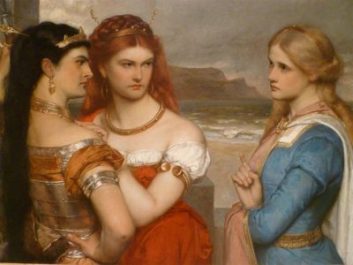
Soon after his two eldest daughters receive their inheritance, their kingdoms, they both cast King Lear out into the stormy night. King Lear’s Fool goes with him.
“Fool: This stormy night will turn us all to fools and madmen.”
The method I used this time for King Lear was to first read the play using the Folger Shakespeare library version which has an explanation or elaboration accompanying nearly every line of the play. Once again I realized that I would require all of these notes to fully understand the various facets of the play. Then, after I had thoroughly read the play with all of the notes, I was able to listen to the entire play on audio and enjoy it.
 Soon into my effort, I realized that the first time around I had almost totally missed the subplot involving the bastard son Edmund of Gloucester who is one of the main villains in the play along with Goneril and Regan. Thus I paid special attention to the Edmund story this time around. Somehow it almost seems that Shakespeare blames Gloucester’s fooling around and having an illegitimate son for Edmund’s misbehavior. Apparently Edmund is quite good looking, since both Goneril and Regan want to take Edmund as their lover, much to the displeasure of their husbands.
As in all of Shakespeare’s tragedies, good does not triumph in the end as both King Lear and his good daughter Cordelia wind up dead.
After closely studying both ‘Hamlet’ and ‘King Lear’, which do I prefer? Of the two plays, I prefer ‘Hamlet’. ‘Hamlet’ has the two characters, Polonius and Hamlet himself, who are capable of deep thought and thus have more insight into the terrible things that are happening around them. In ‘King Lear’ whatever wisdom there is comes from either fools or madmen. Granted that, although mixed in with both the Fool’s clever banter and the madmen’s ravings, there are deep truths; it is sometimes difficult to tell which is which.
I suppose ‘King Lear’ could be read as a cautionary tale. Don’t divide up your fortune between your heirs while you are still around.




 Tony's Book World
Recent Comments