Posts Tagged ‘Thomas Bernhard’

‘Old Masters’ by Thomas Bernhard – A Long, Long Rant


‘Old Masters’ by Thomas Bernhard   (1985) – 156 pages            Translated from the German by Ewald Osers
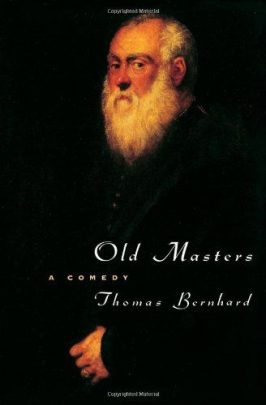
 

The Austrian fiction author Thomas Bernhard wrote several fictions that have captivated me. ‘Old Masters’ is NOT one of them.

‘Old Masters’ is a sustained rant. We get the outrageous opinions of a bitter eighty-two year old man named Reger who sits in the Bordone Room of the Austrian Kunsthistorisches Museum next to the Tintoretto painting of the White-Bearded Man. Reger’s rants are reported by his friend Atzbacher. Here are a few examples of Reger rant statements:

Velasquez, Rembrandt, Giorgione, Bach, Handel, Mozart, Goethe, he said, just as Pascal, Voltaire, all of them such inflated monstrosities.”

Why do painters paint at all, when there is such a thing as nature? Even the most extraordinary work of art is only a pitiful, totally senseless, and pointless effort to imitate nature, indeed to ape it.”

There are only falsehoods and lies in the books which the so-called great writers have left us, only falsehoods and lies in the paintings which hang on the walls.”

A chaotic rubbish heap, that is what today’s Austria is, this ridiculous pygmy state which drips with self-overestimation and which forty years after the so-called Second World War, has reached its absolute low only as a totally amputated state; this ridiculous pygmy state, where thought has died out and where for half a century now only base state-political dull-wittedness and state-adoring stupidity have reigned, Reger said.”

There have also been long rants by Bernhard characters in some of his other novels which I have admired. Why did I not appreciate the rants in “Old Masters”? I believe it is because I could recognize the thought and wisdom that went into those other rants, and the rants made me question my own views of history and art. However the rants in “Old Masters” are so over-the-top, there is no way that a reader can make any justifications for them. The rants go on for over a hundred pages, It doesn’t help that the novel consists of only one paragraph of densely-packed prose.

As it turns out, there are no intellectual justifications for any of these rants; these are just the ravings of an opinionated bitter old Reger whose wife died, falling on the slippery sidewalk outside the museum. The ambulance arrived way late to pick her up, and the hospital botched his wife’s care, so she died. Reger is left alone, and no art or music or prose, not even the finest, can relieve his loneliness. So he rants.

As for me, I resented being subjected to over a hundred pages of senseless ranting before finding out the reasons for it. By reducing the ranting by a hundred pages or so, “Old Masters” could have made a nice short story.

Thomas Bernhard bills “Old Masters” a comedy, I suppose, because the ranting is so-over-the top.

I would recommend that readers, especially readers new to Bernhard’s work, avoid “Old Masters” and instead read ‘Wittgenstein’s Nephew’, ‘The Loser’, ‘Woodcutters’, or ‘Extinction’.


Grade:    C+
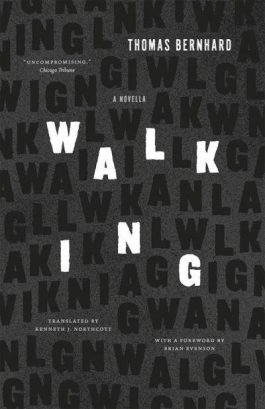


‘Walking’ by Thomas Bernhard – Walking and Talking and Thinking


‘Walking’ by Thomas Bernhard (1971) – 86 pages              Translated from the German by Kenneth J. Northcott

Yes, ‘Walking’ is a novel about walking. Our narrator used to go out walking with his friend Karrer on Mondays and walking with his friend Oehler on Wednesdays. However now that Karrer went mad and is confined in the Steinhof asylum, our narrator goes out walking with Oehler on both Mondays and Wednesdays.

Oehler is the ultimate depressive and a depressing companion.

The whole process of life is a process of deterioration in which everything – and this is the most cruel law – continually gets worse, says Oehler.”

Not only is Oehler forever gloomy, but also he has some quite obnoxious opinions and attitudes.

Anyone who makes a child, says Oehler, deserves to be punished with the most extreme possible punishment and not to be subsidized.”

The centerpiece of ‘Walking’ is when Oehler relates the incident where Oehler and Karrer are out walking together and go to the Rustenschacher’s store. Karrer has his ”terrible collapse” at the store.

While in the store, Karrer complains about the shoddy merchandise calling some pairs of trousers on display “Czechoslovakian rejects”. Of course the sales clerk who happens to be the store owner’s nephew defends their merchandise, and they get into a loud argument.

This scene at the store is so outrageous it is almost comic as Oehler relates it, if it wasn’t for the fact that this is when Karrer gets carted off to the psychiatric ward. This is a frequent technique of Bernhard’s, to make a scene so outrageous and gruesome, it becomes almost comic to picture these people doing these things.

So now our narrator is stuck walking with the depressing Oehler twice a week who keeps saying these grim things.

All people fill their heads without thinking and without concern for others and they empty them where they like, says Oehler. It is this idea that I find the cruelest of all ideas.”

Not much else happens in this novella.

I have read a lot of Bernhard, and I find in much of his work, gloomy as it may be, that there is ultimately a sense of redemption. In fact he has over time become one of my favorite authors. Novels of his that I especially like are ‘Extinction’, ‘Woodcutters’, ‘The Loser’, and ‘Wittgenstein’s Nephew’.

However I did not get much of this sense of redemption in ‘Walking’ which is an early work of Bernhard.


Grade:    B


The Art of the Angry Rant – The Fiction of Thomas Bernhard


Another in my continuing series about my favorite writers


All my life I have been a trouble-maker, I am not the sort of person who leaves others in peace.” – Thomas Bernhard

It took me awhile to fall in love with the fiction of the Austrian writer Thomas Bernhard. Early on, I read ‘The Lime Works’ and ‘Concrete’ and I couldn’t figure out what was so special about his odd work. I must go back and read those two early novels.

However, now I can strongly recommend Bernhard’s novels ‘Extinction’, ‘The Loser’ (one of the characters is the pianist Glenn Gould), ‘Woodcutters’, and the short novella ‘Wittgenstein’s Nephew’. I also notice that the novella ‘Walking’ gets very strong reviews, but I haven’t read it yet.

Thomas Bernhard was born in 1931 to an unwed housemaid mother, apparently the result of a rape. His father, a carpenter and petty criminal from Germany, never acknowledged him as his son.

When Thomas was eight, a social worker arranged for him to be sent to a home for “maladjusted children”. Considering that at that time all Austrian young people were required to join a branch of the Hitler Youth which Bernhard hated, who really were the maladjusted ones? In a later play, Bernhard represented Austria’s Nazi legacy as a pile of manure on the stage.

While establishing a worldwide reputation as one its finest writers, Bernhard was always a figure of controversy in his home country of Austria. One of his plays included the line “There are more Nazis in Vienna now / than in thirty-eight.” referring to Austria’s Nazi past. Austrian leaders on the right called for his expulsion from the country.

After a strong literary career in which he wrote eleven novels and more than twenty plays, Thomas Bernhard died in 1989 in an assisted suicide at the age of 58. He had been having severe problems with his lungs.

His will was controversial in not allowing publication of his works or staging of his plays within Austria’s borders.

What makes the work of Thomas Bernhard special?

One of Bernhard’s main writing techniques is the monologue or, more precisely, the rant. He gives his characters free reign to say exactly how they feel and think about things, and it is often harsh and astringent.

Recently I read Bernhard’s early work, ‘Gargoyles’ which is about a doctor who sees the sometimes ugly truth in his patients’ lives. He sees people get sick and die close up, and sometimes it’s their own fault. He sees people’s families during these rough times in their lives and sees the breaking points within the family. In his village many of the men are cruel and spend all day drinking in the bar and then come home to beat their wives and children. These men are frequently anti-Semitic. There are two doctors in his town and the only Jew in town, Bloch, has “relieved the other doctor of the lasting shame of having to treat a Jew by consulting my father”. Now Bloch is one of the very few men in town in whom the doctor can confide.

I was quite impressed with the first half of ‘Gargoyles’, but later when the doctor visits The Prince the novel turns into a long incoherent deranged rant. I downgraded the novel a bit for that reason. However later in his career Bernhard perfected this monologue or rant technique, and in such novels as ‘Wittgenstein’s Nephew’ and ‘The Loser’, the included rants held my interest throughout.

Sometimes these rants get so over-the-top in their anger that they become humorous. The comic element in Bernhard’s work is frequently overlooked.

Thomas Bernhard told it like it was for him and it wasn’t all peaches and cream, and what more can we expect from any writer? He is one of the great ones.


‘Gargoyles’ by Thomas Bernhard – A Doctor’s Rigorous Unsentimental View of His Patients and His Neighbors


‘Gargoyles’ by Thomas Bernhard (1967) – 208 pages             Translated from the German by Richard and Clara Winston

‘Gargoyles’ is a rigorous accounting of people’s lives rather than a sentimental accounting.

Our narrator in ‘Gargoyles’ is a young man who accompanies his doctor father on his rounds. The doctor sees the sometimes ugly truth in his patients’ lives. He sees people get sick and die close up, and sometimes it’s their own fault. He sees people’s families during these rough times in their lives and sees the breaking points within the family. In his village many of the men are cruel and spend all day drinking in the bar and then come home to beat their wives and children. These men are frequently anti-Semitic. There are two doctors in his town and the only Jew in town, Bloch, has “relieved the other doctor of the lasting shame of having to treat a Jew by consulting my father”. Now Bloch is one of the very few men in town in whom the doctor can confide.

‘Gargoyles’ begins with a senseless barroom murder of one of our doctor’s patients.

All these long drinking bouts end badly,” my father said. “And in this region a high percentage of them end in a fatality. The innkeepers’ own wives are often the victims.”

This doctor is familiar with the underside of townspeople’s lives, not the false fronts people put forward but the reality. There is the daughter-in-law who has only scorn for her mother-in-law and barely speaks to her.

Her daughter-in-law had always hated her. It had started as spontaneous dislike at their first meeting and had grown ever stronger over the years. “My son doesn’t dare to love me any more because of the way his wife hates me.” And by now, Frau Ebenhöh said, she was “crushed” by the more and more revolting stories her daughter-in-law concocted about her.

Another patient is a father who is depressed about his son’s slowness in school. The doctor is even willing to confront the difficulties in his own family. The doctor’s wife died five years ago when his son was 16 and his daughter 13, and he has now noticed that his daughter has become increasingly sullen and uncommunicative.

Among cheerful people who take life easily she was wretched. Pleasant surroundings irritated her. A bright day plunged her into still deeper melancholia.”

The doctor tries to instill in his own son this rigorous sense of reality.

I found the doctor’s words to his son to be brilliant, some of the deepest and most meaningful passages in all of literature. That is the first third of the novel.

However then the doctor and his son visit another patient, the Prince Saurau of Hochgobernitz in his castle. The Prince goes into a long deranged rant which is sustained over many pages. This rant is difficult to follow perhaps because it is so deranged. The actual German name for this novel was not ‘Gargoyles’ but instead was ‘The Derangement’ which is a much more meaningful name.

Over half of this novel ‘Gargoyles’ is taken up with this insane rant by the Prince Saurau. I must say this diatribe is for the most part incoherent and nearly impossible to follow. Because of this long, long incomprehensible rant I would not recommend ‘Gargoyles’ to readers who are new to Thomas Bernhard. Bernhard is one of my very favorite writers, but the last one hundred pages of ‘Gargoyles’ are extremely difficult to follow. ‘Gargoyles’ is one of Bernhard’s early novels, and in my view he had not yet perfected his techniques for getting deeply inside people and society.

I can strongly recommend at least four Thomas Bernhard novels which unlike ‘Gargoyles’ are complete successes. Those novels are ‘Extinction’, ‘The Loser’, ‘Woodcutters’, and the short novel ‘Wittgenstein’s Nephew’. Thomas Bernhard is one of the most original distinctive novelists of the twentieth century, and I would strongly recommend you read his works, but save ‘Gargoyles’ for later after you have developed some familiarity with his method.

In ‘Gargoyles’ Thomas Bernhard has succeeded all too well in capturing this rant of a deranged man. Most of the rant is incomprehensible to a reader, and I don’t think it is only to just this one reader.  But be sure to read one of the other Bernhard novels that I recommend above.


Grade:    B