‘The Tango Singer’ by Tomas Eloy Martinez (2004) – 243 pages Grade: B
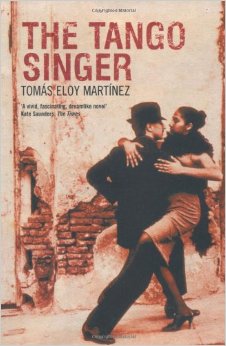
The biography of Argentine writer Tomas Eloy Martinez is instructive and will help us to better understand his novel ‘The Tango Singer’. In the 1960s and early 1970s, Martinez was a prominent Argentine journalist, film critic, and editor. However in early 1976 a military junta led by General Jorge Rafael Videla took power in a coup d’état. The junta was a brutal military dictatorship which plotted to eliminate all leftists from Argentina. The Secretary of the United States at the time, Henry Kissinger, gave his tacit approval to the junta’s plan to eradicate leftists that was part of a larger plan, Operation Condor, which had already replaced the democratic government of Chile with a military dictatorship.
Estimates are from 13,000 to 30,000 as to the number of political dissidents who vanished from Argentina at that time. The junta perpetrated widespread torture, forced disappearances, and murder as part of Operation Condor. One common procedure they used was to take leftists up in a plane over the ocean and then throw the persons out of the plane never to be seen again.
Tomas Eloy Martinez was already in trouble with the government due to his reporting, and beginning in 1975 he moved in exile to Venezuela. Later he moved to the United States in 1984 where he wrote novels and was a distinguished professor at Rutgers University. He died in Buenos Aires in 2010.
 ‘The Tango Singer’ is a paean to that city of Buenos Aires. People who are exiled from their native land where they were born and raised frequently have a great fondness for the place to which they cannot return. Fortunately the military junta fell apart and lost its power in 1983 after Argentina lost the Falkland War. Martinez could have returned there after that but opportunity in the United States beckoned.
The plot of ‘The Tango Singer’ is about a transplanted Argentine now living in New York, Bruno Cadogan, returning to Buenos Aires to search for famous tango singer, Julio Martel, who has never been recorded, but who has achieved far-flung local fame. Martel sings the old tangos which originated in the brothels and bars of Buenos Aires early in the 1900s before the tango form was tamed and popularized. He sings in places throughout the city, but never discloses where he will perform beforehand. He is physically weak and has health problems, and his girlfriend Alcira Vilar takes care of him. Much of the novel is taken up with Bruno’s search for Martel.
We travel to many spots in Buenos Aires, and Bruno tells us a lot of local color stories along the way. We get much of the history of the city. The tone is somewhat elegiac although there is also a fair amount of humor. I found ‘The Tango Singer’ somewhat episodic and anecdotal with no urgent plot to hold the reader’s interest. Although the charm level here is high, I found the novel somewhat scattered with no real momentum. There are many references to alephs and labyrinths which are in stories written by Jorge Borges and are quite obscure to those who have not read Borges. Previously I read Martinez’ novel ‘Santa Evita’, and I found that novel more compelling. I believe that ‘Santa Evita’ will be considered his masterpiece.
At the national Argentinian military college there is a hall which contains portraits of all the former leaders of Argentina. In 2004, a judge ordered that General Videla’s portrait be removed from the hall.
 Tony's Book World
Recent Comments