‘Aeneid Book VI’ by Virgil (Somewhere between 29 BC and 19 BC) 94 pages Translated by Seamus Heaney

‘Aeneid – Book VI’, this translation of the Roman poet Virgil, is the last work of the late Irish poet Seamus Heaney who died in 2013.
Most of the mythology that I have read before have been translations of the Greek, so this Roman work by Virgil was new to me. I was amazed though how closely it followed the Greek stories. Aeneas and his surviving band of Trojans who suffered their terrible defeat from the Spartans at the battle of Troy have landed their boat on the Italian coast.
Aeneas discovers that his father Anchises has died. Aeneas asks the Sibyl if he can cross the river Styx to talk to his father one last time. The Sibyl tells him that it is easy to descend into the Underworld land of the dead, “but to retrace your steps and get back to upper air, that is the task, that is the undertaking. Only a few have prevailed.”
Aeneas must descend to death’s deepest reaches to see and talk to his father. The ferryman Charon navigates his barge through the waters of the river Styx to take him there. Along the way we are given a guided tour of Hades. First we meet those who have not yet been buried – the shades – who are not allowed on Charon’s barge.
“Not until bones have found a last resting place will shades be let across these gurgling currents, their doom instead to wander and haunt about the banks for a hundred years.”
Later Aeneas does meet his father who gives him plenty of pompous advice.
“So now I will instruct you in what is to be,
The future glory of the Trojan race,
Descendants due to be born in Italia,
Souls who will in time make our name illustrious –
I speak of them to reveal your destiny to you.”
So, according to Virgil, the glory of Rome was due to the descendants of this scraggly band of survivors led by Aeneas who escaped the far-off battle of Troy. This is preposterous, but aren’t myths usually preposterous?
Those of you who have read Seamus Heaney’s translations of ‘Beowulf’ and ‘The Burial at Thebes’ know how sensitive and intelligent a translator he was. Of course this Book VI of the Aeneid is mainly concerned with a trip through Hell visiting the dead and learning about posterity. Thus this is a melancholy austere work. It is somber and not particularly fun, but if you are the type who enjoys reading the ancient myths in close to their original form, you will want to read this stately poetic book.
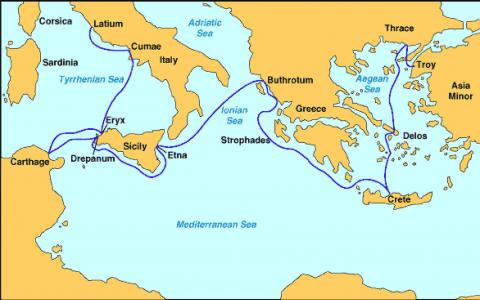
Journey of Aeneas
Grade: A-
 Tony's Book World
Recent Comments