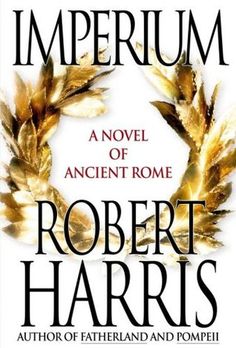
‘Conspirata’ by Robert Harris (2010) – 334 pages
 At the beginning of ‘Conspirata’, Cicero has been elected as consul, the highest office in the Roman republic. He shares the office with Gaius Antonius Hybrida who plays a minor role.
Being the most powerful man in the Roman republic, Cicero has powerful enemies. Soon he finds out that Catilina, a Roman Senator, is attempting to overthrow the Roman republic and is leading a conspiracy to murder Cicero. Five traitors are captured and sentenced to death. Although Julius Caesar is involved in the conspiracy behind the scenes, he survives.
“They may not all plot together but they all see an opportunity in chaos. Some are willing to kill to bring chaos about, and others just desire to stand back and watch chaos take hold. They are like boys with fire, and Caesar is the worst of the lot. It’s a kind of madness – there’s madness in the state.”
After breaking up this conspiracy to destroy the republic, Cicero is hailed as “the savior of Rome” and “the father of his country”.
The trouble is that all this praise went to Cicero’s head. When his consulship ended, he took up writing heroic poems about himself. He bought an expensive mansion from the wealthy Crassus that he can’t afford, but arranges to get some of the money by defending one of the traitors. The rest he borrows from moneylenders. Pride goes before a fall, as Cicero’s faithful assistant Tiro points out:
“But I fear there is in all men who achieve their life’s ambition only a narrow line between dignity and vanity, confidence and delusion. Instead of staying in his seat and disavowing such praise, Cicero rose and made a long speech agreeing with Crassus’s every word, while beside him Pompey gently cooked in a stew of jealousy and resentment.”
Yes, the two most powerful military leaders in Rome, Pompey and Julius Caesar, are also receiving an acclaim which threatens the republic. Whereas Cicero is willing to control his drive in order to save the republic, the ambitions of Pompey and Julius Caesar have no limits. In order to achieve their goals, they make Cicero’s enemy Clodius, “a man of great ambition and boundless stupidity, two qualities which in politics often go together”, a tribune.
Robert Harris has written this trilogy of Cicero as an object lesson on the threats to a republic’s checks and balances which keep any one person, whether it is king or emperor or dictator, from getting too much power. Cicero fought for the rule of law and statute against some powerful enemies. Danger comes from all sides. The rich aristocrats can use their money to buy a government which unfairly gives them even more power. On the other side, unscrupulous politicians can enflame the mob by using racism and patriotism.
 It is a huge accomplishment for a nation to keep a rational set of legal checks and balances protecting the rights of the less rich or powerful or fortunate and not succumb to dictatorship.
Grade: A-

 Tony's Book World
Recent Comments