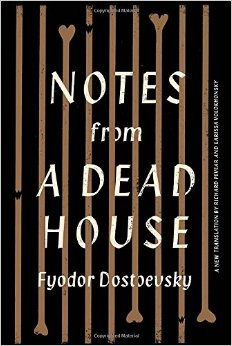
‘Notes from a Dead House’ by Fyodor Dostoevsky (1861) – 304 pages Translated by Richard Pevear and Larissa Volokhonsky Grade: B+
.
I’ve read enough translated classic Russian literature so that it is an occasion for me when a new translation by Richard Pevear and Larissa Volokhonsky is released. Pevear and Volokhonsky are the two stars of Russian classics translators today just as at one time Constance Garnett, Aylmer and Louise Maude, and David Magarshack were the big names.
This novel is perhaps better known by the title ‘House of the Dead’. It is the lightly fictionalized account of Dostoevsky’s time in Siberia.
Dostoevsky was sent to the prison camp in Siberia not for committing any crimes but for political reasons during the reign of Nicholas I. He was thrown in prison with a rough crowd of murderers, armed robbers, rapists, and assorted brutal thugs. But the worst thing for the sensitive Dostoevsky was that all these guys hated him, because he was a highly educated nobleman.
Personality-wise Dostoevsky was probably somewhat like me. He was clumsy at the labor, and the rest of the prisoners scorned him for that.
“It also seemed to me that he had decided without racking his brains too long, that it was impossible to talk with me as with other people, that apart from talking about books, I would not understand anything and even could not understand anything, so there was no use bothering me.”
Yes, Dostoevsky and I do have a lot in common. But also like me, Dostoevsky was the type of guy who when life gave him a lemon, he made lemonade.
Dostoevsky describes the other men in his hard labor prison in Siberia with the same simple-hearted youthful joy that I could use to describe the young guys in my freshman dormitory at college. I prided myself on knowing the names of all 78 men in my freshman dorm, and Dostoevsky got to know all his fellow prisoners no matter how much they disliked him. Some of the men at the prison had committed from one up to six murders, but that doesn’t prevent Dostoevsky from enthusiastically describing these fellows. Just as in the dorm, there were rumors that salt peter has been added to the prison food in order to curb the male libido.
“There are bad people everywhere, and among the bad some good ones.”
‘Notes from a Dead House’ is a fictional memoir of the time spent, so it is necessarily episodic with vignettes from the daily prison life. There are chapters on celebrating Christmas, a stay in the prison hospital, the prisoners’ pets, and even a theatrical performance put on by the prisoners. Some of the patients in the hospital are prisoners who were forced to run the gauntlet as part of their punishment during which they were nearly beaten to death.
For someone new to Dostoevsky, I would recommend they read first one of his intense powerful novels such as ‘Crime and Punishment’ or ‘The Brothers Karamazov’.
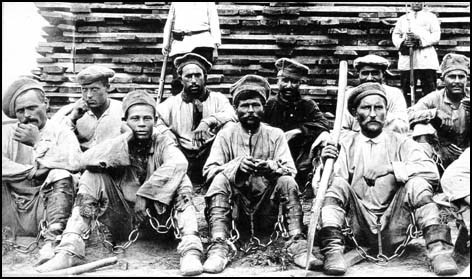 Dostoevsky was released from prison in 1854, and Nicholas I died in 1855. The liberal reformer Alexander II (Alexander the Liberator) became Czar, and Dostoevsky was then allowed to publish all his great novels including this one.
Somehow I believe that Dostoevsky and his fellow socialists would have been terribly disappointed in Lenin and Stalin when they sent millions of fellow Russians to Siberia as political prisoners.
 Tony's Book World
Recent Comments