‘A Thousand Ships’ by Natalie Haynes (2021) – 345 pages
 This tale of Troy and Greece and the Trojan War is a delight. Or I should say this collection of tales is a delight.
Natalie Haynes is so familiar with these stories surrounding the Trojan War, she makes them her own and the characters come alive. She has a light touch with these tales, these ancient myths.
Haynes avoids the stiffness in the telling that so many accounts of the siege of Troy have. Here these ancient Greek stories are humanized in simple down-to-earth language with some humorous and ironic twists. And Haynes gives a fair account of both the men and the women on both sides, both the Greeks and the Trojans.
I was quite familiar with some of the myths here, but some of the myths were new to me. At the end of each scene, Haynes provides a little meaningful twist that gives the scene its significance.
Here we have the entire Trojan war from the Judgment of Paris which caused the war in the first place until the day many, many years later when Odysseus finally returns home to Penelope and murders all 108 of her suitors. The main sources are the two epic poems by Homer, the ‘Iliad’ and the ‘Odyssey’, along with some of the early Greek plays.
“Who could love a coward, she had once heard a woman say. Laodamia knew the answer. Someone for whom the alternative is loving a corpse.”
Laodamia is speaking of her brave dead husband Protestilaus, the first Greek soldier to be killed in the war. The Greek King Agamemnon had already sacrificed his daughter Iphigenia on the day she was to marry Achilles in order to get a stiff wind for the Greek ships so they could leave Aulis for Troy.
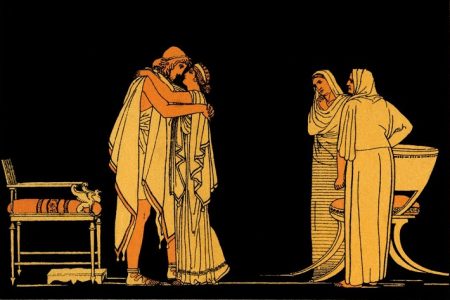
Odysseus and Penelope
Later, after the Greeks have defeated Troy with their Trojan horse subterfuge, we have the long trek of Odysseus back home to Greece and his long-suffering wife Penelope. Time for some humor.
“Because really how many cannibalistic giants can one Greek plausibly meet as he sails the open seas? “
Penelope gets impatient waiting and waiting for Odysseus to return.
“The bards all sing of the bravery of heroes and the greatness of your deeds: it is one of the few elements of your story on which they all agree. But no one sings of the courage required by those of us who were left behind.”
Throughout ‘A Thousand Ships’ presents the women’s views of events as well as those of the men.
“When a war was ended, the men lost their lives. But the women lost everything else. And victory made the Greeks no kinder.”
Grade: A
 Tony's Book World
Recent Comments