Posts Tagged ‘Margaret Atwood’

‘Stone Mattress’ by Margaret Atwood – Nine Wicked Tales


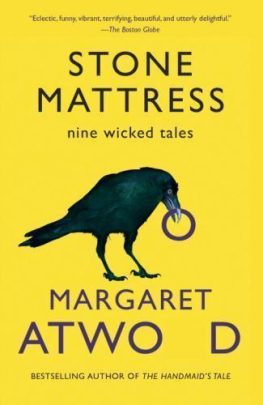
‘Stone Mattress’ by Margaret Atwood   (2014) – 268 pages
 

What is the difference between a tale and a story? According to Margaret Atwood, a woman whose penetrating wisdom I treasure from many of her quotes, it is the following:

Calling a piece of short fiction a “tale” removes it at least slightly from the realm of mundane works and days, as it evokes the world of the folk tale, the wonder tale, and the long ago teller of tales. We may safely assume all tales are fiction, whereas a “story” might be a true story about what we usually agree to call “real life”, as well as a short story that keeps within the bounds of social realism.”

Margaret Atwood calls the fictions in ‘Stone Mattress’ tales rather than stories for a good reason. Tales are wilder than stories and are not limited by what actually could happen to real people.

Alice Munro, another famous Canadian fiction writer, is a wonderful writer of stories that do not veer far or at all from real life as we know it. On the other hand, Margaret Atwood excels at going beyond the everyday world as we have seen from ‘The Handmaid’s Tale’ and other of her works.

These tales in ‘Stone Mattress’ are wild and strange, living up to Atwood’s definition of a tale. In the title story, an old woman on a guided tour spots a man who mistreated her cruelly back in high school. He doesn’t recognize her, and she decides to get her revenge using a billions-year old rock.

In the tale ‘The Freeze Dried Groom’ Atwood writes about a slimeball husband. Instead of being angry about this scuzzbag, Atwood writes a humorous story from his point of view but with him getting his comeuppance in the end.

In the tale, “The Dead Hand Loves You”, the narrator Jack says to his old girlfriend Irena:

I wouldn’t have forgotten you. I can never forget you.” Is this bullshit, or does he really mean it? He’s been in the bullshit world for so long it’s hard to distinguish.

I couldn’t imagine Alice Munro writing a sentence like the following about Jack:

Their view of him was that he was a fuck-up and a jinx from whom stray dogs fled because they could smell failure on him like catshit.”

Both the tales and language of Margaret Atwood are wilder and looser than those of Alice Munro. I really liked the imaginative flourishes and un-restraint of all these tales in ‘Stone Mattress’.

Sometimes it’s good for the imagination to go beyond realism.


Grade:   A


Playful and Astute Words about Life and Literature from Margaret Atwood


I just happened to stumble onto all these fascinating quotes from Margaret Atwood. It’s been awhile since I have found such meaningful yet often humorous words, and I want to share them with you. If the quote is from one of her books, I indicate the source.


About Life in General

“If you’re not annoying somebody, you’re not alive.”

“How could I be sleeping with this particular man…. Surely only true love could justify my lack of taste.”

“I’m not sure which is worse: intense feeling, or the absence of it.”

“Stupidity is the same as evil if you judge by the results.” – ‘Surfacing’

“And yet it disturbs me to learn I have hurt someone unintentionally. I want all my hurts to be intentional.” – ‘Cat’s Eye’

“There’s more than one way to skin a cat, my father used to say; it bothered me, I didn’t see why they would want to skin a cat even one way.” – ‘Surfacing’

“The facts of this world seen clearly are seen through tears.”

“If we were all on trial for our thoughts, we would all be hanged.” – ‘Alias Grace: A Novel’

“Oppression involves a failure of the imagination: the failure to imagine the full humanity of other human beings.” – ‘Second Words: Selected Critical Prose’

“I’ve never understood why people consider youth a time of freedom and joy. It’s probably because they have forgotten their own.” – ‘Dancing Girls’

“Men and women are not “equal” if “equal” means “exactly the same.” Our many puzzlements and indeed unhappinesses come from trying to figure out what the differences really mean, or should mean, or should not mean.”

“You can think clearly only with your clothes on.” – ‘The Handmaid’s Tale’

“Forgiving men is so much easier than forgiving women.” – ‘Cat’s Eye’

“If he wants to be an asshole, it’s a free country. Millions before him have made the same life choice.”

“I hope that people will finally come to realize that there is only one ‘race’ – the human race – and that we are all members of it.”

“The desire to be loved is the last illusion. Give it up and you will be free.” – ‘Selected Poems II (1976-1986)’

“Men are afraid that women will laugh at them. Women are afraid that men will kill them.”

“The fabric of democracy is always fragile everywhere because it depends on the will of citizens to protect it, and when they become scared, when it becomes dangerous for them to defend it, it can go very quickly.”

“Better never means better for everyone… It always means worse, for some.” – ‘A Handmaid’s Tale’

“Don’t let the bastards grind you down.” – ‘A Handmaid’s Tale’

About Literature

“A word after a word after a word is power.” – ‘Spelling’, a poem

“In the end, we’ll all become stories.” – ‘Moral Disorder’

“Show me a character totally without anxieties and I will show you a boring book.” – ‘Margaret Atwood: Conversations’

“Poetry is where the language is renewed.”

“It’s a feature of our age that if you write a work of fiction, everyone assumes that the people and events in it are disguised biography — but if you write your biography, it’s equally assumed you’re lying your head off.”

“I read for pleasure and that is the moment I learn the most.”

“Everyone thinks writers must know more about the inside of the human head, but that’s wrong. They know less, that’s why they write. Trying to find out what everyone else takes for granted.”

“Once you publish a book, it is out of your control. You cannot dictate how people read it.”

“More of your brain is involved when reading than it is when you watch television… because you are supplying just about everything… you’re a creator.”

“You need a certain amount of nerve to be a writer.” – ‘Writing with Intent: Essays, Reviews, Personal Prose: 1983-2005’,


There are hundreds more, but it’s time to move on.