Posts Tagged ‘Juan Gabriel Vasquez’

‘Five Tuesdays in Winter’ by Lily King vs. ‘Songs for the Flames’ by Juan Gabriel Vásquez – Round 2, The Final Round


‘Five Tuesdays in Winter’ by Lily King  (2021) – 231 pages

‘Songs for the Flames’ by Juan Gabriel Vásquez  (2018) – 237 pages    Translated from the Spanish by Anne McLean

Both of these story collections follow the usual pattern with the best stories first, and the stories gradually getting less involving except for the last story which is usually one of the better stories to leave a good impression on the way out.

I have read Lily King’s last two novels, ‘Euphoria’ and ‘Writers and Lovers’, and have much enjoyed her spirited and original emotional insights into her characters’ personal lives. By the same token, I have read two of the previous novels of Juan Gabriel Vásquez, ‘The Sound of Things Falling’ and ‘Reputations’, and have been much impressed with his profound insights into the situation of Colombia. The United States, with its unofficial war on Communism and its unofficial War on Drugs, has been heavily involved in the waves of violence that have shattered Colombia. The result has been more like War on Colombia.

Meanwhile, the stories of Lily King are compelling slices of emotional family life that resonated with my own experiences. One story that in particular held me was ‘When in the Dordogne’. A mother and father are in Europe recovering from the father’s suicide attempt while they leave two young male college students to look after their fourteen year old boy. Contrary to all expectations, the college students and the boy have a fine old time.

The stories in ‘Five Tuesdays in Winter’ are intimate and exhilarating; the stores in ‘Songs for the Flames’ are wide-ranging and devastating in their violence. The two collections could not be more different except for the mastery of each of their territories.

Lily King wins, since her enthusiasm for her stories shines through in her sentences. Of course Juan Gabriel Vásquez was operating at a disadvantage because I had to read his collection in translation.


‘Five Tuesdays in Winter’ by Lily King                      Grade: A

‘Songs for the Flames’ by Juan Gabriel Vásquez   Grade: A-


‘Five Tuesdays in Winter’ by Lily King vs. ‘Songs for the Flames’ by Juan Gabriel Vásquez – Round 1


‘Five Tuesdays in Winter’ by Lily King (2021) – 231 pages

‘Songs for the Flames’ by Juan Gabriel Vásquez (2018) – 237 pages      Translated from the Spanish by Anne McLean
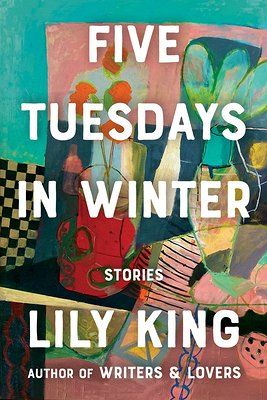
When I have two collections of short stories I want to read, both by authors whom I admire and whom I have read before, I like to bounce back and forth between the two. I alternate reading the individual stories by the two writers, because somehow that makes both sets of stories more interesting. That way I can compare and contrast. So now my victims are ‘Five Tuesdays in Winter’ by Lily King and ‘Songs for the Flames’ by Juan Gabriel Vásquez. The content and the style of these two collections have almost nothing in common, which makes the effort even more fun for me.

Most of Lily King’s vivacious stories in ‘Five Tuesdays in Winter’ take place in the home, mostly upper and upper-middle class homes. She even makes the distinction between mansions and houses; mansions are stone and houses are wood, a distinction I had not considered but surely rings true. King’s stories are domestic stories of social interactions between members of a family and their friends. Several of the stories are coming of age stories of young people growing up within the family. Lily King has a light touch which I much appreciated. I loved the title story which was all about “the most reticent man in the world”. I found King’s stories to be lively and buoyant.

The stories of Juan Gabriel Vásquez have a much larger canvas. Vásquez is vitally aware of nearly every facet of public life in the nation of Colombia over the past fifty years and has studied the past of Colombia from its earliest days. His stories resonate with the history of Colombia. Colombia has been one of the most war-torn countries during the last fifty years with over 220,000 of its citizens killed, the large majority of them civilians. His stories are cosmopolitan; they often take place in airports or hotels in Bogota or Paris or other places. Nearly all the people who populate Vásquez’s stories are grown-ups dealing with grown up problems.

The stories in ‘Songs for the Flames’ are more substantial and thus require more effort for the reader to understand and appreciate them. The stories involve drug traffickers, paramilitary death squads, hit men, informants, intelligence agents, machine gun fire, the police, the army, persecution by the drug cartels, organized and unorganized crime, and detectives.

On a lighter note, I will leave you today with a line of French which appears untranslated in one of the family stories of Lily King:

une femme qui rit est une femme au lit”.

Let’s just say this line will be worth your while to translate.

Stay tuned for the next and final round of this contest when I will announce the winner.


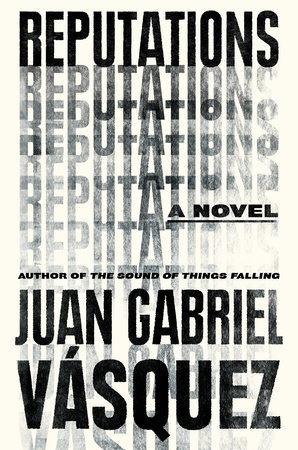
‘Reputations’ by Juan Gabriel Vasquez – A Political Cartoonist from Columbia


‘Reputations’ by Juan Gabriel Vasquez    (2013)  –   187 pages        Translated by Anne McLean

9781594633478

The previous novel by Juan Gabriel Vasquez, ‘The Sound of Things Falling’, was spectacularly good in my opinion, and it made my Top Ten list for 2014.  That was a moving novel about the violent Pablo Escobar years in Vasquez’s home country of Columbia.

‘Reputations’ does not quite measure up to that performance for me.  ‘Reputations’ is about a renowned political cartoonist, Mallarino, who becomes powerful through his newspaper drawings.  The story is told from the perspective of the cartoonist, and he just seems a little too self-satisfied with his life for me to entirely empathize with his situation.  The cartoonist job, the house in the mountains, the beautiful ex-girlfriend Magdalena, the understanding daughter, everything seems just a little too perfect for Mallarino for him to be believable.  If our hero had been a bit more conflicted, I could have accepted him.

At the same time the writing here is crystal clear and fun to read.  The plot premise is a good one.  Early in his career Mallarino drew a cartoon about an ambiguous situation involving a politician he didn’t like and an eight year-old girl which destroyed the politician’s career and caused the said politician’s early death.  Twenty-five years later, Mallarino is confronted with the girl who was involved, grown up now.  Mallarino must relive the circumstances of his drawing the cartoon which he had pretty much forgotten.

“Forgetfulness was the only democratic thing in Columbia:  it covered them all, the good and the bad, the murderers and the heroes, like the snow in the James Joyce story, falling upon all of them alike.  Right now there were people all over Columbia working hard to have certain things forgotten – small or big crimes, or embezzlements, or tortuous lies – and Mallarino could bet that all of them, without exception, would be successful in their endeavor.”      

If Vasquez had taken his plot to its logical conclusion and once and for all given us the absolute facts of the case, I believe the novel would have been stronger for it.  However Vasquez gives us an open-ended conclusion so we don’t know whether or not the cartoonist had made a terrible mistake early in his career or not.   Mallarino does not fully confront his demons.  I felt the author had let Mallarino off the hook just like he had let Mallarino off the hook by having his ex-long-term girlfriend still be his lover.  Neither Vasquez or his protagonist Mallarino never really confront any difficulties head-on, and the novel is weaker for it.


Grade:   B  


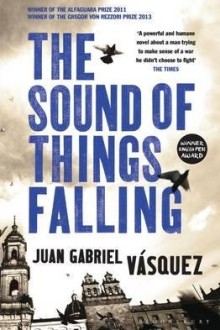
‘The Sound of Things Falling’ by Juan Gabriel Vásquez – The Novel That Beat ‘My Struggle’

The Sound of Things Falling’ by Juan Gabriel Vásquez  (2013) – 270 pages  Translated by Anne McLean

sound-of-things-falling-220x330

A literary award that I follow closely is the International IMPAC Dublin Literary Award.  This award is truly a world literary award, and they seem to get it right a lot of the time.  Of their nineteen award winners since 1996, I’ve read eleven including ‘A Heart So White’ by Javier Marias, ‘Wide Open’ by Nicola Barker, ‘The City of Bohane’ by Kevin Barry, and ‘The Known World’ by Edward P. Jones.   The judges so far have seemed to pick novels that will last, that people will be reading fifty years from now.

This year’s winner is ‘The Sound of Things Falling’ by Juan Gabriel Vásquez, the first South American to win the award.   Vásquez’s novel beat out seven other nominees including ‘My Struggle’ by Karl Ove Knausgaard.

Vásquez is from Colombia, home of Gabriel Garcia Marquez.   In ‘The Sound of Things Falling’ there is a playful mention of Cien años de soledad which translated is the title ‘One Hundred Years of Solitude’.  The girlfriend of a main character says of the novel, “The only thing I have here is a book the senor gave me as a going-away present, and I’ve tried to read it, I swear I’ve tried, but the Spanish is very difficult and everybody has the same name. It’s the most tedious thing I’ve read in a long time, and there’s even a typo on the cover.”  This is Vásquez having a little fun at the expense of the master.

Gabriel Garcia Marquez is known, of course,  as the great practitioner of magical realism.   Vásquez is no great fan of magical realism.

 “I want to forget this absurd rhetoric of Latin America as a magical or marvelous continent. In my novel there is a disproportionate reality, but that which is disproportionate in it is the violence and cruelty of our history and of our politics.” – Juan Gabriel Vásquez.

 ‘The Sound of Things Falling’ covers a violent time in Columbia’s recent history, the years when drug lord Pablo Escobar was controlling the world cocaine trade.  Yet this novel is in no way a drugged-out tale.  It is more about how many Columbians on the sidelines inevitably got caught up in the turbulence.

It begins with a hippopotamus which had escaped from Escobar’s old private zoo which had “during that time of freedom destroyed crops, invaded drinking troughs, terrified fisherman, and even attacked the breeding bulls at a cattle ranch.”  Marksmen shot the hippopotamus dead in 2009, thirteen year after Escobar’s reign ended.  This causes the narrator Antonio Yanmara to recall his own injurious brush with the Escobar years.

Through him we get the story of the life of Ricardo Leverde.  Ricardo as a young man meets the love of his life in American Peace Corps volunteer Elaine Fritts.  Ricardo flies private airplanes, and why not fly some stuff if they are willing to pay a lot of money?

The writing here is a wonder of superior storytelling that will leave you enthralled from beginning to end. As I mentioned before, don’t get the impression that this is a drug novel because that is far from the case. The story of Ricardo and Elaine captures the story in part of Columbia during the Escobar years and how even people not involved were severely affected. I strongly recommend this novel.