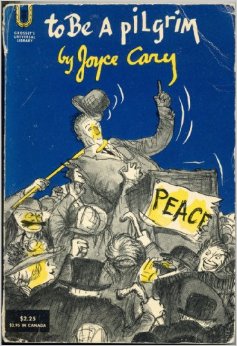
‘To Be a Pilgrim’ by Joyce Cary (1942) – 451 pages Grade: B-
 You know the routine.
I am supposed to say that I picked up this old novel that was written way back in the 1940s and that no one else has read in a coon’s age. Then I am supposed to say that I started reading this musty ancient tome, and, lo and behold, I was really quite amazed. The book was beyond wondrous, a real gem actually. You must drop anything else you were intending to do, useful or useless, and read this book.
Sadly the truth about ‘To Be a Pilgrim’ is much more complicated. It is a very odd novel.
‘To Be a Pilgrim’ is the second volume of Cary’s first trilogy. I read the first volume of the trilogy, ‘Herself Surprised’, a few years ago and quite enjoyed the lively high-spirited cleaning lady narrator of that story, Sara Munday. However the narrator of ‘To Be a Pilgrim’, Tom Wilcher, is distinctly unlikeable.
Tom’s description of himself is “that life-battered gnome”. Except for the time he spent with Sara Munday, Tom has never lived his own life. He spent his years as the lowly factotum and gofer to his brother Edward who was a big-time politician. One of Tom’s tasks was to keep track of Edward’s mistress Julie and keep her in line. Tom is now in his mid-sixties and has returned to his family home, but he fears his young relatives will put him in an asylum. He is waiting for Sara Munday to get out of jail for stealing items from his apartment. Although he is very devout in his religion and is given to making prim pronouncements about the younger generation, Tom himself is a dirty old man. He has already attracted the attention of the police for his antics with young women in public parks.
“Do you think it is a good thing for girls to paint their faces like the lowest strumpets and go around in short skirts or even short trousers and drink and swear like bargees?”
 One thing you won’t find in ‘To Be a Pilgrim’ is an exciting plot. Here we get flashbacks to many scenes from Tom’s tedious previous life over the years as well as his staid but troublesome current existence. The life story of a rather passive person makes for a listless read.
The time I spent reading this long novel seemed interminable. Nothing of the faintest interest seemed to happen, but still I kept reading. I suppose that speaks to a positive aspect of the work. Will I read the third novel in the trilogy, ‘The Horse’s Mouth’, which is supposed to be the best of the three? Perhaps.
But if you value your time at all, you probably should not read ‘To Be a Pilgrim’.
 Tony's Book World
Recent Comments