‘All the Names’ by Jose Saramago (1997) – 238 pages Translated from the Portuguese by Margaret Jull Costa
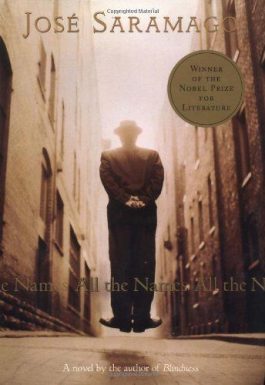
Jose Saramago was one of the few modern authors who could fully imagine complete meaningful allegories which he did time and time again. I have read a lot of the work of Saramago who I consider an absolute master of fiction, and ‘All the Names’ is another deeply intelligent work. However I found reading its long sentences and longer paragraphs rather slow going.
Of all of the works of Jose Saramago that I have read so far, ‘All the Names’ is the one that I have found to be the most difficult to read. For readers new to Saramago, my recommendation would be not to read ‘All the Names’ until you have read a few of Saramago’s other novels. ‘Blindness’ was a best seller; it has been a gateway into Saramago’s work for many people. I have found his two novels based on religious figures, ‘The Gospel According to Jesus Christ’ and ‘Cain’ to be quite accessible and enjoyable. Saramago’s amazing novel about fellow Portuguese writer Fernando Pessoa, ‘The Year of the Death of Ricardo Reis’, is another entertaining strong passage into his work.
However we are here today to discuss ‘All the Names’ which is probably the most metaphysical of all of Saramago’s work.
Our main character Senhor Jose, no last name, is a lowly clerk in the Central Registry of Births, Marriages, and Deaths. Above him are senior clerks, above the senior clerks are the deputies, above the deputies is the all powerful Registrar. Each level of management must keep their employees operating quietly and smoothly, thus not causing any problems for the next upper level of management. If you have ever worked in a business or government office, you know all about the bureaucratic decision-making process here.
In the Central Registry’s filing system. The records for the dead are kept separate from those for the living. That means that when any person in the living section of records dies, a clerk must retrieve their record from the living section and take it to the vast rarely-accessed dusty dead archive.
With all this trafficking between the living and the dead, you can easily see the allegorical possibilities here, and Saramago takes full advantage of them. ‘All the Names’ is profound as all of the work of Saramago is profound.
Our main character Senhor Jose becomes captivated with the search for an unknown woman when he comes upon her record in the living section. His quest for this woman begins quite humorously, but soon turns into a desperate obsession which interferes with his work life at the Central Registry. The Registrar sees certain actions that Senhor Jose takes as “mistakes committed against oneself, born of loneliness”.
‘All the Names’ is indeed profound.
“Senhor Jose both wants and doesn’t want, he both desires and fears what he desires, that is what his whole life has been like.”
As Senhor Jose descends ever deeper into his compulsive obsession to find this woman, the reader gets long interminable paragraphs, some several pages long, of conversations with himself or, more absurdly, with the ceiling of his room. This is where I started to have problems as these expressions of the inner turmoil of his mind went on and on with little relief for the reader. I found all these lengthy machinations of Senhor Jose’s mind rather tedious to read.
Grade: B


 Tony's Book World
Recent Comments