Posts Tagged ‘Ian McEwan’

‘Nutshell’ by Ian McEwan – To Be or Not to Be


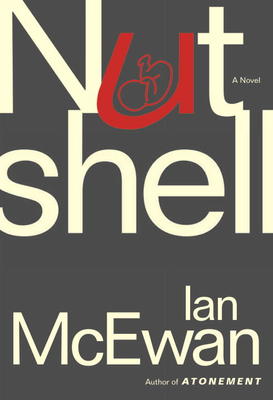
‘Nutshell’ by Ian McEwan    (2016) – 197 pages
m-php

‘Nutshell’ is an English low comedy about a nasty modern-day murder told by an eight-month fetus who is still inside his mother.

Two of the protagonists in this novel are Trudy and Claude.  Do these names ring a bell?  They might.  Remember Gertrude and Claudius in ‘Hamlet’?  Claudius is the King’s brother, Gertrude is the King’s wife, and Hamlet is the King’s son.  The same setup is here in the novel with Claude fooling around with Trudy behind the father’s back, except our Hamlet is still unborn, still in the womb.  Being inside he feels every aftershock from Claude and Trudy’s frequent sex escapades.  At one point our unborn Hamlet is so disgusted, he tries to strangle himself with the umbilical cord.  This is a scene which brings to mind McEwan’s early black humor phase.

So our Hamlet in ‘Nutshell’ is a troubled young fetus instead of a troubled young man. ‘Hamlet’ is high drama; ‘Nutshell’ is low comedy.

If you recall the play ‘Hamlet’, you probably remember that Hamlet does not have much respect or use for his uncle Claudius.  The same is true in ‘Nutshell’ with Claude being a particularly self-serving dolt who speaks in the lamest of clichés. Claude is the joke figure of the novella, especially when Claude and Trudy are plotting the murder.  However our unborn prince still loves his cheating mother.

The father here, named John Cairncross, is a poet instead of a King.

Our unborn first-person narrator speaks like a hyper-articulate English aristocratic twit since Trudy listens to self-improving podcasts.  This is all great comic fun for the reader with none of the sincerity that had crept into McEwan’s work of late.

Of course ‘Nutshell’ could not be a take on ‘Hamlet’ if the father’s ghost did not appear.  The ghost does show up.

The play ‘Hamlet’ does have that effect on writers.  The plot of the play is so vivid that writers like to do parodies of it which ‘Nutshell’ essentially is.  The American writer John Updike also did a parody of Hamlet called ‘Gertrude and Claudius’ which I consider Updike’s finest work.

‘Nutshell’ is great fun to read although it, being a pastiche, is not at all original or profound, unlike the original play ‘Hamlet’.  There is no one with the wisdom of Polonius here, and Hamlet himself being a fetus, his ideas are kind of unformed.


Grade:   B+
 

‘The Children Act’ by Ian McEwan – Another Day in Family Court

‘The Children Act’ by Ian McEwan   (2014) – 221 pages


      .

.

“I apologize for being so obvious, but every time I watch the curtain come down on even a halfway decent production of a Shakespeare play I feel a little sorrowful I will never know the man, or any man of such warm intelligence.” – Ian McEwan

 “You can spin stories out of the ways people understand and misunderstand each other.” – Ian McEwan

Fiona May in ‘The Children Act’ is a judge in the Family Division of the High Court in London.  Every workday she must decide complex emotional cases of divorce and custody of children, of terrible disagreements between two parents, and arguments about children’s medical treatment.  She has devoted her life to the law.  She is 59 years old, married, childless.

At the beginning of ‘The Children Act’, her husband Jack announces that since they haven’t made love for ‘seven weeks and a day’ he is leaving to embark on ‘one big passionate affair’ with a younger woman.  Fiona is most concerned that night about writing her decision for tomorrow morning’s custody case, but she does get the locks changed on their apartment so Jack can’t get back in the apartment without asking her.

“A professional life spent above the affray, advising, then judging, loftily commenting in private on the viciousness and absurdity of divorcing couples, and now she was down there with the rest, swimming with the desolate tide.”

There is one legal case that is the focal point of ‘The Children Act’.  A seventeen year old boy, Adam Henry, has leukemia, and his parents refuse to allow life-saving blood transfusions due to their religion as Jehovah’s Witnesses.    Adam himself goes along with his parents’ wishes even though this could result in his quick and early death.  Judge May must decide whether or not to override the boy and his parents’ refusal.   In order to make the right decision Fiona May decides she must visit the boy at the hospital.

“Adam’s unworldliness made him endearing, but vulnerable.  She was touched by his delicacy, by the way he stared fiercely at his sheet of paper, perhaps trying to hear in advance his poem through her ears.”

 I have been reading Ian McEwan since from the beginning of his fiction writing career.  I still have a special fondness for his early macabre disturbing novels and stories such as ‘The Cement Garden’ and ‘The Comfort of Strangers’, and have much enjoyed and admired his later works including ‘Atonement’ and ‘On Chesil Beach’.

In the new novel ‘The Children Act’,  judge Fiona May is a strong intelligent female protagonist.  Mc Ewan has pulled off that difficult feat for a man of writing from a female point of view.  Fiona May rings true as an exceedingly wise professional woman who must decide on critical issues and still deal with a wandering husband.

There are some nice musical touches with Fiona May singing to accompany Adam on the violin in the hospital and she harmonizing in the Christmas concert.

Perhaps I wished for a more interesting exciting court case for her to be involved in and rule on.  These instances of people refusing medical treatment for religious reasons were momentous new stories about a dozen or so years ago, but now they seem somewhat mundane and ordinary.

Despite its unexpected end, ‘The Children Act’ seemed a little too schematic and contrived.  It did not have the strong impact for me of Ian McEwan’s best work of which there is much.