Posts Tagged ‘Hubert Mingarelli’

‘Four Soldiers’ by Hubert Mingarelli – A Short Lull in the Fighting


‘Four Soldiers’ by Hubert Mingarelli (2003) – 155 pages        Translated from the French by Sam Taylor


‘Four Soldiers’ is another simple but moving war story from Hubert Mingarelli. This time it is set during the Russian Civil War of 1919 rather than World War II which is when the war story in ‘A Meal in Winter’ takes place.

Pavel, Kyabine, Sifra. and our narrator Benia are four soldiers in the Red Army fighting in Romania. They have all recently been involved in heavy fighting with many casualties and the Polish army has taken back the village which they had earlier held. Cold winter is approaching, and at that time in history there is still a break in the wartime fighting for winter. The four come upon a forest and Pavel, who is their informal leader, tells the rest of them that in the forest they could build a hut where they could stay for the winter. So they build the hut.

The four of them spend an idyllic peaceful time that cold winter in their hut. A quiet pond is near by where they can go to contemplate and look at the blue sky and watch the fish jumping.

The other three all like to kid Kyabine who is rather a lovable fool. Pavel calls him “you big Uzbeki idiot”.

He was incredibly strong and loyal, and he had a voice like thunder. But clever? No.”

All four of them realize that the heavy war fighting will start up again when the snow melts and it is spring. But in the meantime they can enjoy this quiet respite.

And let me tell you at that moment, I looked at the confident smile on Sifra’s face, because Kyabine was leading the horse at the right pace. And I watched Kyabine’s slow, reassuring gait, and Pavel was there too, walking next to me, and suddenly I was filled with emotion because each one of us was in his place and also because it seemed to me in that instant that each of us was far away from the winter in the forest. And that each of us was also far away from the war that was going to start again because the winter was over.”

When the snow starts to melt , the fighting resumes.

We were all full of worries and fears, but that morning it was Kyabine – the huge muscular Uzbeki – who was showing it most.”

It will be alright, Kyabine,” I told him.

You really think so?” he asked.

Sifra, who seldom talks, answered him:

Yes it’s true, Kyabine. It’ll be all right, because we’ll always stick together.”

And then the inevitable. Although the last few pages are predictable, they are still heartbreaking.


Grade:    A-
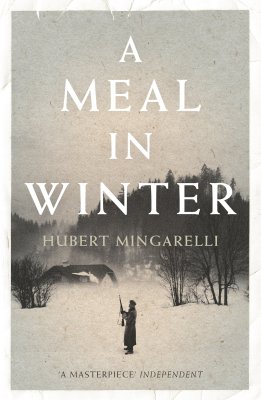


‘A Meal in Winter’ by Hubert Mingarelli – A Provocative Novel of World War II


‘A Meal in Winter’ by Hubert Mingarelli (2012) – 138 pages Translated from the French by Sam Taylor

Why do people read Holocaust literature when there are so many more pleasant things to read about? Because some of us want to face the worst there is in human beings, the bottom dregs of atrocious human behavior and perhaps somehow deal with it. It is just not possible to sweep the deaths of over six million people under the carpet and pretend it never happened.

In ‘A Meal in Winter’ three German soldiers who are in Poland are sent out on a harsh cold day in winter to hunt for Jewish people who are hiding and to bring any that they find back to their camp. They specifically requested this mission of their base commander because otherwise they would have had to stay in camp and shoot the Jewish people who were already captured.

We explained to him that we would rather do the hunting than the shootings. We told him we didn’t like the shootings; that doing it made us feel bad at the time and gave us bad dreams at night. When we woke in the morning, we felt down as soon as we start thinking about it, and if it went on like this, soon we wouldn’t be able to stand it at all – and if it ended up making us ill, we’d be no use to anybody. We would not have spoken like this, so openly and frankly to another commander. He was a reservist like we were , and he slept on a camp bed too. But the killings had aged him more than they had us.”

They do capture one Jewish person who is hiding in the woods. One of the soldiers notices an embroidered star on the winter hat that the Jew is wearing.

Because if you want to know what it is that tormented me, and that torments me to this day, it’s seeing that kind of thing on the clothes of the Jews we’re going to kill: a piece of embroidery, coloured buttons, a ribbon in the hair. I was always pierced by those thoughtful maternal displays of tenderness.”

Then to pass the rest of the day they go into an abandoned house of which there were many in Poland during the German occupation. The three soldiers will spend the rest of the day in the house since they have done their duty already by capturing a Jew. They lock up the Jew in the pantry and then start a fire in the furnace of this bitterly cold house by breaking up some of the furniture.

They decide to prepare a makeshift meal with whatever food they can come up with. Another Polish guy shows up at the house as they are preparing this meal. In order to get enough fire to heat the meal properly they must burn more and more of the furniture.

This novel is a strong attempt to watch this atrocity from the viewpoint of the perpetrators. Some of the perpetrators were gung-ho with the German high command; others may have been only reluctantly following orders.

This is a simple but moving story.


Grade:   A