‘Nothing’ by Henry Green (1950) – 183 pages
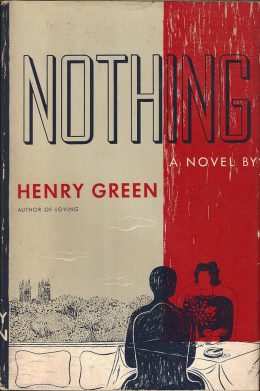
Henry Green is an English novelist from an earlier time to whom I keep coming back in my reading. There is an immediacy, an intensity at the sentence level that makes Green’s writing fun to read even when he writes about supposedly mundane things like office life or just walking in a park. Reading Green, one gets a sense of the wondrous strangeness of ordinary life for all of us.
I was somewhat surprised to find that the New York Review Books Classics series published eight of the nine novels Henry Green wrote, all except ‘Concluding’. (Is there any author other than Henry Green for whom NYBR Classics has published 8 novels?) What surprised me is that the last two of his novels, ‘Nothing’ and ‘Doting’, have not been highly praised by critics. ‘Nothing’ and ‘Doting’ are almost entirely all dialogue and have been variously described by critics as “talky”, “brittle”, “lacking the old magic”, and not at all approaching his earlier masterpieces like ‘Party Going’ or ‘Loving’. I have read and much enjoyed five of his earlier esteemed-by-critics novels and consider Henry Green one of the high points in English literature in the 20th century, so it was time for me to go off the deep-end with Henry Green and read one of these two so-called “talky” novels.
The main characters in ‘Nothing’ are John Pomfret and his 20 year old daughter Mary and his friend Jane Weatherby and her 21 year old son Philip. John Pomfret and Jane Weatherby had a torrid affair many years ago despite being married to others, and now they are still platonic friends. Now her son Philip and his daughter Mary have gotten together, and these two serious young people worry that they might be more closely related than they thought. Philip discusses it with his mother:
“It wasn’t anything I could mention over the phone. Look here you won’t be annoyed will you but am I Father’s son?”
Mrs. Weatherby went deep red under the make-up.
Henry Green, as a writer, did not believe in omniscient all-knowing narrators. Nobody knows for sure how another person feels about anything. All we know for sure are the words they say and their physical reactions such as smiles, frowns, turning red, etc., and these physical reactions might not reflect their true feelings. Thus in ‘Nothing’, besides the dialogue, we get frequent mentions of what a character “seemed” to be feeling. Any description of a character’s feelings must be tentative, because we really don’t know what they are feeling.
“He seemed very comfortable in the chair with his sherry.”
“Mr. Pomfret appeared to ignore the dryness of her tone.”
“she said with apparent sincerity”
 I believe that this absence of an omniscient narrator is one of the reasons that Henry Green’s novels still charm while other writers’ works have fallen by the wayside.
However, ultimately ‘Nothing’ did not measure up for me to the other Henry Green novels which I have read. As good as Green is with dialogue, I missed the connective tissue of description to back up the story. If you have not read Henry Green before, don’t start with ‘Nothing’. Read ‘Party Going’ or ‘Loving’ or ‘Living’ or ‘Back’ instead.
Grade: B-
 Tony's Book World
Recent Comments