‘Fates and Furies’ by Lauren Groff (2015) – 390 pages
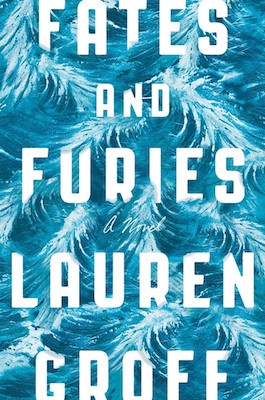
Even the title of Lauren Groff’s tremendous new novel, ‘Fates and Furies’, indicates that it is mythic, not realistic. That’s OK since realism in fiction has pretty much run its course over the last few decades although there is a glut of new realistic novels coming out every month. We all know that the real is a boring dead end; just watch reality television.
In Greek mythology, both the Fates and the Furies were women. The Fates are a group of women, usually three, who weave the tapestry which determines the lives of men. The Furies on the other hand are the infernal goddesses, the angry ones, who punish wrongdoers on Earth as well as the damned in Hell.
The novel ‘Fates and Furies’ is the story of a married couple, Lotto and Mathilde. The first half of the novel, ‘Fates’, is mainly Lotto’s story. Mathilde, the love of Lotto’s life, is there more as a helpmate than anything else. We learn very little about her history in the ‘Fates’ section of the novel.
“Paradox of marriage: You can never know someone entirely; you do know someone entirely.”
However a woman does also have a history. The ‘Furies’ section of the novel is mainly Mathilde’s story, and what a story it is.
‘Fates and Furies’ is a performance. As well as one of the main characters [Lotto] being an actor / playwright, the novel is filled with artifice ranging from the Greek myths and tragedies to Shakespeare. When today so much of literature is realistic and naturalistic to the point of plainness, Lauren Groff strives for something bigger and brighter, more mythic than that, and succeeds. Also a manic energy, a liveliness, and an inventiveness infuse her writing. ‘Fate and Furies’ was a delight for me.
The first name Groff mentions in the acknowledgements to ‘Fates and Furies’ is Anne Carson, a writer I much admire who translated the trilogy of ancient Greek tragedies in the Oresteia by Aeschylus and who often incorporates mythology into her poems and other work.
While I was reading ‘Fates and Furies’ I kept thinking about another author, the great Canadian novelist Robertson Davies whose Deptford Trilogy [‘Fifth Business’, ‘The Manticore’, ‘World of Wonders’] is not to be missed by anyone who appreciates fine literature. Robertson Davies was another writer who put a lot of Greek myth, Shakespeare, and theatre in his novels.
After completing ‘Fates and Furies’, I decided to google ‘Lauren Groff Robertson Davies’ to see if there was any connection between the two of them. I came up with only one connection between the two authors. In an article in the New Yorker from 2011, Lauren Groff discusses what she was going to read that summer:
“Half of my collection is pretty random, books that I’ve picked up at the local library sale (an extensive collection of Barbara Pym and Robertson Davies, despite the fact I’ve never read a word by either writer.)”
After noticing the similarities between ‘Fates and Furies’ and Robertson Davies’ fiction, I strongly expect that Groff has read Davies since 2011.
‘Fates and Furies’ is a novel that goes into my “Don’t Miss” category.
Grade: A
 Tony's Book World
Recent Comments