Posts Tagged ‘Eugene O’Neill’

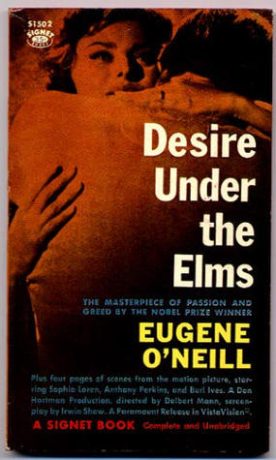
‘Desire Under the Elms’ by Eugene O’Neill – A Greek Tragedy on a New England Farm


‘Desire Under the Elms’ by Eugene O’Neill    (1923) – 70 pages
 

The reason I read the plays of Eugene O’Neill is for their psychological intensity. In such plays as ‘The Iceman Cometh’, ‘Long Day’s Journey Into Night’, ‘Moon for the Misbegotten’ and others O’Neill delves more deeply into what it is to be human than other playwrights before or since. If you get a chance, read or watch one of these plays either in the theater or on TV and you will see what I mean.

‘Desire Under the Elms’ is one of O’Neill’s earlier plays, written in 1923. O’Neill always did have a way with giving his plays enticing titles. His experimental idea for this play was, I think, a good one. He would take one of the ancient Greek tragedies, in this case Euripides’ Hippolytus and loosely update it into a United States play. ‘Desire Under the Elms’ takes place on a New England farm around the year 1850. Instead of Theseus, Hippolytus, and Phaedra, we have Ephraim, Simeon, Peter, Eden, and Abbie.

Old man Ephraim has worked two wives to death keeping his stony farm land producing, and now he’s working his three sons to death. Meanwhile Ephraim’s off to the city to find wife number three. Two of the sons, Simeon and Peter, decide to run away to California to find gold while he is gone, but youngest son Eden decides to stick around. Soon Ephraim returns with his new wife Abbie who is quite young, only in her thirties. Abbie is repulsed by old man Ephraim, and she only married Ephraim because she was in terrible financial straits. Since the young son Eden hates his father, Ephraim decides he wants to have another baby son to inherit the farm, and Abbie says she’s willing, because she wants the farm for herself. Meanwhile Abbie and Eden naturally develop a strong attraction for each other.

As you would expect in a play written by O’Neill, he captures the way these New Englanders talk perfectly. However the plot is straight out of Greek tragedy. When we people of today read these old Greek tragedies, we can handle the often disturbing and gory plots which include patricide, matricide, and even infanticide, since we are so far removed from these ancient Greek people. However ‘Desire Under the Elms’ brings one of these terrible events directly home to us here. It is almost too gruesome, overwrought, and intense for us modern playgoers, including myself , to handle.

There is a 1958 movie of ‘Desire Under the Elms’ starring Anthony Perkins, Sophia Loren, and Burl Ives, but the consensus is that this movie isn’t very good so I didn’t watch it. I believe that under the right circumstances, someone could make a powerful movie of this play.


Grade:    B+
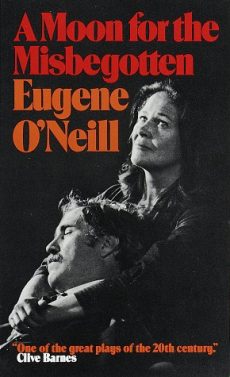


‘A Moon for the Misbegotten’ by Eugene O’Neill – A Doomed Romance


‘A Moon for the Misbegotten’ by Eugene O’Neill, a play  (1943) – 115 pages


Anyone who has a real interest in literature must finally confront the soul-searching dramas of Eugene O’Neill. Eugene O’Neill was the first United States playwright to take drama seriously, and performances of his plays hold up well even today.

O’Neill’s plays are often about people not facing or finally facing the hard truths about themselves, how people lie to themselves about who they really are in order to make it through the day.

Eugene O’Neill had already won the Nobel Prize for Literature in 1936, years before he wrote his two most famous plays, ‘A Long Day’s Journey into Night’ and ‘The Iceman Cometh’. It was a movie production of ‘The Iceman Cometh’ in 1973 that really spurred my interest in literature. That production of the play caused me to conclude that literature had some things important to say to me.

‘A Moon for the Misbegotten’, like ‘A Long Day’s Journey into Night’, is closely related to O’Neill’s own family, and O’Neill did not allow stage production of either play until after O’Neill died. One of the main characters in both plays is Jamie Tyrone who is based closely on Eugene O’Neill’s actual older brother Jamie O’Neill.

The year is 1923. Since his actor father James has already died, Jamie is now known as James Tyrone. He is 33 and also a stage actor and a hopeless alcoholic. He has come home from New York to recover and manage his father’s holdings which includes a farm rented to Phil Hogan. Hogan lives with his daughter Josie after all six of her brothers have run off from the farm. When James comes to visit Hogan, the two joke around and kid each other while Josie listens. Then James and old man Hogan head off to the bar for the day. Hogan comes back by himself at late afternoon angry because James has said that he will sell the farm to this obnoxious rich guy Harder. So Hogan hatches this scheme for Josie to seduce James, then Hogan can catch them in bed and force them to get married.

Josie goes along with her dad’s scheme despite being strongly attracted to James anyhow. James harbors tremendous guilt because when his mother died, he was so drunk he couldn’t attend her funeral.

I won’t give away any more of the plot of this deeply affecting emotional drama.

As a dramatist, Eugene O’Neill had something of the Irish poet in him. And no one came up with better titles for his works than O’Neill.


Grade:   A


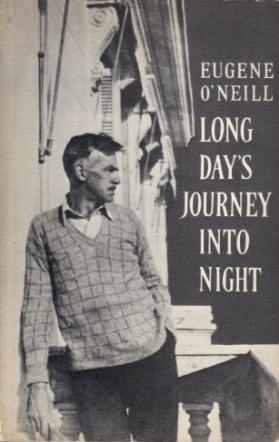
‘Long Day’s Journey into Night’ by Eugene O’Neill – The Tyrone Family

‘Long Day’s Journey into Night’ by Eugene O’Neill (1941) – 179 pages

Many claim that ‘Long Day’s Journey into Night’ is the greatest play written by a writer from the United States. Personally I think that distinction belongs to another play written by Eugene O’Neill, ‘The Iceman Cometh’. If you ever get the chance to see Lee Marvin in John Frankenheimer’s movie ‘The Iceman Cometh’ from 1973, don’t miss it. Lee Marvin plays gregarious salesman Harry Hickey who comes to his old bar to destroy the pipe dreams of everyone who is at the bar. Pipe dreams are those lies we tell ourselves to get us through each day. That play profoundly moves me to this day.

But on to ‘Long Day’s Journey into Night’ which is O’Neill’s most autobiographical play. O’Neill wrote the play in 1941 about his wretched early family situation involving his father, mother, and older brother. O’Neill would not publish the play while he was alive, and he made arrangements not to publish it until 25 years after his death. However his widow Carlotta recognized what a great play it was, and had it published in 1956. The play was first performed in November, 1956.

As its title suggests, the play of four acts takes place during one day in 1912. The Tyrone family is living in their summer seaside home in Connecticut. The father James is a famous actor who could have been a great Shakespearean actor if he hadn’t settled for more money. The sons Jamie and Edmund are fully grown. Older brother Jamie works as an actor in jobs that his father gets for him but mainly Jamie is a rake about town spending most of his time in bars and whorehouses. Edmund, the younger son, has worked as a journalist, written poetry, and has traveled widely but is sickly and may have consumption (tuberculosis) probably somewhat due to excessive alcohol consumption. Edmund is O’Neill’s stand-in for himself. All three men are alcoholics, but it is the mother Mary who has the worse problem; she is a morphine addict and has been confined to a sanatorium before.

One can comprehend how difficult it was for Eugene O’Neill to confront his real family situation. This is family realism at its most honest and most brutal. Each character must confront his or her own reality and shortcomings or else another member of the family will point them out for him or her.

None of us can help the things life has done to us. They’re done before you realize it, and once they’re done they make you do other things until at last everything comes between you and what you’d like to be, and you’ve lost your true self forever.”

I do think ‘Long Day’s Journey into Night’ is a very strong honest family drama. However it is somewhat of a sad and depressing play with no redemption for its characters. I prefer ‘The Iceman Cometh’ because while it is still brutally honest with the people on stage, it still offers a way out for these people at the end.

Under any conditions, Eugene O’Neill is still the greatest playwright from the United States.

Grade : A