‘The Names’ by Don DeLillo (1982) – 339 pages
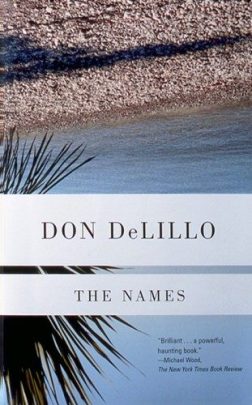 You may ask why I read this decidedly old novel. Having read the three novels ‘White Noise’, ‘Libra’, and ‘Mao II’, I consider Don DeLillo one of the finest, if not the finest, writers in recent US history. I have a copy of ‘Underworld’ which I intend to read when I have time and space to read an 827-page novel.
Geoff Dyer wrote an article in The Guardian in 2014 stating that if US novels had been eligible for the Booker Prize in 1982, ‘The Names’ would have won. The original reviews of ‘The Names’ were rather negative, but over the years it has gained admirers.
Delillo has had an interesting career as a writer. Before ‘White Noise’ which was DeLillo’s big breakthrough he had written eight post-modern novels which had limited success. After ‘Underworld’ which is considered DeLillo’s supreme achievement, DeLillo wrote five shorter novels which have garnered mixed reviews.
So does ‘The Names’ belong with the set of DeLillo’s other four masterpieces or is it the last of his apprentice works? To find out the answer to this question, I read ‘The Names’ for myself.
Most of ‘The Names’ takes place in Athens, Greece. James Axton has followed his divorced wife Kathryn and their young son Tap to Athens who are there for an archaeological dig.
“This is what love comes down to, things that happen, and what we say about them. Certainly that is what I wanted from Kathryn and Tap, the seeping love of small talk and family chat. I wanted them to tell me how they spent their day.”
James has obtained a position as a risk analyst for a corporate insurer. The job is to evaluate the risks, especially the terrorist risk, for major executives as they carry out their corporate duties in the Middle East. As part of his job, he travels to various places such as Beirut and Ankara and Jordan.
“This is a relatively safe place for a Turk. Very bad in Paris. Even worse in Beirut. The Secret Army is very active there. Every secret army in the world keeps a post office box in Beirut.”
There is a mysterious “language cult” called Ta Onomata operating throughout the Middle East that is behind a number of unexplained murders. They murder people whose initials match the letters of place names. I found this rather silly, but I suppose that was the point.
“They intended nothing, they meant nothing. They only matched the letters. What beautiful names.”
One of the characters wants to infiltrate and film the cult
“The twentieth century is on film. It’s the filmed century. You have to ask yourself if there is anything about us more important than the fact that we’re constantly on film, constantly watching ourselves. The whole world is on film, all the time.”
Ultimately James finds out that his employer is a front for the CIA.
“American strategy. This is interesting, how the Americans choose strategy over principle every time and yet keep believing in their own innocence.”
While many of DeLillo’s lines about various topics, his digressions, are interesting in themselves, for me the novel as a whole does not cohere. Maybe it is because I’m out of practice reading DeLillo’s work. Who knows? However the ridiculous plot of a cult that kills people based on the initials of their names kind of spoiled the novel for me. I got the impression that not even DeLillo was interested in the plot since it is dropped without a resolution.
Grade: B-
 Tony's Book World
Recent Comments