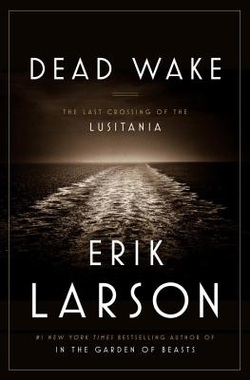
‘Dead Wake’ by Erik Larson (2015) – 359 pages Grade: B
–
The sinking of the Lusitania was no accident. The giant passenger cruise ship was torpedoed by a German submarine U-boat on May 7, 1915 during World War I leaving 1198 passengers and crew dead. Germany had just issued an advisory against ship travel through the war zone, but the warning was paid little attention.
“The idea that Germany would dare attempt to sink a fully loaded civilian passenger ship seemed beyond rational consideration.”
At that point there were still rules about not killing civilians in wars, but those rules were rapidly disappearing. The United States consul in Queenstown, Ireland said, “The reference to the Lusitania was obvious enough, but personally it never entered my mind for a moment that the Germans would perpetrate an attack upon her. The culpability of such an act seemed too blatant and raw for an intelligent people to take upon themselves.”
However the German U-boat commander had no misgivings about torpedoing a liner full of civilians. His performance was measured in the amount of ship tonnage he sank.
The non-fiction ‘Dead Wake’ covers the sinking of the Lusitania in a very traditional fashion. The ship name ‘Lusitania’ was the country name that the ancient Romans had given to Portugal. We get the stories of a number of the passengers on the boat and all the details about what was on the boat, its route, and what happened on deck. After the ship was torpedoed, it listed so badly that only 6 of the 22 lifeboats could be launched, and soon the ship tipped over completely and sank. Some of the passengers mistakenly thought that they would be safer on the huge ship than on the tiny lifeboats.
A mass wail rose from all it engulfed. “All the despair, terror and anguish of hundreds of souls passing into eternity composed that awful cry.”
There is some speculation that England did not adequately guard the huge cruise ship through dangerous waters because there were many Americans on board, and England wanted to force the United States into World War I. 128 Americans were among the dead. There were also war munitions on board the Lusitania.
The only other Erik Larson I read was ‘In the Garden of Beasts’ which was about the American ambassador to Germany and his family in the years leading up to World War II. This was new and highly compelling material, a story I did not know before about this entire American family dealing with the Nazis. I may be different from most of Larson’s audience, but this ship disaster did not hold my interest to that extent. Tragedies happen nearly every day, and each one has its compelling details which we get in the newspapers. Reading the Wikipedia article about the Lusitania probably would have been sufficient for me. I really don’t want or need all the minutia about the Lusitania’s final voyage. With his talent for exposition, Erik Larson should be finding more original striking story lines.
 Tony's Book World
Recent Comments