Posts Tagged ‘Catherine Lacey’

‘Biography of X’ by Catherine Lacey – Performance Artist and Avant-Garde Celebrity X


‘Biography of X’ by Catherine Lacey   (2023) – 389 pages
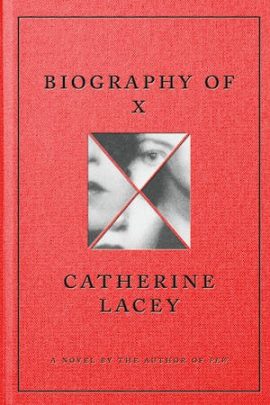
 

C.M. Lucca wrote this meticulously researched and documented second biography of the deceased woman X after Lucca read and was extremely dissatisfied with the first biography. After all, Lucca left her husband to become the wife of X, so she should know a thing or two about the life of X. Besides, in that first biography Lucca was referred to as a “mousy little nobody”. Lucca herself admits that others often see her as plain and glamourless, whereas X is an avant-garde celebrity, a media monster. Meanwhile Lucca has a score to settle with her dead lover X.


However many of her performances, paintings, and sculptures seem a little heartless to me now, designed not to evoke real feeling, but to get a reaction or a check.”


Our new biographer C.M. Lucca knows very little about the early life of X, so she travels to the Southern Territory to Mississippi where X was born as Caroline Luanna Walker in 1945. You see, the Christian Coup of the Southern Territory had built a wall and broken off from the rest of the United States in 1945 when Emma Goldman became President Roosevelt’s Chief of Staff. This was the Great Disunion. Instead of a United States we had a Northern Territory, a Southern Territory which was a violent theocratic dictatorship, and later a Western Territory.


After “an act of terrorism against a despotic government” known as the Revelation Rifle Affair in 1968, Caroline had to leave the Southern Territory in a hurry and she had to assume a different identity. After that she assumed several different identities until she finally became just X in 1982. At various times she was Dorothy Eagle, the singer/songwriter Bee Converse, the writer Clyde Hill, Martina Riggio, the writers Cindy O. and Cassandra Edwards, the artists Yarrow Hall and Vera, She has been influenced by Andy Warhol and much of what she does is performance art.


There are never any conclusions with people, he said, are there ?”


X becomes famous in the bohemian scene in New York City Along the way, a number of renowned real-life people show up in X’s life. These include the writers Dennis Johnson and Kathy Acker and musicians David Bowie, Patti Smith, Connie Converse, and Tom Waits.


In this highly detailed fake biographical work, I suspect there are many “in” jokes which I mainly missed, not being conversant with the New York art scene. And was it really necessary to rewrite United States history in order to tell X’s story?


This fictional biography is steady and workmanlike, but for me it lacked that definite spark of style or enthusiasm that would have put it over the top. Part of the problem for me was that the colorful story of X requires a more flamboyant outrageous telling than this mousy little nobody C.M. Lucca is capable of.


Grade:   B
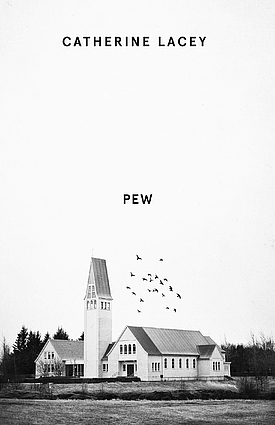


‘Pew’ by Catherine Lacey – A Modern-Day Fable


‘Pew’ by Catherine Lacey    (2020) – 207 pages

I suppose the first thing they tell you in Fiction 101 is to have a well-defined main character to drive your story or novel and to give that main character human emotions with which the readers can empathize and identify. However in Catherine Lacey’s new novel ‘Pew’, the main character narrator Pew is not at all well-defined. We don’t find out if the main character, Pew, is male or female, black or white or something else. Pew is homeless and sometimes sleeps overnight in churches which have accidentally or intentionally left one of their many doors open. For all intents and purposes, Pew is amorphous and talks barely at all.

But that is what significant novelists do, break the rules. Here Catherine Lacey has broken the rules to stimulate and challenge herself to come up with something new and different.

Steven and Hilda and their boys find him/her sleeping in their regular pew at church on Sunday morning. They decide to take him/her into their home and to call him Pew.

Pew is a blank slate. What we do find out in the novel is how the various townspeople react to his/her presence. Here is the son Jack:

We don’t even know if you’re a girl or a boy or where you come from or nothing and you’re sleeping in my bed. In my bed. It’s disgusting. You ought to go back where you came from, go back there and leave us alone.”

Some of the people Pew meets or is introduced to treat him much nicer than Jack at least on the surface. Steve and Hilda have Pew visit with church people or psychiatric or psychological staff. Pew sits through all these evaluations by the so-called experts.

There are a few people who relate to him/her much better than others. These people tend to be the ones who realize that they don’t have all the answers either. The people who are on Pew’s wavelength are those that have found out that life is a struggle for everyone. Pew almost wants to talk to these few people. One of these less judgmental people tells Pew:

I felt so sure then – of course I was younger. It’s easier to be certain of things then – and the older you get, the more you see that certainty depends on one blindness or another.”

The big event each year in this southern town is the Forgiveness Festival. This is when the townspeople let themselves off the hook for each other’s sins. Is it truly a Forgiveness Festival or is it a Forgetfulness Festival?

I felt that given the build-up and all the talk of the Forgiveness Festival, it could have been presented more dramatically than it was. My other complaint is that the blank-slate narrator Pew comes across as a bit sad and austere, perhaps because Pew says so little. I would have made him/her a bit more upbeat and playful, but then Pew probably would not have been a blank slate.

This is the second work of fiction by Catherine Lacey which I have read, and I still feel very strongly that she is one of the most significant fiction writers out there today because she is not afraid to deal uniquely with the larger matters. I will continue to read her work.


Grade:   A-


‘Certain American States’ by Catherine Lacey – Modern Stories with Some Wicked Twists


‘Certain American States’ by Catherine Lacey (2018) – 190 pages

The loneliness of certain American states is enough to kill a person if you look too closely.”

If you are searching for something new and different in fiction, you might try Catherine Lacey. I’m at the point where I would rather read her disordered unpredictable stories in ‘Certain American States’ than the simpler more straightforward sincere stories of someone else. This is my first encounter with Lacey’s work, but it won’t be my last.

It is not that her subject matter is so weird or different. These stories usually start out as direct stories of modern life. Perhaps Lacey describes her subject matter best in her story “Small Differences” with the phrase “the conditional and imperfect nature of human-on-human love,”

It is clear now that Nathan and I have always had just enough respect for each other to withstand a mutual disrespect.”

You only learn who you’ve married after it’s too late, like one of those white mystery taffies you have to eat to find the flavor, and even then, it’s just a guess.”

So what makes Catherine Lacey’s stories so peculiar? It is the outlandish unpredictable twists that occur along the way. None of the stories are written in chronological order but skip around as needed to heighten their impact. Also Lacey writes superb, occasionally extraordinarily long, sentences. These are the kind of sentences and stories you want to read more than once to capture their full meaning. In fact the first sentence in the first story is nearly two pages, nearly perfect except the editor of my edition left out a ‘to’ early in the sentence.

But sometimes Lacey uses short sentences effectively too. Here is a fine example of Catherine Lacey’s unique voice from her story “Because You Have To”. Here is a young woman’s interior monologue to the guy who has recently left her:

You have been calling and hanging up.

I know it’s you. The telephone rings differently when you call.

You can’t tell me I don’t recognize this. You have no idea what I hear, but it is so like you to doubt me, to assume I’m wrong. It is so like you to not be here, and to call as if to point out your absence and to say nothing just to frustrate me.”

A reader can never tell if Catherine Lacey is serious, and it is probably wise for you to assume she is not.

My main complaint with Lacey’s works here is a a lazy one. These stories each contain so much that they are simply exhausting. A reader shouldn’t have to work this hard in order to enjoy a story. These are the kind of stories that you may want to re-read, but that you may also need to reread in case you have missed a key point. Even in the stories that misfired for me there were a sense of humor and plenty of interesting ideas.

I am going to end with a quote about Catherine Lacey’s stories from novelist Anne Enright:

Although Lacey’s work can be sad, it is rarely monotone, never earnest. Her stories are profoundly playful and piercingly good. You don’t have to read them, but you really should.” – Anne Enright, The Guardian


Grade : A-