Posts Tagged ‘Anthony Marra’

‘Mercury Pictures Presents’ by Anthony Marra – Not a Hollywood Novel


‘Mercury Pictures Presents’ by Anthony Marra    (2022)  – 408 pages


I suppose there are many other readers like me who have been waiting for a more literary Hollywood novel, and with its title this novel presents itself in its opening pages as exactly that.

What kind of masochist enjoys realism? Realism is everywhere. It stinks.”

We start with the two brothers Artie and Ned Feldman who run Mercury Pictures during the World War II years, a profitable B-movie operation in Hollywood.

The Feldman brothers are rather stock stereotypical characters, but at least the opening dialogue is witty and comedic and sharp.

I pay you to be honest.”

Honestly, you look like Elmer Fudd’s dad.”

Artie winced. “I don’t pay you to be that honest.”

Then you should pay me more.”

However the novel wanders a long way from its Hollywood opening, all the way to Mussolini’s fascist Italy to tell of the plight of Maria Lagana, a woman who later is heavily involved in making Mercury movies, and her family. ‘Mercury’ establishes its pattern very early on. First a short, sharply written Hollywood scene, then an interminable scene back in Italy where the people are suffering under the Mussolini Fascist regime. The Italian scenes suffer from an overdose of sincerity.

I found that the Italian section of the novel which goes on for at least one hundred pages dragged for me. Perhaps my problem was my expectation that this would be a Hollywood novel, not a World War II novel. We are introduced to all these minor Italian characters, and when they later appear in the novel I couldn’t remember why they were there in the first place. That only added to my frustration in reading this novel.

The only parts of the novel that I really enjoyed were the short injections of Hollywood humor usually involving Artie Feldman.

He was a harried man with eyes clouded in resignation and a misplaced faith in the magnetism of bowties. He looked like someone’s ex-husband.”

After Pearl Harbor, and the United States goes to war, Mercury Pictures makes propaganda films which are quite profitable. We have the story of Chinese actor Eddie Lu, Maria’s boyfriend. hired to play an evil Japanese spymaster for a war propaganda movie made after Pearl Harbor was bombed.

You weren’t hired to act,” the director told him bluntly. “You were hired to be hated.”

Eddie is disgusted with the movie business.

The way I see it, they’ll have me playing Jap villains until the end of the war, then it’s back to the usual devious Chinaman shit.”

Although there are some short sharp comedic interludes in ‘Mercury Pictures Presents’, I found most of the novel diffuse and meandering, and it dragged for me.


Grade:    B-
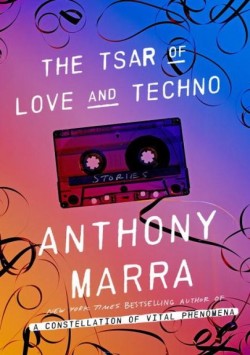


‘The Tsar of Love and Techno’ by Anthony Marra –“Heroin on the Kitchen Table, Snow on the Window Sill”


‘The Tsar of Love and Techno’ by Anthony Marra   (2015) – 332 pages


anthony-marra-2015-the-tsar-of-love-and-techno-stories-bog-med-haard-ryg

Here is a story of modern Russia with its origins in the old Soviet state.  Life goes on, and Anthony Marra captures a lot of it.

‘The Tsar of Love and Techno’ is arranged like a homemade mixtape with a Side A, an Intermission, and a Side B.  At first the material on the mixtape seems unrelated, but a pattern develops.   It contains riffs on Kirovsk in Siberia, Chechnya, and St. Petersburg, riffs on the old Communist oligarchy and the new organized crime oligarchy who took over after Communism fell.  The crime team now rules, and not much has changed since the old Communist years.

When Communism fell, the people of Chechnya fought a war and won their independence just like many of the countries in Eastern Europe had achieved.  However the organized crime bosses ruling Russia lusted after all that oil money to be made in Chechnya and fought another vicious Chechen War to get it back.

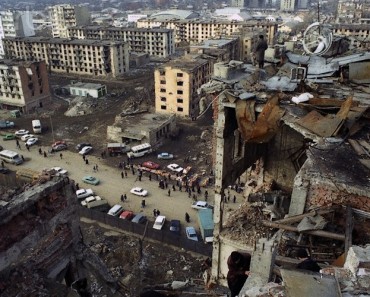
An example of Anthony Marra’s sardonic black humor is the story titled “The Grozny Tourist Bureau”. It takes place in 2003 after the first and second Chechen Wars have left Grozny the most devastated city on earth according to the United Nations.  In the 1990s, Chechnya was one of the most heavily mined regions in the world with an estimated 500,000 planted land mines. The Chechnya Museum of Regional Art had been destroyed by Russian rockets, and now the former deputy director of the museum has been named the chief of the Grozny Tourist Bureau.  He must now write a brochure explaining the glories of Chechnya for tourists.

“Upon seeing the space where an apartment block once stood, I wrote “wide and unobstructed skies”.  I watched jubilantly as a pack of feral dogs chased a man, and wrote “unexpected encounters with natural life”.

Life goes on even in miserable circumstances whether it was in the old Soviet forced labor camps in Kirovsk, Siberia or in the new war-torn Chechnya.

“Kirovsk isn’t that bad, is it?”

It’s a poisoned post-apocalyptic hellscape.  “It’s a wonderful place to raise a family.”    

‘The Tsar of Love and Techno’ is one work of fiction I do not recommend you listen to via audiobook as I originally attempted to do. Many of the sentences in ‘The Tsar of Love and Techno’ are too rich and dense with meaning and attitude to be fully appreciated by a casual listen.  Here it is best you read the words so you can easily stop, think about them, and fully appreciate them before moving on.  Here are typical sentences:

“Whatever life-preserving instincts evolution endowed him with have been war-blunted to an amused disregard for all mortality, particularly his own.”    

“But to some people ignorance is a sleeping mask they mistake for corrective lenses.”    

Besides, this fiction is so packed with marginally related characters, locations, and plot lines, it is difficult to keep the stories all together while listening.

Grozny, Chechnya After Two Wars

Grozny, Chechnya After Two Wars

The stories take place in many locales ranging from St. Petersburg to Kirovsk in Siberia to rural Chechnya to the Chechen capital city of Grozny to outer space.

If I were summarizing the plots of these interconnected stories, it would be as follows.  These stories give specific examples of the oligarchy-induced tragedies for the Russian people from the 1930s up until today.  From Stalin’s forced labor camps in Siberia to the Chechen Wars and beyond, the misfortunes for the people of Russia have continued.

This is a rich devastatingly well-written novel.  I only wish it were more tightly organized.  I just feel that a novel this complex should have more than a mixtape structure.  Anthony Marra is certainly making some strong statements about modern Russia, but the impact is somewhat blunted by the hodge-podge arrangement of the material.


Grade:   B+