Posts Tagged ‘Ali Smith’

‘Gliff’ by Ali Smith – Briar and Rose, Two Innocents in the Harsh Modern World


‘Gliff’ by Ali Smith     (2025) – 274 pages
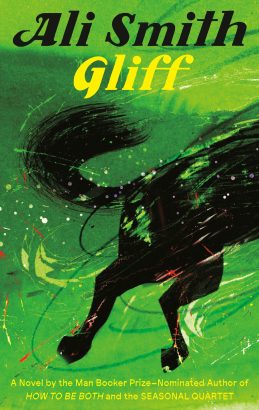
 

In ‘Gliff” the two young girls Briar and Rose are left on their own. Briar, the older sister, is around 13 while Rose is around 11. Briar tells the story.

Here is an example of how the sisters Briar and Rose talk to each other:

Then she said,

Bri. What actually is trust?

Eh, I said. It’s you know.

I don’t, she said.

You trust me, yeah?

First tell me what it is, then I’ll tell you, she said.

Their mother had to leave and is working in another country. Later we learn that their mother was fired from her job for being a whistle blower pointing out the dangers of the chemical that they were making at the weed killer factory where she worked. She has become a UV – an Unverifiable – and thus not welcome in her home country anymore.

A whistleblower means someone who tells the truth about something when other people don’t want anybody to tell the truth about it.”

Though the daughters have done nothing wrong themselves, they are now Unverifiables too. At first they live on canned food in their old house. Later they move into a communal house with a group of other Unverifiables.

Gliff is the name of a horse that the sisters save from the abattoir and they take into their house (which I had difficulty picturing).

The various strands of this fable or allegory never congealed into a reasonable plot for me. The parts of ‘Gliff’ seemed scattered and disjointed almost to the point of incoherence. There is the story of the two young sisters living on their own with the horse ‘Gliff’ staying in their house. Then suddenly the sisters are living in a communal housing arrangement with other Unverifiables. And then we have the scenes five years later when Briar is more grown up which made even less sense to me.

Supposedly there is some relationship between Orwell’s ‘Brave New World’ and ‘Gliff’, but I could not find any similarities beyond the ominous threats that the modern technologies pose to our human community. Instead of having adults confronting an authoritarian world as in ‘Brave New World’, in ‘Griff’ we have children which leads to an over-simplication and a certain naivety.

I would like to read a coherent novel about why with all our supposedly wonderful new technology such as the world-wide web and cell phones, so many countries are once again descending into dictatorships just as they did before World War II. Ali Smith does point out the ease which these new systems provide for authorities to keep surveillance on their people, However ‘Gliff’ is just too diffuse and perhaps too naive to effectively address the problem.


Grade:    C


‘Spring’ by Ali Smith – A Slapdash Effort


Spring’ by Ali Smith   (2019) – 340 pages

‘Spring’ did not work for me at all. It has all the ingredients of an Ali Smith novel but does not meld into a coherent whole. It is a slapdash effort.

This novel did not work for me even though I certainly agree with Ali Smith on most of her opinions of Brexit and Donald Trump. Ali Smith and I would agree that something has gone terribly wrong with our societies, and that this wrongness is imbedded in our current online world.

‘Spring’ begins with a rant. While reading the first few pages of ‘Spring’, I almost gave up on the novel due to its incoherence. I actually wish I had quit the novel. However I did not have anything else pressing to read so I gave ‘Spring’ another try starting from the beginning again. Ultimately I made it through the entire novel.

There are two main strands of the plot in ‘Spring’ which are united in what I consider haphazard fashion. The first strand is about Richard Lease who is working on a film project about the weeks that the writer Katherine Mansfield and the poet Rainer Maria Rilke spent in the same Swiss town in 1922. Even though the two did not even meet each other in real life and were unaware of each other’s presence, the movie producer wants to turn it into a great love story.

In Smith’s previous novel ‘How to Be Both’, these obscure references to the artistic and literary past delighted me but here they seem almost gratuitous.

The second strand of ‘Spring’ is about Brittany Hall who works in an IRC, an Immigrant Removal Center. Conditions for the immigrants at this place are atrocious. The people locked in there are called “deets” for detainees. The place resembles a prison.

I did not know that now England had a problem of mistreating its new immigrants. I thought that only the United States was mistreating its immigrants.

We want you to know you have full access to your information – you and anyone who shadows you.”

One day Brittany hears about a schoolgirl named Florence who somehow got past security and has somehow shamed the director into cleaning all the toilets at the Center. I suppose that this young girl could count as an instance of the literary device magical realism, but it all seemed rather makeshift.

Soon Brittany, Florence, and another woman are off to Inverness in Scotland, and somehow they pick up Richard along the way. How this all happens did not make any sense at all to me. I doubt if it was supposed to make sense. I suppose the author meant this trip to Inverness to be a whimsical juxtaposition of the two plot strands but to me it just seemed absurd.

In baseball parlance, Ali Smith’s ‘How to Be Both’ is a home run, and her ‘Spring’ is a strike out.


Grade:   C


‘Autumn’ by Ali Smith – Not the Post-Brexit Novel

‘Autumn’ by Ali Smith   (2016)  –  260 pages


‘Autumn’ has been called the first Post-Brexit novel, and there are a few bits about the anti-refugee hysteria that has taken over England, but it is not the Post-Brexit novel.

“Rule Britannia, a bunch of thugs had been sing-shouting in the street at the weekend past Elisabeth’s flat.  Britannia rules the waves.  First we’ll get the Poles.  And then we’ll get the Muslims.  Then we’ll get the gyppos, then the gays.  You lot are on the run, and we’re coming after you, a right-wing spokesman shouted at a female MP on a panel on Radio 4 earlier that same Saturday.  The chairman of the panel didn’t berate, or comment on, or even acknowledge the threat the man had just made.  Instead he gave the last word to the Tory MP on the panel, who used what was the final thirty seconds of the programme to talk about the real and disturbing cause for concern – not the blatant threat that was just made on the air by one person to another – of immigration.” 

9780241207017These lines echo the spiteful Trump phenomenon in the United States as well as apply to Brexit.  However a few good lines scattered through ‘Autumn’ do not a Post-Brexit novel make.  We must wait for a novel that more intensely deals with the Right-Wing racial hatred and viciousness sweeping across both England and the United States now.

In many ways ‘Autumn’ is similar to Smith’s previous novel ‘How to Be Both’.  Both concern a young girl/woman and an old, old man.  In ‘Autumn’ the girl/woman is Elisabeth Demand, now a 32 year-old university contract lecturer, and the old man, as opposed to a 15th century Renaissance artist, is now 101 year-old Daniel Gluck, a former neighbor who is on his death bed.  There is a profound innocence between the old man Daniel and the young Elisabeth.

For me, ‘Autumn’ is just not as sharply written as ‘How To Be Both’.  It has some of the same themes as ‘How To Be Both’, but these themes do not cohere so well.  The story is more scattered and less clever and engaging.

One particular quality which I do like a lot in the fiction of Ali Smith is how she can make a facet of art history come alive.  In ‘How To Be Both’, it was the life and times of Renaissance painter Francesco del Cossa.  In ‘Autumn’, the artist who Smith spotlights is 1960s English pop artist Pauline Boty.  Like so many stories, Boty’s story is exquisitely sad only to emerge triumphant in the end.

And I’ve got some final advice for the British people.  Don’t sound too vicious or stupid in your racist rants or you will wind up sounding like Donald Trump.


Grade:    B


‘How To Be Both’ by Ali Smith

‘How To Be Both’ by Ali Smith  (2014) – 372 pages   Grade: A

Smith-203x300

‘How To Be Both’ is a novel that is divided into two equal parts.  One part follows the Italian Renaissance painter Francesco del Cossa.  The other part is about a 16 year old girl living in modern England named George who hates the song ‘Georgy Girl’ for which she was named (How many English girls got stuck with that name?).  Somehow Ali Smith has fit their two stories into this one playful novel.

George’s 52 year old mother has died recently.

“This will be the first year her mother hasn’t been alive since the year her mother was born.  That is so obvious that it is stupid even to think it and yet so terrible that you can not think of it.”  

George’s mother is (was?) what I would call an art subversive.   She subverted the political world with art and the artistic world with politics.  But now she is gone, and George and her little brother Henry are hurting.  Their father is drinking too much, and the children are mainly left to themselves.

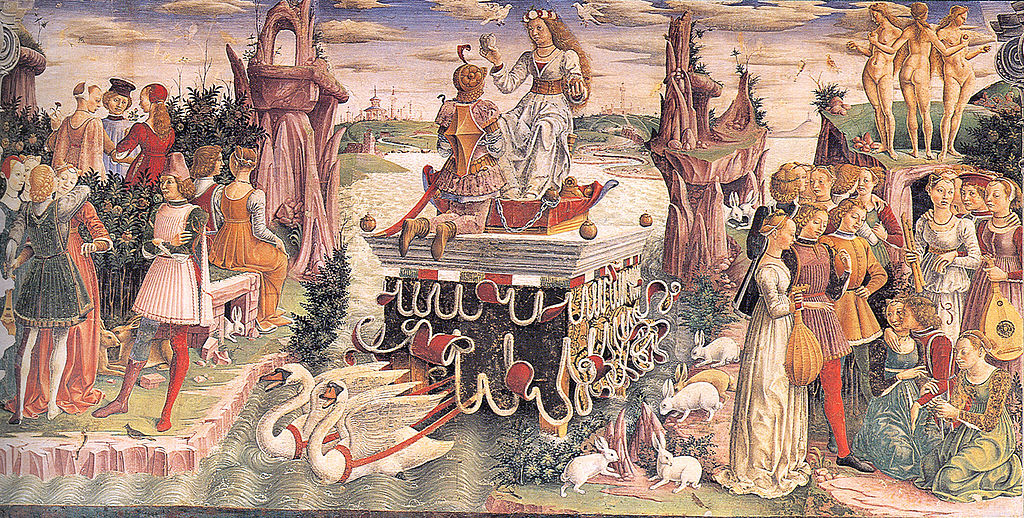
Before she died George’s mother took them on a trip to Ferarra, Italy to see the frescoes of Francesco del Cossa in the Palazzo Schifanoia.  On the walls of the palace are painted allegories for each month of the year.  Cossa painted the Allegories for March, April, and May which are considered the finest in the palace as lesser painters did the other months.

As you can see from the picture of the Allegory of April below, Cossa’s frescos are teeming with life which is something that also could be said of ‘How To Be Both’.

1024px-Aprile,_francesco_del_cossa,_11

So the ‘George’ part of the novel is about this teenage girl trying to cope with her mother’s death, but it would be a mistake to say that it is sad.  We flash back to conversations when George’s mother was still alive which are warm and funny and filled with clever word play.

So how does Renaissance painter Francesco del Cossa become a character in this modern novel?  His picture of the Saint Vincent Ferrer is in the National Gallery in London.  Remembering her trip to Ferrara, George goes to see this picture.  Cossa, still in Purgatorium, is hovering over the picture and sees this sad boy.   At first he doesn’t realize that George is a girl.  But Francesco is actually a girl herself.  Her father disguised her as a boy in order for her to pursue a painting career.  There is no mention of this in any of the history books; this is most certainly another riotous whim of Ali Smith.

Francesco del Cossa tells his (her?) life story which in Ali Smith’s hands is wicked and bawdy and filled with sexual confusions.

In this funny novel Ali Smith has pretty much undermined our preconceived ideas of what a novel is supposed to be just as she is constantly undermining our notions of sexual identity. I found reading ‘How To Be Both’ to be a joyous anarchic experience.  This is a novel for anyone who is getting kind of tired of the straightforward and traditional.