‘So Late in the Day’ by Claire Keegan – Stories of Women and Men


‘So Late in the Day’ by Claire Keegan   (2023)  –  118 pages


Note that the subtitle of this collection of three stories is “Stories of Women and Men”, not “Stories of Men and Women”. In each of these stories, the woman is the main protagonist and the man plays a peripheral though critical part. “Critical” is the operative word here.

That was the problem with women falling out of love; the veil of romance fell away from their eyes, and they looked in and could read you.

But this one didn’t stop there.”

The man can only react to the woman’s lessened opinion of him.

He had looked at her then and again saw something ugly about himself reflected back at him, in her gaze.”

The second story has a nice twist to it, a female writer retaliating. She is staying at the Boll House, the former home of the famous German author Heinrich Boll on Achill Island, to work on her new story. Heinrich Boll’s family left this house as a working residence for writers.

A German literary professor visits her at the house and she hopes he won’t interfere with her writing progress, However it turns out that he has been spying on her and is highly critical of her.

You come to this house of Heinrich Boll and make cakes and go swimming with no clothes on.”

Our woman writer retaliates the best way she knows how. She puts him in her story and gives him “the long and painful death” in the story, which is the story title.

The first lines of the last story, “Antarctica”, are :

Every time the happily married woman went away, she wondered how it would feel to sleep with another man. That weekend she was determined to find out.”

I doubt there are very many readers who could stop reading after those opening sentences

It’s proving very difficult to criticize anything Claire Keegan writes, and I am not going to do it. These three stories are all fine. This is a very quick lively read.


Grade:   A


‘This Plague of Souls’ by Mike McCormack – Terror in Ireland


‘This Plague of Souls’ by Mike McCormack     (2023) – 177 pages


Can one fault a writer for the key information he intentionally leaves out?

In ‘This Plague of Souls’ paints a picture of a man who has just been released from prison who returns to his small farm in western Ireland to find that his wife and son are not there. He cannot reach them by cell phone either, so he takes up living on the farm as he did before he met his wife.

This man, Nealon, gets these mysterious sporadic phone calls from a guy who seems to know all about him. This strange unknown guy wants to meet up with him, but Nealon hesitates at first. Who is he? What does he want?

In the meantime, I should mention something about the writing style of Mike McCormack. His descriptions are over the top, but so deadly acute and accurate. It’s as if every single word in this novel matters.

The morning sky is swollen with clouds and driving rain through the gray light, in a steady fall, this day is down for good. Some people are already abroad, a harassed breed with their eyes fixed to the ground, dispirited before the day has drawn breath. They have about them the resentful look of men and women who wish they are elsewhere, anywhere.”

This unique inimitable description of the rain and the people of this city that Nealon is approaching could only be made by McCormack.

Meanwhile a major terrorist incident is occurring in Ireland, and the television anchors are filled with impending doom except when they continue to cover sports events.

Finally Nealon agrees to meet with this mysterious stranger who knows too much about him.

At this point, I was quite satisfied with ‘This Plague of Souls’ even though there were many unanswered questions. What were the crimes that Nealon had been in prison for? How did they relate to this new major terrorist threat? How did this mysterious stranger find out so much about Nealon? Surely they would all be answered in the denouement.

No, none of these questions was specifically answered. Instead we get a lot of dire talk from this mysterious stranger that seems to imply that Nealon was somehow directly involved in this new terrorist threat, but we get no new details about Nealon’s involvement. Instead we get hints like “ripping off insurance companies”.

I’m quite sure that Mike McCormack left out these details on purpose to create a modern ominous atmosphere of menacing terrorist doom, but this reader was left hanging with too many unanswered questions and critical facts left out.


Grade :    B


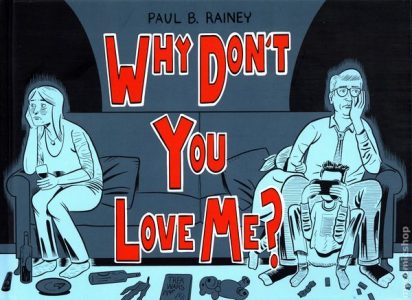
‘Why Don’t You Love Me?’ by Paul B. Rainey – A Graphic Portrait of an Unhappy Couple Who are Terrible Parents


‘Why Don’t You Love Me?’, a graphic novel, by Paul B. Rainey    (2023) – 214 pages


Here is a graphic novel that depicts a miserable marriage and the resultant bad parenting in horrific detail. We have married couple Mark Hopkins and his wife Claire and their two children Charley and Sally.

Claire spends much of her days in bed, is depressed, and drinks too much. Mark, after spending months on sick leave from his job as a web manager due to his own severe depression, finally must return to work at the office. Both parents try to avoid their little children as much as possible by letting them watch TV or play with their Xboxes all the time. The parents resent it when their children’s sickness or a birthday party intrude on their time. Mark can’t even remember his son Charley’s name most of the time.

Then Claire has a quickie affair with her friend Esther’s husband, and her son Charley sees his mother’s lover as le leaves their house. Claire says to her son “You naughty boy! I thought I told you to stay in your room!”

The first half of ‘Why Don’t You Love Me?’ paints a grim picture of a terribly unhappy marriage and severely dysfunctional parenting. Each page of this graphic novel is a separate entry as would be a serial comic strip. Mark and Claire are such a miserable couple and such lousy parents, their situation is almost laughable, almost.

About half way through ‘Why Don’t You Love Me?’, there is a sudden unexpected twist and Mark and Claire are leading entirely different separate lives apart from each other. Mark is a barber and Claire has a job answering technical questions on the phone. She lives with a another man.

At one point, Claire actually writes to her grown-up son Charley,

At best, Mark and I were negligent. Other times I was cruel. Especially to you.”

For me, the author needed a much better, earlier explanation of this big switch, the unexpected twist, that occurred. In the absence of this explanation, the reader is left hanging with the impression that this story is severely disjointed and contrived. Thus I cannot rate ‘Why Don’t You Love Me?’ very highly.

Later there is some science fiction claptrap about “parallel universes” theory to explain the sudden drastic changes. To me, this explanation was too late and insufficient.

‘Why Don’t You Love Me?’ is published by the graphic novel publisher Drawn & Quarterly whose works I usually rate much more highly.


Grade:    B-


‘The Secret Hours’ by Mick Herron – Spy vs. Spy


‘The Secret Hours’ by Mick Herron    (2023) – 365 pages


I suppose the death of John le Carre created a vacuum in the writing of spy fiction that someone will have to fill. One of the likelier candidates to fill this spy vacuum is Mick Herron who has written several novels, one from which the television series “Slow Horses” was adapted.

Mick Herron’s latest work ‘The Secret Hours’, which I have just read, is a stand-alone spy thriller.

Having spent much of my work career in several seemingly unending bureaucracies, I much appreciated Mick Herron’s arch cynical humor about the ultimate bureaucracy, the M15 British Intelligence Agency.

A new inquiry, the Monochrome Inquiry, is investigating the historical overreach by the British Intelligence Service. The two main investigators are Griselda Fleet and Malcolm Kyle, both of whom come to believe that they have been named to the inquiry only so the Service can get rid of them. There are also two others named to the inquiry.

Guy Fielding and John Moore, back-benchers both, were experienced committee sitters, happy to make up the numbers whenever warm buttocks were required on padded seats, provided the padding also applied to the expense accounts.”

Griselda Fleet is an old hand on these type of inquiries.

She’d long been aware, for example, that those who have garnered more power than wise minds would have allotted them tend to think themselves above the reach of the law.”

At first, the progress of the Monochrome panel is very slow and halting. This gives author Mick Herron an opportunity to regale us with his humor regarding bureaucracies. We get a hilarious account of how bureaucracy actually works or doesn’t work, how the members of a bureaucracy achieve their goals or don’t achieve their goals.

This was Westminster, and London Rules were in play, which – right below Never apologize, never explain – stated Never admit you’ve made a mistake.”

Along the way, we get lots of facetious wisdom.

And then there were the endless complications of joining an organization whose watchword was secrecy, even if its prevailing ethos was obfuscation.”

We also get insights into the characters of people they meet.

Somewhere inside that petulant, uptight young man was an arrogant asshole trying to get out.”

A man named Anthony Sparrow is described as “a man who wouldn’t need to be hungry to grind your dog into sausages”.

Later, the pace of the story speeds up to breakneck speed as all good spy stories must. The action moves to Berlin, and the inquiry pursues agency secrets from the time when the Berlin Wall came down.

‘The Secret Hours’ is a very humorous look at a vast bureaucracy that winds up with an engaging spy story.


Grade :    A


‘Absolution’ by Alice McDermott – There is no Vietnam Absolution


Absolution’ by Alice McDermott    (2023) – 324 pages


Since this novel has such a highfalutin title, let’s start with a definition for ‘Absolution’.

Absolution : act of absolving; a freeing from blame or guilt; release from consequences, obligations, or penalties.; forgiveness

Sadly, there is no absolution for what the United States did in and to Vietnam in the 1960s and 1970s.

‘Absolution’ is almost entirely about the wives who went with their husbands to Saigon, South Vietnam during the early 1960s, the Kennedy era. This was the early optimistic stage of United States involvement in the Vietnam War. The husbands were there as military officers, advisors, and contractors. The husbands are nearly extraneous to the ‘Absolution’ story. This is about the women. I rather admire Alice McDermott for sticking with the part of the story she would be most familiar with, how these women interact.

It was another inborn talent of these privileged girls: they were irresistible, much as you hated them.”

The two main characters are the young wife Patricia who is in Saigon with her engineer husband and Charlene who is somewhat older and in Saigon with her entire family. Charlene is a do-gooder who wants to do good for the Vietnamese people. She comes up with all these projects to raise money, and Patricia, being a novice wife, follows along. One of Charlene’s projects is ‘Saigon Barbie’, dressing Barbie dolls in Vietnamese clothes. Saigon Barbie is quite popular with the American families, even the ones back home. It’s a big seller. She puts her Vietnamese maid to work sewing these outfits for the Barbie dolls.

These American women staying in Vietnam just loved the Vietnamese women, especially the ones working as servants for them.

Later Charlene takes Patricia to a leper colony run by Catholic nuns. Doing good in a leper colony is a much larger, scarier project than Saigon Barbie.

You ladies got the lepers laughing, I’m talking lepers here. Laughing. We all heard it. Laughing lepers. Man.” He shook his head. “There should be some kind of medal for that. From the Vatican. From Albert Schweitzer It’s a frigging miracle.”

Meanwhile Patricia and her husband are trying without success to start a family. Charlene has three children, seemingly with little effort. Charlene’s middle daughter is an eight year-old called Rainey. The novel is addressed to the daughter Rainey, presumably written by Patricia many years after the events in ‘Absolution’ have taken place.

I suppose the title of this novel ‘Absolution’ is to be interpreted in an ironic sense.


Grade :   B+


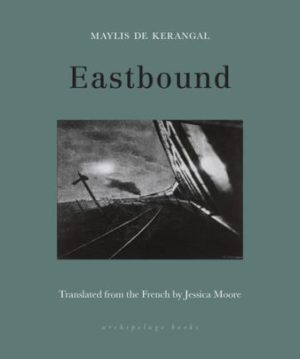
‘Eastbound’ by Maylis de Kerangal – Riding the Train through Siberia


‘Eastbound’ by Maylis de Kerangal    (2012) – 127 pages            Translated from the French by Jessica Moore


‘Eastbound’ is the story of two people boarded on a train traveling through Siberia to the far eastern Russian city of Vladivostok. One is a young Russian guy named Aliocha who is with a large group of other young guys who have been conscripted into the Russian army and now must report for duty. These guys are riding on the train in third class at the back of the train. Aliocha is not at all happy about being conscripted into the army and while on the train he decides to desert.

Or maybe he’d take advantage of a stop in some station to hightail it outta there: the guys would get out on the platform, he’d follow the crowd, pretend to be buying a pack of smokes, step away quickly and erase himself into the darkness while dodging the rounds of night watchmen.”

The other main character is a still young French woman named Helene who is in her late thirties and riding near the front of the train in first class. Helene moved to Russia, to the town of Yenisey, to be with her boyfriend Anton. Anton just got a big promotion to manage a hydropower plant in Yenisey so now he says they must stay there. Helene wants to be back in Paris and decides to run away on the train, the Trans-Siberian train to escape to Vladivostok, as far away from Paris as possible.

Who would be crazy enough to go from Krasnoyarsk to Vladivostok in order to get back to Paris? Why?”

Helene and Aliocha meet on the train.

It seems at this moment the train speeds up, a slight jolt unbalances them, she’s thrown against him and he steadies her, she laughs, not bothered, a French woman indeed, and asks Aliocha where he’s headed,”

Helene decides to help this boy desert. Both are running away from something, Helene from her boyfriend and Aliocha from forced conscription. Helene lets Aliocha stay in her compartment, to help him desert in the next town stop or the next. Aliocha fails to escape in a couple of towns they pass through, and Helene has second thoughts about helping him.

all she has to do is to look at the soldier sleeping on the bunk to feel that his presence is absurd, out of place, and to see that something’s off here, something’s short-circuited.”

The train passes by Lake Baikal, the deepest and apparently one of the most beautiful freshwater lakes in the world.

We Russians may be poor, but we have Baikal!”

So, as well as the story of these two people on a train, we get some beautiful word pictures of the Siberian landscape in this novella ‘Eastbound’. I thought the entire novella was well constructed and well written. I will be looking for more works by Maylis de Kerangal to read.


Grade :    A


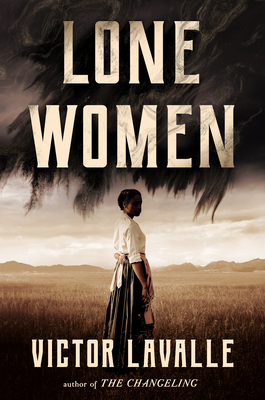
‘Lone Women’ by Victor Lavalle – A Western Smash-Up


‘Lone Women’ by Victor Lavalle    (2023) – 275 pages


There is a fine line between the highly imaginative and the preposterous. For me, ‘Lone Women’ crossed that line in many ways. I prefer my fiction to be at least grounded in some reality, to express some truth. However ‘Lone Women’ is nearly entirely far-fetched and preposterous. It is also filled with gratuitous violence.

At the beginning of ‘Lone Women’, young black woman Adelaide Henry is dumping gasoline all over her parents farmhouse in southern California and setting it on fire, then heading out to a town called Big Sandy in northern Montana. The year is 1915. In the sparsely populated Montana of that time, even a lone woman can acquire a homestead there for free if she can work the land and survive for three years.

This land overpowered people, but it hadn’t come to them, they had come to it. It wasn’t trying to kill them; it didn’t even notice them.”

Wherever Adelaide goes, she takes her enormous old heavy trunk. What’s in the trunk? I won’t tell.

I will have difficulty describing the basic absurdity of ‘Lone Women’ without giving away plot secrets, and I won’t give away any plot secrets, so just take my words for it. ‘Lone Women’ is preposterous. I suspect that for many other readers that is part of the fun of the novel. The reviewer for the New York Times found ‘Lone Women’ “almost impossible to put down”. I did not have that problem.

The whole idea of a single woman going to Montana and somehow clearing the land and working it is difficult to accept, but she does have neighbors who help her.

When people need each other, they find ways to be good,” Mr. Olsen told her. “I wish I could say better of the human animal, but I can’t.”

However, rather than becoming a realistic western story, ‘Lone Women’ becomes an unbelievable gruesome tale of horror.

The ridiculous plot did hold my interest, so perhaps I shouldn’t be so hard on it. I suspect for many readers, the more ridiculous the better.


Grade:   C


‘The Caretaker’ by Ron Rash – Well-To-Do Parents Deceive Their Son


‘The Caretaker’ by Ron Rash    (2023) – 252 pages


This poignant affecting novel ‘The Caretaker’ takes place near the eastern Tennessee border in the town of Blowing Rock, North Carolina during the time of the Korean War in 1951. The Hampton family owns the local sawmill and the general store in the town. Their son Jacob Hampton defies his disapproving parents, takes up with a poor uneducated hotel maid Naomi Clarke, elopes with her, and gets her pregnant. His prosperous parents then disinherit him. Now he is called up for military duty in Korea.

Jacob entrusts his friend Blackburn Gant to look after Naomi while he is gone to Korea. Blackburn’s face has been disfigured by polio and the townspeople avoid him. Blackburn works as the caretaker of the town cemetery of Blowing Rock. The isolation of the graveyard position suits Blackburn for one reason: “The dead could do nothing worse to him than the living had already done.” Most of ‘The Caretaker’ is told from Blackburn’s point of view.

Blackburn and Naomi, outcasts for different reasons, form a bond while Jacob is away. Naomi returns to her father’s Tennessee farm. Then Jacob is severely injured in a Korean battle and sent home.

At the center of ‘The Caretaker’ is a massive deception by the well-to-do Hampton parents when Jacob is convinced that Naomi and the baby died in childbirth and Naomi is convinced that Jacob was killed in battle in Korea. Jacob’s friend Blackburn is stuck in the middle of the Hampton parents’ scheme. Let’s just say this is one of the most hurtful deceptive plots that I’ve come across in fiction, and the author Ron Rash convinces us readers that it could happen this way. This is an original plot that is believable since well-to-do parents are so anxious that their children marry the right mates.

‘The Caretaker’ is a fine regional fiction with an original plot. It captures the rural Appalachian landscape, the hills and the trees and the flowers of western North Carolina, as well as the people. Perhaps the best way to capture a land in its essence is to focus on one small area and its people.

The novel also teaches a lesson that many in the United States have seemed to have forgotten. Is it old-fashioned for a novel to have a moral lesson, that having a lot of money tends to corrupt?


Grade :   A


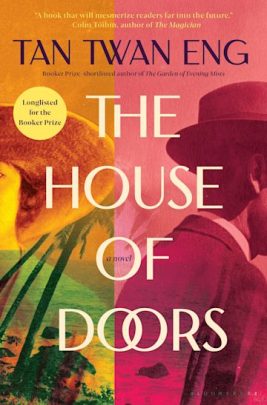
‘The House of Doors’ by Tan Twan Eng – A Colonial Novel with W. Somerset Maugham


‘The House of Doors’ by Tan Twan Eng       (2023) – 304 pages


‘The House of Doors’ takes place on the island of Penang which is a part of the country of Malaysia today, but was part of the British colony of Malaya back in 1910 and 1921 when this story unfolds. This Malaysian novel is very much in the tradition of those British novelists whose subjects often were those far-flung British colonies when the sun never set on the Empire. A few of these novelists included Joseph Conrad, E. M. Forster, Evelyn Waugh, Graham Greene, and, yes, W. Somerset Maugham. In fact, W. Somerset Maugham appears as one of the main characters in ‘The House of Doors’.

W. Somerset Maugham is a writer whose literary reputation was much higher forty years ago than it is today, and I read a lot of his fiction back then, especially his short stories. His two most famous stories, “Rain” and “The Letter”, have been made into movies several times. “The House of Doors” contains a fictional account of how Maugham may have gotten the idea for “The Letter”.  Maugham was a fine writer, probably too talented to be forgotten.

Sun Yat-Sen, first leader of the Republic of China, is another famous real person who appears in this novel.

In ‘The House of Doors’, W. Somerset Maugham, usually referred to as Willie here, and his “secretary” and male friend Gerald are visiting Penang and staying with Maugham’s married friends Robert and Lesley Hamlyn. Although Willie has a wife back in England he usually travels with his male friend. It soon becomes apparent that Willie and Gerald are more than just “friends”.

I don’t just write about adultery – I write about the human weaknesses that create these unhappy marriages – cowardice, fear, selfishness, pride, hypocrisy . . . All the emotions are found within love too, you know.”

Well, you must feel godlike, sitting in judgment over the people you put in your books.”

I’m the last person in the world to judge anyone, Lesley,” he said quietly.

The story in ‘The House of Doors” is told through the alternating points of view of the wife Lesley and of Willie. Willie is mainly looking for story ideas for his next book of stories which will be ‘The Causarina Tree’. Meanwhile Lesley has the more dramatic events occurring in her life as she faces questions in her marriage and looks for meaning beyond it which brings her to become closely involved with some of the dislocated Chinese people in Penang, including Sun Yat-Sen, who are striving to turn China into a republic.

What sustained a marriage, kept it going year upon year, I realized, were the things we left unmentioned, the truths that we longed to speak forced back down our throats, back into the deepest, darkest chambers of our hearts.”

I was never bored reading ‘The House of Doors’ and found it to be a well-written interesting read. It just did not quite have that inspired spark that would have lifted it into the stratosphere.


Grade :   B+


‘Honeymoon’ by Patrick Modiano – A Honeymoon in France During the German Occupation


‘Honeymoon’ by Patrick Modiano    (1990) – 120 pages                        Translated from the French by Barbara Wright

During World War II, from June of 1940 until August of 1944, France was occupied by German forces. During this time it was extremely dangerous to be Jewish or for the authorities to find out that you were Jewish. ‘Honeymoon’ is a novella about those perilous times in France.

The year is 1942, and Ingrid and Rigaud are staying at the Dodds Hotel and pretending to be on their honeymoon. That reassures the other guests and hotel staff.

If young people still went on their honeymoon, it meant that the situation wasn’t as tragic as all that and that the earth was still going around.”

Complicating matters, Ingrid is only 16 years old, Austrian-born, and a Jew.

While exploring the streets near the Dodds Hotel, they see this man in a city suit sitting on a bench reading a newspaper. They repeatedly run into this man, who is often seen writing things into his notebook. Was this man spying on the hotel guests, in particular on Ingrid and Rigaud?

The story in ‘Honeymoon’ is told from the point of view of someone from the outside, 40 year-old Jean who later becomes friends with Ingrid and Rigaud. Jean has problems of his own. His wife Annette is having a long-term affair with his best friend Cavanaugh. Jean is by nature an explorer and has spent most of his adult life exploring Brazil. However now he is pretending to his wife to again visit Brazil, but is actually staying in Paris.

Later in the story, it is several years after 1942, and Jean has found out about the suicide of Ingrid. He secretly investigates what happened to Ingrid and find, if possible, the whereabouts of Rigaud.

What a strange idea to come and commit suicide here, when friends are waiting for you in Capri. . . What caused her to do it I might never know.”

I have read three of these short novellas by Patrick Modiano, and ‘Honeymoon’ is my favorite so far. Modiano has a natural way with stories. ‘Honeymoon’ is very much in the style of Modiano’s other works, remembering the people we meet along our own winding, twisting way and wondering whatever happened to those we have lost contact with.

I know the life stories of these shadows is of no great interest to anyone, but if I didn’t write it down, no one else would do it,” – Patrick Modiano, ‘Ring Roads’.


Grade :   A


‘Prophet Song’ by Paul Lynch – An Irish Wife and Mother’s All-Too-Real Fascist Nightmare


‘Prophet Song’ by Paul Lynch    (2023) – 309 pages


‘Prophet Song’ begins with an ominous knock on the door. The Dublin wife Eilish answers the knock. It’s the newly formed Irish secret police, the Gardai. They want to speak to her trade unionist husband Larry. The police insist it is nothing to worry about, but they take him away since he is under investigation for agitating against the authoritarian government.

From then on, the wife and mother Eilish must fend by herself for her family. She has four children, teen Mark, adolescents Molly and Bailey, and baby Ben. Eilish finds that her family is being watched constantly. Her car is vandalized by thugs. Eilish is first sidelined in her work as a laboratory researcher and soon loses her job. Even her children are not left alone. The oldest son Mark must decide between being forced to work for the secret police or running away.

Your son was most likely detained, but you should go to the morgue.”

‘Prophet Song’ has captured the menace of our times as more countries around the world fall into fascist authoritarian rule. Somehow I don’t expect that Ireland will be one of those countries that will make this huge mistake.

I do think that ‘Prophet Song’ could have been more effectively written, that the author has made some decisions that lessen its impact. My main concern is the author’s decision to write the story in the present tense.

She turns again to face her son, thinking about how much more she has to lose, not just a husband but a son as well, grief upon grief is still more grief, watching her son as though suspended in time, his image graven to memory”

Using the present tense does lend a sense of immediacy to Eilish’s predicament as she moves from one terrible event to another involving the authoritarian government. However depth is sacrificed for immediacy. The reader does not get any insight or understanding into why or how this fascist regime got into power in the first place. Instead we get impressions and worries and dreams rather than facts.

How can I even begin to explains this to the kids, that the state they live in is a monster?”

I wish there had been more of a thoughtful consideration of how this “monster” authoritarian government had taken over Ireland.

The entire novel is written in that single note of Eilish’s desperation. It would actually be more terrifying if there were a few good times for Eilish and her family between the horrifying events. We go from one desperate scene involving this mother and her children on to the next desperate scene. That makes reading this novel rather a chore.


Grade :    B-


My Favorite Fiction I’ve Read in 2023

Another year. Here are my favorite fiction reads of 2023, and as always, fiction is all that really counts.


‘Glassworks’ by Olivia Wolfgang-Smith – ‘Glassworks’ is an intriguing and endlessly fascinating quirky family saga with one family member of each of four generations involved with working with glass in one form or another. The situations that Olivia Wolfgang-Smith creates for her characters are like no other I have encountered in fiction. They are unique and wildly inventive.


‘The Bee Sting’ by Paul Murray – Clocking in at 643 pages, ‘The Bee Sting’ was the longest novel I read this year and the most immersive. This long story of the Irish Barnes family held my interest throughout.

We’re all different, but we all think everybody else is the same, he said. If they taught us that in school, I feel the world would be a much happier place.”


‘North Woods’ by Daniel Mason – ‘North Woods’ is the captivating story of a plot of land in western Massachusetts and the people who lived there through the years from colonial times until the near present when it is now advertised as Catamount Acres. What makes ‘North Woods’ a special delight is that the author Daniel Mason’s playful enthusiasm for his material shines through. It is written with a certain esprit with warmth and intensity.


‘My Phantoms’ by Gwendoline Riley – Having read two books by Riley this year that were excellent, Gwendoline Riley was my Writer Discovery of the year.

My Phantoms’ is a daughter’s portrait of her mother, a mother she cannot love or even like very much. I found this unsentimental approach to family life entirely refreshing. The author Gwendoline Riley has a gift for getting at the root of her characters’ personalities and for noting the subtle differences between people that might cause them not to get along with each other. Mother love is not an automatic thing.
 

‘Vera’ by Elizabeth von Arnim – ‘Vera’ was inspired by the author’s disastrous second marriage. Here are some words that describe the husband Everard: ruthless, domineering, merciless, cruel, without pity or compassion, malevolent, unrelenting, vindictive, demanding, trying. There is also “his extraordinary capacity for being offended”. This is a dark comedy.


‘Time Shelter’ by Georgi Gospdinov – ‘Time Shelter’ won the 2023 International Booker Prize. In the novel, each country in Europe must vote to decide what years of their past they want to return to, which years from the past really glowed for the people in that country.

If Scandinavia couldn’t decide which of its happy periods to choose, Romania was also racked by doubt, but for opposite reasons.”

Time Shelter’ is a thought provoking novel that is quite playful and humorous at the same time.
 

‘Abyss’ by Pilar Quintana – The story in ‘Abyss’ is told by an 8 year-old girl which makes it easy to follow. Children as young as eight can sense the undercurrents that are roiling beneath the surface in their family. They have a front row seat for observing marital discord. What Elena Ferrante did for family and community life in Florence, Italy, Quintana does for family and community life in Cali, Colombia.
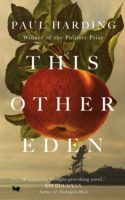
 

‘This Other Eden’ by Paul Harding This novel is based on a real incident in United States history. Malaga Island was home to a mixed-race fishing community from the mid-1800s to 1912, when the state of Maine evicted 47 residents from their homes and exhumed and relocated their buried dead. Why is the government so anxious to evict them from their island? Many of the islanders have dark features, so white racism enters into it.


‘The Queen of Dirt Island’ by Donal Ryan – There are four main characters in ‘The Queen of Dirt Island’, all of them female and each of them from a different generation.

You only get one life, and no woman should spend any part of it being friends with men. That’s not what men are for.”

The short two-page chapters in this novel made for a quick comfortable read.
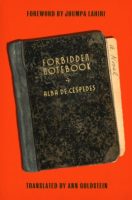
 

‘Forbidden Notebook’ by Alba de Cepedes – In ‘Forbidden Notebook’, Valeria Cassati must make entries in her notebook surreptitiously. The other family members must not find out about it, which is not so easy to do with a husband and two college age children. She does not have a room of her own in their small house. Did keeping this forbidden notebook which was hidden from her family cause Valeria to seek out a life of her own, including this forbidden romance with her boss Guido?
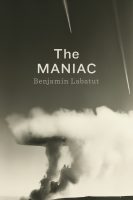
 

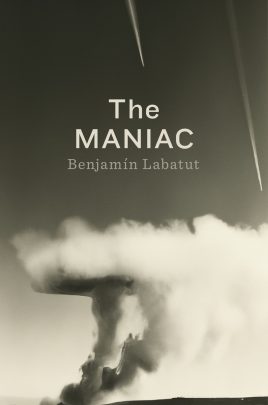
‘The MANIAC’ by Benjamin Labatut – Here is a fictionalized biography of the real mathematician and scientist John Von Neumann. Von Neumann was one of those eccentric genius types who had difficulty tying his shoes, but came up with the stored-program concept for computers which allows them to do quite a few things these days.
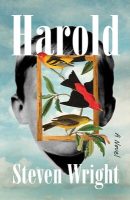
 

‘Harold’ by Stephen Wright – Harold, the seven year-old boy, is in the third grade. Mrs. Yuka is his teacher. Harold’s mind wanders, a lot.

He was in and out of paying attention like someone who was away and occasionally came by to pick up their mail.”

Of course this does present a problem for Mrs. Yuka.

The author Stephen Wright is a quite famous comedian, and ‘Harold’ is filled with the same kind of offbeat humor as Wright’s routines. Like Steven Wright, Harold looks at things from a different angle.


That’s all, folks.


‘A Shining’ by Jon Fosse – Stuck in the Woods on a Snowy Evening


‘A Shining’ by Jon Fosse    (2023) – 74 pages                         Translated from the Norwegian by Damion Searls


In ‘A Shining’, we start out with this guy driving haphazardly.

I got in this car and drove and when I got somewhere I could turn right or left I turned right, and at the next place I could turn right or left I turned left, and so on. I kept driving like that.”

Of course this aimless guy winds up getting his car stuck in the forest. He gets out of his car and while walking gets lost. In the unending forest, he first meets up with “a shimmering whiteness”, a presence. The presence says “I’m walking with you”. Later he meets his father and his mother in this dark cold forest. Is he imagining his parents?

Soon the reader realizes that we are in death allegory territory here. The language throughout ‘A Shining’ is vague and sketchy and unspecific. I suppose it was meant to be dream-like and haunting.

My mother was here. My father was here. I saw them right over there, yes, just there, right there. Right over there, yes. Or maybe it was here where I am now that I last saw my parents. Maybe they were standing right here where I am now. That’s possible, it may very well be that it was here. Yes, I almost think it was here. Yes, it was here. Now I am sure of it. It was here. Nowhere else. Not there, bu here. Here’s where. Maybe I can call out and ask where they are.”

After a couple of pages of this sleep-inducing prose, I am less than half awake. This is the longest 74-page book I have ever read.

It does not help that this entire novella is written as one long paragraph with no convenient stopping points. However I did find my own natural stopping points for the several times I fell into a sleepy trance due to the dullness of the prose.

As far as death allegories go, I found this to be an overly simplistic lame one. By keeping his allegory so general and unspecific, Jon Fosse has made sure it applies to no one.


Grade :    C-


‘The MANIAC’ by Benjamin Labatut – The Life of a Genius, John Von Neumann


‘The MANIAC’ by Benjamin Labatut    (2023) – 354 pages


There is little question that John Von Neumann was one of the most intelligent humans of the 20th century. This Hungarian Jewish mathematician, real name Janesi Von Neumann, came up with the idea of stored-programs on a computer in the early 1950s. Up until that point, computers were little more than glorified calculators. The stored-program concept allowed the same computer to be used for millions of different uses which is where we are today. Earlier he was also one of the scientists and mathematicians who worked on the Manhattan Project, the development of the atomic bomb and later the hydrogen bomb. Von Neumann was also a pioneer in artificial intelligence, and his papers on the subject are still read today.

Von Neumann was one of those eccentric genius types who had difficulty tying his shoes.

We owe so much to him.

‘Cause he didn’t just give us the most important technological breakthrough of the 20th century.

He left us part of his mind.”

First we are with Von Neumann in his birthplace of Hungary. Neumann was one of a group of scientists and mathematicians knows as the Hungarian Horsemen of the Apocalypse. Von Neumann was fortunate to be able to move his family from Hungary to the United States in 1930. In the United States he did all he could to defeat the Nazis.

It did not help, of course, that soon after he met Godel the Nazis came to power and began to persecute us, but to him that was not really a surprise, only the starkest confirmation of his total disillusionment with human decency and the ultimate proof of the sway that irrationality held over the human race.”

The maniac of the title of this novel is not John Von Neumann as some might be expecting, but instead it is the name given to the first stored-program computer. MANIAC = “Mathematical Analyzer, Numerical Integrator, and Computer”.

I often wonder if my horrific inferiority complex, which not even the Nobel Prize has diminished in the slightest, is a product of having known Von Neumann for the better part of my life.” Eugene Wigner

Benjamin Labatut’s first novel, ‘When We Cease to Understand’, was a revelation. This fiction describing the minds and lives of some of the most brilliant minds of the twentieth century was unique and like nothing I had read before. ‘The Maniac’ is more a continuation of that first book rather than a revelation.

The first 272 pages of ‘The MANIAC’ are pretty much a straight fictionalized biography of Von Neumann. However the last 75 pages of the novel make a sharp turn in another direction. As we mentioned, Von Neumann was a pioneer in artificial intelligence. The oriental game of “Go” is even more complex than Chess. In 2016, South Korean Lee Sedol was the world champion Go player. Starting March 9, 2016, Lee played a five-game match, broadcast live, against the computer program AlphaGo, developed by a London-based artificial intelligence firm Google DeepMind. After Lee Sedol lost three games to the computer, Lee finally won a game.

After defeating another human champion, AlphaGo has developed into an unbeatable force.


Grade:    A


‘Hangman’ by Maya Binyam – An Exasperating Yet Profound Read


‘Hangman’ by Maya Binyam    (2023) – 194 pages


I struggled with this novel. So much of it made little sense to me, but every once in a while there would be a stunningly original insight that would redeem my efforts to comprehend what was going on.

‘Hangman’ is a novel that pushes the boundaries of fiction. A word that is often used in the reviews for ‘Hangman’ is “enigmatic”. Perhaps my problems stem from the fact that the unnamed narrator is quite confused himself.

He has been kicked out of the country he has lived in for 26 years and returned to the African country where he was born. The author is deliberately vague about the country he was kicked out of (although there are hints that it is the United States) or the African country to which he is returned.

In the morning, I received a phone call and was told to board a flight. The arrangements had been made on my behalf. I packed no clothes, because my clothes had been packed for me. A car arrived to pick me up.”

He still has a brother, a son and an ex-wife (She is always referred to as “my son’s mother”) in this African country. I suppose returning to a country you were born in after 26 years away would be very confusing.

I wanted to apologize to everyone, myself included. I wasn’t used to being a confused person, but that was how life was. Sometimes the events of the world were clear, and at other times they rearranged themselves in such a way that nothing made sense, and even if they did, they made no discernible sense to me. Either that or I was jet-lagged, which was another possible explanation.”

The sentences are short, and the words used and the ideas presented are not at all difficult. Those are not the problems I had with ‘Hangman’. One of the main problems I did have is that our narrator is constantly running into people who are deliberately described in a surreal fashion. None of the characters are named. These encounters with assorted local people include a group of missionaries, a zookeeper, a bank teller, and a taxi driver. Even his encounters with his brother and his ex-wife seem almost aimless and arbitrary.

I thought to ask about their lives, but I was sick of hearing about people’s lives, which were made up of stories that were not even true. People liked to talk, because talking made them feel like their experiences amounted to something, but usually the talk turned those experiences into lies.”

The reviews praised ‘Hangman’ for its deadpan humor in these encounters, but in most cases I did not get the joke.

So what kept me reading ‘Hangman’? Perhaps the reviewer Houman Barekat said it best: “Refreshingly, there is none of the dreary didacticism or syrupy sentimentalism commonly found in novels about migrant diasporas.” I knew there was something important in ‘Hangman’ if only I could find it.

Meanwhile, there was one other reason I kept reading, some of the profound statements that these random characters and our narrator make. Here is one from ‘Hangman’ which applies to Putin and other authoritarians:

“The world was experiencing such an extreme consolidation and sequestering of wealth that it had become almost impossible to compete with agents of exploitation.”

Another astute insight:

No matter who was suffering, anyone could feel something for them, even people who found them abhorrent, because even abhorrent people reminded us of ourselves and all the things we had gone through or assumed we one day would.”

About politicians, Maya Binyam is particularly sharp.

She told me that politicians pretended to have personalities, but their idiosyncrasies were just traits they developed in order to get elected. For most voters, it was less important for a candidate to have a coherent ideology than it was for them to have a dog, a second home, or a familial sense of humor.”

So I found ‘Hangman’ extremely exasperating, yet also valuable. Is that even possible?


Grade:    C+


‘First Blood’ by Amélie Nothomb – A Lively Novella about Her Father


‘First Blood’ by Amélie Nothomb    (2021) – 107 pages                 Translated from the French by Alison Anderson       #NOVNOV23


A long time ago, 2009, I declared Amélie Nothomb to be a must-read author. Since then, I have read four more of her novellas, and I still consider her to be a must-read author. In fact, the novella I’m reviewing today, ‘First Blood’, won two literary prizes, the 2021 French Renaudot Prize and the 2022 Strega European Prize.

‘First Blood’ is a fictional novella based on the real events in the early life of her father, Patrick Nothomb. It starts out in 1964 in the Belgian Congo. (Yes, Belgium did have colonies, the largest being the Belgian Congo.) Patrick is a diplomat, 28 years old, and is now a hostage and is facing a firing squad.

As Patrick faces the firing squad, his life passes before his eyes. Patrick’s father was a soldier and was killed in battle when Patrick was only 8 months old.

Later, as a teenager, Patrick relates to his friend Charles :

If you only knew how much I miss having a father.”

You’ve got it all wrong. I have a father, and it doesn’t make me any wiser.”

In Shakespeare, the fathers are incredibly important; they’re magnificent. Fathers like that do exist. I’m sure of it.”

You’re reading Shakespeare?”

I blushed with shame.”

Patrick’s widowed mother constantly attends high society soirees and has no interest in raising Patrick. Thus his grandparents take the responsibility of bringing Patrick up.

In an early romance, Patrick learns an important lesson :

That debacle equipped me with a wise reflex: never fall in love with a woman until you’ve seen her lose her temper.”

Patrick would like to be a soldier, but there’s a problem. He faints at the sight of blood. Instead he becomes a Belgian diplomat which is why he is in the Congo during this turbulent time of their fighting for independence.

Amélie Nothomb moves the plot along rapidly, and I thank her for that. While some writers will get bogged down for hundreds of pages discussing some plot point, Nothomb will move on to an entirely new scene. She writes lively, often humorous, little novellas.


Grade:   A


#NOVNOV23


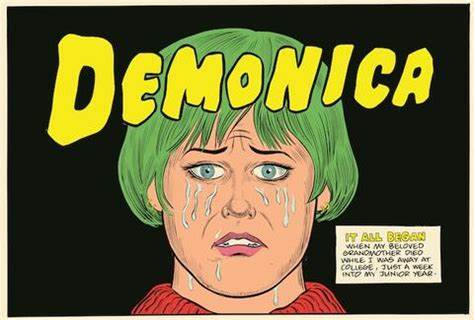
Monica’ by Daniel Clowes – Demonic


‘Monica’ by Daniel Clowes, a graphic novel (2023) – 106 pages


What a wild and wicked ride ‘Monica’ is.

We start out even before Monica is born. Johnny is fighting over in Vietnam. His girlfriend, back in the US, gets caught up in the spirit of the times, the hippy spirit of free love and sexual liberation. She sleeps around, gets pregnant, and has the baby Monica. For a few years, Penny stays with her child, but then she takes Monica to her parents’, the grandparents’, home.

From that moment on,” Monica says, “I lived a normal life, happy and safe from harm, but I never saw my mother again.”

From then on, we get chaotic episodes from Monica’s life, from early childhood to old age. After a relatively uneventful childhood, Monica’s college years wind up with a car crash which leaves her in a temporary coma. After she recovers Monica finds financial success by opening a candle business which eventually burns down.

Meanwhile Monica avoids any involving relationships, but she has an ever persisting quest to reunite with her mother and to find her father, whoever he may be. She hears that one of Penny’s old boyfriends, Krug, is the leader of a demonic cult called The Way, Monica decides to infiltrate the cult and perhaps find her mother and figure out who her real father is.

The last episode takes us into current times.

Like many others, ours is a divided town, with us hippy artists on one side and gross redneck idiots on the other. We used to all get along but, as you know, those days are over.”

She does finally find her father, now a businessman living in a suburb with his wife and three children.

It’s quite a blow to discover after a lifetime of fairy-tale fantasies that you are not really special, just the unwanted fetus of two random fuck-ups caught in a confusing historical moment.”

My rather straightforward account of ‘Monica’ leaves out the phantasmagoric effects of the cartoon drawings, the black comedy of this woman’s life, and several of the more devastating otherworldly plot twists. Those looking for down-to-earth realism need not apply, yet Daniel Clowes has many mordant ironic insights into life as it is lived today. ‘Monica’ definitely pushes the boundaries of what a graphic novel can be.


Grade:    A


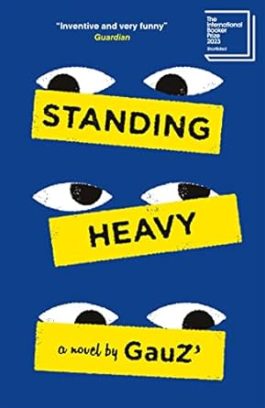
‘Standing Heavy’ by GauZ – Black African Security Guards in Ritzy Paris Fashion Shops


‘Standing Heavy’ by GauZ      (2014) – 167 pages         Translated from the French by Frank Wynne         #NOVNOV23

‘Standing Heavy’ is a fun humorous novella about black men from Africa working as security guards in the posh clothing and perfume shops in the Champs-Elysee in Paris, France. This novella was shortlisted for the 2023 International Booker Prize but did not win.

It is the 1990s, and the fashion shops in Paris are looking for somebody they hardly have to pay any money to to stand in their stores and intimidate the customers so they don’t shoplift.

Training is absolutely minimal. No experience is required. Employers are all too willing to overlook official status.”

The morphological profile for the job of security guard makes black men very much appropriate for the job:

Black men are heavy set. Black men are tall; black men are strong; black men are deferential; black men are scary.”

The author GauZ can make fun of black Africans because he is a black African himself.

So the job mostly requires the security guard to “stand heavy” to intimidate the customers to not shoplift, although occasionally he must confront a customer he suspects of stealing merchandise or when the customer’s shopping bag sets off the metal detector when he or she leaves the store.

Most of ‘Standing Heavy consists of short witty vignettes describing various facets of these black security guards’ jobs. Since these Paris fashion shops attract customers from all over the world, some of the vignettes show how customers from various countries behave. For example, one explains the difference between Chinese shoppers and Japanese shoppers. In another, the Camaieu axiom is presented:

In a clothing store, a customer without a bag is a customer who will not shoplift.”

However after 9/11/2001, everything changed. Kassoum, one of the black security guards, watches as 9/11 takes place on TV :

White people, as Kassoum knew, always did things by the book. Not like this. Not without debates in Congress, round tables at the UN, press conferences, solemn declarations and a bunch of hoopla to prove they were civilized people before they went out and slaughtered each other like savages.”

Soon all the black security guards in these Paris fashion shops were let go, replaced by white security guards. However, after a few years, there was such a huge demand for low-waged baggage checker security guards due to 9/11, many of these black men were hired for that purpose.

‘Standing Heavy’ was a very pleasant interlude for my reading.


Grade:     A


#NOVNOV23


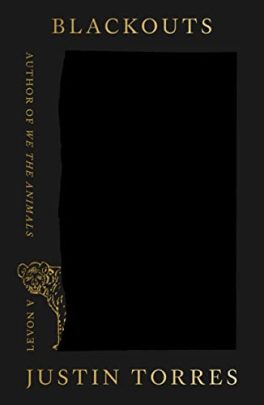
‘Blackouts’ by Justin Torres – A Brave Mix of the Real and Fiction


‘Blackouts’ by Justin Torres    (2023) – 297 pages


‘Blackouts’ is a brave work of art.

For the two main protagonists in this novel, the old man Juan Gay and the nameless young man narrator, their homosexuality is a given. They both have been put in jail for it. They have been sent to the loony bin for it. In fact they met in the loony bin where both of them had been locked up due to their homosexuality. Juan had befriended the younger scared teenager there. Now, ten years later, Juan Gay has gotten old and is dying, and our young man who Juan just calls “Nene” (baby) is there to provide Juan some company during his last days. There are hints that the events in the novel take place in the early 2000s. Both men are Puerto Rican.

Juan shows his young friend a two-volume book that Juan has carried around with him for many years, ‘Sexual Variants: A Study of Homosexual Patterns’. This is an actual real book published in 1941 that still exists. In the 1930s, during a short time frame when homosexuality was more accepted, an outgoing lesbian woman named Jan Gay (real name Helen Reitman) got permission to interview eighty of her gay friends, 40 men and 40 women, and write down those interviews. The interviews would show the basic day-to-day humanness of these people. However after she had completed this work, one of her bosses took her only copy and blacked out huge sections of it, because he insisted that homosexuality be still treated as a disease. Hence the title of this novel is ‘Blackouts’. Throughout the novel ‘Blackouts’ real pages from ‘Sexual Variants’ are reproduced with most of the verbiage blacked out. This was a lost opportunity for the public to better understand and accept homosexuality.

When Juan Gay was still a small boy, he was adopted for a time by Jan Gay and her gay friend illustrator Zhenya, and he was used as a model for the books they wrote for small children. (This part of the story is fiction.)

Most of ‘Blackouts’ is about these two men telling each other stories from their lives to entertain each other. Both know that Juan is dying, but the younger guy will need to get on with the rest of his life afterwards.

Justin Torres got the inspiration for ‘Blackouts’ from the novel ‘Kiss of the Spider Woman’ by Manuel Puig and the movie from 1985 which was made from that novel. What was unusual about ‘Kiss of the Spider Woman’ was that, despite its gay theme, it became widely popular with a general audience and won many awards. I suppose another example of a gay-themed work finding general acceptance is ‘Brokeback Mountain’.

I have read and really liked Justin Torres’ widely praised previous novel ‘We the Animals’. I expect that ‘Blackouts’ will also find acceptance and praise from a wide general audience.


Grade:   A-


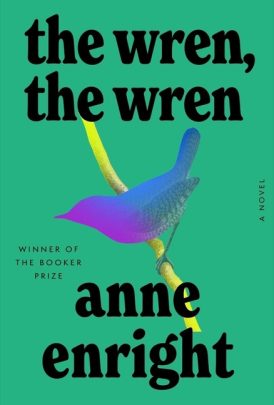
‘The Wren, the Wren’ by Anne Enright – The Poet with a Self-Important Heart and his Family


‘The Wren, the Wren’ by Anne Enright (2023) – 273 pages


In ‘The Wren, the Wren’, Phil McDaragh is a famous Irish lyric poet. His nature poems about the flora and fauna of Ireland, a number of which are reprinted in the novel, have brought him renown beyond Ireland. ‘The Wren, the Wren’ is the story of his first family over many years, mainly from the perspective of his daughter Carmel and granddaughter Nell.

In the first chapter, the granddaughter Nell is already 22. Phil is dead. Nell is in an abusive relationship with her boy friend Felim.

I found it hard to tell the difference between sex and getting hurt in other ways.”

And then we jump back in time and we get some of the history of this family. The poet Phil and his wife Terry are married, living in Dublin. They have two daughters, Carmel and Imelda. When Carmel is 12, her mother Terry had to have one of her breasts removed and she has taken abed for a while. This is when Phil decides to move out and get divorced.

They lived together in Dublin for some time he said, but she got sick, unfortunately, and the marriage did not survive.”

This is the first sign that this famous poet Phil McDaragh is not all that he is made out to be, not such a nice fellow. Phil goes to the United States, and meets a younger woman there whom he marries. Not only did Phil desert his Irish wife when she was ill, he left her with the debts he incurred in Ireland after he left her.

It was so easy to hate this man – the facts spoke for themselves – but it was still hard to dislike him. And it was devastatingly easy to love him.”

Next we jump forward to when Carmel is a young woman. She finds herself pregnant. The father could be several guys that she has slept with, and Carmel decides to keep the baby, Nell, on her own.

She had not been a good mother. Carmel knew that. All the love in the world would not make her a good mother. It was always such a wrangle. She could not hold her daughter, and she could not let her daughter go. “

Nell herself goes through some wild times as a young woman just as her mother Carmel had. Will she ultimately right herself? That is the question.

Later Phil’s American wife writes Nell a letter containing the following line:

We who loved Phil knew, on some level, that we loved him not in spite, but because of his ‘badness’ in those days, that was quite the thing.”

And Carmel remembers a time with her father:

With his fake modesty and feigned sorrow. Her father was up there being a bastard for all time.

 He had a self-important heart.”

Somehow Phil’s poetry, some of which is reprinted in the novel, seemed more like fake poetry than real poetry to me. It is fictional.

‘The Wren, the Wren’ does show the profound effect that the behavior of someone in one generation can have on their future generations.


Grade :    B