Archive for the ‘Book Reviews’ Category

‘The Short End of the Sonnenallee’ by Thomas Brussig – East Berlin Teens Living on Sunny Avenue


‘The Short End of the Sonnenallee’ by Thomas Brussig    (1999) – 137 pages      Translated from the German by Jonathan Franzen and Jenny Watson


Sunny Avenue” might be a misnomer for this street, especially for the small part of the street which was assigned to the Russians and East Germany. The people there live next to the death strip where the armed guards will shoot on sight anyone attempting to cross over from East Berlin to West Berlin. But the teenagers on the street, being teenagers, go about living their lives anyhow. Contrary to all expectations, this is a humorous novella about boys and girls making the best of a bad situation.

Immediately after World War II, Germany and Berlin were divided up between the Russians and the Allies. According to Thomas Brussig in ‘The Short End of the Sonnenallee’, Truman, Stalin, and Churchill were negotiating the fate of Sonnenallee after World War II. Churchill’s cigar went out, Stalin relit Churchill’s cigar, and then the grateful Churchill gave Stalin and Russia a small part of Sonnenallee. This is the short end of the Sonnenallee which wound up behind the Iron Curtain.

The teenage boys on the short end of the Sonnenallee are obsessed with two things: teenage girls, especially Miriam, and rock music from the West. These teenagers will do just about anything, spend any amount of money, to get their hands on a Rolling Stones album which is one of the many items that are illegal.

When the wind blows Micha’s first love letter from Miriam into the death strip even before he has read it, he and a friend try to “fish” it out with no success.

Uncle Heinz visiting from the West, tries to smuggle things in for the family, but the things he tries to smuggle are things that are already legal anyhow.

Somehow the author Thomas Brussig winds up with a quite funny story under the worst of circumstances.

I’m a painter, but what’s there to paint here? You only need one color – gray. You’ve only got one look on your face, and that’s being sick of it … What are you supposed to paint with bright colors? Man, it’s like they’re even clamping down on color.”

I doubt that the humor could have been sustained for an entire full novel’s length, but as a novella it works fine.


Grade:   A-


‘Small Mercies’ by Dennis Lehane – Counteracting White Hate in South Boston


‘Small Mercies’ by Dennis Lehane   (2023) – 299 pages


Being almost entirely a “literary” reader, I usually don’t pay much attention to best seller lists or the books that are on them. However once in a while , one of these best sellers will capture my interest. Dennis Lehane’s crime thriller ‘Small Mercies’ tempted me to see how Lehane would handle it in these times when there seems to be so much racial hatred by white people going around.

The year is 1974. Mary Pat Fennessey has lived in South Boston, Southie, all her life. She has already lost her Vietnam vet son to drugs, and now her daughter has turned up missing.

You raised a child who thought hating people was okay. You allowed that hate, you probably fostered it. And your little child and her racist friends, who were all raised by racist parents just like you, were sent out into the world like little fucking hand grenades of hate and stupidity.”

1974 was the year that school busing was proposed. The idea was to bus students from predominantly black neighborhoods to schools in predominantly white neighborhoods and visa versa. Of course only in the poorer neighborhoods was busing to take place. Thus racial tensions were high.

In Southie, there is a group of white men, the Butler crew, who run things and supposedly fix things in the neighborhood. The Butler crew has a lot of cops on their payroll.

Mary Pat, in her search for her daughter, has the help of a good cop, Bobby Coyne. Bobby tells Mary Pat about his parents:

But they also weren’t racists, Something about the idea of it – the pure irrationality of it – offended them. They didn’t think black people were necessarily good, don’t get me wrong, they just thought that everyone – regardless of what color they were – was probably an asshole. And to say you were less of an asshole because your skin was lighter was reprehensible to them. It just made you a bigger asshole.”

‘Small Mercies’ is a page-turner, a propulsive read. There is a lot of vigilante justice. Once I started reading, I found it difficult to stop, and that’s something I really like in my fiction. It has few of the subtleties I usually expect from fiction, but for this one time only that is OK.

…and he considers the possibility that maybe the opposite of hate is not love. It’s hope. Because hate takes years to build, but hope can come sliding along the corner when you’re not even looking.”


Grade:    A-


‘Glassworks’ by Olivia Wolfgang-Smith – “Life is the Cause. One Must go Mad Sometimes.”


‘Glassworks’ by Olivia Wolfgang-Smith    (2023) – 354 pages


‘Glassworks’ is an intriguing and endlessly fascinating quirky family saga with one family member of each of four generations involved with working with glass in one form or another.

The first generation takes place in 1910 and centers on Agnes and the Bohemian glass modeler Ignace Novak. Ignace makes delicate glass sculptures of flowers and bees, etc. He has become world famous in his glass artistry, and Agnes brings him over to Boston for her company to sell his sculptures.

Agnes and Ignace. Their first names even rhyme. Except Agnes already has a husband, a mistake.

Was an unhappy marriage enough to ruin a woman?”

One day when Agnes shows up at his studio with bruised ribs, Ignace tells her,

He harms you. He is harmful.”

When two people are right for each other as Ignace and Agnes plainly are, a bold solution may be required. The reader will be hooked irretrievably after reading this first section.

In the second generation in 1938, their son Edward installs decorative windows for libraries and other public buildings. Edward only got the job because his boss admired Edward’s father’s work. Edward is clumsy and liable to break any glass he is working with and cut himself in the process. Agnes and Ignace are happily married, away from Boston, and intent on pursuing their own interests; they often forget about Edward. Edward is in quite desperate circumstances until he meets Charlotte.

In the third generation taking place in 1986, Edward and Charlotte’s daughter, simply known as Novak, washes the windows on New York City skyscrapers.

But Novak also worked with glass. She knew about distributing pressure, about not pushing something so hard it broke.”

Much of this section takes place in a Broadway theater during a performance of the play “Dames in Love”. Novak becomes fascinated with one of the actresses, Cecily, and tries to help her with disastrous results.

Novak had baptized them in fire, by hurting Cecily the way only family could hurt you.”

The fourth and last section in 2015 focuses on Cecily’s daughter Flip. Flip also works with glass:

The system” at Solid Memories was simple. Customers sent in cremains – at least three tablespoons – from a loved one or pet. They chose an ornament design and color from the catalog. And they waited to receive a glass sculpture – “not a paperweight,” Martin said; “you gotta be careful with folks on this verbiage” – shot through with the ash of their departed, twirled and pigmented into purposeful abstract designs.”

In each of these four generation stories, our main protagonist or protagonists gets themselves into a desperate situation by virtue of their own defects or wrong turns. The reader becomes heavily involved in their plight to the point where the reader is hanging on to every sentence. Finally our protagonist or protagonists reach some totally unexpected resolution to their plight. These situations that Olivia Wolfgang-Smith creates are like no other I have encountered in fiction. They are unique and wildly inventive.


Grade:   A+


‘Knowledge of Hell’ by Antonio Lobo Antunes – An Over-The-Top Diatribe Against Psychiatry


‘Knowledge of Hell’ by Antonio Lobo Antunes    (1980) – 298 pages                 Translated from the Portuguese by Clifford E. Landers


The Portuguese writer Antonio Lobo Antunes published ‘Knowledge of Hell’ when he was 38 years old. At that point he was only a part-time writer, and he still had a psychiatry practice in Lisbon, but by this time he was absolutely disgusted with his chosen profession. In this novel Antunes puts in all the venom that he has accumulated over the years toward psychiatry.

The main character in this impressionistic fever dream of a novel with its unstoppable stream of metaphors is Antonio Lobo Antunes himself. He is about 40 years old and is looking back on the hellhole that his life has been so far. After college, he had been sent down to Angola as a medic with the Portuguese army in their nasty fight against Angolan independence. After Portugal finally withdrew from Angola, he came back to Portugal to become a psychiatrist in a mental hospital. His wife Isabel by whom he had two children divorced him recently.

Wasn’t it you who said psychiatry is the most noble of the medical specialties?” he asked. “Shit, if I’d known what I know today I’d have been a dentist.”

The previous lines are Antunes’ most mild criticism of psychiatry. Here is his more typical criticism of their treatment of mental patients:

We have amputated them from past and future and reduced them, through injections, shock treatment, insulin-induced comas, to obedient animals with expressions grounded by apathy and fear.”

The psychiatric office is shown to be a place where “anyone who enters here, he ends up losing”. Antunes also has a negative opinion of his fellow psychiatrists:

the dream of guys like these is to be psychiatrists by divine prerogative, to be right by papal infallibility, to impose their pompous and melancholy order on the disorder of others”

We get Antunes’ full diatribe as he with his daughter Joanna drive to the beach:

I’m going to get away from this shit for a while, get away from this benign concentration camp, this pathetic inferno, my monotonous job of distributing pills.”

Daughter Joanna is the only benign being in this novel.

Later Antunes visualizes what it would be like if the other doctors decided to put him in the mental institution too. Then things take a phantasmagorical turn toward cannibalism when we get a full dinner party of psychiatrists, mental patients, and even soldiers from Angola where the main course of the dinner is Antunes himself.

Antunes is a writer with whom the reader is constantly in danger of getting too much – too many metaphors, too many adjectives, too many lists, too many abrupt story turns, too many off-the-wall characters, too many long, long sentences, too much venom, too much craziness. Or as Wikipedia puts it, “His style is considered to be very dense.” Did I mention that ‘Knowledge of Hell’ is also quite humorous at times too?

Readers who are reading translations are at the mercy of the translator, and I wonder what my opinion would have been if I had read a different translation.

However anyone who has their own doubts about the mental health industry would do well to read this account by this jaundiced insider, Antonio Lobo Antunes.


Grade:   B


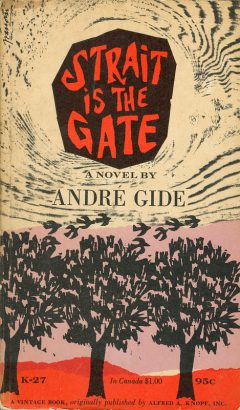
‘Strait is the Gate’ by Andre Gide – Pure Unadulterated Love Between Cousins

‘Strait is the Gate’ by Andre Gide  (1909) – 102 pages                  Translated from the French by Dorothy Bussy


This novella is the love story between two cousins, Jerome and Alissa, which begins when they are still very young, adolescents. No mention is made in the novella that a love between cousins might be inappropriate.

As cousins, Jerome and Alissa have always been close, but when they find Alissa’s mother making out with an army officer not her husband, the two children become even closer.

With my mind rapt and as in a dream, I saw my aunt’s room; I saw her lying there on the sofa, laughing; I saw the brilliant officer laughing too… and the very idea of laughter and joy became an offence and an outrage, became, as it were, the hateful exaggeration of sin.”

The next day Alissa’s mother runs off with the officer and leaves her family. After this shock, Jerome becomes devoted to Alissa while Alissa becomes devoted to her religion, rejecting human love. Alissa still is close friends with Jerome, but deep down Alissa has rejected Jerome as anything more than a friend. Jerome does not know this.

Jerome is so enamored of Alissa that he does not notice that her sister Juliette has fallen completely in love with him. Jerome can see only Alissa in his future, and Juliette must settle for a guy she doesn’t really love.

‘Strait is the Gate’ is what would be called an epistolary novel as much of it is taken up with the letters between Jerome and Alissa as well as entries from Alissa’s journal.

The reasons which make me fly from him? I no longer believe in them…And yet I fly from him, sadly and not understanding why I fly.”

Meanwhile Jerome remains unmarried, still longing for Alissa. I did not fully understand Alissa’s motivation for removing Jerome, the one person who truly loves her, from her life. Perhaps her mother’s behavior has caused Alissa to feel unworthy of Jerome.

Was he not born for something better than to love me?”

This short novella held my interest throughout.


Grade:   A-


‘Intimate Ties’ by Robert Musil – DO NOT READ the second Novella, ‘The Temptation of Silent Veronica’


‘Intimate Ties’ by Robert Musil   (1911) – 206 pages                     Translated from the German by Peter Wortsman


In my continuing quest to read more fiction by the German writer Robert Musil who wrote one of the most brilliant long novels of the twentieth century, ‘The Man Without Qualities’, I stumbled upon this short work called ‘Intimate Ties’ consisting of two novellas. A short work by Robert Musil – what more could I ask for? His short novella ‘The Young Torless’ is also excellent, and I was hoping for another one of that caliber.

It turns out I should have done some more research on ‘Intimate Ties’ before diving into it. What did the critics say of it?

Michael Hoffman dismisses the entire work.

Intimate Ties is one of those regrettable publications that hurts the reputations of everyone connected with it: Musil’s own, the translator’s, and even the luckless publisher, Archipelago. The novellas themselves are very strange: very slow, very interior, minutely analytical, and revolving around frankly pornographic subjects: being sodomized by a stranger in “The Culmination of Love,” a childhood recollection of bestiality in “The Temptation of Silent Veronica.” But we are not talking Anaïs Nin here. Musil’s overall effect is about as untitillating as the contemporary paintings of Gustav Klimt (themselves described as so unerotic, they were an argument for chastity), and indeed the author might have set himself the challenge or exercise of rendering such material opaque, decorative, somehow theoretical. His lens is so thickly smeared with verbal Vaseline that if there is any “action,” the reader can barely follow it.” – Musil’s Infinities, Michael Hoffman, NYBR

One might describe Intimate Ties as weird, finical, oversubtle, probably misconceived, and in the end barely readable, one of the stranger and chillier blind alleys in literature. It is also shockingly badly translated. This is the more upsetting as Peter Wortsman is not a beginner but an experienced operator. (He has even translated a book of Musil’s before: Posthumous Papers of a Living Author, back in 1987.)” – Musil’s Infinities, Michael Hoffman, NYBR

While the critic Hoffman dismisses the entire work, J. M. Coetzee only dismisses the second novella and finds much to like in the first novella, ‘The Culmination of Love’.

Musil’s later attitude toward this story—which appeared in company with the much inferior “The Temptation of Quiet Veronica” in 1911—is an interesting one: though it remained the only one of his works he could bear to reread, he dissuaded friends from venturing upon it. It was so obscure he said, so much a matter of “the artist’s arcana,” that the ordinary reader was all too likely to respond with “revulsion.” – On the Edge of Revelation, J. M. Coetzee, NYBR

I totally agree with Coetzee’s attitude toward both novellas. The second is much inferior, and I will dismiss it from further consideration. However I do agree with Coetzee that the first novella has considerable merit. It is written from the point of view of the young married woman Claudine.

She loved him, even as she contemplated how to hurt him in the worst way possible.”

Claudine is traveling by train to visit her 13 year-old daughter whom she had before she met her husband. She starts remembering that time before she was married. In her early days, she remained “under the sway of any men who crossed her path, for whom she was then prepared, to the point of self-sacrifice and a complete abandonment of will, to do anything they asked of her”.

After she met her husband, that all changed.

All she had done and suffered in the past was repressed the moment she met her present husband. From then on, she lived a life of quiet and solitude.”

However this train trip is bringing her previous life back to her. There is a sales man sitting across from her who is giving her the eye.

And suddenly she felt a dark longing for her life before, that time of mistreatment and exploitation by strangers.”

There is a snowstorm, and the passengers on the train are snowed in at a small hotel for several days.

The translation of the first novella is just clear enough for the reader to follow and the translation of the second novella is near incomprehensible.


Grades :

First novella : ‘The Culmination of Love’ –      A-

Second novella : ‘The Temptation of Silent Veronica’ –      D


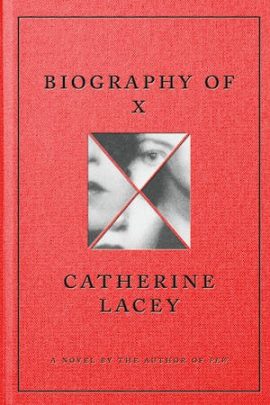
‘Biography of X’ by Catherine Lacey – Performance Artist and Avant-Garde Celebrity X


‘Biography of X’ by Catherine Lacey   (2023) – 389 pages


C.M. Lucca wrote this meticulously researched and documented second biography of the deceased woman X after Lucca read and was extremely dissatisfied with the first biography. After all, Lucca left her husband to become the wife of X, so she should know a thing or two about the life of X. Besides, in that first biography Lucca was referred to as a “mousy little nobody”. Lucca herself admits that others often see her as plain and glamourless, whereas X is an avant-garde celebrity, a media monster. Meanwhile Lucca has a score to settle with her dead lover X.


However many of her performances, paintings, and sculptures seem a little heartless to me now, designed not to evoke real feeling, but to get a reaction or a check.”


Our new biographer C.M. Lucca knows very little about the early life of X, so she travels to the Southern Territory to Mississippi where X was born as Caroline Luanna Walker in 1945. You see, the Christian Coup of the Southern Territory had built a wall and broken off from the rest of the United States in 1945 when Emma Goldman became President Roosevelt’s Chief of Staff. This was the Great Disunion. Instead of a United States we had a Northern Territory, a Southern Territory which was a violent theocratic dictatorship, and later a Western Territory.


After “an act of terrorism against a despotic government” known as the Revelation Rifle Affair in 1968, Caroline had to leave the Southern Territory in a hurry and she had to assume a different identity. After that she assumed several different identities until she finally became just X in 1982. At various times she was Dorothy Eagle, the singer/songwriter Bee Converse, the writer Clyde Hill, Martina Riggio, the writers Cindy O. and Cassandra Edwards, the artists Yarrow Hall and Vera, She has been influenced by Andy Warhol and much of what she does is performance art.


There are never any conclusions with people, he said, are there ?”


X becomes famous in the bohemian scene in New York City Along the way, a number of renowned real-life people show up in X’s life. These include the writers Dennis Johnson and Kathy Acker and musicians David Bowie, Patti Smith, Connie Converse, and Tom Waits.


In this highly detailed fake biographical work, I suspect there are many “in” jokes which I mainly missed, not being conversant with the New York art scene. And was it really necessary to rewrite United States history in order to tell X’s story?


This fictional biography is steady and workmanlike, but for me it lacked that definite spark of style or enthusiasm that would have put it over the top. Part of the problem for me was that the colorful story of X requires a more flamboyant outrageous telling than this mousy little nobody C.M. Lucca is capable of.


Grade:   B


‘The Eyes & the Impossible’ by Dave Eggers – Where All the Main Characters are Animals.


‘The Eyes & the Impossible’ by Dave Eggers   (2023) – 249 pages


There is Sonya the squirrel, Angus the raccoon, Bertrand the sea gull, Yolanda the pelican, Helene the goat, and of course, Johannes the dog who narrates this story of this group of animals, each with their disparate skill, working together to accomplish a critical goal.

Yolanda landed with her usual chaos-clatter of wings and feet. Yolanda is a pelican, and a clumsy one, which is saying something, given all pelicans are clumsy, ungainly, unlikely in their shape and ludicrous in their flight.”

Freya, Meredith, and Samuel are bison; they have ruled the park for millions of years or more But wouldn’t they be happier on the mainland instead of on this tiny island?

When I heard about ‘The Eyes & the Impossible’ by Dave Eggers, my first impulse was to compose a list of all the adult novels I had read in which all the main characters were animals. However I found there were very few of these novels. My list did not extend much beyond ‘Watership Down’ by Richard Adams and ‘Animal Farm’ by George Orwell.

It seems to me that writers are missing a good bet by not writing more of these anthropomorphizing novels for adults that we remember so fondly from our childhoods.

When I was a child there was an entire series of children’s books by Thornton Burgess called Old Mother West-Wind which included as characters Peter Cottontail (later to be known as Peter Rabbit), Jimmy Skunk, Sammy Jay, etc.

As a kid, I did not read superhero comic books; instead I read comics with Donald Duck, his girlfriend Daisy Duck, his nephews Huey, Dewey, and Louie, and his rich Uncle Scrooge McDuck. And then there was Bugs Bunny, Elmer Fudd, Porky Pig, and their gang.

When I became a parent, I found that many of the books for little children had animals as their main characters such as the Russell Hoban series about the badger Frances – ‘Bedtime for Frances’, ‘Bread and Jam for Frances’, etc. George and Martha in the James Marshall series are two hippos. Then there were the ‘Curious George’ books about a funny little monkey.

There is something innately humorous about having animals talk and act like humans, and ‘The Eyes & the Impossible’ captures that. They are advertising this book for readers of all ages.

I doubt that it will be a classic like ‘Watership Down’, but it was a pleasant enough time for me reading this book.


Grade :   A


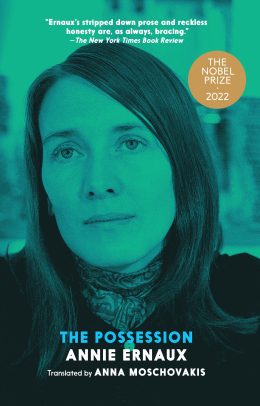
‘The Possession’ by Annie Ernaux – Possessed by Jealousy


‘The Possession’ by Annie Ernaux   (2002) – 62 pages           Translated from the French by Anna Moschovakis


In ‘The Possession’, a woman tells of being possessed. Her boyfriend of six years has gone off to live with another woman. She is possessed by a profound jealousy of this other woman.

This woman filled my head, my chest, and my gut, she was always with me, she took control of my emotions.”

As is the case with many of the works of Annie Erbnaux, ‘The Possession’ could be called a semi-fiction, part memoir and part fiction. Another phrase to describe ‘The Possession’ would be to call it an autobiographical novella.

The strangest thing about jealousy is that it can populate an entire city – the whole world – with a person you may never have met.”

Here she goes through all the stages of jealousy. First she wants to find out exactly who this other woman is, so she plays guessing games with her ex-boyfriend who she still sees on occasion.

He had not wanted to tell me her name. This name was a hole, a void around which I turned in circles.”

She asks him to tell her the first letter of the other woman’s first name. At one point she admits that her thoughts had turned murderous toward this other woman.

In the self-erasure that is the state of jealousy, which transforms every difference into a lack, it was not only my body, my face, that were devalued but also my occupation – my entire being.”

However, by the end of this novella, she no longer has any desire to know anything about this other woman. She has moved on.


Grade:   A


‘Vera’ by Elizabeth von Arnim – Inspired by the Author’s Disastrous Second Marriage


‘Vera’ by Elizabeth von Arnim    (1921) – 164 pages


The Vera in the title of this novel is dead before the novel begins. Vera supposedly fell out of the window of her upper floor sitting room. There was an inquest.

Vera’s husband’s name is Everard Wemyss.

Lucy Entwhistle has also suffered a loss. Her widowed father has just died, quite a loss for the 22 year-old Lucy.

It is as though Everard intentionally walked by her house in order to meet and commiserate with Lucy over their losses. Everard is a take-charge guy, and he uses their shared losses as a pretext to starting a relationship with Lucy, even though it has only been days since his first wife died.

That settles it. We two stricken ones must fall together.”

Everard Wemyss is 45 years old.

From the beginning Lucy has doubts about Everard and his previous wife Vera, but Everard presses on with their relationship.

Here are some words that describe Everard : ruthless, domineering, merciless, cruel, without pity or compassion, malevolent, unrelenting, vindictive, demanding, trying. There is also “his extraordinary capacity for being offended”.

for she had offended him again, and this time she couldn’t even remotely imagine how”

Still, he talks Lucy into marriage, although her friends express their doubts. Lucy is vulnerable, “unquestioningly acquiescent”.

After the wedding, Lucy must sleep in the bed Vera slept in and even use the sitting room where Vera met her tragic fate. Lucy begins to question if it was an accident.

Everard has an extensive library, but he doesn’t want anyone else, including his young wife, to read or mess up his books. If she wants to read one of his books she must ask him for the key, tell him what books she plans to read, and read them in the library itself.

In ‘Vera’, there is an undercurrent of laughing at this cruel fool, Everard Wemyss, who is so proud of himself, yet has no real understanding of what life is like. That is why ‘Vera’ is often called a dark comedy. Elizabeth von Arnim herself considered ‘Vera’ her “high water mark” as a writer, even higher than her widely read ‘The Enchanted April’.

‘Vera’ is very well-written and a scarily effective depiction of a very bad marriage. This one is vivid and you will remember it.


Grade:   A


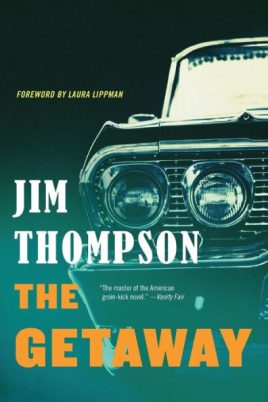
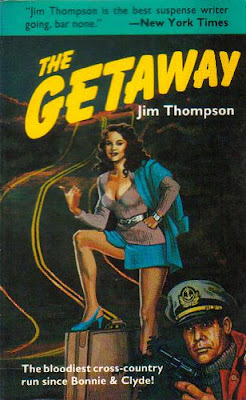
‘The Getaway’ by Jim Thompson – A Bank Robbery and a Getaway by an Adept Career Criminal and his Wife


‘The Getaway’ by Jim Thompson   (1959) – 205 pages


In ‘The Getaway’, Doc McCoy is a very smart dedicated career criminal.

Doc was made for crime, the truly big operations which he rapidly moved into.”

Doc McCoy can even see the up side of getting caught and being put in prison.

He liked his work. Beginning a stiff sentence at age twenty-five, he still remained committed to it. His take for the last five years was more than a hundred thousand a year. For that kind of money, a man could afford to sit it out for awhile. He could use his enforced leisure to relax, make new contacts, improve his criminal knowledge, and plan new jobs. Doc’s ensuing eight years were entirely comfortable and often enjoyable.”

However when Doc gets caught a second time, they give him a longer sentence. He asks his wife Carol to meet with the warden and bribe him to get him out of prison. The warden and Carol agree to a deal where Doc is released from prison and then Doc will plan and execute a large bank robbery with the warden getting a share of the loot. Doc wonders what else was part of the deal between his wife and the warden.

The bank robbery is successful, although a bank guard is murdered. Doc also shoots one of his accomplices, Rudy Torrento, who is no longer useful to Doc. Doc also shoots the driver of a car which he then steals, and Doc and Carol begin their getaway. Unknown to Doc, Rudy is still alive and when he recovers, he trails after Doc for revenge and murder.

‘The Getaway’ is written from the point of view of the criminals rather than law enforcement. I believe the secret to the success of Jim Thompson is that he can think like an adept criminal. Several times I was impressed with Thompson’s understanding of the details of crime. Since we are seeing events through the eyes of the criminals, we begin to root for them. It requires a lot of knowledge to pull off a successful bank robbery and get away with it. Doc and Carol become the most-wanted criminals in the country.

‘The Getaway’ is most cynical like a good crime novel should be. Even Honest Johns can be bought if you approach them the right way.

However I found the ending of ‘The Getaway’ somewhat questionable. Up until that point we have a quite straightforward crime story, albeit with quite a few murders. However the ending is quite surreal, and this ending was scrapped for the famous movie version of ‘The Getaway’ directed by Sam Pekinpah and starring Steve McQueen and Ali McGraw in 1972. I don’t blame them for scrapping the ending.


Grade:   B+


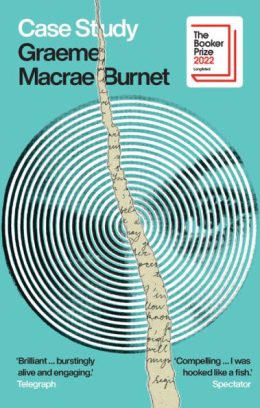
‘Case Study’ by Graeme Macrae Burnet – On the Psychiatric Couch


‘Case Study’ by Graeme Macrae Burnet   (2022) – 271 pages


The decade of the 1960s saw many of the old established ideas of mental illness and psychiatry being challenged by younger professionals in these fields. At that time there were still large facilities called insane asylums for the severely mentally ill. Electroshock therapy, insulin shock, and lobotomy were still routine “treatments” being used on mental patients to adjust their mental states. One of the leading proponents of new less drastic and less harmful methods of dealing with the mentally ill was young Scottish psychiatrist R. D. Laing. I remember being aware of Laing and his then revolutionary ideas back during my college days in the 1960s. Laing would write:

I was beginning to suspect that insulin and electric shocks, not to mention lobotomy and the whole environment of a psychiatric unit, were ways of destroying people and driving people crazy.”

The novel ‘Case Study’ in not about R. D. Laing but instead a fictional young Scottish psychiatrist who is also trying to make a name for himself, Arthur Collins Braithwaite.

He (Braithwaite) declared himself to be “an untherapist”: his task was to convince people they did not need therapy; his mission was to bring down the ‘jerry-built edifice’ of psychiatry.”

Like Laing, Braithwaite has also published books suggesting new ways of dealing with the mentally ill. His books are titled ‘UnTherapy’ and ‘Kill Your Self’.

Although Dr. Braithwaite meant that second title metaphorically, one of his patients took it literally. A young woman named Veronica who was a psychiatric patient of Braithwaite has indeed killed herself. Her sister Dorothy is convinced that it was Braithwaite’s methods which caused her suicide. Dorothy decides to go under cover with an alias name of Rebecca and also become a patient of Braithwaite. She kept five notebooks detailing her experiences as a patient of Braithwaite, and these notebooks make up a large part of the novel ‘Case Study’. The rest of the novel is more or less a fictional biography of Braithwaite.

Soon this alter ego Rebecca becomes nearly a separate character from Dorothy.

I appreciated that ‘Case Study’ is about an important subject that is not often covered in the world of fiction, the treatment of mental illness. I also liked the variety of formats which make up the novel.

The main problem I had with the novel is with the five notebooks written by Dorothy/Rebecca. Much of the subject matter of these notebooks does not concern this main plot of the novel and was much less compelling for me. I found that especially the scenes of her away from the psychiatrist’s office involving just her and her acquaintances were not particularly interesting and were rather a drag on the rest of the proceedings. We also get long stretches of the conversations between Rebecca and Braithwaite that do not deal with the primary story line.

Still, the main premise of ‘Case Study’ is solid, and the variety of sources is engaging.


Grade :   B


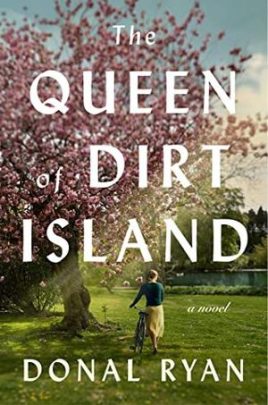
‘The Queen of Dirt Island’ by Donal Ryan – Four Generations of Females Living in a Rural Irish Homestead


‘The Queen of Dirt Island’ by Donal Ryan (2023) – 242 pages


According to the author’s bio, author Donal Ryan is from Nenagh, County Tipperary, Ireland. His new novel ‘The Queen of Dirt Island’ takes place in a rural homestead near Nenagh.

There are four main characters in the novel, all of them female and each of them from a different generation. First there is great-grandmother Nana or Mary. Then there is her daughter-in-law Eileen. Then there is Eileen’s daughter Saoirse (don’t ask me to pronounce that name), and finally the very young daughter of Saoirse, Pearl.

Nana has some advice for her granddaughter Saoirse :

You only get one life, and no woman should spend any part of it being friends with men. That’s not what men are for.”

The father of Saoirse’s daughter Pearl was only in Nenagh for one night with his rock band. Saoirse never saw him again. Saoirse cannot remember them even having sex that night. It must have happened while she was sleeping. Now she reads about him in the newspaper as his band has become quite famous.

Always fight, Saoirse, won’t you? For yourself and for her. Don’t ever allow yourself to be trampled on.”

The men in this novel, and there are a few of them, are peripheral to the story, as these women must confront the world mainly on their own.

That the male author Ryan’s main focus is almost entirely on the women here is not the only unusual aspect of this work. Each very short chapter of this novel is close to exactly the same length, slightly less than two pages or 500 words long. Each of the 120 chapters is given a one-word title. The first chapter is titled ‘End’, and the last chapter is titled ”Beginning’. These constraints, apparently imposed by the novelist, give the novel it’s definite rhythm. And once a novel has established a rhythm, more than half the battle is won.

I happen to be one of those who believes that having constraints on the style or a restricted form, like in poetry, aids rather than hinders creativity. Having constraints to your writing makes you more creative, not less. This is definitely the case in ‘The Queen of Dirt Island’.

The enemy of art is the absence of limitations.” – Orson Welles

The short two-page chapters made for a quick comfortable read. Many of these short chapters end with a severe twist at the end of them, a sudden death or an attempted murder or a missing child, etc. Perhaps there are too many of these severe twists for ‘The Queen of Dirt Island’ to be entirely realistic, but that’s OK too.


Grade:   A


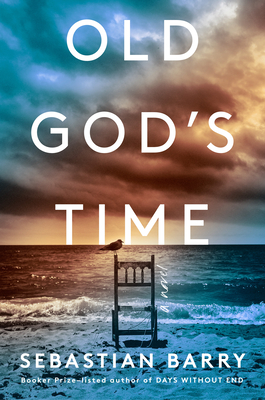
‘Old God’s Time’ by Sebastian Barry – An Irish Garda Policeman, Retired


‘Old God’s Time’ by Sebastian Barry    (2023) – 261 pages


In ‘Old God’s Time’, ex-Garda Tom Kettle is rejoicing in his retirement from the force. He lives alone in an apartment by the ocean, happy to be done with police work.

There were no saints in any era, Tom knew, just good men and bad, and sometimes both in the same bottle.”

Tom’s wife June, daughter Winnie, and son Joe have all died, so he lives alone.

Tom often waxes lyrical about his current life in retirement as well as about his previous family life.

These were the gifts given to him in his life, there was no reason to mourn or complain.”

We have the juxtaposition of this Irish lyricism with some truly awful episodes in Ireland’s recent past including the child sex crimes in the Church orphanages, the Magdalene Laundry scandals, etc.

As a policeman, Tom Kettle was on the front lines in confronting these scandals. Actually both Tom and his wife June were both in Church orphanages as little children. So both of them had an intimate knowledge of what was going on inside these Church-run orphanages. For one priest in particular, there is no forgiveness.

Better to have been born dead, the Brother used to shout, than the filthy melt of a prostitute.”

Perhaps that was the rationalization for some of the priests and brothers for the crimes they committed against these little children. Worst of all is Father Thaddeus :

I’ve come for my kisses, June.”

Sometimes Tom Kettle applies his colorful language and lyricism to some very ugly things :

Father Joseph Byrne and Father Thaddeus Matthews, two jackals in a coop devouring little chickens. Filthy, relentless, feckless men who never paused a moment in their evil.”

There is no ambiguity in ‘Old God’s Time’. The good men are all good, and the bad men are horrible. It is like the old TV Westerns in that sense. Perhaps in these circumstances ambiguity is unwarranted.

The entire novel is made up of Tom Kettles reminiscing about his family life and his life on the job as a policeman. Along the way he divulges some closely held family secrets.

But oftentimes, the unlikely was the truth, as you might find out, in the end, when it was too late.”


Grade :    A-


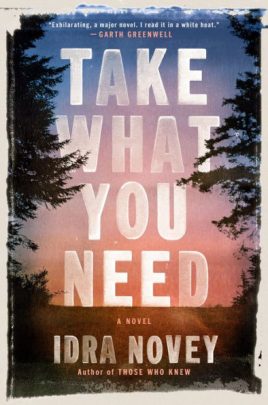
‘Take What You Need’ by Idra Novey – “A Real Artist has to Fail and Fail and Still Go On.”


‘Take What You Need’ by Idra Novey   (2023) – 240 pages


The previous novel by Idra Novey, ‘Those Who Knew’, was overtly political, and I loved it. ‘Take What You Need’ is more about the personal struggle to create art and only occasionally gets political.

Let’s say the country cracks as well, the floor gives way to a new era, or at least the prospect of one. We watch hordes of armed people storming one of the most important government buildings in the country. Their faces appear on the news while I’m making a frittata. One of the first heavily armed people arrested is from Sevlick.”

Our main character here, Jean, is in her mid-sixties and has lived in Sevlick, West Virginia in the Allegheny mountains her entire life. Jean is the estranged stepmother of Leah. Jean was married to Leah’s father for only a few years, but those were Leah’s childhood formative years. Leah has gone off and made a family and a decent life for herself, but she still occasionally wonders about Jean.

Jean lives alone in the old ramshackle house that was her parents’ home when she was a kid. Jean’s father was a welder, and she as a kid would go out to the garage and watch him weld. She took up welding later in life to create large works of art.

It never occurred to me that the secret release I saw him find under the cover of his helmet might be the best gift he didn’t intend to give me.”

Her obsession is creating huge metal sculptures created from old discarded pieces of metal. She calls these sculptures, her Manglements.

Her metal art has never attracted much interest, but Jean persists in her art.

A real artist has to fail and fail and still go on.”

Her metal sculptures are so large, they would have to dismantle her house to remove them

Her Sevlick neighborhood has gone downhill. A mother and her two teenage children have moved next door, and since the city has disconnected their water the mother asks if they can take some of Jean’s water to use. The teenage boy Elliot comes up each morning to get the water, and Jean asks his help in moving the large pieces of metal she needs for her sculptures. Elliot does become interested in what Jean is doing, and an unusual relationship develops between them.

Meanwhile the estranged stepdaughter Leah finally comes to visit and is taken aback by Jean’s eccentric life.

I won’t go into any more details of the plot. Let’s just say there is definitely a political angle to ‘Take What You Need’ as well as the predominant artistic angle.

The author Idra Novey makes no attempt to prettify the small West Virginia town of Sevlick or to prettify the people who live there. Instead the author conveys the ugly vicious white supremacist attitudes of many of the young guys in the town. That honesty is refreshing.


Grade:   A


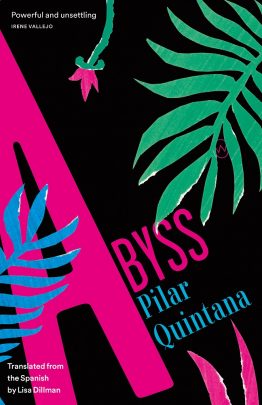
‘Abyss’ by Pilar Quintana – An Eight Year-Old Girl Watches Her Family


‘Abyss’ by Pilar Quintana   (2021) – 219 pages                                Translated from the Spanish by Lisa Dillman


The story in ‘Abyss’ is told by an 8 year-old girl which makes it easy to follow. Children as young as eight can sense the undercurrents that are roiling beneath the surface in their family. They have a front row seat for observing marital discord. The daughter Claudia fears her mother will commit suicide. Her father who works long hours at the supermarket he manages is rarely at home.

The place is Cali, a large city in the South American country of Colombia, and the time is the early 1980s.

Claudia’s mother, also named Claudia, spends much of her time in bed reading celebrity magazines. She is fascinated with those female celebrities who have had somewhat mysterious deaths such as Natalie Wood, Grace Kelly, and Karen Carpenter. The daughter Claudia spends a lot of time with her doll Paulina.

The abyss is a large canyon which plays a major role. I suppose an abyss can also be seen as the large gap between people that mental illness causes.

The author Pilar Quintana has learned the lessons of Elena Ferrante. What Elena Ferrante did for family and community life in Florence, Italy, Quintana does for family and community life in Cali, Colombia. Both writers, by closely observing the lives seething around them, turn their cities into a wonderland for the readers. Just as Ferrante gives us the Florence neighborhood through the eyes of a child, Quintana gives us the Cali neighborhood through the eyes of an eight year-old child.

Life is going on all around us, there to be captured.

The publishers of ‘Abyss’ must have realized they had something special on their hands, because the physical design of the paperback version of ‘Abyss’ is outstanding. It feels right in your hands and welcomes you to read it. I’m usually ambivalent, couldn’t care less, about book design. The publishers were right to give this extra fine novel special treatment.

I much appreciated that ‘Abyss’ did not have a neatly wrapped up ending. Life goes on.


Grade:   A


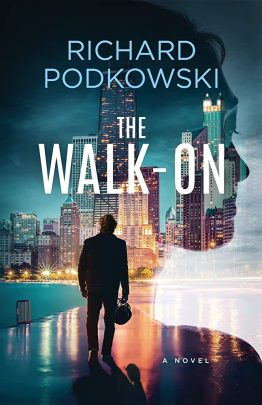
‘The Walk-On’ by Richard Podkowski – A Rough Fall from Grace


‘The Walk-On’ by Richard Podkowski   (2022) – 299 pages


From star NFL middle linebacker for his football team to sitting in jail awaiting trial, Mike Stalowski has a spectacular fall from grace. And he has only himself to blame. Will Mike be able to dig himself out of his deep hole and somehow regain some self-respect?

This is a classic story that never goes out of fashion.

To his fans, Mike is the Steelman. Football is a game of controlled violence, and Mike is a warrior in a brutal game.

Growing up in a traditional Polish-Czech working class neighborhood on Chicago’s south side, Mike’s coaches find he has the talent, the size, and the aggression to make the big defensive plays that stop the opposing team from scoring. He gets a football scholarship to college.

Early on Mike’s mother recognizes his main character flaw.

She was fearful he could not control his emotions or brute force.”

Sometimes Mike is fueled by uncontrollable rage, and if Mike hits someone who is not dressed in football gear, odds are quite good they will wind up in the emergency room. His tackles on the football field have ended the careers of promising players.

The scouts for the professional teams were watching him develop in college, and he has the good fortune of signing a contract with the Chicago professional home team for millions of dollars. Mike achieves fame and accolades quickly for his ferocious hits on the field. All of a sudden this poor south-side boy has lots of money to spend on flashy cars, motorcycles, boats, disfiguring tattoos, etc.

After several successful crowd-pleasing years, Mike is nearing thirty and feeling the pain of all those tackles. He takes oxycodone to relieve his pains. His wife, his high school sweetheart, throws away millions of dollars on a ridiculously bad investment offered by a male friend of hers. Mike starts staying out at bars until after closing, picks up available women, gets into fights, and gets into trouble with the police and with his football team. His troubles are just beginning.

Seventeen years of countless hits, drugs, alcohol, and injuries, commingled with personal problems, took their toll.”

After his terrible fall, will Mike be able to pick himself up and save himself?

Does Mike really deserve a second chance? He has probably destroyed the careers of several young players over the years with his brutal tackles, but that’s just the controlled violence of football, and he has been paid handsomely for it.

Are the old traditional values which are inculcated into us by our family, our schools, and our churches obsolete and of no use in this modern world?

The ending of ‘The Walk-On’ defies expectations. That is all to the good.


‘Aliss at the Fire’ by Jon Fosse – Looking Out the Window, Waiting for Over 22 Years


 ‘Aliss at the Fire’ by Jon Fosse     (2003) – 107 pages              Translated from the Norwegian by Damion Searls


They have recently published Jon Fosse’s 800-page, single-sentence, seven-part novel ‘Septology’. They have also recently republished Jon Fosse’s short novella from 2003, ‘Aliss at the Fire’. Lately I have read a lot of good things about this Norwegian fiction writer and playwright. So guess which book of his I decided to read.

In ‘Aliss at the Fire’ it is 2002, and wife Signe is sitting by the fire and looking out the window waiting for her husband Asle to return from his rowboat excursion in the fjords around their home. She has been waiting for over 22 years.

she thought he was just staying out on the fjord for a long time, she thinks, that he’d still come back, but the hours went by, hour after hour, no she can’t bear to think about it, she thinks, because he’s really just gone, he’s never coming back,”

I am quoting only a partial sentence as the sentences in ‘Aliss at the Fire’ are very long with a multitude of short phrases. Despite being lengthy, the sentences are easy to follow and understand. The entire novella is Signe sitting by the fire, remembering, and for her as well as for us the thoughts in our minds don’t stop with a period but go on and on and on.

Waiting, waiting for Asle to return.

she never fully understood him, not from the first time she met him, she thinks, and maybe that was why she felt so close to him”

Signe recalls that Asle’s great-uncle, also named Asle, met the same fate on the fjords and that this great-uncle’s father Kristoffer had nearly drowned in the fjords also but was saved by his mother Aliss. The family’s history in the fjords goes way back.

The writing in this short novella is vivid and dramatic, almost incantatory. I could easily visualize actors performing the roles of Signe and Asle, of Aliss and Kristoffer, etc. It did not surprise me to find out that Jon Fosse is one of the most produced living European playwrights. There is an Anton Chekhov-vibe, a Eugene O’Neill-vibe, a Tennessee Williams-vibe to Fosse’s evocative writing.

Someone would do well to translate the best of the plays of Jon Fosse into English so that they can be performed on stage in the United States.


Grade:    A


‘If I Survive You’ by Jonathan Escoffery – From Kingston, Jamaica to Miami


‘If I Survive You’ by Jonathan Escoffery    (2022) – 256 pages


Topper and his wife Sanya and their two young sons, Delano and Trelawny, moved to Miami, Florida in the 1970s.

You’re black, Trelawny. In Jamaica we weren’t, but here we are. Here there’s a ‘one drop’ rule.”

In grade school Trelawny tries to fit in with the Puerto Ricans; however they don’t accept him since he doesn’t speak Spanish. Later Trelawny is harassed by African-American boys after being mistaken for Puerto Rican.

The Jamaicans speak a colorful patois of English. Here is Trelawny’s father, Topper:

You tell Sanya, Something wrong with the boy, but she tell you, Be patient. At him school open house, Trelawny’ teacher say she wan’ to put him in t’ing called Gifted. You say, what that, special ed? She say is for advanced children so him don’t get bored, but you tell her, Teach him to tie him shoe, then we can talk.”

The preceding paragraph is pretty much my story. What could seem more useless to a working-class father than a college degree in English?

I’m selfish. When I read a novel about people from a different country or from a different race or a different economic class, I want to get something out of it for myself. Sympathy or envy for their plight is not enough. In order to fully appreciate a work, I must feel a strong empathy for the characters.

‘If I Survive You’ entirely passes my empathy test.

‘If I Survive You’ is eight linked stories, but all of the stories involve the same characters in this one small family, so it feels much like a novel to me. Somehow the stories all fit together to form a complete picture of this Florida family.

This being Miami, Florida, hurricane Andrew topples the family house in 1992. Husband and wife Topper and Sanya split up, and Delano goes with the father while Trelawny stays with the mother.

Later at his father’s retirement party, his father tells Trelawny that he’s “defective”, so Trelawny gets the ax out of the garage and chops down his father’s favorite Ackee tree. His father then throws Trelawny out of the house.

In the final acknowledgments, author Jonathan Escoffery thanks, among others, the author Percival Everett “for pushing me to write unflinchingly”. This is advice Escoffery has surely taken in ‘If I Survive You’.


Grade:   A


‘The Pastures of Heaven’ by John Steinbeck – Transitioning into a Major Writer


‘The Pastures of Heaven’, linked stories, by John Steinbeck   (1932)  201 pages


John Steinbeck put together ‘The Pastures of Heaven’, this collection of linked stories about a rural area of central California, while still a nearly unknown writer. However his situation changed rapidly within a few years with the publication of the novella ‘Of Mice and Men’ in 1937 and the full-scale novel ‘The Grapes of Wrath’ in 1939.

With this collection, Steinbeck was still developing his talent as a fiction writer. I found the early stories to be more sketches, although quite interesting sketches, rather than fully developed stories. For me, Steinbeck does not really come into his own until more than half way through this collection, until Chapter 8, which is the story of Molly Morgan. Abandoned by her good-natured entertaining alcoholic father at age twelve, Molly is hired as the teacher in the Pastures of Heaven grade school after a job interview. Molly soon becomes an integral member of the community. She still misses her father, but when a drunken man matching his description shows up in a nearby town she is agonized.

In all of these sketches and stories, Steinbeck finds redemption in even the sorriest of human creatures. He is accepting of all kinds of behavior as long as people mind their own business and do not interfere in other people’s lives. A generosity of spirit permeates these sketches and stories.

John Steinbeck, winner of the Nobel Prize for Literature in 1962, is often described as a writer of the naturalism school rather than of the realism school. Emile Zola is considered the founder of naturalism. Whereas realism seeks only to describe subjects as they really are, naturalism attempts to determine the underlying forces influencing the actions of the subjects. Today, realism has seemed to have won out over naturalism as writers are most concerned with accurate descriptions of behavior rather than root causes for it.

The real Pastures of Heaven

For readers new to John Steinbeck, I would certainly recommend you read his two masterpieces, the novella ‘Of Mice and Men’ and the novel ‘The Grapes of Wrath’ first, and then perhaps read other of his work – perhaps ‘Cannery Row’ or ‘Tortilla Flat’ or the novella ‘The Red Pony’. ‘The Pastures of ‘Heaven’ I would save until you are fully immersed in Steinbeck.


Grade: B-