“Trio” by Dorothy Baker (1943) – 234 pages
“It’s a simple formula; do your best and somebody might like it.”
Dorothy Baker
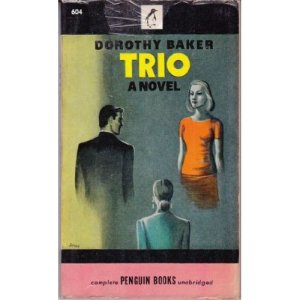 “Trio” is a novel about a love triangle but not the usual love triangle. This love triangle is not two men competing for one woman or two women vying for the same man. In “Trio”, Pauline Maury, the first woman full professor at her college, is in danger of losing her live-in young academic ward Janet Logan to young Ray Mackenzie who wants to marry Janet.
Before “Trio”, I had read two novels by Dorothy Baker, “Young Man With a Horn” and “Cassandra at the Wedding”, both of them excellent. “Young Man with a Horn”, Baker’s first novel written in 1938, is about a young jazz musician who is much like the real Bix Beiderbecke. “Young Man with a Horn” was an immediate bestseller and was later in 1950 turned into a movie starring Kirk Douglas. “Cassandra at the Wedding”, a late novel by Baker written in 1962, is a tragicomic story about a young woman trying to sabotage the wedding of her twin sister. It has recently been republished by NYRB Classics, enough said.
After reading these two superior novels, I’ve wanted to read another novel by Dorothy Baker for a long time. The only other Dorothy Baker novel available at the Minneapolis Public Library was “Trio”. “Trio” was Dorothy Baker’s second novel published in 1943. According to Wikipedia, “She and her husband made it (“Trio”) into a play which was quickly taken off Broadway because of its lesbian theme after a protest by a group of Protestant clergymen. At this time, Dorothy was reportedly beginning to show her own lesbian inclinations.”
Apparently Dorothy Baker and her husband thought well enough of “Trio” to turn the novel into a Broadway play. “Trio” was rejected for decidedly non-literary reasons. After finding all this out I absolutely had to read “Trio”. The only copy of “Trio” which the Minneapolis library had was the original which was published in 1943, so the physical book I read was almost 70 years old.
Besides being a ‘love triangle’ novel, “Trio” is also a California novel. Being a French professor, Pauline has many faculty and academic tea parties and cocktail parties at her modern designed apartment she shares with Janet. The novel is divided into three crisp scenes or chapters, the first of which takes place at one of Pauline’s tea parties.
Most of “Trio” is dialogue, although its sharp descriptions vividly crystalize and set the scenes well. I’m partial to novels that have strong dialogue because of the immediacy and the dramatic intensity it lends to the interaction between the characters, and Dorothy Baker writes spectacular dialogue which drives the story. I can well see why Baker and her husband turned this novel into a play.
As it turned out, “Trio” completely won me over. All three of the main characters come across vividly and ultimately sympathetic. The story was not at all out of date, and it would be easy to visualize the same situation occurring today. The novel is as fine a read as Dorothy Baker’s other more famous two novels. It must have been devastating for Baker to have her most personal novel rejected on non-literary grounds, because she was serious about her fiction writing.
 Dorothy Baker jokingly said that her own writing career “was severely hampered by an abject admiration for Ernest Hemingway”. I do see the qualities of Hemingway in Baker’s novels in that both writers do not waste a lot of verbiage getting into their stories, and that gives their stories an intensity they otherwise would not have.
Unfortunately “Trio” has not been republished since 1977, and only used copies are available, sometimes ar exorbitant prices. Large city or university libraries usually will have a copy of it. I’d like to see NYRB classics consider republishing “Trio”, the novel is that good. Dorothy Baker belongs up there with the great woman United States writers of that era including Dawn Powell, Carson McCullers, Mary McCarthy, Jean Shepherd, and Harper Lee.
 Today I have the privilege of guest posting at Whispering Gums for the continuing series of “Monday Musings on Australian Literature”. My guest post is about one of my favorite Australian writers.







 Tony's Book World
Recent Comments