Archive for the ‘Book Reviews’ Category

“Familiar” by J. Robert Lennon – The Parallel Worlds of Elisa

“Familiar” by J. Robert Lennon (2012) – 205 pages

                   .

.

Science Fiction and the paranormal are not my usual genres.  Sure I’ve read “Brave New World”, “Fahrenheit 451”, “We”, “The Martian Chronicles” and a few others over the years, but that is about it.  Now I can add “Familiar” to this short list, because “Familiar” is about parallel worlds. 

 Each year Elisa Macalester Brown leaves her husband Derek and son Sam to travel to her former home city of Madison, Wisconsin, and visit the grave of her other son Silas who was killed in a horrific car accident.  As she is driving back to her new home in New York, all of a sudden a crack in her car’s windshield suddenly heals itself.  Thus begins her journey into an alternative reality.  When she arrives home she discovers that she is a few years older than she was and that both of her sons are alive.  And thus the story begins.

 Even though “Familiar” has this paranormal plot of perhaps a Twilight Zone episode, the novel is written in the style of intense minimalist realism.  Throughout the novel we are in the mind of Elisa.  We see everything through her eyes and with her perspective.  There is the bare minimum of description of locales or of nature as we enter her obsession.  She remembers vividly her former life, and can plainly recognize the differences between her new life and her former life.  Her husband Derek is unlike the person he was before, her sons are not the same as they were, and she herself has changed dramatically.   The changes that have occurred are not necessarily for the better, because “Familiar” is not a comforting novel.  There are no happy memories, no humor, and little everyday fun.

 “Familiar” is more of a psychological novel rather than speculative science fiction.  It is all about Elisa confronting her new reality and comparing it with her old reality.   In an afterword, J. Robert Lennon discusses 9/11/2011 and that writing “Familiar” was a way to address quite indirectly the aftereffects of September 11.  The book “was going to be about the cognitive dissonance that traumatic events introduce into our minds – about the connections between the fragile constructions of the self and the chaotic world outside.”

 What is my reaction to “Familiar”?  First “Familiar” has an extremely original plot which I appreciated.  While reading the novel, I missed a lot of the crutches that I usually use to relate to a story such as lush descriptions of place, humor, warmth, liveliness.  Lennon has imagined a quite cold rigorous world for Elisa, not much fun.   But I’m not ready to dismiss “Familiar”, because I believe this is the kind of novel that I will remember and think about for some time.

“Billy Lynn’s Long Halftime Walk” by Ben Fountain – Bravo Company from Iraq goes to Texas Stadium, Home of the Dallas Cowboys

“Billy Lynn’s Long Halftime Walk” by Ben Fountain (2012) – 307 pages

BILLY LYNNÕS LONG HALFTIME WALKBy: Ben Fountain.

No other novel I have read captures the way things are in the United States in the 2000s better than “Billy Lynn’s Long Halftime Walk”.  This over-the-top black comedy grabbed me on the first page and didn’t let go until the last.

What better place to honor the soldier heroes of the Iraq War than Texas Stadium, home of the Dallas Cowboys football team, America’s team and the epicenter of well-to-do Iraq War boosters? Many prosperous supporters of the Iraq War, all the doctors, dentists, and corporate executives with their wives, including sometimes President George W  and Laura Bush congregate here on Sundays to watch their Cowboys play.  It becomes immediately apparent that there is a huge gap between the rich and affluent Dallas football fans and the dirt-poor soldiers who had little choice but to become soldiers and go to fight in Iraq.   Ben Fountain has found the ideal plot to point out the many absurdities that exist between all those comfortable moneyed supporters of the war and the soldiers who were actually out there fighting in the war.

Billy Lynn is one of the troops in the 2004 battle of Al-Ansakar Canal in Iraq which the embedded Fox News camera crew caught live and showed continually on their network to support the war.   Then the George W. Bush administration sends the 8 soldiers of Lynn’s Bravo Company on a two-week Victory Tour of the United States ending at Texas Stadium for Dallas’ Thanksgiving Day game.  After that it’s back to Iraq for Bravo Company.

Deal maker Albert accompanies the soldiers, and he is always trying to sell the Bravo Company story to Hollywood as a movie.  Hilary Swank is officially interested in their story and is floating the idea of playing both Billy and his Sergeant in the movie.

Meanwhile at the football game, a picture of Bravo Company is put up on the Jumbotron screen every few minutes between advertisements for Ram trucks.  Some of the fans come up to the soldiers to greet and thank them during the interminable delays between football plays.  The soldiers in Bravo Company wander off frequently to get more booze against their Sergeant’s orders.

  “They (the fans) want autographs.  They want cell phone snaps.  They say thank you over and over and with growing fervor, they know they are being good when they thank the troops and their eyes shimmer with love for themselves and this tangible proof of their goodness.  One woman bursts into tears, so shattering is their gratitude.”

 And then there is halftime as only Texans can do it. Hundreds of cheerleaders, at least six high school marching bands, drill teams in formation, Destiny’s Child with Beyonce performing, the Bravo soldiers onstage, fireworks. A couple of the soldiers in Bravo Company are spooked by all the noise and confusion.

It is not a very sophisticated literary theory, but it just seems to me that an author’s enthusiasm for their own story rubs off on the readers.       The writing in “Billy Lynn’s Long Halftime Walk” is so energetic and lively it draws you in.  Ben Fountain has a knack for finding the perfect metaphor or simile.   He describes a pastor who is continually texting Bible passages to Billy as “a used-car salesman in sheep’s clothing.” Then there is Cowboys corporate executive Josh with “every hair, every thread, every crease and pleat in place, as if he’s sheathed in a varnish of pussy-boy perfection.”

One of the blurbs used to sell “Billy Lynn’s Long Halftime Walk” is from Karl Marlantes, author of the great Vietnam War novel, “Matterhorn” who says “The ‘Catch 22’ of the Iraq War”.  No, it does not approach ‘Catch 22’, but it is a good wicked start to unraveling what happened to the United States with the Iraq War.

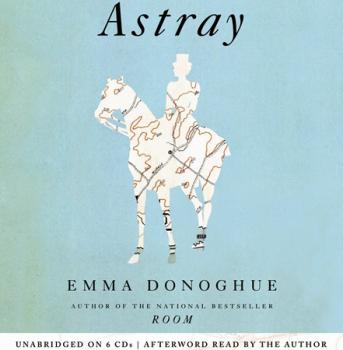
“Astray” by Emma Donoghue – Straying into Canada and the US

“All we like sheep have gone astray.” – Isaiah 53:6, Old Testament

Astray-Emma-Donoghue

Each story in Emma Donoghue’s new collection is about Europeans (including Irish and English) who will go or have gone into the New World of North America in the 17th, 18th, 19th, or early 20th centuries. Each story is based on some form of historical document, sometimes only a small item in an old newspaper, Yes, I suppose you could call “Astray” historical fiction, but the stories are all regarding common non-famous people, and go so far beyond the actual documentation that they are nearly completely works of the imagination.

Emma Donoghue makes each of these stories come vividly alive using the same story skills that made her long novel “Room” so moving. One fact I learned while preparing for this article is that Emma Donoghue’s background is as a historian. Even the novel “Room” is based on an actual historical incident, and that makes me wonder how someone so wide-ranging as an historian could write such a convincing claustrophobic novel as “Room”. In a previous article I mentioned natural-born story writers, and I do believe that Emma Donoghue does qualify as a natural. The people and events in these stories are well-developed and memorable, and the stories stay in your mind long after you have completed them.

Donoghue starts this collection with an irresistible story called ‘Man and Boy’ about an elephant Jumbo and its trainer last-named Scott. They are living in London in 1882 until P. T. Barnum buys Jumbo, and Scott must decide if he will go to the United States with Jumbo. This story is a strong start to the collection.

A continuing interest of Donoghue is that of women in extreme situations, and these stories reflect that interest. One story, ‘Onward’, is about a woman who must prostitute in her home to support her family until Charles Dickens and his friend Angela Burdett-Courts provide her with the money to emigrate to Canada. Another story, ‘The Long Way Home’, is about a cross-dressing woman who drags wayward men back to their families which they had abandoned. Another story, ‘The Hunt’ is about a young soldier in a Prussian regiment while fighting for the English.  The regiment takes over a colonial estate and some of its members rape the women there. 

There is nothing nostalgic, sentimental, or comforting in these historical stories. These are people in tough situations living as best they can. I appreciate the wide range of subjects in these stories which we can probably credit to Emma Donoghue’s historian background. But what makes each of these stories so vital and alive is her superior story-telling skills. This is a excellent book to read while waiting for Emma Donoghue’s next novel.

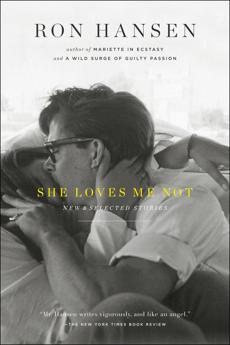
“She Loves Me Not” by Ron Hansen – New and Selected Stories

“She Loves Me Not” by Ron Hansen  (2012) – 233 pages

She%20Loves%20Me%20Not%20by%20Ron%20Hansen_r 

“She Loves Me Not” is a solid interesting collection of stories, worth reading but by no means exceptionally good.  Ron Hansen is not a natural-born short story writer like Alice Munro or William Trevor or Joyce Carol Oates or Tom Rachman or Maile Meloy.  I realize I’m setting the bar quite high, but these other authors’ story collections are all out there to be read. 

 My grade for “She Loves Me Not” would be B-.   Some of the stories in the collection are not fully developed and lack focus; some are sketchy. Not one story in the collection stood out as spectacularly well done.   

 As a short story writer, Ron Hansen goes wide rather than deep.  The stories in “She Loves Me Not’ range from a story about the devastating effects when a massive winter blizzard strikes a small Nebraska community in 1888 to a story about a woman and her boyfriend’s attempt to kill her outlandish evil husband  in the title story.  There is also in “Wilde in Omaha” a story about Oscar Wilde’s book tour stop in Omaha   In that story, all the best lines are the well-known ones from Oscar Wilde. 

 The story about the Nebraska blizzard, “Wickedness” was quite affecting, but it was more of a panorama of the local people caught in the blizzard rather than an actual story.  

 ‘Eclectic’ is the operative word for Ron  Hansen’s stories.  The stories vary greatly in plot and feel. The diversity of the stories is a positive quality, but most of the stories are too short to go very deeply into their characters’ lives, and each story is stand-alone so there is no build-up of intensity from story to story. 

 Seven of the 19 stories are re-printed from Hansen’s 1989 collection ‘Nebraska’.  I found these old selected ‘Nebraska’ stories some of the stronger in the collection.  Most of the others were hit or miss for me with several of the stories not registering much of an impact at all.

“The Yips” by Nicola Barker – Searching for the Quintessential Nicola Barker Lines

“The Yips” by Nicola Barker  (2012) – 548 pages

9781453288207_p0_v1_s600

Nicola Barker is for sure one of the flakiest oddball writers in the world today.  She is wonderful.   While reading “The Yips”, I was ever on the lookout for the quintessential Nicola Barker lines that in their quirkiness would fully do her justice.  Not to keep you in suspense, I believe I found the ultimate lines, and here they are.

“Did you know that the word – the actual word – for ‘individual’ didn’t even exist in Japan until 1884?” Jen asks, casually fishing the seam of her white catsuit out of the crack in her bottom as she speaks.    

Well it seemed great at the time.

This is part of a conversation; “The Yips”, like many of Barker’s novels contains many, many conversations between disparate characters.  I won’t describe these disparate characters, because they won’t make sense to you unless you read the novel, and even then it’s rather iffy.   A writer must emphasize her strong points, and Nicola Barker is glorious with dialogue.  One gets the sense that Barker improvises these dialogues as she goes along.

The intermixing of the cleverly rational with the low profane physical is another quality of Nicola Barker’s writing illustrated by the above lines.  Also typical of Barker, her character Jen is having problems wearing her white catsuit.

“The Yips” is a long novel page-wise, yet it reads fast, since so much of it is made up of conversation, and there is plenty of white space on each page.

Having been repeatedly nominated for literary awards and prizes, Nicola Barker has won over many English readers.  However, she is still comparatively unknown in the United States where she tends to get written off as a quirky local regional English writer.  I discovered Nicola Barker several years ago when I read her novel “Wide Open”.  I was tremendously impressed with that novel which seemed light as a soufflé.  Most other novels were heavy fare in comparison.

But not all of the conversations in “The Yips” are light as a feather.  For instance, here is “The Yips” on marriage.

‘How does it work?’ With endless amounts of compromise, of course! And self-denial.  And frustration.  And confusion.  And bitter recrimination.  And constant resentment.  And utter boredom…’  She pauses briefly to draw breath.  ‘And bouts of incandescent rage,’ she continues opening her eyes again, ‘gales of hysterical laughter.  Perhaps even the tiniest sprinkling of  Divine Providence…’she glances up at Valentine, shrugging, resignedly.  ‘Pretty much like any marriage, I suppose.’

Nicola Barker I do think that Nicola Barker’s style of writing works better in shorter novels.  “Wide Open” at about 300 pages is still my favorite.  It’s hard to make a soufflé stay up for over 500 pages.  Yet I was tremendously entertained by most of the conversations that are in ‘The Yips’.  I really would like to see Nicola Barker write a great 300-page novel that would take over the United States for once and all.

In “The Yips”, Barker comes up with a pretty good description of her effect on readers:

 “It was brilliant! Insane!  How the hell did you just spontaneously come up with all that shit?”

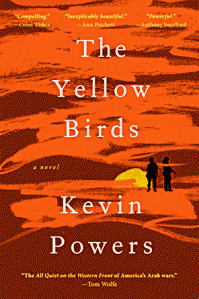
“The Yellow Birds” by Kevin Powers, an Iraq War Novel

“The Yellow Birds” by Kevin Powers  (2012) – 226 pages

2019064749 

“The Yellow Birds” begins with a U.S. platoon on patrol on the streets of Al Tafar in northern Iraq in 2003.  New recruits Bartle and Murphy are part of the platoon led by battle-hardened tough guy Sergeant Sterling.  Their enemy is anything that moves on the city streets.  The U. S. soldiers have immensely superior weapons; they are fighting in a foreign land, and the enemies are civilians all around them.  Sergeant Sterling toughens them to shoot first and ask questions later, to kill hadjis.  If the perceived enemy turns out to be an old lady or a young teenager that’s the way it goes; they are still hadjis.

 Although this novel is about a recent war, a lot of the clichés in novels from wars past are in it.  The tougher-than-nails Sergeant, the naive young recruits, the enemy menace, the too-short R. and R. leave in Germany, then the return to Al Tafar. In many ways, “The Yellow Birds” is a very traditional war novel. One difference here is that the platoon is in a civilian area and is fighting mainly civilians and not soldiers.

 When Bartle goes back to his home near Richmond, Virginia, strangers come up to him and thank him for killing all those hadjis.  He thinks he doesn’t deserve any gratitude, “…because there isn’t any making up for killing women or even watching women get killed, or for that matter killing men and shooting them in the back and shooting them more times than necessary to actually kill them and it was just trying to kill everything you saw sometimes…”

Tal Afar

Tal Afar

The reviews for “The Yellow Birds” have been extremely positive.  This is the first attempt to make some sense out of the Iraq War in a serious novel, and I suppose just for that reason it would be over-praised.   The story in “The Yellow Birds” is about the very early days of the war in 2003 when Americans were mostly gung-ho about the war, and the war could still be considered fairly traditional.  It does not cover the difficult years ahead from 2004 until the end of the war in 2010.   There is no mention at all of that all-pervasive private American paramilitary force, Blackwater, which played a major role in the Iraq War. 

 I see “The Yellow Birds” as only a good start to telling the full Iraq War story.  There were 4,486 United States soldiers killed in Iraq, and the best estimates of Iraqi deaths are 110,000 deaths, most of whom were civilians.  It will take years and years until the United States fully comes to terms with the Iraq War.  We need novels that deal with the politics that got us into the War in the first place, novels from the Iraqi point of view, novels that deal with Blackwater, and so on.

“The Testament of Mary” by Colm Toibin

“The Testament of Mary” by Colm Toibin (2012) – 81 pages

                    .

.

“The Testament of Mary” is NOT a celebratory Christmas story, far from it.  The novella’s subject is not Jesus’ birth but rather his death.  It contains a graphic eyewitness account by Jesus’ mother Mary of his crucifixion and death.  She watches as they drive the nails into her son’s wrists to bind him to the cross, and as he screams out in pain. 

 The novel begins a few weeks before the crucifixion.  Jesus has a devoted group of followers.  Mary is always worried that Jesus’ followers will ultimately get him into trouble.  Mary describes these followers.

 “He gathered around him, I said, a group of misfits, who were only children like himself, or men without followers, or men who could not look a woman in the eye.  Men who were seen smiling to themselves, or had grown old while they were still young.  Not one of them was normal, I said…”

Jesus and his mother (Joseph had already died.) travel to Cana for the wedding of her cousin Miriam’s daughter.  Lazarus, the brother of their friends Martha and Mary who also live in Cana, falls ill and dies while they are there, and Jesus performs one of his major miracles raising Lazarus from the dead.   The acclaim of Jesus grows, but his mother only sees that Lazarus is now much like a ghost, only half alive.  In every instance Mary downplays Jesus’ accomplishments perhaps in the hope that he won’t attract the jealous attention of the government officials. 

 These stories were familiar to me from my early religious training, but it was interesting to see them played out from the mother Mary’s perspective.     

“The Testament of Mary” is the second book by Colm Toibin I’ve read, having read “The Heather Blazing’ before.  I must admit that I do have a problem with his style of writing.  This problem is probably more my problem rather than his.  Toibin’s style always seems to me to be austere, unadorned. stripped down, and exacting.  Its simplicity and clarity are major positive attributes of this style.  However I wish the style were more lively, colorful, and surprising.  I suppose one could say that each of Toibin’s sentences has a simple perfection.  However I prefer a more ragged style filled with more possibilities and personality.

The Wedding at Cana

The Wedding at Cana

 Perhaps one could argue that “The Testament of Mary” is a novella with a deeply religious subject, and obviously you don’t want some vile cynic like Evelyn Waugh or Kingsley Amis telling the story.  True, true, but I get bored with pristine perfection.

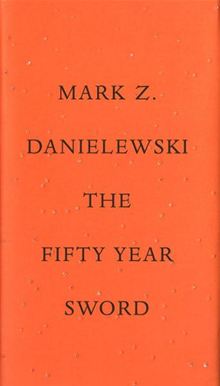
“The Fifty Year Sword” by Mark Z. Danielewski

“The Fifty Year Sword” by Mark Z. Danielewski  (2012) – 298 pages

sword 

No writer has had more success creating a mind-bending mystique around his books than Mark Z. Danielewski (from here on referred to as Mark Z.).  His first book, “House of Leaves”, had an unconventional page layout and style with backwards text, a maze-like story, copious footnotes, etc.  It was widely acclaimed, and his next novel “Only Revolutions” also had unusual format features and was a finalist for the National Book Award for Fiction.

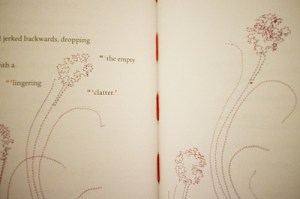
By now Mark Z. has a large cult following and there are web sites wholly devoted to discussions of each of his books.   “The Fifty Year Sword” was first released in a very limited edition.  Then Mark Z. put together well-attended Halloween performances of the novel.  Now “The Fifty Year Sword” has been published in quite lavish fashion.  What started as a 50-page horror story has been turned into a 298-page novel with ‘stitchings’ by Atelier Z. instead of drawings and lots and lots of blank space and blank high-quality pages.

tumblr_mc9ymjJEON1qzrfxgo1_400I don’t know.  First of all I was not at all aware of the mystique surrounding it when I read “The Fifty Year Sword”.  The ‘stitchings’ did nothing for me; they seemed more like random scribble drawings rather than in any way illustrating or representing the story.   The story is OK but nothing special, a Halloween story centering on the sword.  The story is not particularly intriguing, certainly not as scary as the famous Edgar Allan Poe horror stories. In the book there is a system of color-coded quotes which was completely lost on me.  Couldn’t the author just write “Chintana said” or “Belinda Kite replied”?    That would not have been half so precious but a hundred times clearer.    

 Another characteristic of “The Fifty Year Sword” is the use by Mark Z. of words that will never be found in the dictionary.

  “Too many hours, shoomed the Social Worker, gratefully accepatating Chintana’s concoctions.” 

In the sentence above, ‘shoomed” seems a good use of a made-up word, but it is questionable that ‘accepatating’ works any better than ‘accepting’.  Quite a few of the made up words added nothing to the word they were adapted from. 

 By now Mark Z. has become an industry, not just a writer.  There are speculators who buy copies of his limited editions on eBay in the hopes they will go up in value, and one guy wrote on Amazon that he was disappointed that this new edition of “The Seven Year Sword” was published for wide release.  Mark Z. recently won a seven-figure advance for the first 10 books of a planned 27-volume serial novel called at this point “The Familiar”.    

 I don’t begrudge any writer being financially successful, but somehow it seems that at least for this book, Mark Z. is like the Wizard of Oz, doing it with smoke, mirrors and other gimmicks.

The Top Ten List of Fiction I’ve Read in 2012

topten3

This year there were 14 novels I wanted to put in my Top Ten , so I’ve included the other 4 novels in a Very Honorable Mention List.   All 14 of these novels had that depth charge that meant they were to be in in my Top Ten.    

 1. “My Brilliant Friend” by Elena Ferrante (2012) – Even in translation, this book is the most well-written novel I’ve read this year.  Ferrante brings to life almost every member of the seven families who live in this tight little neighborhood in Naples, Italy in the 1950s.  The writing in this novel is colorful, moving, and a joy to read. 

 2. “Matterhorn” by Karl Marlantes (2010) – You are a United States platoon leader in Vietnam.  Your commanding officer orders you to take this hill at any cost.  Your platoon fights.  Three members of the platoon are killed, and two are severely wounded.  Your platoon takes the hill.  The next morning your commanding officer orders your platoon to leave the hill. 

 3. “The Unlikely Pilgrimage of Harold Fry” by Rachel Joyce (2012) – The plot of this novel is so good it could be another story line for ‘Love Actually’.  But some people don’t like ‘Love Actually’?  I love ‘Love Actually’, and I love ‘Harold Fry’.   So there.

 4. HHhH” by Laurent Binet (2010) – The true World War II story of two brave heroes Jozef Gabčík and Jan Kubiš in Czechoslovakia told in spectacular fashion.  It demonstrates how historical fiction can be done in the future based on real events. 

 5. “A Hologram for the King” by Dave Eggers (2012) – A humorous satirical novel about Americans doing business in Saudi Arabia.  Who knew Saudis and Americans working together could be so funny? 

 6. Perla” by Carolina de Robertis (2012) – This courageous dramatic novel makes sure that the world and especially South America will never forget what happened in Argentina in the 1970s and the thousands of people who were ‘disappeared’.    

7. “The Forgiven” by Lawrence Osborne (2012) – A novel about Europeans and Americans in Morocco interacting with the Muslims who live there.  This is a fascinating story that will change your view of the Muslim world. 

8. “Gilgamesh” by Joan London (2001) – A teenage woman and her young child take an amazing trip from rural Western Australia to Armenia and back.  This is a blunt novel that deals with life’s tough truths.

 9. “American Boy” by Larry Watson (2011) – a classic small town novel that feels like it was etched in stone rather than written on a computer.  The writing is spare and crystal clear.

10.  “Suddenly a Knock on the Door” by Etgar Keret (2010) – A collection of wildly original outlandish stories that are humorous and emotional at the same time. 

 Very Honorable Mention

 “The Lower River” by Paul Theroux (2012) – A novel that faces the hard truths about Africa today in an honest straightforward manner. 

 “Underground Time” by Delphine de Vigan (2009) – You know you’re the victim of nightmarish office politics when they move you to the office that shares a wall with the men’s bathroom.  This is the most realistic novel I’ve read about the devastating effects of grim office politics.

 “The Successor” by Ismail Kadare (2003) – A novel about the mysterious death of the number two man in the government of Albania in the 1980s.    

 “History of a Pleasure Seeker” by Richard Mason (2011) – a risqué novel about a young man making his way in society in 1907 Amsterdam.

beautiful-christmas-tree

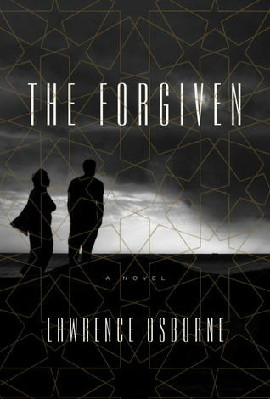
“The Forgiven” by Lawrence Osborne – An Incident in Morocco

“The Forgiven” by Lawrence Osborne (2012) – 272 pages

 “Between the two men there existed a mental chasm – centuries of antagonism and mutual ignorance,”

forgiven

 Young husband and wife David and Jo Henniger rent a car at Tangier in Morocco to drive to an extravagant weekend party being held five hours south of there.  The hosts are Dally Margolis and Richard Galloway, rich male lovers who live in an ancient mansion or ‘ksour’; they throw a wild profligate party to which they invite many rich Europeans and Americans.  The Muslims living near the mansion are hired as servants and staff for which they are paid well, but secretly they were “outraged by the presence of the infidels in a place built expressly for Muslims”.   Here is how the Moroccan Muslims look on their wealthy European and American visitors.

“It was not just their alcoholic habits which were extreme even by the abject standards of Europeans.  Nor was it just their distasteful sexual habits, though there was much to say about those….They swam naked in their own swimming pool, and sometimes – God forbid it – in the pools of the Source des Poissons, contaminating the source…People said there were naked boys asleep on the floors, boys everywhere and some of them Moroccans.“

$11Lawrence Osborne has spent most of his adult life writing non-fiction travel books.  He did write one novel, “Ania Malina”, back in 1986, but wrote no other fiction until now with this novel “The Forgiven”.    According to Wikipedia, “Osborne was educated at Cambridge and Harvard, and has since led a nomadic life, residing for years in France, Italy, Morocco, the United States, Mexico, Thailand, and Istanbul.”  All of his travel experience pays off in “The Forgiven”.  This is the most perceptive novel I’ve read about the interaction of Europeans/Americans and Muslims.  Most novels written by Europeans/Americans have the white foreigners viewing the natives as they would animals in a zoo, pointing out the traits they observe.  “The Forgiven” gives us a more accurate picture by presenting the Europeans/Americans at this wild party with their use of alcohol and sex drives in full tilt while the Muslims observe them.  Also since most writers haven’t had that much experience in Muslim lands, they present the stereotypical Muslims as harsh, rigid, and intransigent.   “The Forgiven” goes beyond these over-simplifications and gets inside the complex minds of the Muslim characters. 

“The Forgiven” has an intense interesting story and I strongly recommend that everyone read this novel.   I’ve been looking for a long time to find a novelist who, like Graham Greene and Paul Theroux, could present life in foreign lands with an expert depth.   This novel which will entertain you will also change the way you view the Muslim world.

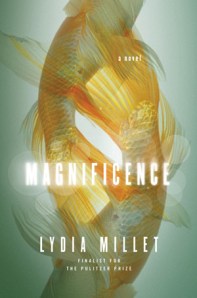
“Magnificence” by Lydia Millet and also My Two Worst Reads in 2012

“Magnificence” by Lydia Millet   (2012) – 255 pages

magnificence-lydia-millet“Magnificence” is an overwrought self-indulgent interior monologue of a novel.   Previously I had read Lydia Millet’s last novel “Ghost Lights” and also “Oh Pure and Radiant Heart” and was favorably impressed by those books,   Sadly “Magnificence” doesn’t  measure up to these. 

 At the end of “Ghost Lights”, Susan’s husband Hal was murdered in a mugging in Belize City in Central America.  “Magnificence” takes up where “Ghost Lights” left off.  It is Susan’s story in California after Hal died.

 My first problem with “Magnificence” is that the entire narration is filtered through Susan’s mind, and she is just not an interesting person.  Most of her thoughts are prosaic and mundane, certainly a waste of my time. To have all the events of the novel interpreted through the mind of someone so boring is a disaster.  Susan had cheated on Hal occasionally and that was one of the reasons Hal had left for Central America.  Now she tells herself she ‘murdered’ Hal.  Somehow she inherits a mansion that is filled with old stuffed animals which are mounted throughout the mansion.  She starts an affair with Jim, a dull lawyer.  She often sees her daughter Casey who was injured in a car accident earlier and is now confined to a wheel chair.  Casey marries Susan’s and Hal’s boss T., and they ask Susan to take care of T.’s dotty old mother Angela, and soon the mansion is filled with old women. 

 None of the characters in “Magnificence” held my interest, not filtered through Susan’s interior monologue. 

 So why was the novel ‘Ghost Lights’ a relative success while ‘Magnificence’ is a failure?  I have a theory.  ‘Ghost Lights’ has a male Hal as the narrator.  For a woman writer to create a convincing male narrator requires a lot of discipline and creativity just like it would require the same for a male writer to create a convincing female narrator.  So this was a challenge for Millet which she rose to meet.  However in “Magnificence” there is a female narrator and that was no challenge for Millet.  She could just fall back on her own thought processes.     Without the challenge, it was just too easy to fall back into a mundane rut.

 The Two Worst Novels I’ve Read in 2012

 A few of the novels I read in 2012 had some aspects that I didn’t care for, but there were only two novels during the year that I didn’t like at all. 

 “The Chemistry of Tears” by Peter Carey – The writing in this novel is as contrived, intricate, and precious as the mechanical clock animal toys of the 19th century which it describes.  What is missing is a reason to care about any of the characters either in the alternating 19th century sections or the 20th century sections.

 “Magnificence” by Lydia Millet – You guessed it, an overwrought self-indulgent interior monologue and a bunch of less than interesting characters.

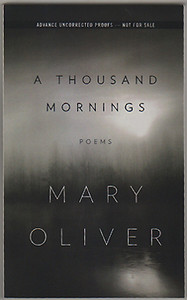
“A Thousand Mornings” by Mary Oliver

“A Thousand Mornings” by Mary Oliver – Short Poems – (2012) – 82 pages

 “A Thousand Mornings” is a well-suited name for this collection of short poems by Mary Oliver.    I’m sure many of you have discovered that one of the best ways to tune in to the rhythms of the natural world is to take walks alone early in the morning through a forest or across a field or along the seaside.   These poems have the clarity and simplicity of a morning walk.

 “Today

one small snake lay, looped and

solitary

in the tall grass,”

         from “The Instant” *

Many of the poems are about individuals and their relationship with the natural world.  In the poem “Good-Bye Fox”,   a person carries on a dialogue with a fox.  At one point, the fox says,

“You fuss over life with your clever words, mulling and chewing on its meaning, while we just live it.”  *

 These short poems are the kind you can read and re-read many times over the months and years and find something new and startling there.  In an interview on National Public Radio, Mary Oliver said, “One thing I do know is that poetry, to be understood, must be clear,  It mustn’t be fancy.”  Oliver’s poems are simple and direct.  I appreciate these qualities, because so much modern poetry seems opaque and leaves me perplexed as to what the poet intended to say.  Somehow the poets who used the old structured rhyming verse expressed themselves more clearly and succinctly than most modern poets do with their free verse.   Mary Oliver is an exception to this rule in that her free verse is easily understandable.    

 I requested and received permission from Mary Oliver’s representative to quote a few lines from “A Thousand Mornings”.  This is a difficult task, because so many of the lines in this book are worth quoting.

 I will end with an entire two-line poem which applies well to blogging


 “After I Fall Down the Stairs at the Golden Temple”

For a while I could not remember a word that I was in need of,

And I was bereaved and said: where are you beloved friend?  *  


              *         Copyright, Mary Oliver, 2012


The Best American Short Stories – 2012, Tom Perrotta, Editor

Why read a collection of short stories written by various authors?   For me it is an adventure and a great deal of fun reading these best stories of the year.  Also reading a collection like this is a painless way to get introduced to the work of a number of authors.  If an unfamiliar writer has a great story here, I might seek out more of their work since writers who create a good short story are more likely to write good novels than those who don’t.         

Every year there are two collections of the best short stories published in the United States and Canada.     One collection is called the Pen/O Henry Prize Stories, and the other collection is called the Best American Short Stories which has a different guest editor each year.   The guest editor makes the final decisions about which 20 stories to include after the series editor has narrowed the list of thousands of stories down to 120 finalists.  There are also 20 stories in the Pen/O Henry collection.

I’ve had good luck with both collections and tend to alternate back and forth between the two.  I checked this year, and none of the stories is in both collections although two authors, Steven Millhauser and Alice Munro, have stories in both books. 

 First here is a brief summary of the stories in Best American Short Stories which I’ve just completed.  Five of the stories were first published in the New Yorker, two each in Tin House, Ploughshares, and Hobart, and one story each from New Ohio Review, American Short Fiction, Granta, Orion, Fifth Wednesday Journal, McSweeney’s and Paris Review.  Nine of the stories are written by men, and eleven stories are written by women.  Some of the writers are famous and were quite familiar to me.  I’ve read nearly everything Alice Munro has written, and I’m quite familiar with the work of Steven Millhauser, Mary Gaitskill, George Saunders, Nathan Englander, Jess Walter, and Carol Anshaw. The other 13 writers were new and unfamiliar to me.

 It would be difficult to draw conclusions concerning the styles of these stories.  None of the stories here is in the minimalist mode that Raymond Carver popularized and which has been so prevalent since then.  Alice Munro’s story “Axis” is straightforward, direct, and dramatic.  George Saunders’ story “Tenth of December:” is about as twisted and crooked and flat-out demented as a story can be.  It’s great.  Tom Perrotta seems to like busy realistic hunorous stories like his own fiction.  Nathan Englander’s story “What We Talk About When We Talk About Anne Frank” is exceptionally good.  But so is “Miracle Polish” by Stephen Millhauser which is in the classic Edgar Alan Poe/ Oscar Wilde style.

 After a couple of stories I got in the spirit of this collection, and it was entertaining moving from one story, one view of reality, to another story that was a totally different view of reality.   

 Of the stories by those writers who were unfamiliar to me the following stories made a strong impression, and I will be on the lookout to read more of these authors’ works.

                “Occupational Hazard” by Angela Pneuman

                “Volcano” by Lawrence Osborne

                “Pilgrim Life” by Taylor Antrim 

                “North Country” by Roxanne Gay

 Best American Short Stories is a strong collection, but next time I may go back to O Henry. 

   P. S.:   Based on his fine story in this collection as well as some positive reviews, I am now reading the novel, “The Forgiven” by Lawrence Osborne.

“Seven Years” by Peter Stamm – One Man, Two Totally Different Women

Seven Years” by Peter Stamm  (2009) – 264 pages     Translated by Michael Hofmann 

 It is November, time for  German Literature Month which is hosted by Lizzy at Lizzy’s Literary Life and by Caroline at Beauty is a Sleeping Cat.  Today’s novel is “Seven Years” by Swiss writer Peter Stamm and translated from the German by writer Michael Hofmann.

 In “Seven Years”, Alexander has two women in his life.  First there is Sonia.  Sonia “was lovely and smart and talkative and charming and sure of herself.  I always found her presence somewhat intimidating, and I had the feeling of having to be better than I actually was.”  Sonia is headed for a successful career in architecture, the same field as Alexander.  She is the perfect socialite and from a well-off background.

 Then there is Ivona who “was completely unattractive.  Her face was puffy…Her nose was reddened, and a few crumpled up tissues were in front of her…Her clothing looked cheap and worn…From the very onset Ivona was disagreeable to me…Her whole appearance was somehow sagging and feeble.  She seemed to have given up all hope of pleasing anyone, even herself.”  Ivona’s monosyllabic replies stop any conversation in its tracks.

 There is no comparison between Sonia and Ivona.  Yet who is Alexander always sneaking off to see and be with?  Ivona.  He sneaks off, because he doesn’t want any of his friends and especially Sonia ever to see Ivona and him together.  Why is Alexander so strangely attracted to Ivona?  Ivona is in love with Alexander and her love is unconditional.  She was actually stalking him when they met.  Maybe his attraction is based on the fact that he doesn’t have to be something he isn’t in front of Ivona.

 I have not encountered this plot in a novel before, so I give Peter Stamm points for originality.  In most novels the hero winds up with the lovely lady, and that’s that.  “Seven Years” goes deeper, and I find it somewhat courageous how Stamm sets this story up.

 There are a few things in the novel for which I would subtract points.  Whenever Stamm describes Ivona’s unattractiveness he mentions that she is from Poland. This is mentioned so many times you wonder if that is one of the reasons Alexander finds her unattractive.  Also I don’t think Stamm goes quite deep enough to find the underlying reasons for Alexander’s visceral attraction to Ivona.  Alexander does express severe guilt at times for his clandestine treatment of Ivona, but she doesn’t seem to mind.    

 I found “Seven Years” to be quite a strong novel overall.   It is well-written, and it’s always refreshing to read a novel that has an original yet realistic plot.  I suspect many men are faced with a situation similar to Alexander’s.             .   .

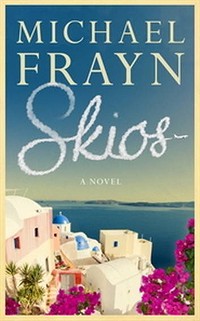
“Skios” by Michael Frayn

“Skios” by Michael Frayn   (2012) – 257 pages


Even madcap comedies require some intensity.  Michael Frayn handles this comic novel “Skios” expertly at the technical level.  All the comic details unroll and fit together.  However the main things missing from “Skios” are any soul or any evidence of authorial passion.      

 “Skios” is a zany romp, a bedroom farce with mistaken identities, mixed-up luggage, switched cell phones, and so on.  The novel takes place on the fictional Greek island of Skios at the philanthropic Fred Toppler Foundation.  It is the weekend of their annual Great European House Party, and their staff and especially organizer Nikki Hook are eagerly awaiting their guest speaker for the Fred Toppler Lecture, Dr. Norman Whitfield.  Of course no one at the foundation has actually met Dr. Norman Whitfield, and so the fun begins.

 First of all is the Fred Toppler Foundation.  The Foundation and their Guest Lecture are just too easy targets for any meaningful satire, so all we have left is wackiness.  I’m not saying every comedy must be intensely emotional for the author.  It just seems to me that the author should have some totally involving issue at stake while writing and not just an excuse to sleepwalk through the plot.   I kept thinking about “Lucky Jim” by Kingsley Amis, a novel I consider probably the greatest madcap comic novel.  What propelled Kingsley Amis was his very real intense contempt for most of his characters in “Lucky Jim”.  In “Skios” I didn’t notice any evidence of strong feelings either way for any of the characters.  The characters in “Skios” are likeable I suppose, but it would be difficult for anyone to actually care about any of them.    

 Without any passion from the writer, all the antic proceedings became tiresome for this reader.  Ultimately it was up to me to stay awake to finish the novel, since Michael Frayn apparently stayed awake to write the novel.

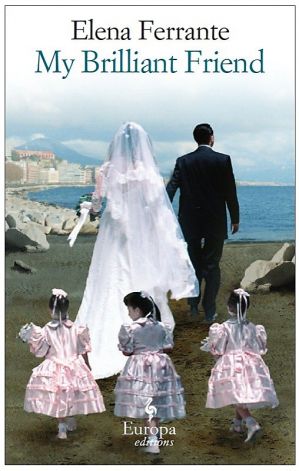
“My Brilliant Friend” by Elena Ferrante – A Naples, Italy Neighborhood in the 1950s

“My Brilliant Friend” by Elena Ferrante (2012) – 331 pages   Translated by Ann Goldstein

 My enthusiasm for Elena Ferrante grows with each of her books I read.   Her writing is a joy to read; it is sharp, affecting, and intelligent.     Here she makes a small neighborhood in Naples, Italy in the 1950s come vividly alive.  There are eight families in the neighborhood, and nearly every individual in each of these families is distinct and is eloquently presented in a few well-chosen words.   These characters are not clichés but at least as genuine as the people you and I grew up with. 

 “My Brilliant Friend” centers on two girls who are friends, Elena Greco and Lila Cerullo, who are seven years old when the novel begins and sixteen by the end of the novel.  As friends, they are continually comparing and contrasting themselves with each other.  Both realize there is some special quality in the other that brings them together.  We see their friendship in the daily life of the neighborhood.  We overhear the neighborhood gossip and see close up the romances and feuds.  We get a strong sense of these families mixing and fighting.  Our narrator is Elena Greco as an adult looking back on her childhood years.

 We are there in Naples in the 1950s.  In the early years of the decade, Italy is still recovering from World War II, and nearly everyone is poor.  As a few years go by, some start to do OK.  They own restaurants and grocery stores.  Soon some of the guys buy nice cars which attract a lot of attention on the streets.

 The pull of sex and the threat of violence are always just near the surface.  If one of the neighbor girls gets picked up by a young guy driving a sleek car, her reputation might be ruined, and her father or brothers might be ready to beat up the offending guy.  However, as well as the moments of violence, these are young men and women relating to each other in a caring civilized fashion. 

 A lot of Elena Greco’s own story is about her experiences in school.  From the earliest days she excels in school, and although her parents are indifferent, her teachers encourage her to continue on to high school which was unusual for a girl in the 1950s.  The fact that the main character’s first name is Elena and the author’s first name is Elena is no mere coincidence.  Not least of the many attractions of “Mt Brilliant Friend” is the intelligence and insights of our narrator. 

 Alberto Moravia has been my favorite Italian novelist for many years.  I can never get enough of his novels; I’ve read many of them.  I’m developing the same strong appreciation for Elena Ferrante.  Perhaps the best news is that “My Brilliant Friend” is the first book in a planned trilogy.  Book Ome, “Childhood, Adolesence”  is special, and I will be eagerly awaiting Book Two.

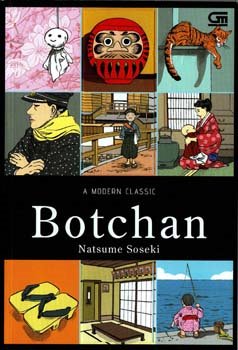
“Botchan” by Natsume Soseki – The New Kid Teacher

“Botchan” by Natsume Soseki (1906) – 172 pages     Translated by J. Cohn


“Botchan” means ‘kid’ in Japanese.  The young guy in our novel is no kid; he’s 22 years old.  However among the teachers at the school where he teaches, he is ‘the kid’ teacher.

 This novel brought me back to memories of my first job in downtown Madison, Wisconsin.  I had just graduated from the University of Wisconsin – Madison in 1970 which was a hotbed of radicalism at the time.  I who came from straight off the farm stayed pretty much on the sidelines. For some reason it was very important to me that I get a job right away,  so on the Monday after I graduated I started working at the General Casualty Insurance Company, perhaps the most conservative insurance company in the world.  I had a Bachelors’ degree in Mathematics, and they hired me to do some low level actuarial type work developing rates.

 But first I had to learn the underwriting business.  On the first day, my boss saw that I walked to work and figured out that I walked right past the store where he purchased a cigar every day, so that became one of my duties, to pick him up a cigar each morning.   One of the main responsibilities of an underwriter is cancelling people’s car insurance.  This was based on secret inspection reports the company purchased on all their new insured’s.  If the inspection report said the insured had a drinking problem, we cancelled them right away.  Not only that, but if a single woman was determined to be living with a man, we’d cancel her for ‘moral’ reasons.  I found the whole idea of secret inspection reports on people offensive.  I started expressing some of my opinions to the other underwriters during break time, and pretty soon some of them were calling me ‘a Commie’.

 One Wednesday night, my old roommate and his girlfriend showed up in Madison and invited me to a little party at their hotel room.  We drank wine and smoked dope, and soon it was 3 AM.  Conscientious guy that I am, I showed up for work at the insurance company the next day at my usual time of 8 AM.  Somehow I sort of managed on the job.  Then in the middle of the afternoon, the underwriter who was second-in-charge took me into a private office and told me, “Never, Never show up at work like that again.”  I remember his words exactly.

I really identified with Botchan in this novel.  This is his first job as a teacher.  He’s from Tokyo and now he’s teaching school in some backwater town..  He has funny nicknames for all the other teachers like “Porcupine”, “Redshirt”, “Badger”, and “the Madonna”.  That’s a major difference between me and Botchan;   this first teaching job is mainly a joke for him except that he needs the money.  I took it all quite seriously, not knowing there was any future after this first job. 

Anyhow “Botchan” is a humorous classic in Japan, and I found the humor translated quite well over to our society, because we’ve all had our first jobs.  Apparently the author, Natsume Soseki dashed this short funny novel off in a few days before he wrote his deeper more serious works. 

 According to J. Cohn in the introduction “’Botchan’ remains one of the most familiar, most read, and most loved of all novels in Japan.”  I can fully understand why it is so popular in Japan.   If you are mostly not familiar with Japanese literature, “Botchan” is an accessible humorous novel and a good place to start.

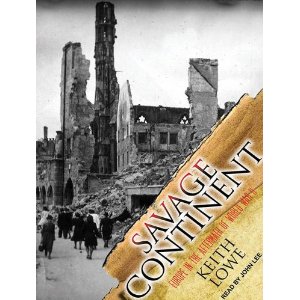
“Savage Continent” by Keith Lowe – Europe Immediately After World War II

Savage Continent” by Keith Lowe (2012) – 378 pages

 “While it is important to make it clear at the outset that the atrocities that took place here were on nothing like the scale of the Nazi war crimes, it is equally important to acknowledge that they did occur, and they were barbarous enough.” –  “Savage Continent” by Keith Lowe on Allied prison camps, particularly Soviet prison camps, after World War II   

 The above is probably the most important sentence in “Savage Continent”.   Revenge was one of the main matters after World War II.  However the atrocities that occurred after World War II were not as dreadful as the atrocities that the Nazis perpetrated during the war itself.  Keith Lowe makes this point several times throughout “Savage Continent”.  Revenge is a blunt instrument; millions of German-speaking people through much of Europe who were relatively innocent suffered terribly while some of the major perpetrators of Nazi atrocities escaped to South America.  Perhaps the best way to highlight the material in “Savage Continent” is to present some of the facts that are in the book.      

 As the Soviet Army advanced across Eastern Europe into Germany in 1944 and 1945, it took 3 million prisoners.  Many of these prisoners were German soldiers and German civilian leaders and partisans, but they were also Hungarian and Romanian soldiers who were allies of the Nazis.  Of these 3 million prisoners of war, more than a third or over a million prisoners died in captivity, many from starvation but some from outright murder. 

When the Allied forces liberated some of the concentration camps where Jewish prisoners were kept, they would be so repelled by the conditions in these camps that they would allow the few remaining  Jewish survivors to kill some of the German guards in revenge. Later there was a group of Jewish partisans called the Avengers who placed a bomb in an SS prison camp that killed eighty of its inmates.  The group was planning to poison the water supply of five German cities, but was foiled when the group’s leader was arrested trying to smuggle the poison from Palestine.  

As part of the settlement of the end of World War II, the ancient German provinces of Pomerania, East Brandenburg, Lower and Upper Silesia, some of East Prussia, and the port of Danzig all became Polish.  Eleven million German people lived in these provinces before the war, but by the war’s end many had fled the Russian Army, and only four to six million German people remained in these provinces.  Poland, with the help of the Russian army, expelled many of these remaining Germans from these lands, first taking their property and putting them in refugee camps, then sending them on trains to what remained of Germany. 

The end of World War II was not only a time of retaliation against the Nazis, but also a time for ethnic cleansing of any groups that were considered undesirables within the individual countries. Between 1944 and 1946, 782,582 Poles were removed from the Soviet Ukraine and resettled in Poland.  A further 231, 152 Poles were expelled from Belarus, and 169,244 from Lithuania.  In turn, over 482,000 Ukrainians were expelled from Poland.

According to recent research, about 20,000 French women had their heads shaved in public demonstrations as a punishment for collaboration with the Nazis, the largest proportion of them for sleeping with German soldiers.  In many cases the women were forced to undergo this ordeal partially or completely naked. 

As devastating as the material in this book is, I would still recommend that if you read only one history book this year, make it “Savage Continent”.

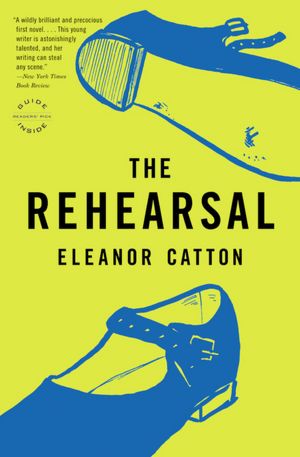
“The Rehearsal” by Eleanor Catton – In Praise of Maximalism

“The Rehearsal” by Eleanor Catton (2008) – 309 pages

.

“The Rehearsal” breaks every rule of literary minimalism along its merry and harrowing way, and that is a good thing. 

 We’ve all read minimalist novels.  In them the sentences are short and laconic.  The number of characters is kept to a classic few.  The dialogue cannot be profound or witty, because people don’t naturally talk that way.  The sentences themselves have little variety of structure just like the ones I’m using to describe minimalism.  When finally a small epiphany does occur in the minimalist novel, it glows brightly across the dull flat surface of the rest of the book.

 “The Rehearsal” flaunts these rules of minimalism.  Perhaps it is because Eleanor Catton is from New Zealand, far from the United States which is the home of minimalists such as Raymond Carver, Ernest Hemingway, Cormac McCarthy, Ann Beattie, Richard Ford, and many others.  Perhaps it is because Eleanor Catton was only 22 years old when “The Rehearsal” was published. Take the following lines of dialogue which would never show up in a minimalist novel or story.

 “The clarinet is tadpole to the sax, can you see that?  The clarinet is a black and silver sperm, and if you love this sperm very much it will one day grow into a saxophone.” 

 This is spoken by one of the main characters of the novel known only as the saxophone teacher. The over-the-top profound and witty dialogue of “The Rehearsal” was the first thing that struck me.   Of course people rarely talk this way in real life, so the dialogue here comes across as extravagant and fabricated.  However I find this dialogue refreshing, because it is thought-provoking and interesting in its original quirky way.  It reminds me of much of the writing of Oscar Wilde who was always willing to stop the progress of his stories for the sake of an outstanding line.    

 “The Rehearsal” is about school, music, and the theatre. Most of the novel is seen from the point of view of the high school girls and the slightly older theatre group which occupies an adjoining building.  The crucial event of the novel is when one of the male teachers Mr. Saladin is discovered to be carrying on an affair with one of his underage students Victoria.  The theatre group decides to re-enact this affair as their original play for the year.

 Here is one more interesting quote from the novel to give you more of the flavor of “The Rehearsal”.

 “Acting is not about making a copy of something that already exists.  The proscenium arch is not a window.  The stage is not a little three-walled room where life goes on as normal.  Theatre is a concentrate of life as normal.  Theatre is a purified version of real life, an extraction, an essence of human behavior that is stronger and more tragic and more perfect than everything that is ordinary about me and you.” 

 “The Rehearsal” runs out of energy well before the end, and I found myself losing interest during the last third of the novel.  The girl students’ and theatre students’ reactions to the teacher-student affair were unexpected and interesting, but I think they could have gone even deeper.  I do see this novel as a noble attempt to write an original novel.

  “The Rehearsal” was long listed for the Orange Prize in 2010 and Amazon’s First Novel Award of 2010.   It must be a heady experience being 22 years old and seeing your novel published all over the world.

 Currently Eleanor Catton is studying at the Iowa Writers’ Workshop in Iowa City, Iowa.  I for one hope she is not learning minimalism.

“It’s Fine by Me” by Per Petterson – From School to Factory in Norway

“It’s Fine by Me” by Per Petterson  (1992) –  199 pages

 I was halfway through “It’s Fine by Me” and still wavering, still considering quitting the book.  But I stuck with this short novel until the end and I am happy that I did.  

This is an early work by the Norwegian novelist Per Petterson who of course wrote the hugely successful novel “Out Stealing Horses” in 2003. It is the fifth novel by Petterson to be translated into English.  I thought “Out Stealing Horses” was excellent (nearly everyone did), but had not read any of his other novels until this one. 

“It’s Fine by Me” is about a young Norwegian working class teen who lives with his mother.  His father, a violent drunk, has moved out of the house but still hangs around the town    There have been a lot of novels about sensitive young guys brought up in broken abusive homes; I liked that here the young guy, Audun, is no sensitive shrinking violet but is a tough guy willing to fight for himself.  There’s a lot of fighting in this book as you would expect among the young men living in a poorer neighborhood. 

The first sections of the novel switch between scenes from when Audun is 13 and scenes from when he is 18.  At times I couldn’t figure out which sections were which, so the novel just seemed disjointed to me.  Although some of the individual situations were stark and interesting, I couldn’t figure out where Petterson was heading with the entire story.  That is when I wavered at continuing the book. 

However halfway through “It’s Fine by Me”, everything fell into place for me.  This is not a conventional story with a beginning, a middle, and a conclusion; this is a character study of a tough young guy who lives in a rough Norwegian working class neighborhood.  It is about his transition from going to high school to working in a printing factory.  I especially liked the scenes of the straight-from-high-school Audun starting to work on the factory floor, fitting in with the older workers and dealing with his bosses.

One of the strengths of  “It’s Fine by Me” is that you don’t get the sense that the main protagonist Audun is just the author at a young age.  That occurs too many times in novels.  Here Audun stands on his own feet.  No one makes excuses for him.  He is not a particularly good person; he is not a particularly bad person.   He’s a tough guy living in a rough neighborhood who survives at least to the end of the novel.  It rings true, and that is the best thing.