Archive for the ‘Book Reviews’ Category

“The Colonel” by Mahmoud Dowlatabadi – Truth to Power

“The Colonel” by Mahmoud Dowlatabadi  (2009) –  220 pages Translated by Tom Patterdale

bookreview

This novel is about the Iran Revolution of 1979, a revolution in the words of translator Tom Patterdale that “ate its own children.”

As this novel begins, the Colonel in his sixties is sitting in a room in his house in Rasht, Iran.  The time is the late 1980s.  The Colonel had spent time in prison in the 1970s for killing his adulterous wife.  His son Amir was imprisoned for political reasons at that time and tortured by members of the Shah’s CIA-trained intelligence agency SAVAK.  Now the revolution has taken place, the Shah is gone, and Amir, the victim of a long-term mental breakdown, is living in his father’s house.

Two of the Colonel’s five children are dead, and tonight the Colonel will find out that his daughter Parvaneh was also murdered by the fanatical religionists who now rule Iran.  Her crime was distributing pamphlets critical of the Khomeini government.   In 1988 many of the people who took up arms against the Shah as resistance fighters were executed as “dissidents” by Iran’s new Islamic ruling government of Khomeini.  Even the Shah and his SAVAK did not murder so many

As you can tell from the above, this is not a fun read.  So why read this book?  First of all Mahmoud Dowlatabadi is a powerful and courageous writer who while telling the story of the Colonel relates much of the history of Iran.  Iran is the home of one of the world’s great civilizations, Persia.   There have been hopeful times, times of good government in Iran, but the presence of oil has caused other countries including the United States, Russia, Israel, and Great Britain to meddle and interfere in Iran’s internal affairs.   When Iran finally rid itself of the Shah and the hated and feared SAVAK, who could blame Iran for withdrawing into isolation and religious fanaticism?  It has been over 33 years.

 “Who am I trying to fool?  I’m well aware that at every stage of history there have been crimes against humanity, and they couldn’t have happened without humans to commit them.  The crimes that have been visited on my children have been committed and still are being committed, by young people just like them, by people stirring up their delusions, giving them delusions of grandeur.  So why do I imagine that people might improve?  Everything going on around us seems to indicate that the values our forbears passed down to us no longer apply, Instead, we have seen the seeds of mistrust, skepticism and resignation, which will grow into a world of nihilism and cynicism, a jungle in which you will never find the courage to even mention the names of goodness, truth, and common humanity, a crop that is now bearing fruit with remarkable speed.  We are obliged to dig our own children’s graves, but what’s even more shocking is that these crimes are creating a future in which there is no place for truth and human decency.  Nobody dares to speak the truth any more.  Oh my poor children…we’re burying you , but you should realize that we are also digging a grave for our future.  Can you hear me?”   

 “The Colonel”  is unique in that it has been translated into English and German while it still has not been approved for publication in Iran.   This is a novel that deals with life and death and makes most novels published in the western world seem trivial in comparison.
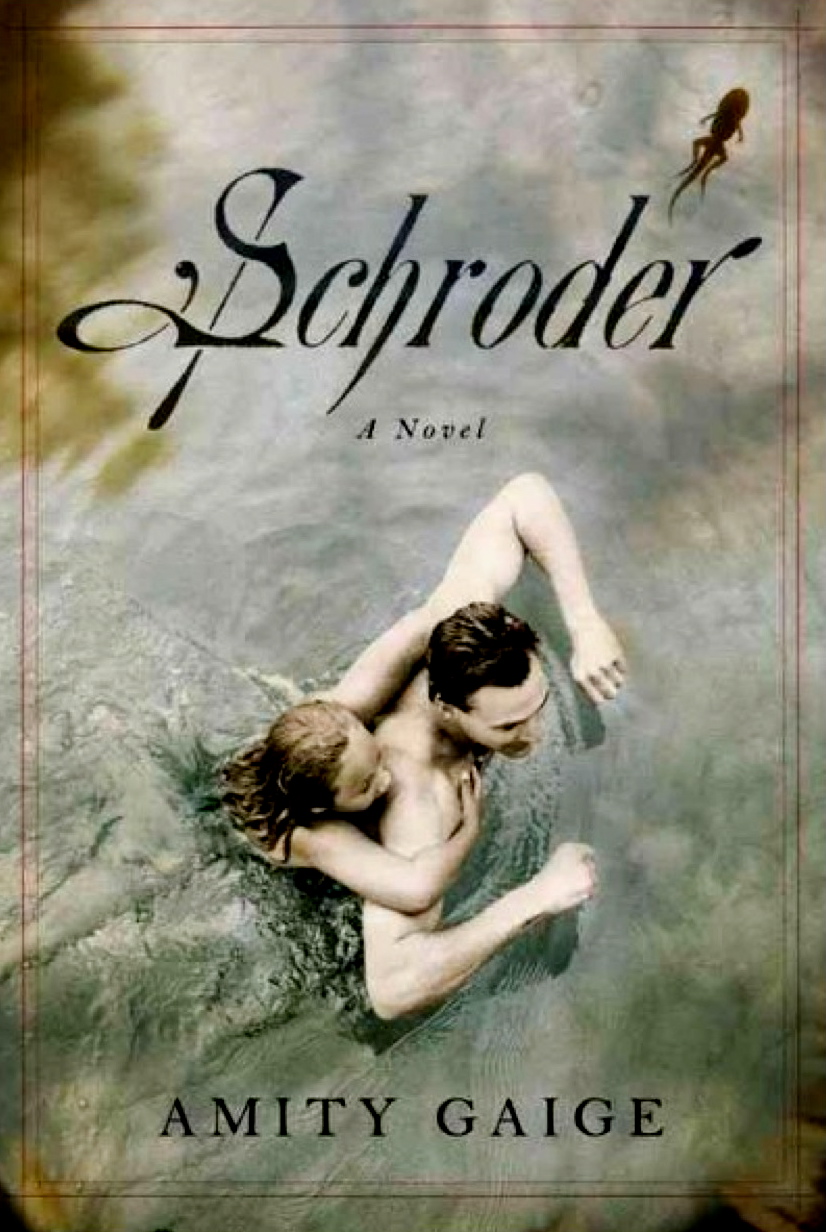
 

“Schroder” by Amity Gaige – A New England Road Trip

“Schroder” by Amity Gaige  (2013)  – 269 pages

0001Fb

If you want to write an emotionally gripping novel, keep the story as simple-minded and one-dimensional as possible.  Never veer far from your main plot, and never give your reader a reason for his or her mind to wander from the basics of your story.  If you can do that, you are well on your way to a best seller.

That is why so few novels from literary authors become best sellers, unless they win the Booker Prize.  Literary authors realize that our lives are multi-faceted and complicated and inconclusive.  To introduce complexity and inconsistency into your characters might make your story more intellectually satisfying and meaningful, but it will usually limit your novel’s sales potential.

I could well imagine the main plot of “Schroder” being ground down into a best-seller.  A soon-to-be-divorced father drives away with his six-year-old daughter thus violating the agreed upon visitation rules.   A fair number of lesser authors than Amity Gaige could turn this story into a fast-moving twenty-first century morality play / police procedural, and the royalty checks would roll in.

However Amity Gaige is not that kind of writer.  She gives this story added complexity by introducing another subplot which is quite removed from the unapproved road trip, the story of an East German boy transplanted to Massachusetts who later becomes the father in the story. He decides at the age of 14 that he would fare better in this world as a Kennedy, a shoestring relative of the clan.   Gaige tells the story of this boy turned father driving away with his daughter from the father’s point of view, and this father is an empathetic if not sympathetic figure.  If Gaige had followed the rules for best sellers, she would have made this father an evil villain for whom the whole world would stand up and cheer when he finally got caught.

I suppose the secret for a literary novel to succeed is for it to combine the visceral appeal of a best seller as well as those satisfactions which would take it beyond the run-of-the mill best seller.  What are these satisfactions?  Distinctive language is one. Unique insight into a particular life situation would be another.  A third might be some perspective on how the story fits into the historical or current time.

Although “Schroder” held my interest throughout, it did not quite succeed for me on either visceral appeal or intellectual satisfaction.  For me, “Room” by Emma Donoghue is the gold standard in novels which have a young child as a main character.  The six year old girl, Meadow, in “Schroder” did not come across quite as vividly as the five year old boy, Jack, did in “Room”.  Also the two plot lines in Schroder, the German father with a self-changed identity and the unauthorized auto trip with his daughter, were an uneasy fit and did not reinforce each other into an entirely satisfying whole.

“Dotter of Her Father’s Eyes”, Mary Talbot and Lucia Joyce

“Dotter of Her Father’s Eyes” by Mary M. Talbot and Bryan Talbot  (2013) – 90 pages

dotter3

Let me tell you about this unusual book.  First it is a graphic novel, not so uncommon these days, but it is a smart graphic novel, not a dumb one, and I like that.  It is illustrated by Bryan Talbot who apparently is quite famous in the comic book world.  But “Dotter of my Father’s Eyes” is far from your typical comic book.  It juxtaposes the story of two daughters who share an interest in dance. However the two girls never meet each other.  One girl is Lucia (pronounced Lu CHEE a) Joyce, daughter of Irish novelist James Joyce and his woman friend.  The other girl is Mary M. Talbot, daughter of James Joyce scholar James S. Atherton.

Early on in the story, it is revealed that Lucia Joyce spent the last 30 years of her life in a mental institution.   “Dotter of Her Father’s Eyes” deals with Lucia’s life before that time.  At that point James Joyce is still an unpublished writer struggling to support his woman friend chambermaid Nora Barnacle and their two children.  During the span covered, James Joyce publishes “Portrait of the Artist as a Young Man” and “Ulysses” and thereby becomes perhaps the most famous writer in the world.   At the same time Lucia Joyce becomes a dance phenomenon in Paris.  Later she is romantically involved with the author Samuel Becket.

                         .                      .

. .

Mary Talbot uses her childhood brush with the dance world as a means of approaching Lucia Joyce’s life.  So we get scenes of Mary Talbot’s home life as well.  Both Mary and Lucia must deal with difficult parents.  In Lucia’s case it is mainly her mother who is a barrier.  In Mary’s life her father has a difficult personality.   However the book does not make the mistake of depicting the two girls’ lives as just too parallel.

“Dotter of Her Father’s Eyes” won the Costa prize for Biography this year, what I consider an amazing feat for a graphic novel.  I can imagine how some of the writers who wrote huge in-depth biographical tomes about their subjects must feel.  But I am all for the new and different, and a graphic novel about the literary world has a strong appeal for me.  This book is a delight.  The story is well told and not too obvious.  The art work enhances the story and fortunately does not have that shrill quality that sometimes puts me off comic books.

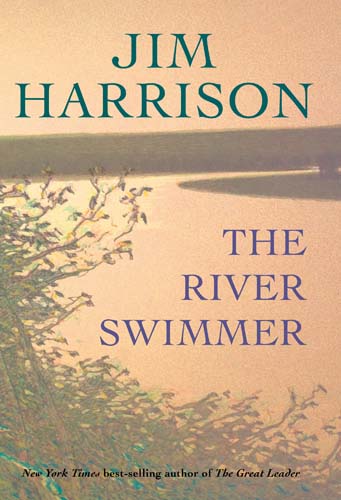
“The River Swimmer” by Jim Harrison, Gentle Humor, My A** !

“The River Swimmer” by Jim Harrison  (2013) – 198 pages

9780802120731_cx_1

Sometimes listening to the audio version of a book enhances the experience of the book for the reader.  However sometimes the opposite is true and listening to the audio version highlights an author’s defects and limitations.  Unfortunately audio brought out all the shortcomings and also brought out my own severe irritations with the two novellas in “The River Swimmer” by Jim Harrison.

The dialogue is rude, crude, and wooden.  The writing is drearily unfocused; there are frequent lengthy discursions into what the main character ate for lunch as if he is so special that we readers care.  We don’t.  But the main sin of “The River Swimmer” is the author’s undeserved arrogance.

Harrison stacks the cards totally in favor of his insufferable ‘hero’ in each of these stories and against the other male characters. The women in these novellas exist only to heap adoration and sex on the main character whom they simply can’t resist to their own detriment.

The first novella “The Land of Unlikeness” is all about 60-year-old braggart artiste Clive as he returns to his rural boyhood home in Michigan.  Usually when a story has a main character like Clive who is this obnoxious egomaniac, there is a sly humorous wink toward the reader to indicate we should be laughing at this guy.  No sly winks here.  This novella is so lame the author actually believes we readers will take this bag of wind seriously.  Clive shares all the high points of his life always putting himself in the best possible light; this gasbag just will not shut up.

In the second novella “The River Swimmer”, we have the teen Thad who likes to swim.  He has the same self-centered attitudes as blowhard Clive from the previous story, but the author must hope that by making him young he can get away with it.  No such luck.    This novella only proves that in the wrong hands, any character can be annoying.

The novellas in “The River Swimmer” are so bad that this is the first sure selection for my “Worst of the Year 2013” article.  These novellas are so bad that it is difficult for me to accept that I’ve liked previous works by Jim Harrison, such as “Legends of the Fall” and “The Woman Lit by Fireflies”.  How could I possibly have been taken in by a writer whose writing here is so transparently bad? After reading a few positive reviews of “The River Swimmer”, I have also lost faith in critics.  Gentle humor, my ass.  These novellas are so awful I probably won’t be reading Jim Harrison ever again.

“The Sly Company of People who Care” by Rahul Bhattacharya – A Tropical Non-Paradise

“The Sly Company of People who Care” by Rahul Bhattacharya  (2011) -278 pages

Guyana-Fall-08-Eng-with-title

“The Sly Company of People who Care” is a love song / story to the country of  Guyana.  Guyana is a country in the northeastern corner of South America that is so forlorn and forsaken that most of the white people have left.  Let the party begin.

First Bhattacharya in a note breaks down the population of Guyana as follows :

East Indians                                                                                43.5 %     

(These are the descendants of the coolies and

indentured laborers from India who came

after slavery was abolished in Guyana in 1838.)

  Africans                                                                                      30.2 %

(These are the descendants of the slaves who had

been brought here before slavery was abolished.)      

 Mixed Race                                                                                   16.7 %

Amerindians (the original indigenous people)               9.2 %

 Portuguese                                                                                     0.2 %

 Chinese                                                                                          0.19 %

White                                                                                               0.06 %

The author himself is from modern India, an Indian national who apparently as a group don’t make up even a recordable percentage of the population of Guyana.

“The Sly Company of People Who Care” celebrates “the remarkable freedom of a forgotten and irrelevant place on earth.”  This is a fun humorous novel to read.  It is not often that an author captures the spirit of a whole country in the pages of one book, but somehow Bhattacharya manages it.  Guyana shares the relaxed looseness of those tropical islands in the Caribbean Sea like Trinidad and Martinique.

 “Guyana had the feel of an accidental place.  Partly it was the epic indolence.  Partly it was the ethnic composition.  In the slang of the street there were chinee, putagee, buck, coolie, blackman,  and the combinations emanating from these, a separate and larger lexicon.  On the ramble in such a land you could encounter a story every day.”

 Much of this novel is told on the ramble, perhaps a long boat trip to Kaieteur which happens to be the largest single drop waterfalls in the world, but which tourists rarely visit due to its location in Guyana.   And everywhere our narrator meets the diverse persons of Guyana who are  maybe the friendliest and most unpretentious people in the world.   Conversations are in the native Guyana patois.

9792232“The Sly Company of People Who Care” is not a novel you read for its sustaining plot, since it does not have one.  You read this book for its carefree welcoming tropical spirit which is far removed from the tense, over-worked civilized parts of the world.  What comes across strongly is Battacharya’s fondness for this land of Guyana and its people.

Another writer who wrote of this part of the world is Nobel prize winner V. S. Naipaul who is from Trinidad.  “Sly Company” reminded me of  Naipaul’s early works such as “Miguel Street” and “The Mystic Masseur”, both of which have this same tropical spirit.

I recommend this novel to readers who like exotic locations and people.  It has the ambience of a wild island vacation.

“Middle Men” by Jim Gavin

“Middle Men” by Jim Gavin  (2013) – 221 pages

9781451649314_p0_v2_s260x420

The basic story in “Middle Men” is about a young guy,  kind of a goof-off and burn-out, living near Los Angeles today and trying to make a go of it somehow.  The author, Jim Gavin, is young and lives somewhere around Los Angeles himself.  The stories here are shamelessly funny yet they sting at the same time.

It is refreshing to read these unpretentious stories  in the here and now, young guys living life as we try to live it today.  There are a few woman writers who capture their current lives in fiction, but most of the male writers are off fighting wars, telling historical adventure stories, or reminiscing about their wonderful childhoods.   Meanwhile the guys in Gavin’s stories are heading out to get lunch at the nearest Del Taco.

Jim Gavin had a story, “Costello”, published in the New Yorker a little over two years ago.  For me, “Costello” which is the last story in the collection is the weakest story here.  All of the other first six stories center on a young man, while this last story is about old Marty Costello and his plumbing salesman associates.  It is not a bad story; it just doesn’t have that excitement of youthful immediacy which the first six stories have.

My favorite story is the longest one in the book, “Elephant Doors”.  During the day, our young man hero is a personal assistant to famous game show host Max Lavoy.   At nights our hero does ‘Open Mike’ stand-up routines at ‘El Goof’ comedy clubs around Los Angeles, hoping to catch on.  This is a Hollywood insider story, one that gets under the mystique of the show biz world to what actually is going on.

 “If you knew some of the jobs I’ve had.”

“I was a writer’s assistant on ‘Mr. Belvedere.”

“Jesus Christ”, said Adam.

There was a grim silence, as if Doug had just confessed his role in some infamous wartime atrocity. 

 “Middle Men” is a quick read.  These stories barrel along, while our young heroes keep their good natures and their gruesome gleeful outlooks as the world collapses around them.

Jim Gavin has that self-deprecating sense of humor I somehow associate with the Irish.  Why make fun of other people when you can make such fun of yourself instead?  Besides if you ridicule your own life, it doesn’t seem so mean when you tell cruel jokes about those around you.   What is a writer to do except to do as one of Gavin’s characters does, “to indulge in vile misanthropy one minute and false pleasantry the next”?

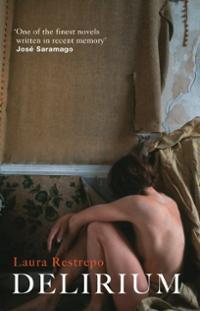
“Delirium” by Laura Restrepo

“Delirium” by Laura Restrepo  (2004) – 320 pages  Translated by Natasha Wimmer

delirium-restrepo-laura-hardcover-cover-art Somehow I missed “Delirium” when it first came out in English translation in 2007.  Now I have read it, and it is a fine novel indeed.  If you look closely at the book cover, you’ll find this quote from Jose Saramago, no slouch as a novelist himself : “One of the finest novels written in recent memory”.

“Delirium” is a Colombian novel which takes place during the time of Pablo Escobar, leader of the Medellin cartel, who at his peak was estimated to have provided 80% of the cocaine used in the United States in the late 1980s and early 1990s.   This was a time of widespread cocaine use in the US, and Escobar became a multi-billionaire.

I learned one economic lesson from “Delirium” which I hadn’t considered before.  The people who fear poverty the most are those who come from traditionally wealthy families but now are in danger of losing the family estate and fortune.  These are the people who ‘invested’ their money with Escobar.  Some of these wealthy people would give Escobar thousands of dollars, and in return his lieutenants would later come back with suitcases of money for them.  One of the main characters in “Delirium” is one of these lieutenants, Midas McAlister.  He runs a health and exercise club, but he is also a suitcase man for Escobar.  Laura Restrepo was originally an investigative reporter, and she puts her experience to good use in describing how the Escobar crime syndicate operated, all told in the voice of Midas.

“Delirium” is another of those novels where the narrative voice changes from short chapter to short chapter.  I like this technique because you get the story from several angles and with different voices which adds variety to the proceedings.  The first narrator is ex-professor/now dog food salesman Aguilar who comes home from a trip only to find his wife Agustina in a state of mental chaos, of delirium.  Aguilar earnestly tries to discover what caused his wife’s confusion.  The second narrator is the not-so-earnest Midas who is Agustina’s former lover.  Then we get a third person narrator who fills us in on the background of Agustina’s family all the way back to her grandparents.  This multiple narrative technique speeds the story along, because we don’t have to wait for one person to discover every little detail.

“Delirium” is not your traditional novel; it moves along from the unexpected to the risqué to the psychological and gives a good picture of what life was like in urban Colombia during that time.  I will be on the lookout for more novels by Laura Restrepo.

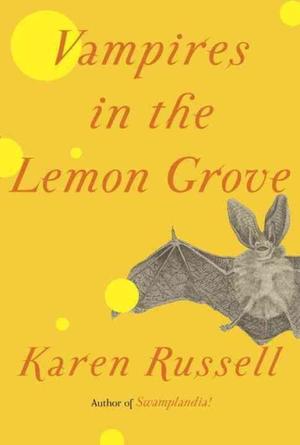
“Vampires in the Lemon Grove” by Karen Russell

“Vampires in the Lemon Grove” by Karen Russell (2013) – 243 pages

g12c000000000000000968219f3805148771c2724c7a5c1e439966bdf9b

After my extremely positive reaction to “Swamplandia” by Karen Russell, I fully expected that my review of “Vampires in the Lemon Grove” would be filled with paroxysms of delight.  However such is not the case.  I found the story collection “Vampires in the Lemon Grove” only intermittently interesting.

So how is “Vampires” so different from “Swamplandia”? First although the main characters in these stories include vampires, young Chinese women, ex-Presidents reincarnated as horses, etc., these characters did not seem sharply delineated.  Whereas each member of the Big Tree family in “Swamplandia” had their own distinctive personality and behavior traits which made them special, little attempt is made here in any of these stories to give the side characters a distinguishing touch.

The most disappointing example for me was the story “The Barn at the End of Our Term” which is about ex-US Presidents re-incarnated as horses.  Thus we have Rutherford Hayes, James Buchanan, William Harding, Dwight Eisenhower, and so on all now as horses.  I could have gone along with this humorous gimmick if only each horse was given some peculiar trait of the ex-President they were supposed to be a re-incarnated from.  Otherwise what’s the point?  As it was, there was not even an attempt to relate the horse to the traits of the particular ex-President.

Each of these stories is based on a gimmick.  Perhaps the most well-developed of the stories is “Reeling for the Empire”  in which young Chinese girls are taken away from their families and given a strong tea drink that turns them into human silkworms.  Give Russell credit; this is one sick disgusting idea for a story, especially when the girls start producing silk all over their bodies, and then the silk is extracted from them.  However the story would have been much stronger if the individual girls and women were given more defined personalities.

Of course Russell has gotten a lot of static for putting vampires in the title of her story collection when so much lame writing today is about vampires.  What I found most offensive is that it opens with the vampire story which is rather a loser story.

There were times when I could get caught up in a few of the stories and just enjoy them, but throughout the collection there was writing that just wasn’t that tight.  The characters were sludgy and vague, and the plots were not well-framed.

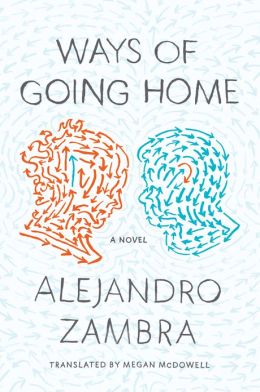
“Ways of Going Home” by Alejandro Zambra

“Ways of Going Home” by Alejandro Zambra (2011) – 139 pages   Translated by Megan McDowell

 “Although we might want to tell other people’s stories we always end up telling our own.” 

               .

.

Alejandro Zambra is a young writer from Chile, and “Ways of Going Home” is the first of his novels I’ve read.   It contains some great lines, and I believe Zambra has the potential of writing a great novel.  However “Ways of Going Home” was much too digressive, disjointed, and self-reflexive to entirely hold my interest.

“Ways of Going Home” starts about 30 years earlier from now when the dictator Augusto Pinochet ruled Chile.  The novelist/narrator was only a nine-year-old child then.

In order to get my facts accurate regarding this era in Chile, I will quote directly from Wikipedia.

 “As a result, the Richard Nixon administration organized and inserted secret operatives in Chile, in order to quickly destabilize Allende’s government.  In addition, American financial pressure restricted international economic credit to Chile.”    

” Finally, a military coup overthrew Allende on 11 September 1973. As the armed forces bombarded the presidential palace, Allende apparently committed suicide.   A military junta, led by General Augusto Pinochet Ugarte, took over control of the country. The first years of the regime were marked by human rights violations. On October 1973, at least 72 people were murdered by the Caravan of Death. According to the Rettig Report and Valech Commission, at least 2,115 were killed, and at least 27,265 were tortured (including 88 children younger than 12 years old).”

 Gruesome politics aside, our narrator meets an older girl on the beach, Claudia,  during an earthquake, and she wants him to spy on his neighbor.

The novel then goes to the present time which is 2010.  Chile has just elected its first Right-Wing government since Pinochet.  It turns out that the neighbor was the girl’s father who was helping people who might have become victims of Pinochet escape from Chile.  Meanwhile the narrator’s father supported Pinochet or at least did not speak out against him which would have been a dangerous thing to do. Another earthquake in Chile actually occurs in 2010, and I wonder if the author is setting up some correspondence between the cataclysms of the return of a right-wing government to Chile and the earthquake.

“Ways of Going Home” starts out in the first section as if it were going to be plot-driven, but then in the modern sections the plot almost disappears, and the novel becomes more a meditation on writing and on Chile that includes some poetry.  The fairly lengthy parts of the novel about the difficulty of writing the novel were not very compelling, and the poetry did not strike me as particularly involving.

A more subtle understanding of the situation in Chile today might have helped me.   However, it is up to the author to provide all the necessary background for the readers to fully appreciate the novel, and for me Zambra was unsuccessful in doing that.

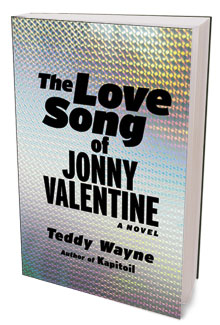
“The Love Song of Jonny Valentine” by Teddy Wayne

“The Love Song of Jonny Valentine” by Teddy Wayne (2013) – 285 pages

BOOK_JohnnyValentine

Have you ever read a novel that was absolutely unsuited for you?

“The Love Song of Jonny Valentine” has been called the Justin Bieber novel.  What ever possessed me to read this book?  That is an excellent question.

It all started when I happened to glance at a review of Jonny Valentine which mentioned “A Visit from the Goon Squad’ by Jennifer Egan, “Blonde” by Joyce Carol Oates, and “Room” by Emma Donoghue.  I liked all of those books and usually like novels about show or music people, so I thought I’d give Jonny Valentine a try.

I should have known better.

“The Love Song of Jonny Valentine” is the story of tween (Urban Dictionary definition: girls too old for toys, too young for boys.)  superstar Jonny Valentine; the eleven year old singing sensation is lonely even though he has millions of adoring girl fans.   There are a few main people in his life.  First there is his mother Jane who also serves as his controlling manager.  They usually share adjoining rooms in the hotels where they stay.  Jonny spends hours and hours playing the video game The Secret Land of Zenon.  Then there is Walter who is the world-wise bodyguard and somewhat father figure for Jonny.  Also there are his personal tutor Nadine and his voice coach Rog. Jonny’s real father is locked out from his life by his mother.

Jonny’s life consists of traveling from city to city performing shows in arenas and convention centers.  Since Jonny is nearly 12, his record company arranges for him to be photographed with Lisa Pinto, another tween star, who is a couple of years older than he is, for some pictures to put in the teen tabloids.    One time his opening act band, the Latchkeys, takes him to a nightclub and he gets drunk, and it ends up in all the papers.  The mother fires the band as his opening act, and she controls Jonny’s life more than ever.

I really can’t complain about the writing style in this novel; Teddy Wayne tells the story well.  The problem for me is that this story has become so trite.  This is the old, old story of the singing superstar living in a solitary goldfish bowl where everyone can watch him, yet he is so totally isolated.    I believe this novel would make fine reading for teenagers who somehow aren’t yet familiar with this story, but us adults have seen this plot played out a thousand times not only in films, TV shows, and books but also in real life.

Maybe the problem with “Jonny Valentine” is that the novel doesn’t venture in to any new territory, nor does it contain anything new about Jonny’s plight.   With an 11-year-old narrator trapped in this superstar situation, you probably are not going to get much in the way of original or profound insights.  It would have been more interesting with an objective adult observer such as the bodyguard witnessing what’s happening.  The classic examples of interesting young boy narrators are Mark Twain’s “Tom Sawyer” and “Huckleberry Finn”, and those two books are vivid because the boys are having a good time, and they put a humorous slant to the goings on.  Jonny Valentine is definitely not having a good time.

For me this is just another example of picking a novel that was wrong for me.

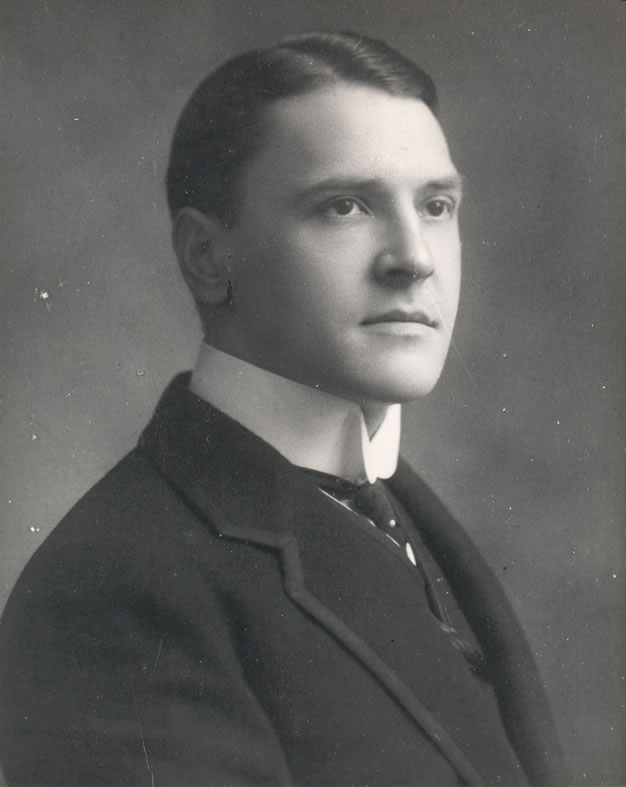
W. Somerset Maugham Sums Up His Career

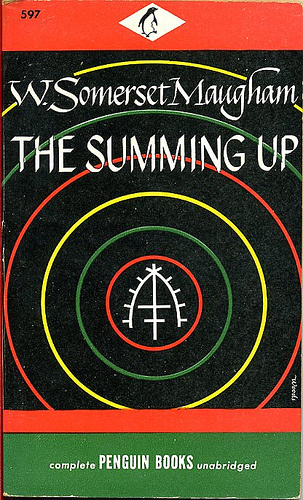
“The Summing Up” by W. Somerset Maugham (1938) – 310 pages

“Perfection is a trifle dull. It is not the least of life’s ironies that this, which we all aim at, is better not quite achieved.”

W. Somerset Maugham

W. Somerset Maugham

As a writer, W. Somerset Maugham was supremely competent.  “Competent” was the word that the critics of his time used to dismiss his work.  Maugham himself considered his work “in the very top rank of the second rate”.  Maugham valued Shakespeare, Cervantes, Tolstoy, and a few other writers as first rate, so there was really little shame involved in being second rate.

I’ve read my share of Maugham’s work including his excellent early novels ‘Cakes and Ale’ and ‘The Painted Veil’ as well as his later novels ‘The Razor’s Edge’ and ‘Of Human Bondage’.  It is probably his stories that I’ve most enjoyed and appreciated, especially his tales of the Far East.

As a young man, Maugham trained as a doctor.  I’m sure he was competent in the medical field as he was in all the fields he pursued, but in ‘The Summing Up’ he talks about working as a doctor during the day and then staying up all night reading the great works of literature.  I’m not sure I would have wanted him as my doctor under these circumstances.   His work in the medical field spurred his empathy for people in extreme circumstances which he used to great effect later in his writing career.

Next he became a playwright.  In the early 1900s he was the toast of the West End theatre district of London; at one point he had four hit plays performing simultaneously.   However he gave up the glamor and the glory of the theatre life, because plays were collaborations between the playwright, the director, and the actors.  Apparently there were one too many times when his play got changed in ways he didn’t want, so he became a fiction writer where he alone had total sole control over what he wrote.

In “The Summing Up”, Maugham shares many of his insights into the life of a writer.  Here is one of the best objective evaluations of a writer I’ve ever seen, and Maugham wrote it about himself.

“I discovered my limitations and it seemed to me that the only sensible thing was to aim at what excellence I could within them. I knew that I had no lyrical quality, I had a small vocabulary and no efforts that I could make to enlarge it much, availed me. I had little gift of metaphor; the original and striking simile seldom occurred to me. Poetic flights and the great imaginative sweep were beyond my powers. I could admire them in others as I could admire their far-fetched tropes and the unusual but suggestive language in which they clothed their thoughts, but my own invention never presented me with such embellishments; and I was tired of trying to do what did not come easily to me.

On the other hand, I had an acute power of observation and it seemed to me that I could see a great many things that other people missed. I could put down in clear terms what I saw. I had a logical sense, and if no great feeling for the richness and strangeness of words, at all events a lively appreciation of their sounds. I knew that I should never write as well as I could wish, but I thought with pains I could arrive at writing as well as my natural defects allowed. On taking thought it seemed to me that I must aim at lucidity, simplicity and euphony. I have put these three qualities in the order of the importance I assigned to them.”

wsmThe first two-thirds of “The Summing Up” were an enjoyable and beneficial read for me.  However Maugham had a life-long interest in philosophy, and in the last third of the book he discusses his philosophical influences and his own views on these matters.   He lost me there.  To me it sounded like blathering on about abstract concepts, and I missed the down to earth quality of the first part of the book.

So what is W. Somerset Maugham’s standing as of today?  Very well, thank you.  Three of his novels have been made into movies during the 2000s : “Up at the Villa” (2000), “Being Julia” (2004 – based on the novel “Theatre”), and “The Painted Veil (2006).  And there is always someone threatening to remake into a movie his classic short story “Rain”    Wikipedia lists a total of 35 film adaptations of Maugham’s fiction over the years.  Not bad for a writer who was only competent and second rate.

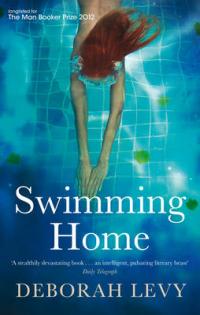
“Swimming Home” by Deborah Levy – It Happened on the French Riviera

Swimming Home” by Deborah Levy (2012) – 157 pages

                 '

There are many, many writers who are adept at producing smart, stylish, smooth sentences, enough of these writers to put us all to sleep.   So sometimes a writer comes along who creates lines that are deliberately choppy so we wake up and pay attention.  That is the vibe I get from Deborah Levy who is both a novelist and a poet.  Even the characters in “Swimming Home” seem choppy.  I don’t mind, being somewhat choppy myself.

I usually like reading novels by poets, because they do interesting things with the words. “Swimming Home” is no exception.  This novel has an edge that held my attention throughout.  Good poets also tend to be economical and meticulous in their use of words.   Even though this is a short novel, it is not a quick novel.  Each character is sharply drawn with a few strokes, and the chapters are written from the points of view of the various people who are staying at the villa

All is not well at the tourist villa located in Alpes-Maritimes on the French Riviera.

At the beginning of “Swimming Home” a body appears in the swimming pool of the tourist villa, the body of young woman Kitty French.  Don’t worry, she is plenty alive as she gets out of the pool in all her naked glory and throws the lives of the others at the villa into disruption.  Kitty is kind of mental, probably crazy.

“She was not a poet. She was a poem.”      

But she does write poems and gives a copy of her poem “Swimming Home” to the renowned straying middle-aged male poet staying at the villa, and no one can understand why the poet’s wife invited Kitty to stay in their spare room.  Everyone, including the reader, waits for the inevitable to occur between the old wayward poet and the crazy young lady.

It is dishonest to give me a poem and pretend to want my opinion when what you really want are reasons to live.”    

In so many ways “Swimming Home” is more of a continental European novel than an English novel, beginning with its locale on the French Riviera, although sone English royals have been known to go there.  “It is hard for an old woman to get a waiter’s attention when he was busy serving topless women sunbathing in thongs.”  Yeah.

“Swimming Home” is so sharp, tart and subversive that I’m surprised that it was short-listed for the old Booker award at all.  It would have been even more surprising if it had won, but instead the awards committee played it safe once again and chose the English kings and queens historical novel.

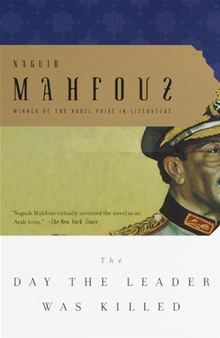
“The Day the Leader was Killed” by Naguib Mahfouz

“The Day the Leader was Killed” by Naguib Mahfouz  (1985)  103 pages Translated by Malak Mashem

It’s a most distressing affliction to have a sentimental heart and a skeptical mind.” – Naguib Mahfouz

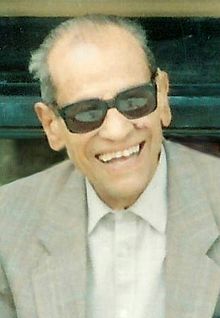
 ImageI want to take the occasion of this review to honor a great man.  In this age of unreason, Naguib Mahfouz was the last reasonable man. 

 Let me first give a short summary of his life.  Mahfouz was born in 1911 in Cairo, Egypt, a city he rarely left during his long life.  His parents were devout Muslims, and he had a strict Muslim upbringing.  He witnessed the Egyptian Revolution of 1919 as a child and watched British soldiers firing at unarmed Egyptian civilians protesting British rule. 

 From an early age he knew he was going to be a writer, and he read widely at a young age.  His mother would take him to museums, and he became well grounded in Egyptian history.  He wrote his first stories at 17 and published his first novel at age 21.   During his long career, he wrote many novels and short stories which take place either in historical or present-day Egypt. In the 1950s, he produced the Cairo Trilogy (‘Palace Walk’, ‘Palace of Dreams’, and ‘Sugar Street’) which is considered a landmark of his career and which I have read and much appreciated in its entirety.  He also wrote famous single novels such as Midaq Alley and many novellas of which “The Day the Leader was Killed” is one of the better ones.  In 1988 Mahfouz was awarded the Nobel Prize for Literature, the first Arab author to be honored.  Throughout his career Mahfouz supported the two ideals of socialism and democracy.

 When the Ayatollah Khomeini of Iran condemned Salman Rushdie to death in 1989 for writing “Satanic Verses”, Mahfouz defended Rushdie.  For this, Mahfouz was put on an Islamic fundamentalist “death list”.  In 1994 Islamic extremists attempted to assassinate him by stabbing him in the neck.  Mahfouz suffered permanent nerve damage as a result, and this highly prolific writer was unable to write for more than a few minutes a day.  He died in 2006 at the age of 95.

 “The Day the Leader was Killed” is narrated in revolving chapters by each of the three main characters.  Elwan is a young man from Cairo who has been going with his girlfriend Randa for many years, but still can’t afford to marry her. He sets Randa free so she can find someone else to marry, even though he still loves her.  They both develop other relationships which turn out to have disastrous consequences.  Both Elwan and Randa narrate chapters of the novel as well as Elwan’s doting grandfather who provides some perspective and distance on the plight of the two young people. 

 The drama advances until the day that the Egyptian leader Anwar Sadat is murdered, October 6, 1981. 

220px-Necip_Mahfuz “The Day the Leader was Killed” is not only the dramatic story of this young couple; it is also a commentary on the unrest and corruption of the Sadat years in Egypt.  Naguib Mahfouz is a capable enough writer to blend the personal drama and the complex political story into a short novella.  “The Day the Leader was Killed” would serve as a good introduction to the work of one of the giants in modern literature.

Gone, but not Forgotten

The following novels which I’ve read over the years have the distinction of receiving my highest rating of five stars.  They also have in common that they were written by novelists who have passed away during the last few years.  I deliberately selected writers whose names aren’t constantly in the literary reviews or blogs.  Those writers get enough publicity.  However the writers here wrote at least one great book and thus deserve to be remembered.  For each of these writers I highlight one book which is my favorite of their work.  Who knows?  One or two of these novelists may be the subject of a revival one of these years. 

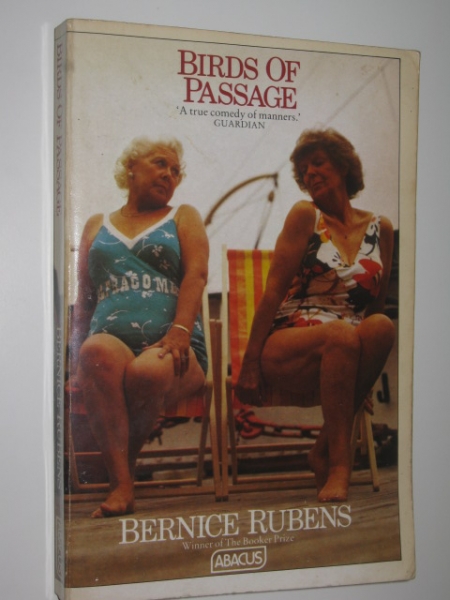
 12010403Bernice Rubens (1928 – 2004)    “Birds of Passage” is an elegant humorous novel like several others by this prolific Welsh writer.  That the main male character is a well-mannered rapist on a cruise ship for aging vacationers does not detract from the humor.  Iva at GoodReads says, “I may be the only American who has read her!”  No, I am another American who has read this delightfully eccentric author.

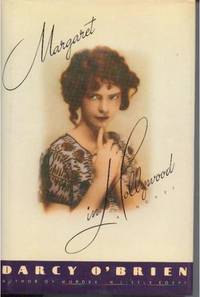
 113748644_0_mDarcy O’Brien (1939 – 1998) “Margaret in Hollywood” is a story of early Hollywood wherein Margaret, the daughter of a vaudevillian, jumps from Broadway to Hollywood.  Margaret is supposedly based on O’Brien’s real mother.  Both of O’Brien’s parents were famous Hollywood actors.  I enjoy novels about the entertainment industry despite being talentless myself.

 386724Jon Hassler (1933 – 2008) “Grand Opening” is a novel about a family buying and running a small-town grocery store.   The New York Times said of Jon Hassler, “a writer good enough to restore your faith in fiction”.  Having read several of his novels, I agree.  He proves that life in a small town in the Midwest is not so prosaic that it can’t be turned into interesting fiction. 

 12175James Purdy (1914 – 2009) “Color of Darkness” is the first book of stories by this writer who was not afraid to deal with “the heartbreaking truth” in his books.  James Purdy is probably the only writer on my list who has his own society.  Here are the first sentences of his artistic statement.  “People have no respect, no empathy for other people; they have no sense of who other people are.  There’s a kind of withering away of the human sensibility, and that leads to the collapse of just about everything.”  Can a good book make you feel uncomfortable? Yes.

 IMG_5080Elizabeth Hardwick (1916 – 2007) “Sleepless Nights” has now been re-published as an NYRB Classic. This short lyrical plotless book is a one-of-a-kind part novel, part memoir.  You have to read it to appreciate it.  Hardwick is often described as “the long-suffering wife of poet Robert Lowell”. 

 925669_120531162044_IMG_9623Lewis Nkosi (1936 – 2010) “Mating Birds” is the story of a black man and a white woman who meet on a ‘Whites Only’ beach in South Africa during the time of apartheid.  The black man ultimately goes to prison charged with rape.  Lewis Nkosi’s fiction was banned in South Africa under the Suppression of Communism Act and lived in exile in the United States.  

 a-legacy-novel-sybille-bedford-paperback-cover-artSybille Bedford (1911 – 2006) “A Legacy” is a novel about Bedford’s German background.  She was born in Charlottenburg near Berlin, raised a Catholic with a half Jewish mother.  She and her family left Germany with the rise of Fascism.  Bruce Chatwin saw her as “one of the most dazzling practitioners of modern English prose.”  After reading all four of her novels, I agree with Chatwin.

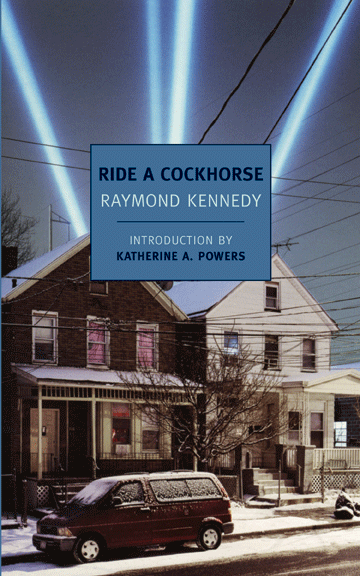
“Ride a Cockhorse” by Raymond Kennedy

“Ride a Cockhorse” by Raymond Kennedy (1991) – 307 pages

productimage-picture-ride-a-cockhorse-244

An alternative name for this novel re-issued by New York Review Books Classics could be “Frankie Takes Charge”.  First Mrs. Frankie Fitzgibbons takes charge of her sex life by seducing the teenage boy who is the drum major of the local high school band, and then she takes charge at work with spectacular results.    She destroys her male boss and moves into his office.  She emphatically increases the business of her bank and becomes a local media star.  There is no stopping Frankie as she fires long-time employees and makes plans to wreck the other local bank rivals.   “Cockhorse” is a black comedy in which we watch Frankie with glee and with horror at the same time.  She is an unstoppable, despotic force.

“If Mrs. Fitzgibbons knew nothing else, she knew that she could crush the man like a bug.” 

 There is one blurb on the back of “Cockhorse” that caused me to select this book over the many other NYRB Classics available.  The blurb attributed to Newsweek said “Perhaps the funniest American novel since John Kennedy Toole’s prize winner ‘A Confederacy of Dunces’”.  Since I’m a great fan of ‘Dunces’, this was a sure-fire line to get me to read this book. 

 No, “Cockhorse” is not quite in Dunce’s league, but how many humorous novels are?   It was eerily fascinating to watch Frankie take over her office and become more cold-blooded and downright mean than nearly any male boss would have been.  One of the other blurbs on the back of the novel points out the similarity between the rise of Frankie and the rise of Sarah Palin, an apt comparison.

 “I’m not suggesting a reign of terror,” Mrs. Fitzgibbons tossed out lightly, although, in truth. she would have liked nothing better than striking dread in the hearts of everyone in the place, “just some selective dismissals.” 

 The story starts out immediately after Frankie’s transformation, and we are given no reasons for the change in Frankie’s character which causes her to seduce the drum major and then take over at her bank office.  We readers learn she is a widow, but we do not learn the motivation for this behavior change in Frankie.  Instead the story barrels ahead which is probably a good thing, but I would have preferred a little back story, an explanation as to the causes for this dramatic change to her personality.  Up to this point, apparently Frankie was a mild good-natured woman.

“Cockhorse” has a strong forward momentum that kept me reading rapidly through the novel.  Raymond Kennedy captures the atmosphere of a local bank office and the terror that an out-of-control bank manager can cause.   Also even though there is little direct mention of Massachusetts, the reader gets a strong sense of the story occurring in New England.    This novel  is a good example of Americana at its near best.

“Paradise Lost” Part IV: The Garden of Eden and the Fall of Woman and Man

“Firm they might have stood yet fell.”

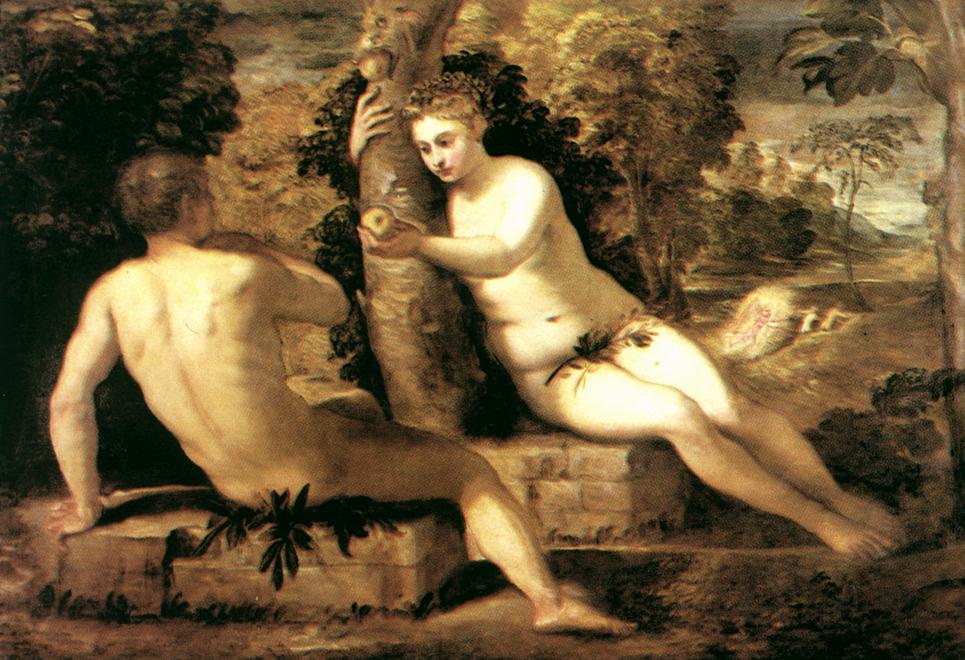
Returning to our story, Adam and Eve are living together in the Garden of Eden in innocent love and natural bliss. The bad angel Satan has rebelled against God, but he and his angels have lost a major battle against God and God’s angels. Satan like Wile E. Coyote has now come up with a new subtle plan to undermine God’s new kingdom Earth by bringing sin into the Paradise of the Garden of Eden.

Adam and Eve - Tintoretto,1550, Gallerie dell’Accademia, Venice

Adam and Eve – Tintoretto,1550, Gallerie dell’Accademia, Venice

John Milton modeled “Paradise Lost” on the ancient Iliad in which the Greek gods are personified and the myths are told about the gods and the mortals during the time of the Trojan War. Milton’s idea was a good one, because the Old Testament of the Bible contains some of our oldest myths including the Creation myth. “Paradise Lost” personifies God, his son Jesus, the angels, and the ancient humans, all in heroic verse.

God repeatedly told Adam and Eve not to eat the apple from the Tree of Knowledge of Good and Evil, but Satan disguised as a serpent slyly seduces Eve through flattery and lies into eating the apple. Eve is goodness and sweetness itself, but she falls for Satan’s lines quickly enough. John Milton, kind of like Satan, over-praises Eve’s beauty, sweetness, and compliance, always an effective strategy for a man. Is “Paradise Lost” anti-feminist? Yes, but not any more or less than the Bible itself. One would need to contort oneself quite severely to see Milton as any kind of feminist, but some critics have done so.

After Eve eats the apple, she realizes what she has done. God’s angels have told her that if she ate the apple she would eventually die. So what does she do? She considers not telling Adam, but then imagines herself dead, and God creating a new woman for Adam. Jealousy gets the best of her, so she tells Adam, and Adam, a good guy but not too smart, joins Eve in eating the apple and they get kicked out of Paradise. And here we are, Adam and Eve’s children no longer living in Paradise.

Odds and Ends

This is my last entry on “Paradise Lost”, so here are some random bits that were too small to fit into any of the other articles.

My favorite word from “Paradise Lost” is ‘thither”’. According to Merriam-Webster it means “to that place” or “a more remote place”. Milton uses the word “thither” about two dozen times. “Thither” is a word that we don’t hear much anymore but which the dictionary does not call archaic. Here is Eve in Paradise Lost:

That day I oft remember, when from sleep
I first awak’d and found myself repos’d,
Under a shade, on flow’rs, much wond’ring where
And what I was, whence thither brought, and how.

The entire text of Paradise Lost can be found at several locations on the Internet for free. At the John Milton Reading Room is the text to all of the works of John Milton including “Paradise Lost”

For another view of the epic, here are ten ways Paradise Lost is like a bad Comic Book.

Thither go me from “Paradise Lost”.

Paradise Lost – Part III: John Milton and T. S. Eliot

miltonportrait2
The short essay that T. S. Eliot wrote in 1936 called “A Note on the Verse of John Milton” may be the most crucially important literary essay written in the 20th century, and none written so far in the 21st century comes even close to matching its influence. This essay is not a declaration or manifesto of Modernism; it is a somewhat polite attack on a decidedly un-Modern poet, John Milton. Eliot begins with two sentences which assert his position:

“While it must be admitted that Milton is a very great poet indeed, it is something of a puzzle to decide in what his greatness consists. On analysis, the marks against him appear both more numerous and more significant than the marks to his credit.“

What are the exact criticisms of Eliot regarding Milton’s verse? Within the essay, Eliot compares Milton unfavorably with William Shakespeare, John Dryden, Henry James, and James Joyce.

Comparing Milton with Shakespeare, Eliot asserts that Milton’s language is ‘artificial and conventional’ He writes that, unlike Shakespeare, “Milton does not infuse new life into the word.”

John Dryden much admired “Paradise Lost”, but he had a problem. Milton was an anti-royalist while Dryden supported the throne. Thus Dryden wrote his own version of the story called “The State of Innocence” in 1674 which actually outsold “Paradise Lost” for the rest of the 17th century. Eliot writes that Dryden’s influence on poetry was healthier than Milton’s, because Dryden preserved “the tradition of conversational language in poetry”.

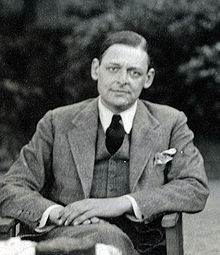
220px-Thomas_Stearns_Eliot_by_Lady_Ottoline_Morrell_(1934)Then discussing Milton’s ‘tortuous style’, Eliot compares Milton with Henry James. Eliot claims that James’ style, which, like Milton’s was ‘far from lucid simplicity’, achieved a precision in describing the intricacies of the thinking mind. On the other hand the complicated syntax of Milton “is determined by the musical significance, by the auditory imagination, rather than by the actual attempt to follow actual speech or thought.”

I found this comparison of Henry James and John Milton the least convincing of Eliot’s arguments. First I’ve had my own troubles with James’ last four convoluted novels. Secondly I don’t find the musical aspects of Milton’s verse a derogatory quality. However with Eliot I do agree that sometimes Milton forsakes the simplicity and directness of conversational language for a more ‘poetic’ verse. The traits of simplicity and directness of language are probably two of the main goals of Eliot and the other modernists.

In Eliot’s comparison of John Milton and James Joyce, he first states the two men’s numerous similarities which are musical taste and ability, wide and curious knowledge, the gift for acquiring languages, remarkable powers of memory, and defective vision. Eliot focuses on the defective vision of both of these writers. Eliot claims Joyce’s later work “turns away from the visible world” whereas “Milton may be said never to have seen anything.”

Then near the end of the article Eliot states:

“I cannot feel my appreciation of Milton leads anywhere outside the maze of sound.”

I can agree with Eliot to some extent on this remark. Sometimes during my commutes listening to “Paradise Lost”, I would get totally caught up in the rhythm of the words. I was mesmerized by the sound of the words rather than the sense.

The modernists of the early 20th century including T. S. Eliot rebelled against the status quo of John Milton. Milton was the primary influence of poets for 250 years. Eliot does make the point that it is the less talented followers of a great poet who cause the problems. A lot of mediocre poets had followed Milton into the thicket of needlessly obscure verse that sounded ornately ‘poetic’. The Modernists had to attack this tendency by replacing it with writing that was more simple and direct. They largely succeeded so that the plain unadorned style is now the main style, and Miltonic verse has been relegated to history. However today we are beset with many bad poets whose writing is, yes, plain and straightforward, but which has no unique or special sound quality whatsoever.

Is it time for John Milton and Miltonic verse to make a comeback?

Paradise Lost – Part II : Satan

“Paradise Lost” by John Milton (1667, 1674) – 284 pages

 “Better to reign in Hell than serve in Heaven.”  – Satan

'Satan in Paradise' by Gustave Dore

‘Satan in Paradise’ by Gustave Dore

Satan in “Paradise Lost” is quite a guy.

The fallen angel Satan is one of the most intriguing characters of all.   John Milton gives Satan a complexity, a subtle intelligence, and a personality that none of the other characters in “Paradise Lost”, not even God, can match.  By listening to or reading “Paradise Lost” intently, many thoughtful persons have figured out the reasons that the deeply religious Milton invests the evil angel Satan with all these vivid empathetic qualities.  I will explain.

At the start of  “Paradise Lost”, Satan and the other thousands of angels are all living peaceably in Heaven under the reign of God.   Then God calls an assembly of the angels to announce He has appointed his son to reign over all of the angels.   “To Him shall bow all knees in Heaven.”

Now it is helpful to look at the life of John Milton more closely.  John Milton was an anti-royalist. He passionately believed in government by republic where the leaders are elected or appointed and there are no Kings or Queens.   He even explicitly defended the execution of the then King of England Charles I in 1649.  Milton was lucky to have not been executed after the Restoration of the monarchy in 1660.

So back to the story, here was God pulling a Royalist move, appointing his own son to reign.  So John Milton must have been severely conflicted.  On the one hand, he definitely believed in God; on the other hand, he was an anti-Royalist. The complexity of the character Satan in “Paradise Lost” is a direct result of this conflict in the mind of Milton.

After God’s announcement, Satan rebels, and many of the angels follow him, resulting in an all-out battle.  Satan and his followers lose and are relegated to a barren dark place “o’erwhelmed with floods and whirlwinds of tempestuous fire’.  These thrown out angels debate what to do now.  Some like angel Molloch want to continue the fight; some want to do nothing and make the best of a bad situation.  Satan has a much more subtle subterfuge to exact his revenge on God.

He has heard of a place called Earth that God has populated with a new species called man which is in God’s own image.  There man and woman, Adam and Eve, live in innocence in the lush Garden of Eden called Paradise.  As long as Adam and Eve do not eat from the Tree of Knowledge, they can stay in Paradise and live forever.  Satan’s sly plan is to undermine this idyll, thus ruining God’s plans.

Meanwhile God is watching over Adam and Eve.

On earth He first beheld

Our two first parents, yet the only two

Of mankind, in the garden placed,

Reaping immortal fruits of joy and love,

Uninterrupted joy, Unrivaled love

In blissful solitude.

Satan proves to be a capable foe in carrying out his devious plan.   The poet William Blake was one of the first to state that Milton “was a True Poet and of the Devil’s party without knowing it.”

1596442468“Around this character (of Satan) he has thrown a singularity of daring, a grandeur of sufferance, and a ruined splendor which constitute the very height of poetic sublimity.” – Samuel Taylor Coleridge

“Nothing can exceed the energy and magnificence of the character of Satan as expressed in Paradise Lost.”   –  Percy Shelley

Satan in “Paradise Lost” is the ultimate anti-hero.

Paradise Lost – Part I : An Introduction

“The  mind is its own place, and in itself  can make  a heaven of hell and a hell of heaven.”  

1596442468

I’ve decided that rather than scurrying from one book to another like I have been doing, it is time for a leisurely stroll during which I will be writing at least 4 or 5 articles about “Paradise Lost” by John Milton.  There are so many facets to this English epic about the creation of the world.

First are the many differing reactions to “Paradise Lost” over the last 350 years.  No other book in the English language has been praised as highly and yet also attacked so totally.

Then there is the matter of the verse.  Milton’s blank verse set the standard for poetic verse in English for centuries until T. S. Eliot and other modernists pointed out how much damage Milton had done to English poetry.  Yet is English poetry that much better today?

Did you know that the word ‘satanic’ was invented by Milton for ‘Paradise Lost?  Also ‘ecstatic’, ‘sensuous’, and ‘jubilant’ along with hundreds of other English words were all created by Milton?

Then there is “Paradise Lost’, the movie.  The all-out fighting scenes between the flying angels of God versus the flying angels of Satan would put to shame the battle scenes in “Lord of the Rings”.  Too bad Hollywood dropped the planned movie last year over concerns about costs.   Hollywood could also have really done justice to the scenes of naked innocence in the Garden of Eden.

Then there is the question of whether John Milton is a misogynist or rather an early feminist.   Satan tempts Eve with the apple from the Tree of Knowledge. She eats the apple and gives it to Adam who also eats it.  Then God kicks both of them out of Paradise.  (I hope I’m not giving out any plot spoilers to anyone.)

Of all the dubious things in the Bible, one of the most dubious to me has always been God kicking Adam and Eve out of Paradise for eating the apple from the Tree of Knowledge of Good and Evil.  Does the Almighty One have a bug up his or her butt against smart people or against people who want to be smart?  As John Milton himself might have written,

 “The wing-ed creature up through His darkest nether regions didst fly.”

 Stay tuned starting Sunday to the answers to this question and many others, as I focus like a laser on “Paradise Lost” by John Milton for the next few weeks.

“Tenth of December” by George Saunders, Absurd Humorous Stories with an Emotional Payoff

“Tenth of December” by George Saunders (2012) – 251 pages

Tenth-of-December 

For at least three of the stories in George Saunders’ new collection, I read a few pages of the story only to discover I had not a clue about what the story was about or where it was headed.  Then I would re-start the story, this time slowing down and paying strict attention.  The second time I would finally get on the right wavelength, and then it was just a matter of hanging on for the emotional or wicked funny ride.   Saunders’ stories are so wildly original that they are disorienting. 

 Although all of the stories in “Tenth of December” are excellent, one story, “The Semplica Girl Diaries”, which is the longest story in the collection stood out as my favorite.    This story which is written as a series of diary entries takes place at some unspecified time in the near future.  It is about a poor family living in a rich neighborhood.  The 12-year-old daughter gets invited to an upper class birthday party for one of her friends and soon realizes she could never have as lavish a party as that.  Her hapless father wants to buy her a special birthday party, but can’t afford it until he wins $10,000 in the lottery.  Among the birthday presents he then buys for the daughter is the latest thing in yard decoration, a frame to which four real white-robed Third World young women are attached at the brain and on which they glide back and forth so the unit operates as an attractive lawn ornament.  This contraption is not only outrageous and over the top; Saunders is also making some points about our society today.  

I suppose the writer that George Saunders is most often compared to is Kurt Vonnegut, but not even Vonnegut dealt with seemingly realistic short stories as outlandish as these.  Saunders got his start as a technical writer for engineers, and he is a wonder when some miscellaneous technical rigmarole is needed to progress a story.  What puts Saunders’ stories above much science fiction is the empathy the reader feels for his characters; the stories have an affecting impact..

 Here is one of Saunder’s hapless characters expressing his philosophy of life: 

 “Based on my experience of life, which I have not exactly hit out of the park, I tend to agree with that thing about, if it’s not broke, don’t fix it.  And would go even further, to: Even if it is broke, leave it alone, you’ll probably make it worse.” – “My Chivalric Fiasco”                   

 A new short story collection by George Saunders is greeted with at least as much enthusiasm in the literary world that a major novel by another writer would generate, and rightfully so.  Saunders writes original stories that no one else could even begin to imagine and that are frequently laugh-out-loud funny.  The only other short story writer that creates this much excitement is Alice Munro.  The two writers have totally different styles and have nothing else in common aside from this fact.