Archive for the ‘Book Reviews’ Category

“Ten White Geese” or “The Detour” by Gerbrand Bakker – A Gorse Novel


“Ten White Geese” or “The Detour” by Gerbrand Bakker  (2013) – 231 pages


 Gorse   noun \gors\  Definition : A spiny yellow-flowered European shrub (Ulex Europaeus) of the legume family; broadly, any of several related plants. 

I was born on a farm in Wisconsin with a lot of woods and marshland, but I had never heard of the word ‘gorse’ until I started reading European novels.  Now I know why.  Gorse is a European shrub.  By now I’ve seen the use of the word ‘gorse’ in so many of a certain type of European novel that I am ready to define what I will call a ‘Gorse Novel’.

Here are the characteristics of a Gorse Novel.

 1. A Gorse Novel takes place in an isolated rural area where the people are few and far between.   But these lonely souls make up for their sparseness with all of their Eccentricities.

 2. These folks in a Gorse Novel are necessarily very close to nature, and the novel will contain elaborate descriptions of the birds, the other wildlife, the plants, or the weather that will usually put all but the most dedicated readers to restful sleep.

 3. People in a Gorse Novel don’t say much, and when they do, it is only in a few short words which are supposed to be Greatly Significant.  So when a character says “Storm’s a coming”, it means much more than that a storm is approaching.

4. Nothing much happens in a Gorse Novel.  There is an eerie sense of quiet and calm, so finally when some tiny event happens like an itch or a cough, it seems as momentous as an earthquake.

“Ten Wild Geese” is a Gorse Novel; I would even say it is a GORSE NOVEL.  The word ‘gorse’ shows up several times, and the book definitely fulfills all the above requirements.  I’m probably not the right person to be reviewing “Ten White Geese” because I was not bowled over by this Dutch novel which won the Independent Foreign Fiction Prize.

The Gorse Novel has all the same traits as what is called the Minimalist Novel in the United States.  Sometimes it seems like over half the literary novels written in the United States during the past thirty years have been minimalist novels, so this whole concept that ‘Less is More’ is nothing new here.  Rather the very idea of minimalist fiction has now become quite trite and overused.

There are many references to Emily Dickinson in the novel.  Dickinson is probably the Godmother of minimalism, so this is highly appropriate.  In fact the central woman character in “Ten White Geese” is called Emilie, and she is writing her dissertation in order to unmask Emily Dickinson’s mediocrity as a poet.  That’s funny, studying someone else’s mediocrity for your Phd.

I can appreciate that for European readers the Gorse Novel is something new and different   By the way, “The Detour” is the European name for the novel, and “Ten White Geese” is the United States name.  I never did grasp the significance of four of the geese dying early in the story, but it must have been tremendously important.

.

“May We Be Forgiven” by A. M. Homes

“May We Be Forgiven” by A. M. Homes (2013) – 480 pages

201210-omag-books-homes-284xfall

What to make of  “May We Be Forgiven”? This is a roller coaster, not at all your traditional novel.  I’ve seen it compared to “The World According to Garp” by John Irving, the stories of John Cheever, the more twisted works of Philip Roth like “Portnoy’s Complaint” or “Sabbath’s Theater”, and the Simpsons.  However A. M. Homes lets the cat out of the bag as to influence on the bottom of page 339.

Coming out of one of the stores, I spot Don DeLillo.  Our eyes meet; he looks at me as if to ask, What are you staring at?

“I see you everywhere I go.”

“I live here,” he says.

“My apologies, I’m a big fan.”  He nods but says nothing.  “Hey, can I ask you a question?”  He doesn’t say yes, he doesn’t say no.  “Do you think Nixon was in on the JFK assassination?”  DeLillo looks at me with a grim snakelike grin.  “Interesting question,” he says and walks away.

 Yes, Don DeLillo lives in “May We Be Forgiven”, although the above few lines are his only appearance as a character in the novel.

The main character in “May We Be Forgiven” is Harry Silver. In the beginning Harry and his wife Claire have Thanksgiving at the home of his TV executive brother George.  During the dinner cleanup, George’s wife Jane shows her attraction for Harry by planting him with a kiss.  A few months later George has a car accident that kills two people and puts him in the hospital.  Harry moves into George’s house temporarily to help.  Harry and Jane wind up in bed together, but one night George sneaks out of the hospital, comes home to find the two in bed,  and smashes a lamp into Jane’s head killing her.

And that is just the first few pages…

The wild frenetic whirlwind pace of these first few pages continues throughout as George is put into a mental institution and Claire divorces Harry, and Harry moves into George’s house to take care of George and Jane’s kids Nate and Ashley.  One crazy event is piled on top of another sick episode on top of another ridiculous adventure.  I found myself thinking those famous words of Shakespeare, that the novel was “full of sound and fury, signifying nothing”. Most novels have a point to make, but in “May We Be Forgiven” all this stuff happens to little meaningful effect

 There is a world out there, so new, so random and disassociated.

 Some of the scenes in this novel are brilliant like George’s stay in a surreal paramilitary outdoor mental facility and Nate’s South African Bar Mitzvah.  You keep reading; this is a quick read despite its long length.  There is an interesting subplot involving some short stories that Richard Nixon supposedly wrote, just the kind of thing Don DeLillo might have put in one of his novels.

“May We Be Forgiven” is so wild and shaggy, so off the wall, I will not attempt to wrap it up in a nice neat little package.  If you read it, you will probably get angry at the author at times like I did, but you will probably keep reading.

A Distant Mirror – Part 2: 1351 – 1400

images“Full wise is he that can himself know.” – Geoffrey Chaucer, ‘The Canterbury Tales’

The 14th century produced some great literature even though the printing press was not yet invented.  ‘The Divine Comedy’ by Dante Alighieri and ‘The Canterbury Tales’ by Geoffrey Chaucer, both of which I’ve read, and ‘The Decameron’ by Giovanni Boccaccio and the poems of Francesco Petrarch, both of which I have not read, were all written during the 14th century.

Here are some of the significant events of the last half of the 14th century.

At the battle of Poitiers in 1356, once again the English beat the French mainly due again to the long bow.  This time the English capture and hold for high ransom the French king John II (John the Good).

Jacquerie In 1358, peasants in France called the Jacquerie were unhappy with their financial burden resulting from the Hundred Years’ War.  They roamed through the countryside killing nobles, raping the nobles’ wives and daughters, and burning down their estates.  Later in 1381, the English peasants also revolted against high taxes and having to work on church lands.

John Wyclif of England began giving stirring sermons in the 1360s against the supremacy of papal law and against payment of revenues to the papacy.  He is sometimes called the Morning Star of the Reformation.   Wycliff was also responsible for the first translation of the Bible into vernacular English.

Pope Gregory XI dies in 1377, and in the disagreement that followed, two Popes are elected.  Urban VI in Rome has the backing of the Holy Roman Empire, England, and most of Italy.  Clement VII in Avignon has the backing of France, Spain, and Scotland.  The papal schism will last until 1418.

The second and third waves of the Black Plague swept through Europe during the second half of the 14th century, killing a further large portion of the population.

At one point. both England and France had boy Kings.  Richard II in England succeeded to the throne in 1377 at the age of 10.  Charles VI was only 11 when he became the King of France in 1379.  In both cases the boys’ uncles actually ruled taking no responsibility beyond lining their own pockets.  Finally in 1388 Charles VI was able to dismiss his uncles, and he became known as ‘Charles the Bold’   However in 1392, Charles VI had his first spell of temporary insanity and killed four of his knights and almost killed his brother.  His sporadic bouts of insanity became more frequent and of a longer duration, and from then on he was known as ‘Charles the Mad’.

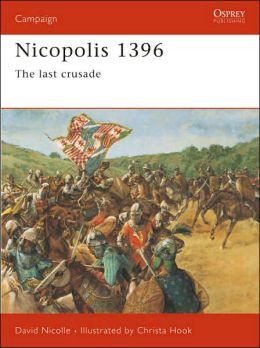
9781855329188_p0_v1_s260x420For most of the 14th century the countries and city states of Europe were too busy fighting each other to mount a crusade.  However the Ottoman Empire made major gains into Serbia and south eastern Europe winning the Battle of Kosovo in 1389. In 1394 Pope Boniface IX proclaimed a new crusade against the Turks.  This was the last major crusade, and it culminated in the Battle of Nicopolis.  This battle was a major victory for the Turks and a major defeat for the crusade army.   Sigismund would later state, “We lost the day by the pride and vanity of these French. If they believed my advice, we had enough men to fight our enemies.”

“A Distant Mirror – The Calamitous 14th Century” by Barbara Tuchman – Part I: 1301 – 1350

“A Distant Mirror – The Calamitous 14th Century” by Barbara Tuchman (1978) – 597 pages

   The Battle of Crecy - 1346

The Battle of Crecy – 1346

The cost of war was the poison running through the 14th Century.”

“Money was the crux. Raising money to pay the cost of war was to cause more damage to 14th century society than the physical destruction of war itself.” – Barbara Tuchman, A Distant Mirror

A few months ago, I was faced with the trivia question ‘Who were the opponents in the Hundred Years’ War?’  I could not answer the question correctly.  My ignorance of the 14th century was total.

Here was an entire century of which I knew nothing.  It was definitely time for me to read “A Distant Mirror – The Calamitous 14th Century”. A book I’d been promising myself ever since it was published in 1978.  For me, a history of a time or place of which I know nothing is almost as good as fiction.

I certainly will not attempt to review or critique Barbara Tuchman as a writer of history.  “A Distant Mirror” stands above criticism.  Instead I will discuss a few of the events related in the book.

VIII_17_08AAt the beginning of the 14th century, France was the dominant power in the world.  It certainly had the largest contingent of aristocratic knights to draw upon for battles.

In 1304, Pope Benedict X in Rome died, supposedly after eating poisonous figs.    French influence leads to the selection of the Bishop of Bordeaux who becomes Pope Clement V.  In 1309 Pope Clement V moves his court to Avignon, France, at the request of the French King to escape Roman hostility.

Starting in 1315 a cold wave hits Europe, the start of a climate change called the Little Ice Age that lasts hundreds of years, and with the shorter growing seasons the peasants become subject to famines. The lords and ladies of the aristocracy continue to do well thanks to the rents, taxes and other fees they collect from their subjects.

In 1338 the Hundred Years’ War, a dispute between France and England, begins.  This war actually lasts 115 years, although it was only fought sporadically.

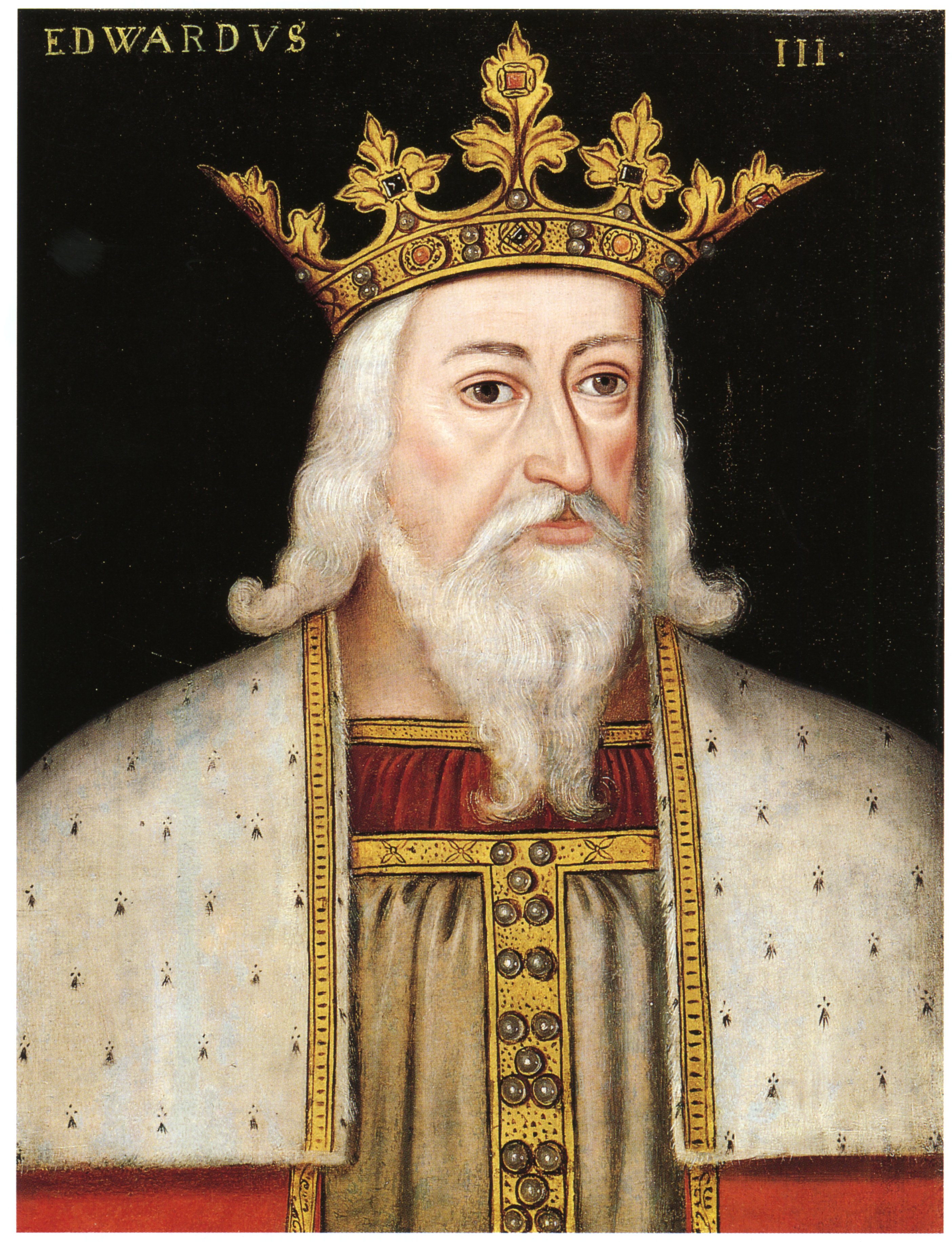
King_Edward_IIIA major battle of the war took place in 1346 at the town of Crecy in northern France.  It was a major victory for the English under King Edward III because of the English superiority with the long bow.  The aristocratic French knights considered themselves much too good to fight alongside commoners who were the best archers.

 “As long as combat was desirable as the source of honor and glory, the knight had no wish to share it with the commoner, even for the sake of success.”

 The first wave of the Bubonic plague hit Europe in 1348-49, killing a third of the population at that time.  So many workers died that wages actually rose.

A Group of Flagellants

A Group of Flagellants

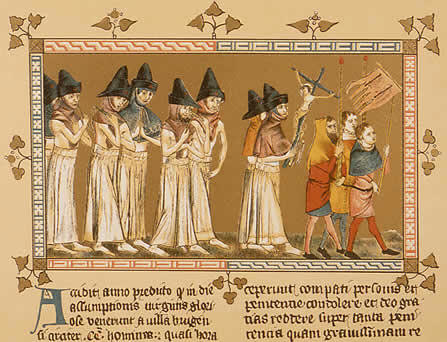
Along with the witchcraft and the anti-Semitism, a group called the Flagellants appeared after the first wave of the Plague.  They believe that the Plague is a judgment of God on sinful mankind.  As they walk through the countryside, men and women flog one another.  They preach that anyone doing this flogging for 33 days – one day for every year Christ lived – will be cleansed of all sin.

Thus ends the first half of the 14th century.  It only gets worse.

(to be continued)

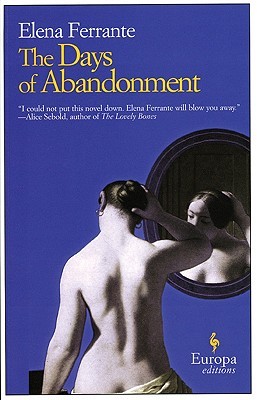
“The Days of Abandonment” by Elena Ferrante

“The Days of Abandonment” by Elena Ferrante (2002) – 188 pages

 “One day, right after lunch, my husband announced that he wanted to leave me.” – the first sentence of “The Days of Abandonment”

               .                 .

. .

It turns out he has found a new much younger woman who happens to be one of their ex-babysitters, thus he is leaving his wife and two children, ages eight and five-and-a-half.  Is ‘abandonment’ too strong a word, too over the top?

Olga, the woman here, is devastated.  Elena Ferrante as a writer is not afraid to deal with strong emotions.  This is not an uplifting novel about how things are not as bad as they seem.  Before the novel is over Olga descends into despair and almost loses it completely. Ferrante as a writer is not afraid to deal with hard unflattering feelings.

“The Days of Abandonment” is the novel that put Elena Ferrante on the map.  As you may be aware, “My Brilliant Friend” by Ferrante was my top read for last year, and now I went back to the well.  ‘Abandonment’ is another winner for me.

“Existence is this, I thought, a start of joy, a stab of pain, an intense pleasure, veins that pulse under the skin, there is no other truth to tell.”

One of Ferrante’s real strengths is that she can be matter-of-fact and honest about her characters’ strongest ugliest reactions.  Her abandoned female character has no stiff upper lip, no toning down of emotions.  Perhaps I’ve read too many fine-tuned even-tempered British novels and appreciate a writer who is willing to go blunt and operatic and let it all hang out.

One statistic I watch to measure a novel’s reception with the public is its waiting list at the Minneapolis Public Library system.  The waiting list even for novels which are originally tremendously popular dwindles down to nothing after a few years.  I checked the waiting list for “The Days of Abandonment” which now stands at 9, extremely good for a novel that is over ten years old.   Perhaps it gets a steady audience of women who find themselves in a similar situation.

Even though I’m a male I could identify strongly with Olga’s clueless-ness when dealing with practical mechanical devices.

“The Days of Abandonment” is not a pleasant read.  It is an unflinching depiction of a woman dealing with an extreme difficult predicament, with abandonment.  The novel does have its redemptive moments especially toward the end.

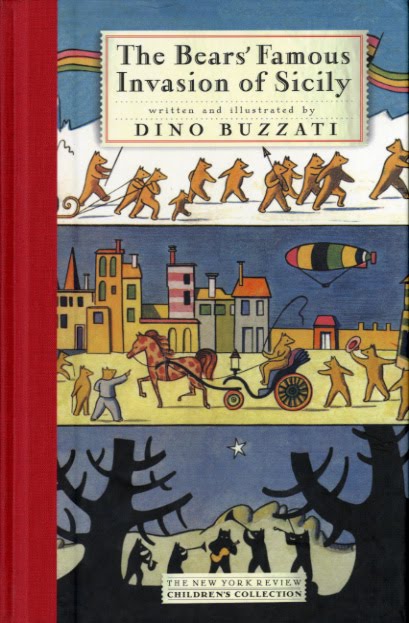
“The Bears’ Famous Invasion of Sicily” by Dino Buzzati

“The Bears’ Famous Invasion of Sicily” by Dino Buzzati (1947) – 143 pages

Bear1

“Sit still as mice on this occasion

And listen to the Bears’ Invasion

Of Sicily, a long, long while

Ago when beasts were good, men vile.”

Having read and enjoyed Dino Buzzati’s “Poem Strip” a while ago, this time I went to the New York Review Children’s Collection rather than their Classics Collection.  With the Buzzati drawings and a fun story, “The Bears Famous Invasion of Sicily” holds pleasures for adults as well as children.

One terrible winter, all the small plants in the mountains were frozen over with snow, and there was nothing left for the bears to eat.  King Leander decides to lead the bears down from the mountains to the plains where the humans live.

Buzzati is not above winking to the adults who are reading this book to children.  Consider the following.

 “King Leander.  He is the King of the Bears, the son of a King who in turn had a King as father.  He is therefore a bear of most ancient lineage.  He is tall, strong, valiant, virtuous, and intelligent too, though not as intelligent as all that.  We hope you will like him.”

 This story might not be right for real small children, since there is a fair amount of violence in the war between the bears and men; also later the bears and the men drink wine and gamble, all tastefully handled. Finally little children might not appreciate Buzzati’s sly humor as above.  I suppose the ideal audience would be children of the age of six or seven, maybe just before they are of an age for action movies.   On the other hand, if you are the type of parent who doesn’t want stories watered down for their kids, little kids might really love this story too.  The story makes clear that the bears aren’t perfect either, but King Leander is a good wise leader, a role model.

bear6Dino Buzzati also wrote novels for adults.  My next book of his I read will probably be the adult novel, “The Tartar Steppe” which was supposed to have been a major influence for J. M. Coetzee in writing “Waiting for the Barbarians”.  Dino Buzzati was one of those multi-talented people like Tove Jansson and Ruth Park who could draw and write children’s books as well as write adult novels.

Most of the story in “The Bears’ Famous Invasion of Sicily” is told in prose, but it occasionally breaks out in rhyme as the first lines above are an example.  Buzzati put everything he had into this book.

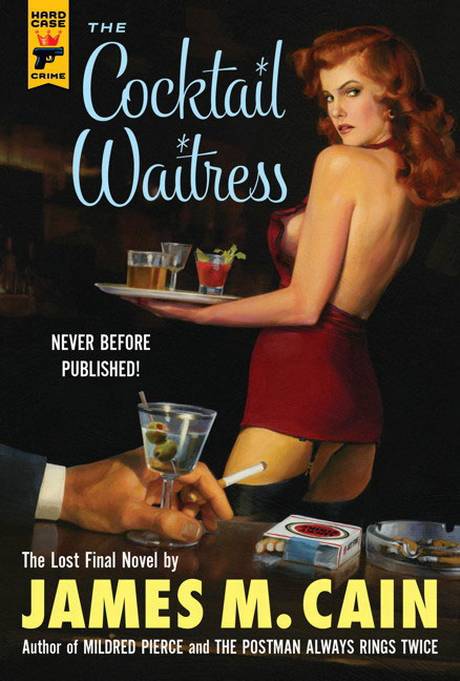
“The Cocktail Waitress” by James M. Cain

“The Cocktail Waitress” by James M. Cain (1977, 2013) – 254 pages

                     -

The attitudes in “The Cocktail Waitress” are so different from those of today that it almost seems like a story from a different century.  Well, it is from a different century, the depraved old twentieth century.  The time is the 1960s, and “The Cocktail Waitress” has that sleazy ambience of “Mad Men”, but even more sleazy.

The story begins with young Joan Medford burying her husband.  He abused her, and one night he came home drunk. She kicked him out of the house, him  wearing only his pajamas, and he crashed the car into a culvert.

Joan is a femme fatale, and she kind of knows it despite her innocent demeanor.  She has a kid, but she can’t keep him at her home, because she has to go out and earn a living all day.  Her ex-husband’s sister is all too willing to keep the child.

Joan takes a job as a cocktail waitress in a bar and restaurant, figuring the pay and tips would be good.  On the job she must wear a very short skirt, peasant blouse, and pantyhose.  Her fellow waitress Liz gives her some advice.

 “In the bar bare legs get kind of cold at one o’clock in the morning.  But if you’ll accept a suggestion from me, with what you’ve got to go inside the blouse, I’d leave the bra off.”

 “You sure about that?”

 “Well I do. It kind of helps with the tips.”

 Soon Liz becomes Joan’s best friend.  Liz makes extra money on the side off-hours from some of the male bar patrons.

Joan starts working at the bar serving drinks.  Two customers in particular pay her a lot of attention.  An old man, Mr. White, comes in and sits at the same table every afternoon, and Joan talks to him when she is not busy.  Soon Joan finds out that he is rich, and that his wife has died.  The other guy interested in Joan is young rake Tom Barclay   Tom would be “pawing me over whenever I came to the table, especially around the bottom which he patted a number of times.”  His bad behavior doesn’t stop Joan from becoming strangely attracted to him.

That is the setup.  If you want to know what develops, you can read it.

“The Cocktail Waitress” is the last novel that James M. Cain wrote.  The problem was not that he hadn’t finished it like many other writers’ last novels; the problem was that he had finished several versions with different endings when he died in 1977, so which to use?  Finally 36 years later, the novel gets published.  I believe “The Cocktail Waitress” is good enough to stand with Cain’s famous works “Double Indemnity”, “Mildred Pierce”, and “The Postman Always Rings Twice”.

Last night I watched “Mildred Pierce”, the old version with Joan Crawford.  Great movie.  “The Cocktail Waitress” is probably closest to “Mildred Pierce” of Cain’s works in that they are both about a woman who loses her husband and must fend for herself in the work world, whether by opening a chain of Mildred’s restaurants or by serving drinks in a bar.  Trouble ensues.

It stands to reason.  Women are people too and thus fully capable of planning and committing murder.

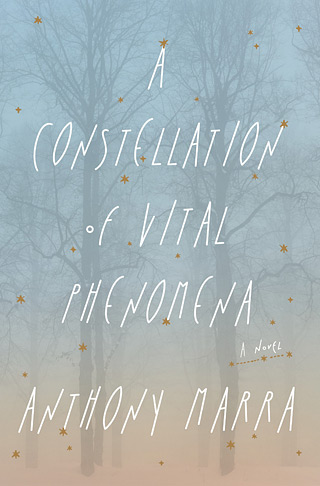
“A Constellation of Vital Phenomena” by Anthony Marra

“A Constellation of  Vital Phenomena” by Anthony Marra (2013) – 382 pages

Chechnya_and_Caucasus

A lot of writers make the following mistake.  When they depict characters in sad and desperate situations, these characters lose their personalities.  The people in the story become stilted and cheerless due to the pressure of events.  But even in the worst of circumstances, unless one is directly affected, his or her essential spirit will shine through.  “A Constellation of Vital Phenomena” is one of the more humorous novels I’ve read, yet there are few situations that are as wretched as that of Chechnya in the years portrayed in the novel, 1996-2004.  Humor, even black humor, is one of our basic coping mechanisms.

                    .

.

Who would have guessed that one of the finer novels released in the United States in recent years would be about the wars in Chechnya?  “A Constellation of Vital Phenomena” is a quite moving story; it will make the readers laugh through their tears.  The novel is about people living and dying in the brutal modern world.

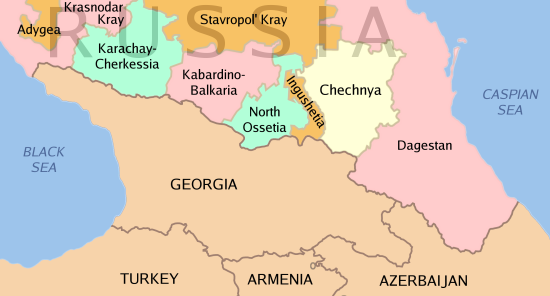
First here is a little background on Chechnya.  Chechnya is a fairly small landlocked country east of the Black Sea and west of the Caspian Sea.  Islam is the predominant religion in Chechnya.  Formerly there was a fairly significant Russian Orthodox population which has mainly left the country as a result of the wars.  When the Soviet Union disintegrated in the early 1990s, Chechens fought and won their independence from Russia in a war.  The country did quite well for a while, mainly due to the huge oil resources under their land.  However in October, 1999, Russia started the Second Chechen War to regain control of the country.

Much of the “A Constellation of Vital Phenomena” story takes place at a bombed-out hospital in the Chechen town of Volchansk.  The hospital used to have a staff of 500 but it now is down to a staff of three including Sonja who is the only doctor.  One whole side of the hospital is missing, bombed during the war.  Yet the hospital still gets quite a few patients due to all the land mines in the area.

The novel mentions Leo Tolstoy a few times.  Tolstoy wrote a novel, “Hadji Murad”, which takes place in Chechnya.  I would guess that Anthony Marra is going for the same emotional sweep in his writing as Tolstoy.

In a few scenes “Constellation” depicts the torture of Chechens by the Russians.  These scenes are so brutal you can well understand why civilized countries outlawed the use of torture to achieve their goals.

The novel certainly takes the pro-Chechen side in the war, although Wikipedia does show that both sides committed atrocities.  The novel does point out that some of the Muslims, especially those in the Wahhabi movement, wanted to turn the war against Russia into a holy war and really didn’t care about Chechen independence.

“A Constellation of Vital Phenomena” shifts the point of view between each of the seven main characters, and each of their stories is gripping emotionally. Each of the main characters must deal with their own situation, and the stories are fascinating.  I unsuccessfully tried to find out more about Anthony Marra’s background to figure out his profound interest in Chechnya.  I suspect that Leo Tolstoy would praise this novel.

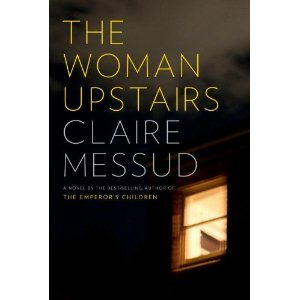
“The Woman Upstairs” by Claire Messud

“The Woman Upstairs” by Claire Messud   (2013) – 253 pages

 “Who is he who always walks beside you?  No-fucking-body, thank you very much.  I walk alone.” 

woman-upstairs

Forty-two year old school teacher Nora Eldridge tells the story in “The Woman Upstairs”.  She teaches second grade at Appleton Elementary in Boston.  She lives in an apartment and has never been married.

 “We’re always upstairs…We’re the quiet woman at the end of the third floor hallway, whose trash is always tidy, who smiles brightly in the stairwell with a cheerful greeting, and who, from behind closed doors, never makes a sound.  In our lives of quiet desperation, the woman upstairs is who we are, with or without a goddamn tabby or a pesky lolloping Labrador, and not a soul registers we are furious.  We’re completely invisible.”

 A new school year starts, and one of the new students is a boy named Reza.  Nora meets Reza’s mother Sirena and his father Skandar.  Sirena is an artist, and soon Sirena and Nora together rent an artist studio in an old warehouse.  Nora sees this as a chance to pursue her art, something she hasn’t done since before college.  Meanwhile Sirena is a real artist who is quite famous in Paris and is preparing for her next Paris show.

I discovered Claire Messud early in her career with her first novel “When the World was Steady”.  That novel had a depth of insight into her characters’ inner lives that most writers do not approach.  Her next two books “The Last Life” and “The Hunters” also impressed me with their perceptiveness.  Her next novel “The Emperor’s Children” was her breakout novel.  That novel about New Yorkers before and after 9/11 made the best seller lists and was long listed for the Booker.

However to me it seemed that in “The Emperor’s Children” Messud went wide with a large number of characters so that it did not have the depth of her earlier novels.  In “The Woman Upstairs” Messud concentrates on only a few individuals and I actually prefer “The Woman Upstairs” over “The Emperor’s Children” for that reason.

Messud has found the drama in the life of this middle-aged schoolteacher Nora.  There is high drama in every human life, but sometimes it takes a writer of the intelligence and acuity of Claire Messud to discover and develop it.  It almost seems like Messud intentionally sets up these challenges to her writing ability by choosing characters whose lives are seemingly mundane. This time the challenge really paid off.

“The Woman Upstairs” will be considered a feminist novel, and that it surely is.  That doesn’t mean that men must bypass an exceptionally intelligent and interesting novel.

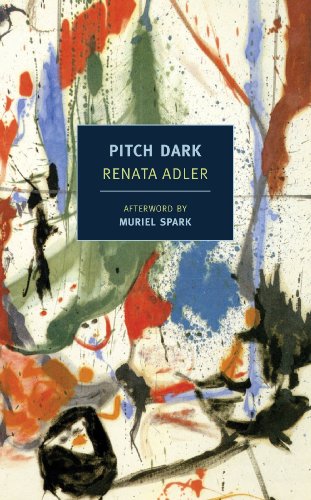
“Pitch Dark” by Renata Adler

“Pitch Dark” by Renata Adler  (1983) – 149 pages

1590176146_01_LZZZZZZZ

“We watched The Newlywed Game. The moderator had just asked the contestant, a young wife from Virginia, What is your husband’s least favorite rodent? “His least favorite rodent,” she replied, drawling serenely and without hesitation. “Oh, I think that would have to be the saxophone.”

If the above lines from “Pitch Dark” make perfect sense to you,  this novel may be for you.

When I saw that New York Review books (NYRB) was releasing both “Speedboat” and “Pitch Dark” by Renata Adler, I must admit I was surprised.  I read “Speedboat” back when it came out in 1976, and I was tremendously charmed by it like nearly every other reader was.  However “Pitch Dark” was a different story.  That novel had more than its share of negative or so-so reviews.   I decided not to read the novel then.  If the reviews had been at all good, I probably would have read it based on how much I liked “Speedboat”.

There was one significant positive review of “Pitch Dark” when it first came out in 1981.  That was the New York Times review written by Muriel Spark which is now the Afterword of the novel.  There are few people whose opinion on a novel I would trust more than Spark, but that rule did not hold true in this case.

Most of the recent reviews have reviewed both of the books together and have been extremely favorable toward both books  and have the tone of being valedictory toward Adler.

Having a strong positive view of the books NYRB publishes, I finally read “Pitch Dark” now.  The ‘plot’ of the novel or what there is of it is about Kate Ennis who is on the verge of a nervous breakdown because she is breaking up with her married lover Jake.  This seems to be the main theme of Chapter 1, but Jake is dropped and never mentioned in Chapter 2 when Kate takes a car trip through Ireland.  There she has a fender-bender with a big truck, and she is enormously paranoid that all the Irish are out to screw the insurance company.  She says some really awful mean things about the Irish which I won’t repeat here.   Kate, like Renata Adler, is extremely blunt.   Kate is deeply disturbed throughout her Irish trip.   Chapter 3 is sort of like Chapter 1, but even less coherent and penetrable.

The entire novel is introspective and is essentially an interior monologue.  I found  “Pitch Dark” to be extremely murky and disjointed.  It was not a pleasant or meaningful read for me on any level.   There were a few scenes that held my interest but nothing tying them together.   There are no memorable characters in the novel besides Kate Ennis herself.   After reading some of Adler’s own review criticism, I feel more comfortable with my own negative words on “Pitch Dark”.   After all, Adler said the following about the movie ‘Green Beret’ starring John Wayne – “so unspeakable, so stupid, so rotten and false in every detail.”  I probably would agree with her on ‘Green Beret’ but maybe not with those words.    Of the writings of Pauline Kael, Adler wrote that it was, “piece by piece, line by line, and without interruption, worthless. “

“Pitch Dark” was Renata Adler’s last novel.  Since 1981 she has written solely non-fiction.

By all means read the delightful “Speedboat”, but to quote Adler’s own words from another movie review, ‘I think you ought to skip’ “Pitch Dark”.

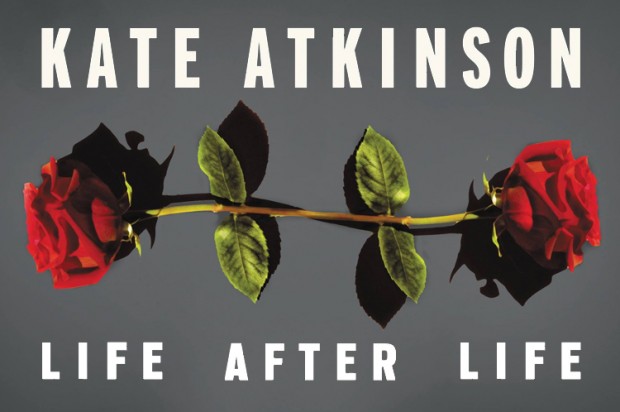
“Life After Life” by Kate Atkinson

“Life After Life” by Kate Atkinson (2013)  544 pages

life_after_life-620x412

Here is how “Life After Life” begins.

It is February 11, 1910, and a baby, a girl, is being born at home to the Todd family at Fox Corner near Beaconsfield in England.  The birth goes terribly wrong, because the umbilical cord is twisted around the baby’s neck, and the baby dies.

This would be a very short novel, except our story starts again.

It is February 11, 1910, and a baby, a girl, is being born to the Todd family at Fox Corner.  The umbilical cord is twisted around the baby’s neck.  This time old family doctor, Dr. Fellows, arrives in time to cut the cord, and the baby girl, Ursula, lives on to have more adventures.

So it goes.  “Life After Life” makes us think of all the perilous misadventures that might have occurred and severely affected us or even ended our lives.

A few years ago my family and I took our regular trip up to my parents’ place, and somehow the talk turned to my own birth.  At the dinner table my mother mentioned that I had been born several weeks premature.  She talked about this as though it explained quite a lot about me.  Up until then I had not known about this at all.  I’m still trying to come to terms with this basic fact.

“Life After Life” has the imaginative plot where if our hero Ursula Todd or one of her closest relatives or friends meets a bad end, we can rewind the story and start again.  But this is far from science fiction.  The method used in “Life After Life” may be quite innovative, but it is used for the most traditional of purposes, to create an affectionate portrait of an English family.  Even if you are not from England, this novel will make you feel nostalgic for English family life between the Wars.

The Todds are loving and loveable, strong and spunky, spunky enough to win World War II despite the heavy bombardment.  There is stoic father Hugh, prim mother Sylvie, practical sister Pamela, obnoxious big brother Maurice, adorable quiet brother Teddy, and bumptious baby brother Jimmy. Finally there is of course plucky Ursula Todd who as an adult somehow manages to be both on an English civil defense team rescuing townspeople from bombings and also visiting in Germany to meet Hitler and his girlfriend Eva Braun.  Only Aunt Izzy is a free spirit, and plenty of scorn is heaped on her except for one time when she comes through dramatically for Ursula.

Kate Atkinson is a strong and steady writer.  I discovered her on her first novel “Behind the Scenes at the Museum”, and since then have always been on the lookout for her novels.  She also writes detective novels about former detective Jackson Brodie.  I expect that “Life After Life” will be a strong contender for the Booker prize this year.

As a sidelight, there is an unexpected mention in “Life After Life” of ‘Casaubon’ that made it seem for me that all the endless hours I’ve spent reading novels were worthwhile.

“Life After Life” is of course a tour de force and a crowd pleaser, and if you haven’t already read a dozen other English novels about spunky English families, you will like “Life After Life” even more than I did.

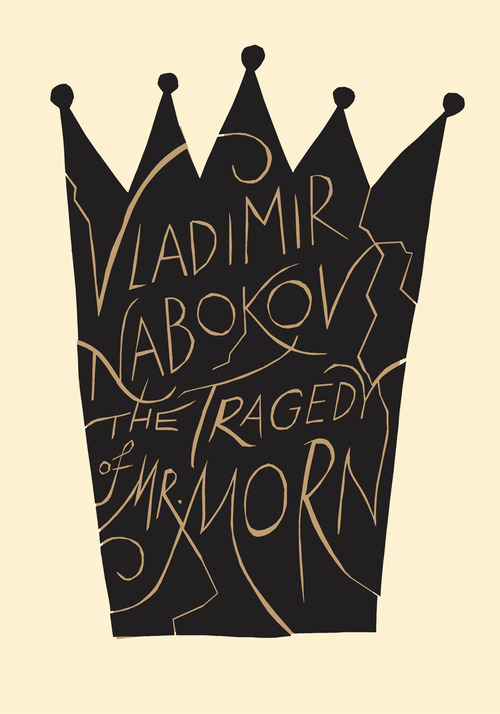
“The Tragedy of Mr. Morn”, A Play by Vladimir Nabokov

“The Tragedy of Mr. Morn”, A Play by Vladimir Nabokov (1924) – 144 pages   Translated by Anastasia Tolstoy and Thomas Karshan

tumblr_mlgp0q05gS1qbxxuao1_500

I have been a fan of Vladimir Nabokov for a long time and consider him one of the great novelists of the twentieth century.  My favorites of his work have always been the literary send-up “Pale Fire” and the college novel “Pnin”.  Both of these novels are uproariously funny, and the individual sentences within each novel are nearly perfect.   I’ve also read and enjoyed several of his other works, both those he wrote in Russian and those he wrote in English.  For me “Lolita” is a less entertaining work, because the obsessive situation in the novel is inherently not comedic.

“The Tragedy of Mr. Morn” is a play that Nabokov wrote when he was just 24 years old in 1924.  Nabokov and his family were living in Germany after having escaped the Bolshevik revolution in Russia.  Nabokov’s father had been an official of the liberal progressive government of Alexander Kerensky which had originally ruled Russia after the Tsar abdicated in February, 1917, but was overthrown by the Communist Bolsheviks in October, 1917.   This is another example of a revolution eating its own people.  Later in 1922 Nabokov’s father was murdered in Germany by a Russian monarchist assassin.  After these events Nabokov had a deep distrust of revolutionaries which is quit evident in this play.

“The Tragedy of Mr. Morn” is a lively busy play with several colorful characters, both male and female.  Although I’ve considered Vladimir Nabokov a great Russian novelist, I never saw the connection between him and all the great Russian novelists of the 19th and early 20th centuries. His writing always seemed far removed from Tolstoy, Dostoyevsky, Chekhov, Bely, Turgenev, Gogol, etc. This play is the missing link.  The play is deeply Russian beginning with a large dance ball in a Russian villa, then an illicit love affair, proceeding to a duel.  What could be more Russian?  Later we even have a fortune teller reading of a card from the deck which could have sprung directly from Alexander Pushkin.

Even more than Pushkin, William Shakespeare was the guiding force behind this play.  Before writing the play, Nabokov spent a couple of years at Cambridge in England, and he must have immersed himself in Shakespeare. Nabokov got the very movement and spirit of the play from Shakespeare.  The play is written in iambic pentameter, the same rhythmic pattern as Shakespeare’s dramas.  Just as in Shakespeare, there is high drama and low comedy in the interaction of the many characters within the play    I would like to see this play staged in a theater here in the United States today.  It has the theatrical qualities to be a success today.

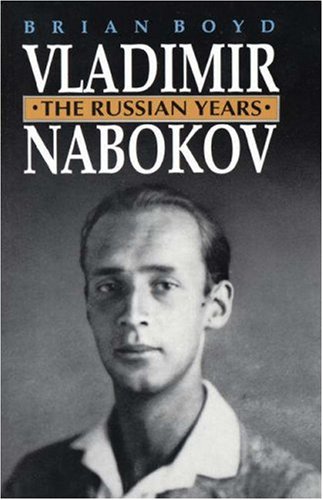
Young_Nabokov I’ve always had one theory about Vladimir Nabokov which frankly may not have any validity whatsoever.  Nabokov’s works written directly in English have always appealed to me more than the ones that have been translated from the Russian.  This might be explained by his maturing as a novelist, but I have a different theory.  Nabokov always assigned his son Dmitri Nabokov to translate each of his Russian books.  I’ve always suspected that Dmitri may not have been the best translator for these works.  “The Tragedy of Mr. Morn” was not translated by Dmitri.  It has an energy and liveliness that is missing from some of the other Russian works in translation.  I would really like to see a new translator start from scratch with one of Nabokov’s Russian novels.  The results could be very interesting.

“A Map of Tulsa” by Benjamin Lytal

“A Map of Tulsa” by Benjamin Lytal  (2013) – 256 pages

Cover_MapofTulsa_r

Once in a while a novel comes along which is highly lauded by the critics yet falls totally flat for me.  “A Map of Tulsa” by Benjamin Lytal was that kind of novel.

“And when it rose, the morning sun smelled like acorns and dirty jeans.” 

What?!? This must be the first time in recorded history anyone has ever smelled the sun.  Even the language of this novel struck me as pretentious and off-putting, but most of all clumsy.  However to be fair, if you do like the above sentence, you will probably like “A Map of Tulsa”.

The story here wants to be a quirky romance.  However neither of the two main characters, Jim nor Adrienne, is particularly interesting or appealing.  Adrienne is the far-out kooky gal leading our rather straight Jim astray.   As an aspiring poet, Jim wants a more artistic existence.  He is spending the summer in his hometown of Tulsa after returning from his Eastern college.  The year is about 2004; you could call the story ‘the passion of the Millennials’.

The city of Tulsa must also be considered a main character in this novel.    The author fills us in on some of the Big Oil history of Tulsa and waxes poetic about the city.  However most of the scenes in the city are of our couple on the top of  big skyscrapers looking down on the urban landscape or of our couple walking on the deserted streets around the empty office buildings at night.  There are no scenes of Tulsa that project any warmth or color.

“At their roots, the skyscrapers are dumb.”

 For once I agree with the author.

It has been a long time since I’ve encountered dialogue as wooden and stilted as that in “A Map of Tulsa”.  The awkward wording throughout the novel is perhaps the main reason the scenes and the characters come across as murky.

After reading all the enthusiastic reviews of “The Map of Tulsa”, I keep thinking there must be something that I missed.  However I can’t figure out what it is.

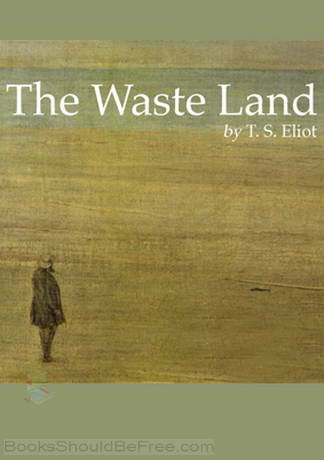
Six Reasons to Not Like “The Waste Land” by T. S. Eliot

“The poem is—in spite of its lack of structural unity—simply one triumph after another . . .” – Edmund Wilson on “The Waste  Land”

 “A pompous parade of erudition” – Louis Untermeyer on “The Waste Land”

Waste-Land-Eliot

A lot of ‘authorities’ on poetry consider “The Waste Land” perhaps the greatest modernist poem.  However it is very easy to dislike this poem.  I ought to know, because I’ve just listened to it six times.

1.  “April is the cruelest month”.  Just as the poem begins to make some semblance of sense, Eliot drives us off the trail of understanding by throwing in un-translated lines in a variety of foreign languages.

                          Frisch weht der Wind

                          Der Heimat zu

                          Mine Irisch kind,

                          Wo weilest du.                          (German)


                          Et O ces voix d’enfants, chantant,dans le coupole   (French)


                          Poi s’ascose nel foco che gli affina

                          Quando fiam uti chelidon – O swallow swallow

                          Le Prince d’Aquitaine a la tour abolie              (Italian)  


                          Shantih shantih shantih                  (Sanskrit)

2. As if the un-translated lines weren’t confusing enough, Eliot then tosses in some lines of pure nonsense gibberish to really throw us off.

                    Twit twit twit

                     Jug jug jug jug jug jug

                     So rudely forc’d

                     Tereu                                               (Nonsense)


                     Weialala leia

                     Wallala leialala                          (Nonsense)

3.  Even if after all the un-translated and nonsensical lines, you think you might still salvage some meaning from “The Waste Land”, forget about it. Now Eliot bombards us with obscure erudite allusions to mythical and real figures of the past.  Here are some of the figures he expects us to have a nodding acquaintance with: Philomel, Tiresias, Coriolanus, and, of course, the Fisher King.

4.  Supposedly Eliot was reading “Ulysses” by James Joyce while writing “The Waste Land”.  In fact it is from Joyce that Eliot picked up his indecipherable fragmented style.  James Joyce is also where Eliot picked up that ridiculous dialogue in the poem between a man and a woman who appear to be Irish or English bar patrons.  Thus among all the learned references, we have these two dummies talking who  wouldn’t know their Coriolanus from a hole in the ground.  At least these lines I could figure out.

 “He’ll want to know what you done with that money he gave you

To get yourself some teeth. He did, I was there.

You have them all out Lil, and get a nice set,

He said, I can’t bear to look at you.

And no more can’t I, I said, and think of poor Albert,

He been in the army four years, he wants a good time,

And if you don’t give it to him, there’s others will, I said.”    

5.  If you translated all the foreign phrases, made sense of all the nonsense lines, and fully understood all the literary allusions, you would still be stuck with the dismal theme of the poem, that the modern world and modern life is a waste land.   “The Waste Land” is T. S. Eliot’s response to the spiritual collapse of his era. In fact, the better you understood the poem, the bleaker your world view would be.

6.  In one of the more brilliant(?) analyses of the poem, Conrad Aiken, a friend of T. S. Eliot, considered the incoherence of “The Waste Land” a virtue because its subject was incoherence.  Of what other poems can this be said?

After listening to the poem six times, I finally did come to some sort of terms with “The Waste Land”  I decided to not even consider whatever Eliot was trying to get at.  Instead I would just listen to the sound of the fragments.  The poem does sound great; and it is in the sound of the words and phrases where T. S. Eliot excels.

“The Flamethrowers” by Rachel Kushner, a Rising Literary Star

“The Flamethrowers” by Rachel Kushner  (2013) – 383 pages

201304-omag-flamethrowers-284xfall

The difference between good writing and bad writing is really quite simple.  With bad writing, you keep waiting to reach your intended stopping point.  With good writing, you are so captivated that you don’t even notice that you’ve read beyond your stopping point.  There are some writers that you realize early on have the dexterity and steadfastness to tell just about any story and hold your interest. The great strength of Rachel Kushner as a writer is that she can keep your attention.  Many times during “The Flamethrowers” I wanted to read just a few more pages.

The young woman, Reno, who narrates “The Flamethrowers” is not your typical female if there is such a thing.  The story  begins with our twenty-two year old heroine driving her Solo Valera motorcycle to the Bonneville Salt Flats near her hometown Reno, Nevada, in order to try to set the world land speed record for women.   Sandro Valera, grandson of the owner of the Valera Motorcycle Company in Milan, Italy, happens to be her boyfriend.  Both Sandro and our heroine who hereafter has the nickname ‘Reno’ are aspiring artists who live on the scene of the 1970s New York art world.   Later Reno returns to New York and Sandro.

Don’t read “The Flamethrowers”, if you are looking for a heartwarming sentimental family novel to read.  What you get here with “The Flamethrowers” is what its title implies.   These so-called artists of the New York art set are as unrestrained as can be, and with Reno and Sandro we are right in the middle of the social scene.

Much of “The Flamethrowers” takes place in Italy as well as in New York.

Fortunately “The Flamethrowers” is very little about the art, but instead it is about some of the wild eccentric people who made up the art crowd in the Seventies.   Yes, the Seventies were off-the-wall times, and those times are captured well here.   The writing is matter of fact, and that leads the reader to trust even the most outlandish of circumstances.  Kushner does not over-write and doesn’t overplay the emotions of a scene.  Thus you come to rely on her as an honest retailer of events.  Yet at the same time there can be fire in her words.

 “All you can do is involve yourself totally in your own life, your own moment…And when we feel pessimism crouching on our shoulder like a stinking vulture…we banish it, we smother it with optimism. We want, and our want kills doom. That is how we’ll take the future and occupy it like an empty warehouse. It’s an act of love, pure love. It isn’t prophecy. It’s hope.”

 Rachel Kushner is the real thing, a top-of-the-line literary novelist, and I suggest you start reading her soon.

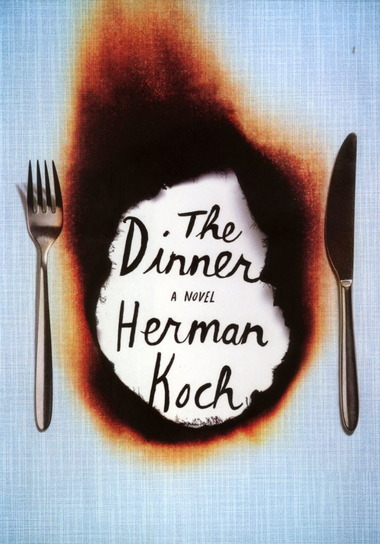
“The Dinner” by Herman Koch

“The Dinner” by Herman Koch  (2013) – 304 pages    Translated by Sam Garrett

               .

.

Nothing is more annoying or irritating for a guy than to have a brother who is more successful than you are.  I can vouch for that.  That’s what we have in “The Dinner” by Herman Koch.  Paul Lohman is a failed school teacher while his brother Serge Lohman is a famous Dutch politician.  Serge is so famous that strangers in restaurants come up to him and ask to have their or their kids’ picture taken with him.  Paul, the lesser brother, tells the story here, and his vexation with Serge fairly oozes out of him.

Much of “The Dinner” takes place in a fancy restaurant where Paul and Serge and their wives are having dinner.   Thus we have section headings of “Apperitif”, “Appetizer”, “Main Course”, etc.  Although later the story ranges far from the dinner table, in the early chapters the dinner is an excellent framing device for the story Herman Koch tells.

Just under the surface of this exquisite dinner occasion, there is an act of outrageous nastiness involving these two couples’ children.  Of course it is a good thing to love our children, but is it possible to love our children too much, to the point where we are ready, willing, and able to hurt other people in our children’s defense?  That is one of the questions “The Dinner” asks.  Give Dutch author Herman Koch points for juxtaposing this dinner at an exclusive restaurant with such a miserable act of human cruelty.

I liked “The Dinner” quite a lot, but didn’t like myself much for liking this novel.  The story seemed to give free reign to our lowest basest prejudices.  The novel is like an ugly modern artwork mounted in an expensive hardwood frame, something we have all seen.   We really get inside Paul Lohman’s head in “The Dinner”, and it is not a pretty sight.  His successful brother Serge is a liberal politician for whom Paul has the utmost disdain.  Meanwhile Paul has this nasty racist and misogynist streak although he does love his wife Claire.  I suppose Paul should get some points for expressing his feelings honestly.  And no matter how obnoxious his attitudes are, they are expressive and do have a lot of energy and move things along.

In “The Dinner”,  Herman Koch has etched a plot which will probably stay in my mind forever unfortunately.  Apparently Koch has written six previous novels, and with the success of “The Dinner” all the books will probably get translated within the next few years.

“The Dinner” tells a vivid story which will provoke a strong reaction in you.   How many novels manage to do that?

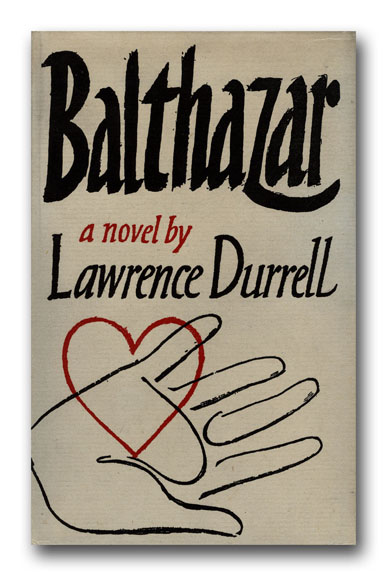
“Balthazar” – Whither Lawrence Durrell?

“Balthazar” by Lawrence Durrell (1958) – 243 pages

“English life is really like an autopsy.  It is so, so dreary.” – Lawrence Durrell

26157P

Lawrence Durrell is one of those writers whose reputation as a literary writer could go either way.  It has been over fifty years since he wrote the Alexandria Quartet, a group of novels which take place in Alexandria, Egypt for which he won his most acclaim.  It has been twenty three years since he died.  Even during his lifetime, Durrell was known for his lush over-writing, his luxuriant romantic prose.  One wonders how his novels would go over with today’s readers who have been brought up on sparse realistic prose, matter-of-fact characters, and cut-and-dried plots.

Here is typical Durrell prose.

 “And spring? Ah! There is no spring in the Delta, no sense of refreshment and renewal in things.  One is plunged out of winter into: wax effigy of a summer too hot to breathe.  But here, at least in Alexandria, the sea-breaths save us from the tideless weight of summer nothingness, creeping over the bar among the warships, to flutter the striped awnings of the cafes upon the Grand Corniche.” 

And when it comes to discussing women and sex, his prose gets even more rampant.

“In a sense everything that Clea felt was at this time meaningless to her.  As a prostitute may be unaware that her client is a poet who will immortalize her in a sonnet she will never read, so Justine in pursuing these deeper sexual pleasures was unaware that they could mark Clea for years; enfeeble her in her power to give undivided love – what she was most designed to give by temperament.  Her youth, you see.  Yet the wretched creature meant no harm.  She was simply a victim of that Oriental desire to please…”

Lawrence Durrell was close friends with the writer Henry Miller.  They shared an obsession with sex which came to play in their novels.

The city of Alexandria, Egypt is as much of a character in “Balthazar” as any of the humans.  These novels take place while the British still ruled Egypt.  At that point Alexandria was one of the most cosmopolitan cities in the world. A Mediterranean seaport, Alexandria, over the centuries from the time Alexander the Great founded the city, had become home to a wide variety of different ethnic groups.   Durrell described it as “a great sprawling jellyfish” of a city.  One wonders about Alexandria today.  In 1973 Egyptian President Nasser forced all foreigners to leave Egypt, and one can only imagine that Alexandria has only gotten even more isolated since then.

Durrell had an interesting colonial background.  He was born in northern India to an English father and an Irish-English mother. When Lawrence was seven, his family moved to England, and he hated it and spent the rest of his life outside the country.  Alexandria was particularly suitable for him.

The Alexandria Quartet was considered a literary classic in its time.  I found that once I cut through the jungle of some of its prose, there is an interesting story and original insights in Balthazar.  However I wonder if the modern reader has the patience and endurance for the over-the-top purple prose.

Angela Huth, an Underrated English Writer

“Monday Lunch in Fairyland and Other Stories” by Angela Huth  (1978) –  214 pages

9781906763022

 “Angela Huth writes with grace and high spirits about the hazards we face in continually falling in and out of love.  It appears we are helpless not to do so, in spite of husbands, wives, jobs, distance, self-doubt, and other difficulties.  Wittily, poignantly, Miss Huth lets us see that love can teach us nothing about itself except that it is indispensable.”     –   Brendan Gill

 A couple months ago I was pleasantly surprised when the audio book site Audible.com released eleven books of fiction by Angela Huth, all within a matter of a few weeks.  Since Angela Huth was already one of my favorite writers, that was great news to me.

Huth wrote the much praised novel “The Land Girls” about the young women who left the cities to work on English farms replacing all the farmers who went off to fight in World War II.   That novel is justly famous and was made into a well-received movie.  Soon I discovered that her other novels such as “Easy Silence” and “Wives of the Fishermen” were just as high quality as “Land Girls”  I also discovered that Angela Huth is also an excellent short story writer.  Thus among the eleven of her books now offered at Audible I chose “Monday Lunch in Fairyland and Other Stories”.

This book had an interesting publishing history.  It was first published in 1978 with the above title.  However the publisher decided to re-release it a year later with a different title.  This time the collection was titled “Infidelities”.  After all, this was the 1970s, and “Infidelities” was a very appropriate name for this collection.  Most of the stories in the collection deal with infidelity in one form or another.  The stories vary from the emotional to the ironic to the comic, and all the characters in the stories are engaging. On the Internet I discovered that Angela Huth was close friends with Princess Margaret, sister of Queen Elizabeth, who did have her own marital problems.

“There’s much to be said for recognising a friend’s plight but not dwelling on it.” – Angela Huth

If I were to pick one word to describe Huth’s writing, that word would be ‘vivacious’.  The word vivacious is “having much high-spirited energy and movement”.   There is a sparkling quality to her prose that makes it inherently interesting.  Huth makes her characters come poignantly alive, and she makes it seem almost effortless.  This effortless quality to her writing might be why she doesn’t get as much acclaim as other writers who are not nearly so talented.  This reminds me of the situation of the writer Elizabeth Taylor.  Taylor never did get the critical attention she deserved, yet during the last 15 years three of her novels have been made into movies.  The world is finally discovering Elizabeth Taylor the writer nearly forty years after her passing.

Angela_HuthAngela Huth is still writing, and I am eagerly awaiting her next fiction.   Discover this excellent fiction writer before everyone else does.

“Semper Fidelis” by Ruth Downie – Always Faithful

“Semper Fidelis” by Ruth Downie  (2013) – 327 pages

15702877

“Semper Fidelis” takes place near the town of York (Eboracum) in the Roman province of Britannia during the reign of the Emperor Hadrian (Emperor from 117 AD to 138 AD).  In fact Hadrian and his wife Sabina make several appearances in the story.   However they are not the main characters.  The main characters are chief legion medical officer  Gaius Petreius Ruso and his Britannia-born wife Tilla.  It was quite rare for a Roman to marry a woman who came from the native tribes of Britain which in itself aroused suspicion among the Romans.

“Semper Fidelis” is the fifth book of a series on the Roman Empire with Ruso and Tilla by Ruth Downie, but it  entirely stands alone without any knowledge of previous books necessary.

The form of “Semper Fidelis” is a mystery and a very traditional mystery at that.  The Romans are recruiting British men into the Roman legions.  Some of these British recruits are dying and sustaining severe injuries under suspicious circumstances.  Both Russo and Tilla are trying to figure out what is the cause, much to the chagrin of some of their Roman superiors.

It is ironic to note that way back then in the second century AD, England itself was a colony of the Roman Empire, and the people of England were considered primitive barbaric members of tribes.  I guess turnabout is fair play.  Who better is there to understand the evils of colonization than the British?  Who better to understand the difficulties of recruiting men from the local tribes of the colony into the Imperial Army?

If you are looking for detailed knowledge or penetrating insights into the Roman occupation of Britannia, you won’t find them in “Semper Fidelis”.  Instead this book is a cozy little English drawing-room  mystery  even though much of the action takes place outside.   The story has several eccentric humorous characters and much good-natured dialogue between husband Ruso and wife Tilla.  The book does get the basic facts right such as Hadrian’s visit to Britannia to oversee the construction of his wall.  Ruth Downie is comfortable enough writing a story in the Roman era so she does not need to hit the reader over the head with details.  This is a fun read rather than a deep read, more about colorful personalities and an exciting story rather than the more serious aspects of  the Roman era.   On those terms, “Semper Fidelis” is an entertaining success.

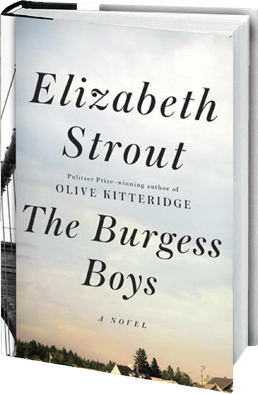
“The Burgess Boys” by Elizabeth Strout – Mainly in Maine

“The Burgess Boys” by Elizabeth Strout  (2013) – 320 pages

burgessboys1

I had two vivid impressions while reading “The Burgess Boys”.

The first impression was positive.  In the novel we are introduced to many people from different family backgrounds and differing life situations.  It is fascinating how these people interact with each other and become a part of each other’s lives. One of the main reasons I read novels is to have this quality of unique people bumping into each other and intermingling in varying ways.  There is this sense of lived life in “The Burgess Boys”.

The second impression was not so positive.  That is concerning the plot, the major action around which the entire story pivots.  The son of one of the Burgesses throws a butchered pig’s head into a Somali mosque on Ramadan and gets into endless legal trouble.  This son is a social sad sack misfit, and this act is committed for little apparent reason.  It is a mindless, senseless, meaningless act.  This seems like a small peg to build an entire novel around.

I would have much preferred that this act were performed for specific concrete reasons.  For example, maybe instead have the boy impressionable and easily swayed by an adult he admires who has contempt for Muslims.  There are certainly enough Americans who have a deep contempt and hatred for Muslims.  Then Strout could have dealt with a valid issue, deep-seated prejudice in small towns like this small Maine town of Shirley Falls.  Dealing with a real issue would have given the story intensity and passion.  However we have this squeamish near mental case of a boy doing something even he can’t comprehend.  This seemed like a copout by the author and made everything else seem scattered and without a point.

Because the episode around which the entire plot is built is so ambiguous, the novel seems discursive and stuck on the surface.  We never get to the root of anyone, because no one has any real strong beliefs or feelings. Novels which have many story lines happening at the same time can sometimes amount to more than their parts.  However the stories in “The Burgess Boys” did not coalesce for me into a satisfactory whole.  Toward the end of the novel the focus changes from the boy and Shirley Falls to the New York City lives of the two Burgess brothers.  This seems like a salvaging effort for the novel which does not succeed.

Before this novel, Elizabeth Strout wrote “Olive Kitteridge” which was a more successful book.  That novel was made up of related stories of people in a small Maine town.  It didn’t matter and probably was a good thing that we stayed on the surface of people’s lives, because we were only with them for twenty or thirty pages.  However for “The Burgess Boys”, staying on the surface is deadly.  A long novel cannot be sustained with just a cursory overview of a lot of people.  The reader will soon lose interest unless the author cuts to the chase and tells us precisely what is troubling these people.  We don’t want some amorphous ennui or nervous tension or indigestion.  We want real people with real problems to which we can relate.