Archive for the ‘Book Reviews’ Category

‘Wonderland’ by Stacey D’Erasmo – The Comeback Tour

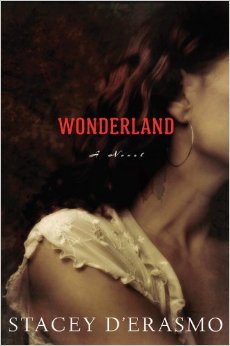
‘Wonderland’ by Stacey D’Erasmo   (2014) – 242 pages
wonderland

‘Wonderland’ is the perhaps too authentic story of the comeback tour of 44-year-old indie rock artist Anna Brundage.  Her first album ‘Whale’ was a monster hit, her next two not so much.  She dropped out of the music business for seven years, and now she’s back touring Europe with a new band.

The rock performance life is all here.  The shows where the band is hot, the bad scenes, the casual hookups, the drinking, the all-pervasive drugs.  For most of us the Sixties and Seventies have long been over, but these musicians and their entourages are still living the life.

This is the first novel by Stacey D’Erasmo that I’ve read.  I think she was faced with two ways she could have portrayed the rock life. One way would have been to portray these musicians as sincere serious artists who are attempting to create and perform valuable work that will last.  That would be the Rolling Stone magazine approach, that rock musicians are real artists.  The other way is that D’Erasmo could have presented the rock-and-roll life as an outrageous scam with everyone in it for the drugs and the adulation and the casual sex and the money.

It would have been much easier for D’Erasmo to take the ‘serious artist’ approach, but she took the more complicated route where the musicians, including the main character, are somewhere between artists and shams.

My problem with ‘Wonderland’ is that I did not like any of the characters in this novel.  I had an active dislike for most of them that never went away.  Throughout the novel we see Anna Brundage hooking up with one loser nonentity after another, all of them on a rather casual basis.  Her father is a world-famous artist all because he sawed a train car in half.  This kind of stunt was big in the art world at one time, but it is difficult to see it as anything but a scam.  So this father, though famous and loved by Anna, was an obvious fake and a phony.  He also is a cliché, and he pretty much undermined any appreciation I had for ‘Wonderland’.

And the other characters aren’t better.    The dialogue in ‘Wonderland’ is terrible, mainly because they talk like musicians talk in real life.  ‘The vibe was kind of weird.’  ‘I’m being such an asshole.  Let’s rock this thing.’  Verisimilitude is not always a good thing in a novel.

There have been novels where all the main characters are unlikeable, yet the élan and the spirit of the writer wins us over.  I felt that in ‘Wonderland’ D’Erasmo didn’t realize how detestable her characters really were, and she expected us to like them anyhow.

On the cover of ‘Wonderland’ there is the following quote from Michael Stipe of the band REM: “The world of Wonderland is authentic, vibrant, and genuine.  D’Erasmo explores the delight and terror of second chances.  A great read.”  Michael Stipe is a rock hero of mine, but we kind of disagree on this novel.
 

‘With A Zero at its Heart’ by Charles Lambert – A New Way to Tell Your Life Story

‘With A Zero at its Heart’ by Charles Lambert   (2014) – 147 pages


GetImage (1)In ‘With a Zero at its Heart’, Charles Lambert has come up with a powerful new way for each of us to describe his or her life.  There are rules to the method; let me explain the rules.

First he chose twenty four different aspects or subjects from which to view his life including ‘Clothes’,  ‘Money’, ‘Work’, ‘Home’, ‘Sex’, and ‘Language’.  For each category, he posts exactly ten items that have meaning for him.  Sometimes these are early memories from childhood.  For example for ‘Clothes’ he tells how as a young teenager he wanted for Christmas a velvet frock coat just like the ones worn by the music group the Kinks.  Instead his parents bought him a dark green corduroy double-breasted jacket “which he hangs in the wardrobe that evening and will never wear again.”  In ‘Animals’, he remembers the three white mice in a plywood box he was given as a child and their tragic end.

We all have these very early memories, memories that sometimes go back from even before we started school.  My very first memory was when my mother took a picture of a few kids including me when I was four years old sitting by some of her tulips which had just come into full bloom that spring.  I vividly recall those bright flowers, or is it the photograph that I remember?

My mother told me that even when I was three or four I memorized the song names that were on each of their records and could recognize the record associated with each song, so would yell out, “Play this one, ‘How Much is that Doggie in the Window’, again!”  I don’t recall this at all.

In Charles Lambert’s book, an item can deal with any part of his life, young or old.  Each item must be about 100 words long.  Why this limit of 100 words?  The limit has several beneficial effects.  First this rigor keeps the writer from getting too long-winded on certain subjects which is always a danger in autobiography.  Second each item at 100 words has equal weight so that no single item is given a disproportionate weight.  That becomes important because of the next unstated rule.

The unstated rule is that one must be honest.   One item in ‘Sex’ shows Lambert’s early disinterest in girls.  An item in ‘Danger’ tells about his wild sex “with men whose names he doesn’t know and doesn’t ask.”  For each of us, our items would surely be of a different nature, but all the items together would hopefully achieve an accurate picture of our life.

I found this a brilliant method of autobiography, a rigorous honest approach to conveying a life, the bad stuff as well as the good stuff.  It approaches what we do in our own minds when we look all the way back to our earliest memories up to our current situation.  Each of our life stories would be different, perhaps not unique, but with tremendous variety.

The best method for understanding the items is to read each item – a paragraph – twice, first to get the main idea and second to fully appreciate it.

In the afterward to ‘The Zero at its Heart’, Charles Lambert thanks his publisher for taking an enormous risk in publishing this book.  No risk, no gain.


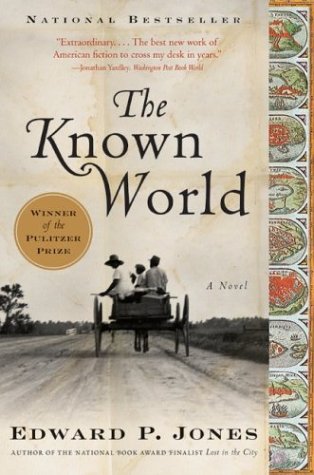
‘The Known World’ by Edward P. Jones – A Great Novel from Early in This Century

‘The Known World’ by Edward P. Jones (2003) –  388 pages

the-known-world

Of all the novels that were published in the early 2000s, the one I have most regretted not having read was ‘The Known World’.  I have read both of his two spectacular collections of stories, ‘Lost in the City’ and ‘Aunt Hagar’s Children’, so I knew how profound and moving a writer Jones is.  ‘The Known World’ won both the Pulitzer Prize and the International IMPAC Dublin Literary Award, so it was way past time that I read this novel.

‘The Known World’ recreates the rural world that included slavery in the state of Virginia in the 1850s.  Slaves – humans – were the property of slave owners and were bought and sold.  In Virginia a few of the slave owners were black, and that is a situation that is dealt with in this novel.  By this time Great Britain had already outlawed slavery throughout the entire British Empire.  The nearby state of Pennsylvania passed a law in 1780 that gradually abolished slavery so that by 1860 there were no slaves in the state.  The American South was one of the few last places in the world that still allowed slavery.  The Civil War was still a few years away.

There were the slave owners, the slaves, and those people who neither owned slaves nor were slaves.  Up to three quarters of the white people did not own slaves.  As opposed to the slaves who had a specific property value, these white people had no recognizable value to the slave owners.

The slaves were either field slaves or house slaves.  The house slaves sometimes grew quite close to the owner and the owner’s family due to proximity.

Since the slaves had a property value to the owners, most owners would take care of their property.  There were some vicious owners who did not and would usually wind up with their farms foreclosed.  This only caused more devastation for the slaves as they would be auctioned off, their families split up.

Slaves who attempted to run away and were caught were often hobbled by having their Achilles tendon cut.  Then they could never run away again and would walk with a hobble for the rest of their lives.

By focusing on a black slave owner, Edward P. Jones avoids turning this re-creation of the days of slavery into a morality play of good and evil.   There is no one preaching in this novel.  The matter-of-fact tone of this narrative only intensifies the reader’s reaction to the events in the story.

edward jonesJones’ strong story-telling skills are on full display here.  We care what happens to all of these characters.

I’m happy that I went back and caught one of the big novels from the early part of this century.  Now that I’m caught up with the work of Edward P. Jones, all I can do is wait for his next novel or collection of stories.


‘The Temporary Gentleman’ by Sebastian Barry

‘The Temporary Gentleman’ by Sebastian Barry   (2014) – 307 pages

“After all the world is indeed beautiful and if we were any other creature than man we might be continuously happy in it.”  – Sebastian Barry,  ‘The Secret Scripture’

               .

.

At one point Jack McNulty, our main guy in this novel, is in the army and assigned to the bomb disposal unit in London during World War II.   He has the job of defusing undetonated bombs which the Germans had dropped.  The men who did this dangerous explosive job were naturally called ‘Temporary Gentlemen’.

It is now the 1950s.  Jack McNulty is living in a small apartment by himself on the Gold Coast of Africa in Ghana as he recounts his life back in Ireland.  The novel alternates between short scenes in Ghana and Jack’s memories of his youth in Ireland.

 “Was there really such happiness?  There was, there was.”

 As a young student Jack met Mai Kirwan in Galway.  She is a local beauty, ‘a fierce gaiety to her every move’.  Mai is the love of his life, and they marry.

Alcohol plays a major role in this sad Irish story as Jack is a guy who drinks too much and bets on the horses.

 “How is it that for some people drinking is a short-term loan on the spirit, but for others a heavy mortgage on the soul?”

So far I’ve read three previous novels by Sebastian Barry, ‘A Long, Long Way’, ‘The Secret Scripture’, and  ‘On Canaan’s Way’.  I consider him one of the finest novelists writing today and will always read his novels.   Barry has a dexterity with words, a sense of the music of language, which places him above most other novelists.

I realize I’m being terribly unfair, but there is one defect for which I’m always on the lookout especially in novels by Irish writers.  That is excessive sentimentality.  Maybe it is because I’ve been stuck in too many Irish pubs on too many St. Patrick’s Day nights listening to dreadful renditions of ‘The Unicorn’.  Not being Irish myself, why should I care any more about the Irish than about anybody else?

‘The Temporary Gentleman’ does not escape that cliché of an Irish man crying in his beer.  That seems to be the sad story of Jack McNulty‘s life.   It would be difficult telling his story without getting maudlin.

But Sebastian Barry makes his characters come alive, and if you haven’t already read dozens of other similar novels, you will get caught up in Jack McNulty’s story.  I preferred ‘A Long, Long Way’ and ‘The Secret Scripture’ because they didn’t seem so stereotypical, but ‘A Temporary Gentleman’ is a strong moving novel nonetheless.


‘The Ballad of a Small Player’ by Lawrence Osborne – Gambling in Macau

‘The Ballad of a Small Player’ by Lawrence Osborne  (2014) – 257 pages


cover210x330Our hero, ‘Lord Doyle’ (he’s not really a lord), in ‘The Ballad of a Small Player’ is sitting at a high rollers table in the Greek Mythology casino in Macau, a small peninsula off the Chinese mainland near Hong Kong.  Macau is called the Monte Carlo of the Orient, and its gambling revenue has surpassed that of Las Vegas since 2007.  Most of the gamblers in Macau are Chinese business people, but gamblers from all over the world come there.

Our hero is playing the punto banco version of baccarat which is his game.  He is quite forthright on how he came by his money.  Previously as a lawyer in England he embezzled a large sum of money from a wealthy elderly female client, and then he flew away and escaped to Macau.

Earlier I was quite taken with Lawrence Osborne’s novel ‘The Forgiven’, because of its expert depth in presenting life in a foreign land which I found similar to writers such as Graham Greene and Paul Theroux.  Thus I had high expectations for ‘The Ballad of a Small Player’.

The entire plot of this novel revolves around gambling in the Macau casinos.  If you are not deeply interested in the world of high stakes gambling, you are probably not going to have much interest in the story in this novel.  That was my problem.  I have absolutely no appreciation for the world of gambling.   I figure the odds in gambling are always stacked in favor of the house, and I have never been tempted to gamble.  There is a reason that casino owners from Aristotle Onassis to Donald Trump to Sheldon Adelson are among the richest people in the world.

‘…everyone knows you are not a real player until you secretly prefer losing.’

 Beyond my lack of interest in gambling itself, I wound not want to go to these flashy plastic places like Las Vegas and apparently Macau.  These casino areas always seem like cold and bitter lifeless places.

Macau Casino District

Macau Casino District

My lack of enthusiasm for gambling is not the only reason for my lack of enthusiasm for ‘The Ballad of a Small Player’.  The characters in the novel did not appeal to me.  Most of the novel focuses on the main character Lord Doyle who is absolutely obsessed with gambling.  He meets a call girl Dao-Ming who stupidly, in my opinion, gives him some of her money to gamble.  There is a lot of talk about synchronicity and causality and the Chinese mind and supposedly having control over one’s luck, all of which may just as well have been nonsense gibberish as far as I’m concerned.

So ‘The Ballad of a Small Player’ was a severe disappointment for me.  The next time if I consider reading a novel by Lawrence Osborne, I will make sure it has nothing at all to do with gambling.

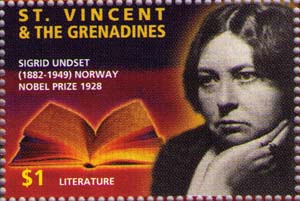
‘Marta Oulie’ by Sigrid Undset – Unfaithful in Christiania

‘Marta Oulie’ by Sigrid Undset  (1907) – 112 pages   Translated by Tina Nunnally

Sigrid Undset

Sigrid Undset


The first sentence in ‘Marta Oulie’ by Norwegian writer Sigrid Undset is “I have been unfaithful to my husband.”  It happens, even back in 1902 when this novel takes place.  This is a personal painful account, written in diary form, of one woman’s coming to terms with her adultery.  Not only has she been unfaithful; her youngest daughter is not her husband’s child.

The Marta Oulie diary entries start a couple of years after her affair with Henrik, her husband Otto’s partner and her first cousin.  Now Otto, the husband, is in a sanitarium suffering from consumption, and she feels tremendous guilt.   She relates her story up to this point.

She had always been good in school and achieved academic success while young.  Then she meets Otto in her early twenties, and they fall in love and get married.  He is practical, simple-minded, optimistic, and good at business, and soon they have three children.  She is a school teacher, but Otto convinces her to stay home with the children.  That is when she becomes dissatisfied.  Otto must travel to London on business for a few months.  Otto has charged his partner Henrik to look after Marta and the family, so Henrik hangs around the house.  You can guess the rest.

18778004 This first novel by Sigrid Undset was a success de scandal in Norway when it was first published in 1907. This intimate realistic story of an unfaithful wife is much different from Undset’s most famous work, ‘Kristin Lavransdatter’, which is a historical trilogy about Scandinavia in medieval times. ‘Marta Oulie’ had never been translated before this new edition by the University of Minnesota Press.

Undset won the Nobel Prize for literature in 1928.  She was a vehement anti-Nazi and had to go into exile to the United States during World War II.  She returned to Norway after the war.

I was surprised and delighted to find out that Tim Page, the critic who almost single-handedly rescued Dawn Powell out of the ash heaps of literary history, has also taken up the work of Sigrid Undset.  He discovered that one of Dawn Powell’s favorite books was the novel ‘Jenny’ by Undset, and then he put together a collection called ‘The Unknown Undset’.

12425s So there are two sides to Sigrid Undset, the historical novelist of the medieval and the daring scandalous contemporary novelist.  Yet her historical novels speak in an intense realistic voice of the continuing problems of living, and her intimate contemporary novels put the modern problems of living into an objective framework.   I have read both sides of her work and believe Sigrid Undset is a valuable novelist who still speaks to us today.

‘Marta Oulie’ is an intense novel and a quick memorable way to become familiar with the work of Sigrid Undset.

‘The Lie’ by Helen Dunmore – On the 100th Anniversary of World War I

The Lie’ by Helen Dunmore   (2014) – 292 pages


               .

.

‘The Lie’ by Helen Dunmore is a well-written ‘life goes on’ English historical novel.  The story is about one shell-shocked English veteran’s return from World War I, and his gradual, perhaps too gradual for this reader’s taste, return to normalcy.  The story concerns three staunch steadfast English individuals, perhaps a little too staunch for this reader’s taste.

Daniel Branwell returns to his home on the coast of Cornwall, England from fighting in France during World War I.  On return he finds that his mother has died, and he has no home to go to, so he sets up in the woods of an isolated farm of a neighbor elderly invalid woman named Mary Pascoe.  The woman has told him she does not wish to be buried in the town cemetery but instead on her own land.  When she dies, Daniel buries her on the farm, but tells no one that she has died.  This is the lie in ‘The Lie’.

Soon he meets again Felicia, the younger sister of his dear boyhood friend Frederick who was killed in Daniel’s platoon in France during the war.  Flashback scenes of Daniel’s horrific war experiences are spread throughout the story.  For anyone who has read much World War I literature, these flashbacks are rather conventional and offer no new insight into the Great War.

A relationship between Daniel and Felicia slowly ensues.  Daniel gradually transfers his great love for his boyhood friend Frederick to the sister Felicia who is a war widow with a baby herself.  Meanwhile Daniel must worry that someone will find out that Mary Pascoe is dead, and that he is living on the farm under false pretences.

I suppose if a reader falls under the spell of this story, there is enough happening to sustain his or her interest.  I did not fall under the spell of the story.  To me, the characters were a little too standard and conventional and without the quirkiness or personality to keep me much involved in the story.   The war scenes were unoriginal and predictable despite their horrific-ness.

One feature I did like in the novel is that the author throws in quotes from famous English poems in the past.  Coleridge, Byron, Arnold, etc., this is very much an English novel.  The poems I liked.  Other readers probably saw these as a distraction from the story, but I was all too willing to be distracted from this ordinary story.

As I mentioned before, this novel is well-written, and each sentence is graceful and alive.  I just wish that the characters in the story were livelier and more colorful, and the situation less stereotypical.  English readers might enjoy this patriotic novel more than the rest of us.

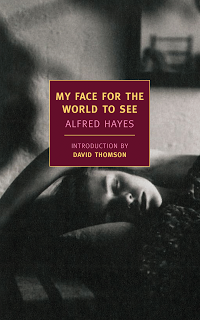
‘My Face for the World to See’ by Alfred Hayes – The Screenwriter and Marilyn Monroe

‘My Face for the World to See’ by Alfred Hayes  (1958) – 131 pages

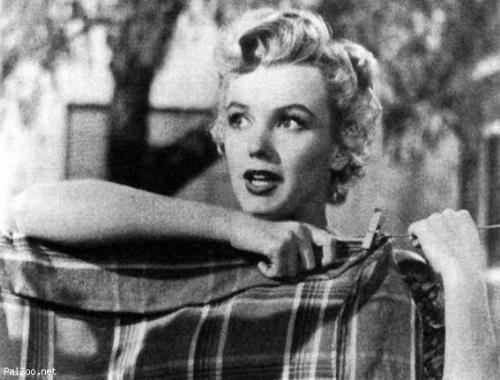
Marilyn Monroe in 'Clash by Night'

Marilyn Monroe in ‘Clash by Night’

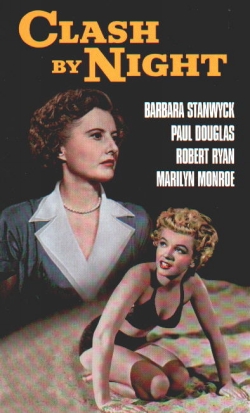
In 1951 Alfred Hayes wrote the screenplay for ‘Clash by Night’ from a Clifford Odets play.  The movie was a noir drama directed by Fritz Lang and starred Barbara Stanwyck, Robert Ryan, Paul Douglas, and a 26-year-old Marilyn Monroe.  Hayes stayed around the movie set, because there were daily rewrites of the script.  The movie turned out to be quite good (I’ve watched it.) as most of the movies Stanwyck starred in or Lang directed are.  Marilyn Monroe had only a supporting actress role, but this was her first movie where her name was listed before the title.  In the movie she plays a worker in a fish cannery, a type of role which was rare for her.  Critics praised her performance.

During the film shoot of ‘Clash by Night’ the nude calendar photos of Marilyn surfaced, and the set was crowded with reporters and photographers who hounded her constantly.  This upset the other stars, especially Paul Douglas.  Monroe was terrified of Fritz Lang, and she vomited due to nerves before nearly every scene.  She frequently arrived late, and she always required her acting coach  Natasha Lytess to be on set with her which Lang and the cast members didn’t want at all.  The making of the movie was chaotic, but the movie itself was a popular success.

clash1A couple of years passed. Monroe’s new boyfriend Joe DiMaggio wanted to help advance her acting career, so he read a bunch of novels and selected one called ‘Horn for the Devil’ as a good vehicle for her.  Marilyn called up writer Alfred Hayes and offered him a contract to write a screenplay for ‘Horn for the Devil’ and gave him an advance of a few thousand dollars.  Both this contract as well as the screenplay itself are now for sale on the Internet.  The script was never made into a movie.

In 1958, Alfred Hayes published the novel ‘My Face for the World to See’.  It is about an affair between a world-weary screenwriter and a 26 year old beautiful aspiring actress who bears a certain psychological resemblance to Marilyn Monroe.  At the beginning of the story the screenwriter rescues the actress from the sea in what may or may not have been a suicide attempt.  Already by 1951 Marilyn Monroe was known for her several real and fake suicide attempts.  The actress in the novel sees a psychoanalyst regularly and has a mysterious medical ailment just as Marilyn had at the time.  Despite all of the problems the actress has, she and the married screenwriter, with much reluctance on his part, fall into an affair.

productimage-picture-my-face-for-the-world-to-see-367Did Alfred Hayes have an affair with Marilyn Monroe?  I found no mention of an affair between these two on the Internet. During the filming of ‘Clash by Night’ in 1951, Monroe was between boyfriends since Johnny Hyde died on December 18, 1950, and she did not get together with Joe DiMaggio until the summer of 1952.  She is known to have had several affairs including one with Elia Kazan during this time.   However Alfred Hayes was very much the professional writer, and he could very well have made this novel up on the basis of stories floating around Hollywood.  He probably did not want to make it too apparent that this actress was Marilyn Monroe since he did have a business relationship with her, and the portrait of the actress in ‘My Face for the World to See’ is a particularly unflattering one.

Both Marilyn Monroe and the actress in the novel share a ‘grotesque self-destructiveness’.  To make love to Marilyn Monroe was the fantasy of many men at that time, and Marilyn did her best to fulfill these fantasies, because she was dreadfully insecure and she wanted these men to like her.

“My Face for the World to See’ is a fine novel in more ways than one.  Besides the devastating story line, it offers strong insights into Hollywood and the crazy life there.

“At this very moment, the town was full of people, lying in bed thinking with an intense, an inexhaustible, an almost raging passion of becoming famous if they weren’t already famous, and even more famous if they were; or of becoming wealthy if they weren’t already wealthy, or wealthier if they already were; or powerful if they weren’t powerful now, and more powerful if they already were.” 

“But it seemed to me, or at least it had seemed to me in the years I had been coming and going from this town, there was something finally ludicrous, finally unimpressive about even the people who had all the things so coveted by all the people who did not have them.”

 I previously reviewed Hayes’ novel ‘In Love’ which also has this cynical understated world weary and world wise quality.  It is difficult to choose between these two excellent novels ‘My Face for the World to See’ and ‘In Love’.  Now seventy years later, Alfred Hayes’ stock is rising as one of our great novelists of the Fifties.  Perhaps it is time for his other novels to be republished.

For another excellent take on ‘My Face for the World to See’, read here in Pechorin’s Journal.


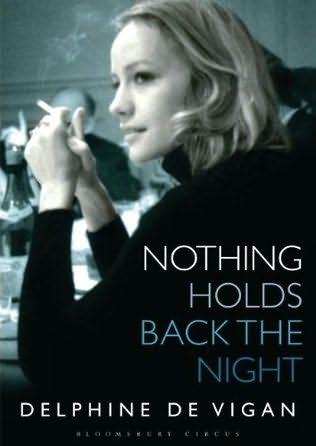
‘Nothing Holds Back the Night’ by Delphine de Vigan

Nothing Holds Back the Night’ by Delphine de Vigan  (2011) – 340 pages   Translated by George Miller

n425730

Imagine you were to write a book reconstructing your mother’s life.  There would be large gaps in your knowledge especially for the years before you were born, so the book would necessarily be fiction.  However you want to be as close as possible to the facts and the spirit of your mother.  You interview aunts and uncles and others who were close to her.  You necessarily must invent conversations and even scenes to give your story authenticity.  This is what French writer Delphine de Vigan has done in her novel ‘Nothing Holds Back the Night’.

I first became acquainted with the writing of de Vigan with her novel about the workplace called ‘Underground Time’.  That novel was such an intense and insightful look at office politics that I decided Delphine de Vigan is a writer to watch for any of her future novels.

“Nothing Holds Back the Night’ brings that intensity and insight to family life.  The novel makes no attempt to surprise the reader with its ending since the first few pages discuss finding her mother Lucile’s body after she committed suicide at age 61.

The book can easily be divided into two distinct parts.  The first part recreates the childhood of Lucile, and the second part deals with the adult years.

Lucile was born into a large middle-class family who lived outside of Paris.  She was the pretty one who got photographed for magazine ads; she also was the un-athletic one.

 “It grieved Liane to see her daughter (Lucile) was so unsporty: always the last to run, to jump into the water, to agree to a game of table tennis.  She was the last to get out of bed, quite simply, as though all of life were contained in the pages of books, as though it were enough to stay there, sheltered, contemplating life from a distance.”

 Although there are several childhood tragedies, one is left with the impression this was a happy family in the 1960s.  Family secrets are discussed in the novel which must have been tremendously embarrassing to other living members of the family.

The second part of the novel deals with Lucile’s adulthood when she goes off the rails.  She has two children by the age of twenty, and her marriage falls apart after six years.  During these years her daughter Delphine, our author, becomes a part of the story.

I really think that for fiction there is such a thing as being to0 close to the story.  The first half of this novel is lively and colorful as that family from the 1960s is re-imagined.  However the second half of the novel after Delphine is born is just too stark of a memoir.  I got the impression that large parts of the story had to necessarily be left out because they would be hurtful and might raise legal issues to some living people.

Basically this novel would have been much better if de Vigan had written it totally as fiction.  She certainly could have used scenes from her mother’s life in a story, but she would not have been limited by the memoir’s severe restrictions of accuracy.

As it is, I found her previous novel ‘Underground Time’ superior to ‘Nothing Holds Back the Night’.  Still the first half of this second novel is good enough so that I will be watching for her future works.

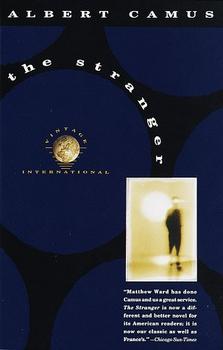
‘The Stranger’ by Albert Camus – Do You Love Your Mother?

The Stranger’ aka ‘The Outsider’ by Albert Camus  (1942) – 117 pages  Translated by Matthew Ward

‘In our society, any man who doesn’t cry at his mother’s funeral is liable to be condemned to death.’   –  Albert Camus


958400400_stranger_answer_5_xlarge

It is a quite simple series of events that occurs for the main character, Meursault,  in ‘The Stranger’ starting with his mother’s death and funeral.

Do you love your mother?  Many people when answering this question would overwhelm us with their emphatic ‘Yes’, telling us just how very much and how very deeply they loved their mothers.  These people would show the world just how wonderful they are, because they loved their mothers so much.

However for some people the question of loving your mother isn’t that easy.  If you really loved her, you would not have put her in that old folks’ home.  Instead she would have been living here with you.  There were times you got into terrible fights with her, and you feel guilty about that.  You always thought she loved one of your brothers or sisters more than she liked you.   She disapproved of your wife and family.  She was a terrible bother, calling you up in the middle of the night to berate you.  She was an alcoholic or embarrassing in some other way.

Camus4So when you are asked the question ‘Did you love your mother?’, to be honest the best you can say is “Yes, but…”  or “She was OK some of the time.”  You might not say anything with much enthusiasm. However, if you answer the question honestly or with some hesitation, you immediately become suspect to the entire rest of the world.  How can anyone not totally love the woman who brought you into this world and raised you?

So what does loving or not loving your mother have to do with ‘The Stranger’?  Everything.

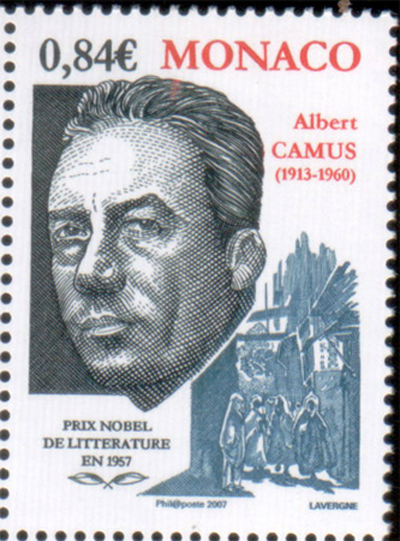
Albert Camus, in his own afterword to a 1955 edition of ‘The Stranger’, wrote:

 “A long time ago, I summed up The Stranger in a sentence which I realize is extremely paradoxical. ‘In our society, any man who doesn’t cry at his mother’s funeral is liable to be condemned to death.’ I simply meant that the hero of the book is condemned because he doesn’t play the game … He refuses to lie. Lying is not only saying what isn’t true. It is also, in fact especially, saying more than is true and, in the case of the human heart, saying more than one feels. We all do it, every day, to make life simpler. But Meursault, contrary to appearances, doesn’t want to make life simpler. He says what he is, he refuses to hide his feelings and society immediately feels threatened. For example, he is asked to say that he regrets his crime, in time-honoured fashion. He replies that he feels more annoyance about it than true regret. And it is this nuance that condemns him.”

 ‘The Stranger’ is a classic, a powerful novella. I can’t believe I hadn’t read it up until now.


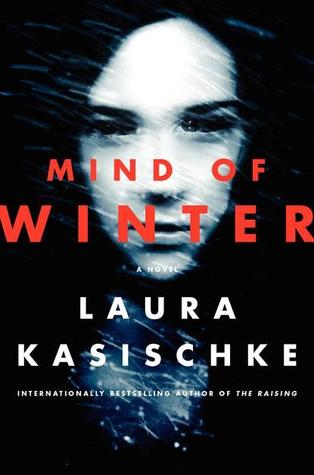
‘Mind of Winter’ by Laura Kasischke, Now Playing

‘Mind of Winter’ by Laura Kasischke (2014) – 276 pages

18081146

Ever since I read her first novel, ‘Suspicious River’, I have followed the career of Laura Kasischke with interest.  She has now written nine novels of which three (“Suspicious River,” “The Life Before Her Eyes” and “White Bird in a Blizzard”) have been made into movies.  Her previous novel ‘The Raising’ has also been recently optioned for film.  She has also written eight collections of poetry.  My review of her novel ‘Eden Springs’ can be found here.   ‘The Raising’ was shortlisted for the French literary prize, the Prix Femina; Kasischke is probably more famous in France than she is in the United States.  Meanwhile she remains in her home state of Michigan.

‘Mind of Winter’ begins in a seemingly pleasant suburban setting.  Holly Lodge and her fifteen year old daughter Tatiana are home alone on Christmas morning preparing a dinner for a few relatives and friends.  Husband Eric is off to the airport to pick up his parents for the dinner.  A huge snowstorm develops, and Eric is delayed on his trip home.  Tatiana is flighty and temperamental and locks herself in her room, causing her mother Holly to reflect back on the time when they had adopted Tatiana as a baby.  Holly and Eric had made two trips to Siberia to Pokrovka Orphanage #2 thirteen years ago for the adoption.  The first trip was to pick their baby, and the second three months later to take her home.

As the Christmas snowstorm gets worse and worse, the guests call in to say they are not coming.  With the dinner cancelled, Holly has time to become more and more obsessed about her adopted daughter who is not behaving well at all.

Laura Kasischke writes eerie disturbing novels of menace.  I won’t reveal any more of the plot except to say that ‘Mind of Winter’ is as scary and horrific as its cover indicates.

What stands out about the novel ‘Mind of Winter’?  I think it is the author’s ability to create and sustain a dire foreboding mood with words.  This is where Kasischke’s background as a poet becomes critical.   One gets the impression that every word and every phrase was chosen to create an ominous atmosphere.

And the cat.  The horror of that.  And before that, the hen, their favorite.  How the other chickens had turned on her.  Not even pecked her to death, but pecked her so close to death that she was only a forgotten brokenness, left behind them, as they went on with their lives. 

 The short sentence fragments, every word chosen for its morbid impact.  One could say that this kind of writing is over the top, but sometimes ‘over the top’ is a good thing because it gets the mood across.  We get inside the mind of Holly, and it is not pretty.  Perhaps the best way to describe the writing of Laura Kasischke is that it is a cross between Joyce Carol Oates and Stephen King.

I can already see the cameras rolling for the scenes inside Pokrovka Orphanage #2.


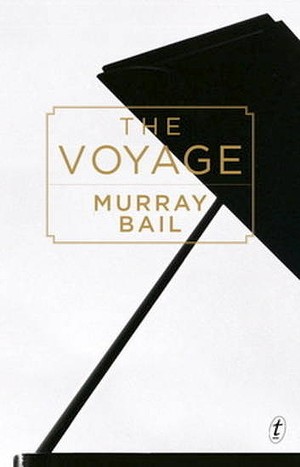
‘The Voyage’ by Murray Bail – My Favorite Novel of the Year (so far)

‘The Voyage’ by Murray Bail (2012) – 166 pages

an-Author-20Murray-20Bail-20at-20his-20Potts-20Point-20Apartment-20120921120818547105-300x0

I previously read and enjoyed ‘Eucalyptus’, but nothing prepared me for ‘The Voyage’.  This novel is so out there and unique yet down-to-earth, it is almost beyond my powers to describe it.  There is no question in my mind now that Murray Bail is one of the very finest writers in the English language.

First the plot such as it is.  The plot is straightforward, about the only aspect of this novel that is.  Piano designer-manufacturer Frank Delage travels by ship from Sydney, Australia to Vienna, Austria in the hopes of selling some of his self-designed ‘necessary breakthrough’ Delage pianos there.  He brings one of his pianos with him.  In Vienna he meets the von Schalla family, patrons of the arts. The wife Amalia takes a special (erotic?) interest in Delage and lines up contacts for him.  Later the 35-year old daughter Elizabeth is strongly attracted to him also, and she joins him in his cabin for the six week voyage on a container ship, the Romance, back to Australia.

Most of the novel takes place on the ship back as Delage dallies with Elizabeth and reflects on his time in Vienna.  Vienna is one of the most cultured cities in the world, and taking a piano to Vienna is somewhat similar to hauling a load of coal to Newcastle.  Vienna is the land of pianos, chandeliers and Old World charm.  Except for the severe wrong turn Austria made before and during World War II, it could have been one of the most honored countries in the world.

Some reviewers have pointed out that with its Vienna connection, ‘The Voyage’  can be considered homage to the great Austrian novelist Thomas Bernhard.   The novel even has a scene in the Café Braunerhof, one of Bernhard’s favorite restaurants, where ‘the most irritable men of Vienna sat and read their newspapers’.

Murray Bail is an Australian novelist, but like Bernhard he expresses his displeasures with his own country.   The opinion expressed of the Sydney Opera House is that it ‘had the worst acoustics of any opera house in the world’, and Australian newspapers ‘are among the worst in the world, certainly the worst in the English-speaking world.’    I suppose anyone who has had the misfortune of watching Fox News here in the states has a good idea how terrible the newspapers of Australia must be.

Frank Delage is a humorous Australian character, an optimist like Candide.  There are no specific jokes in the novel but the entire situation puts a smile on your face and keeps it there.  There is a great deal of subtlety that went into the writing.  I suppose some points are being made with our Australian taking on the Old World culture, but you really can’t tell which side Bail is on.

Only he could have written this novel.  It is delectably stubbornly original and idiosyncratic.  Here Bail has discarded all the simplistic so-called rules for good fiction.  There is no beginning, no middle, no end.   The sentences are frequently long, and the paragraphs go on for pages and pages.   There are no chapters.  The reader must be wary of sudden confusing but endearing shifts of scene.  There is no attempt to separate dialogue from description. The novel just sails merrily on its way, surprising and delighting us with each bend and turn in the story.

Many novels are louder and splashier than this one, but ‘The Voyage’ has the unmistakable quality of great literature which will last and last.  I expect people will still be reading ‘The Voyage’ a hundred years from now.

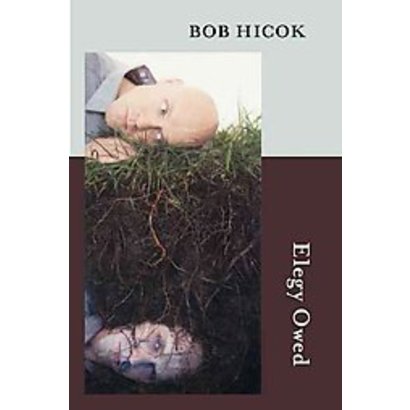
‘Elegy Owed’, a Collection of Poems by Bob Hicok

‘Elegy Owed’, a Collection of Poems by Bob Hicok  (2013) – 106 pages

It is so rare when I find a poet whose poems I really like so that when I do, I want to shout about it from the rooftop.  Today I am here on the top of the roof shouting the name of Bob Hicok and his offbeat collection of poems, ‘Elegy Owed’.

14486867_130326020000

Let’s start with some lines from the poem ‘Goodbye, topspin’.

 But nostalgia:

go to hell.


Not going to do that.


Not going to be a lamprey on the side of the past, sucking for dear life,

           Since I have had

and am having a dear life.

 The above lines show at least two qualities of the poetry of Bob Hicok.  First, there is a toughness here.  Second, the poet frequently ties in animals and plants and other facets of nature to make his points.

Many of the poems in ‘Elegy Owed’ concern death.  I am almost tempted to say that ‘Elegy Owed’ is a collection of playful poems about death, but that would not be exactly right.  The collection certainly takes death seriously, but the poet has a dexterity with words that makes even this most grim of subjects engaging. The poem ‘Coming to Life’ is about a very young boy’s early encounter with death.  His aunt has died.  This may or may not be a big deal for the boy.  However for his crying mother this is her sister and very well could have been her best friend.  As they pass the coffin, the boy’s mother kisses her sister on both cheeks and says something in her ear.  Then the mother takes the boy’s hand and puts it on her dead sister’s face.  Much later, the grown-up boy remembers this.

It was just that, in the silence of her skin, all possibilities had been taken away. 

  I don’t want to leave you with the impression this is all gloom and doom.  Even in the face of bad things like death and rape, life goes on.  That is where the toughness comes in.  There are many lines here that are just for fun.  Take these from ‘You Name This One’.

Or when

 I realized ‘she loves me, she loves me not’

 explains why daisies avoid us

 as often as they can, I say ‘Run, simple flower,

 away from my need to know

 anything at all, everything

 would be better’.

  There are many more examples I could have quoted.  I am not sure the above cover picture does this collection justice, although apparently it is trying to inject some humor into the elegy motif.

At least I didn’t fall off the roof this time.


‘In the Cage’, A Memorable Novella by Henry James

‘In the Cage’ by Henry James (1898) – 138 pages


mzi.ajcmgzft.340x340-75The novellas of Henry James are a good way into his fiction, and ‘In the Cage’, written in 1898 which is quite late in his career, serves as a gateway to his later major works.  The story here is more rooted and down-to-earth than in other of his work and is thus more approachable.

A nameless young woman works in a separate area of a grocery store, in the cage, preparing telegrams for customers. She is not really that young, perhaps about 25 years old.  She is engaged to Mr. Mudge, the grocery store manager.  Mr. Mudge is a man on the rise hoping to manage five grocery stores in the near future.  However our young woman is hopelessly bored with his scrupulous attention to all the mundane everyday details of running grocery stores.

So what does fascinate our young telegraph operator?  That would be her job or at least certain aspects of her job.  The people who send telegrams are the social elite of the town to arrange their hotels and travel plans.  Even though the lowly telegraph operators are supposed to feign disinterest in the subject matter of these telegrams, they can not help but find out intriguing and salacious details of their customers’ lives.   For example the married Lady Bradeen arranges assignations with the dashing young man Captain Everard.  They each often come separately in to the telegraph office to arrange the times and the places for their secret trysts.  The telegraph girl looks on in wonder at the illicit doings of these rich people.

 “What twisted the knife in her vitals was the way the profligate rich scattered about them, in extravagant chatter over their extravagant pleasures and sins, an amount of money that would have held the stricken household of her frightened childhood, her poor pinched mother and tormented father and lost brother and starved sister, together for a lifetime.”

Our young telegraph operator takes a personal interest in making sure all the details are correct in the telegrams which these two lovers send. She is captivated by their social lives and romance.

Captain Everard is not upper class himself.  One day our telegraph operator meets him on the street as she is going home from work.  They sit together on a bench and share some moments holding hands.

I will not reveal any more of the plot.

I’ve read a fair amount of the fiction of Henry James, and found ‘In the Cage’ refreshing in that it did not seem so precious or convoluted as some of his other work.  It is a straightforward story of a young working class woman being very practical in arranging her own future yet enamored of a style of life that is beyond her reach.

I must say that the four major characters in ‘In the Cage’, Mr. Mudge and Lady Bradeen and Captain Everard  and most of all the telegraph woman, are presented in dramatic and sympathetic fashion, and this short novel is a joy to read.


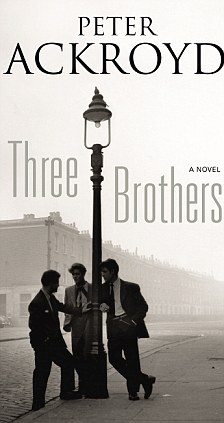
‘Three Brothers’ by Peter Ackroyd

Three Brothers’ by Peter Ackroyd  (2014) – 246 pages

article-0-18427DE700000578-756_224x423

The growing up of three brothers may not be an earth-shattering subject for a novel, but it could have been a fascinating account of how three sons raised in similar circumstances could turn out so unalike.  I began this novel hoping this actually was the story of three brothers growing up in London.

I grew up in a family in which the only children were us three sons.  From an outsider’s point of view, we three brothers may bear a family resemblance and thus seem quite similar.  However from the inside of our family looking out, it is obvious that we three brothers are quite different from each other, millions of miles apart in personality, attitude, and our very being.

The three brothers in ‘Three Brothers’ also grow up totally dissimilar from each other.  The oldest, Harry, marries into money and finds success on Fleet Street in London as a journalist.  The middle son, Daniel, is gay, doesn’t marry, and becomes a noted literary academic.  The youngest, Sam, is a ne’er-do-well who can’t hold a steady job, but has a special quality that makes him likeable.

The novel starts out strong delineating these different traits of the three brothers.  We also learn some of the family back story.  Their father wanted to be a writer but ultimately settled as a nightwatchman.  Their mother suddenly walked out on the family while the boys were still in grade school.  The beginning of the novel built up my expectations that this would be an involving story of how three very different brothers live in London and interact.

However, about a third of the way through any attempt at character study is forsaken, and the novel becomes mired in this labyrinthine contrived plot involving news magnates, professors, crooked landlords, and prostitutes. Apparently the only way to bring these three brothers back together into this plot is by the sheerest chance.   When coincidence is used as a plot device, the readers know they are in trouble, and coincidence is used all over the place in this novel.   Perhaps the point Ackroyd is trying to make is that for natives, London is a small town and its inhabitants run into each by accident all the time.  I don’t believe that for a moment.

Since Ackroyd evidently gave up on this novel being any kind of character study, all we are left with is this unsatisfying complicated plot that really has nothing substantial to do with the three brothers.  Without a specific subject, the novel is supposed to have a grand subject like the city of London.    However I’ve been to London, and London deserves much more than this cobbled story.


“Marry Me” by Dan Rhodes

“Marry Me” by Dan Rhodes  (2013) –  174 pages

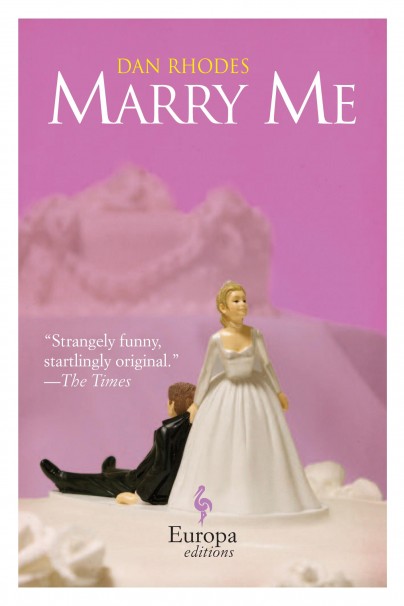
Marry Me Cover

The men in ‘Marry Me’ by Dan Rhodes tend to have star-dazed love-struck attitudes toward marriage such as “I can’t believe I’m going to marry the girl of my dreams.”  However the women are more realistic, saying “It’s a legal procedure.  Let’s just get through it with the minimum of fuss.”

‘Marry Me’ is a fun little book of 79 very short stories, each about as long as this post, on love and marriage.  Each of these stories will put a smile on your face especially if you’ve gone through the marriage process yourself. The book is deadpan, wry, and cynical. It is an extremely quick read and a most enjoyable way to pass a couple hours.

‘The Spinning Heart’ by Donal Ryan – The New Dark Ages in Ireland

‘The Spinning Heart’ by Donal Ryan  (2012) – 156 pages

spinning-heart

In times of extreme economic downturn, the lives and attitudes of the people regress to an earlier more brutal stage.  Witness the severe George W. Bush recession in the United States and the subsequent rise of the Tea Party.  Some aspiring dictators have even deliberately destroyed their countries’ economies in order to make their people more subservient and to ensure there are plenty of unemployed young men available for military service.

The evidence in ‘The Spinning Heart’ indicates that with their economic downturn, the lives of the people of Ireland have returned to the Dark Ages, not only economically but also socially.  It starts with the workmen discovering that their foreman, Pokey Burke, has absconded with all their pension and Social Security money and also leaving them without a job.  They were taken for fools, and they react violently.

 “Auld Mickey Briars lamped Timmy Hanrahan twice across both sides of his innocent head before we subdued him.”

I doubt if there is a Pokey Burke in every small town in Ireland who stole all the people’s money.  There are larger economic forces, more sinister villains, at work at a national or global level.  It is just easier to blame all the problems on one of your own.

‘The Spinning Heart’ is divided into twenty-one chapters, each told by a different person from a village in western Ireland.  We get the same story from numerous different angles.  There are so many points of view that the story is not entirely coherent; the novel is more like a chorus, an Irish chorus, of voices.

Life goes on even without a job.  Some of the young guys are headed off to Australia, some to England.  Some of them stay, their heads filled with bitterness and resentment.  Their talk turns to girls, and who is ‘tapping’ who.  There is little talk of birth control here, and the only mention is when a  young woman stops using it without telling her boyfriend.  Usually the men here don’t care.  Generally the women in this novel are happy to have his baby even if their man is long gone.  I did not say this novel is realistic; supposedly these are the old Irish ways.  It gives the villagers something to gossip about.

‘The Spinning Heart’ is quite mean-spirited about everyone except its hero, Bobby Mahon.  This may be just because of the whole chorus of voices who are only repeating gossip and hear-say.  It also may be the result of the downshift in people’s lives caused by the bad times; the need to blame someone.  There is a lot of lashing out here.

I suppose ‘The Spinning Heart’ may be an accurate picture of village life in western Ireland today.  It is not a pretty picture.


‘Byzantium’ by Ben Stroud

‘Byzantium’, stories by Ben Stroud (2013) – 206 pages

61Vs+jNOr6L._SY300_

When our thoughts turn to historical fiction, we usually think of long epic novels which evoke a particular time and place in history.  However several of the stories in ‘Byzantium’ show us that historical fiction can also be in the short story form.

Did you know that the Emperor Constantine I moved the capital of the Roman Empire from Rome to Byzantium in 330 AD and renamed the city Constantinople?  In 1923 the city was again renamed to its modern name Istanbul.  It must have been an incredible move to take the entire government of the empire from Rome to what is now Turkey.

The ten stories in ‘Byzantium’ have the depth and density of a novel yet also contain the individualized point of view of a short story.  The stories range from ancient Roman times to modern times, from ancient Byzantium to east Texas.  Even though the settings for the stories are wide ranging, they get down to the specifics of individuals and the relationships between them. We get inside the head of the main character in each story.

The stories are outdoor and action-oriented.   They are not drawing room comedies.  If I sense a weakness in the author, it is in dialogue.  Don’t look for witty repartee here.  Stroud is no Oscar Wilde; the dialogue is more suited for stone tablets rather than for the stage.

However the stories are extremely well presented and are evidence of a vivid imagination.  Ben Stroud does an excellent job of framing each story to fully capture its significance for the readers.

A particular favorite of mine is ‘At Boquillas’ which takes place along the shallow Rio Grande border between Mexico and the United States.  A modern-day young husband and wife confront their marital difficulties.    Getting out of a failed marriage may be as easy and as momentous as walking across the shallow water into Mexico.

‘Byzantium’ is a strong collection of offbeat and vastly different stories.


‘Bark’ by Lorrie Moore

‘Bark’ by Lorrie Moore (2014) – 192 pages

113fc7f7346d6e106297b109e3a5795d

Sincerity is something a lot of writers can do.  In fact the writing world is drowning in sincerity.  That is why I appreciate Lorrie Moore who interrupts her stories with edgy silly jokes.  Take this line about a woman singer who was booed by her audience.

 “Despised especially were her hip-hop renditions of Billy Joel and Neil Young (she was once asked to sing down by the river, and she thought they’d meant the song).”    

 But sharp humor is a young person’s game.  As time goes on, life gets all too serious, sometimes even desolate.    There are illnesses, failed relationships, divorce, bad jobs, severe recessions, unnecessary wars, despicable politicians, deaths of loved ones.  How does one keep a sense of humor?

Lorrie Moore made her name with sharp stories containing wicked sardonic humor.  In ‘Bark’ the humor is still there, but the stories also deal with the calamities listed above.  This is a high wire act, combining jokes with despair, and sometimes Moore does not fall.

 “ ‘Marriage is one long conversation,’ wrote Robert Louis Stevenson. Of course, he died when he was forty-four, so he had no idea how long the conversation could really get to be.”

However sometimes things get disjointed.  My example is the first story in this collection, a long story called ‘Debarking’.  Ira has been divorced for six months and is rather desperate for a relationship.  He gets involved with a woman named Zora who is a friend of a friend.  It turns out Zora has a fifteen year old son Bruny whom she is constantly nudging, wrestling, and physically teasing. Soon Ira realizes that Zora ‘might not be all that mentally well’. This story is played mostly for laughs but could easily go the other way.  I applaud Moore for putting such unusual characters and situations in her stories.    

Throughout this collection there is a mixture of laughter and sadness, and sometimes they go together uneasily. 

 “A woman had to choose her own particular unhappiness carefully.”

Sometimes it feels like Moore is trying to accomplish too much with each story including social satire, political commentary, humor, emotion, and poignancy.  That probably is better than attempting too little. 

‘Travels With My Aunt’ by Graham Greene

‘Travels With My Aunt’ by Graham Greene  (1969) – 244 pages

9ffb64a87bcac528db3e519ea3766258

Reading a Graham Greene novel is for me like meeting a dear old friend again.  I have a strong liking for Greene’s writing and have read most of his work. 

There are a couple of reasons I had not read ‘Travels With My Aunt’ before.  First the title wrongly suggested to me that this might not be fiction and might instead be some dreaded memoir.  I’m no fan of memoirs generally.  Also I erroneously thought that ‘Travels With My Aunt’ was one of the last works by Greene, and I have not had good luck with the last works of prolific authors.  Only today did I find out that he wrote several of his best novels including ‘The Human Factor’ and ‘The Honorary Counsel’ after ‘Travels With My Aunt’.  For whatever reason, I still find the title ‘Travels With My Aunt’ anomalous among the titles of his novels in its personal reference   However the number of Graham Greene novels I haven’t read is dwindling down to a precious few, and it was time for ‘Travels’.

‘Travels With My Aunt’ is a fun good-natured comedy by Greene, perhaps not as edgy as some of his other books.

The main character in this novel is Englishman Henry Pulling.  He has recently retired from his life’s work as an accountant.  He has never married, and now that he is retired his main interest is tending his garden of dahlias.  The novel begins on the day of his mother’s funeral.  His aunt Augusta shows up at the funeral, and she turns Henry’s world upside down or right side up as the case may be.

Aunt Augusta’s life is entirely different from Henry’s sedate life.  She is a free spirit living her life to the fullest.

 “I despise no one, no one.  Regret your own actions, if you like that kind of wallowing in self pity, but never, never despise.” – Aunt Augusta in ‘Travels With My Aunt’

Soon they are travelling to Paris, Istanbul, Argentina, and Paraguay on missions involving mysterious gentlemen, jewels, and government intrigue. 

I found ‘Travels With My Aunt’ a merry romp of a novel, but perhaps not quite as dramatic as some of Greene’s other work. However a technique is used in this novel that I hadn’t seen before.  A secret becomes apparent to the readers early in the novel.  We wait for the main character Henry Pulling to figure it out, but he never does.

I would not recommend ‘Travels With My Aunt’ as a book to start with in reading Graham Greene.  Better books to start with would be ‘The Heart of the Matter’, ‘Our Man in Havana’, ‘A Burnt-Out Case’, or, above all, ‘Brighton Rock’.   There are any number of other fine Greene novels to start with, but ‘Travels With My Aunt’ isn’t one of them.

However I do recommend that you start reading Graham Greene if you haven’t already.   I should mention that I am a fallen-out Protestant and still hold this most Catholic of novelists, Graham Greene, in highest esteem.