Archive for the ‘Book Reviews’ Category

‘The Book of Strange New Things’ by Michel Faber – Bringing Our Religion to Another Planet

‘The Book of Strange New Things’ by Michel Faber   (2014) – 500 pages


The+Book+of+Strange+New+Things

‘The Book of Strange New Things’, the new novel by Michel Faber, is much different from his ‘The Crimson Petal and the White’ which had a Victorian setting.  ‘Strange New Things’ mostly takes place in some unspecified future time on the planet Oasis.   A man called Peter travels there in order to bring Christianity to the sentient creatures who live there.  ‘The Book of Strange New Things’ is what these aliens call the Bible.

The novel itself is almost as big as a Bible, weighing in at 500 large gold-leafed pages.

Perhaps the best way to give you an idea of what this novel is like is to quote Peter’s description of these alien Oasan creatures.

 ‘Here was a face that was nothing like a face. Instead, it was a massive whitish-pink walnut kernel. Or no: even more, it resembled a placenta with two foetuses – maybe three-months-old twins, hairless and blind – nestled head to head, knee to forehead. Their swollen heads constituted the Oasan’s clefted cheeks, their spindly arms and webbed feet merged into a tangle of translucent flesh that might contain – in some form unrecognisable to him – a mouth, nose, eyes’. 

 Peter knew the Oasans had some sort of viewing units instead of eyes, but he couldn’t figure out where they were located.  The aliens have difficulty speaking sibilants.  Compared to the creatures one usually finds in science fiction, these are rather drab, ‘gentle, kind, humble, hard-working people’.

Peter keeps in frequent written communication with his wife Bea back on Earth via a device called the Shoot   Bea lets him know that things are falling apart on Earth with earthquakes and floods and other natural and man-made calamities devastating large areas of the world.

One of the reviewers on ‘GoodReads’, Mary Lins, wrote in regard to this novel that ‘I know I will be thinking about it for the next few days’.  Well I completed the book several days ago, and I have not thought about it since.  Michel Faber is a strong storyteller, and the story was quite interesting while I was reading it.  However I did not get any startling or original ideas or insights from the novel.  The Christian evangelizing was old hat even if it was on another planet.   It seemed like Faber made the landscape and the creatures of this planet Oasis as drab and commonplace as possible.

I must admit that science fiction is not a genre I often read, but I did like Michel Faber’s first sci-fi novel ‘Under the Skin’ a lot, and ‘The Crimson Petal and the White’ was wonderful.  In ‘Strange New Things’ there just did not seem to be enough story to warrant all the writing.

For me, the pay-off did not match the time and effort spent on ‘The Book of Strange New Things’.
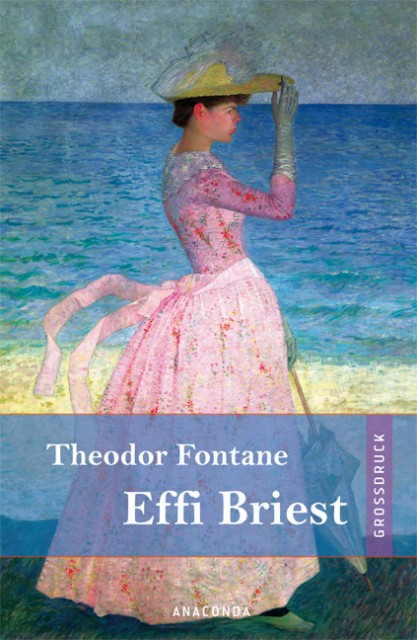
 

‘Effi Briest’ by Theodor Fontane – Effi B. versus Emma B.

‘Effi Briest’ by Theodor Fontane  (1896) – 235 pages    Translated by William A. Cooper

7091267_7091267_xl

Having read ‘Effi Briest’ now and re-read ‘Madame Bovary’ quite recently, I am in the somewhat fortunate position to be able to compare and contrast these two young women with the same initials and quite similar fates.

‘Effi Briest’ begins with seventeen year old Effi in the backyard playing with her friends Bertha, Hertha, and Hulda.  Effi is a high-spirited and fun loving girl. Parents usually want the best for their daughters, and the parents of Effi are no exception.  So when a financially well-established man, Innstetten, asks the parents for Effi’s hand in marriage, they agree.  Innstetten is an old friend of the family, in fact a former suitor of the mother.    He is more than twenty years older than Effi, and the parents do have doubts about the arrangement, but they do decide it is for the best.

screen-shot-2014-09-24-at-07-23-25For me one of the most poignant scenes in ‘Effi Briest’ is after the wedding when her parents sit around the kitchen table discussing the suitability of this arranged marriage.  I wonder how often today parents pause to discuss the quality of their children’s marriages.

Meanwhile the marriage in ‘Madame Bovary’ is not an arranged one as Charles Bovary actively courts Emma Rouault before they marry.  Still he too is about twenty years older than Emma.   Charles Bovary is a doctor who is dedicated to his work, and soon Emma is making fun of him behind his back.  She regards him as boring and a stick-in-the-mud, and her contempt for him grows.  She is fascinated with Parisian high society and has little use for the dull doctor, her husband.  She also spends a lot of the good doctor’s hard-earned money.

At the same time Effi Briest admires her husband even though he is somewhat cold and distant. ‘Innstetten was kind and good but he was not a lover.’  The problem here is that he lives far to the north in Germany in the seaport town of Kessin.  Effi must leave her parents and friends, and she is somewhat lost and lonely in her new surroundings.

So here is a major difference between Effi and Emma.  Effi is essentially a good girl who is overwhelmed and distracted by her severe isolation.  However Emma is mischievous and ready for trouble from the very beginning.

Trouble does arrive for both Emma and Effi in the form of a young man.  I suppose there has never been a shortage of young men out to seduce pretty young women.  Rodolphe of ‘Madame Bovary’ and Major Crampas in ‘Effi Briest’ are both womanizers of the first order.

Hanna Schygulla as Effi Briest

Hanna Schygulla as Effi Briest

Theodor Fontane is quite discreet about Effi’s affair with Major Crampas.  Effi goes off alone for long walks in the woods or along the river and comes back alone a couple of hours later.  We never have a scene of the two of them by themselves together.  Meanwhile in ‘Madame Bovary’, Rodolphe is not Emma’s first affair, and we do actually see them getting it on in the woods during their horse riding.  Although ‘Effi Briest’ was written nearly forty years after ‘Madame Bovary’, ‘Madame Bovary’ is the much more explicit novel.

Since both Effi and Emma have committed that most heinous of crimes, adultery, they both must be punished severely.  In both cases the adultery is found out by hidden secret letters several years later. In Emma’s case, adultery didn’t bring her down; it was her spendthrift ways. Effi Briest remains a kind worthy person until the bitter end.

The difference between Effi Briest and Emma Bovary is as follows.  Effi is a good young woman driven by loneliness to temporarily go bad.  Emma is a forever mischievous troublemaker but loveable.


My review of ‘Madame Bovary’ can be found here.


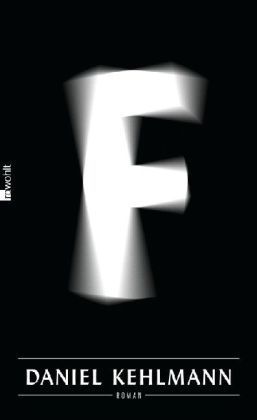
‘F’ by Daniel Kehlmann – How Do We Mediocre People Live?

‘F’ by Daniel Kehlmann (2013) – 272 pages     Translated by Carol Brown Janeway

screen-shot-2014-09-24-at-07-23-25

‘F’ raises some of the major questions of life, yet somehow manages to be playful.  At the same time it is a well-constructed work of fiction.

‘F’ is about a father and his three sons coming to terms or not coming to terms with our post-modern world.  Not that the modern world before had been all that great what with the Great Depression and World War II.

But in the post-modern world, even the priests don’t believe in the sacraments they perform or even in God.  Many businessmen and politicians cheat and defraud but are rarely punished.  And of course the art world and museums are rife with hype and fakes.  ‘Sheer noise triumphs over quality.’

36fac0f98daab33866b736ced92788b1The father Arthur is an author who walks out on his family to pursue his writing after an auto-suggestion from the hypnotist, the Great Lindemann. The sons grow up.  One son Martin is a fat priest who still is intrigued by the Rubik’s Cube, one son Eric is a stock broker living the high life but contemplating suicide, and one son Ivan is a gay artist and art critic.

‘F’ is by no means what I would call a ‘straight line’ traditional novel.  It is definitely post-modern.  It resists any simple plot explanation and it raises a lot of questions it doesn’t answer.  That is a good thing.  Each of the sons gets to tell his story.

One of the many questions ‘F’ asks is ‘How do people who are mediocre manage to live their lives?’  Ivan wrote his dissertation on ‘Mediocrity as an Aesthetic Phenomenon’.

“Ivan often wondered how people with no particular gifts put up with their existence.” 

Each brother has his own way of dealing with Ivan’s question — how do you live with mediocrity, why do you keep on going?   The general answer in ‘F’ seems to be that we fake it.

“If I kept on painting, I would be average at best.  Would that be terrible? Most people are average by definition.”

Although the tone of ‘F’ is light and playful, it is not an easy novel. However it is a rewarding one.  I had to listen to the entire novel twice to get its full effect.  One chapter is a story, ‘Family’, the father Arthur wrote.  He has no memory at all of his own father, but he traces his ancestors back to medieval times. The story seems to point out how random and stupid fate is that we are here today.

18339155So what does the ‘F’ stand for?  My best guesses are ‘Fate’ or ‘Fake’.  Maybe the two are interchangeable in our post-modern world.


My review of ‘Fame’, Daniel Kehlmann’s previous novel, can be found here.


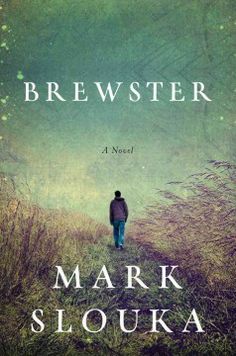
‘Brewster’ by Mark Slouka – In High School During the Late Sixties

‘Brewster’ by Mark Slouka  (2013) – 281 pages

86163ba3171b3acd66843d419620aa24

‘Brewster’ is centered on a guy in high school growing up in the town of Brewster in New York during the late Sixties and 1970.  The temptation and the downfall of many novels about the late Sixties is to overdo it, the hippies, Right On!, Make Love not War, Power to the People, Woodstock Nation, the Mansons, Flower Power.  All have become stereotypes, clichés of a past time that is long gone.   ‘Brewster’ pretty much avoids the cliché problem by concentrating on its dramatic high school story.

Sixteen year old Jon Mosher is somewhat of a lonely figure in his high school, eating lunch by himself most days.  Then his World History teacher notices Jon and sees that he has just the right build, tall and thin, for long distance running on the high school track team.   It turns out that Jon is well-suited for competition, and soon he is devoted to practicing and running races at which he excels. In track, Jon has found something he can believe in, and that makes all the difference.  These are some of the best scenes in ‘Brewster’.

Jon’s parents are German-Jewish refugees from World War II who “slipped through the closing door with a suitcase apiece and started again”.  When Jon was four, he lost a brother due to a household accident, and his mother continues to be distraught over this twelve years later.

 “I think now they just broke.  People break, just like anything else.  They’d lost just about everything once, now they’d lost it again.  And they broke.  No more to it.

 I’m not making any claim to anything.  You read worse stories in the paper every day.”

 At high school, Jon makes a close friend in Ray Cappicciano who is much different from himself.  Ray is a rebel and a fighter who has family problems of his own.  Soon Ray gets a girlfriend Karen and the three teenagers hang out together.

So in ‘Brewster’, we have scenes of track field drama juxtaposed with scenes of intense sometimes violent family drama.  This is a novel of foreboding where the tension mounts as the story progresses.  This is neither a humorous novel nor an intellectual novel.  It is about some high school kids growing up and finding out some more about what life is like.  The background music is of course the Beatles and the Rolling Stones and Credence Clearwater Revival and Jimi Hendrix, and these high school boys know that their future is probably either college or Vietnam.

Mark Slouka is a very sure storyteller, and ‘Brewster’ held my interest throughout.  I became heavily involved in these young people’s lives and kept reading to find out what will happen next.


‘Can’t We Talk About Something More Pleasant?’ by Roz Chast

‘Can’t We Talk About Something More Pleasant?’ by Roz Chast   a graphic memoir   (2014) –  228 pages

cantwe

Can you imagine a graphic memoir that contains cartoon pictures of the writer’s aged parents just after they have died?  There are a whole series of pictures here of the author’s mother as she goes through the last stages before death.  Yes, the decline and ultimate death of one’s aging parents which is the subject of this book is unpleasant.  It is a natural part of life.

In this graphic memoir Roz Chast gives an honest account of her parents’ final days told from the perspective of a usually caring but sometimes exasperated daughter.

Both parents are in their nineties.  The two parents take different routes to their final destination.  He is prone to forgetting things, a touch of senile dementia which steadily increases.  The mother has mainly physical symptoms like high blood pressure, arthritis, and digestive ailments.  The mother has been and still is a demanding person, and the daughter still has unresolved issues with her from childhood.

The financial considerations are covered here too as she sees her parents’ life savings evaporate with the huge costs of assisted living.  Chast makes no attempt to prettify the whole aging and death process.   She throws in her own mixed feelings about her parents and their situation.  This openness about the subject of parental decline and death that has been shrouded in secrecy is refreshing.

SomethingMorePleasant_AF

The visuals really drove this story home for me.  As well as the cartoons which reminded me of Jules Feiffer in their loose style, Chast includes actual photographs from her childhood of her parents and herself.   In one ten-page section she shows us photographs of all the objects and clutter in her parents’ last home after they moved into assisted living.  Nearly all of it will be thrown away.

 “I began the massive, deeply weird, and heartbreaking job of going through my parents’ possessions – almost fifty years’ worth, crammed into four rooms.  If I wanted mementos, it was now or never.”

 The book even deals with what to do with the urns that contain her parents’ ash remains, a thorny problem.

In my own case, I was one of those offspring that left the immediate area where my parents lived, so I did not have to deal with all these aging parents’ problems.  I had a brother and sister-in-law that handled all of that for me.  ‘Can’t We Talk About Something More Pleasant?’ gave me a good idea of what it must have been like for them.


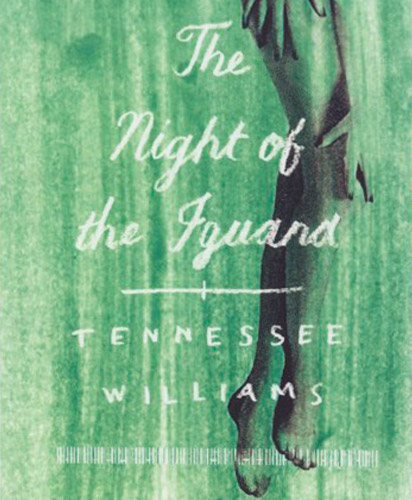
‘The Night of the Iguana’ by Tennessee Williams – At the End of their Ropes

‘The Night of the Iguana’ by Tennessee Williams   a play (1961) – 137 pages

‘Nothing human disgusts me, Mr. Shannon, unless it is unkind or violent.’ – Tennessee Williams,  The Night of the Iguana

‘If I got rid of my demons, I’d lose my angels.’ – Tennessee Williams, Conversations With Tennessee Williams

            -

‘The Night of the Iguana’, written in 1961, was Tennessee Williams’ last hit play, running for ten months and 316 performances on Broadway in its original run.  As Howard Taubman in his original review of the play stated, Williams is “writing at the top of his form”.  Williams had had a spectacular run of hits on Broadway and in the movies including ‘The Glass Menagerie’, ‘A Streetcar Named Desire’, ‘Cat on a Hot Tin Roof’, ‘The Rose Tattoo’, and ‘Sweet Bird of Youth’ as well as the movie ‘Baby Doll’.

In 1963 Williams lost his long-time lover and personal secretary Frank Merlo who must have been a stabilizing influence on him.  The loss plunged him into a near catatonic depression and increasing drug and alcohol use resulting in several hospitalizations and commitments.

But Williams’ fabulous glory days were beyond compare.  He dominated the American theatre in the late 1940s and 1950s as no one has done since.  Nearly all of his plays then were turned into well-regarded movies. The film rights to ‘The Glass Menagerie’ were the highest that had ever been paid for a Broadway play.  Even today his plays are constantly being revived on Broadway.  A new production of ‘The Night of the Iguana’ is scheduled for Broadway in 2015.

‘The Night of the Iguana’ is unique in that it takes place in an exotic resort on the west coast of Mexico.  Just like the two iguanas tied up at this cheap hotel, the humans here are trying to escape their personal plights but are at the end of their ropes.

The play centers on a bus driver named Shannon.  A former minister who was kicked out of his church, Shannon is now driving a tour bus full of traveling woman teachers.  Shannon has a brief adventure with an underage girl accompanying the group, and the group leader wants to report him to the bus company management.  So Shannon deflects the bus from its normal route to this remote resort run by his friends, in hopes of not getting reported.  The woman who runs the resort, Maxine, has lost her husband about a month ago and is trying to lure Shannon with her sexual charms to stay and help her run the resort. Shannon resists. Meanwhile there are an old man and his granddaughter, Nonno and Hannah, staying at the hotel who are also trapped in a hopeless gypsy-like existence.  The conversation between Shannon and Hannah near the end of the play is one of the most moving scenes in all of theater.

The timeframe of the play is 1940, and there are some German tourists at the resort who are rejoicing in the bombings of London which they hear about on their radio, much to the unspoken annoyance of everyone else.

USDespite its Mexican backdrop, ‘The Night of the Iguana’ is still very much a Southern Gothic like most of Williams plays.  Nearly all the main characters are transplanted from the American South.   It contains what you would expect from a Tennessee Williams play, raunchy flamboyant characters who are emotionally overwrought and seeking moral redemption.   Williams is particularly good with his female characters in that each has her own distinct personality and way of being.

”Purists of the craft may object that, strictly speaking, The Night of the Iguana does not go anywhere. In the deepest sense, it does not need to. It is already there, at the moving, tormented heart of the human condition.” – TIME magazine reviewer

I also watched the excellent movie adaptation of ‘The Night of the Iguana’ starring Richard Burton, Ava Gardner, and Deborah Kerr.

A new biography of this tortured genius, ‘Tennessee Williams – Mad Pilgrimage of the Flesh’ by John Lahr, has recently been published.


‘Truth in Advertising’ by John Kenney – Humor at the Office

‘Truth in Advertising’ by John Kenney   (2013) – 306 pages


Truth_In_Advertsing‘Truth in Advertising’ won this year’s James Thurber prize for American humor.  It is a devastatingly sharp satire on corporate life, particularly the advertising world.

 “There are two kinds of creative people in advertising.  Those who think they are smarter than the client and those who are successful.”

 Our hero, Finbar Dolan, works on the diaper account for a large ad agency in New York.  The joke here is that all these high level executives, creative directors, and creative writers go about their job of making diaper advertisements for TV with the utmost seriousness.  Their ultimate challenge is to make a diaper commercial to be aired during the Super Bowl.

  “Then there’s the rest of us. Me and my coworkers. We do diapers. We do little chocolate candies. We do detergent and dishwashing liquid and air fresheners and toilet paper and paper towels and prescription drugs. Our commercials have cartoon animals or talking germs. It’s the stuff you see and think, Blessed Mother of God, what idiot did that? That idiot would be me. I make the commercials wherein you turn the sound down or run to the toilet.”

 John Kenney writes humor pieces for the New Yorker.  This is his first novel and he does capture the ridiculousness of office life with a mocking vengeance.  I know, I’ve been there.

Finbar quotes one of his bosses on advertising:

 “It’s my religion, it’s my personal Jesus.  And it is also incredibly profitable.  Can I refresh your drink?”

 Actually there are two stories in ‘Truth in Advertising’.  One is this uproarious story about office life at the ad agency, but also there is the poignant personal and family story involving the death of Finbar’s estranged father.  The tone of these two stories is so totally different that they don’t fit together so well.  While the tone of the ad agency story is super wise guy and cynical, the tone of the family story winds up being somewhat sentimental.   The comedy shines; the melodrama is somewhat sappy.

But the parallel stories do hold together due to the voice of Finbar Dolan, the main character. Finbar’s quest for meaning takes him far afield from the advertising world.  ‘Truth in Advertising’ has the familiar theme that perhaps the best way to having a good life is not living larger but instead living better.

The bottom line on ‘Truth in Advertising’ is that it captures the wild-ass comedy of the advertising world, not so much the family drama.

 “Cynicism is very dangerous in advertising.  You must be a believer.  If you stray, if you start questioning its worth and validity, its credibility, you are in for a very long day.”

 Read ‘Truth in Advertising’ for its insights into advertising and office life.


A Dozen Show Biz Novels

Show business takes many forms from motion pictures and TV to live theater to music and dance performances.  Here are some of the best novels that take place at the show.

                   ,

,

‘The Day of the Locust’ by Nathanael West  (1939)  This is not the first Hollywood novel about an aspiring young actress of little talent and astounding beauty, but it is perhaps the best.  A realistic novel about a few hangers-on in a Hollywood grotesque.

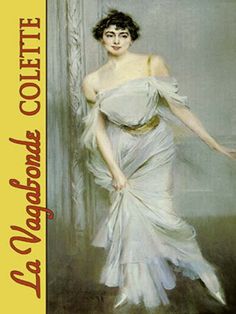
‘The Vagabond’ by Colette (1910) – This novel is the story of a woman who after her divorce becomes a dancer in music halls.  It was inspired by Colette’s own experiences.

‘The Loser’ by Thomas Bernhard (1983)  A fiercely original novel in which one of the main characters is Canadian musical genius Glenn Gould, “the most important piano virtuoso of the century”. Thomas Bernhard constantly berated his native Austria for its Nazi past, its stupidity, its sentimentality, and its philistinism, yet he rarely left the country.  This is perhaps the finest novel by one of the most unique writers of the twentieth century.

‘The Feast of Love’ by Charles Baxter (2000) –  In this novel Charles Baxter uses one of the oldest most dependable of schticks, a re-imagining of Shakespeare’s ‘Midsummer Nights Dream’ in modern times.  This year I’ve already read two works of fiction with re-imaginings of ‘Midsummer Nights Dream’, ‘Wise Children’ by Angela Carter and a story in Donald Antrim’s collection of stories.  “Disparate people joined by the meanderings of love come together in a tapestry that depicts the irresistible arena of life.” – Promo text for ‘The Feast of Love’.

9781497658622_p0_v1_s260x420Margaret in Hollywood’ by Darcy O’Brien (1991) –  O’Brien was a son of Hollywood with his father being actor George O’Brien and his mother being actress Marguerite Churchill, a frequent costar of John Wayne.   This novel is about someone like his mother, and it depicts her Vaudeville and silent movie days.  Here one gets an authentic picture of early Hollywood including the crooked agents.

‘Young Man with a Horn’ by Dorothy Baker (1938) – This novel is loosely based on the short tragic life of jazz musician Bix Beiderbecke who was a great cornet player but died of alcoholism at the age of 28.  It was made into an excellent movie starring Kirk Douglas and Doris Day.

A Couple of Comedians’ by Don Carpenter  (1979)  Two guys are a comedy team that goes to Hollywood to make a movie each year, then heads to Las Vegas to perform their act.  It is an hilarious look at the underside of show business.  This is the first novel in Carpenter’s Hollywood Trilogy.

‘The Song of the Lark’ by Willa Cather (1915) – the story of a young soprano from a small Colorado town who winds up an opera diva at the Metropolitan Opera House.

“But if you decide what it is you want most, you can get it. Not everybody can, but you can. Only, if you want a big dream, you’ve got to have nerve enough to cut out all that’s easy, everything that’s to be had cheap.”  Willa Cather, ‘The Song of the Lark’

‘Morality Play’ by Barry Unsworth (1995) – This novel takes place in Medieval England that centers on a travelling group of players who portray morality and mystery plays.  It was made into a movie called ‘The Reckoning’ in 2003 starring Paul Bettany and William Dafoe.

c7841664d5ae81c58c444ce1bc86ed74‘Contempt’ by Alberto Moravia  (1954)  – a novel about making a movie and about a marriage disintegrating.  Never has contempt been depicted so realistically.  Read the novel and watch the movie; you won’t regret it.

‘Jazz’ by Toni Morrison (1992) – A lyrical novel told in an improvisational jazz style.  It is about Harlem, New York in the 1920s but extends back to the Civil War to tell its story of jealousy and romantic love.

‘The Englishman’s Boy’ by Guy Vanderhaeghe (1996) – A young man goes to Hollywood and winds up filming a movie about a cowboy hero.  This is a novel about the early movie days as well as a Western.

***

Enough for now. There are so many others: ‘Sister Carrie’ by Theodore Dreiser, ‘Rehearsal’ by Eleanor Catton, ‘Nana’ by Emile Zola, ‘The Garrick Year’ by Margaret Drabble, ‘Theatre’ by Somerset Maugham,  ‘A Visit from the Goon Squad’ by Jennifer Egan and on and on and on.

The O. Henry Prize Stories – The Best Stories of the Year 2014

This year’s O. Henry Prize Stories collection is a strong mix of twenty stories by writers who are familiar to me and writers I’ve never heard of before. The familiar names here are William Trevor, Louise Erdrich, Mark Haddon, Tess Hadley, David Bradley, and Stephen Dixon. The collection is dedicated to the Nobel winning storywriter Alice Munro.  The rest of the authors were new to me.

safe_image

One of the reasons I read these ‘Best of’ collections is to find new writers who appeal to me.  That is the thing about short stories and fiction in general.  I might think a story is wonderful, but you might not care for it very much, and vice versa.  Even within my own reading my reactions to a story can vary due to a number of factors, but I always find enough stories I really like in these series to warrant the time spent.  This year was no exception.

The author Laura Furman has been the editor of the O. Henry Prize stories since 2003.  It is her job to select the stories to include.  Each year there are three judges whose task it is to read all the selected stories and choose their favorite among them.  Each judge this year picked a different favorite with Tash Aw picking the Mark Haddon story, James Lasdun picking a story by Kristen Iskandrian, and Joan Silber picking a story by Laura van den Berg.

As per usual, my personal favorite is none of the ones the judges picked.  My favorite story is ‘Oh Shenandoah’ by Maura Stanton which is about the pursuit of a replacement for a cracked toilet seat in Venice, Italy if you can imagine.  It is a perfectly executed story, pleasantly humorous but still with a meaningful point to it in the end.  I was not familiar with Maura Stanton before, but after reading ‘Oh Shenandoah’ I will definitely be on the lookout for her fiction.  Besides being a poet, she has also written one novel and two story collections before.

Of the twenty stories, three each were first published in the New Yorker and Tin House and two were first published in The American Reader.  The others came from a variety of sources.

Stephen Dixon is a writer whose stories I have read several times as they appear in these ‘Best of Year’ story collections.  His story ‘Talk’ is about a man sitting on a bench in a neighborhood church garden who realizes that he has not talked to anyone today in the twelve and a half hours he has been awake.  The first eight pages are a long monologue about his potential opportunities for conversation.  Aspiring writers might be encouraged that a good story could be written about such a prosaic subject, but very few writers could pull it off as well as Dixon does here.   The story also got me interested in the ancient Babylonian epic poem Gilgamesh.

The following lines from Tash Aw sum up my thoughts about these O. Henry stories:

“We think we own our memories, we think we construct the narrative of our lives, but in fact we don’t.  Things just happen – random events, sometimes boring, sometimes monumental, often just plain weird.  We are mere observers to the strangeness of our own lives, the sequence of events that unfolds before us, leaving us bewildered, lost in a blurred landscape, just like the protagonist of ‘The Gun’.”

                                                                      Tash Aw      

‘Lila’ by Marilynne Robinson – The Old Preacher and the Feral Female

‘Lila’ by Marilynne Robinson    (2014) – 261 pages

616Eizn12dL._SY344_BO1,204,203,200_No writer has been more successful at imparting her Christian values to the literary world than Marilynne Robinson.  In her novels she has shown us the good side of Christianity, the side that helped set up the Underground Railroad which aided black slaves escaping into the north to freedom.  Even her Christianity of today is a positive force for good, not the smarmy TV Christianity that sickens and corrupts.

When ‘Lila’ begins, the four year old girl Lila is locked out of her house by her parents on a cold night.  Fortunately a woman named Doll saw what was happening and stole Lila away from her family.  Doll has to travel by foot all over Missouri to find temporary jobs, and she takes Lila everywhere she goes.  The only permanent possession they have is a big knife that Doll keeps for protection.  Lila grows up loving her makeshift mother.

Most of the novel ‘Lila’ is an interior monologue by the grown-up Lila looking back on her early years.  Her fortunes have drastically changed since her childhood as she is now living in Iowa, married to local minister John Ames, and expecting a child of her own.  The novel explains how all these changes came about.

‘Lila’ is the third novel in Robinson’s Gilead series, the other two being ‘Gilead’ and ‘Home’.  I found both of the first two books tremendously moving.   ‘Lila’ did not have quite the impact on me of these first two novels.

For one thing, the story is told in a reverie, and sometimes events seem a little murky and not as vivid as they could be.  Still there are sentences here that memorably evoke nature along the roads and rivers of Missouri.

 “The river smelled like any river, fishy and mossy and shadowy, and the smell seemed stronger in the dark, with the chink and plosh of all the small life.”

 Perhaps the weakest part of ‘Lila’ for me was the character Reverend John Ames.  Too many times he seemed little more than a beatific nonentity.  When Lila shows up at his church one day, he decides immediately that she will be his future wife despite their thirty-plus years’ difference in age.  What his congregation thinks of this June/December romance is not discussed.  Nearly all his time in the novel is taken up with quoting biblical passages, praying, and sermonizing. Take page 223 in ‘Lila’.  This entire page is taken up with one of Reverend Ames’s sermons.  I suppose if you delight in listening to sermons this will be wonderful, but for people who don’t it makes the novel drag.  If you got rid of the sermonizing sludge, you would probably have a fine little 125 page novel here.  The Reverend should have been given some controversial church issue to struggle with so he would have been a more interesting meaningful character.

But the center of ‘Lila’ is Lila herself.  Despite or maybe because she has dealt with rough circumstances throughout her life, she has emerged a strong self-reliant person.  Because of her,  ‘Lila’ may be one of those novels I will have to think about for awhile before I fully recognize its worth.

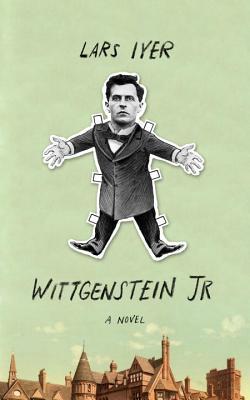
‘Wittgenstein Jr’ by Lars Iyer – An Hilarious Philosophy Class Novel

‘Wittgenstein Jr’ by Lars Iyer   (2014) – 226 pages


19288788Here is just what the world needed, a humorous novel about an advanced philosophy class at Cambridge University taught by a fellow who resembles the famous philosopher Ludwig Wittgenstein more in his pronouncements than in his looks.  His students call him Wittgenstein Jr. in fun and in partial derision.  The story is narrated by Peters, one of the students in the class.

Wittgenstein Jr. takes his philosophy very seriously.  Here are some of his somber pronouncements:

‘It is never difficult to think.  It is either easy or impossible.’

‘What stands between us and good philosophy is the will, not the intellect.  We must refine the will.’

‘You must know who you are in order to think without deceit.’

‘We are latecomers. Disinherited children.  We are without tradition.  Without belief.’

 A class of students obsessed with their perhaps deranged teacher.  A teacher obsessed with his students.  There are certain similarities with ‘The Prime of Miss Jean Brodie’, but here the students are a bunch of unruly drunken wise-ass students at Cambridge University.

Along with the philosophy classes, we also get the wild and crazy parties of these Cambridge students.  Some of the best parties take place after the pubs close.  Here is Wittgenstein Jr. lecturing his students on their alcoholic lives:

 “We drink because we do not live, he says.  Because we have no idea what it means to live.

He’s heard the thump-thump of our music.  He’s heard our drunken laughter. 

We’re guzzlers he says.  Cambridge is our trough, and we are its pigs. 

How disgusting we are! How filthy – morally speaking! Actually speaking.

We’re stupid he says. Shallow.  We’re without soul.  Without insight.”

 There is a dark undercurrent in Wittgenstein Jr.’s background.  His older brother committed suicide while teaching at Oxford.  Perhaps that is why Wittgenstein Jr. is such a cheerless soul.  The actual Wittgenstein had three brothers who committed suicide. The students wonder if that is their teacher’s ultimate end.

Lars Iyer creates vivid word-pictures throughout the novel using incomplete sentences.   Here is an example:

“Rah students everywhere.  Rah boys in gilets and flip-flops, with piles of bed-head hair.  Rugby types as big as fridges, all red-cheeked health, their voices booming.  Rah girls dressed down in gym gear and pony tails.”

I can understand almost enough references in this description to feel that it is almost wonderful.

‘Wittgenstein Jr’ is one amusing mind-shifting book.  Even if you are not into philosophy as I am not, this would be a great book to read.


‘Kill My Mother’ by Jules Feiffer – A Noir Graphic Novel

‘Kill My Mother’ by Jules Feiffer    (2014) – 148 pages

22290940

‘Kill My Mother’ is part hard-boiled detective noir, part World War II battle drama, part Hollywood mystery with scandalous celebrities and a dancing fool.

Since it is a comic, it can be as over-the-top as it wants to be.  The art work is a playful zany delight.  The story is crazy noir with mysterious murders, a hard-bitten horny drunk private eye, lotsa femme fatales, a jaunt through Hollywood, and a military battle thrown in for good measure.  Do you remember the USO shows where Hollywood stars would tour the battlefields to put on a show for our troops?  There is one of those shows here.  Of course there are boxing scenes; there are bar scenes, swing dance scenes, tap dance scenes, transvestite scenes, nude scenes.  There is a casting call scene and a nightclub scene.  Nearly every trope from old 1940s movies can be found here.

This graphic novel has one of the most explosive, dramatic conclusions you will ever find.

‘Kill My Mother’ is divided into two parts.  The first part called ‘Bay City Blues’ takes place in 1933 and has pretty much a traditional detective noir setting.  The second part takes place ten years later in 1943 and is called ‘Hooray for Hollywood’ where we have almost all the same characters from Part I who have now moved to Hollywood and are working in the movie business at one function or another.

Pages-from-KMM_feiffer-opener-580px (1)

Jules Feiffer has been cartooning forever.  His comic strips ran for 42 years in the Village Voice.  He has drawn political cartoons, written novels and plays, and published his autobiography.   He drew one of the earliest graphic novels, ‘Tantrum’, in 1979.  An early book of his cartoons was called ‘Sick, Sick, Sick: A Guide to Non-Confident Living’.  He is eighty five years old now.

The only small criticism I have is that the unique print style of Jules Feiffer’s handwriting is somewhat hard to read.  I remember even having that problem in college while reading his cartoons.

This graphic novel is dedicated to Milton Caniff, Will Eisner, Hammett and Chandler and Cain, John Huston, Billy Wilder, Howard Hawks, and Joan Z. Holden.

I believe ‘Kill My Mother’ will be great fun for a lot of people, especially those who have watched and enjoyed those old 1940s movies.  But even young people could get a kick out of this preposterous story.


‘Life Drawing’ by Robin Black – After Her Affair

‘Life Drawing’ by Robin Black   (2014) – 240 pages

628x471

‘Life Drawing’ is a fine mix of the real events in a woman’s life and her consciousness of those events.  Doesn’t that describe a lot of novels?  Yes it does, but it all depends on the style of writing.  Here we have a taut direct voice that puts this story of marital discord across in a dramatic way.  ‘Life Drawing’ is a high-wire act by Robin Black that succeeds.

Augusta (‘Gus’) and Owen are a long-married couple.  Gus is an artist and Owen a writer.  They used to live in Philadelphia until Gus had a few-month affair with a man.   After Owen found out, Gus broke off the affair, and she and Owen moved to this remote farmhouse to try and repair their marriage.  This is where ‘Life Drawing’ begins, at the farmhouse.  However Owen is still deeply resentful of his wife’s infidelity.  He is rigorously polite, but there is no easiness or relaxation in his relations with his wife.  He is also blocked in his writing.  Gus has pursued new painting projects, but she has a deep underlying guilt.

Gus and Owen have lived in isolation in this remote farmhouse for two years, but then a neighbor, Alison, shows up.  She is a divorced mother whose daughter Nora is away at college.  Alison and Gus quick become close friends, sharing drinks and talk on many occasions.

“Life.  It begins and begins and begins. An infinite number of times. It is all beginnings until the end comes. Sometimes we know it, and sometimes we do not, but at every moment life begins again. Nora. Young. And elegant – shockingly so, something that hadn’t quite come through at our hurried first meeting.” 

 Yes, Nora.  The daughter Nora is also a writer, and when she comes home from college to visit her mother, she becomes enamored of Owen.  This marks the end of Owen’s writers’ block.

The above excerpt is a good example of the exquisite style of writing in ‘Life Drawing’.  It is Gus who is telling the story from her emotional perspective.  I found the story of the novel quite moving, and the novel held my interest throughout.

Alison, the mother, is also an artist.  So everyone is either a full-time artist or writer.  These people in ‘Life Drawing’ fly in different circles than most of the people I know who must work a job for a living.   I suppose that is one of the problems in the United States.  The only people who can afford to be artists or writers are people who have never had to struggle with a job to live.

However that is beside the point.  The point is that ‘Life Drawing’ is a strong well-written novel about the continuing effects of an affair on a long-term relationship.  There is also an astonishing conclusion.


‘Those Who Leave and Those Who Stay’ by Elena Ferrante – Not Women’s Lit

‘Those Who Leave and Those Who Stay’ by Elena Ferrante   (2014) – 418 pages    Translated by Ann Goldstein

those-who-leave-and-those-who-stay (1)

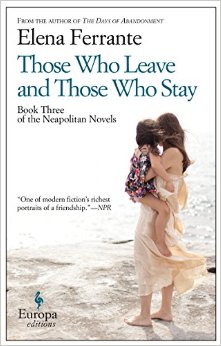
Don’t let the cover mislead you.  The picture of a woman holding her small daughter looking out to the ocean gives the false impression that this is some Woman’s Lit novel.  I would hate to see males being scared off of some of the best fiction written this new century just because of this cover.

 “Nothing you read about Elena Ferrante’s work prepares you for the ferocity of it.”

Amy Rowland, NYT

‘Those Who Leave and Those Who Stay’ is written with an intense angry passion.  This is Italy during the 1970s.

Our two friends, Lenu and Lila, are now in their mid-twenties.  Lila has left her well-to-do wife-beating husband and lives with a man whom she doesn’t sleep with.   To support herself she must work in a sausage factory in Naples.  Meanwhile Lenu has left the city and has published a very popular risqué novel and tours the country promoting her book.

Lenu is now moving in book-publishing intellectual circles, but a meeting with Lila brings her back to her hometown of Naples and her old neighborhood.  Things are not going well with Lila at the sausage factory.  The boss routinely makes sexual advances on some of the female employees.  When Lila rejects his advances, she is given the absolute worst jobs to do in the sausage factory (which you probably can imagine).  The conditions for all the workers in the sausage factory are abysmal, and some try to organize.  When the boss and owners get wind of this, they send in a group of young fascist thugs to brutally beat up the worker leaders.  The workers retaliate and murder a couple of the young fascists.  This is not the kind of stuff you usually find in a woman’s novel.

Elena Ferrante gives us a complete picture by focusing on two women, one who flees the old neighborhood and one who stays or is stuck there.  Lenu, with her college education and book writing, feels like she has escaped her old Naples neighborhood, but there is always something drawing her back into the turmoil.  I think what Ferrante is saying is that there is no real escaping those old primal primitive bonds of our early childhood.

Elena Ferrante never paints a pretty or sentimental picture of the lives of these two young women.  You are always fully aware that life is a struggle especially for women in Italy at that time.

Those who are tempted to read ‘Those Who Leave and Those Who Stay’ should realize that it is a continuation of the story.  In order to get all the necessary background, you should start with the first novel ‘My Brilliant Friend’ and then the second ‘The Story of a New Name’ before reading this one.  A fourth one is planned for next year.


‘The Emerald Light in the Air’ by Donald Antrim – Folks on the Frightening Comic Edge

‘The Emerald Light in the Air’ by Donald Antrim    stories   (2014) – 158 pages


41DrZn8A0dL._SY344_BO1,204,203,200_

I knew a man in another city who owned and ran a new car dealership.  The business was quite successful, and he and his family lived a comfortable, well-to-do life.  However each spring in late April or early May, he would become terribly depressed and disconsolate.  Since it happened nearly every year, he could recognize the symptoms and would check himself into a mental facility/rest home for several weeks to deal with the problem.  After the stay he would be fit and ready to take up his position again.

Like this car dealer, the New York men and women in Donald Antrim’s stories are hyper aware of their mental problems.  They will willingly check themselves into mental hospitals as needed.  They take the anti-depressants or anti-psychosis pills as the doctor prescribes.  If anything, they will take more of the medication than recommended.  Unlike the above seemingly serene car dealer, they struggle frantically and humorously to get by in a modern world that is none too kind to them.

“What was the use in telling her how bleak he felt when people found him funny?”

 Contrast this awareness of mental illness with the way things are for most people, especially men, in the United States.  First for the average man, any hint or recognition of mental problems will cost him his standing in the community and/or even his livelihood.  Thus he must keep a tight lid on his mental state.   There is no recognition until the problem occasionally explodes into a monstrous violent act.

All of the stories in ‘The Emerald Light in the Air’ were first published in the New Yorker.  Antrim writes the kind of stories that are edgy, antic, and hilarious at the same time.  They somehow fit neatly into the pages of the New Yorker.

All of the stories sparkle here, and I will not get into the details. except the one story ‘The Actor Prepares’ is about a wild and risqué production of ‘A Midsummer Night’s Dream’ that you won’t forget.

Donald Antrim deals with realistic situations in these stories which usually take place in New York, but his people are usually on the dark comic edge between sanity and insanity.   They rely on their pills and their drinks to keep them happy, but the pills and drinks don’t always work.  Most of the main characters in his stories started life in the South but somehow wound up in New York like Antrim himself.    They do these grandiose acts to show the world and their girlfriends that they are fine only to wind up seeming more foolish and suspect than before.

What sets Donald Antrim apart from many other writers of stories is the peculiarity of his world.  No one else could have written these stories with the same antic yet despairing vision.


‘The Children Act’ by Ian McEwan – Another Day in Family Court

‘The Children Act’ by Ian McEwan   (2014) – 221 pages


      .

.

“I apologize for being so obvious, but every time I watch the curtain come down on even a halfway decent production of a Shakespeare play I feel a little sorrowful I will never know the man, or any man of such warm intelligence.” – Ian McEwan

 “You can spin stories out of the ways people understand and misunderstand each other.” – Ian McEwan

Fiona May in ‘The Children Act’ is a judge in the Family Division of the High Court in London.  Every workday she must decide complex emotional cases of divorce and custody of children, of terrible disagreements between two parents, and arguments about children’s medical treatment.  She has devoted her life to the law.  She is 59 years old, married, childless.

At the beginning of ‘The Children Act’, her husband Jack announces that since they haven’t made love for ‘seven weeks and a day’ he is leaving to embark on ‘one big passionate affair’ with a younger woman.  Fiona is most concerned that night about writing her decision for tomorrow morning’s custody case, but she does get the locks changed on their apartment so Jack can’t get back in the apartment without asking her.

“A professional life spent above the affray, advising, then judging, loftily commenting in private on the viciousness and absurdity of divorcing couples, and now she was down there with the rest, swimming with the desolate tide.”

There is one legal case that is the focal point of ‘The Children Act’.  A seventeen year old boy, Adam Henry, has leukemia, and his parents refuse to allow life-saving blood transfusions due to their religion as Jehovah’s Witnesses.    Adam himself goes along with his parents’ wishes even though this could result in his quick and early death.  Judge May must decide whether or not to override the boy and his parents’ refusal.   In order to make the right decision Fiona May decides she must visit the boy at the hospital.

“Adam’s unworldliness made him endearing, but vulnerable.  She was touched by his delicacy, by the way he stared fiercely at his sheet of paper, perhaps trying to hear in advance his poem through her ears.”

 I have been reading Ian McEwan since from the beginning of his fiction writing career.  I still have a special fondness for his early macabre disturbing novels and stories such as ‘The Cement Garden’ and ‘The Comfort of Strangers’, and have much enjoyed and admired his later works including ‘Atonement’ and ‘On Chesil Beach’.

In the new novel ‘The Children Act’,  judge Fiona May is a strong intelligent female protagonist.  Mc Ewan has pulled off that difficult feat for a man of writing from a female point of view.  Fiona May rings true as an exceedingly wise professional woman who must decide on critical issues and still deal with a wandering husband.

There are some nice musical touches with Fiona May singing to accompany Adam on the violin in the hospital and she harmonizing in the Christmas concert.

Perhaps I wished for a more interesting exciting court case for her to be involved in and rule on.  These instances of people refusing medical treatment for religious reasons were momentous new stories about a dozen or so years ago, but now they seem somewhat mundane and ordinary.

Despite its unexpected end, ‘The Children Act’ seemed a little too schematic and contrived.  It did not have the strong impact for me of Ian McEwan’s best work of which there is much.

Back to School – Fourteen Excellent School Novels


       .

.

Countless academic satires as well as tons of other novels which take place in school or on campus have been written. The following are all ones I have read and have found enjoyable and/or moving.

‘Election’ by Tom Perrota (1998) – Here is a novel about high school politics wherein a history teacher decides to get involved in a school election much to his detriment. Given the circumstances and the manipulative overly ambitious girl Tracy Flick, who can blame him?

‘This Side of Paradise’ by F. Scott Fitzgerald (1920) – This is Fitzgerald’s first novel written when he was only twenty-three years old, and I like it better than ‘The Great Gatsby’. It is a thinly disguised version of Fitzgerald’s college days at Princeton turned into fiction.
“They slipped briskly into an intimacy from which they never recovered.”
“I’m a slave to my emotions, to my likes, to my hatred of boredom, to most of my desires.”

‘The Prime of Miss Jean Brodie’ by Muriel Spark (1961) – What would a list of school novels be without Miss Jean Brodie at her prime?
“Give me a girl at an impressionable age and she is mine for life.”
“It is impossible to persuade a man who does not disagree, but smiles.”

‘The Sweet Hereafter’ by Russell Banks (1991) – This is probably the saddest novel on the list, because it begins with a school bus crash that kills fourteen of a small town’s children and cripples several others. Not only does it tell what happens in the town’s schools afterwards, but also it explores the entire town’s reactions through the points of view of four different townspeople.

‘The Groves of Academe’ by Mary McCarthy (1951) – There have been many satires of academic campus life, and this novel is one of the sharpest.
‘To be disesteemed by people you don’t have much respect for is not the worst fate.’ – Mary McCarthy, New Yorker

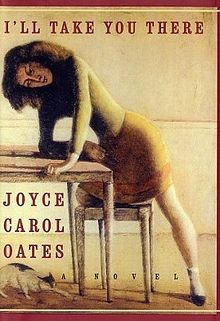
IllTakeYouThere‘I’ll Take You There’ by Joyce Carol Oates (2002) – I consider this one of the prolific lady’s best. It takes place in the 1960s with a girl being asked to join a popular sorority, then getting kicked out and falling for a troubled but brilliant grad student in one of her classes.
“The individual who’d been myself the previous year… had become a stranger.”

    .

.

‘Pnin’ by Vladimir Nabokov (1957) – ‘Pnin’ is an academic comedy about Professor Pnin who is supposedly based on Nabokov’s time teaching at Cornell University in New York. The novel has been described as ‘heartbreakingly funny’.

‘Caleb’s Crossing’ by Geraldine Brooks (2011) – The school scenes here are particularly memorable. The Pilgrim boy is an indifferent student more interested in other things. The Indian boy is the far superior inquisitive student and will go on to Harvard. All is seen through the eyes of the sister of the Pilgrim boy.

‘Lucky Jim’ by Kingsley Amis (1954) – Some novelists hit the jackpot on their first novel and will never again attain that success. That’s Kingsley Amis. This would go on my list as one of the funniest novels ever.
“If you can’t annoy somebody, there is little point in writing.‘

‘The History Man’ by Malcolm Bradbury (1975) – a dark and scathing satire about the absurdities and contradictions of campus politics and life. This is the novel that killed sociology as an academic discipline.

“Marriage is the most advanced form of warfare in the modern world.”

‘The Getting of Wisdom’ by Henry Handel Richardson (1910) – It is one of the few classic coming-of-age stories depicting a girl becoming a woman as she attends a girls’ school.
“The most sensitive, the most delicate of instruments is the mind of a little child.”

‘Wonder Boys’ by Michael Chabon (1995) – The hilarious blocked novelist Grady Tripp is also a professor, but the main reason I’m including it here is because the New York Times review by Michiko Kaukitani contains a sentence that is perfectly suited for all of us book bloggers: “It is a beguiling novel, a novel that for all its faults is never less than a pleasure to read.” This is the perfect line in order to hedge one’s bet about a novel. It is also accurate. ‘Wonder Boys’ is a modern classic.

‘Staggerford’ by Jon Hassler (1977) – This book humorously pins down school life in a small Minnesota town through the eyes of a teacher. Jon Hassler is a Minnesota writer who died in 2008. He is too good to be forgotten. Hassler has been described as a Minnesota Flannery O’Connor. The several novels of his that I have read, including Staggerford, have all been excellent.

lucky‘A Good School’ by Richard Yates (1978) – The story of a boy in the shabby second-rate Connecticut boys’ boarding school Dorset Academy in the 1940s much like the one Richard Yates attended himself. This is a strong novel by one of the best, if not the best, late twentieth century writers.


I have left out so many school novels starting with ‘Small World: An Academic Romance’ by David Lodge, ‘A Separate Peace’ by John Knowles, and ‘Galatea 2.2’ by Richard Powers.

What are your favorite school or college novels?  I would like to hear about them.

‘Wise Children’ by Angela Carter – A Show Biz Story

‘Wise Children’ by Angela Carter (1991) – 234 pages


                .

.

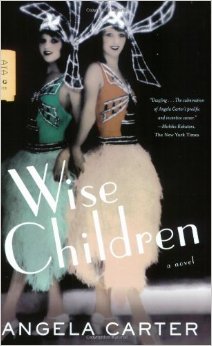
Here is a novel about the dance act the Lucky Chances who are identical twin sisters Dora and Nora Chance.  The sisters are part of the Royal Family of the British Theatre although unacknowledged by their father.

 “We are his natural daughters, as they say, as if only unmarried couples do it the way nature intended.  His never-by-him recognized daughters, with whom, by a bizarre coincidence, he shares a birthday.”

 Yes, it is William Shakespeare’s birthday and their actor father’s birthday and Dora and Nora’s birthday all on the same day, April 26.  This is highly apropos since Shakespeare is surely the guiding light of ‘Wise Children’.  Many of the scenes take place on stage with either members of the family acting or Dora and Nora dancing.

This is a jolly old London novel filled with risqué humor with a bawdy detour to Hollywood.  It covers over 100 years of the theatre stopping in at the sisters’ act in the London dance halls of the 1920s and then at a memorable Hollywood movie production of ‘A Midsummer Night’s Dream’ (‘The Dream’) in the 1930s.

Much of the action centers on Dora and Nora’s famed actor father Melchior Hazard, him with “that selfsame knicker-shifting smile”.  The final scene in the book takes place at his hundredth birthday party as Dora reminisces about their lives in show business.

‘Wise Children’ was Angela Carter’s last novel.  She died at the age of fifty one a year after it was published in 1991.  I read one of her books a few years later and wasn’t much taken with it.  However after seeing all the acclaim that Angela Carter has received since then, I decided it was time to read ‘Wise Children’.

‘Wise Children’ is a witty lively read that keeps moving and is quite funny in pinning down this show business family.   It gives you a good feel for what these old London dance halls must have been like, and we are entertained by Dora and Nora’s cheerfully ribald antics.  We watch as the dance halls go from music revues in the 1920s to sleazy topless shows in the late 1940s.

The Hollywood scenes capture the early days of motion picture sound and the whole idea of highly respected London Shakespearean actors going to Hollywood to get some quick cash and then becoming enamored by the latest Hollywood starlet.  And thus the outraged ex-wife back in London.  How many times has that situation happened?


’10:04’ by Ben Lerner – A Novel About Writing a Novel

’10:04’ by Ben Lerner    (2014) – 241 pages

1409_SBR_1004_COVER.jpg.CROP.original-original

The technical term for ’10:04’ by Ben Lerner is that it is a lame metafiction. According to Dictionary.com, Meta-fiction is “fiction that discusses, describes, or analyzes a work of fiction or the conventions of fiction.”  Or, more simply, metafiction is a fiction that deals with writing fiction.

The word MetaFiction sounds like one of those pretentious modern terms, but the first great metafiction novel goes all the way back to ‘Don Quixote’ by Cervantes in the early seventeenth century.  In ‘Don Quixote’, Don Quixote’s friend advises him how to make his story look like other tales of chivalry, and thus the first great metafiction was born.  I love the games that Cervantes plays with his knight Don Quixote and his trusted squire Sancho Panza.

A more recent example of a metafiction that I admire is ‘Dublinesque’ by Enrique Vila-Matas in which he and some of his author friends go to Dublin to celebrate Bloomsday.  ‘Dublinesque’ is one of the most charming novels ever written.  Another great work of metafiction is ‘Pale Fire’ by Vladimir Nabokov which dazzles us with its hunor and depth.

However I do not find all metafiction so entertaining.  For example, this year I found ‘My Struggle – Book I’ by Karl Ove Knausgaard to be mundane and essentially humorless, a long slog.

But I’m here today to review ’10:04’.  The novel is about Ben Lerner writing a novel which happens to be ’10:04’.

 “I was there at the age of thirty three because a doctor had discovered incidentally an entirely asymptomatic and potentially aneurismal dilation of my aortic root that required close monitoring and probable surgical intervention and the most common explanation of such a condition at such an age is Marfan, a genetic disorder of the connective tissue that typically produces the long-limbed and flexible.” 

 Please take the above sentence, because I don’t want it.  Lerner may be making some sly comment on medical lingo.  He also may be using these words to obtain precision.   However I found this sentence and the many other sentences like this in the novel off-putting.

There’s a lot of medical jargon in the book. I was not delighted by the several pages devoted to the author’s wisdom tooth extraction.  Nor did all the other pages devoted to the author’s various medical procedures do anything for me. Then there is the sperm donation scene.  That shtick is a stale old comedy routine.

The danger for Ben Lerner is that he may come across as an insufferable hypochondriac and not very funny.  When he talks about his book, he talks about the huge advance the publishers will be paying him.  Contrast that with the sparkling insights expressed by the various writers in ‘Dublinesque’.   Instead of “a nice crossing of reality and fiction” which is probably what the author intended, many of the scenes are distinctly unpleasant.

The novel begins and ends with a bad storm in New York City.  The New York presented here is pretty much the standard issue New York with no original thoughts or insights regarding the city.  The way Lerner talks about the storms sounds like an extension of his hypochondria.

’10:04’ is somewhat of a diffuse hodgepodge with a story thrown in here and a poem thrown in there.  The only character that comes across distinctly is the Author himself, and I found the Author somewhat repellent.


Vera Caspary and ‘Laura’

‘Laura’ by Vera Caspary   (1943) – 194 pages

tumblr_inline_mwc4smbVkU1s6lxse

Vera Caspary was a strong independent woman who had a highly successful career as a novelist and screen writer.  She wrote eighteen novels and ten screenplays.    In her autobiography ‘The Secrets of Grown-Ups’, she wrote:

“This has been the century of the woman, and I know myself to have been a part of the revolution.  In another generation, perhaps the next, equality will be taken for granted.  Those who come after us may find it easier to assert independence, but will miss the grand adventure of having been born in this century of change.”

 It was fairly easy for her to get into the screenwriting business in the 1930s, because the studios paid next to nothing for writers in those days.  She had her fights with Hollywood directors and producers, but she hung in there.  In the 1950s she was gray listed by Hollywood for her political views, but she continued on with her productive writing career.  In her seventies, Caspary taught writing workshops to prisoners in the New York Women’s House of Detention.

In her autobiography, she sums up her life as follows:

 “Everything good in my life has come through work: variety and fun, beautiful homes, travel, good friends, interesting acquaintances, the fun of flirtations and affairs, and best of all the profound love that made me a full woman.” 

 The novel ‘Laura’ is her most famous work by far, but I suspect there are other novels among her writings that would be well worthy of attention.

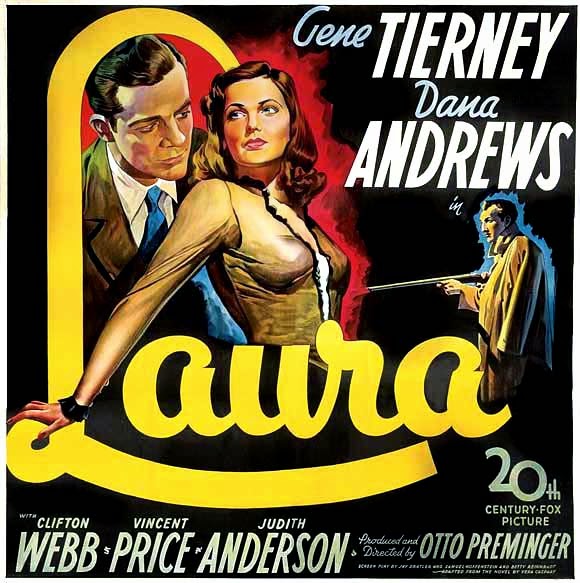
Perhaps the best way to describe the novel ‘Laura’ would be to call it a psychological mystery thriller.  Whereas the classic movie ‘Laura’ is usually classified as a film-noir, the novel is more astute and better reflects Caspary’s views on the relations between men and women.  Although Caspary had her battles with director Otto Preminger in the portrayal of Laura, she praised the film warmly in her autobiography for its nuanced direction.

In ‘Laura’, Caspary uses a technique of multiple narrators first used by Wilkie Collins in ‘The Woman in White’  The three main narrators are the aesthete columnist Waldo Lydecker, the policeman Mark McPherson, and the advertising executive Laura Hunt herself.   The other main character is Shelby Carpenter, Laura’s fiancé.

Laura Hunt is highly successful in the advertising business, and she makes her choices on her own despite the spurious manipulations of the men around her.  As Vera Caspary also started out in advertisement writing during her early days, it is a good bet she based Laura Hunt on herself.

laura-otto-preminger (12)I found ‘Laura’ to be a good read with a lot of twists and turns that make the story fun.  It also contains many subtle and clear-eyed insights into the relations between men and women.  Caspary’s depiction of the policeman Mark McPherson is particularly interesting as he is shown not to be the hard-boiled detective type at all, but rather someone who spent 14 months reading books and thinking about the world while recovering from a bullet wound. With his literary enthusiasms and sensitivity and straightforward manner, Mark McPherson proves himself to be someone worthy of Laura Hunt’s interest and attention.

“I’m not nearly as interested in writing about crime as I am in the actions of normal people under high tension.”  – Vera Caspary

 The more I study the life, writing, and views of Vera Caspary, the more I am intrigued by this extraordinary woman.