Archive for the ‘Book Reviews’ Category

‘Summerlong’ by Dean Bakopoulos – A Hot, Hot Summer

‘Summerlong’ by Dean Bakopolous   (2015) – 354 pages
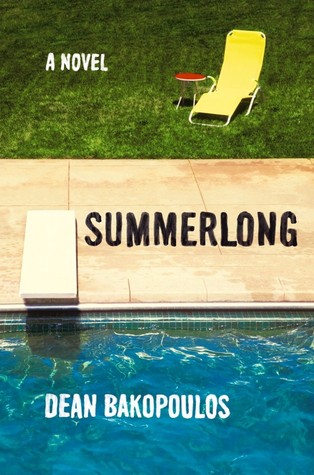
Summerlong

The new novel ‘Summerlong’ reminded me of one of my favorite movies, Ingmar Bergman’s atypical comedy movie ‘Smiles of a Summer Night’ which in its turn was influenced by the William Shakespeare play ‘A Midsummer Night’s Dream’.  All three of these works are based on the premise that summer is a wondrous and magic time for trysts between men and women.

If ever there was a hot summer novel, ‘Summerlong’ is it. It is summer, and sex is all over the place.  I never realized that the small college town of Grinnell, Iowa was such a steamy place, but this is a summer idyll so let the libidos wander free.

The novel centers on real estate agent Don Lowry (“It’s your home, but it’s my business”) and his wife Claire.  They are both in their late thirties with two adolescent children.  As the novel opens, Don is out walking by himself and meets an alluring young woman who is called ABC lying in the grass.  Soon he is going to her house often where she and he share some marijuana.  At the same time his wife Claire meets a young man Charlie to whom she is much attracted. Will she or won’t she? So the marriage is shaky on both sides.  Besides Don and Claire have severe financial problems and may lose their own house.

It turns out that Charlie’s father was a lecherous professor at Grinnell College who had dozens of affairs including one with ABC.  Later in the novel ABC and Charlie get together also.  Then there is Ruth, the wise old woman that ABC is caring for who makes mysterious and clairvoyant pronouncements throughout the novel.  I believe she also had a rendezvous with Charlie’s father.

All the hook-ups in ‘Summerlong’ happen at a pace much too smooth and easy, so the novel is not at all realistic and ultimately untrue.  However this is a summer idyll and not grim dull reality.

One thing Bakopoulos is very good at is to make you feel the atmosphere of a scene.  Thus when a scene is at the pool or on the beach on a hot summer day, you can feel the heat in your shorts.

‘Summerlong’ is a smooth read but not a deep read, and it is best for a reader not to think about or question the characters or events, because I doubt they would stand up to much scrutiny.

I listened to the entire audio book in three days, and it was entirely sufficient to listen to the story only once.  It is not Shakespeare or Bergman. ‘Summerlong’ probably will not make my year-end Top Ten list, because the story is much too facile, but I enjoyed it for what it is, a summer amusement.


Grade:   B+               


‘A Hand Reached Down to Guide Me’ by David Gates – Never has Romance been so Unattractive

‘A Hand Reached Down to Guide Me’, stories by David Gates   (2015)  314 pages


          -

The stories in ‘A Hand Reached Down to Guide Me’ are about adults.  That does not mean they behave responsibly.  They drink too much; they have affairs on the side.  They sneak off for a tryst away from their wives or husbands with a lie.   Most of the people in these stories write or teach for a living.  Thus they are very good at expressing their side of the story.

Many of the stories in ‘A Hand Reached Down to Guide Me’ are about old men having unpleasant affairs with much younger women.  Considering this dismal subject, the stories are surprisingly energetic and engaging despite there being a certain sameness to several of them.   The old men in these stories seem driven to pursue sexual affairs with much younger women, and after he gets the woman the old man feels guilty and takes it out on her with his extreme dislike.  Life isn’t always pretty.  I wish Gates would try some other subject matter once in a while in his stories.   A little variety would be a good thing.

David Gates was a literary star of the 1990s.  I remember being much impressed with his two novels ‘Jernigan’ and ‘Preston Falls’.    The two novels are in the realistic mode and show a willingness to look hard at the sordid sides of upper middle-class life on the order of Richard Ford or Russell Banks.  ‘A Hand Reached Down to Guide Me’  is the first book Gates has published since 2002.

The last story in this collection, the title story, is probably the best story, because it is about someone the old man narrator actually likes.  That person Paul Thompson is a hillbilly musician whom the narrator met when he was young and also in a band.  Over the years they have been in bands together and attended weekend parties together, and now Paul is seventy-one years old and dying.  Paul wants to stay at the narrator’s place to spend his last days, and the narrator agrees.  Of course, this being a David Gates story, the two old men both have younger girlfriends, but at least in this story that isn’t the main point.

David Gates is good at expressing himself.  There is no question he can write.  I just wish he could write about something else besides these squalid May-December pseudo-romances.


Grade:   B+    


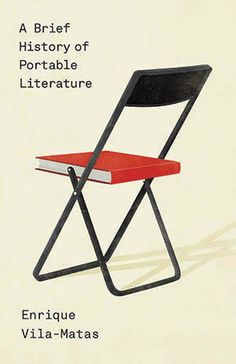
‘A Brief History of Portable Literature’ by Enrique Vila-Matas – Shandyism

‘A  Brief History of Portable Literature’ by Enrique Vila-Matas    (1985)   84 pages  Translated from the Spanish by Anne McLean and Thomas Bunstead

2f2ca8d9e212a61f58102362a3ed2c8b

I am afraid I have gone all PostModern and MetaFiction on you people with Enrique Vila-Matas.  How much chance is there that many of you earnest readers of realistic novels will be drawn to the playful skepticism and irony of Vila-Matas as he describes the characters and events in his imaginary 1920s literary movement, Shandyism?   The problem is that I quite liked it.

‘A  Brief History of Portable Literature’  is a whimsical novella about a supposed European literary and art movement of the 1920s called Shandyism.  Shandyism was the crazed movement that came after Dadaism, that actual avant-garde movement that rejected reason and logic and prized nonsense, irrationality, and intuition.   Some of the same characters who were associated with Dadaism such as Marcel Duchamp,  Tristan Tzara, and Francis Picabia show up in the Shandy secret society as well as such names as Blaise Cendrars, Paul Klee, Georgia O’Keefe, Frederico Garcia Lorca, and many, many others.  The people are real even if the movement isn’t.  They throw a raucous party in Vienna and spend a sojourn on a stationary submarine called the Bahnhof Zoo.

Shandyism was loosely based on the famous Laurence Sterne novel ‘Tristam Shandy’ and also on the alcoholic drink shandy.  In other words, this is a cock and bull story.

Here are some of the essential requirements for being a Shandy apart from the demand for high-grade madness:

“an innovative bent, an extreme sexuality, a disinterest in grand statements, a tireless nomadism, a fraught coexistence with doppelgangers, a sympathy for negritude, and the cultivation of the art of insolence.”

What makes this novella particularly problematic is that there are probably dozens of in-jokes regarding characters whose names are recognizable but with whom I’m little familiar such as Walter Benjamin and Aleister Crowley.  Even though I did not catch all the in-jokes, I enjoyed the spirit of the thing.

Perhaps the novel that ‘A Brief History’ most reminds me of is ‘Nazi Literature in the Americas’ by Roberto Bolano.  Both of these novels are definitely post-modern and are written with tongue firmly in cheek.

I can only hope that there may be a few of you who have grown a little weary of the usual fare and for a change want to reach out to something new and radically different.  I would not recommend ‘A  Brief History of Portable Literature’ as your first choice, but either ‘Never Any End to Paris’ or ‘Dublinesque’ by Vila-Matas would be good places to start into the ironic world of post-modern metafiction.


Grade:    B+  


‘Her’ by Harriet Lane – A Family Thriller

‘Her’ by Harriet Lane    (2015) – 261 pages


medium

Every psychological thriller needs a tagline, and the tagline for ‘Her’ is “You don’t remember her, but she remembers you.”

‘Her’ is the story of two women in their early thirties, Nina and Emma.  Emma is a mother with a three-year old son, Christopher, and a baby, Cecily, so her life is chaotic.  Nina is also a mother, but her daughter is away at school.  Emma doesn’t remember Nina at all, but Nina has sought Emma out because of an incident that happened when they were teenagers.

The chapters in ‘Her’ alternate with first a chapter with Nina as narrator and then a chapter with Emma as narrator, then Nina, then Emma, and so on. It is quite easy to diagnose the main problem with this novel. I suppose the fact that their names, Emma and Nina, are so similar is a giveaway.   Their voices as narrator are much too similar.  It is difficult to distinguish who is talking at any given time.  Neither Emma nor Nina has a distinctive voice, her own interior monologue, which would give each her own personality.  In their chapters, there is nothing besides their differing life situations that distinguishes them.

Just for the sake of variety, the author should have given the two characters easily recognizable individual styles so the reader would know immediately who is speaking.  As it is both Nina and Emma have the same way of describing things, but this sameness may have been intentional.

Still there are moments of great suspense in ‘Her’.  The reader speeds along in desperate fear and concern for the characters.  The novel starts out in London, winds up in France, but the locations are hardly relevant as this is a psychological thriller.

I am not one to quickly classify a novel as a Man’s Novel or as a Woman’s Novel.  I usually prefer novels that have an appeal to both sexes without overdoing either the man’s stuff or the woman’s stuff.  I believe a good writer can get inside both a man’s head and a woman’s head.  However ‘Her’ leans toward the Woman’s Novel side.  The male characters here are mere ciphers.

But what really makes ‘Her’ a woman’s novel is the language Harriet Lane uses to describe things.  I doubt there is a man in the world who would describe a plate of radishes as “the red-deckled alabaster slivers of radish”.  There are many other turns of phrase in ‘Her’ that mark it as a woman’s novel.

Although I did have my quibbles with the logistics and language of ‘Her’, as a suspense tale it still works.


Grade: B  


‘The Maintenance of Headway’ by Magnus Mills – Driving Bus in London

‘The Maintenance of Headway’ by Magnus Mills   (2009) – 152 pages

51KCcCFB24L._SY344_BO1,204,203,200_

I remember when the first novel by Magnus Mills, ‘The Restraint of Beasts’, was published in 1998.  It was treated as one of the major literary events of the 1990s.  Magnus Mills was a diamond in the rough, not your typical novelist.  He was already 45 years old, and unlike many writers he was quite familiar with the ordinary work-a-day world.  For seven years he had a job building fences and later he worked as a bus driver.  ‘Restraint’ was a tragicomic deadpan novel about putting up fences for a Scottish company.  It was shortlisted for the Booker and the Whitebread, and it won the McKittrick Prize.   Thomas Pynchon called ‘Restraint’ “a demented deadpan comic wonder”.  Of course I read it and enjoyed it immensely.

Now it is eighteen years later, and Mills has published eight novels and three short story collections.  The press hoopla over Magnus Mills has stopped as well as the major awards.

‘The Maintenance of Headway’ was just published in the United States although it was first published in Great Britain in 2009.   Bus driving in London is the subject of ‘Maintenance’ as Mills continues his investigation of the world of everyday work.

More than anything, ‘The Maintenance of Headway’ is about the philosophy of running buses.  Of course it is a bad thing for a bus to be late.  The passengers who get on are upset and angry about getting to work late.  The bus will be packed with people, and it takes a lot of time loading and unloading all of them, so the bus will get even further behind schedule.

“He had plainly fallen victim to the Law of Cumulative Lateness: late buses always carried more passengers; therefore once a bus was late it could only become later still.  Now, it seemed, his lateness was compounded beyond redemption.” 

A lot of bus drivers realize that the job goes a lot smoother if they run a few minutes ahead of schedule.  There will be fewer people at the bus stops since the previous bus just picked them up, so there is no interference to a quick ride.  However from the bus company management perspective being early is just as bad as being late.  Thus you have a lot of irate riders who get to the bus stop on time only to find their bus has already been there and gone.    The bus company hires inspectors to nab drivers who are driving a few minutes ahead of schedule

“There’s no excuse for being early,”

Maintenance of headway is “the notion that a fixed interval between buses on a regular service can be attained and adhered to.”

london-bendy-bus-300x225Our narrator is one of these ‘ahead of schedule’ bus drivers.  He watches as some of his fellow bus drivers who also always ran ahead of schedule become inspectors who severely enforce the rules against running early.  As is so often the case, some of the most flagrant violators become some of the harshest enforcers.

‘The Maintenance of Headway’ is down-to-earth and contains a lot of the deadpan humor Magnus Mills is famous for.  Who cares that the other characters besides the narrator are never fully developed and are mere props for the humor?  This is a quick read and is worth the small effort it takes to finish it.


Grade:   B 


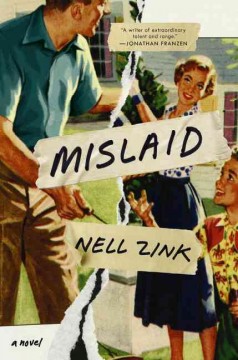
‘Mislaid’ by Nell Zink – An Outlandish Virginia Family at Stillwater Lake

‘Mislaid’ by Nell Zink   (2015) – 241 pages

Jacket

‘Mislaid’ is a story about a family but not like any family you or I have ever encountered.

Thus we have our lesbian student Peggy getting pregnant by Stillwater College’s homosexual poet in residence, Lee Fleming.  They marry, have two kids, and stay together for 10 years.  We can only assume they were temporarily attracted to each other, but later the poet goes back to guys, Peggy drives his car into Stillwater Lake, and she leaves with her daughter but not her son.  This all happens in the early pages, and things only get wilder from there.

Nell Zink’s style of writing is quite evocative and suggestive, and her riffs on just about anything are a lot of fun.  Here is part of her take on Stillwater College:

“In the 1960s it was a mecca for lesbians, with girls in shorts standing in the reeds to smoke, popping little black leeches with their fingers, risking expulsion for cigarettes and going in the lake.”  

Most of these short riffs in ‘Mislaid’ are wild and wonderful.  Here is Zink’s take on Lee Fleming, the poet father:

“His parents were wealthy.  But he had expectations and an allowance, not money.  His father suggested he move to a secluded place,  Queer as a three-dollar bill doesn’t matter on posted property.  Lee’s father was a pessimist.  He imagined muscle-bound teaboys doing bad things to Lee, and he didn’t want passersby to hear the screaming.   He offered him the house on the opposite side of Stillwater Lake from the college.”

The first part of ‘Mislaid’ is a riff on how this Lee guy who is attracted only to men wound up as a father. Later Zink explains how the daughter of Lee and a white lesbian student at the college becomes a Negro.  This is Virginia after all where if a person has even one drop of Negro blood, they are a Negro.

What better place to look for a phrase which describes a particular novel than within that novel itself?  For the novel ‘Mislaid’ I found that appropriate phrase toward the end in “weirdly fascinating”.

I liked the novel much more on the paragraph level than I did at the full plot level.   Part of the fun of this book is that it goes all over the place.  Part of the problem is that it goes all over the place and could use more coherence.   The pace is fast and frenetic and never stops to explain characters’ motivations.  This is especially a problem when we get into trippy drug scenes later in the novel.  In drug taking there already is a lack of coherence and logic, so I would suggest Zink avoid drug scenes in her future work.

However, I found the wild suggestive style of Nell Zink fun, original and entertaining.


Grade:   B+

‘The Author and Me’ by Eric Chevillard – Trout Amandine vs. Cauliflower au Gratin

‘The Author and Me’ by Eric Chevillard    (2013)  –  146 pages    Translated by Jordan Stump


theauthorandmeAt its best, ‘The Author and Me’ is a hysterical inspired rant for the delights of trout amandine and against the horrors of cauliflower au gratin.

It begins when the waitress commits the heinous crime of serving our narrator, instead of the trout amandine he has ordered, a plateful of cauliflower au gratin.  Even worse, the cauliflower au gratin secretly contains potatoes.

“You’re licking your chops for a trout and you end up mired in cauliflower.” 

Whenever the narrator, or sometimes the French author, starts a diatribe against cauliflower au gratin, this novel is hilarious, sure to put a smile on your face.  This is comic stuff of the first order.

“On the one hand, the loveliest fish of the rivers; on the other, the drabbest vegetable of the garden.” 

“On the one hand, a dish of great elegance, worthy of the finest tables; on the other, something straight out of a lunchroom, the mortar ladled out by a fat paw between catechism and math class.”

I mention both the author and the narrator, because both are present in the novel.  It starts out with the author explaining in the footnotes how his views differ from those of the narrator. Later the author worries that he might be confused for the narrator, so by authorial fiat he turns the narrator into an ant, so no one will mistake the two of them.  The author will make damn sure this is his novel, not the narrator’s  There is a lot of metafiction going on here.

All of this metafictional stuff is somewhat interesting but not as much fun as the cauliflower au gratin. ‘The Author and Me’ is wildly uneven, the peaks so high, the valleys so low.

Whenever Chevillard gets away from the relative merits of food, things tend to get a little murky.  Sometimes the joke here seems to be that the author is punishing the reader.  Footnotes which are an integral part of the story that go on for more than thirty pages printed in the tiniest print possible.  Terribly disjointed story lines that have no reference to what has gone before.  These are authorial jokes I want no part of.

Buried within that thirty page tiny-print footnote, I found the following gem of wisdom.

“There’s always a touch of compassion in a woman’s love for a man – good thing too let me say in passing: if you had to be loveable to find love, the human race would never proliferate so freely.”    

Let me just say that if I were the author of ‘The Author and Me’, I would not have buried such lines in an interminable footnote.  Still even these lines do not totally redeem this novel for me.

‘The Author and Me’ was a finalist for the Best Translated Fiction award for 2015.


Grade:   B-

‘The Perfect Stranger’ by P J Kavanagh – At Last, Another First-Rate Memoir

‘The Perfect Stranger’ by P J Kavanagh   (1966)   –   213 pages    Grade:  A-

9988002

I hardly ever read memoirs.  Both political and literary memoirs usually seem self serving to me, and I try to avoid them. However if a memoir does get exceptionally good press over many years, I might consider it.   Once in a blue moon I’ll find a ‘Good-Bye to All That’, Robert Graves’ memoir of his World War I experiences, which has turned out to be one of my all-time favorite books.

After reading ‘The Perfect Stranger’, I am happy to announce it is blue moon time again.   It took me almost fifty years to find this memoir and decide to read it, but the wait was worth it.

There are only a few internet references to ‘The Perfect Stranger’, but those are enthusiastic enough to realize that this book is a classic.  It is also listed in the Independent’s Top Ten list of Literary Tearjerkers.  It is actually in print and available on Amazon, contrary to what it says at the above link.

Like ‘Goodbye to All That’, ‘The Perfect Stranger’ was written by a young man in his thirties.

Kavanagh looks back to his youth with light humor, to his first teenage job as a Redcoat at a Butlin Holiday Camp, the highly structured and regimented English family vacation camp.  There is a lot of comedy in these early memories, and it is usually at the expense of Kavanagh himself.

“The problem of how to make a beginning with a girl was much discussed between us in our chalet.   It seemed insoluble because we took it for granted that nothing could be further from a girl’s mind, you had to apologize for your baseness and at the same time convince her it was a good idea.  We pondered this, getting nowhere.”

Still he meets his first girlfriend who attempts to be “more feminine than anybody ever was”.

Perhaps the reason I enjoyed “The Perfect Stranger” so much is that P. J. Kavanagh and I share pretty much the same attitude.  In the midst of a hugely important technical or military task, we are both all too likely to be sneaking off somewhere to read a novel by Franz Kafka, Leo Tolstoy, James Joyce, etc.  Actually P. J. Kavanagh had the literary bug even worse than I did, because he was aiming to be a poet.

“I drifted incompetently in a world that became more and more incomprehensible.”   

He fought in the Korean War facing a seemingly endless line of enemy Korean soldiers.

“I’d no desire to make life difficult for anyone, least of all myself, and within a few weeks the boredom was insupportable.”   

Later ‘The Perfect Stranger’ turns into a romance as Kavanagh meets the love of his early life and future wife, Sally Phillips, who happened to be the daughter of English novelist Rosamond Lehmann.   Hint:  Sally is the Perfect Stranger.

So if you are looking for something light and fun but still at times sad and profound, you would do well to consider the memoir ‘The Perfect Stranger’.

Grade:  A-


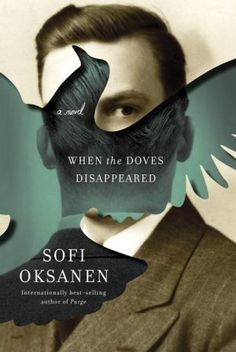
‘When the Doves Disappeared’ by Sofi Oksanen – An Outstanding Novel of Estonia

‘When the Doves Disappeared’ by Sofi Oksanen  (2012) –  296 pages  Translated by Lola Rogers     Grade: A

e63a74088b795cca1ff46651304e3c22

In 2009, my family and I visited Tallinn, Estonia as part of a tour package which included St. Petersburg in Russia, Riga in Latvia, and Tallinn.  During the three short days we spent in Tallinn, I developed a quite optimistic impression of Estonia.  Finland has an informal partnership with Estonia which works to the betterment of both countries.  We learned that there is a Finno-Ugric language and cultural bond between the people of the two countries.  During the time there, we took a ferry to Helsinki, Finland across the Baltic Sea and back. I got the impression that Estonia was a small country which really has its act together.   Even the buildings seemed more brightly painted than in the other countries.

The following interesting fact about Estonia is from Wikipedia:

In 1936, the British based Jewish newspaper The Jewish Chronicle reported that “Estonia is the only country in Eastern Europe where neither the Government nor the people practice any discrimination against Jews and where Jews are left in peace and are allowed to lead a free and unmolested life and fashion it in accord with their national and cultural principles.

‘When the Doves Disappeared’ is about two much less optimistic times for Estonia. The early 1940s were a despicable time for middle Europe with those two brutal dictators Adolf Hitler and Joseph Stalin strutting their stuff.  First Russia occupied Estonia during World War II, then the Germans took over, then Russia again for 45 years.  Scenes in ‘When the Doves Disappeared’ switch back and forth between the German occupation in the early 1940s to the Russian occupation in the 1960s.

The title ‘When the Doves Disappeared’ refers to the fact that the occupying Germans liked to eat doves, and thus they disappeared from the city.

The novel centers on three Estonian people who know each other well.  Roland is part of the Estonian underground who helps smuggle people in danger out of the country to Finland.   His cousin Edgar collaborates first with the Russians, then with the Germans, and then again with the Russians.  The same people like Edgar who tried to advance themselves under the Germans behaved similarly with the Russians.  The best way to advance under both the German and Russian regimes is to report to the authorities negative information on your neighbors and relatives.

The third main character is Edgar’s wife Juudit.  Juudit is dissatisfied with her marriage and dates a German officer while Edgar is gone during the German occupation.  However Edgar and Juudit get back together after the war and are still living together twenty years later under the Russian occupation.

Sofi Oksanen

Sofi Oksanen

So we get the stories of three people: the hero Roland, the collaborator Edgar, and the damaged Juudit.  One particular strong thing I liked about this novel is that it tells its story with as much moral ambiguity and  mystery as the events probably actually occurred.   Yes, people do collaborate with the enemy, and, yes, local women do date the occupying officers.  Those who try to do the right thing look like losers in the short run and perhaps even in the long run.  They pay a price.

I was much impressed with the writing in ‘When the Doves Disappeared’.  It clearly and methodically tells the unique story of the interactions of these three intriguing main characters.  Sofi Oksanen has done a fine job of bringing these characters to life in a tale of politics and psychology that is never predictable.

Grade:   A


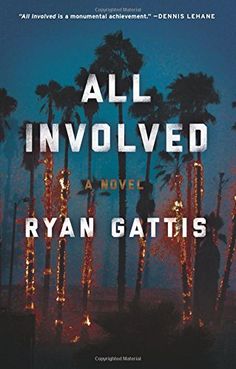
‘All Involved’ by Ryan Gattis – Six Days of Lawlessness in Los Angeles

‘All Involved’ by Ryan Gattis   (2015)   –  359 pages

78f7f26efeb0c98ff8d2bc8f9e5394c1

Here is a novel that is brutal and gritty about Chicano gangs and gang war in Los Angeles.

‘All Involved’ is about the six days of Los Angeles rioting and lawlessness that occurred after a jury acquitted the police officers of using excessive force to subdue Rodney King on April 29, 1992.  In those six days 10,904 people were arrested, 2383 people had been injured, 11,113 fires had been set, over one billion dollars of property damage had been sustained, and 60 deaths had been directly tied to the rioting.

“Every single cop in the city is somewhere else, and that means it’s officially hunting season on every fucking fool who ever got away with anything and damn, does this neighborhood have a long memory.”

As the Los Angeles police were all involved with the rioting in specific areas of the city, gangs from other parts of the city saw this as an opportunity to engage in criminal activity, violently settle old scores, start fires, and loot and rob businesses.  The police were busy elsewhere, so there was a general air of lawlessness that pervaded the city.

‘All Involved’ takes place in a Latino South Central neighborhood far removed from the rioting.  Ernesto is walking home from the taco truck where he works.  He has avoided being in a gang, but his brother is a gang banger.  Suddenly three guys appear out of nowhere and jump him, beating him senseless with a bat.  Then they tie his ankles to the back of a car and drag him over the street before murdering him with a knife.  His body lays there unclaimed for two days.

The violence in ‘All Involved’ is extreme and graphic and not softened to spare the reader. The story is told from 17 different points of view, all living in this Latino neighborhood.  We get Ernesto’s sister who is the girlfriend of the gang leader who is called Fate.  Of course there is a major retaliation for Ernesto’s murder.  One member of the gang, Lil Creeper, just gets crazy and goes out and starts as many fires as he can just for the hell of it.

‘All Involved’ is filled with wicked mean stuff, and your typical Jane Austen drawing room reader is going to loathe this novel.

However the plays of the old master William Shakespeare are filled with wanton violence also.  Do you really believe that the Kings and Queens and Princes and Princesses in Shakespeare’s plays are more sensible than Los Angeles gang bangers?  If so, you are a true Royalist.

I’ve also been watching Wolf Hall, and nothing that happens in ‘All Involved’ is more outrageous than Henry VIII having two of his wives beheaded.

Grade:   B+

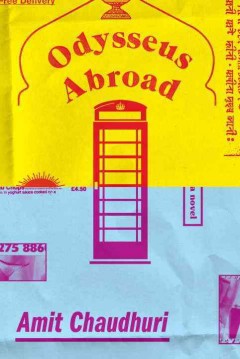
‘Odysseus Abroad’ by Amit Chaudhuri – The Counter-Rushdie Novel

‘Odysseus Abroad’ by Amit Chaudhuri   (2015)  –   204 pages

3e3a1ac94cea9ad4859e4f99d1d2b8d8 (1)

If I were to describe ‘Odysseus Abroad’ for what it is, a pleasantly uneventful novel, you would probably by now be well on your way to another place on the Internet, and I couldn’t blame you.

The plot here is beside the point.  Nearly half of the novel is taken up with a “pointless ramble” in London by Bengali graduate student Ananda and his uncle Radhesh during which they stop for tea and later visit a book shop.

As happens with close family members, the uncle and nephew often annoy each other. The two men are like a comedy team with pointed and wicked repartee about nearly everything including the rest of their family members, each other’s sex lives, Indian versus English literature, and restaurant etiquette.

Ananda has strong opinions on the relative merits of Indian and English literature.  He finds only a few English poets helpful to his own work: Edward Thomas, Geoffrey Hill, Philip Larkin.  He considers the Mahabharata to be the “equal of all of Shakespeare and more”.  I particularly enjoyed his views on Thomas Hardy:

“and the later, almost comical tragedies of Thomas Hardy, in which things went relentlessly wrong, as in a Tom and Jerry cartoon.”

‘Odysseus Abroad’ fully embodies Chaudhuri’s  views.  For the last thirty-five years the novel ‘Midnight’s Children’ by Salman Rushdie and its many successors and imitators have dominated the world’s view of Indian literature.  All Indian literature was now supposed to be big, loud, and bold.  There was no longer room for the small, the quiet, or the subtle.

Enter Amit Chaudhuri and his “refutation of the spectacular”.  He has set about to write novels that are deliberately low key.  In order for a novel to be entertaining, it does not have to be explosive or overly dramatic.  Perhaps it is more about noticing the little things that happen every day that make the day odd and amusing. Also Chaudhuri’s novels do not deal with a monolithic India but instead with an India consisting of hundreds of different groups of people, each with its own particular culture.   Some of these cultures have existed long before England appeared.

To fully appreciate ‘Odysseus Abroad’ requires a change in mindset.  It is more like a jaunt around the neighborhood or a bike ride rather than a world changer.   Sharp conversation, some humor, subtle insights.  Listening to the audio of this book twice in order to fully appreciate it, I spent a lot of time with this novel in which not much happens.  That time was pleasant enough


Grade: B+

‘Our Souls at Night’ by Kent Haruf – Sleeping Together

‘Our Souls at Night’ by Kent Haruf   (2015) – 179 pages    Grade:  B+

B821981376Z.1_20150602172515_000_G821G7OUM.2_Gallery‘Our Souls at Night’ begins with a seemingly outrageous proposal.

The lady Addie asks the man Louis, “I wonder if you would consider coming to my house sometimes to sleep with me.”

“No, not sex.  I’m not looking at it that way.  I think I’ve lost any sexual impulse a long time ago.  I’m talking about getting through the night.  And lying warm in bed companionably.  Lying down in bed together and you staying the night.  The nights are the worst.  Don’t you think?”

Addie and Louis live in the same neighborhood. They’ve known each other, not very well, for a long time.  They have both lost their mates to death as sometimes happens with older people.

Why not sleep together?

“I wondered why you picked me.  We don’t really know each other very well.”

“Because I think you are a good man.  A kind man.”

“I hope I am.”

“I think you are.  And I’ve always sort of thought of you as someone I might be able to like and to talk to.”    

Despite all the glamorous clubs and casinos, all the Internet chat rooms, and all the huge sports stadiums, men and women of all ages are still just looking for and not finding a little non-threatening meeting place where they can get together and talk to each other.

In plain simple unadorned prose, Colorado writer Kent Haruf tells the story of these two near seventy-year-olds Addie and Louis

“It’s some kind of decision to be free.  Even at our ages.” 

Of course neighbors see Louis arriving at Addie’s house in the evening and leaving in the morning.  These neighbors react in two distinct ways.  Some decide it is none of their business, take it in stride, and wish them the best.  However there are moments of sharpness when a few other neighbors start gossiping about them and questioning their relationship.  Their own grown-up children have difficulty dealing with it.

Despite their children’s discord and a few neighbors’ interference, the actual bond between Addie and Louis is presented as near idyllic.  Addie’s son is having problems in his own marriage and soon her six-year-old grandson Jamie is living with Addie.  Louis decides that Jamie should have a dog, and they take the boy and dog on outings around Colorado.

This is the last novel by Kent Haruf.  He died last November.  ‘Our Souls at Night’, like all of his novels, takes place in the fictional eastern Colorado town of Holt.  I suppose Kent Haruf could best be described as a western minimalist.  ‘Our Souls at Night’ is a short novel, and its stately prose frames this simple story well.

‘Look Who’s Back’ by Timur Vermes

‘Look Who’s Back’ by Timur Vermes    (2012)  –  305 pages    Translated by Janie Bulloch     Grade:  B-

33f2bb19652bb8bde0c72b6e09cc318c

We had hoped that Adolf Hitler was gone forever, but according to German writer Timur Vermes now he is back.  It’s the real Hitler who shows up, but everyone mistakes him for a Hitler imitator, and soon he is starring as a loony YouTube Hitler.

“Once upon a time he murdered millions – now millions have made him a YouTube sensation.  With his tasteless routine and bizarre catchphrases, a “comedian” dressed up as “Adolf Hitler” is venting hatred against foreigners, women, and democracy in Ali Gagmez’s show.”

A lot of the humor in ‘Look Who’s Back’ is based on the Hitler of 1945 confronting the modern world of smart phones, Starbucks, and ubiquitous computers.  He still spews the same old hate, but people just figure it is part of his act.

In some ways Vermes has softened Hitler up having him “love to watch the children romp around and squeal with excitement”.  This Hitler is also attractive to a variety of women.

Frankly I found another portrayal of Hitler much more amusing than anything in ‘Look Who’s Back’. That would be the angry rant of Adolf Hitler against his generals by Bruno Ganz in the movie ‘Downfall’ after he is given the news that the Russian army has swarmed Berlin and that the total defeat of Germany is imminent.   This rant occurred just hours before Hitler and Eva Braun committed suicide.  ‘Downfall’ is one of the great movies of the past dozen years.

I am much more comfortable with Adolf Hitler as an evil monster rather than as any sort of likeable fellow.   But Vermes’ reasoning seems to be that in order for Hitler to do what he did, he must have had some attractive qualities which appealed to the German folk.  Instead of a lone monster, we have a whole people who followed and were severely misled.  I can buy that.  Hitler certainly did not act alone, but Hitler still bears responsibility for leading Germany down into the cesspool of history.

At certain points in the novel, the six million Jews that Hitler was directly responsible for murdering are mentioned.   When the producers of his TV show say “The Jews are no laughing matter”, Hitler agrees with them.  That is supposed to be some kind of joke.

In a way, the humor here reminded me of ‘The Producers’ where two guys write a Broadway musical called ‘Springtime for Hitler’ expecting it to be a flop, but it turns out to be a hit because it is so ridiculous.  The humor is quite cynical and distasteful in ‘Look Who’s Back’, yet the novel has set sales records in Germany.   Quite a bit of the humor is local and depends on inside references to Germany that I did not get.  The time-traveler humor of an old-time person confronting the modern world was somewhat old hat.

At one point in the novel Hitler says of England, “How many more bombs would we have to drop on their cities before they realized that we were their friends?”  Same old Hitler.

‘The Green Road’ by Anne Enright – Grotesque But Energetic

‘The Green Road’ by Anne Enright   (2015)   –  310 pages    Grade: B+

           -

The world was beginning to seem just too bright and cheerful for me again.  It was time to read Anne Enright.

‘The Green Road’ is what I call a “cutting the heads off chickens” novel.  ‘The Green Road’ begins in rural western Ireland where even the little children know all too well that before the chicken is roasted and served for dinner, the live chicken must first be caught, its head chopped off, and its feathers plucked.  I was born on a farm in western Wisconsin and so I witnessed the beheading of chickens at an early age.  My father was too diffident and imprecise; he would not have been very good at this task.  However my mother was highly skilled at holding the live chicken’s head flat on the tree stump, lifting the axe and bringing it down exactly on the chicken’s neck, sort of like Wolf Hall.  After that the headless bloody chicken would go sort of wings flapping half flying off around the area in its last gasp of life.

Each of the early chapters of ‘The Green Road’ has a disturbing sickening scene which also just happens to be a part of life. In the first chapter it is that chicken beheading. In the second chapter we are in the East Village and Fire Island of  New York City during the early days of the AIDS crisis when many young men were coming down with the horrible disfiguring of Kaposi’s syndrome and were dying soon afterwards.  In the third chapter, we are with a large group of women being checked for breast cancer and awaiting the results.   The next chapter takes place in Africa.

“And the street was a medical textbook, suddenly.  People with bits missing.  The bulge of a tumor about to split the skin.  The village idiot was a paranoid schizophrenic.  A man with glaucous eyes was sweating out a fever in a beautiful carved chair, his head tipped back against the wall.” 

Other scenes that are more grotesque occur later in the novel.

‘The Green Road’ is a family reunion novel.  I think it is to Anne Enright’s credit that every one of the members of this family amounts to less than average because that is true of most families.  All the members of this Irish family gather at the old family home after many years apart.  Still Anne Enright can come up with ugly descriptions for even the most innocuous of scenes.

“It was awful.  The pain was awful.  Her mother juddering and sputtering, with the carrots falling from her mouth in little lumps and piles.”

A couple of weeks ago I berated ‘I Refuse’ by Per Petterson along with all Norwegian realistic novels for being cheerless and grim.  Despite all of the unpleasantness in ‘The Green Road’, I did not find it to be bleak or dismal at all.   Instead time and time again, she has a way of choosing the exact words to describe her characters for example in “Emmet would drive you mad for being good.”  Anne Enright seems to take great delight in these grotesque situations and brings a great amount of energy and enthusiasm to her art.

‘Satin Island’ by Tom McCarthy – Not Oprah Literature

‘Satin Island’ by Tom McCarthy    (2015) – 192 Pages    Grade: B

41PwOaZXvtL._SY344_BO1,204,203,200_

Tom McCarthy writes avant-garde fiction.  He has also written dismissively of “Oprah literature” which he characterizes as “candid confession and exposure of personal peccadilloes”.  He goes on to say  “the naive and uncritical realism dominating contemporary middlebrow fiction, and the doctrine of authenticity peddled by creative writing classes the world over” were hopelessly “simple-minded”.  I have read a fair share of the better Oprah-recommended books, so I was quite curious about exactly how Tom McCarthy would do things differently.  Thus I read ‘Satin Island’.

The narrator of ‘Satin Island’ is a young anthropologist who has been hired by The Company to work as an “in-house ethnographer”.   His boss challenges him to  “write the Great Report … the Book. The first and last word on our age … What I want you to do, he said, is name what’s taking place right now.”   The Great Report would be part of the all-pervasive Koob-Sassen Project which like all modern projects is boring and inscrutable.

An up-to-date satire with an anthropologist studying the modern corporation could have been quite humorous, but nothing is finally done with the idea.  Our anthropologist realizes that such a Great Report is impossible to write.  Thus the writing of the Great Report is just dropped.  I would have much preferred it if our guy had made specific attempts to write the Great Report before he gave up.  That could have been funny.

Instead we get riffs on a variety of subjects ranging from a major oil spill to the sudden death of a parachutist whose strings were cut. Our narrator sees on an airport TV a man wearing a Snoopy T-shirt surveying the carnage and death in a marketplace that has been bombed. Some of the riffs worked for me; many of them did not.  I suppose all these side stories relate to the modern world in some way, but this constant changing of subject lacked coherence for me.  Sometimes it seemed that pointlessness was the point of ‘Satin Island’.

I do feel at a disadvantage not having read what apparently is McCarthy’s masterpiece, ‘Remainder’.

Avant-garde fiction is a good thing.  ‘Ulysses’ is one of my all-time favorite novels, and I could name many other experimental novels that I have loved including ‘White Noise’ by Don Delillo, ‘Nazi Writers of the Americas’ by Roberto Bolano, and the novels by Stephen Wright. At the same time, it seems to me that throwing out characterization and a coherent plot is like throwing out the baby with the bath water.  Even the most daring novels need these elements.

‘The Fires of Autumn’ by Irene Nemirovsky – World War I, then a Respite, then World War II

‘The Fires of Autumn’ by Irene Nemirovsky   (1957)   229 pages – Translated by Sandra Smith     Grade: A-

51AjdwZUfrL._SY344_BO1,204,203,200_

In ‘The Fires of Autumn’, Irene Nemirovsky again vividly demonstrates her ability to deal with both the large scale events of nations as well as their impact on individual families.  She captures what life was like for her fictional families in Paris from 1912 to 1941.

One aspect of Irene Nemirovsky that isn’t pointed out often enough is that she was highly educated.  She started writing fiction when she was eighteen years old while she attended the Sorbonne University in Paris from 1920 to 1925.  First she studied Russian literature and language at the university and later studied comparative literature.  She published her first novel, ‘David Golder’, in 1929, and it was an immediate success.  Both it and her second novel ‘Le Bal’ were so popular that they were immediately turned into movies.

Nemirovsky completed ‘The Fires of Autumn’ in the spring of 1942 just before she was arrested for the crime of being “a stateless person of Jewish descent” by the Nazis and sent to Auschwitz where she was murdered soon afterward.  She apparently wrote ‘The Fires of Autumn’ and ‘Suite Francaise’ at the same time.

‘The Fires of Autumn’ starts out with three neighborhood families taking a stroll on the Champs-Elysees in 1912, and we get a sense of the stately peace of the stroll at that time.  But then World War I breaks out, and everyone is soon caught up in the horrors of war.

“Oh how he had hated death, how he had feared it, just as he had doubted God and blasphemed as he looked at the little blackish heaps lying between two trenches, dead bodies as numerous and insignificant as dead flies in the first cold snap of winter…And yet even that moment held a rather tragic beauty.”

 After the war, there is a shortage of men, an abundance of women.  The men who are left have been devastated by the war and just want to enjoy life.  There is a loosening of morals not only in relations between the sexes but also in the business world.  Fortunes can be made overnight by travelling to the United States to impress financiers.  The novel implies that these underhanded business dealings led to the French army being shoddily and inadequately equipped so that when the next war, World War II, breaks out the French military is easily defeated.

Blog pic_1We see all these developments take place within the lives of one family.  Irene Nemirovsky never sweetens or softens what is happening but deals with it in a straightforward manner.

Lately I’ve tried to pinpoint the qualities of the writers I most admire.  One thing that has not sufficiently been noted about Irene Nemirovsky is her intelligence.  Certainly we get a family drama in ‘The Fires of Autumn’ but we see this family in the panoramic context of national and world events over thirty years.  I cannot name another writer besides Irene Nemirovsky who captured this era between the wars in fiction so well.


‘The Touchstone’ by Edith Wharton – A Novella about a Literary Misdeed

‘The Touchstone’ by Edith Wharton   (1900)  –  92 pages  Grade: B+

touchThe novella ‘The Touchstone’ has a tidy little literary plot. Here is the setup.

Stephen Glennard was good friends with the famous author Margaret Aubyn for a long time.  In fact she was infatuated with him and sent him hundreds of passionate love letters, but he kept rejecting her as a lover.  She suddenly died, and then she became a legend in the literary world.  Now it is three years after her death, and Glennard has met a new woman, Alexa Trent, he does want to marry.  However his current finances would not support such a marriage.

He then discovers that there is so much public interest in Margaret Aubyn that her correspondence would be worth a lot of money if published.   He secretly has the letters published in two volumes and thus gets the money that allows him to marry Miss Trent.  He removes his own name from the letters, and not even the publisher knows that these letters were written to him.

These “unloved letters” of Margaret Aubyn have a profound effect on readers, especially upon woman readers.  Soon Glennard’s new wife asks him to purchase the two volumes of Margaret Aubyn’s letters for her.  Glennard begins to feel extremely guilty about having had the letters published, and his guilt soon comes between him and his new wife.

I found this setup tremendously interesting, although the logistics are a bit questionable.  We are never told the ages of any of the participants, and also has there ever been a writer’s correspondence that was worth a whole lot of money?  Along the way in ‘The Touchstone’ we readers get some interesting viewpoints of the literary world.

“Literature travels faster than steam nowadays.  And the worst of it is that we can’t any of us give up reading; it is insidious as a vice and as tiresome as a virtue.” 

 But the ultimate story is about the endangered relationship between Glennard and his wife Alexa.

 “Only the fact that we are unaware how well our nearest know us enables us to live with them.”  

 ‘The Touchstone’ was Edith Wharton’s first novel, and perhaps she was still in thrall to Henry James.  Here, as in James, we have sensibilities so refined that it would be impossible for the average person to understand them.  Sometimes I feel like a bull in a china shop around such fine sensibilities.  Sometimes I just want James or Wharton to come out and say what they mean clearly and directly.  In later works such as ‘House of Mirth’ and ‘Custom of the Country’, the Henry James influence is somewhat lessened which is only beneficial to Wharton’s work.

Ultimately Edith Wharton developed into a more interesting writer than Henry James, because James’ theories on social class and fiction writing sometimes got in the way of his story telling.   Still it is very much to Henry James’ credit as a mentor that he developed such an excellent student as Edith Wharton.

It is only near the end of ‘The Touchstone’ that it became somewhat difficult to keep track of the characters’ feelings.  For most of the way, ‘The Touchstone’ is a very fine novella indeed.

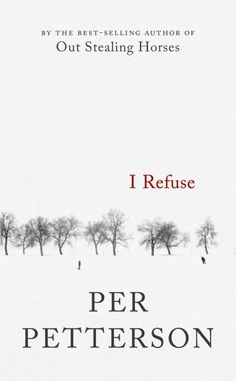
‘I Refuse’ by Per Petterson – A Severe Overdose on Norwegian Realism

‘I Refuse’ by Per Petterson    (2012)  –  282 pages      Translated by Don Bartlett    Grade: C

2dc56701674d23da1b2af8ed21a7f426


I Refuse’ is the novel where I have finally realized that I have overdosed on Norwegian realism.  This is Norway where the fathers are all alcoholic trolls, and their sons are all hurt and self-centered.  This is Norway where no one has a sense of humor in spite of their problems.

‘I Refuse’ has the traits we have all come to know and put up with in Norwegian realism.  It is cheerless, depressing, ominous, fatalistic, brooding, portentous, bleak, dismal, listless, humorless, and grim.  One could easily believe that ‘I Refuse’ is a parody of a Scandinavian realistic novel, but there is no evidence that Per Petterson is in on the joke.

Here we have two sons, Jim and Tommy.  Jim’s father ran off when Jim was small.  Tommy’s mother ran off, but his father stuck around to beat up their children until Tommy retaliated with a baseball bat.  Then Tommy’s father ran off too.  Jim and Tommy are best friends as kids until Jim goes off the rails mentally.  Now it is 35 years later, and they run into each other near Oslo. So far this is your typical Norway story, and it doesn’t get any better than this.  It is no help that we switch back and forth from these guys’ grim childhoods to their unhappy adulthoods.

In all these stories of sons who have mean decrepit drunk fathers, there is one thing they forget to mention.  At some point, the sons grow up and are likely to become mean and decrepit and drunk too, but most of all self-centered.

There is little dialogue in ‘I Refuse’ which is a good thing, because the dialogue that is there reeks.

 “Do you ever hear from your mother or father?”

 “No.”

“Don’t you think that’s sad?”

“No, I don’t think it’s sad.  I don’t give a damn.”

“I can understand that.”

So if you are looking for scintillating witty conversation, avoid ‘I Refuse’ at all costs.

I have had it with these self-absorbed Norwegian novels.

During the last couple of years I have read and truly enjoyed two fine lively exuberant novels by Enrique Vila-Matas of Spain, and I have always liked the work of Spanish author Javier Marias.  Perhaps I will seek out some more excellent novels from Spain to read.

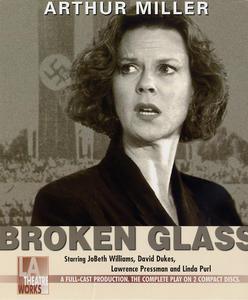
‘Broken Glass’ by Arthur Miller – The Kristallnacht Play

‘Broken Glass’ by Arthur Miller  – a play   (1994)  – 161 pages

brokenglass

Although several of the most famous of the plays of Arthur Miller including ‘All My Sons’, ‘Death of a Salesman’, ‘The Crucible’ and ‘A View from a Bridge’ were written quite early in his career, he wrote this play that most directly addresses what it means to be Jewish in the United States, ‘Broken Glass’, in 1994 when he was 78 years old.

“Well, all the plays that I was trying to write were plays that would grab an audience by the throat and not release them, rather than presenting an emotion which you could observe and walk away from.” – Arthur Miller

‘Broken Glass’ takes place in November, 1938, when the American newspapers had just reported on Kristallnacht, a series of coordinated deadly attacks against Jews throughout Nazi Germany and Austria.  For anyone who was paying close attention, none of the subsequent events that took place in these countries would come as a surprise.

After reading and becoming terrified by these Kristallnacht news stories, Brooklyn Jewish housewife Sylvia Gellberg suddenly loses her ability to walk.  There is no physical reason for the paralysis, so it must be psychosomatic.   Her husband Phillip calls in the family doctor Dr. Harry Hyman to determine the root cause of her hysterical paralysis.  Arthur Miller actually based this doctor on one of the many physicians who had treated his ex-wife Marilyn Monroe.

 “I just get the feeling sometimes that she knows something.  It’s like she’s connected to some . . . some wire that goes half around the world, some truth that other people are blind to.”  

 The husband Phillip is a successful mortgage banker, the only Jewish banker within his company.  It turns out there are deep-rooted problems in the marriage of Phillip and Sylvia, stemming from Phillip’s discomfort with his own Jewishness.

After a disastrous short run on Broadway, a separate production of ‘Broken Glass’ opened in London to near universal acclaim, and the play went on to win the 1995 Laurence Olivier Award for best new play.  There have been several recent revivals of the play including one in London in 2010.  The play was also turned into a TV movie.

As with so many of Arthur Miller’s plays, ‘Broken Glass’ achieves a depth and edge that is missing from so many modern plays.  I wish there were more new plays that are this cerebral and heartfelt. It is still possible to deal with serious themes and yet have small moments of humor.

I listened to the audio version of the play with JoBeth Williams, David Dukes, and Lawrence Pressman in the main roles, and as always the audio proved a fine substitute to actually seeing a live production of the play.


Grade: B+

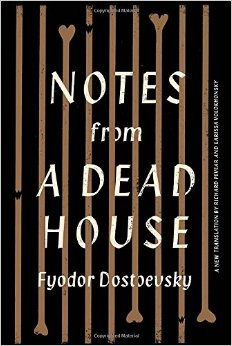
‘Notes from a Dead House’ by Fyodor Dostoevsky – Four Years of Hard Labor in a Prison Camp in Siberia

‘Notes from a Dead House’ by Fyodor Dostoevsky   (1861)  –  304 pages   Translated by Richard Pevear and Larissa Volokhonsky     Grade: B+

.

.

I’ve read enough translated classic Russian literature so that it is an occasion for me when a new translation by Richard Pevear and Larissa Volokhonsky is released.  Pevear and Volokhonsky are the two stars of Russian classics translators today just as at one time Constance Garnett, Aylmer and Louise Maude, and David Magarshack were the big names.

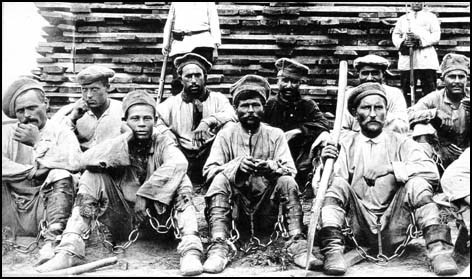
This novel is perhaps better known by the title ‘House of the Dead’.   It is the lightly fictionalized account of Dostoevsky’s time in Siberia.

Dostoevsky was sent to the prison camp in Siberia not for committing any crimes but for political reasons during the reign of Nicholas I.  He was thrown in prison with a rough crowd of murderers, armed robbers, rapists, and assorted brutal thugs.  But the worst thing for the sensitive Dostoevsky was that all these guys hated him, because he was a highly educated nobleman.

Personality-wise Dostoevsky was probably somewhat like me.  He was clumsy at the labor, and the rest of the prisoners scorned him for that.

“It also seemed to me that he had decided without racking his brains too long, that it was impossible to talk with me as with other people, that apart from talking about books, I would not understand anything and even could not understand anything, so there was no use bothering me.” 

 Yes, Dostoevsky and I do have a lot in common.  But also like me, Dostoevsky was the type of guy who when life gave him a lemon, he made lemonade.

Dostoevsky describes the other men in his hard labor prison in Siberia with the same simple-hearted youthful joy that I could use to describe the young guys in my freshman dormitory at college.  I prided myself on knowing the names of all 78 men in my freshman dorm, and Dostoevsky got to know all his fellow prisoners no matter how much they disliked him.  Some of the men at the prison had committed from one up to six murders, but that doesn’t prevent Dostoevsky from enthusiastically describing these fellows. Just as in the dorm, there were rumors that salt peter has been added to the prison food in order to curb the male libido.

“There are bad people everywhere, and among the bad some good ones.”

 ‘Notes from a Dead House’ is a fictional memoir of the time spent, so it is necessarily episodic with vignettes from the daily prison life.  There are chapters on celebrating Christmas, a stay in the prison hospital, the prisoners’ pets, and even a theatrical performance put on by the prisoners.  Some of the patients in the hospital are prisoners who were forced to run the gauntlet as part of their punishment during which they were nearly beaten to death.

For someone new to Dostoevsky, I would recommend they read first one of his intense powerful novels such as ‘Crime and Punishment’  or ‘The Brothers Karamazov’.

716723Dostoevsky was released from prison in 1854, and Nicholas I died in 1855.  The liberal reformer Alexander II (Alexander the Liberator) became Czar, and Dostoevsky was then allowed to publish all his great novels including this one.

Somehow I believe that Dostoevsky and his fellow socialists would have been terribly disappointed in Lenin and Stalin when they sent millions of fellow Russians to Siberia as political prisoners.