Archive for the ‘Book Reviews’ Category

‘Adam and Evelyn’ by Ingo Schulze – 1989, The Wind of Change

image14

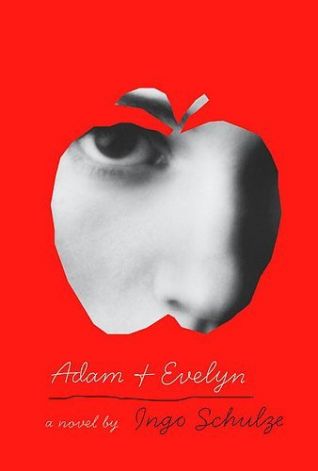
‘Adam and Evelyn’ by Ingo Schulze    (2008) – 282 pages    Translated from the German by John E. Woods
628x471a

Adam is a ladies’ custom tailor.  He makes dresses for women which sometimes involves intimate measuring and adjusting.  Sometimes the lady is so delighted with his work and so grateful she wants to give him something extra.

One time Adam’s girlfriend Evelyn walks in on Adam and one of his more portly customers and catches them in a compromising position.  Then Evelyn takes off on a road trip with her friends leaving Adam behind, but he follows behind her in his car.

‘Adam and Evelyn’ is a sex comedy and a road trip story, a light soufflé of a novel.  However it all takes place against a dramatic political backdrop as the time is August, 1989, and Adam and Evelyn are living in East Germany.   This is the summer of mass flights of East German citizens across the Hungarian border, and there are constant rumors that Hungary will open its borders again.  The Soviet Union’s tight restrictive hold on Eastern Europe is loosening rapidly.

Several of the scenes in ‘Adam and Evelyn’ take place at border crossings.  In one scene Adam drives across a border with a young woman he met hidden in his trunk, she accompanied there in the trunk by his pet turtle Elfriede.

I wasn’t expecting a light humorous comedy about East Germans but that is what I got.   Everything we heard about East Germany was terribly serious about the heavy-handed governmental rule and border enforcement of the Communist era.  Now it has been over 25 years, and I do wonder what it is like today for the people who stayed in what used to be East Germany.

I would imagine there would be some difficulties for John E. Woods in translating such a carefree and fluffy novel.  The challenge is not only to find precisely the right words for each sentence but also to maintain the airy mood of the story.  Much of the novel is dialogue, so the interplay between the characters is critical.

Despite the clever title, I did not see a meaningful reference to the Adam and Eve story. A novel can be so light and inconsequential that it just floats away like a balloon leaving no impact on the reader.  That happened to me here to some extent in that I could only read a few pages at a time.  I could appreciate some of the humor, but the poignancy of the scenes for the characters escaped me, and I lost interest.  I don’t know if it was a problem of the translation or of the story itself, but I found ‘Adam and Evelyn’ a less than riveting read.

Grade:    B     
Colorful Novels – Wonderful Novels with at Least One Color in Their Title


Each of the following novels have met three qualifications:  1) It has been read by me. 2) It received my highest rating when I read it. 3) It has at least one color in its title.


blue‘The Blue Flower’ by Penelope Fitzgerald (1997) – This is one of many fine short novels by Fitzgerald, this about the German Romantic writer Novalis.  Here is a historical novel for people who don’t like historical novels.


letter‘The Scarlet Letter’ by Nathanial Hawthorne (1850) – Hester Prynne is found guilty of adultery and must wear a scarlet ‘A’ on her dress to shame her.  Don’t be afraid to read Hawthorne.  I find him as easy a read as Mark Twain although in a totally different style.


0340822791.01.MZZZZZZZ

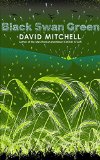
‘Black Swan Green’ by David Mitchell (2006) – I loved this little novel about a Worcestershire boy with a speech disorder, whereas I find some of Mitchell’s longer stuff perplexing.  I have high hopes for ‘Slade House’ which will be released soon and is again a shorter novel.


mo3ARmkX1KkqeSJFMK4k2Ww


‘From the Black Hills’ by Judy Troy (1999) – This is a strong coming of age work about a son who must contend with his father’s dark deeds.  The father has shot and killed his female receptionist lover and has disappeared.   This sounds melodramatic, but these things do happen, and Troy’s skill as a novelist pulls it off well.


f25d9e9bcad54884bb990b9de3e42637‘The Red and the Black’ by Stendhal (1830) – ‘Red’ stands for army, and ‘Black’ stands for clergy.  This novel about young man Julien Sorel is considered the first psychological novel.

“The idea which tyrants find most useful is the idea of God.” – Stendhal


clckworksmll

‘A Clockwork Orange’ by Anthony Burgess (1962) – After a night of ultra-violence with his gang of droogs, Alex is sent off to prison for aversion therapy to cure him.  This is a dystopian novel that resonates and sickens with modern psychological theory.


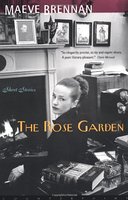
514ejli9TeL._AC_UL200_SR128,200_‘The Rose Garden’ by Maeve Brennan (2000) – I suppose this is cheating since ‘Rose’ is both a plant and a color.  However if there is an opportunity to include Maeve Brennan in a list, I will do so.  This is a short story collection by one of the wittiest people who ever lived.

“The impulse toward good involves choice and is complicated, and the impulse toward bad is hideously easy and simple.” – Maeve Brennan


Tournier2

‘The Golden Droplet’ by Michel Tournier (1987) – Again I cheat as ‘Gold’ is both a mineral and a color.  And again Michel Tournier is a writer worthy of inclusion, no matter what.  Michel Tournier is a writer of fairy tales for adults, and this is one of his finest.


11402991_1017516621592805_7290768700836813189_n

‘White Noise’ by Don DeLillo (1985) – An industrial accident unleashes an “Airborne Toxic Event”.  This is a brilliant post-modern novel.  Lev Grossman said ‘White Noise’ is “pitched at a level of absurdity slightly above that of real life.”


mtjykTvSeT2OI3ihZGq1hNw‘The Golden Spur’ by Dawn Powell (1962) – A young man is in search of his real father which could be any one of three men.  This is a raucous outrageous novel told with Powell’s sparkling wit.

“Hold fast to whatever fragments of love that exist, for sometimes a mosaic is more beautiful than an unbroken pattern. – Dawn Powell


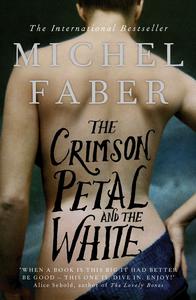
01200000029156134398085025912_s‘The Crimson Petal and the White’ by Michel Faber (2002) – Here is a vivid obscene Victorian novel for today.  The Victorian Era was much sexier than we ever considered.

“History indulges strange whims in the way it dresses its women.”  – Michel Faber

‘High-Rise’ by J. G. Ballard – War in the Elevators

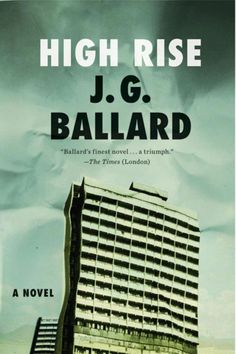
‘High-Rise’ by J. G. Ballard   (1973) – 204 pages

7dc8d80a4b86cca1ccee95357d3ae34d

‘High-Rise’ is a unique novel rescued from the 1970s which will soon be a major movie starring Tom Hiddleston, Jeremy Irons, and Sienna Miller.

About 2000 people live in the 40-floor high-rise luxury apartment building.  We readers don’t even find out what city or country the high-rise is located in, because the building is pretty much self-contained with its own supermarket, swimming pools, high-speed elevators, exercise facilities, restaurants, and liquor stores.  Except to go to work, the residents find little reason to leave the building.

We see events in the building through the eyes of the recently divorced doctor Robert Laing who has an apartment on the twenty-fifth floor.  This being the Seventies, Dr. Laing has an eye out for the ladies, and he often gets invited to cocktail parties usually hosted by the well-to-do childless couples on the upper floors.  The less affluent people on the lower floors are too busy with their children to throw elaborate parties.  Dr. Laing is in the middle, between the upper class residents above and the relatively lower class residents below.

Although the well-to-do upper class residents don’t have children, many do have expensive dogs, and they are usually extremely fussy and exacting about their dogs.  What irritates these people is when the residents from the lower floors bring their kids up to the pool on the upper floor, and the kids pee in the swimming pool.   Another source of dispute between the floors are the elevators which the residents on the lower floors can bring to a halt and make live miserable for those above.

Soon everyone is complaining about the shiftlessness of those on the lower floors or the arrogance of those on the upper floors.  The first violence breaks out when a dog from the upper floors is found drowned in the swimming pool.  Things degenerate quickly with skirmishes breaking out among the residents.  Those on the upper floors throw bottles down on the balconies below.  The lower floors retaliate by taking over the elevators.

The violence escalates, and soon there is all-out war between the floors.  There are punitive expeditions, and apartments are ransacked.   The electricity goes out sporadically for no good reason.  Fights break out in the hallways.  Cars parked outside are vandalized.    Soon the residents of this ultra-modern apartment building revert to primitive savagery.

This is indeed a brilliant idea for a novel, and I would give the author an A+ for plot.  The situation is original and intriguing.  However, I found the portrayals of the people in the novel somewhat disappointing, so I will only give the author a C+ for characterization.  The male characters are little more than stick figures.  The female characters, this being the Seventies, are little more than stick figures with breasts, hips, and thighs.  The person or persons who write the screenplay for the movie and the actors will need to flesh out real characters that the audience can identify with.

Read ‘High-Rise’ for its amazing plot.

Grade: B+ 

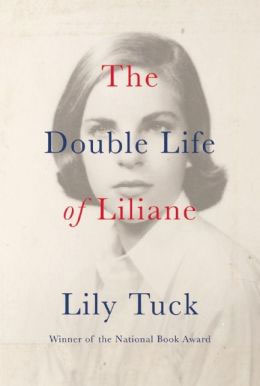
‘The Double Life of Liliane’ by Lily Tuck

‘The Double Life of Liliane’ by Lily Tuck   (2015) – 238 pages

201509_tuck_double

‘The Double Life of Liliane’ is a largely autobiographical work by Lily Tuck that also contains many black-and-white pictures of her family and friends during her childhood years, yet on its back cover are the words “A Novel”.  Her life story makes most of our own life stories seem insufferably plain and dull in comparison.

Liliane was born just before World War II, and both of her parents were from Germany.  Her father, being a movie producer, travels with an international set, and he happens to be in France just before the Nazi takeover but without a passport.  This is critical, because he does have Jewish ancestors in his background although they have converted to Lutheranism.  The dancer Josephine Baker helps him get a passport and escape France just before the Nazi takeover.

Liliane’s mother has Jewish relatives in her background also.  She has beauty such that she is often compared to Great Garbo and Marlene Dietrich.  She and Liliane wound up spending the war years in Peru far from Germany.

I had never considered before the plight of the millions of people who had just one Jewish grandparent or great-grandparent.  There must have been all these gradations of Jewishness that would cause widespread fear and panic among the general population.

After the war, Liliane’s father and mother are together for a short time, but then they divorce with the mother and Liliane in New York and the father off producing movies in Italy.  The mother soon remarries.  The double life for Liliane is her cross-Atlantic arrangement set up by her parents.  In an early chapter of the novel, we have 9-year-old Liliane traveling by herself on an airplane from New York to Italy to stay with her father.   In Italy she watches first-hand the fast set of movie stars, directors, producers, and others.

As the novel progresses, the girl Liliane turns into a young woman with adventures of her own.  Through her father she has lunch with the Italian writer Alberto Moravia who relates some of his times while married to the writer Elsa Morante.

Lily Tuck doesn’t overplay her hand by trying to make the events in the novel seem more exciting or glamorous than they really were.  She downplays her childhood experiences if anything, since they are colorful enough as is. This is in contrast to what frequently happens with memoirs.  When someone writes about their own life, they often get so caught up in telling their story that they forget to entertain.  Thus memoirs can be deadly for the reader.

‘The Double Life of Liliane’ is another example of the recent mode of blending fiction with non-fiction on the order of  W. G. Sebald or Karl Ove Knausgaard.  I am somewhat skeptical of the results of this Reality trend, but in ‘The Double Life of Liliane’, the reader is not forgotten.  Even though the story treads very closely to the author’s life, it is told with the zest and creativity of fiction.

Grade:   B+

‘Lines of Life’ by Francois Mauriac – The Attractions of Wickedness

‘Lines of Life (Destins)’ by Francois Mauriac   (1928) –  153 pages    Translated by Gerard Hopkins

mauriac-lines (1)

I was first tuned in to the awesome fiction of French novelist Francois Mauriac by my trusty literary critic Martin Seymour-Smith whose ‘Who’s Who in Twentieth Century Literature’ was and is my constant guide.

Seymour-Smith shares the view of most critics that Mauriac wrote all of his greatest work before 1933.  Up until then Mauriac wrote intense moral dramas about the ongoing battle between Evil and Good in everyday life. In early Mauriac, Evil is so attractive and Good is so smug that a winner is by no means assured. After that Mauriac turned to Christianity and Catholicism with a vengeance, and the critical consensus was that he then stacked the deck in his fiction in favor of Good, and that his work weakened due to his new-found religious fervor.   I still follow Seymour-Smith’s advice and have not read any of Mauriac’s work written in 1933 or after. By this point, Mauriac was already 47 years old and had written several masterpieces including ‘A Kiss for the Leper’, ‘Genitrix’, ‘The Desert of Love’, ‘Therese Desqueyroux’, and ‘The Knot of Vipers’, all of which I have read.  ‘Lines of Life’ is considered a near masterpiece in Mauriac’s work.

One of the qualities that make Mauriac’s pre-1933 fiction so appealing is how he depicts the life of Evil as quite delightful, just like it is in real life.  The ‘hero’ of ‘Lines of Life’ is Bob Lagave, the dissolute son of a landowner in Bordeaux.  Bob is “a young man whose only concern is to seduce others, to soil others, to lead them to damnation”.  His hardworking father has only contempt for his son:

“But there’s some as takes their fun and does a bit of work too.  There’s a time and a place for all things.  But this young man’s a no-good, if not worse.”

Bob has taken up the Paris high life which his father despises.

But the real moral center of the novel is the neighbor Elizabeth who closely observes one of Bob’s romantic exploits and develops a passion for him even though she is much older than he.  Elizabeth’s son Pierre who is a religious fanatic accidentally spies on Bob and his young woman trysting in Elizabeth’s yard and condemns Bob in no uncertain terms, after which Bob punches him in the face.

Women are not off the hook in this morality drama either.  The young woman who was caught trysting with Bob later says,

“After all,” she said: why should one give up a young man on the ground that he is not worthy to be one’s husband? Marriage is one thing, love quite another.”

 Now that is a statement that would make any devout Christian cringe.

A Bordeaux Wine Farm

A Bordeaux Wine Farm

One of the ways to measure the impact of a writer is to look at his or her followers.  Two of Mauriac’s ardent followers are the writers Graham Greene and Flannery O’Connor, two writers I hugely admire. I suppose it is somewhat strange that I, born and raised a Lutheran, am so enamored of the Catholic novelist Mauriac, but one cannot help liking what one likes, and I find Mauriac a simpatico spirit.

I find that these pre-1933 fictions of Francois Mauriac go deeper into analyzing the souls of the characters than other writers.  Even though Bob in ‘Lines of Life’ is held in contempt by his father and is condemned by the religious, he is ultimately viewed sympathetically as we all must be.  The battle between Good and Evil is not as clear-cut as it is sometimes made out to be.


Grade: A-  


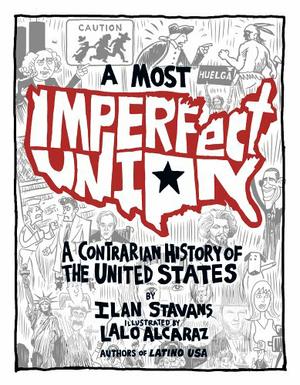
“A Most Imperfect Union – A Contrarian History of the United States” by Ilan Stavans and Lalo Alcaraz

‘A Most Imperfect Union’, a graphic novel written by Ilan Stavans and illustrated by Lalo Alcaraz  (2014) – 252 pages

9780465036691

Here is a chronological pictorial history of the United States told by two Mexican immigrants.  It is a contrarian view as indicated by its author:

“I often criticize the United States for those aspects of its culture and national character that make me uncomfortable: its insatiable appetite for pleasure, its plastic-surgery aesthetics, its love of consumption, its frequent ignorance of history, its xenophobic disposition, its condescending political correctness, its arrogant foreign policy.” 

Despite his sometimes contrary views, Ilan Stavans is an American by choice, an immigrant.

As a child I received a very traditional view of American history in my one-room grade school in western Wisconsin.  First the history was United States-centric.  We were hardly taught anything about the rest of the world, even about our nearest neighbors Canada and Mexico.  Yet we were told every detail about George Washington, even the story ending in ‘I cannot tell a lie.  I chopped down the cherry tree.”  About the trials and tribulations of the Native-Americans, we were only told that the Pilgrims invited them to Thanksgiving dinner.  We were taught that Abraham Lincoln freed the slaves, and that act put an end to racial problems in the United States.  Even though we were only eight years old when we were taught this stuff, I can’t believe how naïve we were.

The first thing I did when I got to college was sign up for a course in European history, because the only things we were taught about Europe were the names of the explorers who first discovered America.

So first of all, ‘A Most Imperfect Union’ is a necessary corrective to the simple-minded view of history that was instilled in us at an early age.  I could even see this graphic novel being used in grade schools to give children another view of American history at an early age besides that of the history textbooks.  ‘A Most Imperfect Union’ deals with American history all the way up to 2014.

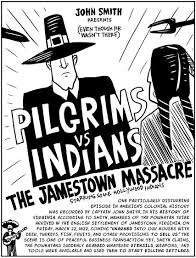
download (7)However I do have one objection to one page of the book.  This is the page that is pictured here, “Pilgrims vs. Indians” – The Jamestown Massacre”.  This was a massacre on March 22, 1622 in which the Powhatan Indians killed at least 347 Jamestown settlers.  Just about any grade school student in the United States could tell the authors that the settlers at Jamestown were not Pilgrims; they were English and other European settlers in search of economic opportunity.  The Pilgrims who left England to escape religious persecution settled up north in New England.  To any even casual student of United States history this mistake by the authors is near unforgivable.

Overall  ‘A Most Imperfect Union’ does raise important points on nearly every step along the way.  It is an especially fun book for those of us who have been taught a very traditional view of United States history.  The artwork by Lalo Alcaraz is also impressive.


Grade: B+   


‘This is Your Life, Harriet Chance’ by Jonathan Evison – Light and Devastating

‘This is Your Life, Harriet Chance’ by Jonathan Evison   (2015) – 294 pages


25810633The world and its events are heavy enough.  Sometimes the best way to approach it is with lightness.  It takes a certain kind of genius to compose lines like:

“Tide, Wisk, Cheer, you’ve tried them all – yes, even All.”

This novel is constructed like the old TV show ‘This is Your Life’ where the host walks through the entire life of the main guest through a series of short vignettes recalling various scenes that were significant to this person.  Of course on the television show, the scenes recalled were all happy uplifting events that made the guests feel good about their lives.  However a novel does not face this feel-good restriction.  There are disturbing events recalled in ‘This is Your Life, Harriet Chance’ that you would never expect to find in a light humorous novel or TV show.

As it turns out this is an excellent way to tell the story of a person’s life, because that is how our minds work all day (and sometimes all night) long.  We flash back to the various incidents that have occurred throughout our lives, the good and the bad, in seemingly random fashion, but they all somehow fit together to define who we are now.

Harriet Chance is 78 years old.  Her husband of many years died almost a year ago, after a long disastrous spell of Alzheimer’s disease.  She has two children, a son and daughter.  Now Harriet is planning to go on an Alaskan cruise for two which her deceased husband had signed up for a long time ago.  She wants to take along her best woman friend from the neighborhood.  So far, so normal.

Then we flash back to scenes that go all the way back to Harriet’s early childhood to scenes when she was a young professional single woman up to scenes from her married and family life.

evisonJonathan_0By the end of the novel we get the full picture of Harriet Chance, and it is a mostly sad picture for such a seemingly light humorous novel. I admire the dexterity of Jonathan Evison’s writing style that he can switch from light and breezy to heartbreaking in just a few sentences.  His novel seems a lot more accurate than many other novels which attempt to be more serious and profound. This is a poignant story of a woman reconciling the various parts of her often awful life, which in Harriet’s case is a near impossible thing to do.

Can a novel be both light and devastating?  ‘This is Your Life, Harriet Chance’ is.


Grade:   A-


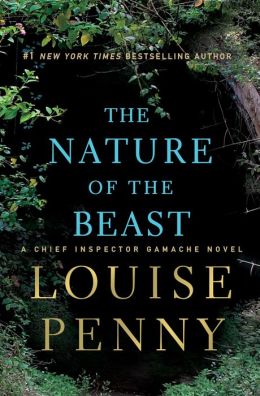
‘The Nature of the Beast’ by Louise Penny – A Return to Three Pines

‘The Nature of the Beast’ by Louise Penny    (2015) –   394 pages

Nature-gallery

Once again we are in the charming picturesque French-Canadian village of Three Pines in Quebec, just north of the Vermont border.  The locals are putting on an amateur play, “She Sat Down and Wept” which former Chief Inspector Gamache recognizes as the work of notorious imprisoned criminal John Fleming.

Meanwhile the dead body of a nine year-old boy from the village, Laurent, is discovered in the woods nearby.  Near the body, a huge artillery gun is found buried in the dense undergrowth.  Soon members of the Canadian intelligence service arrive as well as a mysterious professor from McGill University who knows a lot more about the gun than he admits.

The colorful town eccentrics at Three Pines do show up including Ruth Zardo and her pet duck Rosa as well as the two men who run the best bistro in the known world.   With the intelligence agents, the professor, the cast members and director of the play, the new Chief Inspector, and the townspeople, there is a large crew of characters in ‘The Nature of the Beast’, perhaps too many for a reader to keep track of easily.

This is the second Chief Inspector Gamache novel that I’ve read.  I thought that the first one, ‘How the Light Gets In’, transcended the mystery genre.  It was a gripping and engaging story of corruption in high places, an excellent novel regardless of the category.

However, ‘The Nature of the Beast’ has a contrived outlandish plot about Operation Babylon and gigantic missile launcher guns named Baby Babylon and Big Babylon.  Sadly I could never quite accept this plot with the big guns as believable.  Even though the plot is based in part on a real story, I found these monster guns quite incongruous with the small town life of Three Pines.  Things also get a bit too convoluted for my taste.

“The Nature of the Beast’ had more of the feel of an artificial mystery than of actual life.

This novel will probably appeal to fans of mysteries and fans of Louise Penny but probably will not have a wider appeal to readers seeking more literary fare.


Grade: B

‘Fates and Furies’ by Lauren Groff – “A Pathological Truth-Teller”

‘Fates and Furies’ by Lauren Groff    (2015)  –  390 pages

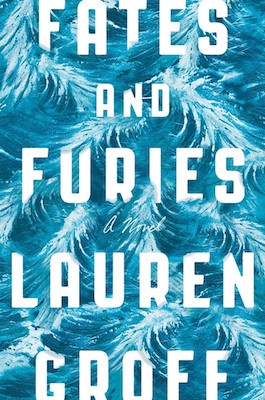
Fates-and-Furies-Cover-Image

Even the title of Lauren Groff’s tremendous new novel, ‘Fates and Furies’, indicates that it is mythic, not realistic.  That’s OK since realism in fiction has pretty much run its course over the last few decades although there is a glut of new realistic novels coming out every month.  We all know that the real is a boring dead end; just watch reality television.

In Greek mythology, both the Fates and the Furies were women.  The Fates are a group of women, usually three, who weave the tapestry which determines the lives of men.  The Furies on the other hand are the infernal goddesses, the angry ones, who punish wrongdoers on Earth as well as the damned in Hell.

The novel ‘Fates and Furies’ is the story of a married couple, Lotto and Mathilde.  The first half of the novel, ‘Fates’, is mainly Lotto’s story.   Mathilde, the love of Lotto’s life, is there more as a helpmate than anything else.  We learn very little about her history in the ‘Fates’ section of the novel.

“Paradox of marriage: You can never know someone entirely; you do know someone entirely.”   

However a woman does also have a history.  The ‘Furies’ section of the novel is mainly Mathilde’s story, and what a story it is.

‘Fates and Furies’ is a performance.  As well as one of the main characters [Lotto] being an actor / playwright, the novel is filled with artifice ranging from the Greek myths and tragedies to Shakespeare.  When today so much of literature is realistic and naturalistic to the point of plainness, Lauren Groff strives for something bigger and brighter, more mythic than that, and succeeds.  Also a manic energy, a liveliness, and an inventiveness infuse her writing.  ‘Fate and Furies’ was a delight for me.

The first name Groff mentions in the acknowledgements to ‘Fates and Furies’ is Anne Carson, a writer I much admire who translated the trilogy of ancient Greek tragedies in the Oresteia by Aeschylus and who often incorporates mythology into her poems and other work.

While I was reading ‘Fates and Furies’ I kept thinking about another author, the great Canadian novelist Robertson Davies whose Deptford Trilogy [‘Fifth Business’, ‘The Manticore’, ‘World of Wonders’] is not to be missed by anyone who appreciates fine literature.  Robertson Davies was another writer who put a lot of Greek myth, Shakespeare, and theatre in his novels.

After completing ‘Fates and Furies’, I decided to google ‘Lauren Groff   Robertson Davies’ to see if there was any connection between the two of them.  I came up with only one connection between the two authors.  In an article in the New Yorker from 2011, Lauren Groff discusses what she was going to read that summer:

“Half of my collection is pretty random, books that I’ve picked up at the local library sale (an extensive collection of Barbara Pym and Robertson Davies, despite the fact I’ve never read a word by either writer.)”    

After noticing the similarities between ‘Fates and Furies’ and Robertson Davies’ fiction, I strongly expect that Groff has read Davies since 2011.

‘Fates and Furies’ is a novel that goes into my “Don’t Miss” category.


Grade:    A   


‘Three Sisters’ by Anton Chekhov – “How strangely life changes and deceives one!”

‘Three Sisters’, a play by Anton Chekhov   (1901)  –  64 pages

250px-Three_Sisters_cover_1901

There are two sides to Anton Chekhov for me.  First there are the short stories which are simple, direct, and easy to understand and love.  But then there are the plays which are a much more complex situation.  There are four major Chekhov plays:  ‘The Seagull’, ‘Uncle Vanya’, ‘Three Sisters’, and ‘The Cherry Orchard’.

I have attended a fair number of performances of Chekhov.  They always teem with Russian village life, contain a variety of colorful characters, and are loaded with poignant stories, but they often leave me wondering, “What’s the point?”  However I know Chekhov is a major playwright so I keep coming back to the plays.

‘Three Sisters’ is, as its name indicates, the story of three sisters, Olga, Masha, and Irina.  They are living in a Russian village, but they long to get back to their old home of Moscow which they had to leave after their father died.  As the play starts, Olga is 28, a school teacher, and she realizes she probably will never marry.  Masha is 24 and married, but her husband bores her.  Irina is 20 and pursued by the persistent Baron who is not very good looking and whom Irina does not take seriously as a suitor.   There is also a brother, Andrei, who is prone to gamble away large amounts of money and who winds up marrying the harridan Natasha.  This woman makes the sisters’ lives a living hell, and she is probably the villain of the play.

Life in this Russian village is dull, and the Russian army unit stationed in the village is the only thing that brings excitement and color, and when the army leaves in the fourth act, the villagers lament that the town will become insufferably dull.  Masha, the married sister, has fallen in love with one of the soldiers.

There are four acts to the play.  The acts are separated in time by months or a couple of years, all occurring in the 1890s.  This is a time in Russia when the people realize that Russian life is changing momentously but they still don’t fully realize what the changes will bring.

“Perhaps our age will be called a great one and remembered with respect. Now we have no torture chamber, no executions, no invasions, but at the same time how much unhappiness there is!”

‘Three Sisters’ was written in 1901 and this was the time when Stanislavski was a powerful force in Russian theatre.  Stanislavski took a special interest in Chekhov’s plays and directed all of them.  The Stanislavski method of using an acting ensemble and his concepts of naturalistic acting and psychological realism are evident throughout the play, even though Stanislavski and Chekhov were often at odds.

o_three-sisters-chekhov-kristin-scott-thomas-kate-burton-9d37Despite some comedy, there is a sadness that permeates ‘Three Sisters’ of loveless marriages, of empty days and nights, of being dissatisfied with one’s current life and wishing for something else.

Originally I was going to listen to the audio book of the play which has worked well for me on several plays before.  However I quickly found that there are just too many characters in ‘Three Sisters’ to separate them all by voice only.  Fortunately there was a good version of the play on YouTube starring Kristin Scott Thomas as Masha.

I would really like to find out about your own reactions to Chekhov’s plays.


Grade:   A-   

‘The Story of the Lost Child’ by Elena Ferrante – Back to Naples, Italy

‘The Story of the Lost Child’ by Elena Ferrante   (2015) – 473 pages     Translated by Ann Goldstein

 -

Now that Elena Ferrante’s Neapolitan novels are completed, I added up all the pages and came up with a total of 1693 pages.  Since the four novels combined are the life story of the two girls, Lenu and Lila, from a poor neighborhood in Naples, Italy, I suppose at some point they will all be combined into one novel, and it will make even ‘War and Peace’ seem puny.

To me, these four novels have been highly addictive.  I appreciate movie director John Waters’ comment, “Elena Ferrante: the best angry woman writer ever!”

The two girls grow up to be not only angry women but tough and smart and enterprising.  In the earlier novels we got a total picture of the men and women in the families in their Naples neighborhood as the girls grow up.  It was not always a pretty picture, but it appeared to be emotionally true and real.  Now the girls are full adults themselves and make mistakes like most of us adults do.

At the beginning of ‘The Story of the Lost Child’, Elena has become a successful writer, and her novels are even translated into other languages.  She has a husband and two daughters, but she leaves her husband and children to take up with one of the boys, now an adult would-be writer himself, from her old neighborhood, Nino.  Once long ago during their teenage years, the two girls had gone on vacation with Nino’s family, and one night Lila had gone off with Nino leaving Elena behind.  This had made Elena so hurt, jealous, and angry that Elena had wound up sleeping with Nino’s father.  Now twenty years later, Nino, though still living with his wife, becomes Elena’s lover.  Nino even gets his wife pregnant during this time, and Elena puts up with the arrangement.  She even gets writing assignments for him with her publisher.

“Ma, today it’s not like it used to be.  You can be a respectable person even if you leave your husband, even if you go with someone else.”    

There are soap opera qualities to these novels just as there are in real life.

Elena Ferrante has written a story each of us ought to be able to write but don’t, the real story of a child growing up in a neighborhood.  I cannot think of any other novels that have captured the inhabitants of a neighborhood as well as these Neapolitan novels.

I suppose there might still be some debate as to whether Ferrante’s Neapolitan novels are great literature or not.  All I can say is that I have read these novels with the same eager interest and pleasure as I have read ‘Middlemarch’ and ‘War and Peace’.


Grade:    A

‘Did You Ever Have a Family’ by Bill Clegg – After the Tragedy

Did You Ever Have a Family’ by Bill Clegg    (2015) – 293 pages

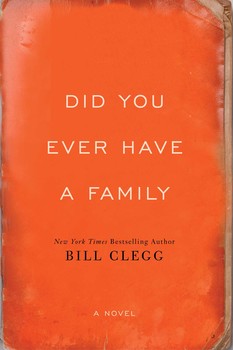
did-you-ever-have-a-family-9781476798172_lg

Four people are killed in a house gas explosion including a couple who were to be married the following afternoon.  This is the defining event in ‘Did You Ever Have a Family’, and the novel deals with how those who survived cope in the aftermath to this tragedy.  ‘Did You Ever Have a Family’ is a grief novel.

The story is told by multiple narrators each somehow connected to those who died. The mood is subdued reverie.  There is no direct dialogue. Someone must have forgotten to tell the author that each of the various narrators must have a distinctive voice.  As it is each sounds pretty much the same, their narration filled with muted hazy remembrance. The characters sound so much alike that it is difficult for the reader to tell them apart.  Two of the main characters are Lydia and June, but I couldn’t tell one feature of their personality which would distinguish them.

The long sections of indistinguishable mournful reverie are only occasionally interrupted by a sparkling sentence like the following:

“She takes a long, late-day look at the town where she has lived her whole life, where there are no friends, no family, but where her feet are famous to the sidewalks.” 

I suppose my opinion of ‘Did You Ever Have a Family’ has been somewhat colored by my having previously read what I consider to be a much superior grief novel.  That would be ‘The Sweet Hereafter’ by Russell Banks which tells the story of a town dealing with a terrible school bus accident.  That novel also used the multiple narrator method, but its telling was so simple and direct and heartfelt I never was confused about who was talking at any given time.

‘Did You Ever Have a Family’ is a much more subtle novel but unfortunately more confusing and less affecting.  Perhaps a sign of the novel’s diffuseness is that its events are spread out to both coasts from Connecticut where the accident occurred to the state of Washington.  The novel attempts to include side plots about racial injustice involving both blacks and Native Americans, but these are half-hearted at best.

However after about two hundred pages of listlessness, something near miraculous occurs.  The story in ‘Did You Ever Have a Family’ actually starts to cohere, become involving.   Perhaps this is because we readers have finally gotten to know a couple of the narrators well enough to care about and follow their account of events.


Grade:   B 

Some Nearly Forgotten Novels Written in the First Decade of the 1900s which are Exceptionally Good

In England it was known as the Edwardian Era.  In France it was the La Belle Époque (“Beautiful Era”).  In the United States it was the Progressive Era.  It was a time of optimism and peace and prosperity before the terrible Great War spoiled everything.  Here are some wonderful novels written during that time.

Claudine_ecole_colette‘Claudine at School’ by Colette (1900) –This was the first novel by French writer Colette, and as with so much of her work it caused a huge scandal with 15 year-old Claudine taking on affairs with her female instructors.   It was not published in English until 1957.

10725_poster‘The Confusions of Young Torless’ by Robert Musil (1906) – Another scandalous novel, this is the first novel by German writer Robert Musil based on his own experiences at a military boarding school.  Boys left to themselves get into all kinds of troubles.

9780195108118‘Esau and Jacob’ by Joachim Maria Machado de Assis (1904) – This is one of many excellent novels by the great Brazilian writer, Machado de Assis.  I’ve read most of them, because I consider Machado de Assis with his sense of humor one of the all-time great novelists.  This one is the story of Brazil itself disguised as a story of twin brothers falling in love with the same woman, Flora.

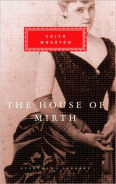
9780679406679_p0_v1_s118x184‘The House of Mirth’ by Edith Wharton (1905) – This early novel about New York society beauty Lily Bart put Edith Wharton on the literary map and could well be her best.

“She had no tolerance for scenes which were not of her own making.”

9781590171158‘The Late Mattia Pascal’ by Luigi Pirandello (1904) – Here is a comic novel of black humor by Italian writer Luigi Pirandello in which a man goes on a successful gambling outing only to return home to discover that his wife and family have declared him dead.  Thus the man is free to assume another identity, which he does with unexpected consequences.

sister-carrie‘Sister Carrie’ by Theodore Dreiser’ (1900) – Here is the realistic and unsentimental fictional account of the rise of actress Caroline Meeber, Sister Carrie, by United States writer Theodore Dreiser.  As a novelist Dreiser was crude and powerful, and I consider him one of the greats.

“How true it is that words are but the vague shadows of the volumes we mean. Little audible links, they are, chaining together great inaudible feelings and purposes.”

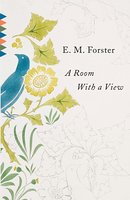
1649385._UY200_‘A Room with a View’ by E. M. Forster (1908) – This English novel has been described as an Edwardian rom-com, a ‘Love Actually’ for its time.   Perhaps that is why it was made into a successful movie.

“When I think of what life is, and how seldom love is answered by love; it is one of the moments for which the world was made.”

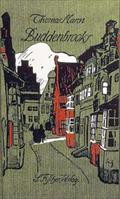
34712190‘Buddenbrooks’ by Thomas Mann (1901) – Although I thought ‘The Magic Mountain’ and ‘Death in Venice’ were wonderful, I still consider ‘Buddenbrooks’ as Thomas Mann’s masterpiece.  It is the story of a successful German family’s decline over the generations.


‘Purge’ by Sofi Oksanen – Free Estonia!

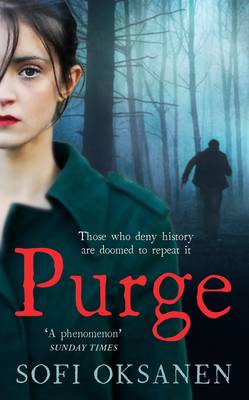
‘Purge’ by Sofi Oksanen   (2010) – 390 pages    Translated by Lola Rogers

imagerepository

After reading ‘When the Doves Disappeared’ earlier this summer, I had no choice.  That novel was so dramatic and intense, I absolutely had to read Sofi Oksanen’s earlier novel ‘Purge’.  ‘Purge’ is perhaps an even stronger novel than ‘When the Doves Disappeared’, but it is a close call between the two books.

Here is the setup of the story in ‘Purge’.  In 1992, An old woman, Aliide Truu, living in the Estonian countryside finds a young woman, Zara, lying in her yard and brings her into her house.  Oksanen sets the situation up nicely as the two women develop a relationship so that Zara acts more like a daughter to Aliide than her own daughter.

Two ruthless men are pursuing Zara who was forced to work for them at sex trafficking and has now escaped.

The young woman Zara is hardly more than a girl.  Zara wanted to get money for college, but instead she was taken up by two violent young Russian male pimps, Pasha and Lavrenti, who drove her to Berlin, Germany and peddled her for sex.

The old woman Aliide had to face her own brutal interrogation in the 1940s after the Russians took over Estonia from the Germans.

Oksanen pursues her usual technique of presenting short scenes out of order.  The present time of the novel is 1992, but we are presented flashbacks for both Zara and Aliide.

Let’s talk a bit about this method of Sofi Oksanen, the method she has used effectively in both ‘Purge’ and ‘When the Doves Disappeared’.  ‘Purge’ started out as a play. And I believe that fact was crucial to Oksanen in arriving at her technique.

Instead of presenting her scenes in chronological order, she skips around from time to time, from place to place.  Thus one scene might be from 1992 in Estonia, and the next scene might be from 1991 in Vladivostok, and the next scene might be from 1945 in Estonia.  This allows each scene to be presented in real time rather than as a memory.  Real-times scenes in the here and now are much more vivid than memories.  I find this technique increases the impact of the story.  We are given the separate pieces of the puzzle as they are needed until they all fit together into a complete picture.  The method also allows Oksanen to tell complex stories using simple dramatic single scene building blocks.

Gradually the full stories of both women are revealed, and all the pieces of the mosaic fit together into a compelling story.

Oksanen deals with the totality of these two women’s situations, the bad as well as the good.  The author never veers away from any subject because it is just too awful or disgusting whether it be political torture or sex trafficking.  Evil as these subjects are, they are a part of the lives of these people and must be dealt with.  That is why ‘Purge’ gets to deeper truths than other novels do.  In the presence of overwhelming evil, one must make allowances for ordinary people in order for them to survive.


Grade:   A

‘Eileen’ by Ottessa Moshfegh – Dirty Realism at its Best

‘Eileen’ by Ottessa Moshfegh   (2015)  – 260 pages

9781594206627

I want to explain to you what Dirty Realism is, because ‘Eileen’ is the best novel of Dirty Realism I have read in a long, long time.  ‘Eileen’ is a must-read.  I came across the following definition of ‘Dirty Realism’ in an article about Tobias Wolff by Claire Allfree in Metro magazine:

“Depictions of ordinary people, using transparent prose that gets uncomfortably close to the fabric of the characters’ lives.”

Usually the term ‘Dirty Realism’ was applied to short stories, but ‘Eileen’ is a novel, a sustained performance.  It is so honest it is uncomfortable.

The 24-year-old woman Eileen in ‘Eileen’ doesn’t get out much.  She stays at her New England home taking care of her drunk abusive father who is an ex-cop and thus well-respected in the community.  Eileen’s cruel mother died a painful death a couple of years ago.  Occasionally Eileen goes to a movie by herself telling her father she is going out with friends, but her father won’t believe her.  She has no friends.  Eileen works at a boys’ detention center where teenage boys are imprisoned for committing some horrific crime like burning down the family home or murdering a parent or sibling.

“There was a reason I worked at the prison; after all, I wasn’t exactly a pleasant person.”    

Eileen’s thoughts reverberate with negativity toward herself. What makes ‘Eileen’ special is the provocative and disturbing voice of Eileen.  There is nothing girlish or perky about Eileen.  We’ve had enough of those.  Eileen’s voice is real.

“I was unattractive in temperament most of all, but many men don’t seem to care about things like that.”  

 Here is Eileen describing her body:

“So just for laughs, here I am again, my little virginal body at age twenty-four.  My shoulders were small and sloped and knobbly.  My chest was rigid, a taut drum of bones I thudded with my fist like an ape.  My breasts were lemon-size and hard and my nipples were sharp like thorns.  But I was really just all ribs, and so thin that my hips jutted out awkwardly and were often bruised from bumping in to things.  My guts were still cramped from the ice cream and eggs from the day before.  The sluggishness of my bowels was a constant preoccupation.”

The novel takes place in 1964 with Eileen many years later telling her story from back then.  Things change for Eileen when Rebecca Saint-John starts working as the first ever prison director of education.  Rebecca immediately befriends Eileen.

“I prefer being sort of flat-chested, don’t you?  Women with big bosoms are always so bashful.  That, or else they think that their figures are all that matters.  Pathetic.”  

Moshfegh-200x200As I said before, the novel ‘Eileen’ is Dirty Realism with a vengeance.   The writer Raymond Carver, a writer also well worth reading, is considered the King of Dirty Realism.  According to Stuart Evers in the Guardian, Carver wrote “pared-down tales of urban dismay, of losers and liars, of drunks who never know when to stop.”  Despite this being her first novel and despite there being other fine female dirty realists like Jayne Ann Phillips and Joy Williams, I am compelled to call Ottessa Moshfegh the new Queen of Dirty Realism.


Grade:   A


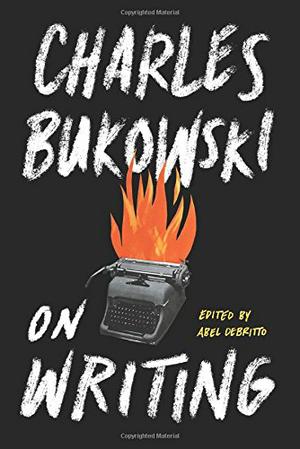
Charles Bukowski On Writing

‘On Writing’ by Charles Bukowski   (2015) – 214 pages – Edited by Abel DeBritto

9780062396006

There is still a lot of controversy about Charles Bukowski so before you read this article I want you to read Bukowski’s famous poem of writing advice called ‘So You Want to be a Writer’.   This poem might change your mind about him.  Then again, maybe not.

Charles Bukowski, the King of the Underground, would never be mistaken for a respectable person.  Lewd, crude, and rude are three words often used to describe him.

“I don’t write so much now.  I’m getting on to 33, pot-belly and creeping dementia.  Sold my typewriter to go on a drunk 6 or 7 years ago and haven’t got enough non-alcoholic dollars to buy another.”

‘On Writing’ is a collection of the letters that Bukowski wrote to editors and to other writers from early in his career until the end.  After some early success getting stories and poems published, he went on “a ten-year drunk” during which he sold his typewriter for alcohol and horse race money but still submitted a few poems to editors in longhand.  He was persistent.  Around 1960 he took a job at the post office, got another typewriter, and wrote some more poetry.  Beginning in  1967 he wrote a column called “Notes From a Dirty Old Man” for an underground newspaper.  In 1969 Bukowski accepted an offer from Black Sparrow Press to become a full-time writer.  He was 49 years old.

“I have one of two choices – stay in the post office and go crazy … or stay out here and play at writer and starve. I have decided to starve.”    

The following year he published his first novel, ‘Post Office’.

What kind of writing advice does Charles Bukowski give in ‘On Writing’?  Above all, “Don’t try”.  This is the actual epitaph that is written on his gravestone.

“We work too hard. We try too hard. Don’t try. Don’t work. It’s there. It’s been looking right at us, aching to kick out of the closed womb. There’s been too much direction. It’s all free, we needn’t be told. Classes? Classes are for asses. Writing a poem is as easy as beating your meat or drinking a bottle of beer.”

Here are some more good lines of advice from ‘On Writing’.

“It’s best to stay loose, work wild and easy and fail any way you want to.”   

“My writing is jagged and harsh; I want it to remain that way, I don’t want it smoothed out.”  

“That’s crude.  I like it.”

 “I’m not interested in poetry.  I don’t know what interests me.  Non-dullness, I suppose.  Proper poetry is dead poetry even if it looks good.”

Bukowski also expresses some literary criticism of other writers in ‘On Writing’.  Here is his take on the poet Conrad Aiken:

“His main fault was that he wrote too well; the silk-cotton sounds almost hid the meaning, and, of course, this is the game of most shit-poets: to appear more profound than they really are, to sneak in little delicious darts and then retire to their safe comforts.”  

589088505Charles Bukowski’s literary heroes were  Knut Hamsun, Louis-Ferdinand Celine, John Fante, and Henry Miller.  Those first two were Nazi sympathizers who also wrote fiction.  Lately there has been a lot of talk about whether Bukowski himself was a Nazi sympathizer.  After all he was born in Germany.  He may have been, but he wasn’t much interested in politics at all.  His interests were elsewhere.

“Right now I’m into a great many things: screenplay, correcting somebody else’s screenplay, a short story and playing the horses and fighting with my girlfriend, and visiting my daughter, and then feeling bad and then feeling good, and all the rest of it.” 

He was given to saying outrageous things just to set people off.  I’ll end with one of his better lines.

“Most drunks I’ve known aren’t very interesting people.  Of course, most sober people aren’t either.”   


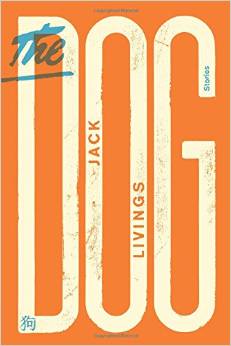
‘The Dog’ by Jack Livings – Stories from China Today

‘The Dog’ stories by Jack Livings   (2014) – 226 pages

41Gj+byI-JL._SY344_BO1,204,203,200_QL70_

This year is shaping up for me to be the Year of the Short Story Collection.  Some years are like that.  I’ve read four of the novels on the Booker-Man longlist, and none of them has soared.  There have been a couple of other novels this year that I’ve read which have been excellent, but the main action has been in short story collections.  So far this year I’ve read fine story collections by Edith Pearlman, Rose Tremain, Kelly Link, and now Jack Livings.

All of the stories in ‘The Dog’ take place in China, and all the main characters of the stories are people who are citizens of China.  Some of the reviewers have called Jack Livings ‘courageous’ for writing these stories; I would call him audacious.

Forget all your stereotypes about the Chinese people.  In these stories Livings captures individual people with empathy and sensitivity.

We here in the West tend to think that all Chinese people are similar, yet there is much diversity among its people.  Take the employees of the Horizon Trading Company.

“There were a couple of Mongols, a guy who was half Xibe, a Uyghur, a couple of Yaos, some Koreans.  For a while we even had an American, but he was lazy and got fired.”

China has a significant twelve million minority population of Uyghurs – Turkic Muslims from the western provinces.  They are treated poorly, forced to live in their own Uyghurville ghettoes, and are blamed for everything that goes wrong in China.

In these stories, a reader gets the impression that earthquakes occur quite frequently in China and are a significant problem.

“He found himself in a wild notion: he should bus the entire workforce to Sichuan to aid in the recovery effort.  But by the time they got there, the men would have been drunk for two days.  They would have beaten each other to a pulp and would get off the bus in worse shape than the quake survivors.” 

From this it appears that alcohol use is also rampant in China today.

From a productivity and economic standpoint, China has been a success story of the twenty-first century despite the recent stock market problems, and several of these stories take place in factory situations.  China has been Communist for seventy years, but today just about everything is at least partly privatized.  Perhaps the best description of China’s current government is “socialism with Chinese characteristics”.  General Motors now sells more cars in China than in the United States.

 Beijing, China

Beijing, China

In one of Living’s stories, “An Event at Horizon Trading Company”, some of the employees start to dress up in traditional Hanfu feudal garb, but some of the other employees are real skeptical.  These other employees point out that it is the Japanese, China’s bitter enemies, who worship their feudal past.

“Look at it this way.  If there’s going to be a battle over who’s got more Chinese pride, I want to be on the side that destroyed feudalism and liberated the peasants, not the side that oppressed the masses.  I’m just saying, if it weren’t for the Red Guard, we wouldn’t be here today, Slick Lips said.”

Perhaps I will find a Chinese writer who will give me accurate insights into China and the Chinese people today.  In the meantime I trust Jack Livings to provide the lively inside story.


Grade:   A       


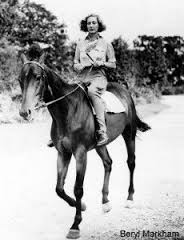
Beryl Markham – Brave Heroine or Scandalous Woman or Both?

‘Circling the Sun’ by Paula McLain   (2015)  – 355 pages


beryl‘Circling the Sun’ is an historical fiction memoir of British-born Kenyan aviator, race horse trainer, and author Beryl Markham.  In the novel Beryl Markham tells her story herself from when she was a little girl.  When Beryl was four her father decided to move the family from England to a horse farm in Kenya, Africa.  However her mother couldn’t stand being isolated on the farm and soon returned to England.  Thus Beryl grew up independent and wild in Africa without her mother.

As a young woman she became the first female race horse trainer in Kenya and was successful and renowned among the racing community in Kenya. Later she took up flying and became the first woman to fly across the Atlantic from east to west in 1936 and also flew from Kenya to England.  She also became friends with the Danish writer Karen Blixen (pen name Isak Dinesen) who also spent years in Kenya.

Since ‘Circling the Sun’ is written as a memoir, Beryl Markham presents herself in a positive light as a spunky trailblazing young woman.  The website Scandalous Women has a quite different take on Beryl.  The life story is pretty much the same, but her romantic life is presented in a much different light.

‘Circling the Sun’ presents the first 28 years of Beryl’s life up to the year 1931 when her lover Denys Finch Hatton is killed in a plane crash.  Up to 1931 the novel depicts her as having two marriages, both of which end in divorce, and three other lovers.  According to Scandalous Women, her marriages “foundered under the weight of Beryl’s infidelities. Beryl didn’t know the first thing about the responsibilities of being a wife, nor did she grow up with many examples of a good marriage.”

b2Her first marriage at seventeen to a man twenty years older than her was a total disaster.  However she was definitely at fault in her second marriage as she had an indiscreet affair with Prince Harry, a previous Prince Harry, while married.  Her husband at the time, Mansfield Markham, found out and threatened to sue for divorce, and Prince Harry to avoid a scandal agreed to put 15,000 pounds in a trust for Beryl.  According to Scandalous Women,

“Beryl treated sex more like a man, as a necessary function like brushing one’s teeth, or eating. Very few of her lovers touched her heart.” 

‘Circling the Sun’ has Denys Finch Hatton as the love of Beryl’s life, the only problem here being that he was Karen Blixen’s lover at the time that Beryl moved in on him.

Scandalous Women places Beryl Markham as one of the notoriously decadent Happy Valley set in Kenya.  According to Scandalous Women,

“She could be ruthless and amoral, using people and then discarding them. She often took advantage of friends, running up huge bills on their accounts, without guilt.” 

‘Circling the Sun’ is fairly accurate in relating the significant events of Beryl Markham’s life, but it is a prettified high school girl’s version of her life.  This often happens when one is allowed to tell one’s own story.  To get a more realistic, objective view of Beryl Markham’s life, you need to dig deeper.


Grade: B+ 

‘Get in Trouble’ by Kelly Link – Far Beyond the Typical

‘Get in Trouble’ stories by Kelly Link   (2015)   – 333 pages


7485bc71999564284c24dbe3a916719cThe stories in ‘Get in Trouble’ are exceedingly strange with ghost animatron boyfriends, demon lovers, super-heroes and sidekicks, pocket universes, and mermaids.  What saves the stories from drowning in strangeness is Kelly Link’s brilliant use of dialogue.  No matter how far-fetched the story is, the down-to-earth conversations between her characters give the readers something real, substantial, and emotional to hold on to.  The people relate to each other human-to-human no matter how strange the story is, and we readers follow the story line due to these interactions.

Here are Fran and Ophelia discussing those mysterious creatures, ‘the summer people’:

“Have you seen them?” Ophelia said.

“Now and then,” Fran said.  “Not so often. Not since I was much younger.  They’re shy.”

Ophelia was practically bouncing on her chair.  “You get to look after them?  That’s the best thing ever!  Have they always been here?”

Fran hesitated.  “I don’t know where they come from.  Sometimes they’re…somewhere else.  Ma said she felt sorry for them.  She thought maybe they couldn’t go home, that they’d been sent off, like the Cherokee, I guess.   They live a lot longer, maybe, forever.  I don’t know.  I expect time works different where they come from.  Sometimes they’re gone for years.  But they always come back.  They’re summer people.  That’s just the way it is with summer people.” 

“Like how we used to come and go,” Ophelia said.  “That’s how you used to think of me.  Like that. Now I live here.” 

The talk between Fran and Ophelia sets up this spooky story “The Summer People”. All the stories contain plenty of dialogue which is a good thing.

Each of the stories is a mixture of the eerie and the everyday.  “Secret Identity” is narrated by a 15-year-old girl who has run away from Iowa, to a hotel in Manhattan, where she is to hook up with a man she met online. At the hotel there are two conventions, one of dentists and one of super-heroes.  How to tell the dentists from the super-heroes is a running joke.

All of the stories in ‘Get in Trouble’ worked for me except one, “Valley of the Girls’.  I read that story twice and it still made no sense to me beyond that it related somehow to ancient Egypt.

The collection contains a great variety of locales from Hollywood to an abandoned Wizard of Oz theme park to deep space.  The emotional situations of the stories are just as varied.

The strong attraction of ‘Get in Trouble’ is that it overwhelms the predictable sameness of so much current realistic fiction by offering a diverse multitude of supernatural settings, extreme weird situations, and offbeat people.


Grade:   B+


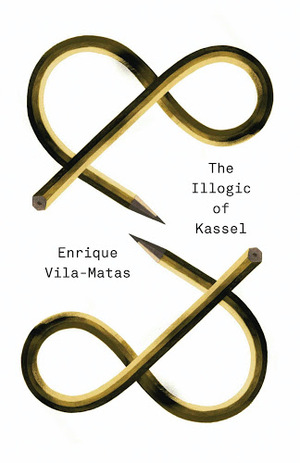
‘The Illogic of Kassel’ by Enrique Vila-Matas – More a Cheerleader Than a Critic

‘The Illogic of Kassel’ by Enrique Vila-Matas   (2014)  – 220 pages   Translated from the Spanish by Anne McLean and Anna Milsom

vila

‘The Illogic of Kassel’  is Enrique Vila-Matas’ account of his one-week sojourn at the avant-garde art festival Documenta 13 in Kassel, Germany in 2012.  He was both a participant in and an observer of the art installations at Documenta 13.

During World War II, Kassel had the misfortune of being the location of several Nazi armament factories, and ninety percent of Kassel’s downtown area was destroyed by Allied bombing.  Also fierce tank battles destroying much of the city occurred here during the Allied invasion toward the end of the war.

Germany under Hitler had classified German art as degenerate, expelling and murdering its artists.  In an act of redemption after the war, Kassel started Documenta in 1955, and now thirteen of these festivals have been held so far.  Kassel is now considered a world center for contemporary art.

As a participant, each morning Vila-Matas was to sit in a Chinese restaurant in Kassel, the Dschingis Khan, and just do what he normally would do and write in front of the public.  As an observer, Vila-Matas was “a sort of erratic stroller in continuous perplexed wandering”.

The good news about ‘The Illogic of Kassel’ is that it is written in the mature self-confident style of Vila-Matas’ later works such as ‘Never Any End to Paris’ and ‘Dublinesque’.  In other words, this is a work that makes the reader think about the world around them, to press deeper into the real questions than we normally would go.  This is a mind-expanding work.  For better or worse, Enrique Vila-Matas has become my guru, my guide.

Vila-Matas is fervent in his advocacy of the avant-garde:

“Perhaps it is this desire for something more that propels us to seek the new,  to believe something exists that still can be distinct, unseen, special, something different, around the most unexpected corner; that’s why some of us have spent our whole lives wanting to be avant-garde, because it is our way of believing that in the world or maybe beyond it, out beyond the poor world, there might be something we’ve never seen before.”

However ‘The Illogic of Kassel’ is by no means an easy read; it is a most difficult read.  First, even though he describes many of the art installations at Documenta 13, don’t expect any sort of meaningful criticism of any of them.  Vila-Matas is much too polite for that.  Since this is non-fiction and deals with the real people putting on Documenta 13 and the real artists, Vila-Matas treads carefully, way too carefully.  No art installation or person is ever criticized in any way.  Vila-Matas describes these art installations in detail, but these descriptions do not come alive and do not have much impact.  He apparently feels he cannot criticize anything or anyone.  He also never praises any one piece of avant-garde art highly for fear it might hurt the feelings of other participants.  Vila-Matas is a lousy critic, and the book slogs down when he is out surveying the field.  None of the officials of the festival comes alive either, because of Vila-Matas’ friendly politeness to neither criticize nor over-praise.

I would have much preferred a fictional account of the art festival where the author would not have been constrained by the bounds of courtesy.

So my bottom-line feelings about ‘The Illogic of Kassel’ are quite ambivalent.  I highly regard Vila-Matas’ mind when he is dealing with literary, philosophical, and historical issues, but his take on Documenta 13 was slow going and quite inadequate.


Grade: B+