Archive for the ‘Book Reviews’ Category

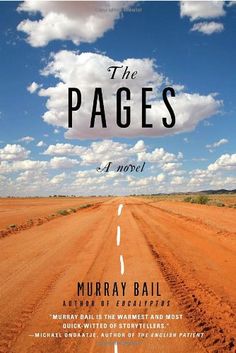
‘The Pages’ by Murray Bail – Ambiguous and Elusive and Enigmatic, yet Warm


‘The Pages’ by Murray Bail   (2008) – 196 pages
 

 -

Two women in their 40s – Erica and Sophie – are on a mission from Sydney to a family sheep farm in the interior of Australia in order to appraise the work of a philosopher who lived there and recently died.  Still living on the sheep farm are the philosopher’s brother and sister.  The philosopher did his work in an old shearing shed on the farm, and his papers are still in there to be read and evaluated.  Actually Erica will be doing all the work; Sophie, a psychoanalyst who is escaping Sydney after another of her disastrous romances fell through, is along for the ride accompanying her friend.  Erica is disciplined and systematic in her work; Sophie is sexy and passionate and unruly.

“They were city women.  Comfortably seated and warm, they were hoping to experience the unexpected, an event or a person, preferably person, to enter and alter their lives.  There is a certain optimism behind all travel.” 

This is the setup for the needless-to-say unusual plot of ‘The Pages’ by Murray Bail.  Over the years I have come to appreciate Australian novelist Murray Bail and his atypical stories.  I like the fiction that I read to be original, intelligent, and as rich and strange as all the complications that arise in this life.  The novels of Murray Bail meet all these requirements for me.

I would much rather read a writer who is too subtle and profound for me rather than one who is not subtle or profound enough.   With Murray Bail, a subtle and profound writer to the extreme, I feel like I am extending my horizons beyond the limits that they were before.  Enigmatic, elusive, ambiguous…  These are words to describe Bail’s fiction.

What exactly do philosophers do?  They write lines like these:

“There is nothing ordinary about anything.” 

“The process of disturbing the mind is the mind.” 

“The desire to love is stronger than the desire to be loved.” 

Bail ends his novel with five pages of these exceedingly wise or incredibly foolish lines written by the philosopher.  I am not at all sure that Bail isn’t showing that the life work of this so-called philosopher is a failure.  That is the kind of curve ball Bail throws us, that this philosopher’s work might be a self-deluding joke.  I am not sure.

Perhaps the best phrase I have seen to describe Murray Bail’s fiction is “oddly compelling”.  As far as I am concerned, you can throw all your simple straightforward single-minded stories out the window.  I would much rather be reading Murray Bail’s unreliable engaging narratives.


Grade:     A-


‘You Can’t Change That’ by Raydio – A Great Exhilarating Rock and Roll Song

hqdefault

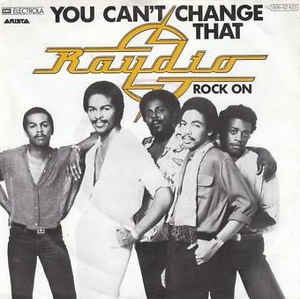
As most of you know I usually write about books, but this is one of my rare forays into music.  I have discovered the perfect rock and roll song and a fine live performance of it.  It is an old song that has never really gotten the credit it deserves.  The song is “You Can’t Change That” by a band called Raydio which was led by Ray Parker Jr.  It came out in 1979 and only reached number 9 on the charts, but this is not your typical number 9 song.  Here is an excellent video from 1979 on YouTube of Raydio doing this song.  You can watch it also by clicking on the picture.

I’ve watched the video and listened to ‘You Can’t Change That’ probably over a hundred times, and I have still not tired of it. It is an exciting lively warm performance that you just want to hear and see over and over.

Early on in the video you see Arnell Carmichael jumping around the stage, and that is indicative of what is to come.  The tune starts out with Ray Parker Jr. singing with the rest of the band joining in as needed:

Honey, I’ll always love you
I promise I’ll always love you
‘Cause I think the whole world of you
And you can’t change that, no, no

Parker’s voice is smooth and steady. He is the group leader.  But then Arnell Carmichael takes over the vocals moving things to a new dimension of pure energy and bliss:

There’s nothing you can do or say
I thought about this for many a day
And my mind’s made up to feel this way
And you can’t change that

R-2166513-1270363731.jpegThis is a powerful performance by Arnell Carmichael, and he owns this song.  Whenever he sings, your ears perk up and take notice.  His energy and spirit are contagious, and the whole band is smiling because they know they have nailed it.

Ray Parker Jr. is probably most famous for his Ghostbusters movie theme song (“I ain’t afraid of no ghost”), but ‘You Can’t Change That’ is the one song which captures the spirit of rock and roll more than any other song I know.  Thanks especially to Arnell Carmichael for that.


‘As Good as Gone’ by Larry Watson – How Long Ago was 1963?


‘As Good as Gone’ by Larry Watson   (2016) – 341 pages


576c2df499a5c.image

‘As Good as Gone’ takes place in Montana in 1963.  It is difficult for me to accept that the year 1963 is farther back in time from today than World War I was in 1963.  We are dealing here with ancient times.  To me it seems like only yesterday.

This is a western story of an old Montana hermit cowboy reuniting with the family he left decades earlier.  Of course Larry Watson could write this novel in his sleep, blindfolded, with both his arms tied behind his back.  The real question is whether or not Watson could make this story meaningful and entertaining to me.

My problem with ‘As Good as Gone’ is that I did not like this old vigilante cowboy that Watson seems to be trying hard to set up as some sort of hero.  This guy is the kind who will shoot first and ask questions later.   This man is quick to take matters into his own hands, especially if anyone is a threat to a member of his own family.  This so-called hero has it both ways. As a child and young man he had an upper middle class existence with a prosperous living through the family real estate business.  He leaves his family and business behind to become a lone cowboy presumably taking some of that real estate money with him.

“Many people believe that he once caved in a man’s head because the man made a vulgar remark about his wife.” 

Due to his daughter-in-law’s medical emergency, this cowboy returns to the old family home to watch his grandchildren. That is one plot point that is difficult to accept but does get the story rolling.  The kids have problems of their own which the cowboy deals with in his reckless manner.  The cowboy even starts shacking up with the lady next door who immediately falls in love with him.

Perhaps the best example of the cowboy’s hard-hearted social philosophy is what he says during a run-in with an Indian who has defaulted on the rent.  The cowboy tells his new-found ladyfriend “We won, they lost.  Simple as that.”  And the Indians kept on losing and losing for over a century and still today due to white men’s – probably a lot of Montanans – attitudes like this cowboy’s.  These wannabe cowboys don’t seem to realize how much the cards have been stacked in their favor.  Their ignorance confounds me.

There is a side story about the daughter-in-law’s medical problems which really doesn’t go anywhere and could as well have been dropped.  The main story line is glorifying this old stubborn cowboy, and it does have its entertaining aspects.  However ‘As Good as Gone’ could have been a much deeper story if Watson could have confronted the more negative issues of this cowboy’s state of mind.


Grade:   B 


‘Wilde Lake’ by Laura Lippman – “Does anyone get through life blameless?”


‘Wilde Lake’ by Laura Lippman    (2016) – 352 pages


ed8815a263064453a39a7a8f5b2c6bb8

Although Laura Lippman has written twenty-one novels, ‘Wilde Lake’ is the first of hers that I have read.  Crime novels are not my usual fare, but in recent years I have been more open to giving them a try.

As a crime novel, ‘Wilde Lake’ has some fine virtues.  This story of Luisa Brant, the first female state’s attorney of Howard County, Maryland, is steady and sure-footed and very readable.  It has an aura of competent professionalism written by someone who is quite familiar with the workings of the office.  Some reviewers have suggested that perhaps with ‘Wilde Lake’, Lippman has transcended being just a crime novelist and moved into the literary category.  I don’t think so, and I will explain why not.

There are two separate strands to the story.  First we have the story set in the present where Luisa, Lu for short, starts working as the state’s attorney.  Second we have a story from Lu’s young childhood involving her older brother and his high school friends.  Each strand revolves around its own separate crime.  Only much later do the two strands meld together into one.

In the strand where Lu is a child, she sees her father and her older brother and his friends as close to perfect.  Her mother died when she was born.   Her father was also a state’s attorney, and they live in a richly deserved (according to Lu) upper class house located in a new town near Wilde Lake.

Perhaps the problem for me was that we see Lu’s father and her brother and her brother’s friends through the eyes of a ten year old girl who sees them all as brilliant and splendid.   This over-simplistic idyllic view of the main characters sustained for more than half the novel annoyed me.  Not only does Lu as a little girl have this view of her family and friends as magnificent, she retains this view into her forties until the events that occur near the end of the book.

Perfect characters have no real depth and are of little interest.  These characters are not fully developed to the point where the reader understands how they are going to behave next.  Thus you have a character who has been built up to be almost god-like doing the most despicable things without the reader being given any forewarning.  I suppose Lippman is making a point about a child losing her illusions about her family as she grows up, but the main characters just do not have the depth to support that point.  Also some of the plot situations are too contrived and simplistic for a literary novel.


Grade:   B 

‘Patience’ by Daniel Clowes – Realism and Time Travel


‘Patience’ by Daniel Clowes, a graphic novel   (2016) –   180 pages


192

The graphic novel ‘Patience’ by Daniel Clowes is a strange blend of realism and time travel.

In 2012, Patience and Jack Barlow are a young couple, and Patience is expecting a baby.  She doesn’t want to discuss her past which she says was “like a horrible reality show”.  Jack doesn’t want to hear about it either.  However one day Jack returns home to find Patience lying dead on the floor, murdered.  At first, the police try to pin the murder on Jack, but after ten months, Jack finds out that the police no longer suspect him and let him go.  By then, the trail to the real murderer is cold.

Time passes, and the year is 2029.  Jack is still hung up on Patience.  He finds out about a substance that allows one to travel back in time.  He decides to travel back to 2006 in order to find out about Patience’s past, determine who her murderer was, and perhaps stop the murder from ever happening.  He becomes involved with some of the people who were involved in Patience’s life at that time including drug dealers and men who abuse her.  He is zeroing in on who the murderer might be when he accidentally travels back even further in time to 1985 to the time of his childhood.  He has a difficult time to find a means of time travel in 1985, but finally he arrives back in 2012 again, the year of the murder.

As far as graphic novels go, I found ‘Patience’ to lean more toward the fantastical comic book side than the literary side with its time travel and its surreal artwork.  I must admit that the concept of time travel holds little or no interest for me.  Here the time travel was a contrivance which only complicated and convoluted the story.  Thus the idea of having Jack Barlow in the same scenes as both a fifty year old and a twenty five year old was confusing and not enlightening in any way.

Other reviewers were much impressed with ‘Patience’, calling it psychologically astute and darkly comic. I saw no humor or potential wisdom in it whatsoever.  I preferred Clowes’ more realistic earlier work, ‘Mr. Wonderful’.

ct-cth-prj-daniel-clowes-patience-2-jpg-20160317It would be way too unfair and facile to use a graphic novel’s own words against it, but these words from ‘Patience’ sum up my own reactions quite well:  “I’m so god-damned sick of all the science fiction mindfuck bullshit, all the guessing games and all the impossible, unsolvable riddles. I just want it all to fucking end.”


Grade:   C  


‘The Loney’ by Andrew Michael Hurley – Devout and Creepy


‘The Loney’ by Andrew Michael Hurley   (2014) – 294 pages


41yFXQ5baML._AC_UL480_SR306,480_

How best to describe ‘The Loney’?  I would call ‘The Loney’ a religious grotesque.

A small group of devout Catholics make their Easter pilgrimage in 1976 from London to Lancashire, stopping at a bleak desolate place called the Loney somewhere along the northwest coast of England, a “wild and useless length of English coastline”.  Their kindly, good-natured priest, Father Bernard, drives the bus.

Among the passengers on the bus are two teenage boys, fifteen year-old Tonto and his older brother Hanny who has been silent and mute his entire life.   The people on the pilgrimage, especially his mother Mummer, are praying for a miracle, that somehow Hanny will begin to talk.

Mummer has baked a cake to be eaten after the Good Friday service.

“She placed the cake in the center of the table  and everyone, apart from Miss Bunce, made a fuss over it, praising the detail on Jesus’ face, how intricate the thorns were, how the cochineal coloring had made the blood trickling down his cheek so vibrantly red.“

Perhaps no image captures the spirit of ‘The Loney’ better than that red food coloring used on the cake to show the blood trickling down Jesus’ face from the crown of thorns.   This is one creepy religious novel.

The story is told from the point of view of the younger brother Tonto who Mummer expects to later become a priest.  Tonto has a sharp astute mind, and he can see that his mother might be overdoing it when she sticks her hand down Hanny’s throat to pull out food he had eaten when he was supposed to be fasting.

Father Bernard does have the best interests of all of his parishioners in mind.  He is a pleasant good-hearted fellow who does occasionally take a drink and who may even stop off at a local tavern for a while.  He is not at all like the priest he replaced, Father Wilfrid, who died under mysterious circumstances.  This small band of parishioners is still in thrall to Father Wilfrid who was strict and devout, and they are not all ready to accept the avuncular Father Bernard as their head.

‘The Loney’ is an old-fashioned traditional scary novel loaded with Catholic ritual. Yet it is still a very likeable tale. The portrayal of Father Bernard is the most positive I have seen for any priest for many years.  Sure, there are some plot points and peripheral characters that aren’t very clear, but this reader did not mind because the main characters are so sharply and wonderfully drawn.  ‘The Loney’ does what all the better novels do, it draws you in so you become part of the story.


Grade:   A-


‘The Meursault Investigation’ by Kamel Daoud – The Arabs’ Story


‘The Meursault Investigation’ by Kamel Daoud      (2013) – 143 pages

Translated from the French by John Cullen


9200000040294895

A couple of years ago I wrote an article about the novel ‘The Stranger’ by Albert Camus on this site which you can find here.  Algerian writer Kamel Daoud has written a “Reply” novel to ‘The Stranger’ called ‘The Meursault Investigation’ which won the 2015 Goncourt Prix for first novel.

In ‘The Stranger’ Albert Meursault shoots and kills “an Arab”.  He is imprisoned and tried for this heinous crime.

Why is this Arab who figures so dramatically in ‘The Stranger’ given no name? That is the central question of ‘The Meursault Investigation’ which is narrated by the Arab’s brother.

In ‘The Meursault Investigation’ we early learn that the Arab’s name is Musa.  We find out how his murder affected his mother as well as his seven-year-old brother Harun who now tells this story seventy years later.

Whereas ‘The Stranger’ is cool and detached, cold even, ‘The Meursault Investigation’ is emotional and heated.  Albert Camus himself summarized ‘The Stranger’ with the following remark:  “In our society any man who does not weep at his mother’s funeral runs the risk of being sentenced to death.”   The main issue at Meursault‘s trial appears to be his reserve and lack of feeling at his mother’s funeral rather than the murder itself.  Meursault views the murder as a result of his being disoriented by the sun.  The murder is nearly a side issue to him, but that still does not pardon Camus from not giving the Arab a name.  Surely Meursault would have learned the name of his victim after the murder and should not always have to refer to him as “the Arab”.   The worst case would be that Camus himself was dismissive of Meursault’s murderous act because the victim was only “the Arab”.  In 1942 Algeria was a French colony, and that may have been a common colonial attitude.

the-strangerBy 1962, Algeria gained its independence from France.  Many remaining French people left their homes in a hurry, and Harun and his mother move into a house vacated by a French family.  During that time, Harun murders a Frenchman who does have a name.

This murder is not the only scene that mirrors ‘The Stranger’.  There is also the story of Musa and Harun’s mother.  In fact the first line of ‘The Meursault Investigation’ is “Mama’s still alive today” which mirrors the first line of ‘The Stranger’.

Kamel Daoud would have built a stronger case if he had dealt with the fact that in ‘The Stranger’ the two Arabs stabbed Meursault’s friend Raymond in the arm and mouth in a confrontation before the murder.  Earlier Raymond had beat up his Arab girlfriend, and the Arabs responded with violence. Certainly Raymond had it coming, but still that fact should have been discussed explicitly in ‘The Meursault Investigation’.

I suppose at some point the two novels ‘The Stranger’ and ‘The Meursault Investigation’ will be sold as a package so readers will get the entire story of both Albert Meursault and his victim.


Grade:    B+


‘Aeneid Book VI’ by Virgil – Translated by Seamus Heaney


‘Aeneid Book VI’ by Virgil    (Somewhere between 29 BC and 19 BC)    94 pages     Translated by Seamus Heaney


416HxQ1EeRL._SX314_BO1,204,203,200_

‘Aeneid – Book VI’, this translation of the Roman poet Virgil, is the last work of the late Irish poet Seamus Heaney who died in 2013.

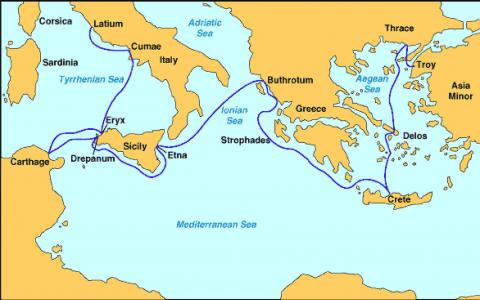
Most of the mythology that I have read before have been translations of the Greek, so this Roman work by Virgil was new to me.  I was amazed though how closely it followed the Greek stories.  Aeneas and his surviving band of Trojans who suffered their terrible defeat from the Spartans at the battle of Troy have landed their boat on the Italian coast.

Aeneas discovers that his father Anchises has died.  Aeneas asks the Sibyl if he can cross the river Styx to talk to his father one last time.  The Sibyl tells him that it is easy to descend into the Underworld land of the dead, “but to retrace your steps and get back to upper air, that is the task, that is the undertaking.  Only a few have prevailed.”

Aeneas must descend to death’s deepest reaches to see and talk to his father.  The ferryman Charon navigates his barge through the waters of the river Styx to take him there.   Along the way we are given a guided tour of Hades.  First we meet those who have not yet been buried – the shades – who are not allowed on Charon’s barge.

“Not until bones have found a last resting place will shades be let across these gurgling currents, their doom instead to wander and haunt about the banks for a hundred years.” 

Later Aeneas does meet his father who gives him plenty of pompous advice.

“So now I will instruct you in what is to be,

The future glory of the Trojan race,

Descendants due to be born in Italia,

Souls who will in time make our name illustrious –

I speak of them to reveal your destiny to you.”

So, according to Virgil, the glory of Rome was due to the descendants of this scraggly band of survivors led by Aeneas who escaped the far-off battle of Troy.  This is preposterous, but aren’t myths usually preposterous?

Those of you who have read Seamus Heaney’s translations of ‘Beowulf’ and ‘The Burial at Thebes’ know how sensitive and intelligent a translator he was.  Of course this Book VI of the Aeneid is mainly concerned with a trip through Hell visiting the dead and learning about posterity.  Thus this is a melancholy austere work.  It is somber  and  not particularly fun, but if you are the type who enjoys reading the ancient myths in close to their original form, you will want to read this stately poetic book.

Journey of Aeneas

Journey of Aeneas


Grade:   A-


‘Sweet Lamb of Heaven’ by Lydia Millet – My Shifting Assessments of Lydia Millet’s Novels


‘Sweet Lamb of Heaven’ by Lydia Millet    (2016) – 250 pages


41ozBGZ4DcLI can think of not a single writer whose novels have caused more widely varying reactions from me than Lydia Millet.  The highs have been high; the lows have been so low.

So far I have read the following four novels by Lydia Millet:  ‘Ghost Lights’, ‘Oh Pure and Radiant Heart’, ‘Magnificence’, and now ‘Sweet Lamb of Heaven’.

I found ‘Ghost Lights’ to be quite appealing.  At the time I read ‘Ghost Lights’, I wrote:

“A ‘Go To’ writer doesn’t have to go overboard to achieve his or her stories’ effects but is supremely confident, and we readers relax and let the writer’s steady hand at the wheel guide us.  Lydia Millet is comfortable enough in her own talent that she can be absurdist and realistic at the same time.”

At that time I was expecting a long and comfortable future sojourn of reading Millet’s novels.  It didn’t work out that way.

The next Millet novel I read, ‘Oh Pure and Radiant Heart’, was a definite step down for me.   This novel was a low comedy featuring the three atomic bomb scientists Robert Oppenheimer, Enrico Fermi, and Leo Szilard. Though the novel is at times compelling, the main characters came across for me here as cartoonish and thus unable to sustain such a long novel.

Then I read ‘Magnificence’.  Even though ‘Magnificence’ was a sequel to the brilliant ‘Ghost Lights’, none of the mundane characters in the muddled interior monologue of this novel sustained my interest.  I selected this novel as one of my two worst reads of 2012.

So now we come to today’s Lydia Millet novel, ‘Sweet Lamb of Heaven’.   In ‘Sweet Lamb of Heaven’, two separate stories are going on.  The first is a straightforward story of a sociopath politician husband harassing and using his wife and daughter for political gain.  This portrait of a Tea Party politician from Alaska is quite accurate and effective.

“Ned’s bible-thumping friends think they’re right and all others are wrong – their powerful fear of other groups that turns to hatred and plays into the hands of the profiteers.  But the profiteers themselves, with their millions of tentacles sunk deep into every crack in the earth, don’t give a shit about being right.  They’re powerful.”

The second paranormal plot of the mother having auditory hallucinations is much more difficult for me to accept or appreciate.  The mother and daughter flee from the sociopath politician husband to a Maine hotel where all of the guests as well as the hotel manager happen to hear voices.  Somehow these people have all gathered (coincidentally?) at this one hotel.  They speak of “an ambient language that underlies life” and of “the background orchestration of the deeper language”. The hotel occupants even talk of the Hearing Voices Movement.

Unfortunately this New Age-y metaphysical stuff just flies right through my head and out the other side.

But I still believe that in time Lydia Millet will write another brilliant novel on the order of ‘Ghost Lights’.


Grade:    B-


‘Signs Preceding the End of the World’ by Yuri Herrera – You Don’t Mess with Makina


‘Signs Preceding the End of the World’ by Yuri Herrera   (2009) –   107 pages     Translated from the Spanish by Lisa Dillman


190827642

‘Signs Preceding the End of the World’ is a tough little Western novella written in distinctive heroic prose.  Every sentence has a fearless attitude.

The young lady Makina is on a mission for her mother.  She lives in the middle of Mexico, but she must cross the border into the grim and foreboding United States.

“Her mother, Cora, had called her and said Go and take this paper to your brother.  I don’t like to send you, child, but who else can I trust it to, a man?”

First Makina must meet up with a few shady guys including Mr. Aitch who “smiled and smiled, but he was still a reptile in pants”.

Here are the rules Makina lives by and which make her respected in her Village:

“You don’t lift other people’s petticoats.

You don’t stop to wonder about other people’s business. 

You don’t decide which messages to deliver and which to let rot.

You are the door, not the one who walks through it.”   

Then she must go to the Big Chilango, Mexico City.  You don’t mess with Makina; just ask the young guy who tried to grope her on the bus.  Later she will cross via inner tube the Rio Grande River where she will encounter the contempt of some roughneck Anglo bastards. Of course many of the people she meets on the northern side of the border are both homegrown (from Mexico) and Anglo.  The story maintains an epic heroic quality that is only partially diminished toward the end.

‘Signs Preceding the End of the World’ was the surprise winner of the Best Translated Book Award for this year, deservedly so.  The translator Lisa Dillman should be recognized, because her translation of this novella is a sustained performance.  I have no doubt that the novella itself is a fine piece of work, but the difficulty here is to translate not only the words but the attitude.  It is the singular voice of the narrator of the story that gives this novella its edge. At times the language is strange and unique, and the translator had to come up with her own made-up words.  For example the invented words ‘to verse’ are used to signify someone leaving or exiting as in “She opened the door and versed”.

I can almost guarantee you that once you have read the first few pages of this sharp novella, you will be happy you chose it to read.


Grade:    A-


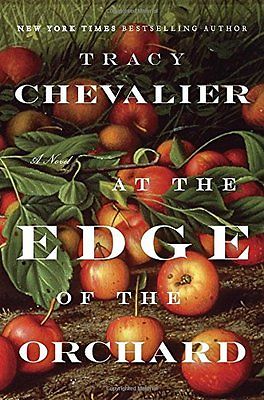
‘At the Edge of the Orchard’ by Tracy Chevalier – Misfortunes and Frolics on the American Frontier


‘At the Edge of the Orchard’ by Tracy Chevalier    (2016) –   285 pages


$_1One of the mistakes that too many novelists make is to have all their choice villain roles filled by males.  The women are all too often depicted as wooden paragons of virtue.  This is particularly true of frontier novels where the family is already up against the harsh natural elements.  ‘At the Edge of the Orchard’ by Tracy Chevalier is refreshing in that one of its main female characters is unexpectedly truly nasty and vile in many ways.   That fact alone makes ‘Orchard’ an inherently more interesting novel.

I was a bit behind the times with Chevalier as I still saw her as an author of European novels like her ‘Girl with a Pearl Earring’ which is about Dutch painter Johannes Van Meer and the girl in his famous painting.  ‘Orchard’ is a novel of the American frontier which takes places in the 1830s and 1840s and 1850s mostly in Ohio and California.  It is a bit of a surprise for me to see her taking on the primitive rough simple lives of the early American pioneers.

I have found that Tracy Chevalier excels in character-driven story telling in her fiction.  This is the third novel of hers that I have read, the other two being ‘Girl with a Pearl Earring’ and ‘Remarkable Creatures’.  Part of that story-telling ability is that she gives her characters, both male and female, the freedom to misbehave.  It is always fun to read about obnoxious or frivolous people.

The characters in her stories make Chevalier’s fiction come alive.  Just like in Charles Dickens, we are given a wide range of spirited characters, some of them likeable and some of them despicable, all of them memorable.

In ‘Orchard’ we start out with a frontier family in the 1830s trying to make a go of it in the wilds of western Ohio.  They plant apple trees.  The family name is Goodenough which is such an eloquent name; I’ve known some Goodenoughs in my time.  The mother Sadie has twelve babies, seven of which die young from the various fevers and diseases.  John Chapman, otherwise known as Johnny Appleseed, visits their farm.

Later we go out to California for the gold rush with one of the sons, Robert.  At the point where he leaves Ohio, I was so fascinated by the Ohio story that I wished Chevalier had continued there rather than moving on to California.  Later, the California story also becomes engaging in its own right due to the offbeat characters.

I do believe that Tracy Chevalier has the gift of Charles Dickens for presenting a variety of colorful characters in all their charming and wicked glories.


Grade:    A-            

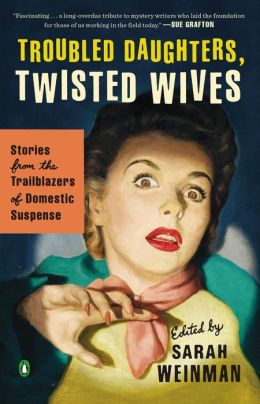
‘Troubled Daughters, Twisted Wives – Stories from the Trailblazers of Domestic Suspense’


‘Troubled Daughters, Twisted Wives – Stories from the Trailblazers of Domestic Suspense’  (2013) – 352 pages


troubled-daughters

All of the crime stories in ‘Troubled Daughters, Twisted Wives’ are written by women, and all were written between 1940 and 1979.  This time frame corresponds somewhat to the noir era, but extends beyond it.

One landmark in crime fiction written by women must have been when Alfred Hitchcock in 1951 purchased ‘Strangers on a Train’, the first novel by Patricia Highsmith. As usual, Hitchcock kept his name out of the negotiations to keep the purchase price low, and he paid just $7,500 for the novel.  Highsmith was quite annoyed when she later discovered who bought the rights for such a small amount.   The film is now considered a classic.  Patricia Highsmith does have the first story in this collection.

I was familiar before with only four of these fourteen story writers:  Patricia Highsmith (‘Carol’), Shirley Jackson (‘The Lottery’), Vera Caspary (‘Laura’), and Dorothy B. Hughes (‘The Expendable Man’).  One of the nice things about the collection is that a short biography is included for each author before their story.

Here is a list of the woman writers who were unknown to me in this collection: Nedra Tyre, Barbara Callahan, Helen Nielsen, Joyce Harrington, Elisabeth Sanxay Holding, Charlotte Armstrong, Dorothy Salisbury Davis, Margaret Millar, Miriam Allen Deford, and Celia Fremlin.

So who were these women mystery writers?  Most of them wrote short stories for mystery magazines such as Ellery Queen’s Mystery Magazine, Alfred Hitchcock’s Mystery Magazine, or Manhunt.  They competed to win Edgar awards.  When television became popular, scripts were needed for the weekly shows, and some of the early series such as Alfred Hitchcock Presents, Twilight Zone, and Perry Mason bought scripts from independent writers.  If a writer was successful writing short stories and/or scripts, they might produce a novel.  I suppose crime fiction was a way for woman authors to write about the rough side of life.

For me, reading a good anthology of stories is a delectable experience.  I deliberately read the stories out of order, juxtaposing short stories with long stories, stories by familiar authors with unfamiliar authors, until I complete the whole book.  Each story is a new adventure just waiting for me.

Not every story in ‘Troubled Daughters, Twisted Wives’ was a total winner for me.    Some of the stories are heavy on plot but thin on character development.  In some of the stories the authors seem to be so busy dealing with the contortions of the plot that the characters remain rather sketchy.  I am not going to rank my reactions to each story since part of the fun of reading an anthology collection is deciding for yourself which stories you like and which you don’t care for so much.

Overall, I consider ‘Troubled Daughters, Twisted Wives’ a good anthology experience, and if you are at all interested in the evil that females can do or can imagine, you will enjoy it.


Grade:   B+


‘Mothering Sunday – A Romance’ by Graham Swift – A Perfect Novella


‘Mothering Sunday’ by Graham Swift   (2016) – 177 pages


57132730c62092c044078e83

“Once upon a time…”  Thus  ‘Mothering Sunday’ begins that old reliable way, and by its end it fulfills my ideal of the perfect novella.

It is a simple story with broad insights into maids, class, love, sex, war, and writing.  It takes place on Sunday March 30, 1924.  Two rooms in the Sheringham manor have been left unchanged since two of their sons left for World War I never to return.  Remaining son to the manor-born Paul Sheringham is soon to be married to his arranged fiancé.  However the day is Mothering Sunday which is the one English day of the year on which domestic servants are given a holiday, and this is Paul’s last chance to dally in bed with the next-door neighbors’ household maid Jane Fairfield, his secret lover for the past six years.  All is told from the maid’s point of view.

‘Mothering Sunday’ captures the sunny ambiance of an unseasonably warm spring day in the Twenties and the sparks of an illicit but romantic love affair.

“It was about being true to the very stuff of life, it was about trying to capture, though you never could, the very feeling of being alive.”  

During the course of the story, we learn Jane Fairfield’s entire biography via flashbacks and flash-forwards from her days in an orphanage up to the time when she is 98 years old and a renowned writer.  As the years go by, the world changes, and new opportunities open up even for a girl who was born as a foundling.   Thank heaven that things are not set in concrete.

“Many things in life – oh so many more than we think – can never be explained at all.”

I completed ‘Mothering Sunday’ in one day, and I am not a fast reader.  Comparisons will inevitably be drawn with that other recent English romantic novella, ‘On Chesil Beach’ by Ian McEwan.  I believe ‘Mothering Sunday’ will hold up very well in the comparison.   From his early novels such as ‘Shuttlecock’ and ‘Waterland’, Graham Swift has been writing excellent unique novels that defy expectations.  Perhaps Swift has been underrated in recent years, but ‘Mothering Sunday’ should change all that.

‘Mothering Sunday’ is a good-natured exquisitely written small slice of life from the 1920s.  I can hardly wait for the movie.


Grade:   A   


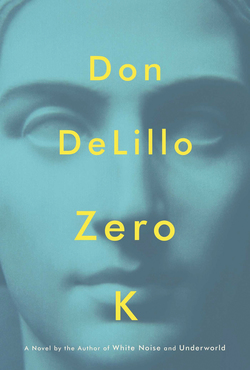
‘Zero K’ by Don DeLillo – Can One Complain About a Lack of Warmth in a Cryonics Novel?


‘Zero K’ by Don DeLillo    (2016) – 274 pages


medium

It is not that I lack appreciation for Don DeLillo’s previous work.  I consider his three novels ‘White Noise’, ‘Libra’, and ‘Mao II’ among the finest totally captivating modern fiction I have read.  Somehow I still haven’t gotten to ‘Underworld’ which is supposed to be his ultimate masterpiece.

“In ‘Mao II’, DeLillo said, “Stories have no point if they don’t absorb our terror”.  DeLillo has confronted the all-encompassing horrors and frights of our modern world for his entire career from Hitler studies (‘White Noise’) to the Kennedy assassination (‘Libra’) to global terrorism (‘Mao II’).

However his new cryonics novel ‘Zero K’ did not work for me.  Sorry.

I fully expect that many of the robber barons of the 21st century, after gloriously partaking in all the good and great things in this short life, now are doing all imaginable to extend that life beyond its mortal limits.  If that means having their bodies frozen in a cryonic chamber until a cure for death can be found, so be it.

“Life everlasting belongs to those of breathtaking wealth.”  

First, here are some facts about the reality of cryonics.  Way back in 1967, James Bedford was the first person put in successful cryonic suspension by the actual non-profit Alcor Foundation of Scottsdale, Arizona which is the largest cryonics organization in the world.  He is still waiting to be thawed.  Perhaps the most famous person to be suspended there is baseball Hall-of-Famer Ted Williams.   The Alcor Corporation currently holds 52 whole bodies and 94 human brains in suspension.

So the idea of cryonics has been around for at least 50 years.  DeLillo personalizes his cryonics story by putting his fully developed fictional characters in this situation.

DeLillo’s novel ‘Zero K’ mainly takes place in far-off Kyrgyzstan where an operation called Convergence has built a cryonics compound.  Wealthy businessman Ross Lockhart has brought his ailing wife here to be frozen.  Ross’s son Jeffrey accompanies them, and he tells the story.

“At some point in the future, death will become unacceptable even as the life of the planet becomes more fragile.”

Much of the dialogue in ‘Zero K’ consists of such pronouncements, and many of the scenes are apocalyptic visions rather than actual events.  All of these disembodied voices and images make the novel seem distant and cold, and I never did warm up to these characters.

The major part of the novel which takes place at the compound in Kyrgyzstan is at least susceptible to human understanding, stark and cold but still comprehensible.   However I found the later scenes that take place in New York to be a pointless portentous muddle.

By all means read Don DeLillo, because he is for sure one of the modern great fiction writers, but once again perhaps you might skip ‘Zero K’.


 Grade:   C+ 


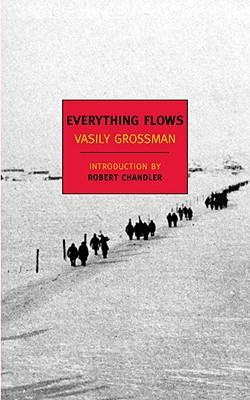
‘Everything Flows’ by Vasily Grossman – “The Madness of False Accusations”


‘Everything Flows’ by Vasily Grossman (1964)  – 208 pages

Translated from the Russian by Robert and Elizabeth Chandler with Anna Aslanyan


9781590173282

After World War II, reporter Vasily Grossman gave one of the first eyewitness accounts of the atrocities and conditions at the Nazi extermination camp at Treblinka.  His account was used as evidence for the prosecution at the Nuremburg  war crime trials after the war.  Later Grossman’s faith in the Soviet Union itself was severely shaken by Josef Stalin’s harsh dictatorship and anti-Semitism.  So who was there better than Vasily Grossman to track the brutal failure of the Communist Soviet Union in a novel?

It is all there in ‘Everything Flows’, the state-induced famine in the Ukraine, neighbors denouncing their neighbors who are then separated from their families and sent off to Siberia, women taken away from their husbands and children, relocated to Siberia, and made to live in barracks in forced-labor camps.  Those who denounced others were rewarded with all the good things in life, while millions of people were displaced and their lives virtually destroyed.

At one point in ‘Everything Flows’ one of the characters asks the question “How could the Germans send Jewish children to die in the gas chambers?”  His answer to that question is I believe one of the most powerful of all.

“From looking at his victim as other than human, he ceases to be human himself.” 

It is much easier to mistreat other people, if you have been persuaded that these others are less than human.  However in this dehumanizing process, you become less than human yourself.

‘Everything Flows’ is an extremely powerful book.  It was written in 1962 shortly before Vasily Grossman’s death, but it was not allowed to be published until 1984.  After it was published, the Soviet Union had to give up any pretense that Communism was a form of government that was in any way good for the people, and Communism quickly fell thereafter.  You may see this as an over-simplified view of the publishing of ‘Everything Flows’ but read the book first.

‘Everything Flows’ is obviously lacking and inadequate as fiction, but it is the  best, most honest, diagnosis of what went wrong with Communism in the Soviet Union I have ever read. About two-thirds of the way through ‘Everything Flows’, Grossman abandons all pretense to fiction and writes a strong polemic about Lenin and Stalin and the Soviet state.   It covers the same territory for the Soviet Union as Lianke Yan’s masterpiece ‘The Four Books’ covers for Red China, but the two novels are not that similar at all.  Whereas ‘The Four Books’ is allegorical, ‘Everything Flows’ is a passionate argument.

“In order to make the State all-powerful, freedom had to be killed in all facets of life. It was not only in politics and public activity that freedom was overcome.  Freedom was overcome everywhere, from the realm of agriculture – the peasants’ right to sow freely and harvest freely – to the realms of poetry and philosophy.  It is the same whether we are talking about shoemaking, the choice of reading matter, or moving from one apartment to another; in every sphere of life freedom was overcome.

Freedom, after all, is life; in order to kill freedom, Stalin had to kill life.”

989081


Grade:    A


‘99 Poems: New and Selected’ by Dana Gioia – A Versatile Selection


‘99 Poems: New and Selected’ by Dana Gioia    (2016) – 188 pages


99_Poems_400h

I could connect with many of the poems in ’99 Poems’ by Danas Gioia.  For me, that is high praise of a poetry selection indeed.  I call ’99 Poems’ a selection because it is made up of new and selected poems.  I try to avoid collections, because collections tend to bombard you with everything the poet ever wrote whether good or bad. My love of poetry is not to the extent that I want to wade through mediocre poems.  I like my poetry books to at least be selective.

‘99 Poems’ is made up of seven sections.  Like everyone else, poets like to put their best foot forward at the start, and the first section ‘Mystery’ contains several of the best poems.

Let’s start with the poem ‘Insomnia’.  It is about a man lying awake in bed in his house unable to sleep.  The entire poem is excellent, but the following lines particularly hit home for me.


But now you must listen to the things you own,

All that you’ve worked for these past years,

The murmur of property, of things in disrepair,

About moving parts about to come undone,

And twisting in the sheets remember all

the faces you could not bring yourself to love.

The second section is called ‘Place’, and these poems are observations of nature.  The third section is called ‘Remembrance’ which contains poems in memory of his first son who passed away. Some of the poems he wrote about his son are quite poignant, but I also like the ones Gioia wrote in a minor key.  Consider these lines from the poem ‘Words’ which is in the first section:

The world does not need words.  It articulates itself

In sunlight, leaves, and shadows.  The stones on the path

Are no less real for lying uncatalogued and uncounted.

The fluent leaves speak only the dialect of pure being,

The kiss is still fully itself though no words were spoken.

The fourth section is entitled ‘Imagination’.  One poem here is ‘Title Index to My Next Book of Poems’ which I found to be quite humorous.

The fifth section is called ‘Stories’ which as its title implies are story poems which can be up to fifteen pages long.  Fortunately Gioia gives these longer poems a less intense narrative style that makes them easy to read quickly.  I enjoyed these stories, particularly the one called ‘Style’.

The sixth section is entitled ‘Songs’, and these poems have the traditional qualities of rhyme and measure and thus are easy to like and appreciate.  The final section is called ‘Love’.

So in this poetry selection, we have nearly all the different kinds of poems that exist.  Dana Gioia is a versatile poet, but one wonders if instead of doing so many different kinds of poems, he might have gone deeper with one particular type of poem.  Perhaps in the future he might take his strongest suit and develop his own unique style.

Overall in these poems, I found Dana Gioia to be an amusing and acute companion.


Grade:   B+


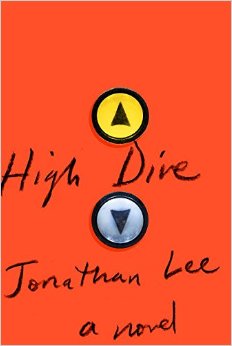
‘High Dive’ by Jonathan Lee – Trouble at the Grand Brighton Hotel


‘High Dive’ by Jonathan Lee    (2016)  – 318 pages


41RRBHZa4BL._SY344_BO1,204,203,200_Somehow I missed the news story of the Grand Brighton Hotel bombing when it actually occurred.  The United States was right in the midst of its Presidential and other elections of 1984 when it occurred on October 12, 1984, and the media here gets obsessed with our own elections to the exclusion of all else.   Anyhow the then ruling Conservative Party in Great Britain was holding its annual conference at the Grand Brighton Hotel. The Prime Minister Margaret Thatcher was there along with her husband Dennis as well as many other government dignitaries.  Unbeknownst to them, the Provisional Irish Republican Army had planted a big bomb with a long delay timer within the hotel weeks before, set to go off at exactly 2:51 AM on October 12.  The bomb did explode as planned doing severe damage to the hotel, and five people staying in the hotel were killed and dozens were injured.  Margaret Thatcher and her husband Dennis were unharmed, although their room was damaged.

‘High Dive’ is a vivid audacious fictional account of this incident.  There are three main characters.  We have Dennis who is one of the IRA guys who set the bomb, Moose Finch who is the assistant general manager at the Grand Brighton Hotel, and his eighteen year old daughter Freya who is working at the reception desk at the hotel over summer.

I knew I was going to really like ‘High Dive’  when I found out that the hair salon where Freya goes is called Curl Up and Dye.   The writing here is wicked and lively, and there is a surprising delightful curve ball in nearly every sentence.   While I was reading ‘High Dive’, especially for the first 200 or so pages, I got this strong sense of exhilaration that I only get when I am reading the best novels.  Jonathan Lee has a strong empathy for his characters and his handling of scenes is especially well done.

‘High Dive’ is not a technical thriller in any sense of the term.  The actual wiring and planting of the bomb or any of the details regarding the bomb are not even covered in the novel.  Instead ‘High Dive’ is a novel about the emotional lives of the people listed above.

After the bomb is planted at the Hotel, it is a matter of waiting for the ultimate explosion.   As the pages mount up as we are awaiting the detonation of the bomb, the high energy of the novel dissipates somewhat.   Although as I said before, Jonathan Lee has great empathy for his people, the everyday events that Dennis, Moose, and Freya deal with at the hotel are almost too mundane to carry the novel.

But overall ‘High Dive’ is an exceptionally strong performance, and I expect most everyone will feel curiously uplifted by this vivid and devilishly well-written story about a bomb.


Grade:    A-


‘A Manual for Cleaning Women’ by Lucia Berlin


‘A Manual for Cleaning Women’ by Lucia Berlin   (2015) – 399 pages


a-manual-for-cleaning-women-by-lucia-berlin

During her lifetime Lucia Berlin wrote 76 stories of which 43 of them were selected for ‘A Manual for Cleaning Women’.  She lived for exactly 68 years, passing away on her birthday in 2004.  She was married three times and had four children.  As a child she lived in mining camps in Idaho, Montana, Arizona, and Chile.  As an adult she lived in New Mexico, Mexico, California, Colorado, and Wyoming.   To support herself and her family, she taught creative writing, worked as a cleaning woman, as a ward clerk in emergency rooms and as a telephone switchboard operator, etc.   She was plagued with health problems including double scoliosis which required her to carry an oxygen tank for many of her last years.  She had severe bouts with alcoholism which she was able to conquer in middle age.  Earlier she had spent time in detox centers.

I think that it is pretty safe to say that this is not your typical biography of a fiction writer.

“God sends drunks blackouts because if they knew what they had done they would surely die of shame.” – “Mama”

Lucia Berlin tells her stories by indirection.  She allows her characters to do things that are not totally scripted.  Compared to hers, other people’s stories are too tightly plotted.  She allows her characters the freedom to do and say surprising things.  Her characters’ behavior is not pre-ordained.   At first this freedom of behavior is a little disorienting to the reader. Just about anything can happen in one of Berlin’s stories at any time.  These are glimpses of shapeless, formless, unfiltered reality.

“I tried to hide when Grandpa was drunk because he would catch me and rock me.  He was doing it once in the big rocker, holding me tight, the chair bouncing off the ground inches from the red-hot stove, his thing jabbing, jabbing my behind.  He was singing ‘Old Tin Pan with the Hole in the Bottom’.  Loud. Panting and grunting.  Only a few feet away Mamie sat, reading the Bible while I screamed, “Mamie! Help me!” Uncle John showed up, drunk and dusty. He grabbed me away from Grandpa, pulled the old man up by his shirt.  He said he’d kill him with his bare hands next time.  Then he slammed shut Mamie’s Bible.” – “Silence” 

   At first I thought these stories were exceptionally rough, crude, and unpolished to the point where they were difficult to read.    My thanks to JacquiWine for convincing me to give ‘A Manual for Cleaning Women’ one more chance.

In Berlin’s story “The Step”, a bunch of alcoholics in their identical blue pajamas gather around a TV screen at a detox center to watch a fight between Sugar Ray Leonard and Wilfred Benitez.

In “Carmen”, a pregnant woman takes a taxicab to a Mexican slum to complete a drug deal for her addict boyfriend.

 “That’s the lousy thing about drugs, I thought.  They work.”  – “Carmen”

Whether the drug is cocaine, OxyContin, heroin, or even alcohol, I suppose this is true.

Even in the most daring unconventional fiction there are limits as to what can happen.  Events are limited by the writer’s imagination.  However in unfiltered reality anything can happen.  Perhaps things occurred in your classroom or neighborhood that were so shocking or disgusting that you won’t even remember them.  These are the kind of things that happen in Lucia Berlin’s stories.


Grade: A-

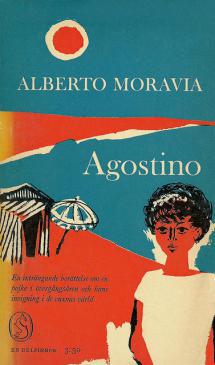
‘Agostino’ by Alberto Moravia – Mother Love


Agostino’ by Alberto Moravia    (1942) – 102 pages       Translated by Michael F. Moore

0_-3288008811398954192

‘Agostino’ begins with an idyllic summer morning scene of a thirteen year old boy, Agostino, out in a rowboat on the Mediterranean with his mother.

“Agostino’s mother was a big and beautiful woman still in her prime, and Agostino was filled with pride every time he got in the boat with her for one of their morning rides.” 

Agostino’s father has died, so he spends a lot of time with his mother.  On their boat trips, sometimes his mother would dive into the sea.

“Agostino would see the mother’s body plunge into a circle of green bubbles, and he would jump in right after her, ready to follow her anywhere, even to the bottom of the sea.  He would dive into the mother’s wake and feel as if even the cold compact water conserved traces of the passage of that beloved body.” 

Later while Agostino rowed the boat, his mother would remove the top of her bathing suit to expose her whole body to the sunlight.  Agostino steered the boat and did not look back at his mother.

One morning however a tanned young man appears, intruding upon the mother and son’s profound intimacy.  In a couple of days the young man and Agostino’s mother go off rowing by themselves, leaving Agostino behind.    After that Agostino must fend for himself.

He encounters a gang of rough boys his own age or older who hang around the beach with an adult lecherous homosexual sailor.  These ragged boys have disdain for Agostino since they can tell by the way he talks and dresses that he is upper class, not one of them.  With nothing else to do, Agostino soon runs with the gang every day.

“The dark realization came to him that a difficult and miserable age had begun for him, and he couldn’t imagine when it would end.”

‘Agostino’ is a fine novella, and as always in Alberto Moravia’s fiction, it deals with elemental issues.  Here we have a young boy enraptured by his beautiful mother who must move on and grow up, and growing up is not easy.   He must come to terms with his mother being just another woman.

Alberto Moravia captures the real down-to-earth drama that occurs in our lives, not on the glamorous or noteworthy occasions, but instead the subtle every day transformations each of us must undergo.  A boy growing up to become a man (‘Agostino’), a wife whose attitude changes toward her husband after two years of marriage (‘Contempt’),  a woman who works as a prostitute (‘The Woman of Rome’).   By tracing problems that face individuals, he can deal with what causes the fascism sickness of entire societies (‘The Time of Indifference’, ‘The Conformist’).

The lyrical and passionate realism of the novels and stories of Alberto Moravia is just as strong and meaningful today as it was back when they were written in the middle of the twentieth century.

images

Grade:   A 


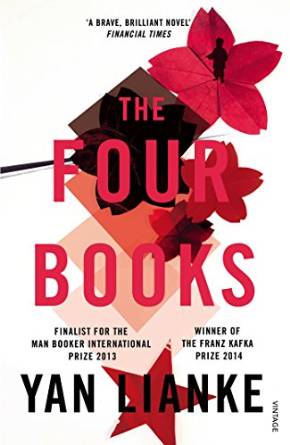
‘The Four Books’ by Yan Lianke – The Great Leap Backward


‘The Four Books’ by Yan Lianke    (2010) – 358 pages    Translated by Carlos Rojas

510VTGJoSnL._SY445_QL70_

So as it turns out, I have read the following three of the six novels on the 2016 Man Booker International shortlist:  ‘The Story of the Lost Child’ by Elena Ferrante, ‘The Vegetarian’ by Han Kang, and ‘The Four Books’ by Yan Lianke.  I did not set out to read so many from the shortlist intentionally; it just worked out that way.  The Ferrante is my sentimental favorite, but I don’t want my sentimental favorite to win.  I want ‘The Four Books’ to win because it is one of the most powerful, ridiculing, and devastating of all the novels I have ever read.

‘The Four Books’ is a novel about the Great Leap Forward which was an economic and social campaign of the People’s Republic of China from 1958 to 1961.  The Great Leap Forward started by Chairman Mao Zedong is widely considered to have caused the following massive Great Chinese Famine which resulted in tens of millions of starvation deaths.  ‘The Four Books’ is the first fictional account of the Great Leap Forward ever published.  It is set in one of the forced labor camps that were set up to improve agricultural productivity.

At first, people were encouraged to speak their minds during the Hundred Flowers Campaign, but when they did speak up, these scientists, engineers, professors, musicians, and writers were forcibly taken away from their families for their rightest views and sent to these labor camps to work on the farm. ‘The Four Books’ is narrated by one of these intellectuals, and he ironically refers to himself and his fellow inmates as ‘Criminals’.

They all just want to get out of the camp and go home to their families if only even for a few days.  The leader of the camp who I expect is a stand-in for Mao Zedong is known as The Child for his youthful appearance.  He sets up a reward system based on flowers so when someone accumulates enough flowers he or she can go home for a few days.  One of the main ways to get flowers is to report bad stuff on your fellow inmates.  Sexual liaisons are particularly forbidden.  So then you have all these inmates spying on each other in order to win flowers.  Also the campers must watch over their flowers very closely or someone else might steal them.

Even though the Great Leap Forward was a deadly business, Yan Lianke sees the humor of all these campers behaving childishly in order to impress their leader, get some flowers, and at least be able to leave the camp for a few days.  One of the points Lianke makes is that the simplistic rules of the camp caused the inmates to revert to childish behavior.

Later we get into the ‘home’ steel production fiasco and then the discovery of a startling new way to fertilize the crops.

One would think reading about forced labor camps and famines would be brutal and gruesome heavy reading, but Yan Lianke lightens the story up with irony and sarcasm and ridicule.  The mood of ‘The Four Books’ could best be described as “bitter laughter”.  I admire the way Lianke uses humor to tell the inside story about these forced labor camps.  Humor does not make a horrible situation any brighter, but it can help point the way as to what went wrong.

This is a story that absolutely needed to be told.  Yan Lianke worked twenty years on this novel, and it was rejected by 20 publishers for political reasons.  Now that it has finally been published and translated, the world can see that he has succeeded brilliantly in telling the awful story of the Great Leap Forward.


Grade:    A