Archive for the ‘Book Reviews’ Category

‘Glass Houses’ by Louise Penny – Three Pines, Quebec is a State of Mind

‘Glass Houses’ by Louise Penny    (2017)  –   388 pages
“Three Pines is a state of mind. When we choose tolerance over hate, kindness over cruelty, goodness over bullying, when we choose to be hopeful not cynical, then we live in Three Pines.” – Louise Penney  

The town of Three Pines is a place where everyone treats and is treated with respect and concern.  Where else are you going to find that today?  It is a shame that this cozy little French Quebec town of Three Pines near the Vermont border has so many murders.  Fortunately they have Armand Gamache, Chief Superintendent of the Surete du Quebec, to nab the criminals.

Louise Penney novels have become my favorite guilty reading pleasure, my literary comfort food.  I realize that these police inspector novels are by no means high literature. Like so many murder mysteries, the plot of ‘Glass Houses’ is necessarily contrived, but this delightful remote little town of Three Pines intrigues me.

 “Readers come to Three Pines for the murders and the quirky villagers – Ruth, the foul-mouthed poet-sage and her duck, Rosa; Myrna, the retired therapist turned bookstore owner – but stay for the celebration of kindness and friendship, the plumbing of the nature of morality, and the musings on the creation of art and its purpose.”  – CS Monitor  

If I were to compare ‘Glass Houses’ to the other Louise Penny novels I have read, I liked it better than ‘The Nature of the Beast’ but not quite as much as ‘How the Light Gets In’ which is still my favorite. ‘Glass Houses’ is the thirteenth in the Gamache series of novels.

In ‘Glass Houses’, Three Pines must deal with the opioid crisis.   Some forms of fentanyl, the opioid that killed Minneapolis musician Prince, are 10,000 times stronger than morphine.  It only takes a relatively small amount of fentanyl to get its effect and even one dose can cause a deadly overdose. Fentanyl has been linked to thousands of overdose deaths in the United States and Canada. Being close to the Vermont border, Three Pines is an ideal place to sneak fentanyl across the border into the United States.

One thing I particularly like about the novels is that they will deal with high-stakes moral quandaries.  If Gamache has discovered a route for fentanyl deliverers into the United States should he arrest small-time operators using it or should he wait for the big shipment?  He compares himself to Winston Churchill who was faced with a similar choice during World War II after British scientists had cracked the German top secret Enigma codes, and the Allies knew ahead of time that the Germans were going to bomb Coventry, England.  Should Churchill warn the people of Coventry thus informing the Germans that the English had their Enigma codes or not?

The bottom line is that ‘Glass Houses’ worked for me as a mystery thriller set in this tiny Quebec village of Three Pines.


Grade :   A
 

‘Improvement’ by Joan Silber – Not Necessarily an Improvement

‘Improvement’ by Joan Silber   (2017) – 256 pages

One of the more common forms of fiction today is the linked story novel.  This type of novel is made up of individual stories which are tied together by a town as in Elizabeth Strout’s ‘Olive Kitteridge’ or by an event such as the Vietnam War as in Tim O’Brien’s ‘The Things They Carried’ or by a workplace such as the newspaper office in Tom Rachman’s ‘The Imperfectionists’ or by a theme such as music in Jennifer Egan’s “A Visit from the Goon Squad’ or by some other unifying device.  ‘Improvement’ by Joan Silber is just such a novel of linked stories.

The stories in ‘Improvement’ range in locales from the country of Turkey to New York City to Virginia, and they range in time across forty years, so time and location are not the unifying factors.  I was quite impressed by a previous novel of linked stories by Joan Silber called ‘Fools’.  However this new novel ‘Improvement’ didn’t really work for me.  I will explain why.

In what are supposed to be connected stories, the connective tissue here seemed vague and almost random.  I could not see how the stories were connected at all, and for me they might better have been just separate stand-alone stories.  I suppose the author somehow felt they were all joined under the title theme of ‘Improvement’ but I couldn’t see how the stories even fit that title.  I did not really see any improvement in the characters’ lives, as for the most part they behave miserably and rather meaninglessly. The individual stories felt mundane and rather pointless to me

Between the various chapters the groups of characters are nearly unrelated.  Thus the novel doesn’t build up any energy or allow the reader to develop strong feelings for the characters. A number of the characters in the novel are black, and I felt that the author fell back on racial stereotypes to some extent in her depictions rather than developing fully well-rounded individuals.

The description of the scenes and the plots of the various stories are perfectly clear and capably done, but they didn’t lead anywhere.  I didn’t feel that this novel transcended its material as some novels do. It left me feeling rather blah, and I felt no compelling urge to return to the novel when I wasn’t reading it except to get through with it once and for all.

I realize this judgment is rather severe for an author that I have admired and praised in the past for her short stories.  When a fiction doesn’t work for me, it just doesn’t work.


Grade :    C+


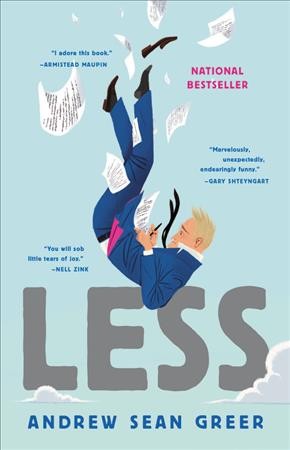
‘Less’ by Andrew Sean Greer – A Gay Guy Novel that Even a Non-Gay Guy Can Appreciate


‘Less’ by Andrew Sean Greer   (2017) – 261 pages

Can a novel about a gay guy be entirely fascinating to a non-gay guy?  I wasn’t sure that it was possible until I read ‘Less’ by Andrew Sean Greer.

Certainly I have read and admired many gay male writers, most closeted and a few not.  However, I have not read or been impressed by scarcely any out-and-out gay guy novels.  Until ‘Less’.    Andrew Sean Greer might be an Oscar Wilde for today.

It helps that ‘Less’ happens to be one of the most humorous novels that I have read.  Greer’s type of humor is universal, a guy laughing at himself and those around him as they sometimes make utter fools of themselves with their outrageous behavior.  Both gays and non-gays can relate to that.

Our hero, Andrew Less, is an author, and ‘Less’ is very much a novel about literary matters.  For many years Andrew lived with a famous older male poet, and Andrew then went off and had a ten-year fling with a younger guy who is now getting married to a new boyfriend.  So now Andrew is on his own.  He has written a couple of novels that didn’t sell all that well.  His third novel has just been rejected by the publisher. In fact, they hold “An Evening with Andrew Less”, and no one shows up.  Much of the humor in ‘Less’ is self-deprecating but high-spirited.

Andrew Less embarks on a trip around the world with stops in Mexico, Italy, Germany, France, Morocco, India, and Japan.

In Italy, he is to be given a literary prize. His second novel has been “super-translated” into Italian.  That means that the translator has greatly improved upon the original for the translation.

In Berlin, Andrew does a reading along with a Russian author for Cold War Nostalgia Night in a nightclub which has a Bond girl and Dr. Strangelove chic, and he there realizes he is boring people to death with his bad German.

In Germany and France, there are unexpected romances.

In Morocco, Andrew comes to the startling revelation that the main character of his recently rejected novel is not a hero but a fool, and Andrew busily begins to rewrite the novel from that perspective.  We readers just know that Andrew is on the right track now.

When author Greer senses that we may be getting bored by a scene or a remembrance, he quickly switches to something totally different. This is a strategy that I appreciate.

‘Less’ is very much a winning over-the-top novel.


Grade :   A
 

The Top Twelve List of the Best Fiction I Have Read in 2017


This year, there were so many fictions clamoring to be on my Best of Year list, that I seriously considered expanding it to a Top 20 list.  However reason ultimately prevailed, so here is my Top 12 list of the best fiction that I have read in 2017.

Click on either the picture or the title and author to read my original review for each book.


‘Golden Hill’ by Francis Spufford – Here is a delightful lively and upbeat historical novel about colonial New York City that kept me smiling throughout.  The guiding light for ‘Golden Hill’ is none other than William Shakespeare.


‘Miss Jane’ by Brad Watson – ‘Miss Jane’ is a novel that was written in 2016 which never did get the acclaim it deserved.  It is the life story of a girl who was dealt a bad hand of cards when she was born.  The story is told by the doctor who delivered her.  It is a story of quiet moving heroism and is a strong work of empathy.


‘Here is Berlin’ by Cristina Garcia – The city of Berlin suffered through a perhaps well-deserved widespread devastation at the end of World War II after its residents blindly followed an evil leader. ‘Here in Berlin’ is a collection of short fictional vignettes of Berliners remembering their pasts.


‘Solar Bones’ by Michael McCormick – This is an amazing one-sentence Irish novel that definitely fulfills the Goldsmiths Prize requirement, “Fiction at its most novel”.  It won that Goldsmiths Prize.


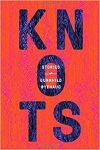
‘Knots’ by Gunnhild Øyehaug – Here are 26 very short stories by a Norwegian writer which are unique comic risqué takes on the relations between men and women. The stories in ‘Knots’ are stunningly original.


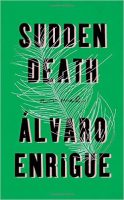
‘Sudden Death’ by Alvaro Enrigue – ‘Sudden Death’ is an incredibly rich entertaining whirlwind trip through the 16th century presented within the framework of a tennis match in 1599 between Italian artist Caravaggio and Spanish poet Francisco de Quevedo. Along the way, we have stops for English Queen Anne Boleyn and Spanish explorer Cortés and the church officials during the Counter Reformation as well as other excursions.


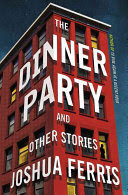
’The Dinner Party’ by Joshua Ferris – These are modern stories.  It is good to see a talented writer tackle what it means to be alive today in the United States.  These often raucous stories contain some quite awful men.  In other words, the stories are realistic.


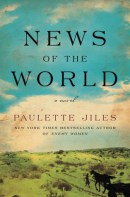
‘News of the World’ by Paulette Jiles – Here is a Western with a simple understated charm.  The story is told in a stately dignified manner like those great old classic Western movies of the 1940s and 1950s like   ‘Red River’, ‘High Noon’, ‘Stagecoach’, and ‘The Searchers’.


‘So Much Blue’ by Percival Everett – Here is a stylish ingratiating and good-natured novel with an odd mix of plot lines.  The main character is an artist who keeps his magnum opus of a giant painting hidden from his family and friends in an outbuilding near his house.


‘The Refugees’ by Viet Thanh Nguyen – Viet Thanh Nguyen is rapidly developing as one of the United States’ best writers, and these poignant stories of Vietnam refugees to the United States further enhance Nguyen’s reputation after his wonderful novel ‘The Sympathizer’ which made the upper reaches of my last year’s Best list.


‘Dunbar’ by Edward St. Aubyn – This is St Aubyn’s humorous yet honest modern take on Shakespeare’s ‘King Lear’ as a media company owner.   “They stole my empire and now they send me stinking lilies.”


‘Based on a True Story’ by Delphine de Vigan – Here is an exceptional novel that deals with the Reality vs Fiction question.  The main character in ‘Based on a True Story’ is Delphine de Vigan herself who is trying to write her next novel, but the mysterious woman L. invades her territory.


And I didn’t even get to mention ‘Beautiful Animals’…


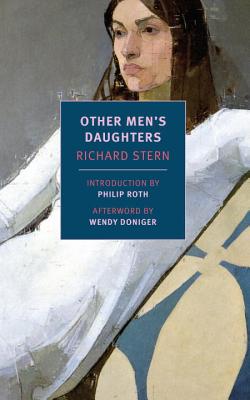
‘Other Men’s Daughters’ by Richard Stern – The Breakup of a Family


‘Other Men’s Daughters’ by Richard Stern   (1973) – 246 pages

Here is a novel that one might think would be relevant for today, since it is about a forty year old man, a married Harvard instructor, having a sexual affair with a twenty year old young woman.  The novel was written in 1973, not long after The Pill had burst on the scene which made this type of relationship much more viable than it was before.

In ‘Other Men’s Daughters’ the twenty year-old girl is the ardent pursuer while the forty year-old married man is hesitant and holds back until he finally falls into the affair.  That does not seem particularly realistic as generally the man is the chaser, even if The Pill is available to the girl.

My main problem is that we never get any strong sense of human attraction between this guy and his young girl.  Instead we get miles and miles of pedestrian inane exposition about Harvard with little or no payoff.  The guy is more in love with himself being at Harvard than he is with the girl.   We get very little sense that, despite their pretensions, human beings – both men and women – are still animals wearing clothes.  I guess I’m downgrading the novel for not being raunchy enough.  That was never a problem for Stern’s fellow author, Philip Roth who wrote the NYRB introduction to this novel. I guess that instead of all the maundering around on the streets and classrooms of Harvard, I wanted Stern to just deal directly with the guy and his girlfriend.

However the main point of ‘Other Men’s Daughters’ is to show the resulting breakup of the family caused by this extramarital relationship.  The husband and his wife did not get along at all for a long time, but when the wife finds out about her husband’s affair, it is divorce time.  There are also the four children ranging in age from about five to seventeen to take into consideration.  Here again I felt that Stern over-intellectualizes the situation instead of dealing directly with the feelings of those involved.  However there are a few times when Stern does capture the emotional toll as in the following interaction of husband and wife.

“They would pass each other on the stairs and exchange grunts. Two adult Americans trained in one of the centers of human fluency, grunting.  Twenty years in one bed, and the contra-faction of their lives issued in grunts.”

Despite a few good scenes and lines, overall ‘Other Men’s Daughters’ was somewhat of a slog to read with all of its prosaic avoidance of feelings.


Grade :   C+


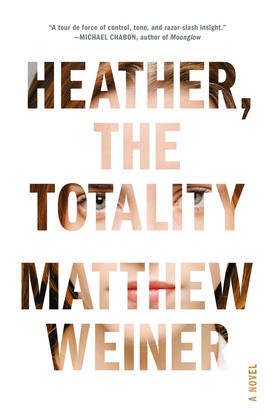
‘Heather, The Totality’ by Matthew Weiner – Faux Minimalism


‘Heather, The Totality’ by Matthew Weiner   (2017) – 134 pages

I admit I enjoyed ‘Mad Men’ the TV series which Matthew Weiner was heavily involved in creating, writing, and directing.  However I found ‘Heather The Totality’, Weiner’s first novel, to be sketchy and cartoonish and sub-mediocre.

You as a reader know you’re in trouble when a writer uses words like “rich” and “beautiful” and “handsome” with little or no elaboration or explanation to describe their characters.  ‘Heather, The Totality’ has such simplistic and unrealistic one-dimensional portrayals of its characters.  There is a preposterous contrast between the two main families portrayed in the novel.   One family is shown as rich and beautiful and near perfect.  The other family is led by the mother who is a heroin addict and allows a bunch of heroin addicts to party and lay around on the floor at her home until morning.  And her son Bobby, this guy is one bad, bad dude. He goes to prison for nearly killing a woman he wanted to rape.  I can see where Weiner wanted to contrast the wonderfulness of the one family with the horribleness of the other, but this is ridiculous.

The story here has the depth of a ‘Family Guy’ cartoon, a show I detest.

Even though Matthew Weiner is a professional screenwriter, there is hardly any direct dialogue in this novella.  That is why some reviewers called ‘Heather, in Totality’ a treatment rather than a work of fiction.  It is like each character is a blank to be filled in by a perceptive actor or actress.  Since there are no actors or actresses available for the reader, this does not help.

On the back cover of the novel there is an army of misguided glowing raves for ‘Heather, The Totality’ from famous writers, which for me is usually a bad sign.

‘Heather, The Totality’ has been called a minimalist novel, but I would call it a dumbed down minimalism.  A couple of the blurbs on the back of the novel mentioned Richard Yates, and these references made me angry.  I have read all of Richard Yates and am deeply impressed with his work. Richard Yates has great empathy for his characters. Matthew Weiner is in no way a Richard Yates.  Yates had a tremendous depth to his work, while this novella by Weiner is superficial and all on the surface.  Weiner and his admirers should be made to realize there is more to being a minimalist novelist than keeping your book short.

If you want to read a good minimalist novella, you might as well read the real thing, and I would suggest ‘The Easter Parade’ by Richard Yates instead.


Grade :   C-


‘Here in Berlin’ by Cristina Garcia – A Human Portrait of a City


‘Here in Berlin’ by Cristina Garcia   (2017) – 204 pages


The story of a city is the story of all the people who lived there.

Cristina Garcia is a Cuban American, and she went to Berlin, Germany to collect stories from Berliners and retell them.  In short vignettes of three to seven pages we get spirited scenes from Berlin’s past told through many distinct voices.

It must be kept in mind that all these stories of Berlin are fiction, enhanced for our reading pleasure, but like all good fiction they have the ring of truth.

  “She’d come to Berlin for stories, and the city had been more than generous.”

In many of these short monologues our author is addressed as Dear Visitor which lends them a certain charm.

“Dear Visitor, how can I convey to you the extent of the city’s ruin.  From the delusional heights of the so-called master race, we were reduced to living like rats in the rubble.  Our once great capital had become a veritable necropolis.”    

 Certainly brutalities were committed against the Berliners and the other Germans at the end of World War II, but nobody in the rest of the world cared after all the atrocities that the Nazis committed.  Most considered it justice.  One can’t help but believe that Berliners brought this all upon themselves with their devotion to Hitler and the Nazis.

“Thousands of Germans committed suicide just after the war – survivors who’d lost loved ones in the bombings, women and girls gang-raped by Russian soldiers.  I pictured river algae draping these girls’ skulls, the sallow cheeks, the perch pecking at their lifeless eyes.”

In one of the stories a zookeeper remembers that by the end of World War II, only 91 of 3,715 animals at the Berlin Zoo had survived. In another story a man recalls the time of the Nazis:

“Let me ask you something.  Have you ever seen a man beaten to death? No? Ah, then you are lucky, very lucky indeed.” 

I found the stories in ‘Here in Berlin’ to be lively and moving, a fitting tribute to the city of Berlin which has been through so much.

When I was in college I took several classes in German, and one of my instructors had lived in Germany for a few years.  The one word he especially wanted us to learn was “Gemütlichkeit”.  “Gemütlichkeit” is a state of warmth, friendliness, and good cheer that was supposedly unique to the German culture.  However Hitler and the Nazis destroyed any sense of a good feeling toward the German people.  The stories in ‘Here in Berlin’ do convey a warmth even when they are relating the terrible events associated with World War II.  Here in the United States, German beer fests are becoming quite popular events.  There is a chance that at some future time the German people will again be associated with “Gemütlichkeit”.

“As for Hitler’s bust, we dug a pit in the garden, dropped the bronze in the bottom and used it as a latrine.”


Grade:   A+   


‘Dunbar’ by Edward St. Aubyn – King Lear Comically Revisited


‘Dunbar’ by Edward St. Aubyn   (2017) – 244 pages

‘Dunbar’ is a pastiche on ‘King Lear’ that is a lot of fun. Instead of a King, we have a media mogul. Edward St. Aubyn writes under the reasonable premise that the world media owner families of today are at least as ruthless, petty, and cruel as the ancient royal families of yesteryear. Think Rupert Murdoch.

King Lear is considered one of the most depressing tragedies ever written, depressing even for a Shakespeare tragedy. St. Aubyn turns King Lear from a tragedy into an over-the-top comedy.  We realize from his Patrick Melrose series of novels that St. Aubyn knows just how dysfunctional and flat out crazy some of these aristocratic families can be.  In ‘Dunbar’ he has perfectly captured the lust for power and the wretched behavior of the super wealthy and privileged.

Old man Dunbar as a media king was the high priest of tabloid entertainment for the masses. Now he has just had his lofty position in his media empire swiped from him by his two elder daughters, and they have stuck him away in a remote sanatorium in the Lake District in rural England.

“They stole my empire and now they send me stinking lilies.”

.

The older daughters outdid themselves professing their great love for their father. The youngest daughter refused to play that game, so Dunbar in a rage disinherited her, a bad move because she is the only one who truly loves him. From the beginning, the two older daughters are portrayed as having an evil wickedness that knows no bounds.

St. Aubyn is one of those authors who understand it is not a novel’s final destination that matters but instead the joys and jests and other acute feelings we experience along the way that matter.  The story is played for laughs, but I suppose it also does contain its share of truth. Edward St. Aubyn is rapidly becoming one of my favorite fiction writers.  There is a verve to his individual sentences that carries the tale. Take this sentence from when Dunbar escapes from the care home into the pastoral moorland of the Midlands:

“The white noise of rushing water helped to camouflage the anxious murmur of his thoughts.” 

Here one of the few quiet moments in the novel is well captured. The humor early on is helped along by Peter who is a drunk but sharp-tongued comedian who plays the Fool in the story.

‘Dunbar’ would be an excellent zany novel even without the shadow of King Lear.


Grade:   A 


Why Poetry?

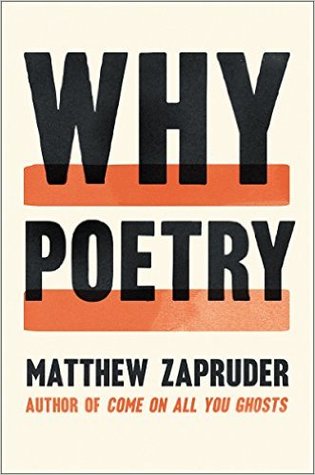
‘Why Poetry’ by Matthew Zapruder  (2017) – 226 pages

About half way through reading ‘Why Poetry’, I realized that the main purpose for the book is to serve as a textbook for a college survey course perhaps called Poetry 101.  It is written to be a guide book both for appreciating poetry and, to a limited extent, for writing poetry.

Matthew Zapruder occasionally mentions his experiences instructing students in such a course, sometimes at a college near Amherst, Massachusetts.  Amherst is the home of Emily Dickinson so it is the ideal place to be teaching poetry.

“Hope is the thing with feathers that perches in the soul.”   Emily Dickinson 

I cannot imagine a more perfect line of poetry than that.

I totally agree with Zapruder’s main point which is that we readers of poetry should take the words of a poem at face value, trust what is said on the surface of a poem, and not overextend ourselves looking for deep or buried meanings. Poetry is mainly about using words effectively, and we must count on the poet to do just that.

As for writing poetry, Zapruder’s advice is to not pursue a career of writing poetry unless you absolutely have to, which I think is good advice.  For myself, I majored in mathematics in college at the University of Wisconsin in Madison, and I stayed safely on the technical side for my career despite becoming increasingly enamored of literary fiction and poetry during my off hours.  I did not have to write fiction or poetry, so I didn’t, although I tried occasionally.

So ‘Why Poetry’ has that comprehensive textbook feel to it which isn’t exactly what I was looking for, but I stuck with it.  At the beginning there are some meaningful quotes by famous writers as to what poetry is which I appreciated.  Marianne Moore said that a poem is “a place for the genuine”.  Aristotle said poets are those who “have an eye for resemblances”.

  “A poem, when it works, is an action of a mind captured on a page.” – Anne Carson 

The book does not mention my favorite quote about poetry:

“A poet is one who manages, in a lifetime of standing out in thunderstorms, to be struck by lightning five or six times.”  – Randall Jarrell

Unfortunately for Randall Jarrell he never did get struck by lightning, and he does not have that one great poem that everyone has heard, although he was a wonderful critic who was responsible for single-handedly rediscovering the novel ‘The Man Who Loved Children’ by Christina Stead.

Anne Carson also has another great quote about poetry which is not mentioned in the book:

“Words bounce. Words, if you let them, will do what they want to do and what they have to do.” – Anne Carson, Autobiography in Red  

Here is a line from Matthew Zapruder himself that I liked:

“Art exists that one may recover the sensation of life; it exists to make one feel things, to make the stone stony.” – Matthew Zapruder

The beginning analyses of poems in ‘Why Poetry’ were quite rewarding for me, but as the analyses grew more complicated, they became less helpful to me.  I suppose to some extent my tastes in poetry diverged from Zapruder’s as I prefer the clear, simple and direct whereas he has a taste for the dreamlike and distracting.  There are some poets we both like including the aforementioned Emily Dickinson, Anne Carson, and Wallace Stevens.  However other poems he uses as examples left me high and dry.  I certainly did not study the examples with the intensity required for a college course.

There may be several reasons for my lack of appreciation for a poem.  Often, I suppose, it is me not paying close enough attention to the poem.  Other times a poem is fine, but it’s just not on the same wavelength as me.  The third possibility is that the poem is just not that good.

‘Why Poetry’ probably will work very well as a textbook, but it might not turn you into a poet or even a poetry aficionado.


Grade:   B      


‘Go, Went, Gone’ by Jenny Erpenbeck – A German Takes an Interest in the African Refugees

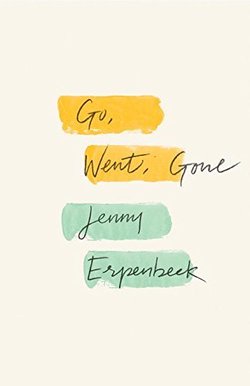
‘Go, Went, Gone’ by Jenny Erpenbeck  (2017)  –  283 pages                                               Translated from the German by Susan Bernofsky


“Where can a person go when he doesn’t know where to go?”

One of the main reasons I read fiction is curiosity about my fellow humans.

‘Go, Went, Gone” tells the story of Richard, a retired, widowed professor in Berlin, who discovers a whole new world of people outside his door.  Near his home, he discovers a group of African refugees, all of them men, who are protesting their treatment by the German authorities.  These refugees are treated by German society in general as nothing more than a problem and to be ignored unless and until they cause any disturbances.  They are moved from school building to office building to warehouse.

In German society where work is so important, these African refugee men are not allowed to work, not even to wash dishes. That is one of these men’s biggest complaints, that they have nothing to do all day long.  Some of them were skilled metalworkers in Libya or Niger or elsewhere, and others had different jobs.

“People have no respect, no empathy for other people; they have no sense of who other people are.  There’s a kind of withering away of the human sensibility, and that leads to the collapse of just about everything.”  – James Purdy

Yet these refugees were treated just as poorly in other European countries. Of Italy, one of the refugees says, “In the subways the Italians get up and sit somewhere else if I sit next to them.”

Richard gives these black men who are stranded in Germany with no place else to go the most important gift anyone can give them, an interest in their lives.  He listens to their stories of their harrowing times while still in Africa.  Many of these men had led relatively comfortable lives when suddenly all was upset by unrest and violence.  They were forced onto unseaworthy boats, and for one man, Rashid, he watched both his children drown when the boat capsized.  Rashid escaped.

The Germans tend to treat the disruptions in these men’s lives as something totally foreign outside of themselves, completely forgetting all the disruptions to Germans resulting from World War II and the division of Germany afterward.  Richard lived in the Eastern sector of Berlin and recalls how he was treated as a second-class citizen when Germany was reunited.

An immigration lawyer tells Richard that two thousand years ago the Teutons in Germany were quite hospitable.  In his book ‘Germania’, Tacitus wrote of these ancient Germans: “It is accounted a sin to turn any man away from your door. The host welcomes his guest with the best meal that his means allow.”

Some writers go overboard with special effects to win over their readers.  Instead Jenny Erpenbeck is one writer, like perhaps J. M Coetzee, who is confident enough in her technique that she remains resolutely unflashy and austere in presenting her story here. Also the lives of these refugees are necessarily plain and austere as they are prevented from doing anything useful and are moved around from building to building.  Perhaps the story Erpenbeck is telling here is so important it goes beyond artifice. “Go, Went, Gone” is not a fun or happy read, but the world is not always a fun or happy place.

In the final Acknowledgements section, Jenny Erpenbeck expresses her deep gratitude to the thirteen African refugees she had many good conversations with.  It shows in her writing.


Grade:  A


‘New People’ by Danzy Senna – She is Engaged Yet Out There Stalking


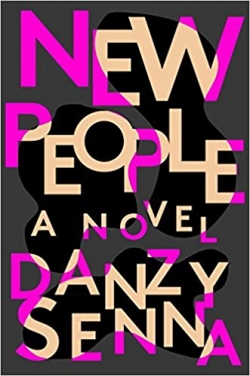
‘New People’ by Danzy Senna   (2017) – 229 pages

Maria is a young woman who ostensibly has it made.  She is in graduate school working on her dissertation on the Jonestown Temple massacre.  Her fiancée Khalil, after graduating college at Stanford, is hoping to cash in big on the first dot.com boom since this is the 1990s.  Both Maria and Khalil are biracial, “the same shade of beige”.   They will soon be married and against all odds they appear to be gliding into a happy upper middle class life.

But there is a slippery problem, and it all has to do with Maria.

Actually Maria is a “one dropper” and could pass for white, but she rebels by embracing her blackness.

“She grew up listening to Whitney Houston and she had never liked or known music out of the mainstream.  Being black and looking white was enough of a freak show.” 

Maria attends a poetry reading with Khalil and a friend, when a black poet she had seen before takes the stage and reads from his work.

“She wasn’t expecting to see him here tonight.  Now her face feels warm while she watches him step on to the stage and pick up the microphone.” 

“In the audience, listening to his voice, she realizes that she has been waiting to see him again.  She feels uneasy in this awareness.”

These short sharp lines are good examples of the lucid bold style of Danzy Senna.

Maria is immediately obsessed with “the poet”. She stalks him mercilessly and gets into some outrageously funny situations.  There are some most surprising hilarious turns in ‘New People’.  Totally engrossed in her search for the poet, she forgets her bridal dress fitting, much to the disgust of Khalil’s family.  She sneaks into the apartment next door to the poet and winds up holding and caring for a screaming baby when the woman living there mistakes her for the occasional babysitter Consuela.   In her crazed attraction for the poet, Maria drives even the trusting Khalil to suspicion.

I really liked the rapt yet playful tone of ‘New People’.  Even someone who is engaged can become terribly obsessed with someone else.  It is not fortunate, but it does happen.  Maria’s brazen obsession with the poet leads to some of the most ridiculous situations this side of ‘I Love Lucy’.  Just like Lucy, Maria is comical in her audacity.

‘New People’ loses some of its original merry energy towards the end, but up until then it is an unpredictable mad lively read.


Grade :   B  


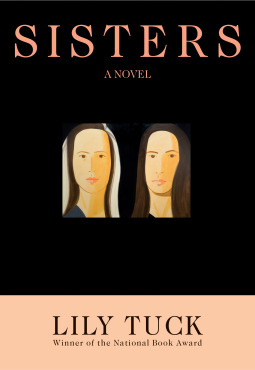
‘Sisters’ by Lily Tuck – “First and second wives are like sisters.”


‘Sisters’ by Lily Tuck   (2017) – 150 pages

If you ever read ‘Sisters’, I can guarantee you it will be one of the quickest novellas you have ever read.  It is only 150 pages, and there is a lot of white space in those pages.  At the same time it is an elegant witty performance based on the following premise which is stated in the novel’s epigraph:

“First and second wives are like sisters.” – Christopher Nicholson (Winter)

In the old days, it was not unusual for a man to marry his wife’s younger sister after his wife died.  Lily Tuck gives several examples of this phenomenon including Jane Austen’s brother Charles.  Although our first-person heroine narrator here in ‘Sisters’ is not a real sister to her husband’s ex-wife and the ex is not dead, she considers that there is a sisterly connection between them.

“And we don’t look alike.  She is blonde, fair-skinned, big-boned, and taller than I.  I have also seen photos of her as a young woman, and I have to admit she was lovely.  Truly.” 

This woman is clearly obsessed with her husband’s ex.  She calls the ex from a phone booth, so the call cannot be traced.  Phone booths are another object that is almost obsolete today like typewriters and film and cassettes.  The new wife gets chances to hear about and see the ex through the son and daughter from that previous marriage.

‘Sisters’ is filled with literary and other allusions which I always enjoy in a novel.  These references have a collage effect similar to that of the works of David Markson.  However, Markson’s allusions are more scattered while Lily Tuck’s allusions always fit into the context of the story in this short novella.

“Once while we were making love my husband called out her name instead of mine.”

‘Sisters’ is much more nasty and erotic than Jane Austen ever could be, and there is a surprising risqué twist at the end of ‘Sisters’.

Elegant, witty, literary, risqué, short.  How could a novella be any better than that?


Grade:   A   


‘Solar Bones’ by Mike McCormack – One Long, Fascinating Sentence


‘Solar Bones’ by Mike McCormack   (2017)   – 217 pages

There are no periods, no stopping points, in ‘Solar Bones’, not even at the very end of the novel. (I looked.)   It is one long stream of conscious thoughts, and what a stream it is!  You could say that what James Joyce started, Mike McCormack has finished by writing his entire novel as one long stream of consciousness.

This one is not a gimmick; this one is for real.  The absence of a period and the presence of a conjunction propel the reader forward on to the next paragraph and the next paragraph and the next and…  Just as our minds go from one thought directly to another that may only be peripherally related to the first, so goes ‘Solar Bones’.  I generally don’t like to take my breaks from reading in the middle of a sentence on an ‘and’, but with this novel I had no choice.

Often ‘Solar Bones’ reads like poetry, poetry written by an Irish engineering supervisor which is who our narrator Marcus Conway is.

“yes you’re an engineer, math and physics and suchlike, but it was always a bit of a mystery where all your references came from, all the poetry and philosophy that overtakes you from time to time, but now I know, it was all part of the old ecclesial schooling am I right” 

Yes, a time spent in religious training as a young man has made the difference for Marcus Conway.  He combines the rigorous calculation of the engineer with the more expansive view of the world that poetry and philosophy provide.

Don’t be put off by this talk of stream of consciousness and poetry; ‘Solar Bones’ is compulsively readable.  I sailed through this novel smiling at this guy’s vivid frequently humorous portrayal of his family and of his engineering fights.  His loving concern shines through for his wife Mairead, his daughter Agnes, and his son Darragh who’s in Australia but sometimes calls home via Skype  It is all overlaid with that old Irish charm which I try hard to resist but somehow fall for anyway.  If I have any complaint at all, it is that McCormick lays that Irish schtick on a little too thickly.

‘Solar Bones’ was the 2016 winner of the Goldsmiths Prize.  It definitely fulfills the Goldsmiths slogan “Fiction at its most novel”.


Grade :     A+   


‘Beast’ by Paul Kingsnorth – An English Man Alone

‘Beast’ by Paul Kingsnorth  (2017) – 164 pages

‘Beast’ is what I call an isolation novel.  Like Robinson Crusoe, Paul Buckmaster is a man alone. Buckmaster is a contemporary man who willingly left his village and wife and baby daughter to live by himself in a dilapidated shack out in the West Country English moors.

‘Are you looking for God or looking for your self? she said. Can you even tell the difference any more? … Six years, she said, it’s been six years, and you leave now, at the worst time there could be, and for nothing … You are a child, she said, you always have been, and now I have two children.’

Buckmaster sees his former village life as empty:

“Everywhere there were voices and I added my voice to them and we spoke out together and said nothing at all.”

“I walked the streets, I sat on the couches, I passed through the sliding doors, I talked but never listened, I sold but I never gave away.”  

He went to the wilderness seeking solace:

“I came here to measure myself against the great emptiness.”

‘Back there,’ Buckmaster says of his abandoned life, ‘I was an item, an object, a collection of gears, a library of facts compiled by others, a spark plug in a universal engine, an opinion machine, I was made of plastic and bamboo canes and black bin bags. I walked like I was human and alive but I was neither. I could know anything in an instant and I knew nothing … I need to be in the places where the light comes through, where people are thin on the ground, where the old spirits still mutter in the hedges and the stone rows.’

However by now Buckmaster has gone nearly insane after a year of solitude. ‘Perhaps I am losing my mind,’ he says: ‘I do hope so.’  On one of his long rambling walks through the woods, Buckmaster encounters a beast with penetrating yellow eyes: ‘a long low dark animal with a thin curling tail that it held above the ground as it walks’.  He has no idea what the creature is but is determined to see it again.

Although of course Kingsnorth never comes out and tells us what the Beast means, my own theory is that it represents this man’s guilt over leaving his wife and baby at a critical time.  Perhaps I’m being a little too straightforward and prosaic.

Whenever I read one of these heavy-duty isolation novels, I find myself longing for Jane Austen and her amusing congenial banter across the kitchen table.


Grade:   B+        


‘A Boy in Winter’ by Rachel Seiffert – A Brutal Nazi Atrocity in Ukraine During World War II


‘A Boy in Winter’ by Rachel Seiffert  (2017) – 242 pages

In Rachel Seiffert’s incisive new novel ‘A Boy in Winter’, Otto Pohl is a German engineer who considers the Nazis’ brutal war across Europe as criminal.  To avoid being complicit in the Nazis’ crimes, Pohl signs up to lead a road-building team in the Ukraine.  Originally he thinks he might be doing a positive thing, building a new road “for when the war is over, for when Hitler loses as he surely must”, but he comes to realize the evil purpose for which the Nazis will use the road.    He witnesses the Nazi SS storm through a small Ukrainian village and then round up all the town’s Jewish people herding them into an old brick factory.  Pohl then understands the truth about these SS Nazis.

“They do not think on a human scale. They do not think they deal with humans.”

At one point Pohl is given an opportunity to select workers for his team from among the imprisoned Jews.  He see only “shopkeepers and clerks, schoolteachers; respectable and indoor people in suits and spectacles”.  He sees that these people are clearly unsuited for the arduous work of roadbuilding, so he selects none of them.  Only after does he realize that he could have saved a few from a horrible death.

Later he witnesses the mass murder of hundreds of Jewish men, women, and children by the Nazis.  The estimate is that the Nazis killed close to a million Jewish people in Ukraine alone.

Rachel Seiffert has mentioned that the character of Otto Pohl is based on a real person, Willi Ahren, who hoped to avoid complicity in Nazi atrocities by transferring to the road construction corps.  Seiffert herself is the granddaughter of a Nazi doctor in the SS.  She regards her grandfather’s conduct “with a lot of sadness”.

“It’s very sobering because he’s a person to me and it’s people who do this. I can’t externalise it. I can’t say it happened over there and it was done by other people. It was very close to home. It means I’m very much aware of human capacity for that kind of cruelty. World War II is unfinished business for me.  I think it always will be.” – Rachel Seiffert

It is crucial for people to continue to confront the Nazi atrocities during World War II because otherwise the atrocities are bound to be repeated.  ‘A Boy in Winter’ would make a great movie just as Seiffert’s previous novel ‘The Dark Room’ was turned into the movie ‘Lore’.


Grade :   A


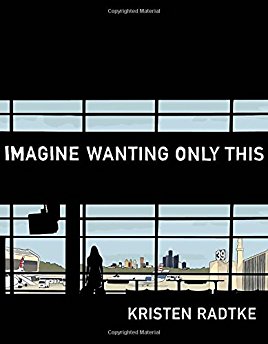
‘Imagine Wanting Only This’ by Kristen Radtke – Everything is Only Temporary


‘Imagine Wanting Only This’, a graphic memoir by Kristen Radtke   (2017) – 277 pages

The event that drives this graphic memoir ‘Imagine Wanting Only This’ is the early sudden death of the narrator’s beloved favorite Uncle Dan when she was a young girl. Later she discovers that she may also have the congenital heart condition that took her Uncle Dan. From then on, she is consumed with the impermanence of life and everything else and devotes much of her energy to studying it.  Not only lives are temporary but also buildings that go to ruins and even relationships which end. .  At one point Radtke writes that she’s “consumed by the question of how something that is can become, very suddenly, something that isn’t.”

Radtke’s approach is somewhat scattered with her taking incidents from around the world as part of her obsession with temporariness.  One incident she dwells on is the Peshtigo Fire of 1871 in her and my home state of Wisconsin which took more than 1200 lives.  Her travels take her to an abandoned church in Gary, Indiana to a village in Iceland decimated by a volcano to a deserted military base in the Philippines.

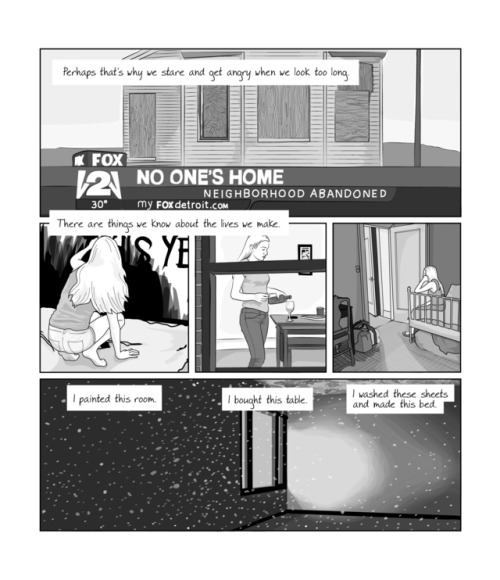
The graphics in this book are interesting throughout.  One quality is the many varied drawings throughout this graphic memoir.  However there is such a thing as being too earnest. The subject here – impermanence – is so deep it begs for a lighter approach.  More humor and lightness in the drawings would have helped.

 I do have one quibble. When Radtke portrays a TV news program about an abandoned Detroit neighborhood, she shows a scene from Fox News.  It is difficult not to deride anything associated with this propaganda network, and that detracts from the gravity of Radtke’s theme.

I don’t believe I have read any graphic book with a theme as serious as this one unless it was Maus and Maus II by Art Spiegelman about the Holocaust or ‘Persepolis’ by Marjane Satrapi about the Islamic Revolution in Iran.  However both of these other authors found ways to lighten their stories.  There is nothing lightening the melancholy mood in ‘Imagine Wanting Only This’ which takes itself somewhat too seriously.

I found Radtke’s approach to her subject just too diffuse and though she attempts to reach a unifying theme she does not quite succeed.  With her scattered approach, Radtke does not achieve the depth that her big subject of impermanence warrants.


Grade :    B –


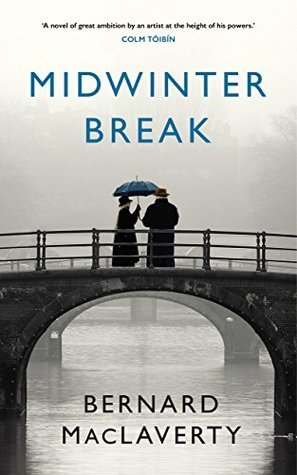
‘Midwinter Break’ by Bernard MacLaverty – Drowning in a Sea of Mundanity


‘Midwinter Break’ by Bernard MacLaverty    (2017) – 243 pages

I have read nearly all of the fiction of Bernard MacLaverty, and in each of his other novels and stories I was ultimately touched by the plights of his characters.  MacLaverty is known as a master of the quotidian and his quiet work has had a strong effect on me in the past.   However while reading his latest work, ‘Midwinter Break’, I constantly felt like I was drowning in a sea of mundanity, and I never did feel the poignancy I was supposed to feel for these characters.

In ‘Midwinter Break’, we have an old couple Gerry and Stella.  He is a retired architect, she is a housewife. He has a drinking problem; she is a devout Catholic.  Gerry is constantly sneaking drinks of Jameson behind Stella’s back. Even at this late stage after being married for several decades, Stella is still considering leaving Gerry.  She wants to join a group that is like a convent, however does not require vows of poverty or chastity.

Gerry and Stella are taking a short winter vacation in Amsterdam, and that is where most of the novel takes place.

Everything about this old couple is relentlessly ordinary.  I almost feel it is unfair to quote the dialogue here but I must to give you an idea of what you will encounter if you read this novel.

“What’s that?” said Gerry.

“Styling mousse.”

“And what’s that supposed to do?”

“It adds body to my – sadly – limp hair.”

“I wonder would it do anything for me,” Gerry said. 

“Volumising hold, as the can says.  Have you never seen me do this before?”

“Not that I remember.”

“At home I do all this in the bathroom.” 

There are pages and pages of this not exactly scintillating conversation about pigeons, flowers, coffee, etc., between Gerry and Stella.   I believe this story of Gerry and Stella would have worked much better as a short story rather than a novel.  That way MacLaverty could have given us the impression of the ordinariness of their lives without delivering us the full load.

There is one event that happened to Stella when she was pregnant many years ago that seems almost preposterous given the boredom of their current lives, but I suppose anything can happen to anyone at any time.

I must consider ‘Midwinter Break’ a disappointment, but Bernard MacLaverty is still in my pantheon of great writers due to his previous profound and moving work.

.

Grade :    C


‘Beautiful Animals’ by Lawrence Osborne – A Dazzling Dreadful Summer on a Greek Island


‘Beautiful Animals’ by Lawrence Osborne   (2017) – 287 pages

“A summer was just a summer, and its dead bodies should remain confined to it.”

Two young women, Naomi and Amy, develop a friendship over summer while their families stay on the Greek island of Hydra. The Greece debt crisis is a tragedy for the Greek people as they must now live in austere circumstances.  However there are still all of these obscenely rich families from around the world including England and the United States who stay at their villas on the Greek islands to spend their dazzling summer vacations going to stylish restaurants and tavernas and private parties and perhaps swimming in the sea at some secluded spot.

The summer intensifies for Naomi and Amy when they discover a young man, Faoud, escaped from Syria and washed up on shore in one of these secluded spots.

“To save another person: it wasn’t nothing … it was a small shift in the balance of power towards the weak.”

What could be more romantic for these two young women than saving this young good-looking Muslim guy who speaks correct English and needs their help?

“His misfortunes made him charismatic,” Naomi thinks, “and therefore arousing.”

Naomi comes up with a so-called “plan”.   However events tumble out of control as they tend to do.  Later the action switches from Greece to Italy.

In dealing with these international situations of intrigue, Lawrence Osborne comes about as close as any modern writer to Graham Greene.   Osborne’s writing doesn’t quite have the quirky charm of Graham Greene but his efficient prose does speed you along and makes for compulsive reading.  David Sexton in the Evening Standard has described Lawrence Osborne as “pitilessly good” and said that comparisons with Graham Greene “aren’t even flattering anymore”.   I would not quite go that far as I have read over a dozen Graham Greene novels and consider Greene the gold standard in international intrigue novels.  However Lawrence Osborne is among the best of the English writers today carrying on that noble travel tradition of Graham Greene.

“There is nothing more exasperating than reading in contemporary guidebooks disparagements of places that are deemed to be “seedy.” Do the writers not notice that such places are invariably crowded with people? When a neighborhood is described as “seedy” by some Lonely Planet prude, I immediately head there.” – Lawrence Osborne


Grade :   A-


‘The Burning Girl’ by Claire Messud – A Close Childhood Friendship Goes Awry

‘The Burning Girl’ by Claire Messud   (2017) – 247 pages

“Nobody particularly wants the happy ending when they care more for the story than the person.”

‘The Burning Girl’ is about two close friends in an early childhood friendship who move apart when they get to be around twelve years old.  This does happen in real life to both boys and girls.  Our early friendships are based more on proximity rather than shared interests or values.  It is not at all rare for a twelve year old to discover that they have little in common with even their best friend until then.  That does not mean that their friendship wasn’t entirely valid up until that point.

Several scenes early in the novel depict the closeness of these two young friends Julia and Cassie who live in the small town of Royston, Massachusetts. These scenes at an animal shelter, at a quarry, and at a defunct mental asylum showing the closeness of these two girls are well-done.

However in the seventh grade they start moving apart and in different circles.  Their separation is exasperated because Cassie gets a new stepfather whom she hates.

One criticism that keeps popping up in the reviews for ‘The Burning Girl’ is that the voice of the narrator is much too articulate for a twelve year old girl.  I don’t consider this criticism entirely valid, because I picture the narrator as Julia when she is fully grown up looking back on her childhood.  Thus it is not like Tom Sawyer where it is the kid telling the story.

Toward the end of the novel Messud uses the word “inchoate”.  Now “inchoate” is a word I cannot imagine any young person using.  In fact I had to look up that word myself. But with the narrator speaking as an adult I suppose the use of the word is entirely valid. Quick, give me the definition of “inchoate”.

So we have these two young girls who were the best of friends.  However when they reach adolescence, Cassie no longer wants to be friends.  Then from Julia’s perspective, we see Cassie’s family life and social life deteriorate.  We and Julia are standing on the sidelines watching Cassie’s life fall apart.  I do believe it would have been more substantial if we also saw more of Julia’s own struggles with adolescence.  As it is the story seems a little one-sided.


Grade :   B

‘Knots’ by Gunnhild Øyehaug – Original Comical Takes on the Relations Between Men and Women

‘Knots’ by Gunnhild Øyehaug   (2012) – 164 pages             Translated from the Norwegian by Kari Dickson

In ‘Knots’, there are 26 stories in the 164 pages which works out to an average of slightly over 6 pages per story.  I don’t need to tell you that reading ‘Knots’ is a vastly different experience from reading a 600 page novel. In ‘Knots’ we have 26 separate narratives, 26 groups of characters, and 26 different plots. And each story is quite different from the rest and by no means simple or easy to understand.  I had to read each story twice in order to fully comprehend each story, so ‘Knots’ is by no means an easy read.  However it is a fascinating read.

One must get into the spirit of each of these stories in order to get it.   A reader must expend a certain effort to fully appreciate each of these very short stories but in most cases it is well worth the effort.  One thing that stands out is the wide variety with each story vastly different from the others.  Apparently there is nothing that Øyehaug won’t try for a story.  These are not your standard issue stories by any means.  Many of the stories allude to literary figures, and they all have a distinctly Norwegian flavor.

Gunnhild Øyehaug puts her characters in comic risqué situations with a lot of humor and from a quirky woman’s point of view. The really short stories of one to four pages are cartoonish in the good sense of the word.  They are rude and sometimes crude. The longer stories are more fully developed.

In the story ‘Small Knots’, a mother gives birth to a son, a perfectly fine son.  There is just one problem.  The umbilical cord between mother and son cannot be cut by any means.  They lead as normal a life as possible, given this constraint.

In ‘Echo’ a young man Bjarte Bo idolizes another young guy Arild that he works with who is “a demon at selling encyclopedias” and thus a “success in its purest and rawest form”.  The one area where Bjarte Bo has the better of Arild is Bjarte’s girlfriend Tone.  Then Arild invites Bjarte and his girlfriend Tone to dinner at Arild’s apartment.  First Bjarte admires Arild’s Italian car which is sitting outside with an appreciative, “Damn”, and Tone responds by quoting Joyce.  This quote goes over Bjarte’s head as literary quotes are “something he didn’t know and didn’t care he didn’t know”.  Later during the dinner conversation Arild mentions that “Poetry was like the glow of a flame under glass”.  This remark resonates with Tone and soon Arild’s left hand “stole up the long split of her dress and she was more conscious of her body than she had been for a long time”.  There the story ends.

My favorite story is probably the last one, ‘Two by Two’, which is about a wife waiting for her husband to get back from a romantic tryst with his girlfriend on a snowy evening.  The wife’s attitude alternates depending on whether she is reflecting on Sylvia Plath or Ted Hughes.

Gunnhild Øyehaug is an original force as a writer.


Grade :   A