Archive for the ‘Book Reviews’ Category

‘Asymmetry’ by Lisa Halliday – An Asymmetrical Novel


‘Asymmetry’ by Lisa Halliday   (2018) – 271 pages
Am I the only one who found the novel ‘Asymmetry’ disjointed?

‘Asymmetry’ is divided into three parts. In Part I, we have the affair between a twenty-five year old woman named Alice and a seventy-two year old famous author who seems to bear a strong resemblance to Philip Roth. In Part II is the story of Amar Jaafari who is born to Iraqi Muslim parents but is a United States citizen by virtue of being born in the United States.  Part III is there seemingly just for fun and has the old author telling us his favorite music.

First let’s discuss the May-December relationship that is in Part I.

Do we even have to ask whether or not this old single man would jump into a relationship and into bed with this young woman?  For the woman this asymmetrical relationship is more questionable.  He has fame, prestige, and money.  She is a book editor and he is a famous author, so he is at the top rung of a field that she works in. He treats her very well. They both are avid Major League baseball fans, she for the Boston Red Sox, he for the New York Yankees. They seem quite compatible, but still…

Somehow her affair seems outside her real life. When someone asks the young woman if she is dating anyone, she tells them, “No”.  Only rarely does Alice have thoughts like:

“Dwarfed by the plane trees, he looked smaller and frailer than he did in the close refuge of his apartment, and for a moment Alice saw what she supposed other people would see: a healthy young woman losing time with a decrepit old man.”   

In this Part I, the writer Lisa Halliday has a light pleasant touch.  There are no angry or resentful arguments between this 72 year old man and this 25 year old woman.  The young woman is at least as happy with the affair as the man.

There is no lightness in Part II.  Amar Jaafari who is a citizen of the United States is trying to board a plane in London to return to his parents’ homeland of Iraq sometime in 2008 and is detained.  The United States is still fighting the needless tragedy of the Iraq War.  If Amar is detained much longer he will miss his connecting flight.

“My relatives would describe to me what Baghdad used to be like.  They told me that as recently as the Seventies, it looked like Istanbul does now: bustling with tourists and business people, a thriving cosmopolitan capital in an ascendant Middle East.  Before Iran, before Saddam, before sanctions and Operation Iraqi Freedom and now this, this too had been a country of culture, of education and commerce and beauty, and people came from all over the world to see it and be part of it.  And now? Do you see, Amar, this chaos outside our doors, this madness?”

The sentences are longer in Part II and much more serious.

There is no or very little connective tissue between Part I of ‘Asymmetry’ and Part II of ‘Asymmetry’.  Most reviewers were fine with that and connected the two parts under the rubric ‘asymmetry’ somehow. However I am not sure that the people who like the light romance of the May-December affair will like the heavy-duty story of the moral consequences of the Iraq War or visa-versa.

I had fun with Part III in which the old author from Part I is interviewed about his favorite music that he would take with him to a desert island.  It lightened things up again after the heavy-duty Part II.  Also it contained this excellent quote I had not heard before:

 “Wasn’t it Socrates, or one of his ilk, who said that the celibacy of old age is like finally being unwrapped from the back of a wild horse?” 


Grade:   B 
 

‘Berg’ by Ann Quin – A Captivating Sleazy Tale about Killing Dad


‘Berg’ by Ann Quin   (1964) – 168 pages

The late author Ann Quin left no doubt as to the plot of her novel ‘Berg’ with the following first sentence:

“A man called Berg, who changed his name to Greb, came to a seaside town intending to kill his father….”

The seaside town is unnamed but is probably Brighton, England, Quin’s hometown.

The father walked out on the mother and her small son many years ago, and what makes it even more annoying for the son is that his mother still speaks affectionately of the long-gone father.

“But I’m damned if I’ll allow the old bastard to get away with it, with the past.  I, the son, have every justification, people will sympathize, might even be considered a hero.”  

Now the son has tracked his father down to a broken-down hotel which is across the street from a dance hall, and it is the kind of hotel where men bring back women whom they have picked up at the dance hall.  The son gets a room adjoining the room where his father is staying with the latest of his many girlfriend flames who is almost as young as the son is, and the son can hear them through the wall in bed at night.

“Were they both just the other side, the old man, mole-like, crawling over her mounds of flesh?” 

This wicked novel takes another wicked turn when the son also winds up sleeping with his father’s young girlfriend.

The problem with murdering your father is that you have to get close enough to him so that you recognize the similarities between him and yourself.  As your mother used to say,

“You’re very similar in funny little ways, strange how it comes out like that, isn’t it.” 

‘Berg’ is seaside noir at its tackiest and most sordid. As a novel, I see ‘Berg’ as a cross between the writings of another Brighton writer Patrick Hamilton (author of Hangover Square, among others) and the romans durs of French writer Georges Simenon. It has the dark humor of the murder farce movie ‘Fargo’.  Yet ‘Berg’ has its own trashy magic.  ‘Berg’ was made into a not-very-good movie in 1990 called ‘Killing Dad’.

The author Ann Quin had a sad end.   During her life she had recurring bouts of depression and had endured electroconvulsive shock therapy.  She wrote three other novels besides ‘Berg’.  In 1973 at the age of 37, she walked off the Brighton Pier into the ocean.  Her body was recovered the next day.

Maybe if Ann Quin had lived, English literature might have been wilder, less cautious, and sleazier than it is today.


Grade:   A


Patrick White – One of My Favorite Fiction Writers of the 20th Century

Patrick White

Born:   May 28, 1912    Died:   September 30, 1990

Naming my favorite writers is kind of like populating my personal Mount Olympus with my own literary gods.  Each of the writers has their own special talents and strengths and weaknesses. Keeping with that Olympus analogy then my Zeus, my god above all gods, is Australian Patrick White.  If I can convey why Patrick White deserves this special place in my literary pantheon, I feel I will have accomplished something special.

First I want to say that White’s fiction has the vivid storytelling and the unique fascinating characters of traditional good fiction.  However he always attempted to go deeper into the human mystery and usually succeeded. Let me explain.

Let’s start with a couple of simple sentences from White’s story “Dead Roses” which is in his story collection ‘The Burnt Ones’”

“If she had only been able to touch him, they might perhaps have pooled their secrets and discovered the reason for human confusion. But as that wasn’t possible, she went outside, into the garden.”

Patrick White is always striving to find that deeper visceral truth between people that goes beyond thinking or rationality.   For instance, let’s take any situation where two people meet.  Each of us has a whole lifetime of experiences that make us unique including our inherited traits, sex, babyhood, childhood, parents, surroundings, school, work, friends, and enemies.  Reason can only take us so far in understanding what exactly happens when any two people meet or collide.  There is always a strong undercurrent.

“I am interested in detail. I enjoy decoration. By accumulating this mass of detail you throw light on things in a longer sense: in the long run it all adds up. It creates a texture — how shall I put it — a background, a period, which makes everything you write that much more convincing.” – Patrick White

All of the concrete detail in his stories keeps White from becoming too abstract. He is a writer who relies on the intuitive rather than intellect.

“I have the same idea with all my books: an attempt to come close to the core of reality, the structure of reality, as opposed to the merely superficial. The realistic novel is remote from art. A novel should heighten life, should give one an illuminating experience; it shouldn’t set out what you know already. I just muddle away at it. One gets flashes here and there, which help. I am not a philosopher or an intellectual. Practically anything I have done of any worth I feel I have done through my intuition, not my mind – which the intellectuals disapprove of. And that is why I am anathema to certain kinds of Australian intellectual.” – Patrick White

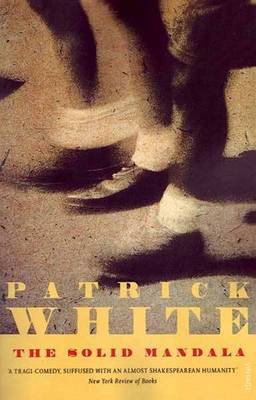
Perhaps White’s best representation of this battle between the cold rational versus the warm intuitive occurs in the novel ‘The Solid Mandala’ which is the story of two dependent but antagonistic brothers.

The one thing that I have left out so far is the sheer pleasure and enjoyment I get from reading one of Patrick White’s many masterpieces. He has a vivid lively way of presenting his stories whether he is writing about an explorer in the Australian outback in ‘Voss’ or a powerful Australian matriarch in ‘The Eye of the Storm’. His novels are long but they are well worth the effort and the time spent.

Fiction by Patrick White that I strongly recommend:  I would recommend any one of his many masterpieces. Here is my personal list: ‘The Solid Mandala’, ‘Voss’, ‘The Eye of the Storm’, ‘Riders in the Chariot’, ‘The Vivisector’, ‘The Tree of Man’, ‘The Aunt’s Story’, ‘The Twyborn Affair’, ‘A Fringe of Leaves’, ‘The Burnt Ones’ (a short story collection).

Quotes about Patrick White

“Patrick White has the ability, for the reader who stays with him, to penetrate one step further into their interior.” – Nicholas Shakespeare

“Patrick White is a strongly individual, richly gifted, original and highly significant writer whose powers are remarkable and whose achievement is large. His art is dense, poetic, and image-ridden. It is always a substantial and genuine thing. At its finest it is one which goes beyond an art of mere appearances to one of mysterious actuality.” – William Walsh, in Patrick White’s Fiction (1977)

Quotes by Patrick White

“What I am interested in is the relationship between the blundering human being and God.” – Patrick White

“Human relationships are vast as deserts: they demand all daring, she seemed to suggest.”  – Patrick White, ‘Voss’

“Human behavior is a series of lunges, of which, it is sometimes sensed, the direction is inevitable.” – Patrick White

“Because he had nothing to hide, he did perhaps appear to have forfeited a little of his strength. But that is the irony of honesty.” – Patrick White

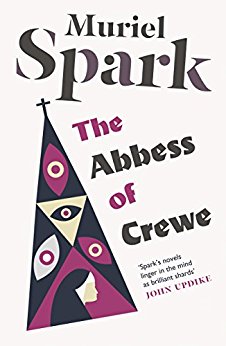
‘The Abbess of Crewe’ by Muriel Spark – A Whole Lot of Bugging Going On


‘The Abbess of Crewe’ by Muriel Spark    (1974) – 116 pages

Only Muriel Spark could get me to read a novel about a convent – an abbey – of nuns (with the delightful exception of the children’s Madeline series by Ludwig Bemelmans of course).  I have read just about everything else Muriel Spark wrote so it was finally time to read ‘The Abbess of Crewe’.

“You mean, Lady Abbess”, she says, “You have even bugged the poplars?” 

Yes, ‘The Abbess of Crewe’ was Muriel Spark’s answering satire to Watergate where US President Richard Nixon had bugged his office, recorded all of his conversations, and which ultimately led to his downfall.

The novel is mainly played for laughs but does have a significant point.  Alexandra considers it her destiny to be the next Abbess of Crewe, and she will let nothing or no one stand in her way.  She has a team of nuns including Mildred, Walburga, and the gullible Winifrede working for her, setting up the electronic equipment.  There is also Sister Gertrude who is out in the field and calling in from the African jungle or the Andes or Tibet or Iceland with philosophical advice. Alexandra is opposed by the rebel nun Sister Felicity “with her insufferable charisma” who is rumored to be having romantic trysts with a Jesuit priest.

“Clear off,” says Mildred, which Winifrede does, and faithfully, meanwhile, the little cylindrical ears in the walls transmit the encounter; the tape-recorder receives it in the control-room where spools, spools, and spools twirl obediently for hours and many hours.

Perhaps the best way to describe ‘The Abbess of Crewe’ is that it is “horrifically comic” like so much of Spark’s work is.  It does capture that mood of Watergate as I remember it with all these underlings furiously working for their harsh unethical boss.

Muriel Spark writes of all the shenanigans going on in this abbey with her usual economical spirited sparkling style.  I can fully understand why Graham Greene provided Muriel Spark enough money early in her career so she could write full time, a good investment.  I wish there were more writers like Muriel Spark or Penelope Fitzgerald who could provide a dazzling entertainment in a hundred or so pages.  Having read and thoroughly enjoyed the 1296-page ‘War and Peace’, I feel I can speak out in defense of the short novel.

During her writing career, Muriel Spark eventually refused to be edited.  She insisted, “If I write it, it’s grammatical”.

‘The Abbess of Crewe’ was adapted into a movie called ‘Nasty Habits’ in 1977.


Grade:   A-


‘The Transition’ by Luke Kennard – A Remedy for Young Hapless Middle Class Under-Achievers


‘The Transition’ by Luke Kennard  (2017) – 328 pages

In, ‘The Transition’, Karl is a young man in the near future who has gotten himself and his wife Genevieve into a whole mess of financial trouble.  It is not that Karl isn’t smart; Karl is very smart.  He has gotten his Master’s Degree in English focusing on the Metaphysical Poets. Who would ever guess that somebody with that superior academic background would have financial troubles?

So now that he is out of college with a loving wife and huge college debts to repay, how does Karl keep the two of them above water?  It helps that Genevieve has a steady job as an elementary school teacher, but that is still not enough money.

However there is the Internet.  Karl makes money on the Internet writing glowing reviews of products he never used and restaurants he has never visited.  He writes brilliant academic papers under the guise of “study aids” that undergraduates can buy and use for their own course work.  Most of the Internet money he earns is faintly dishonest and the employers are anonymous, but he is underpaid for the work anyway.  He still has to jiggle payments between credit cards in order to stay afloat.

Ultimately one of his dishonest Internet jobs gets him into legal trouble.  He is given a choice.  He can either go to prison or enroll, along with innocent wife Genevieve, in something called The Transition. The Transition is a six-month rehabilitation program with a goal of rescuing “a generation suffering from an unholy trinity of cynicism, ignorance and apathy.”

Karl and Genevieve are assigned another couple, Stuart and Janna, as mentors to teach them fiscal responsibility.  Karl and Genevieve must move to an apartment adjoining their mentors. While Karl rebels against the imposed guidance of The Transition, Genevieve flourishes within this new system.

Luke Kennard has created a great setup for this novel which I suspect is a dilemma a lot of young people face with massive college debts and morally dubious low-paying opportunities involving the Internet.  The idea of this relief organization with mentors to rehabilitate people financially is also excellent.  My main concern with ‘The Transition’ is that the humor after the original setup is a little too tame and subtle for me.  It could have been broader and sharper.  I could picture these financial mentors Stuart and Janna as being much more obnoxious.  Somewhere I read an admiring review comparing ‘The Transition’ to ‘Lucky Jim’.  However Kingsley Amis was much, much meaner and nastier with his characters than Luke Kennard could ever be.  I felt Kennard’s attempts to be fair to all of his characters watered down the humor to some extent.


Grade:   B 


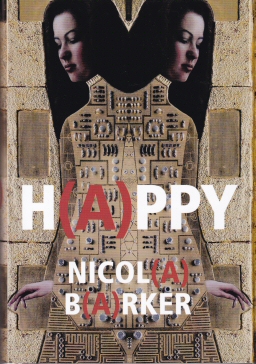
‘H(a)ppy’ by Nicola Barker – A New Age Social Media Dystopia


‘H(a)ppy’ by Nicola Barker   (2017) – 282 pages

‘H(a)ppy’ by Nicola Barker won the Goldsmiths Prize for “Fiction at its Most Novel”, a literary prize I particularly watch out for each year.  ‘H(a)ppy’ has been praised to the skies by reviewers in England, Scotland, and Ireland, yet I did not find even one notable review of the novel by a major United States reviewer. Appreciation for Barker in the United States still lags far behind her success in the British Isles.  At this point I would say that United States readers are too conservative and conventional to fully appreciate the wilder turns that Barker’s fiction takes.

About a decade ago, I was totally won over to Nicola Barker and her unique distinctly odd style of writing with her novel ‘Wide Open’.  At that time I recognized that Nicola Barker was a writer who was new and different yet still delightful, a writer to watch.

‘H(a)ppy’ takes place in a future where a confluence of social media rules everyone’s lives.  “The System” now protects and directs everyone with its “Path of Light”. Psychotropic drugs adjust personalities and advanced electronic devices monitor every thought and every act. Everyone keeps harmoniously “In Balance”. Our narrator Mira A. has almost totally bought into this New Path which is the new way of looking at things.  She says things like “I will not allow myself to regret this strange weakness, because regret is counterproductive.

The one trait in individuals that The System particularly watches out for and monitors for is an EOE, an Excess of Emotion.  Mira A. wants very much to fit into this System, but she also loves her music which can sometimes cause an EOE.

 “Don’t you think there might be a special kind of sadness that is almost a form of happiness?” 

‘H(a)ppy’ is somewhat self-centered and overwrought since it is concerned with only this one central character Mira A.  She wants to fit in and feels terrible that she can’t conform due to her love of music.  Her music makes it difficult for her to be one of the Young and perfected.  Just in terms of the story, it probably would have helped if Mira A. had had a sidekick she could talk to especially since Nicola Barker is usually so brilliant with dialogue.  As it is, I got a bit sick of all of the social media blather in ‘H(a)ppy’.

The text in ‘H(a)ppy’ is zany beyond belief.  Some of the words are different colors and there are experiments with the size of text, and there are a number of pages that have stuff on them that you could not possibly read (which makes the novel shorter than the 282 pages would indicate).  To me, all these experiments in text were more a distraction than anything else.


 Grade :  B+ 


‘Reservoir 13’ by Jon McGregor – The Human Part of Nature


‘Reservoir 13’ by Jon McGregor   (2017) – 290 pages

‘Reservoir 13’ begins with the disappearance of thirteen year-old girl Rebecca Shaw from a small English village.  However the novel does not turn into a mystery attempting to explain the girl’s disappearance. Instead ‘Reservoir 13’ becomes something much more than that.

It is a partial record of the events that transpire for the various townspeople after the disappearance, often the amorous events of these men and women, young and old.  Life goes on.

This may not seem like much but let me explain.

McGregor views the people of this rural village with the same calm steady keenly observant attitude with which he observes the trees, the birds, the fish, and the other animals.  His view appears to be that we humans are as much a part of nature as everything else.

This is an important lesson.

He mentions the births, the deaths, the getting together and the parting of the ways of the various townspeople.  No person is more important or less important than the others.  Just like the plants and the animals, we go about our various affairs.

“There was rain for most of the day and snow on the higher ground.  The tips of the new-growth heather could just be reached through the snow.  Wood pigeons came out into the gardens where feed was put out and were often chased away.”

McGregor describes the doings of the townspeople in the same steadfast methodical tone he uses for the plants and animals.

“At the school there had been talk that either James Broad or Liam, or both, had once slept with Becky Shaw.  That talk seemed malicious and unlikely.  Sophie and Lynsey wanted to know where the talk had come from and James told them he didn’t want to fucking think about it.  Sophie tried to give him a hug but he shook her off.  Liam threw stones into the water.”

Don’t even try to keep track of the stories of all of the various townspeople who are mentioned in ‘Reservoir 13’.  There are just too many things going on with way too many people to follow them all.  That is not the point of ‘Reservoir 13’.

What is the point of ‘Reservoir 13’?  For me it is that we humans are just as much a part of nature as the plants and animals.  Our matings and our partings are just as subject to the rules of nature as those of the other plants and animals.  This undeniable fact is both reassuring and frightening.

Even if life may have come to an abrupt end for someone else, daily life goes on for the rest of us.


Grade:   A


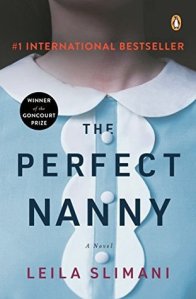
‘The Perfect Nanny’ by Leila Slimani – Not a Lullaby


‘The Perfect Nanny’ by Leila Slimani   (2016) – 228 pages                                                    Translated from the French by Sam Taylor

I would not read a bestselling thriller just because it is popular.  I have never read ‘Gone Girl’.  The only reason I have now read ‘The Perfect Nanny’ by Leila Slimani (titled ‘Lullaby’ in England and other English-speaking countries) is because it won the 2016 Goncourt Prize which to me is usually a mark of French literary distinction.  I have read several Goncourt Prize winners in recent years.

The young French couple Paul and Myriam are looking for a nanny for their two little children, Mila and Adam, so that Myriam can go back to her job as a lawyer. Their main requirement for a nanny is she not be an illegal immigrant.  The French woman Louise shows up, they hire her, and she turns out to be the perfect nanny in every respect.  The kids like her, and she has them doing all kinds of interesting things.  The parents even decide to take her along on their vacations.

And of course the situation is way too good to be true. ‘The Perfect Nanny’ is a nightmarish psychological thriller.

Looking at ‘The Perfect Nanny’ from a literary angle, I must say that I was not impressed with the novel. The prose here is efficient and workmanlike as we’ve come to expect for thrillers, and it is not at all individual or idiosyncratic as one might expect for a Goncourt Prize winner.  For a Goncourt Prize winner, ‘The Perfect Nanny’ is rather a drag at the sentence level.  There is not much going on in the individual sentences.

I also did not find the transformation of the nanny Louise from “prim politeness” to something entirely different at all convincing.  It seems to me that in a psychological thriller there should be hints from the very beginning that something is not right.  However in ‘The Perfect Nanny’ we read the entire first half of the novel, and Louise is still perfect in every way.

I probably will not be reading any further novels by Leila Slimani.  There is one French woman novelist who has not won the Goncourt Prize so far, yet I find her work of such a high quality that I can’t figure out why she hasn’t been awarded the prize yet.  I have read three novels by Delphine de Vigan: ‘Underground Time’, ‘Nothing Holds Back the Night’ and ‘Based on a True Story’. Any of these three but especially ‘Underground Time’ would have been a fine winner.  They have the literary fineness appropriate for the Goncourt.  Delphine de Vigan is the real thing.


Grade :   B-


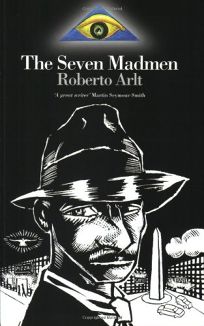
‘The Seven Madmen’ by Roberto Arlt – A Maelstrom of Outcasts in Buenos Aires


‘The Seven Madmen’ by Roberto Arlt   (1929) – 242 pages                                                Translated from the Spanish by Nick Caistor


What words can I use to describe ‘The Seven Madmen’? It is intense, painfully honest, vivid, brutal, grotesque, and insightful as hell. At the same time the novel reflects the energy and chaos and explosive madness in Buenos Aires during the early 20th century.

Among Argentine writers, Roberto Arlt is a legend   His own definition of literature was “a good sock in the jaw”.

Roberto Arlt, born in 1900, was the son of two of the many Prussian immigrants to Buenos Aires. His parents were attracted to Argentina by the promise of land to farm not realizing that all the land was already in the hands of a few owners.  They wound up in the slums of Buenos Aires. Roberto began his career as a journalist writing Buenos Aires Sketches and he wrote the novel ‘The Seven Madmen’ in 1929.

‘The Seven Madmen’ is the story of Reno Erdosain, a small-time swindler and frequent brothel customer. Better than me describing Erdosain, let me give you some quotes about him from the novel.

“He understood that destiny had flung him into that maelstrom of outcasts who stamp life with the foul imprint of every imaginable vice and suffering.”  

“Yes, it’s sad to see other people happy, to see that they don’t understand that you are unhappy and always will be.”

“And yet it is only thanks to crime that I can affirm my existence, just as it is only evil that affirms man’s presence on earth. “

“And tell them I was a murderer. And yet, as a murderer have loved every kind of beauty, and have fought within myself against all the horrible temptations that have welled up hour after hour from deep with me. I have suffered for what I am, and for all the others as well, d’you understand? For all the others as well.” 

It is for good reason that Roberto Arlt has been called the Dostoyevsky of Argentina.  He tells the truth no matter how hurtful it is to himself.

‘The Seven Madmen’ is also a prescient political novel.  Even though it was written in 1929, it predicts the rise of Fascism.

“We will have a wide variety of perfect lies, each one labelled for a different disease of the mind or soul.”

“It’s all the borderline people who get puffed up with empty phrases…And the first people I am approaching for an answer are these malcontents.  As a goal I offer them a lie which will bring them happiness by inflating their vanity.”

Roberto Arltt

Arlt goes on to describe a Fascist society in more detail.  He males several allusions to Mussolini and Lenin who were already on the scene.

This story is continued in a second novel called ‘The Flamethrowers’ which I would like to read if only it were available in English.


Grade:   A


Alice Munro – One of My Favorite Fiction Writers of the 20th Century (and 21st)


Alice Munro

Born:  July 10, 1931

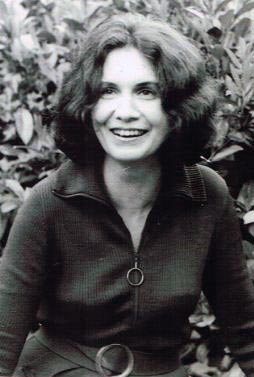
A Young Alice Munro

Alice Munro is the virtuoso of the long short story.  I read my first Alice Munro back in the late 1970s, ‘The Beggar Maid – The Stories of Rose and Flo’, and I was hooked.  I then went back and read her two earlier books and have read every one of her story collections since.   Cynthia Ozick has called Munro “our Chekhov” which is high praise indeed.  Munro is the 2013 Nobel Prize winner in Literature.  She is by no means a surprise choice for me.

Munro was born in rural Ontario, Canada, and her father was a mink and fox farmer who later turned to turkey farming.  That seems to me like a pretty good background for a fiction writer to have. Many of her stories are located in that childhood Huron County area. After she was married she moved to West Vancouver, British Columbia which provided her take on urban life but later moved back to Ontario.  Munro was already 37 when she published her first story collection, ‘The Dance of the Happy Shades’ in 1968.

Even though Munro’s main protagonists are more often women, I as a male am moved by their stories and thoroughly empathize with their eloquent points of view.  She continuously explores the mysteries of humans getting together and falling apart through time.  Her technique can be looked upon as fictional reporting on people’s fortunes from the front lines.

Unusual Fact about Alice Munro

.  She and her first husband opened a bookstore called Munro’s Books in Victoria, British Columbia which is still in business.

Fiction by Alice Munro that I strongly recommend:  I would recommend any one of her many story collections.  I would recommend juxtaposing one of her later collections with one of her earlier collections, because her stories have changed over the years.  A few titles to look for; ‘The Lives of Girls and Women’, ‘The Moons of Jupiter’, ‘Open Secrets’, ‘Runaway’.

Quotes about Alice Munro

“Given a choice between being a person who does good works but has inauthentic feelings and is numb at heart and being one who behaves badly but is true to what she really feels and is thus alive to herself, a Munro woman is likely to choose the latter; or, if she chooses the former, she will then comment on her own slipperiness, guile, wiliness, slyness and perversity. Honesty, in Munro’s work, is not the best policy: it is not a policy at all, but an essential element, like air. The characters must get hold of at least some of it, by fair means or foul, or – they feel – they will go under. “– Margaret Atwood

“in 2009, she withdrew her new book from the Giller prize competition, on the grounds that she had won the prize twice already, so she wanted to step aside to make room for a younger writer. This selfless decision—which, in the role of selfish, greedy publisher, I fought against for weeks, until I saw that Alice’s mind was made up—meant that the book lost not only potential prize money, but potential sales and publicity worth hundreds of thousands of dollars.” – Her Publisher, Douglas Gibson

“The recurrent and very personal themes of Munro’s fiction – the stirring of the creative impulse, the bohemian rejection of provincial anonymity and conservatism, the refusal to be bound by narrow definitions of womanhood, and the complexity of female sexuality – are not what make her work so remarkable. For that we need to look to her style. Munro’s way with form, the scattered chronology of her stories, captures the drift of our thoughts, the endless movement in and out of moments. A Munro sentence, beguiling in its lucidity, compelling in its precision, seductive in its simplicity, offers constant enchantment. Munro’s prose, without sentiment, yet suffused with a hard melancholy, has a composed, wry, crystalline grace.” – Garan Holcombe

“The point is that girls and women, even those who lead narrow and constricted lives, those who wield no influence, who have a limited experience in the world, are just as significant and important as boys and men.” – Roxana Robinson

Quotes by Alice Munro

“Why is it a surprise to find that people other than ourselves are able to tell lies?”  – Alice Munro

“People’s lives … were dull, simple, amazing and unfathomable – deep caves paved with kitchen linoleum.”  – Alice Munro, ‘The Lives of Girls and Women’

“You cannot let your parents anywhere near your real humiliations.” – Alice Munro, ‘Open Secrets’

“Never underestimate the meanness in people’s souls… Even when they’re being kind… especially when they’re being kind.” ― Alice Munro

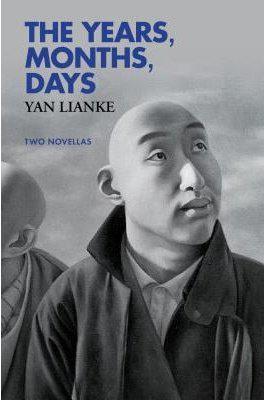
‘The Years, Months, Days’ – Two Unusual and Amusing Novellas by Yan Lianke


‘The Years, Months, Days’ – Two Novellas by Yan Lianke  (1997, 2001) – 192 pages        Translated from the Chinese by Carlos Rojas

Here are two novellas by Yan Lianke, “China’s most feted and banned author” (Financial Times).  Yan Lianke is also rapidly becoming one of my own favorite authors.  Lianke tells some of the most honest tragic strange stories of all, yet lightens things up with irony and sarcasm and ridicule making his stories a pleasure to read.  His ‘’The Four Books’ is a powerful novel about China’s disastrous Great Leap Forward, and with these two novellas he again succeeds.

Both of these novellas use the power of allegory to tell a simple strange story with humor.

In the first novella, ‘The Years, Months, Days’, a major drought has hit this Chinese town, and everyone has left except for one man, the Elder, and his blind dog Blindy. Even the animals had left.  There are no livestock, no sparrows, and even the crows had fled the drought.  The only animals that remain are hundreds of rats, and the Elder and his dog Blindy must do battle against the rats for the few grains of corn that are left as well as for the tiny amount of water still in the city well.

The Elder has one grand objective. He does everything he possibly can to keep his one stalk of corn growing so that he will have some seed corn to give to the villagers when they return.

There is no lack of conversation as the Elder talks to himself as well as to his dog Blindy.

Blindy, the Elder said, What do you think? Are we going to starve to death? 

The blind dog stared into the sky with its eyes that were as dark as the bottom of a well.

The Elder said, “I don’t think this stalk will ever mature.”

It is a simple poignant story of a man and his dog fighting against nature for survival.  What puts this drought disaster story over the top is the humor that Lianke brings to the story.

In the second novella, ‘Marrow’, the mother Fourth Wife You is also on a grand quest to find mates for her four idiot children.   Her husband Stone You kills himself when he finds out that his side of the family’s genetics caused the idiocy of all his kids. However his spirit continues to show up sporadically to give his wife unneeded advice.  She complains,

“Dead one, where are you? When I want you to talk to me, you really are dead; but when I don’t want you to keep talking, you come back to life.” 

So here we have a spooky yet funny dead husband ghost.

The idiocy of the four children takes some bizarre unexpected turns, but the mother is constantly on the lookout for a way out of her dilemma.

Both of these novellas are like folk tales, only stranger and more surprising and more amusing.


Grade:   A  


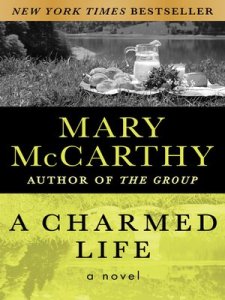
‘A Charmed Life’ by Mary McCarthy – A Disastrous Return to New Leeds

‘A Charmed Life’ by Mary McCarthy   (1954) – 313 pages


The title of this novel which was written by Mary McCarthy in the 1950s, ‘A Charmed Life’, is ironic. Much of the novel is taken up with a very ugly situation.

I had read only one Mary McCarthy novel before, the excellent ‘The Groves of Academe’ which is a very fine and funny wicked parody of the academic community.  I wanted to read more.

In ‘A Charmed Life’, Martha and her second husband John are returning to New Leeds, an “artistic” community in New England. Even in the best of circumstances it is probably a dicey thing to return to live in a place where you once lived before. However they are returning to New Leeds in the worst of circumstances.  It was in New Leeds where Martha’s first marriage had failed, her house had burned down, and she ran off in scandal with John.  Worst of all, her nasty ex-husband Miles Murphy still lives there.

Miles Murphy is an intellectual and an alcoholic who trashes those closest to him, especially his wives, for his own benefit.  Martha had met him when he was forty and she was twenty, and he seduced her on their first date.  She never wanted to marry him, but he insisted.  On her wedding night, he struck her for the first time.  She spent four miserable years with him before finally getting the courage to run away.  This story could have been ripped out of today’s headlines.

Why Martha would return to the scene of this crime, this artistic community of New Leeds, one cannot fathom, but these things do happen.  Now after seven years, Martha and her nice if nondescript new husband John have returned to New Leeds.  Of course they run into Miles and his new young wife, and things get messy once again.

 “He (Miles) was thinking of Martha.  He had always had a weakness for intelligent women, though he knew them to be bad for him, like drink or certain kinds of food.  They disagreed with him, in both senses of the word.”

Miles Murphy is about as mean and nasty a villain as one could find in any novel.  Unfortunately for Martha, she still has some unresolved feelings for him on some intellectual level.  She lets Miles drive her home one evening when John is out of town, and Miles forces himself on her.  By today’s standards, this sex scene is more like a rape than any kind of consensual sex. Later the inevitable happens, and we have this ugly situation.

Mary McCarthy’s writing is lively and intelligent. I ploughed through this novel quickly because I wanted to find out what happens next.

The novel goes somewhat astray for me when they have that fateful get-together during which they read ‘Berenice’ by Racine.  A reading or performance of a play within a novel can be a powerful device for a novel if the play reflects on or intensifies the main theme of the novel.  However in this case the play only leads to random intellectualizing by the group and doesn’t reflect on the main theme of the novel which I take to be Martha’s intense dislike for her ex-husband Miles.  Instead the highbrow discussion after the play brings Miles and Martha closer together again, and Martha agrees to let Miles drive her home.

The basic problem with ‘A Charmed Life’ is that Mary McCarthy is trying to achieve two contradictory goals at once.  Her one goal is to lightly parody the vagaries and pretensions of this artistic community of New Leeds.  Her other goal is to deal with this very ugly personal situation between Martha and her ex-husband Miles.  Ultimately the light parody and the intense drama do not cohere.

On the other hand, I expect I will remember the plot of ‘A Charmed Life’ long after many other novels have come and gone from my mind.


Grade:   B   


‘Special Envoy’ by Jean Echenoz – A Playful if Shallow 1960s Spy Romp


‘Special Envoy’ by Jean Echenoz   (2016) – 240 pages                Translated from the French by Sam Taylor


‘Special Envoy’ is the fourth novel by Jean Echenoz I have read.  I’ve had great praise for him in previous reviews. For his novel ‘Piano’ I wrote, “I do believe that Jean Echenoz is one of the true giants of the literary world today whose works should not be missed.”

However this one you can probably skip.

‘Special Envoy’ is a madcap spy caper that begins in Paris and eventually finds several of the characters in Pyongyang, North Korea with Kim Jong-un. It has plenty of casual sex and many preposterous kidnappings and murders along the way.   Echenoz must surely realize that he has written an anachronism, a 1960s spy novel.  Ian Fleming and James Bond live.  There is no real point to this novel beyond entertainment.

The only requirements for a female in ‘Special Envoy’ are that she be very good looking and compliant and agreeable to sex with any good looking man she happens to meet.  It is the type of tale where a thirty year old woman is called “the girl”.

“On the other hand, after several walks in different parks and museums and other preliminary chores, Tausk will end up screwing the platinum-bunned assistant who, over time, will prove a very good way of killing time.  Charlotte will even reveal herself to be an insatiable if somewhat exhausting partner, to the point that Tausk, by now firm friends with Hyacinth again, will invite him to form a threesome.” 

Echenoz can only be making fun of these laid-back attitudes. I think what Echenoz had in mind when he wrote ‘Special Envoy’ was parodying these old spy novels but instead wound up creating his own dusty old spy novel.  In this day and age, I believe that James Bond is so ridiculous he is beyond parody.   When you try to parody these old 1960s spy novels you must be careful or you will wind up with your own 1960s spy novel.

However there are still sure signs of Echenoz’ talent as a fiction writer even though ‘Special Envoy’ did not really work for me.  The scenes sparkle with their own comic energy, and the outrageous characters and outlandish plot kept my interest throughout.

I prefer the more substantial works of Jean Echenoz.  He is too good a writer to waste on this kind of meaningless stuff.


Grade :    B


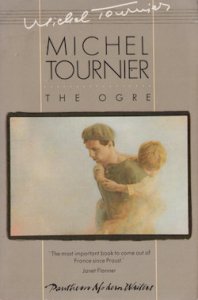
Michel Tournier – One of My Favorite Fiction Writers of the 20th Century

This is the third in a series.


Michel Tournier

Born: December 19, 1924     Died: January 18, 2016

Michel Tournier was an extraordinarily original and somewhat controversial writer who became famous in his home country of France but who never received the world-wide acclaim which his work deserves.

There have been a lot of adjectives used to describe Tournier’s work, not all of them nice.  Grotesque, perverse, beautiful, weird, unseemly, crypto-mystical, subversive, haunting, Germanophile, unsavory, kinky, visionary, shocking.  Michel Tournier was a one of a kind original who really didn’t bother with what the public thought of his writing.  He titled his first collection of stories ‘The Fetishist’.

“There is much to question in Tournier’s enterprise, and many, out of refinement or faith, will not approve it.  But I can think of nothing that matches the verve and daring of these imaginings.  They open the sluices wide to the unconscious materials that are the very stuff of art’s pity and terror.  His way of transforming these into the legends of spirit restores to the novel a sense of “high stakes” that has long been missing.” – Sven Birkerts, ‘An Artificial Wilderness’   

Once you start to actually read his novels, you discover he is not at all difficult to understand and appreciate.  For a reader who has not yet read Tournier, I would first recommend two of his novels which are based on other well-known stories or legends thus making them more accessible.  ‘The Four Wise Men’ is a retelling of the famous biblical story, and ‘Friday or the Other Island’ is a retelling of the Robinson Crusoe story.

After reading those two short and relatively down-to-earth works, you will hopefully be an eager fan of his work and ready for his all-out masterpiece, ‘The Ogre’, also known as ‘The Erl-King’.  This is the novel where Tournier’s hero-monster Abel Tiffauges confronts Nazism.

“Abel Tiffauges is as complex and dangerous in English as in French; his themes are eternal and disturbing. To follow his dark path is a magnificent experience.” – Marian Engel, New York Times.

The fiction of Michel Tournier has the story quality of the finest fiction and at the same time presents ideas that are upsetting and deliberately provocative   It is a wild ride.

Fiction by Michel Tournier that I strongly recommend:   The afore-mentioned ‘The Ogre’, ‘Friday’, and ‘The Four Wise Men’.  His other works including ‘Gemini’, ‘The Golden Droplet’, and his bizarre collection of stories ‘The Fetishist’ are also excellent reads.

Quotes about Michel Tournier

“Tournier, a private, even outsiderly, man, was impervious to literary trends and intellectual fashions. He saw himself as a professional artisan, with an old-fashioned notion of the writer’s duty to entertain and question received values.” – David Coward, The Guardian

Quotes by Michel Tournier

“The first lesson of culture is that the world is vast, the past unfathomable, and that billions of men think and have thought differently than we, our neighbors and our countrymen. Culture leads back to the universal and engenders scepticism.”

“We must be careful to preserve life’s spontaneity as well as the flexibility to adapt to new situations.”

“Books are essential. Literature is the oxygen of the soul.”


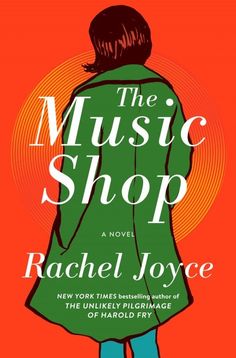
‘The Music Shop’ by Rachel Joyce – Gonna Take A Sentimental Journey


‘The Music Shop’ by Rachel Joyce   (2017) – 306 pages

I miss record shops and book shops.  These stores always seemed like oases in the middle of the commercial desert where you could find something you really liked.

The novel ‘The Music Shop’ takes place in a seedy neighborhood of small shops and bars on Unity Street in London in the year 1988.  The record store owner Frank, “a gentle bear of a man”, stubbornly insists on selling only vinyl even though CDs are the up and coming thing.

“Music is about silence… the silence at the beginning of a piece of music is always different from the silence at the end because if you listen, the world changes. It’s like falling in love. Only no one gets hurt.”

Frank has a knack for picking out music for individual customers just by listening to them talk for a few minutes.  It is Frank’s love of the music that makes him special. One of the bonuses of reading ‘The Music Shop’ is all of its insightful references to various artists and pieces which range from classical composers to punk rock bands.

Frank has a motley crew of misfit friends who live in the neighborhood including his clumsy assistant Kit, the tattoo artist Maud who has a shop next door, the failed priest Father Anthony who runs a religious artifacts shop, and the two undertaker Williams brothers who run a funeral home together and who often hold hands.  These friends of Frank perform in the story like the Scarecrow, the Tin Man, and the Lion do in the Wizard of Oz as a friendly reassuring backdrop for Frank.

Frank has been emotionally scarred by his eccentric childhood, and he keeps to himself until this woman named Ilse Brauchmann shows up at his shop one day, and the sparks fly.  ‘The Music Shop’ is above all a rom.com.

But I must sound a dissonant note. Rachel Joyce writes crowd pleasers, and in ‘The Music Shop’ she pulls out all the stops.  Don’t expect a great deal of enlightening but confusing depth from ‘The Music Shop’ because that is not Joyce’s thing.  I, like many, many others, was totally bowled over by ‘The Unlikely Pilgrimage of Harold Fry’ and Harold’s long walk to save Queenie’s life.  This time out in ‘The Music Shop’, I felt every character and every scene was just a little too calculated and premeditated to induce strong emotions in us readers.  Joyce lays the sentimentality on awfully thick here.  I felt I was being manipulated, and I fought that feeling during the whole time I was reading the novel.  Ultimately I did shed a few tears during the climax of the novel, but I resented crying them.

But you really should read Rachel Joyce because she is really good at this sentimentality thing except for the overload.


Grade:   B+


Graham Greene – One of My Favorite Fiction Writers of the 20th Century

This is the second in a series.

Graham Greene

Born:   October 2, 1904    Died:   April 3, 1991

I came to reading Graham Greene relatively late in my reading career, not until the late 1990s.  Up until that time I had these misguided ideas about Greene that he was a spy genre novelist or that he was a Catholic novelist. My first Greene novel then was ‘The Heart of the Matter’ which I thought was magnificent.  I quickly started reading novel after novel by Greene.  The one novel that really took my breath away was his early ‘Brighton Rock’ about these young guys chasing through the streets and lanes of Brighton, England.  But his novels have a uniform quality, and just about any of them will be fine.  I have read about fifteen so far.

Greene’s novels range from settings in Africa (The Heart of the Matter’) to Asia (‘The Quiet American’) to Latin America (‘The Honorary Consul, ‘The Power and the Glory’, Our Man in Havana’) to England.  He was a novelist of the world.

What I like about Greene is that he is a good-natured compassionate writer who tells great stories.  Also his characters seem to have more underlying depth than most writers’ characters.  In one of his novels, Greene writes:

“Human nature is not black and white but black and grey.”

There are some individuals who are worse than others, but we all share in the guilt to some extent.  Individual people are not pure evil or pure good in Greene novels, and that makes his characters more realistic and human. Greene’s characters wrestle with their own particular guilt. No one is let off the guilt hook, but at the same time no one is eternally doomed on Earth. Also his tolerant view of humanity allows Greene to have a sense of humor about his characters.

Martin Seymour Smith does criticize Greene by saying “His most serious deficiency is his failure to portray women ‘in the round’.  I am not sure I agree with Smith.  I would recommend women to read ‘The End of the Affair’ which is a fiction supposedly based on Greene’s own extramarital affair and probably contains his deepest portrayal of a female character.

Fiction by Graham Greene that I strongly recommend:  Brighton Rock’, ‘The Heart of the Matter’, ‘The End of the Affair’, ‘Our Man in Havana’, ‘A Burnt-Out Case’, ‘The Quiet American’ and about a dozen others.

Quotes about Graham Greene

“I asked for The Heart of the Matter for Christmas in 1947. I suddenly thought, here is this man who can represent ordinary life, ordinary troubles, and make them exciting to read about.” – Shirley Hazzard

“He will be missed all over the world. Until today, he was our greatest living novelist.” – Kingsley Amis for Greene’s Obituary

“He is deepest in my head in the way he looks at the world with a mixture of, I think, kindness and honesty. I feel he’s very undiluted. And he’s really determined to look at the most difficult, dark parts of himself and the world.” – Pico Iyer

“Any writer would envy an imagination of such irresistible contrapuntal thrust – he never lacked a story, he was drowning in them. He famously said that childhood is the credit balance of the novelist, and Greene’s childhood – the misery of his public school, the power struggles with his headmaster father, the teenage seduction of his own psychiatrist’s wife, the flirtations with madness and God – well, he was never, ever going to be in the red. There are many natural storytellers in English literature, but what was rare about Greene was the control he wielded over his abundant material. Certainly one can imagine nobody who could better weave the complicated threads of war-torn Indochina into a novel as linear, as thematically compact and as enjoyable as The Quiet American.” – Zadie Smith

“His (Greene’s) obvious strengths, some of them leaving him vulnerable, are extreme fluency and professionalism, power, the ability to create clear-cut characters and sound plots. His capacity to convey atmospheres of oppression has hardly been equaled in English.” – Martin Seymour-Smith

Quotes from Graham Greene

“Our worst enemies are not the ignorant and simple, however cruel; our worst enemies are the intelligent and corrupt.”

“We praise heroes as though they are rare, and yet we are always ready to blame another man for lack of heroism.”


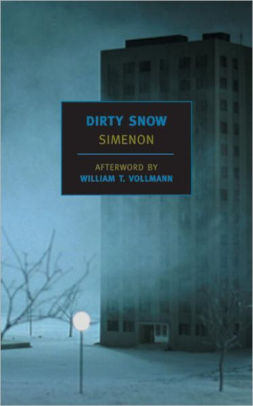
‘Dirty Snow’ by Georges Simenon – Not Only the Snow was Dirty


‘Dirty Snow’ by Georges Simenon   (1946) –  244 pages                                                      Translated from the French by Marc Romano and Louise Varese

The young man Frank Friedmaier in ‘Dirty Snow’ is one of the most vile and amoral characters you will find in any novel.  Frank has a very German name but he lives in Brussels, Belgium because the political boundaries in Europe do not match the ethnic boundaries.  The novel takes place during the German occupation of Belgium in World War II.

Frank’s mother Lotte runs a brothel in their apartment mainly for the German occupiers.  She gets her girls young and innocent when they are only sixteen or seventeen because that’s the way the men like them, and she gets rid of them when they are eighteen so the men don’t get bored. Frank starts the process by dating the innocent girl and corrupting her before bringing her back to the house to work for his mother.  Even as a teenager Frank was on the lookout for fresh young girls to work for his mother.  He would take the girl to a movie, have sex with her, and then ease her into his mother’s prostitution business.  There was always a need for Frank to get more girls.  Frank can have sex for free with any of the girls working in his apartment any time he wants.

Frank does not know who his father is but thinks it might be the police inspector who allows his mother’s business to operate.

Frank hangs out at the local bar which is where all the young thugs hang out.  Most of the guys there have murdered someone, so Frank decides to kill a guy for no other reason.  Later Frank also kills an old woman who had been nice to him as a child in connection with his stolen watch racket.

Frank is then noticed by the German authorities and locked up in a school that has been turned into a makeshift prison by the German occupiers, since the regular prison is already too crowded.   The German authorities couldn’t care less about Frank’s murders or any of his other crimes, but they wonder how he obtained a special pass that only the German occupiers were supposed to have.   Frank says of one his guards:

“He is the kind of man who would calmly beat people up on command feeling no hate as conscientiously as a clerk doing sums in an office.”   

‘Dirty Snow’ is a story of a very bad man living in malevolent times. It is one of Georges Simenon’s romans dur or “hard or tough novels”.  This is an honest novel about the sordid underside of life but it is compelling on its own terms.  It feeds our fascination with the seamy criminal element.


‘Dirty Snow’ is a headlong plunge into the dark side.


Grade :   A


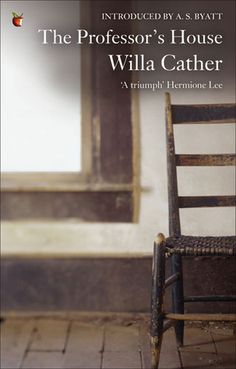
Willa Cather – One of My Favorite Fiction Writers of the 20th Century

With this article, I am starting a new feature on those fiction writers in the 20th century who are my personal favorites.  These fiction writers have entertained and intrigued me both at the sentence level as well as at the story or novel level.  Since these are my favorites, I have usually read a number of books by them which is the case with Willa Cather.  However there may be special cases where only one book gets an author in. Although I am starting with a United States writer, I will be including writers from various parts of the world. You may disagree with some of my choices, especially those writers I choose to leave out.

So here goes.


Willa Cather

Born: December 7, 1873    Died: April 24, 1947

I am starting with Willa Cather because up until recently Cather had been consistently underrated as a fiction writer with guys like Hemingway and Fitzgerald who couldn’t hold a candle to Cather getting the acclaim.  The English writer A. S. Byatt has gone a long way to ensuring that Willa Cather gets her due in the literary world.

Those of us who appreciate Cather’s work are passionate about it.

Willa Cather spent most of her childhood in Nebraska which is the setting for several of her finest novels.  She spent most of her adult life in New York City although she had a summer house on the Bay of Fundy in Nova Scotia, Canada which was the only house she ever owned.

She never married nor had any children which must have been a boon to her fiction writing career.  She frequently dressed like a man.  That’s fine, I don’t care; it is her fiction that fascinates me.

There is a tendency to view a writer’s work as piling success upon success up until the end of their life.  However, I have found that many a writer’s strongest work happens relatively early in his or her career.  That is certainly the case with Cather with her best works being written between 1913 and 1927.  As with the very best fiction, Cather makes her characters come alive for me, and I am moved by much of her work.

Interesting Fact:  She has a prairie, Cather Prairie, near her childhood home in Red Cloud, Nebraska named after her.

Fiction by Willa Cather that I strongly recommend: The Prairie Trilogy which includes ‘O Pioneers’, ‘The Song of the Lark’, and ‘My Antonia’.  Don’t be afraid to read these three novels out of order since each is a standalone story. Also ‘A Lost Lady’ and ‘The Professor’s House’; also ‘Obscure Destinies’ which is a wonderful collection of three of her very best stories.

Quotes about Willa Cather:  “No American novelist was more purely an artist.”- J. Donald Adams

“No romantic novel ever written in America, by man or woman, is one half so beautiful as My Ántonia.” – H. L. Mencken

“She has been steadily admired by stylists. Alice Munro learned from her; Eudora Welty, Katherine Anne Porter, and Wallace Stevens praised her perceptively. She learned from Virgil, Tolstoy, Flaubert, Henry James. She wrote 12 novels and some remarkable long and short stories.” – A. S. Byatt

A Quote from Willa Cather:The stupid believe that to be truthful is easy; only the artist, the great artist, knows how difficult it is.” 


‘To The Back of Beyond’ by Peter Stamm – Walking Away From Home


‘To The Back of Beyond’ by Peter Stamm   (2017) – 140 pages    Translated from the German by Michael Hofmann

Have you ever wondered what kind of adventures you would run into if you just walked away from your home and your family with no destination in mind? You don’t even tell anyone where you are going.  You just walk off on the spur of the moment for no particular reason.  Things were going good with the family but you just had the sudden urge to get away.

In ‘To The Back of Beyond’, there is no discord in this Swiss family, no easy explanation why Thomas decided to leave his comfortable home. His reasons for leaving are inscrutable, even to himself. Instead he just wanders off after returning from the family summer holiday.

Of course, in real life there would be a ton of obstacles to a man walking away and disappearing like that, but Peter Stamm with his quiet precision makes us believe that this could really happen.  The story takes on the quality and existential feel of an allegory.

His wife Astrid is not angry at him at all which to me is another unreal aspect of the story, and she reflects about Thomas:

“He had no close friends; his superficial relationships to colleagues at work, his clients, and his teammates seemed to be enough for him.  Neither of them had an especially active social life, and since the children, they hardly ever went out in the evenings.” 

Days go by, and Thomas doesn’t return. Astrid doesn’t panic even when the police come to the house and look in every room to make sure that he isn’t lying dead somewhere having done himself in.  Instead Astrid covers for him at his job, telling his workplace that he has shingles.

So we have this man walking through the woods and towns near his home.  He rarely encounters anyone as he tries to avoid people as much as he can.  The few people he does encounter seemed to me like oases of interest.  This being Switzerland, he eventually encounters the Alps Mountains.

The scenes in the novel alternate between those with Thomas on his massive strenuous walk and those with his wife Astrid and their kids at home.  The scenes involving Thomas are of a man who is mostly alone in nature.  I know there are some readers who welcome physical descriptions of rocks and karst and tarn and vegetation in their stories, but I am not one of them.  I found the excessive natural description somewhat tiresome and found myself looking forward to the scenes involving Astrid which were more sociable.

The bottom line is that Peter Stamm has achieved a quiet allegory about a patient understanding wife and the restless energy of her husband or perhaps of all men, but I wasn’t quite in the patient mood for a quiet allegory in nature myself.


Grade :   B   


‘Mrs. Osmond’ by John Banville – An Appropriate Sequel to ‘The Portrait of a Lady’


‘Mrs. Osmond’ by John Banville   (2017)  –   369 pages

About two years ago, I read and was fascinated by the novel ‘The Portrait of a Lady’ by Henry James, so it is only right that I read this sequel. ‘Portrait’ is the story of a young American woman Isabel Archer who goes to England and stays with some of her rich relatives there.  Ultimately she travels to Italy and winds up getting wed into a disastrous marriage with Gilbert Osmond. This all takes place in the 1880s.

As ‘Mrs. Osmond’ by John Banville begins, Isabel Archer Osmond is no longer a naïve innocent young woman. A few years have passed since ‘The Portrait of a Lady’.   Trapped in a terrible marriage, she knows she has made a huge mistake.  Now she has a new resolve and a strong determination to set things right again.

In both ‘The Portrait of a Lady’ and ‘Mrs. Osmond’, the villains are Gilbert Osmond and his lady friend Madame Merle.  In ‘Portrait’, after hearing of Isabel’s new inherited fortune, they schemed and plotted to trap her into this marriage to Gilbert Osmond.  Henry James dislike of his character Gilbert Osmond bordered on hysterical frenzy.  How dare these poor Italian nobles scheme to marry into English or American money?  Banville takes a more analytical approach to this insolent devious vindictive man Gilbert.  Few of Gilbert’s actions are unpremeditated. Now Gilbert and Madame Merle are plotting daughter Pansy’s marriage into a rich English family.

Most of the characters from the first novel show up in ‘Mrs.  Osmond’. There is talk of Lord Warburton and Caspar Goodwood, two of Isabel’s old suitors.   Isabel discusses strategy with her independent reporter woman friend Henrietta Stackpole.  She meets Madame Merle and her step-daughter Pansy’s suitor Edward Rozier in Paris.  Finally she returns to Italy in order to confront Gilbert.  Sadly, her cousin Ralph Touchett who was such a lively presence in ‘Portrait’ has died, but his mother does make an appearance.

Writing ‘Mrs. Osmond’ is obviously a labor of admiration by John Banville.  Banville is paying homage to perhaps the greatest novel by Henry James or at least the one which is most accessible.  What is really impressive is the way Banville captures Henry James’ style of writing which uses the longer sentences of the Victorian era. Modern sentences are streamlined, direct, and to the point.  However, back in the time of Henry James, sentences were more involved and intricate than they are today.  Longer sentences allow for more nuances, more shading, and more subtlety. I have read my share of 19th century literature, and it seems to me that these longer sentences allowed for greater depth both in characterization and physical description. I am not so sure that the move to shorter sentences has been totally such a good thing. The shorter sentences of today may be the result of a briefer attention span.   Perhaps our modern short streamlined sentences cause us to stay more simplistic, more on the surface of things rather than going deeper into motivation and implication.

I would recommend ‘Mrs. Osmond’ for anyone who has read and enjoyed ‘The Portrait of a Lady’.  I’m not sure it would work as a stand-alone novel.


Grade :   A