Archive for the ‘Book Reviews’ Category

‘Transcription’ by Kate Atkinson – Listening in on the Fascists


‘Transcription’ by Kate Atkinson (2018) – 329 pages
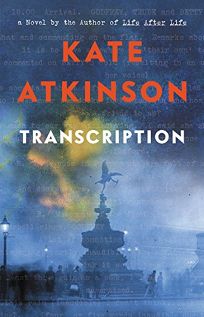
England faced a severe Fascist threat in 1940 just like it does today. At that time the threat was from Germany instead of Russia. ‘Transcription’ is a novel about spying on fifth column British Fascists who were secretly trying to help Hitler and Germany during World War II.

Do not equate Nationalism with Patriotism. Nationalism is the first step on the Road to Fascism.”

So much depends on an intelligent personable voice to carry a novel. Juliet Armstrong is that vivacious voice in ‘Transcription’. She was only eighteen when she started with the British spy organization M15 as a typist and soon she is recruited for a special mission transcribing conversations taking place in an adjacent bugged hotel room between M15 agent Godfrey Toby and assorted British Fascists. Later she becomes even more heavily involved in the dangerous spy work.

It must be awfully handy to have a scapegoat for the world’s ills. Women and the Jews tend to be first in line, unfortunately.”

Most of the first half of ‘Transcription’ is taken up with Juliet Armstrong’s work with these operations for M15 and the various people she works with and also some of the British Fascists. I found this part of the novel entirely fascinating and high energy. We get a captivating picture and insight into the various individuals who make up this operation as well as those who are being spied on. Certainly the equipment used to bug the hotel room was primitive by today’s standards, but that’s part of the fun.

In her M15 work Juliet ultimately gets involved in some dangerous grisly situations.

Later we jump forward to 1950, and the war is over. Juliet is now working for the BBC as a radio producer. Somehow the characters and situation at the BBC don’t have quite the impact of those in M15. For one thing Juliet naturally has somewhat of a condescending attitude toward her BBC work which is of course nowhere near as exciting as her time at M15. Later her M15 connection comes back to haunt her even during peacetime.

‘Transcription’ is a compelling read, perhaps not quite at the level of Atkinson’s amazing ‘Life After Life’ or ‘Behind the Scenes at the Museum’, but still gripping and engaging.

Intelligent fun. That is why I read Cervantes. That’s why I read Chekhov. That’s why I read Shakespeare. That’s why I read Kate Atkinson.


Grade :   A-


‘The Third Hotel’ by Laura Van Den Berg – My Husband, The Zombie

I do not read zombie novels…except this one accidentally. I have never read a zombie novel before and I probably will never read another zombie novel again. I do not find the concept of zombies at all compelling. However this zombie novel ‘The Third Hotel’ has an enticing locale in Havana, Cuba, and an interesting backstory.

To call ‘The Third Hotel’ a zombie novel is perhaps too harsh. It is not at all uncommon for a person who has lost someone close to them recently to imagine that dead person to still be there with them occasionally. Author Van Den Berg ties the events of this story close enough to reality so that I did not lose interest.

Claire has just arrived in Havana, Cuba to attend the New Latin American Cinema Film Festival. Her film critic husband Richard had gotten tickets for both of them to attend but he has been killed by a passing car while walking a few weeks ago. The grieving Claire decides to attend the festival alone. Soon after she watches the movie her husband was particularly interested in, ‘Revolution Zombi’ by director Yuniel Mata, Claire while wandering in Havana spots her dead husband Richard walking away from her.

The museum cast an enormous shadow and her husband was standing within that shadow. She recognized him first from behind, from several hundred feet away, and stopped in the middle of the sidewalk because she was dizzy and her mouth was packed with rocks. She ordered herself to stop recognizing him, because what she was recognizing was plainly impossible, but then she crept closer and saw just how possible it was.”

During the next few days she spots him several times.

You are dead. How could you have forgotten?”

We get the story of the marriage of Richard and Clare. Clare works in elevator sales traveling to towns and cities throughout the United States. Of course the hotel she stays at in Havana has an elevator of interest.

The tone of ‘The Third Hotel’ is overwrought, dreamlike, trancelike, surreal. There is a deliberate confusing of what is real and what is unreal that left me … confused. This is a fever dream of a novel.

‘The Third Hotel’ does capture the exotic atmosphere of the now booming tourist destination Havana nicely. This setting of a horror film festival in Havana is original, colorful, and interesting.


Grade:   B


Ten World Class Fiction Writers I Have Discovered Since I have been Blogging


I have been blogging for a little over nine years now, but I have been an avid reader of world fiction for over forty years. I had read most of the world’s great authors before I started blogging, so they are not included here. However I have discovered many new authors and some existing ones I hadn’t read before then. Some have been featured on other sites. Here are ten I consider the best of the new finds.

Note: I discovered Irene Nemirovsky and Hans Fallada just before I started blogging, so they are not included.

Here goes.

Elena Ferrante – Elena Ferrante has pretty much taken over the world. Her 4-volume Neapolitan Novels will stand as one of the landmarks of Italian literature, and I’ve also read some of her excellent previous work now too. I expect the Neapolitan Novels are quite autobiographical, but she definitely captures what it must have been like growing up in Naples, Italy.

Yan Lianke – I’m only two novels in to Yan Lianke’s work, but I can tell his work will last. I see him as the great political novelist of our time. His ‘The Four Books’ captures the dislocation and devastating results on the Chinese people of the Great Leap Forward started by Chairman Mao Zedong. Lianke is now in my ‘Must Read’ category.

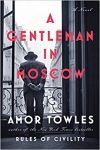
Amor Towles – Amor Towles is the last thing you would expect from the United States today, a smart, stylish elegant charming writer. Both of his novels ‘Rules of Civility’ and ‘A Gentleman in Moscow’ are winners.

Georges Simenon – I never read Georges Simenon in the past because I thought he was a detective genre novelist. Then I discovered his romans durs, and now I am hooked. This French writer deals with the gritty side of life, tacky nasty people, and terrible acts. I find that Georges Simenon has more insight into the way men and women misbehave than just about any other writer.

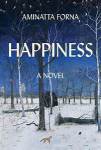
Aminatta Forna – Forna’s Croatian novel ‘The Hired Man’ is written in the style of Kazuo Ishiguro’s ‘The Remains of the Day’ where the sins and conflicts of the past come back to subtly haunt the people of today. Forna’s newest novel ‘Happiness’ about urban foxes in modern-day London captures more than just what is happening on the surface and achieves a depth missing from many novels.

Sofi Oksanen – Finland and Estonia are pretty much twin countries, and Sofi Oksanen has roots in both of them. Both of the novels I have read of Oksanen’s, ‘When the Doves Disappeared’ and ‘Purge’, have taken place in Estonia. Both of these novels have characters and an intensity that makes them superior reads.

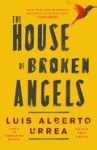
Luis Alberto Urrea – I have only read the one novel, ‘The House of Broken Angels’, but it is one of the most affectionate humorous family portraits I have ever read. Old man Big Angel gathers the family for his one last big birthday party before he dies. Like any occasion when we have not seen many of our relatives for a long time, we think back on these people and what they were like when they and we were young.

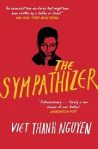
Viet Thanh Nguyen – Watch for this guy, because he has written two thoroughly wonderful works of fiction. ‘The Sympathizer’ tells the story of the Vietnam War from the victors’ point of view which we in the losing US rarely get to see or hear. ‘The Refugees’ is a fine collection of stories about the Vietnam refugees’ experience in the United States.

Tove Jansson – Tove Jansson was another Finnish writer who wrote both children’s books and adult novels and stories. The wonderful NYBR Classics series has brought back many great authors, and Tove Jansson is one of them. The simple language and dramatic events, especially in ‘The True Deceiver’, make her work outstanding.

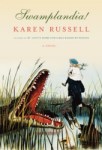
Karen Russell – On no other novel have I lavished such paroxysms of delight as I have on Karen Russell’s ‘Swamplandia’. Afterwards I read a collection of Russell’s stories that was somewhat a disappointment, so now I’m wondering was ‘Swamplandia’ really that good? Sometimes a novel will just sweep you off your feet.


I could also have mentioned Jon McGregor, Lauren Groff, Lawrence Osborne, Juan Gabriel Vasquez, Anthony Doerr, etc. etc.


‘The Winter Soldier’ by Daniel Mason – Romance in a Makeshift Hospital During World War I


‘The Winter Soldier’ by Daniel Mason (2018) – 318 pages

Most of the novels we get here in the United States which take place during World War I involve the Western Front. ‘The Winter Soldier’ is only the second novel I’ve read which takes place on the Eastern Front in the battles between the Austrian Empire and Russia. The first Eastern Front novel I read was the uproarious anti-war masterpiece by Czech writer Juroslav Hasek, ‘The Good Soldier Schweik’. When the Russian government collapsed with the February Revolution of 1917, Russia left the war so there was no longer an Eastern Front.

‘The Winter Soldier’ is about a young Austrian medical student named Lucius. The fighting during World War I was particularly gruesome for the soldiers, and a lot of doctors were needed to treat the soldiers’ horrific injuries. Thus Lucius becomes an army doctor even before he has had any practical experience whatsoever. He is assigned to a makeshift army hospital in a church in a remote valley of the Carpathian Mountains which I believe is somewhere in Poland.

When he arrives, the nurses are happy to see him because there hasn’t been a doctor there for three months. One of the young nurses Margarete who is also a nun has been doing all the necessary amputations and other severe surgeries herself. Lucius tries unsuccessfully to hide his inexperience and all-around incompetence from Margarete.

Margarete is such a strong and likable figure that the reader misses her when she is not in the story. ‘The Winter Soldier’ develops into a romance between Lucius and Margarete.

I found this to be a somewhat unusual subject for a United States novelist to tackle. ‘The Winter Soldier’ is very moving and well done. You will laugh, you will cry. This is substantial real literature that will last.

World War I was probably the most horrific war for the soldiers not only due to the trench fighting but also due to the close combat in other situations. Reading about these soldiers with these dreadful battle injuries, one can’t help but wonder why humans do such terrible things to each other periodically in the name of war. Not only were these war wounds severe, but also the treatment for infections was still primitive then, so there were many amputations due to infected wounds.

Not all of the injuries that the soldiers get are physical. Some are suffering from severe shell shock which can result in catatonia or uncontrollable tremors. However the army sends patrols around to the hospitals, and when they see someone with no obvious injuries, they roust these soldiers up and make them return to battle.

The scenes that take place at this makeshift hospital are definitely the strongest in the novel. Later the war ends and Lucius loses track of Margarete, so the story becomes a search for her. As I said before, the reader longs for Margarete when she is not in the story.


Grade :    A-


‘The Story of a Marriage’ by Geir Gulliksen – The Break-Up


‘The Story of a Marriage’ by Geir Gulliksen (2015) – 152 pages Translated from the Norwegian by Deborah Dawkin

‘The Story of a Marriage’ is a novel about the breaking up of a marriage. It is told by Jon who haplessly watches and listens as his second wife Timmy is attracted to and gradually falls in love with another guy named Gunnar.

As a little inside knowledge about the writing of ‘The Story of a Marriage’ it must be noted that the former real wife of the author Geir Gulliksen complained that during their bitter breakup Gulliksen threatened that he was going to write a novel about the breakup and then he did. So this is reality fiction with a vengeance.

Jon in the novel ditched his first wife when he became attracted to Timmy, and then his first wife prophetically announced ‘Wait until this happens to you’. Twenty years and two kids later…

In the early stages of Timmy’s attraction to Gunnar, Jon is so confident of his good relationship with his wife that he actually encourages her to meet up with Gunnar and perhaps even do more than that. Later he rues that strategy.

I understand that this guy Jon is hurting because his wife left him for another man, but ‘The Story of a Marriage’ could have used a bit of humor. Without any lightness or sense of fun the many extended sex scenes in the novel veer into sappiness. I really can’t blame the girl Timmy for ditching this guy Jon who has no sense of humor for someone else.

Although I’ve got to hand it to the Scandinavians. They can discuss rationally at length what goes on between two people in bed. That’s more than what the rest of the world can do. That’s more than I can do.

The lengthy sober detailed descriptions of the mechanics of the various sex acts between Jon and Timmy in bed are about the only things I found laughable in this entire novel, and I’m sure that was unintentional.

This novel did remind me of ‘Scenes From a Marriage’, a movie directed by Ingmar Bergman which is also about the dissolution of a marriage and which I do consider a much stronger work. In the movie, the husband and wife are on an equal basis and thus each can present his or her side of the story. In ‘The Story of a Marriage’, Jon is the sole narrator, and even though he tries real hard to get inside of his wife Timmy’s thoughts and feelings we don’t really get her views of things.

By the way, I went through several years of watching great Ingmar Bergman films and my favorite of his work is ‘Smiles of a Summer Night’ which is loosely based on Shakespeare’s ‘A Midsummer Night’s Dream’.

My bottom line on ‘The Story of a Marriage’ is that it is not a bad novel if you can get by the sappiness of its extended sex scenes.


Grade :    C


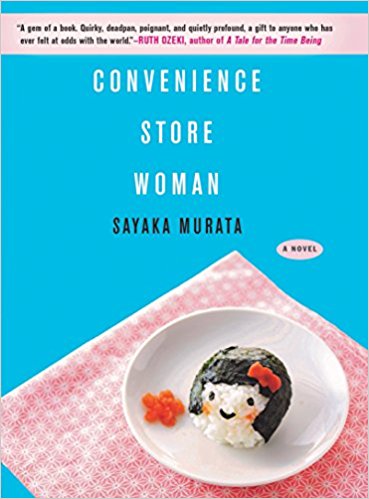
‘Convenience Store Woman’ by Sayaka Murata – An Unsung Hero


‘Convenience Store Woman’ by Sayaka Murata (2016) – 163 pages     Translated from the Japanese by Ginny Tapley Takemori

In every successful endeavor whether it be a family, a business, a clinic, or even a convenience store, there are people who keep it running smoothly and efficiently while at the same time keeping things pleasant and clean. These people are often not the bosses, but they are still totally dedicated to the success of the enterprise. Often these unsung heroes are women. At the same time if there is someone messing up the works with a hateful spiteful attitude, it is often a man who may or may not be the boss.

I read this Japanese novella because convenience stores are something I can relate to, having several of these little stores in our vicinity, usually combined with a gas station. Convenience stores are one thing Japan and Minnesota have in common.

Keiko Furakura has worked part-time at her neighborhood Smile Mart for 18 years. She is not the boss. She greets each customer with a friendly “Irasshaimase, Good Morning”. She makes sure the store keeps the items which customers want in stock, and she arranges her displays to make them attractive. She is dedicated to her store, and her managers think well of her.

Keiko has never had a boyfriend even though she is 38. Her family and her few friends are worried about her because she has no life outside of her job.

Her convenience store hires a young man named Shiraha. It soon becomes apparent that he doesn’t measure up as an employee since he does not do the tasks assigned to him and is insolent and not friendly with the customers. Shiraha is fired from the Smile Mart.

Later Shiraha hangs around Keiko, and Keiko puts up with him because her family feels bad for her for never having a boyfriend. Shiraha moves in with her, does no work, and sponges money off of her. He convinces Keiko to quit the Smile Mart and look for a real job. Keiko’s family and friends are happy for her that she has finally found a male someone.

That is the setup. I won’t tell you what happens next.

Much of what has been written about ‘Convenience Store Woman’ discusses the rigidity and homogenizing pressures of Japanese society. I prefer to concentrate on the similarities between the little stores in Japan and the little stores in Minnesota. Stories like this one about a convenience store woman in Japan could well happen here in Minnesota too. In both places there is a wide variety of types of people that makes it difficult to generalize. I don’t see this situation as at all strange or unusual for any place in the world.

‘Convenience Store Woman’ is a well-done enjoyable novella that celebrates someone who normally doesn’t get the credit she deserves.


Grade :   A


‘The Reservoir Tapes’ – Stories Relating to the Disappearance of Becky Shaw


‘The Reservoir Tapes’ by Jon McGregor (2018) – 166 pages

‘The Reservoir Tapes’ contains a group of linked stories or vignettes involving the people who live in the small rural northern English village from which thirteen year-old Becky Shaw disappeared in McGregor’s last novel ‘Reservoir 13’. Whereas ‘Reservoir 13’ presents a wide picture of the people of this village over time, ‘The Reservoir Tapes’ presents small snapshots of people who knew Becky or knew about her disappearance. It is like Jon McGregor imagined ‘Reservoir 13’ so vividly that he had some leftover material about these people which he put into ‘The Reservoir Tapes’.

In the first story Charlotte, the mother of Becky, is being interrogated by a police officer soon after Becky disappeared. We only get the one policeman side of the conversation.

Okay. And then did you come downstairs before she finished her breakfast?

And was that when the idea of going for a walk was discussed?

It would be fair to say that Becky’s response wasn’t positive, would it?

Is it OK if I call her Becky?

She wasn’t enthusiastic about the walk. And the weather wasn’t great, at that point.

So you let the matter rest for the time being. To avoid a conflict.

This one-sided conversation is a good way to get us readers back into this rural village after the Becky Shaw disappearance.

There are fifteen of these quick short stories about various people in the village. ‘The Reservoir Tapes’ started out as a radio broadcast of fifteen episodes and is a fast easy read, but it would not work effectively for those who haven’t read ‘Reservoir 13’ which is a much deeper novel. Just as is the case of most villages, many of these people know or have heard about each other. The stories involve a wide sweep of people.

By the end of ‘The Reservoir Tapes’, we are no closer to figuring out what actually happened to Becky Shaw, but many possibilities are suggested. She could have drowned in the quarry pond or in Reservoir 13 where she had swam before. She may have been attacked by someone. She may have gotten lost during her walk on the mountain. All are possibilities.

All of these first-hand personal accounts relate to Becky Shaw’s disappearance in one way or another, but some veer far away from that to more recent occurrences or disagreements. Life moves on for the people of the village, and other things become of more immediate concern. There have been adulteries, divorces, a laborer gets trapped under quarry rock. Some of the accounts make you feel uneasy about the potential for violence in this or that character. By the end, we readers have the same eerie feeling we had at the end ‘Reservoir 13’.


Grade :    A


‘Only to Sleep’ by Lawrence Osborne – From the Border Down Into Mexico

‘Only to Sleep’ by Lawrence Osborne     (2018) – 256 pages

Lawrence Osborne was asked by the Raymond Chandler estate to write a Philip Marlowe detective novel, and ‘Only to Sleep’ is what Osborne came up with. I’m not that familiar with Raymond Chandler’s writing, but this is my fourth Osborne novel. I find reading Lawrence Osborne to be a more than adequate replacement for reading Graham Greene whose work I’ve nearly completed. So for me the crucial question would be “Is ‘Only to Sleep’ a good Lawrence Osborne novel?

In ‘Only to Sleep’ we have a 72 year-old retired Philip Marlowe living along the California-Mexico border. The year is 1988. He is lured out of retirement by a life insurance fraud case where the company suspects the beneficiary of faking his death. Most of the story takes place south of the border in Mexico. Apparently Osborne worked as a reporter in this area at one time so he knows this colorful locale well.

This is a Mexico where rich old United States men bring their extremely young wives or girlfriends along in their yachts to Mexican towns along the coast. This is their last fling to which these guys think they are entitled, and they throw wild parties aboard the yachts with drugs and lots of alcohol. Meanwhile Marlowe stays in exotic Mexican hotels as he investigates the case.

In ‘Only to Sleep’, the young femme fatale wife is named Dolores who says lines like “The only thing that matters in life is getting through it to the end without being broke.”

I am familiar enough with Raymond Chandler to realize that he is famous for his snappy lines, and Osborne has written plenty of them here.

It was ninety-seven in the shade and there was no shade.”

He moved like a sloth in linen.”

She seemed dressed for a date in the middle of nowhere.”

We all need something in this world. We all come from places where we can’t get them.”

You get so tired of the people you already know.”

But does this work as a Lawrence Osborne novel? My answer would be “Yes”, it does. I used to not read whodunits considering them a lesser genre, However this one really does capture the flavor of the lives of these rich old Americans living along the Mexican border, and we do get glimpses of the wandering Mariachi bands and the Carnaval parades and the Mexican town police forces that must deal with these rich United States tourists.

I will keep reading Lawrence Osborne. ‘Only to Sleep’ is more than a whodunit.


Grade : A-


Jose Saramago – One of my Favorite Fiction Writers of the 20th Century (and 21st)


Jose Saramago

Born: November 16, 1922  Died: June 18, 2010

Jose Saramago from Portugal was one of those literary giants who make what is being written today seem small and insignificant. I suppose that it is not a good argument for reading Saramago that he spoils modern fiction for you, but read him anyhow. He is one of three Portuguese literary virtuosos – Jose Maria de Eca de Queirós of the late nineteenth century, Fernando Pessoa of the early twentieth century, and Jose Saramago of the late twentieth century – all of whom wrote incredible fictions that are still powerful today. Portugal can consider itself fortunate to have had three such impressive writers.

Jose Saramago wrote convincing allegories that reflect upon the human condition. It was Saramago’s practice as a fiction writer to set whimsical parables against realistic historical backgrounds in order to comment ironically on the human situation. This gives his work a depth that few writers attain.

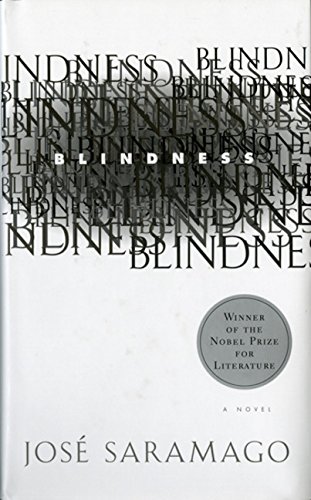
Perhaps his most famous work is ‘Blindness’. In ‘Blindness’ an epidemic of white blindness strikes the city, and the story becomes a parable for the loss and disorientation and struggle for survival which beset the world in the twentieth century. Saramago as a writer never shied away from the big themes and ideas.

Inside us there is something that has no name, that something is what we are.”

I don’t think we did go blind, I think we are blind, Blind but seeing, Blind people who can see, but do not see.”

The difficult thing isn’t living with other people, it’s understanding them.”

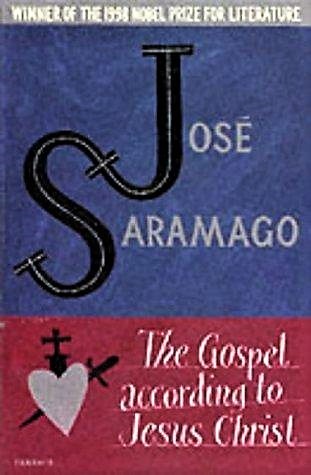
But I’ve been reading Saramago a long time, and there are other novels that I’ve read that absolutely demand to be mentioned. ‘The Year of the Death of Ricardo Reis’ is Saramago’s fictional homage to that maverick Portuguese genius Fernando Pessoa who also wrote poetry as well as fiction. Saramago also wrote ‘The Gospel of Jesus Christ’ which got him into big trouble with the Catholic Church. I will list other Saramago novels that I have read, but the fact that I’m only listing them represents no drop-off in quality : ‘Baltazar and Blimunda’, ‘The Stone Raft’, ‘The History of the Siege of Lisbon’, ‘Cain’.

Saramago was prolific having written at least twenty-five novels, so I still have a lot of his work left to read. Reading each of his novels, even the short ones, is an exhilarating, exhausting, and transforming experience, so I wait a long time between novels.

The above may have wrongly convinced you that Saramago is a difficult writer, but that is not the case. He did his best to make his books readable. Here is one of his thoughts on writing.

Sometimes I say that writing a novel is the same as constructing a chair: a person must be able to sit in it, to be balanced on it. If I can produce a great chair, even better. But above all I have to make sure that it has four stable feet.”

I really think you all have got to read this exciting and mind-altering writer, Jose Saramago.


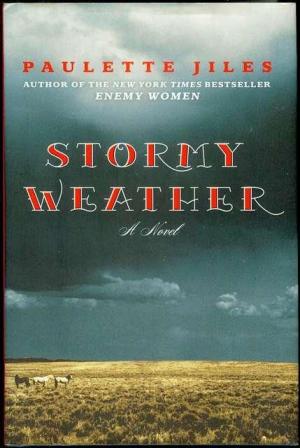
‘Stormy Weather’ by Paulette Jiles – Texas Dust, Rain, and Oil During the Great Depression


‘Stormy Weather’ by Paulette Jiles (2007) – 342 pages

I was quite impressed with Paulette Jiles’ latest novel ‘News of the World’, and that novel made my Best of 2017 list. That Western story is told in a dignified and stately fashion in simple and straightforward prose. So I decided to listen to another novel from Jiles’ back catalog, ‘Stormy Weather’, on audio book. ‘News of the World’ was strong enough to revive my interest in the author’s back catalog as sometimes happens.

Not every novel is made for listening. If a novel contains complex sentences or a difficult plot, it becomes tricky to capture the full effect of the book even with repeated listening. I do read most novels the old-fashioned way (even in physical book form rather than Kindle). However I do occasionally want an audio book (while I’m walking our dog, Bailey) so I am careful to choose only novels for listening that I think will suit the medium. I find these clear and elegant Western novels by Paulette Jiles perfect for audio listening.

‘Stormy Weather’ takes place in Texas oil country during the Great Depression. It is a family story of the Stoddards. The heavy-drinking and gambling father Jack Stoddard dies early on under questionable circumstances, and the mother and three daughters are left to fend for themselves. The only thing their father left them was a race horse named Smokey Joe and a bad reputation. They move back to their mother’s family farm. Much of the story centers around the middle daughter Jeanine who starts out as a scrappy six year old in 1924 and by the end of the novel is twenty-one. As she comes of age, she meets a couple of guys on separate occasions who are quite different from each other, and we get the scenes of her romantic and not-so-romantic encounters as she grows up.

Along the way we get credible stories both happy and sad about what happens to a family through time, And of course there are scenes of the horse Smokey Joe in rural horse races.

‘Stormy Weather’ has the same qualities that drew me to ‘News of the World’. It is a steady family portrait of life during hard times, a story that works just as well for teenagers as it does for adults. It is not the most original story in style or substance, but it is perfect for audio listening.


Grade :    A


‘My Year of Rest and Relaxation’ by Ottessa Moshfegh – Sleeping for a Year


‘My Year of Rest and Relaxation’ by Ottessa Moshfegh (2018) – 289 pages

Ottessa Moshfegh. I can’t imagine any writer voluntarily choosing this name as their pseudonym, but I also can’t imagine this being someone’s real name either. I keep trying to unscramble the letters ‘O t t e s s a   M o s h f e g h’ to come up with the real author’s name.

But Ottessa sure can write. Formerly I called her the Queen of Dirty Realism. Perhaps a more fitting name is the Queen of Ugly Realism. Not that her characters are ugly, far from it. It is just their behavior that is ugly. After our nameless young woman narrator loses her job at a realistic but ridiculous modern art gallery, all she wants to do is sleep. Anyone who can have their main character sleep for a year and still keep the story moving and interesting has got to be a good writer. Of course our nameless heroine does lots of subliminal activities while she is asleep.

Sleep walking, sleep talking, sleep-online-chatting, sleepeating, that was to be expected, especially on Ambien. I’d already done a fair amount of sleep-shopping on the computer and at the bodega. I’d sleep-ordered Chinese delivery. I’d sleepsmoked. I’d sleeptexted and sleeptelephoned. This was nothing new.”

Her psychiatrist the lady Dr. Tuttle prescribes nearly every kind of downer drug and rest medication there is to help our girl sleep, and the ones she doesn’t prescribe she hands out as free samples. Our girl winds up taking one drug called Infermiterol which knocks her out for two days straight but causes her to do a lot of crazy things in her sleep.

Our girl’s best friend Reva comes over once in a while and tries real hard mostly unsuccessfully to cheer our girl up and get her to go out and about. Our girl nearly always snubs Reva and has only contempt for her best friend’s efforts to be friends and to interfere with her sleep.

This novel captures our girl’s darkly comic mood and is filled with caustic black humor. It could have been a tragic story of a young woman withdrawing from the world, but here it is played for mostly laughs. Despite our heroine’s depressive attitude, the humor here keeps us reading.


Grade :    B


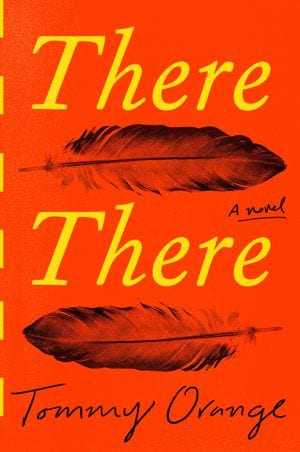
‘There There’ by Tommy Orange – Being Indian Today


‘There There’ by Tommy Orange (2018) – 290 pages

If you are expecting a nostalgic look at Native American life from the past, don’t read this novel. ‘There There’ is an enlightening, sometimes endearing and humorous, sometimes brutal and heartbreaking take on modern urban Indian life. This does not take place on the reservation but rather in the apartments and on the streets of Oakland, California today.


“We know the smell of gas and freshly wet concrete and burned rubber better than we do the smell of cedar or sage or even fry bread—which isn’t traditional, like reservations aren’t traditional, but nothing is original, everything comes from something that came before, which was once nothing.”

We have all heard the legend of the first Thanksgiving of the white settlers and the Native Americans sitting down together to a Thanksgiving feast. Here is an account of a more typical Thanksgiving in American history:

In 1637 near present day  Groton, Connecticut, over 700 men, women and children of the Pequot Tribe had gathered for their annual Green Corn Festival which is our Thanksgiving celebration. In the predawn hours the sleeping Indians were surrounded by English and Dutch mercenaries who ordered them to come outside.  Those who came out were shot or clubbed to death while the terrified women and children who huddled inside the longhouse were burned alive. The next day the governor of the Massachusetts Bay Colony declared “A Day Of Thanksgiving” because 700 unarmed men, women and children had been murdered. – ‘The Real Story of Thanksgiving’, Susan Bates, Manataka American Indian Council

Today Native Americans are still struggling to survive in our cities and on reservations. It is a story of low pay, inadequate employment, excessive alcohol drinking, broken homes, drug use, suicides. Even if you have Fetal Alcohol Syndrome because your mother drank to much when she was pregnant with you, life goes on for you. Some of the men leave their wives and small children to fend for themselves.

But ‘There There’ is enlivened by Tommy Orange’s all-encompassing empathy for these people, his people. The stories of twelve people are interspersed in short chapters until the conclusion where all the characters come together at the Big Oakland Powwow. Powwows may seem like an anachronism today, but they draw thousands of dancers from hundreds of tribes and tens of thousands of visitors to watch.

The eleven year old boy Orvil Red Feather wished his mother had taught him something about being Indian, but she was too busy. Instead he tries to learn it on the Internet, by “watching hours and hours of powwow footage, documentaries on YouTube, by reading all that there was to read on sites like Wikipedia, PowWows.com, and Indian Country Today.” His stolen Indian regalia is ready for the big day and he worries that he might look ridiculous. He teaches his two younger brothers Loother and Lony what it means to be Indian.

The Bay Area American Indian Two Spirits Powwow

Two of the main characters are the half-sisters Opal Viola Victoria Bear Shield and Jacquie Red Feather. They shared a tough childhood with a mother who was often beaten. “Home for Jacquie and her sister was a locked station wagon in an empty parking lot. Home was a long ride on a bus.”

This is a powerful debut novel by Tommy Orange which is sure to move you.


Grade :     A


‘Kudos’ by Rachel Cusk – Where’s Faye?


‘Kudos’ by Rachel Cusk (2018) – 232 pages

My enthusiasm for the Outline Trilogy, or as I call it the Faye Trilogy, peaked with the second novel ‘Transit’. Even though most of the stories people told to Faye in ‘Transit’ were not concerning Faye at all, it felt like Faye and her situation were front and center in that novel. However, in ‘Kudos’, it seems like the stories that the people tell Faye aren’t related to her at all, and Faye is barely there. Faye is for the most part missing in action in ‘Kudos’.

Also I searched for one really nice sentence in ‘Kudos’ that I could use in my review and didn’t find even one, except maybe this one.

A degree of self-deception was an essential part of the talent for living.”

‘Kudos’ begins with our novelist Faye traveling on an airplane to another literary conference in an unspecified European city when the guy sitting next to her tells her the story of his life in a long monologue. As with the previous novels in the trilogy, ‘Kudos’ consists almost entirely of these long monologues from near strangers. These monologues tend to be more philosophical than conversations we have in real life, filtered through Faye’s perspective. They usually are about literature or family life, and especially about marriage and divorce.

Although each of these monologues is quite interesting in itself, there is little to give them any lasting significance. Since each of these characters come on the scene only to tell their story and then are promptly dropped, the only character that is sustained throughout the novel is Faye. And with Faye barely there, there is nothing for the reader to hold on to. The monologues begin to sound very similar to each other. Of course there is no plot in ‘Kudos’ beyond attending this literary festival or conference.

One of the writers at the festival resembles what we know of Karl Ove Knausgaard, but Cusk does not use this resemblance in much of any way to enliven the proceedings.

Two of the bellwethers I use to determine the popularity of a novel are the number of copies and the number of holds on a book at the Hennepin County Library. Hennepin County is the county that contains Minneapolis so it is a big library system. Popularity is usually not a positive characteristic for me, but sometimes it is instructive. I would like to compare ‘Kudos’ with my previous novel ‘Dear Mrs. Bird’ by A. J. Pearce. Both novels received almost universally positive reviews. ‘Dear Mrs. Bird’ was published on April 5, and there are currently 287 holds on 81 copies of the novel at the library. ‘Kudos’ was published on May 18, and there are currently 9 holds on 18 copies of the novel. ‘Dear Mrs. Bird’ is admittedly a crowd-pleaser, but I was struck by how little reader interest there is in ‘Kudos’ for such a well-reviewed novel.

Ordinarily I would take the side of the little-read but uniquely literary novel like ‘Kudos’, but I can’t help feeling that there is something or someone missing from the novel. Perhaps Faye?


Grade :   B


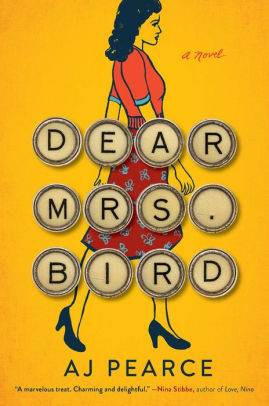
‘Dear Mrs. Bird’ by A. J. Pearce – Advice to Londoners During The Blitz

‘Dear Mrs. Bird’ by A. J. Pearce (2018) – 276 pages

‘Dear Mrs. Bird’ tells the moving story of young 23 year-old Emmeline Lake (‘Emmy’) during the time of The Blitz in London in 1940. The Blitz was Germany and Hitler’s all-out air bombing campaign against England. The German bombing campaign started out to be the bombing of only strategic targets but the bomb dropping was inaccurate, and civilian areas accidentally were bombed. By 1940 the deranged madman Hitler had decided that the terror bombing of London civilians might be useful for his goal of getting England to surrender.

Emmy has two jobs. During the day she works as an assistant to Mrs. Bird who writes a women’s advice column for the Woman’s Friend Magazine. At night she works at the fire station taking calls for the Fire Brigade which must deal with the on-ground devastation of Germany’s bombs.

There are obviously times when ‘Dear Mrs. Bird’ is necessarily heartbreaking but with all the death and destruction around them, living well is even more precious for these young people like Emmy and her friend Bunty. We have the camaraderie, the dances, the boyfriends, the weddings. ‘Dear Mrs. Bird’ is a surprisingly high-spirited read.

The advice columnist Emmy works for during the day, Mrs. Bird, is definitely old school. She will allow nothing concerning “intimate relations” or any other “unpleasantness” in her column. Emmy is supposed to cut up and throw away any letters that contain any mention of these things. As Emmy reads these plaintive letters about the real problems these women are facing in their personal lives, she decides to write to these women herself giving advice, and she signs them “Mrs. Bird”.

I could see people were ever so frank when they wrote in, which I thought really quite brave. Some of them sounded in a real fix. … Things were difficult for everyone at the moment, and I did think it was poor of Mrs. Bird not to write back.”

Since Mrs. Bird doesn’t read the finished magazine, Emmy sneaks some of these letters and her replies into the magazine itself. Emmy also softens some of Mrs. Bird’s more brusque replies.

The papers and radio and even magazines like ours went on about pluck and bravery and spirit,” she says. “How often did anyone ever tell women they were doing a good job? That they didn’t have to be made of steel all the time? That it was all right to feel a bit down?”

I was fully on board with this novel, totally engaged. When I picked up the novel again after temporarily stopping reading it, I was again right away involved because this story really meant something to me. That is probably the best thing I can say about any novel.

‘Dear Mrs. Bird’ is an irresistible tremendously moving story, and I strongly recommend it.


Grade : A+


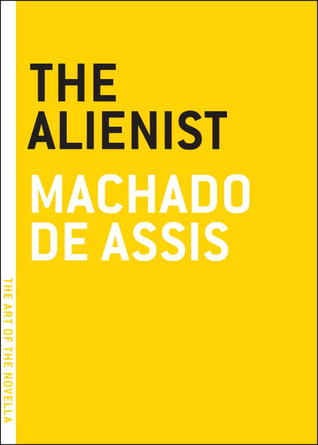
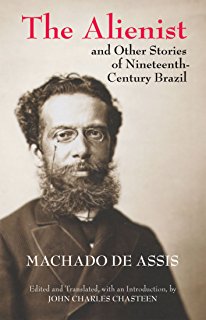
‘The Alienist’ by Machado de Assis – The Out-of-Control Psychiatrist


‘The Alienist’ by Machado de Assis (1882) – 86 pages


Joaquim Maria Machado de Assis is a literary giant.

No one else has written such playful yet psychologically astute satires as Machado de Assis (born 1839, died 1908). His two masterpieces are ‘Posthumous Memoirs of Brás Cubas’ (also known as ‘Epitaph of a Small Winner’) and ‘Don Casmurro’, but much of his other work including some of his stories have withstood the test of time. A new version of his collected stories translated by Margaret Jill Costa and Robin Patterson was just published in June of this year.

Philip Roth called Machado de Assis “a great ironist and a tragic comedian”. Mischievous irony is certainly one of the main devices Machado de Assis uses to connect with his readers.

Usually when Machado de Assis is mentioned, he is called the greatest writer from Brazil or the greatest writer from Latin America. Now it is time to recognize that Machado de Assis is one of those great world class fiction writers who belongs in the same league as such writers as Tolstoy and Dickens and Austen.

I recently read the humorous novella ‘The Alienist’ which can best be described as a playful attack on the science of psychology. The word “alienist” is almost archaic, and the word “psychiatrist” can be used in its place.

A young man named Simão Bacamarte leaves his home village of Itaguai in Brazil to pursue advanced medical studies in Portugal. After completing his education and becoming a brilliant physician, he decides to return to Itaguai and to pursue original research in the new field of psychology. The people in his hometown are happy to have this distinguished doctor back, and he builds a madhouse called Casa Verde for which he picks out residents of his hometown whom he determines are insane and should be locked up. The towns people realize there are some whose madness requires them to be taken off the streets and thus approve of the doctor’s work. At first everything is fine, but soon the doctor decides insanity is more prevalent than he thought, and he locks up more and more of the town residents.

Madness, the object of my studies, was, until now, considered a mere island in an ocean of reason; I am now beginning to suspect that it is a continent.”

The townspeople rebel. By this time three-quarters of the townspeople have been locked up in Casa Verde. The doctor decides to reverse his strategy which you can read all about in the novella.

‘The Alienist’ is a sharp and amusing story about this out-of-control psychiatrist who determines those who are mad and those who are not, but this novella doesn’t quite reach the superior level of those two novels I mentioned above. Start with either of them.


Grade : A-
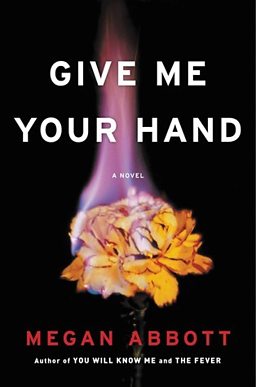
 

‘Give Me Your Hand’ by Megan Abbott – Two Friends and Rivals in the Laboratory

Give Me Your Hand’ by Megan Abbott (2018) – 342 pages

‘Give Me Your Hand’ is the harrowing story of two woman scientists, Kit Owens and Diane Fleming, who became good friends in high school and later are members of the same medical research team. The story alternates between ‘Then’ in high school and ‘Now’ ten years later in the research lab. Kit Owens is from a poor background and has had to struggle to achieve anything. Diane Fleming is from a well-to-do family and has always been treated as the perfect one by teachers and others. Diane inspired Kit to new heights of academic achievement. Now they are both working on a medical project involving PMDD (premenstrual dysphoric disorder) which is a severe form of PMS with symptoms of wild mood swings, intense anger toward others, and even violent behavior. Both Kit and Diane are terribly ambitious, and Kit quotes one of her idols Marie Curie:

My head is so full of plans that it seems aflame.”

This is a psychological thriller. Diane has a dark secret from her past which she has disclosed only to Kim, and Kim could destroy her by telling another person at any time. Along the way we meet others who work in the lab including a couple of men and Dr. Lena Severin, the woman who leads the project.

All of us toiling years in the lab, our necks permanently crooked over microscopes, our faces cadaverous from never seeing the sun.”

This is classic Megan Abbott if there is such a thing (I’ve read two of her previous novels) involving sharp conflicts between young women. The movies are starting to come after Abbott’s work with three of her novels being filmed, and she is a writer for the HBO series ‘The Deuce’. Her work is usually classified as crime fiction and she has won the Mystery Writers of America Edgar Award.

I found ‘Give Me Your Hand’ a bit too simplistic and sketchy to be totally satisfying as a novel for me, but it is probably ideal to be used as the basis for a movie. My reaction to Abbott’s work is similar to my reaction to Stephen King’s work. The prose gets a little too breathless at times for it to be totally convincing as a literary novel. I do like the visceral intensity and obsession of Megan Abbott’s novels and will probably continue to read them in the future.


Grade : B


‘Sabrina’ by Nick Drnaso – An Edgy Original Graphic Novel that Captures Our Times


‘Sabrina’ by Nick Drnaso (2018) – 203 pages

Sabrina’ is a subtle graphic novel that captures the unease, the sense of anomie, and the isolation of our current times.

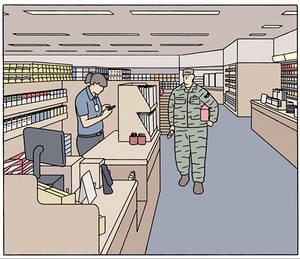
A woman, Sabrina, is missing, perhaps the victim of foul play. Her affectless boyfriend Teddy is at a loss and goes out to Colorado to stay in the apartment of a guy he sort of knew in childhood Calvin Wrobel. Wrobel is newly separated from his wife and child and is a military serviceman who works nights. Wrobel hardly knows this Teddy but lets him have a room. They can barely talk to each other. Teddy spends all his time locked in the room listening to talk radio hosts with wild conspiracy theories. Wrobel goes to his military base job where he must take the following personal survey each day.

How many hours of sleep did you get last night?

Rate your overall mood from 1 to 5, 1 being poor.

Rate your stress level from 1 to 5, 5 being severe.

Are you experiencing depression or thoughts of suicide?

Is there anything in your personal life that is affecting your duty?

At first Wrobel can answer the quiz quite positively, but as Teddy gets on his nerves his mood worsens. Wrobel is also trying to get back with his wife and daughter.

A smaller part of ‘Sabrina’ also follows Sabrina’s sister Sandra as she copes with the aftermath of Sabrina’s disappearance.

‘Sabrina’ is more about capturing the anxieties and the various pensive moods of its characters more than concerning itself with concrete plot incidents. There are hundreds, perhaps thousands of little drawings that depict the isolation and disquiet of these characters. In that way ‘Sabrina is more like a novel than a comic.The colors are subdued, not at all bright or flashy.

Sabrina is not a cheery story, but it does nail the uncertainty and distress of our lives today at this moment.

‘Sabrina’ was published by the Montreal comic and graphic novel publisher Drawn and Quarterly. Whereas other publishers’ comics are loud and violent and repetitive with their endless stockpile of superheroes and anti-heroes, Drawn and Quarterly produces comics and graphic novels that are subtle, moody, nuanced, and human. These are graphic novels that could actually qualify as fiction and literature.

Last week, ‘Sabrina’ by Nick Drnaso became the first graphic novel ever to be selected for the Man Booker longlist. This is a fortunate circumstance for me as I had already completed it. Let me say that I believe ‘Sabrina’ fully deserves this honor.

‘Sabrina’ is an original graphic novel for adults.


Grade : A


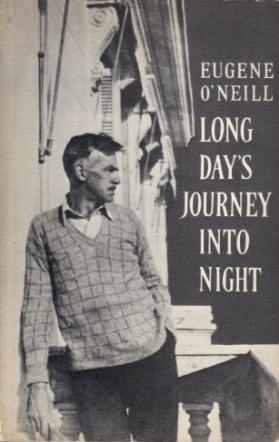
‘Long Day’s Journey into Night’ by Eugene O’Neill – The Tyrone Family

‘Long Day’s Journey into Night’ by Eugene O’Neill (1941) – 179 pages

Many claim that ‘Long Day’s Journey into Night’ is the greatest play written by a writer from the United States. Personally I think that distinction belongs to another play written by Eugene O’Neill, ‘The Iceman Cometh’. If you ever get the chance to see Lee Marvin in John Frankenheimer’s movie ‘The Iceman Cometh’ from 1973, don’t miss it. Lee Marvin plays gregarious salesman Harry Hickey who comes to his old bar to destroy the pipe dreams of everyone who is at the bar. Pipe dreams are those lies we tell ourselves to get us through each day. That play profoundly moves me to this day.

But on to ‘Long Day’s Journey into Night’ which is O’Neill’s most autobiographical play. O’Neill wrote the play in 1941 about his wretched early family situation involving his father, mother, and older brother. O’Neill would not publish the play while he was alive, and he made arrangements not to publish it until 25 years after his death. However his widow Carlotta recognized what a great play it was, and had it published in 1956. The play was first performed in November, 1956.

As its title suggests, the play of four acts takes place during one day in 1912. The Tyrone family is living in their summer seaside home in Connecticut. The father James is a famous actor who could have been a great Shakespearean actor if he hadn’t settled for more money. The sons Jamie and Edmund are fully grown. Older brother Jamie works as an actor in jobs that his father gets for him but mainly Jamie is a rake about town spending most of his time in bars and whorehouses. Edmund, the younger son, has worked as a journalist, written poetry, and has traveled widely but is sickly and may have consumption (tuberculosis) probably somewhat due to excessive alcohol consumption. Edmund is O’Neill’s stand-in for himself. All three men are alcoholics, but it is the mother Mary who has the worse problem; she is a morphine addict and has been confined to a sanatorium before.

One can comprehend how difficult it was for Eugene O’Neill to confront his real family situation. This is family realism at its most honest and most brutal. Each character must confront his or her own reality and shortcomings or else another member of the family will point them out for him or her.

None of us can help the things life has done to us. They’re done before you realize it, and once they’re done they make you do other things until at last everything comes between you and what you’d like to be, and you’ve lost your true self forever.”

I do think ‘Long Day’s Journey into Night’ is a very strong honest family drama. However it is somewhat of a sad and depressing play with no redemption for its characters. I prefer ‘The Iceman Cometh’ because while it is still brutally honest with the people on stage, it still offers a way out for these people at the end.

Under any conditions, Eugene O’Neill is still the greatest playwright from the United States.

Grade : A

‘Jakob Von Gunten’ by Robert Walser – The Hare and the Tortoise Revisited


‘Jakob Von Gunten’ by Robert Walser (1908) – 176 pages Translated from the German by Christopher Middleton

‘Jakob Von Gunten’ is a fictional journal kept by young Jakob Von Gunten during the time he spent attending and living at the Benjamenta Institute. This private institute is a school for training young men to become servants. It is run by Herr Benjamenta and his sister Fraulein Benjamenta. Robert Walser did actually attend such a school, and the novel is based on his experiences there.

Jakob Von Gunten is a young guy who is a born writer in a society that has no use for writers, much like Robert Walser himself.

How fortunate I am not to be able to see in myself anything worth respecting and watching! To be small and to stay small.”

The following journal entry will give you a good idea of the playful ironic spirit of this novel.

We wear uniforms. Now, the wearing of uniforms simultaneously humiliates and exalts us. We look like unfree people, and that is possibly a disgrace, but we also look nice in our uniforms, and that sets us apart from the deep disgrace of those people who walk around in their very own clothes but in torn and dirty ones. To me, for instance, wearing a uniform is very pleasant because I never did know, before, what clothes to put on. But in this, too, I am a mystery to myself for the time being.”

Jakob refuses to take himself too seriously. Jakob prides himself on being silly, impolite, cheeky, and stubborn. Jakob gets bored quite easily. There is another guy named Kraus at the Institute who is the exact opposite of Jakob Kraus is extremely hard-working and has a serious demeanor and does what he is told without questions or even thinking. Kraus never gets bored because he is always concentrating on the task at hand and looking for ways to improve it. Krauss’s motto is “make yourself invisible, or get busy with something.” In contrast Jakob sometimes sleeps late at the Institute, and Kraus comes around and pushes him out of bed and tells Jakob to get to work. However Jakob gets his revenge by teasing and annoying Kraus mercilessly.

Much of the novel is taken up with the interaction between these two guys, Jakob and Kraus. This is a fundamental difference between people, somewhat similar to the difference between the hare and the tortoise in that Aesop’s fable race. Jakob is the hare, and Kraus is the tortoise The hare is at least ten times quicker but is easily distracted and winds up losing the race to the slow and steady tortoise. When I look back on my own years at work, I must admit I was always more of a Jakob, a hare, than a Kraus, a tortoise. I was more of a wise guy who seemingly didn’t take the work all that seriously and got bored with routine tasks, and thus got into conflicts with the tortoise types.

But there is much more to the novel than the interactions between these two guys. We get an entire picture of the Institute including its founders. The writing is always lively and intense. It is not the easiest novel to read because some of the things referred to are foreign or dated, but the overall story is well worth the effort even today.

Here is an interesting side note on the author Robert Walser. At the age of fifty, after suffering from anxieties and hallucinations for many years, he checked himself into a mental institution called Waldau in Bern, Switzerland where he lived for 29 more years. He was known for taking long walks in the surrounding area. He gave up fiction writing completely, and was rumored to have said, “I’m not here to write, I’m here to be mad,”


Grade : A


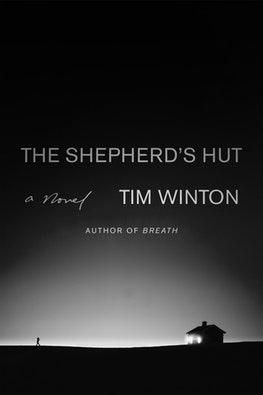
‘The Shepherd’s Hut’ by Tim Winton – A Missed Opportunity


‘The Shepherd’s Hut’ by Tim Winton ( 2018) – 267 pages

‘The Shepherd’s Hut’ starts out strong with a fascinating offbeat family. Fifteen year-old Jaxie Clackton has an all-consuming hatred for his abusive drunken father whom Jaxie calls Captain Wankbag. His father bashes Jaxie regularly, but even worse the father had beat up Jaxie’s beloved mother who has recently died of cancer. Meanwhile Jaxie consoles himself thinking about his distant girlfriend, his first cousin Lee, who is six months younger than Jaxie. Her mother Auntie Marg vehemently disapproves of their relationship as does the rest of Jaxie’s family.

Then old Captain Wankbag dies in a nasty car jacking accident, and Jaxie sets off across Western Australia to join up with his girlfriend Lee. Here is Jaxie driving out of town:

But bugger me, here I am hitting a hundred already and still not even in top gear. On squishy upholstery, with one of them piney tree things jiggling off the mirror. I’m flying. And just sitting on my arse to do it. Off the ground. Out of the dirt. And I’m no kind of beast anymore.”

I was settling in for a delicious family drama or melodrama on the order of Tim Winton’s wonderful probably classic ‘Cloudstreet’. Winton is a master of the Australian argot, and his mastery is on full display here. Jaxie narrates ‘The Shepherd’s Hut’ and his voice is raw, energetic, working class, down-to-earth, and colorful.

However…

However Winton throws this brilliant setup away and forsakes this vivid family story to give us entirely something else, and that is where I think Winton loses his way. Jaxie gets stuck in the harsh desert wilds of Western Australia and meets up with a disgraced old Irish priest named Fintan MacGillis. I expect this priest is supposed to be some enigmatic figure, but he seemed pretty stock to me. The momentum of this novel was lost for me when Jaxie’s family story was totally dropped and instead we’re out in the wilderness with this priest. It probably would have helped if Winton had presented this priest as some sort of father figure for Jaxie replacing old Captain Wankbag, but this is never even considered.

Later Jaxie and Fintan MacGillis must face villains who are nearly nameless and thus of little interest to this reader. So Winton traded an intense family drama for a routine generic adventure story in the Western Australian wilderness with a boring priest as a sidekick.


Grade : B