Archive for the ‘Book Reviews’ Category

‘Strike Your Heart’ by Amélie Nothomb – “Home is where it Hurts”


Strike Your Heart’ by Amélie Nothomb  (2017) – 135 pages                   Translated from the French by Alison Anderson


‘Strike Your Heart’ is a modern-day fable for adults. It is written in the style of a fairy tale, simple and stark and crystalline.

Marie is nineteen and pretty. She is quite sure that the whole world belongs to her. But then Marie gets pregnant and has to get married to the most handsome rich boy in her class Olivier and has a baby Diane. Everyone including Olivier tells Marie what a beautiful baby Diane is, and Marie soon becomes jealous of the baby.

Your mother isn’t cruel, my treasure. She’s just jealous.”

She always has been, that’s just the way it is, there’s nothing you can do about it. Jealous, do you understand that?”

The two-year-old said yes.

Marie, the mother, isn’t unkind or crazy. She just does not show her young little daughter Diane any tenderness. Later Marie has three more babies whom she treats much nicer than Diane.

It would be easy for Diane to see her mother as wicked, but Diane does not see it that way. She is hurt by her mother’s cold attitude toward her, but due to the love and support she receives from the other people around her including her father Olivier she does not turn bitter. She sees her mother Marie as an ice goddess.

‘Strike Your Heart’ is a well-done novel by the prolific Amélie Nothomb who has already written 26 novels and is only 53. She varies her subject and approach each time, and I usually can’t wait to see what she has come up with next. Her novels are usually short and fun to read. Here is an old piece I wrote about her almost ten years ago.

I enjoy stories where the writer treats modern life as an ancient fairy tale. It gives us a simpler plainer perspective on our complicated lives.

I suppose in an ideal world a mother would treat each of her children with the same amount of love and tenderness, but there are so many factors that enter in to family dynamics that there are bound to be differences. The children who get too little love may have it better than the ones who get too much love which may lead to spoiling. A lot depends on how the kid deals with his or her own situation.

This cover which I show above seems to me like a terribly poor choice for such a colorful novel, but ‘Strike Your Heart’ is well worth reading, and I am pretty sure you will enjoy the simple hard-edged prose.


Grade :  A-


Alberto Moravia – One of My Favorite Fiction Writers of the 20th Century

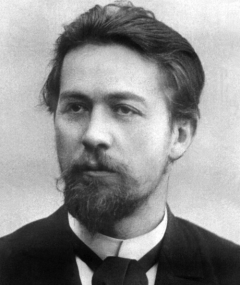
Alberto Moravia

Born : November 28, 1907     Died : September 26, 1990


I suppose by this time that Alberto Moravia has been almost forgotten. How am I going to convince you that Alberto Moravia is an author well worth reading today?

Every true writer is like a bird; he repeats the same song, the same theme, all his life. For me, this theme as always has been revolt.” – Alberto Moravia

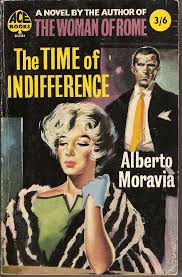
The best writers make it seem almost effortless. In plain simple language, Moravia early on was critical of the Roman middle class for its apathy to the fascism which was pervading Italy under Mussolini before World War II in his first novel ‘Time of Indifference’, written in 1929 when he was only twenty one. After that the fascists clamped down on his work and actually banned his wonderful novel ‘Agostino’ (Two Adolescents) in 1941. Moravia and his first wife Elsa Morante had to hide out from the fascists in Ciocaria in central Italy in 1943.

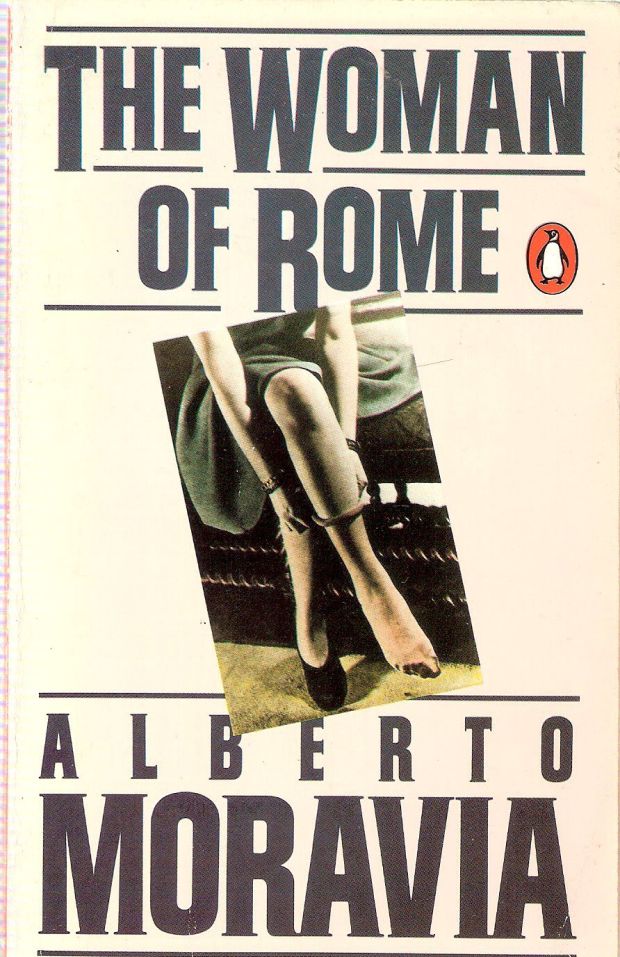
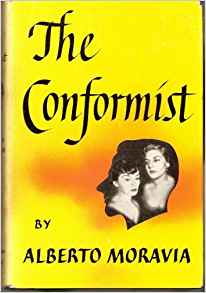
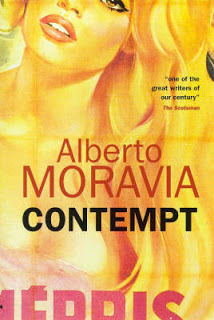
In May of 1944 with the liberation of Rome, Moravia returned. After the war, Moravia’s popularity steadily increased with such novels as ‘The Woman of Rome’ in 1947 and ‘The Conformist’ in 1951. In the Fifties and Sixties, several of his works were made into movies by the great film directors of the time including Vittorio De Sica (‘Two Women’), Jean Luc-Godard (‘Contempt’), and Bernardo Bertolucci ( ‘The Conformist’). After reading ‘Contempt’, I watched the movie which was outstanding and contains Brigitte Bardot’s best performance as an actress.

“One must try to say complicated things in a clear way,” – Alberto Moravia

How can I characterize Moravia’s work after the war? His themes are the hypocrisy of modern life and the inability of people to find happiness in traditional ways such as love and marriage. Moravia is a realist and a sharp but sensitive narrator of contemporary life. ‘The Woman of Rome’ is the story of a young woman who becomes a prostitute. Many of his novels were put on the Roman Catholic Church index of works that Catholics were forbidden to read because of his frankness in dealing with issues relating to sex and marriage.

This thought strengthened in me my belief that all men, without exception, deserve to be pitied, if only because they are alive.” ― Alberto Moravia, ‘The Woman of Rome

Two of his best novels have very simple titles, ‘Boredom’ and ‘Contempt’. Both of these novels would serve as a good introduction to Moravia’s work with his accurate depiction of unsettling feelings in intimate relationships.

Alberto Moravia was always trying to get to the bottom of the human imbroglio.” – Anthony Burgess

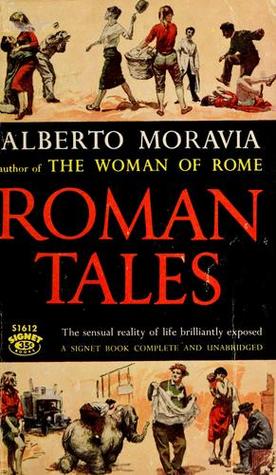
I have read almost all of Moravia’s novels and found them all to be strong and moving works. He was also an excellent short story writer as exemplified by his ‘Roman Tales’ and ‘More Roman Tales’.

Friendship is more difficult and rarer than love, so we must save it as is.” – Alberto Moravia

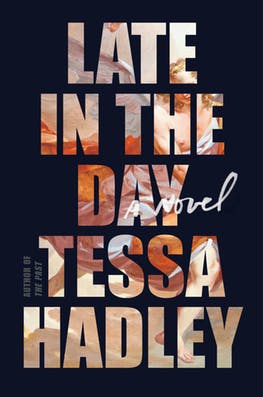
‘Late in the Day’ by Tessa Hadley – Drowning in a Sea of Elegance and Exquisite Taste

‘Late in the Day’ by Tessa Hadley (2019) – 273 pages

I was bowled over by Tessa Hadley’s previous novel ‘The Past’ as well as her latest collection of stories, ‘Bad Dreams and Other Stories’. However after praising Tessa Hadley to the skies twice, I must now don my critical hat, and write about what bugs me most about the writing of Tessa Hadley.

I found the elegance and sheer perfection of these characters’ every move and thought quite annoying. Hadley lays it on quite heavily. To me this seemed like a form of over-writing that I did not care for. Sure these are all wonderful people with their own special talents and personalities, but I grew tired of Hadley pointing out these characters’ magnificence in every little detail.

The refinement of these folks’ clothing, furniture, houses, backgrounds, and all else is something to behold.

‘Late in the Day’ starts with a death. Lydia’s husband Zachary has just died. They are only in their forties so the death was entirely unexpected. Lydia calls her friends Alexandr and Christine to tell them what has happened and they rush to the hospital where they meet Lydia.

She had her air of a disgruntled queen, haughty and exceptional in a sky-blue velvet jacket with a fake leopard-skin collar; when Christine turned to embrace her, people turned their heads to stare.”

Apparently no one is distraught enough not to note every detail of Lydia’s precious clothes. And so it goes.

After this first scene, we get alternating chapters of these two couple’s lives from their early days just after college until the sad present time. In the present day, each couple’s single child, Grace and Isobel, is also brought into the story. I found all of these characters somewhat off-putting.

Everything is pristine perfection. When Zachary wants to buy and open an art museum (because his family has plenty of money), it is not just any old art museum: “A red-brick chapel, built by the Huguenots in a modest backstreet of terraced eighteenth century cottages in Clerkenwell.” Hadley goes on and on detailing the subtle furnishings of this chapel. She describes “the arched side windows which still had their original thick flawed greenish glass”. “The interior with its floor tiles worn by human passage into a shallow relief landscape, its dreamy underwater light, its gracefully curved upper gallery supported on iron pillars.” Hadley continues in excruciating precision:

An arched gateway wide enough for a wagon, fitted at some point with corrugated iron doors now rusted fantastically, gave access to a cobbled courtyard overgrown with buddleia and nettles and filled up high with junk – old chapel pews ripped out when the chapel was used as storage for a builders’ merchant, heaps of rotted drugget, plastic sacks of hardened cement, abandoned steel scaffolding poles and bolts, an ancient Gurney stove, hymn books rotted down to a pulp.”

Even the rust is fantastic. This is an overload of exquisite detail. Enough already. It is enough to make me regret my own miserable surroundings.

At a later point in the novel, the character Lydia gives the game away. “Lydia said she thought things were better when travel was restricted to the upper classes. – At least they had taste and good manners.”

Being very much descended from the lower classes myself, this remark offended me. I hope that this was Hadley’s attempt to show Lydia’s snobbish attitude and not Hadley putting her own thoughts in Lydia’s mouth. I found these characters laughable in their pretensions, but Tessa Hadley wasn’t laughing.

Otherwise, the story in ‘Late in the Day’ held my interest, despite the elegance overload.


Grade :    B


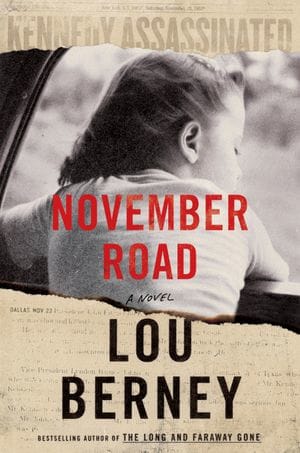
‘November Road’ by Lou Berney – On the Run Across the Southwest after JFK was Shot

‘November Road’ by Lou Berney (2018) – 299 pages

Among my first forays into the adult world were my Kennedy scrapbooks. I was only 12 years old when John F. Kennedy was elected President, but I was entirely fascinated with Kennedy and his family and put together a meticulous scrapbook of the 1960 election using pictures cut out from Life and Look magazines. Then I made another scrapbook of his first year in office. These scrapbooks are buried somewhere in my basement, but I hope they are still intact.

Of course I still recall the devastating report that came over the loud speaker at my high school on noon on November 22, 1963 that President Kennedy had been shot.

‘November Road’ is a thriller and road adventure story that is driven by the Kennedy assassination. Frank Guidry is a low level operative for his crime boss Carlos. One of his last assignments was to park an unlocked car with its key in the ignition near Dealey Plaza in Dallas, Texas. When Guidry hears the news of the assassination, he quickly realizes that the car he parked was the get-away car for the real murderers of Kennedy, and that Lee Harvey Oswald was just a decoy in the murder conspiracy.

The suspicious circumstances of the murder and the ensuing murder of Oswald lead one to suspect there was a conspiracy. ‘November Road’ assumes it was an organized crime conspiracy, but there are definitely other possible political conspiracies.

Guidry realizes that his organized crime boss will want to cover his tracks by getting rid of anyone who was involved in the crime, and that includes Guidry himself. He leaves his apartment in New Orleans and heads west through Texas. And Guidry is right; there is a paid assassin named Barone chasing after him.

In Oklahoma Guidry encounters a small town woman named Charlotte and her two small daughters. She has left her drunk husband. Guidry figures the woman and her kids would provide a good cover in his efforts to escape the hired assassin who is behind him

A love story across the west to Las Vegas ensues. Will our small-time playboy organized crime operator fall for this poor wife with her daughters who represent everything that is nice and decent in this world?

I usually don’t read thrillers, but ‘November Road’ got particularly good reviews. I listened to it on audio, and it was very exciting in that format. We follow Guidry and Charlotte and the girls on the run with the hired assassin Barone right behind them.

‘November Road’ certainly does not have the depth of good literature, but as a thriller and road adventure it was entirely enjoyable and compelling.


Grade :    A-


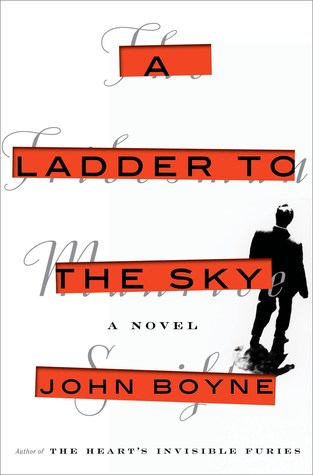
A Ladder to the Sky’ by John Boyne – What Would You Do in Order to Write a Prize-Winning Novel?


‘A Ladder to the Sky’ by John Boyne (2018) – 362 pages


‘A Ladder to the Sky’ is a captivating jaunty thriller about wicked literary politics. Our sole resourceful villain is one Maurice Swift, a man of limited talent who will stop at nothing to write a prize-winning literary novel.

I think Maurice is whatever he needs to be, whenever he needs to be it. He’s an operator, that’s for sure. And I don’t much like him, Gore, if I’m honest. Sometimes I think I might hate him. He’s rude and unkind, utterly self-centered, and treats me like a dog. But I can’t seem to break away from him.”

Yes, the American writer Gore Vidal is a character in this novel. Vidal is the only one who sees through the evil machinations that Maurice Swift uses to get his next novel. We follow Maurice’s career from when he is an aspiring young writer working as a waiter in West Berlin in 1988 up until today.

This is a dark, dark story and I won’t spoil it for you with too many details.

Can the quest for an outstanding literary career really be this mean and cruel? We tend to view our prestigious authors as magnanimous human beings perched high above us in some literary Valhalla of refined manners and good taste. But what cruelties and misdemeanors did these writers have to perpetrate along the way to get there? Perhaps “misdemeanor” is too feeble a word for what they did.

Mostly we see Maurice Swift as others see him. These poor souls are won over by him, and they never see the real Maurice Swift until it is too late.

Reading ‘A Ladder to the Sky’ was a very enjoyable experience for me. The story is very well framed and captures entirely what a person with limited talents might have to do in order to become a distinguished prize-winning novelist. The hardest task for the talent-less is coming up with those succeeding novels after that first success.

This is a lively fiction, and I guarantee you will have a good time reading it.


Grade :   A


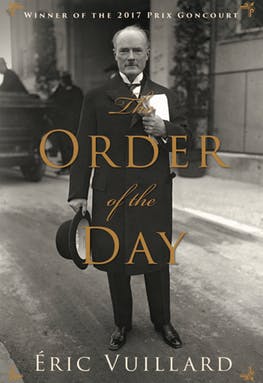
‘The Order of the Day’ by Eric Vuillard – The Raving Lunatic Takes Over Germany and Austria


‘The Order of the Day’ by Eric Vuillard (2017) – 132 pages Translated from the French by Mark Polizzotti

“Great catastrophes often creep up on us in tiny steps.”

Two significant events in Germany’s lead-up to World War II are discussed in the 2017 Prix Goncourt winning novel ‘The Order of the Day’ which is probably as close to non-fiction as a work of fiction can ever be. The events in the novel really happened, and the characters were all real people. Nothing is made up. In fact the novel strives to be entirely historically accurate. The only reason ‘The Order of the Day’ could be classified as fiction is that the author Eric Vuillard recreates private conversations that we know took place but do not know exactly what was discussed.

The first event is a meeting of twenty-four major German business owners on February 20, 1933 where they all agreed to lend their support to Adolf Hitler. These were the Krupps, the von Siemens, the Opels, and others.

And the twenty-four gentlemen present at the palace of the President of the Reichstag that February 20 are none other than their proxies, the clergy of major industry; they are the high priests of Ptah. And there they stand, affectless, like twenty-four calculating machines at the gates of Hell.”

Without the support of these major business leaders, the Hitler nightmare would never have happened. Later Vuillard mentions that some of these same companies were not averse to using slave labor: “BMW hired in Dachau … IG Farben … operated a large factory inside the camp at Auschwitz.”

Just as we are settling in for an account of this horrific meeting, Vuillard switches his focus to another significant event leading up to World War II, Germany’s annexation of Austria which is now known as the Anschluss on March 12, 1938.

First there is a calling into account of English diplomat Lord Halifax who along with Neville Chamberlain were architects of England’s appeasement policy toward Hitler and Germany.

The English aristocrat, the diplomat standing proudly behind his little line of forebears, deaf as trombones, dumb as buzzards, and blind as donkeys, leaves me cold.”

Lord Halifax caving to the Nazis reminds me of the attempts by politicians and diplomats to appease and placate Donald Trump and Vladimir Putin.

Then we proceed to the futile attempts by the leaders of Austria to keep its national integrity despite the German onslaught.

On the day of the takeover of Austria, Hitler ordered a tank invasion – a Blitzkrieg – of Austria. However some of the heavy artillery vehicles stalled in the middle of the road. An entire line of German tanks sat motionless.

What was supposed to be Hitler’s triumphant return in a Blitzkrieg to his hometown and the towns where he spent his childhood turned into a total deadlock standstill with no vehicles moving. It was bitterly cold. Hitler was in his Mercedes behind the stalled vehicles.

Hitler was fit to be tied: what was supposed to be his day of glory, a swift spellbinding passage, had morphed into a traffic jam. Instead of speed, there was congestion; instead of vitality, asphyxiation; instead of a surge, a bottleneck.”

However, Austria was then under the control of a raving lunatic, and the Austrian people along the way cheered.

‘The Order of the Day’ is very fine as an indignant look back at crucial events in modern history, but I am still not sure it qualifies as fiction.


Grade : A-


‘Certain American States’ by Catherine Lacey – Modern Stories with Some Wicked Twists


‘Certain American States’ by Catherine Lacey (2018) – 190 pages

The loneliness of certain American states is enough to kill a person if you look too closely.”

If you are searching for something new and different in fiction, you might try Catherine Lacey. I’m at the point where I would rather read her disordered unpredictable stories in ‘Certain American States’ than the simpler more straightforward sincere stories of someone else. This is my first encounter with Lacey’s work, but it won’t be my last.

It is not that her subject matter is so weird or different. These stories usually start out as direct stories of modern life. Perhaps Lacey describes her subject matter best in her story “Small Differences” with the phrase “the conditional and imperfect nature of human-on-human love,”

It is clear now that Nathan and I have always had just enough respect for each other to withstand a mutual disrespect.”

You only learn who you’ve married after it’s too late, like one of those white mystery taffies you have to eat to find the flavor, and even then, it’s just a guess.”

So what makes Catherine Lacey’s stories so peculiar? It is the outlandish unpredictable twists that occur along the way. None of the stories are written in chronological order but skip around as needed to heighten their impact. Also Lacey writes superb, occasionally extraordinarily long, sentences. These are the kind of sentences and stories you want to read more than once to capture their full meaning. In fact the first sentence in the first story is nearly two pages, nearly perfect except the editor of my edition left out a ‘to’ early in the sentence.

But sometimes Lacey uses short sentences effectively too. Here is a fine example of Catherine Lacey’s unique voice from her story “Because You Have To”. Here is a young woman’s interior monologue to the guy who has recently left her:

You have been calling and hanging up.

I know it’s you. The telephone rings differently when you call.

You can’t tell me I don’t recognize this. You have no idea what I hear, but it is so like you to doubt me, to assume I’m wrong. It is so like you to not be here, and to call as if to point out your absence and to say nothing just to frustrate me.”

A reader can never tell if Catherine Lacey is serious, and it is probably wise for you to assume she is not.

My main complaint with Lacey’s works here is a a lazy one. These stories each contain so much that they are simply exhausting. A reader shouldn’t have to work this hard in order to enjoy a story. These are the kind of stories that you may want to re-read, but that you may also need to reread in case you have missed a key point. Even in the stories that misfired for me there were a sense of humor and plenty of interesting ideas.

I am going to end with a quote about Catherine Lacey’s stories from novelist Anne Enright:

Although Lacey’s work can be sad, it is rarely monotone, never earnest. Her stories are profoundly playful and piercingly good. You don’t have to read them, but you really should.” – Anne Enright, The Guardian


Grade : A-
 

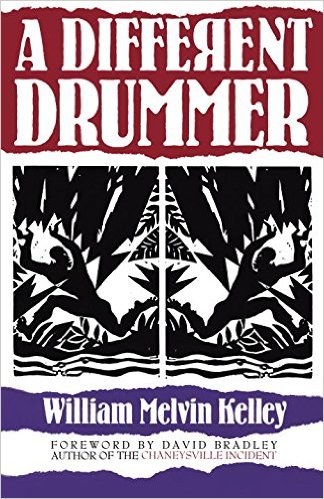
‘A Different Drummer’ by William Melvin Kelley – A Major Rediscovery


‘A Different Drummer’ by William Melvin Kelley (1962) – 205 pages

I have found that some of the finest fictions that I have read have been rediscoveries. These are novels or collections of stories by authors who have been near totally neglected and forgotten for decades but are finally rediscovered by some admiring peripatetic reader with exquisite taste. Suddenly a previously neglected author joins the pantheon of classics.

I search out articles which rediscover almost forgotten novels or writers, because these have usually proven to be among my best reading experiences.

My first experience with one of these rediscoveries was Christina Stead and her 1940 novel ‘The Man Who Loved Children’ for which poet and author Randall Jarrell wrote a famous introduction in 1965 which brought that novel back from obscurity to justified fame. I didn’t discover the novel until about 1980, but Randall Jarrell’s article was still famous then.

Since then there have been a number of authors who have justly come back from the missing. Here are a few of them: John Williams (‘Stoner’), Dawn Powell (‘Angels on Toast’, ‘The Golden Spur’, and just about everything else she ever wrote), Maeve Brennan (‘The Springs of Affection’, stories), Irene Nemirovsky (‘Suite Francaise’), Hans Fallada (‘Every Man Dies Alone’ aka ‘Alone in Berlin’), and Lucia Berlin (‘A Manual for Cleaning Women’, stories). All of these forgotten writers have now assumed their rightful places in literature.

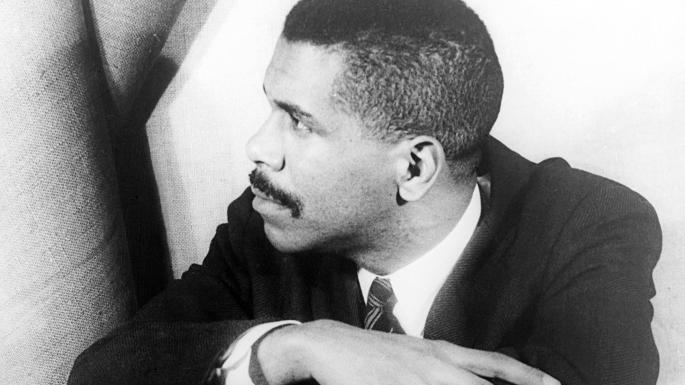
Now a new name to be added to that list is William Melvin Kelley (‘A Different Drummer’). William Melvin Kelley wrote ‘A Different Drummer’ in 1962, and after reading it I find it worthy to be included on this list of forgotten classics. It has already been praised to the heights by articles in the New Yorker, the Guardian, and the Irish Times this year, so don’t blame me for rediscovering it.

Forget the portentous fictions of William Faulkner. William Melvin Kelley writes in the open magnanimous humorous spirit of Mark Twain.

This is a story of black people in the Deep South, but it is told through the eyes of their white neighbors. Some of these white people have been brought up as children alongside their black neighbors and have developed an understanding and affection despite their differences. However there is a hard cruel uncomprehending crew of white racists who have no understanding or affection. These white people have “a gaze that signals the flickering off of the switch that controls the mechanism making man a human being .”

The white landowning Willsons in 1957 sell a piece of land to steady worker and family friend Tucker Caliban who is a descendant of their former slave. This is a transaction many of their white neighbors and townspeople can’t understand.

Tucker Caliban proceeds to destroy the land and farm by salting the land, slaughtering his horse and cow, and setting fire to the farm buildings and then leaving. This sets off a mass migration of all of the black families in the area to the North. Soon there are no black people at all left.

At first the white Governor of the state claims, “We never needed them, never wanted them, and we’ll get along fine without them.” However the other white people are angry because they won’t have anyone to boss around and look down on anymore.

‘A Different Drummer’ captures the full range of white characters from a white boy who recognizes that Tucker is different from him but admires him anyhow to the Willsons who grew up alongside Tucker and his new wife Bethrah to the vicious redneck and white supremacist townsman Bobby Joe.

I like to think about the professional football, basketball, and baseball teams. The white players and coaches on these teams must realize that their teams would be nowhere without their black athletes. Any white racism would be detrimental to any one of these professional teams. Yet the United States and its President persist in their ugly white racism.

But getting back to this excellent novel by William Melvin Kelley, it is Kelley’s light touch in telling his story that impresses me. He captures these people as only the finest writers do. Kelley has a homespun way of telling his story that reminds me of Mark Twain.


Grade : A


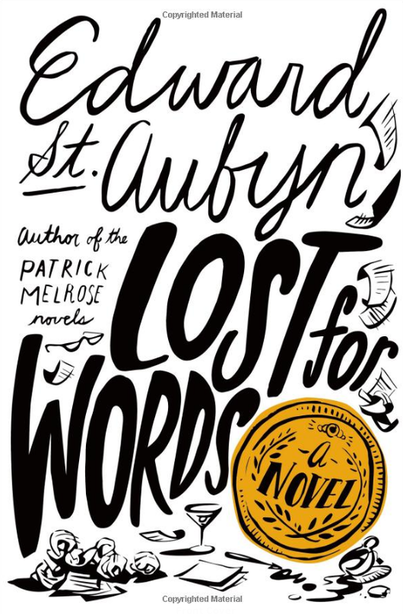
‘Lost for Words’ by Edward St. Aubyn – Trying Real Hard to be Funny

‘Lost for Words’ by Edward St. Aubyn (2012) – 261 pages

Up until recently, I believed that Edward St. Aubyn could do no wrong as a writer, but that was before I read ‘Lost for Words’. This is his novel satirizing the process for selecting the Man Booker Prize for Fiction. Due to his acclaimed 5-novel Patrick Melrose series of which I have read only one novel, Edward St. Aubyn became famous as a humorous literary stylist on the order of Evelyn Waugh and as a brutally funny satirist of the British upper class. Until now, I had only read one other of St. Aubyn’s novels, ‘Dunbar’, which is a pastiche of ‘King Lear’, and the writer turns that bitter family tragedy into a sharp-tongued comedy.

I was expecting great things from ‘Lost for Words’. However…

So what were my problems with ‘Lost for Words’? Nearly everything. The humor is just too broad, too obvious, too over-the-top. The reader is constantly being bombarded with one scene after the next, each more outrageous than the previous and with little connection to reality. The characters are not real characters but stock caricatures of characters.

One of the writers competing for the prize is an Indian Rajah. I don’t believe I’ve encountered an Indian Rajah in a novel since Rudyard Kipling. Do Rajahs still even exist? This is likely an unfair Indian stereotype. The Indian Rajah’s mother has created a cookbook she is trying to publish, and it accidentally gets entered for Booker consideration, and one of the judges champions it as a “ludic, postmodern, multi-media masterpiece.” The book not only makes the longlist but also the shortlist.

One of the novels entered for the Booker is a gritty realistic novel along the lines of Irvine Welsh with the title “wot u starin at”. That is kind of funny. St. Aubyn does include excerpts from these Booker novels which sometimes hit the mark as parody and sometimes do not.

Most of the Booker judges in ‘Lost for Words’ practice literary politics at its smallest and meanest level except for the Oxford academic Vanessa Shaw.

He could hear Vanessa’s exasperation as she gradually realized that the majority of her so-called ‘literary’ novels were not going to make it on to the Short List. She kept trying to argue that the other novels lacked the qualities that characterized a work of literature: ‘depth, beauty, structural integrity, and an ability to revive our tired imaginations with the precision of its language.’

Of course, Vanessa Shaw does not prevail.

I expect the Booker Prize select process is ripe for satirizing, but ‘Lost for Words’ misses its target by being so far out of date and ridiculous.

I do intend to read more of the Patrick Melrose series in the near future as that is St. Aubyn’s still most acclaimed work. I would say read Edward St. Aubyn but avoid ‘Lost for Words’.


Grade :   C


‘Milkman’ by Anna Burns – Middle Sister and The Troubles


‘Milkman’ by Anna Burns    (2018) –  360 pages


‘Milkman’ takes place in Belfast, Northern Ireland, in the late 1970s during the time known as The Troubles – a city divided like no other.

Telling the story is an 18 year old young woman known only as Middle Sister. She has first sister, second sister, third sister, and three wee sisters as well as a few brothers. She also has a maybe-boyfriend. The country over the water governs uneasily. Some of the residents are defenders of this government while others are renouncers. They all live in tight neighborhood enclaves where all are either defenders or renouncers. The renouncers want to be governed by the adjacent country across the border and have formed paramilitary groups to keep the defenders out of their neighborhoods. Here the outsiders’ government is not to be trusted.

The only time you’d call the police in my area would be if you were going to shoot them, and naturally they would know this and so wouldn’t come.”

A mysterious 41 year old married man – Milkman – starts pursuing our young woman. He is not really a milkman; he is one of the paramilitary leaders of the renouncers. He stalks our young woman. He shows up unexpectedly with his entourage and threatens her maybe-boyfriend among other things. Middle Sister’s family and her neighbors all see her with Milkman and wrongly assume she is having an affair with him. Our Middle Sister tries to avoid Milkman by jogging with third brother-in-law, but still Milkman persists.

We get a strong sense of the all-encompassing paranoia that has gripped the neighborhood when maybe-boyfriend who is a mechanic gets in trouble with the renouncers for having some parts of a Blower Bentley, a car made by the country across the water, in his house.

Our young woman reads only eighteenth or nineteenth century literature.

I did not like twentieth-century books because I did not like the twentieth century.”

Her neighbors consider her beyond-the-pale for her reading-while-walking.

‘Milkman’ is a highly original novel that successfully captures the human derangements that must have prevailed in Belfast during The Troubles. It is not an easy read due to its long sentences and long paragraphs, but I would call the novel “wordy” rather than “deep”. The style of not using proper names for characters necessarily leads to long sentences as in her “almost one year so far maybe-boyfriend”. Our young woman narrator is certainly articulate but to capture exactly what she wants to describe sometimes requires a lot of words. Don’t read ‘Milkman’ if you are looking for laconic short sentences. For the most part I had no difficulty following her long trains of thought and even felt enriched by them, but a few times she lost me during a long, long sentence. There were also times where I would stop reading in the middle of a paragraph, something I normally don’t do, but when the paragraph is more than two pages long…

However Middle Sister gives us a convincing depiction of what life must have been like in Belfast during the time of The Troubles.  As far as capturing the paranoid neighborhood spirit of that terrible time in Belfast, The Troubles, ‘Milkman’ is a winner.


Grade : A-


What I Didn’t Like About the Movie ‘The Favourite’


The movie, ‘The Favourite’, directed by Yorgos Lanthimos, has gotten near universal praise and is definitely up for Oscar consideration. Perhaps what has gotten the most praise for the movie is that it provided three actresses, Olivia Colman and Rachel Weisz and Emily Stone, with substantial roles which is something rarely seen in movies.

However it seems to me that there is a big downside to this movie that has not been confronted yet. From an historical perspective the movie is not only false, but it is dishonest to women.

First lets deal with the real Queen Anne. She was born in 1665 to the man who would later become King James II of the Stuart line who reigned from 1685 until he was deposed in 1688. Anne would later become Queen in 1702 and would reign until 1714. Her husband Prince George of Denmark lived only to 1708. ‘The Favourite’ does not mention him at all so presumably the movie takes place after he died.

Queen Anne’s main adviser during her reign is Sarah Churchill. Churchill was a Tory and favored mostly moderate policies. However later in 1710 Queen Anne and Sarah had a falling out precipitated by Queen Anne’s friendship with her servant Abigail Masham. At that point, Abigail became the main adviser. In political outlook, Abigail was a Whig. After Queen Anne’s death, Sarah Churchill wrote an article disparaging the Queen, and that may have been used as the basis for ‘The Favourite’.

So what did ‘The Favourite’ get wrong? The movie takes this rare time in history when three women were making the ruling decisions for Great Britain, and turns it into a lesbian sex farce. Queen Anne was pregnant 17 times, so converting her into a lesbian must have been difficult. There is no historical record or even gossip that Queen Anne was a lesbian. But that isn’t the main fact the movie deliberately gets wrong. One of the major plot lines of the movie is that Abigail severely poisons Sarah in order to take over as Queen Anne’s advisor and lover. This poisoning is totally made up, and turns the whole reign of Queen Anne into a bad joke. So instead of these two royal advisors to the Queen representing two reasonable points of view, Whig and Tory, it all becomes a case of lesbian jealousy. This is not a case of inaccuracy; this is a deliberate lie.

To me this would be similar to making a movie about George Washington in which he is banging both John Adams and Thomas Jefferson. Then in a fit of gay jealousy, Jefferson severely poisons Adams.

The men in ‘The Favourite’ are represented as frivolous fools with their exceedingly long-haired wigs, but that doesn’t excuse the movie from its dishonest portrayal of Queen Anne and her advisors.

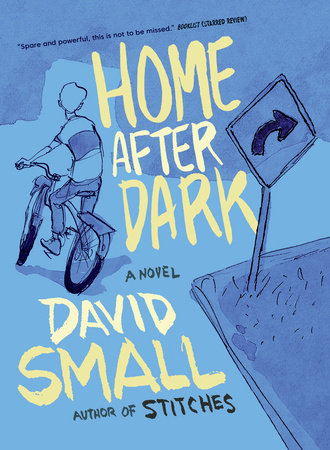
‘Home After Dark’ by David Small – A Ring of Feral Cruel Teen Boys


‘Home After Dark’, a graphic novel by David Small (2018) – 396 pages

´Home After Dark´ is a profoundly sad dramatic graphic novel about family breakdown and adolescent brutality.

I look back on my own childhood with pleasant nostalgia but then realize that I am overlooking the situations when some of the boys were needlessly cruel to others around them including myself. Worse, I forget my own cruelties. There is something about those early teen years that makes some boys especially cruel to those around them. These boys must feel tremendously insecure, and they take out their insecurities on those around them whom they see as being in a worse position than themselves.

‘Home After Dark’ takes place in the middle 1950s starting out in Youngstown, Ohio. Thirteen year-old Russell Pruitt’s mother has run off with her husband’s best friend. Russell’s father Mike decides to relocate to California taking Russell with him. First they head to Los Angeles, but there are no jobs available for Mike there so they head up to northern California to a small town called Marshfield where Mike gets a job teaching English to the inmates in San Quentin prison.

After that, we mainly see the father Mike laying on the couch with a bottle of hard liquor laying on the floor next to him. Thirteen year-old Russell must fend for himself.

Russell first befriends an outsider in his class named Warren. Later Warren offers Russell two dollars if they take their clothes off and hug each other. Russell goes through with it, but from then on avoids Warren.

Russell then takes up with a more wild couple of boys, Kurt and Willie, who spend most of the summer in a tree house and an abandoned arroyo.

Of all the characters in ‘Home After Dark’, only the Chinese couple Wen and Jian who run a restaurant are at all redemptive. They are the only ones who express any concern for Russell’s well-being.

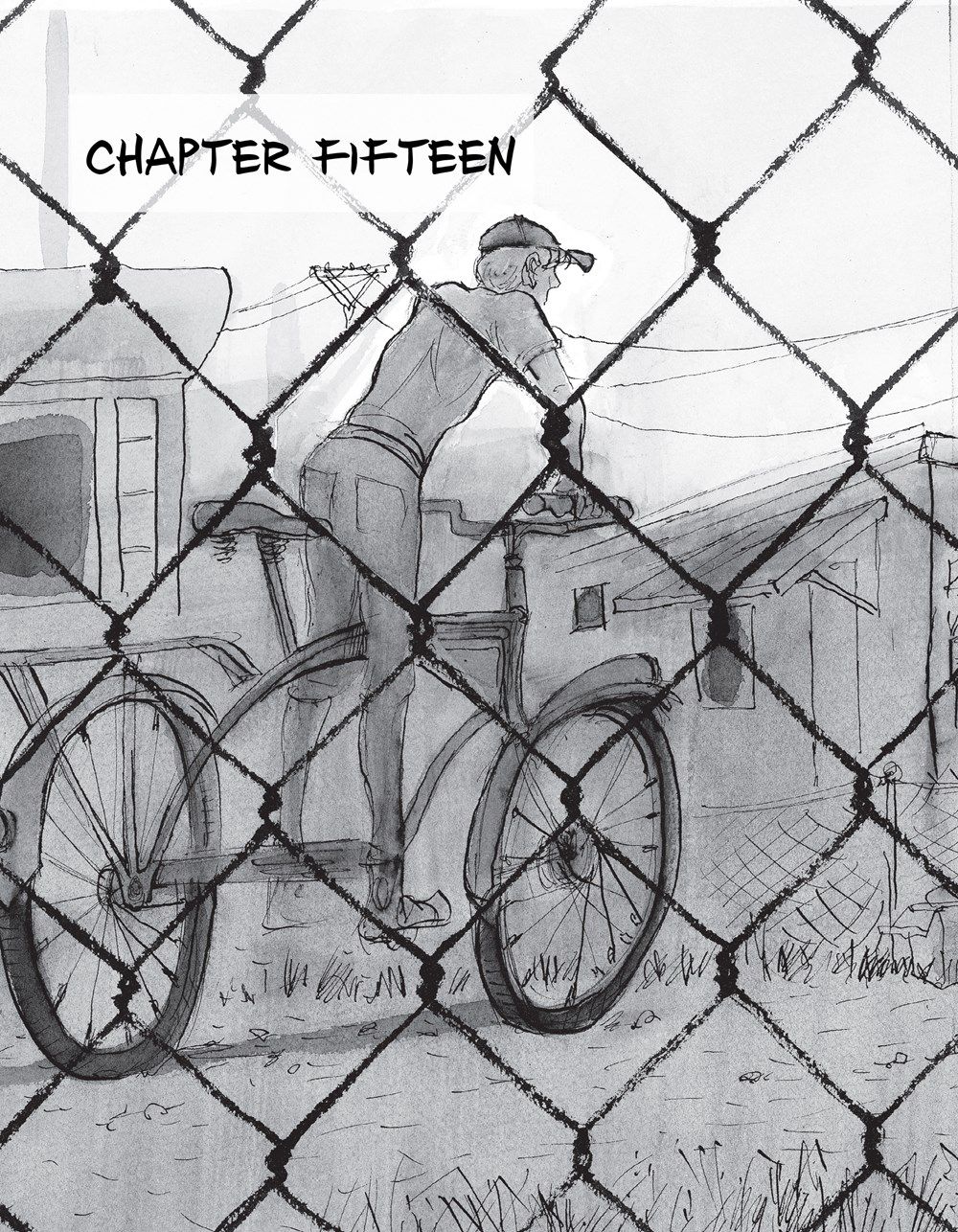
There are very few words in ‘Home After Dark’, only the bare minimum of words to advance the story. What there is in this graphic novel is thousands of pictures. It must have been an incredible amount of work drawing all of these pictures. But I must say that this graphic novel did work for me in the sense that the grim atmosphere and drama were depicted successfully. However I kept wondering if the story could just as well have been conveyed more efficiently with just some well-chosen words in a short story.


Grade:    B+

‘If Beale Street Could Talk’ by James Baldwin – Young Lovers Who Are Kept Apart


‘If Beale Street Could Talk’ by James Baldwin (1974) – 197 pages

You think your pain and your heartbreak are unprecedented in the history of the world, but then you read.” – James Baldwin

In ‘If Beale Street Could Talk’, James Baldwin has created a precarious love story and family drama that has now been made into a movie by Barry Jenkins (he of Oscar Best Picture winner ‘Moonlight’) which will very soon be coming out in theaters. I have not seen the movie and will discuss only the novel by James Baldwin instead.

‘If Beale Street Could Talk’ is the story of a young couple, Fonny aged 22 and Tish aged 19, living in Harlem in New York City in the 1970’s. It is told from the point of view of Tish. She visits Fonny in jail, framed for a rape he did not commit. Later we learn that Fonny was set up by a white racist policeman. Tish goes to the jail and visits him there every day.

“I was sitting on a bench in front of a board, and he was sitting on a bench in front of a board and we were facing each other through a wall of glass between us…I hope that nobody has ever had to look at anybody they love through glass.”

On one of her jail visits, Tish tells Fonny that she is pregnant.

I guess it can’t be too often that two people can laugh and make love, too, make love because they are laughing, laugh because they’re making love. The love and the laughter come from the same place: but not many people go there.” 

Their two families meet and discuss what to do about this predicament. Despite differences between the two families, they agree that they must get Fonny out of jail. Tish’s mother goes to Puerto Rico in an effort to locate the woman who accused Fonny of rape and talk her into dropping the charges.

Tish has the bright optimism of youth but must deal with a dire situation made more dire by prevailing casual white racist attitudes.

‘If Beale Street Could Talk’ is a realistic intense black American love story and family drama of people trying to survive in an inherently unfair world. Baldwin captures the poignancy of both of these two young people and their families as they are caught in this unjust situation. As in ‘Romeo and Juliet’, the world, in this case the white world, is conspiring to keep this loving young couple apart. As Stacia L Brown wrote in Gawker, Beale Street  “belongs to a collection of literature that seeks to humanize black men, through their relationships with parents, lovers, siblings, and children. It swan-dives from optimism to bleakness and rises from the ash of dashed hopes.”

Why Baldwin titled the book ‘If Beale Street Could Talk’ remains a mystery, as there are no references to Beale Street in the novel.

Besides being a novelist, poet, essay writer, and civil rights activist, James Baldwin also came up with some great quotes. I will leave you with one more.

Please try to remember that what they believe, as well as what they do and cause you to endure does not testify to your inferiority but to their inhumanity.” – James Baldwin


Grade:    A

My Top Ten Fiction Reads of 2018

I really have no strategy for making these top fiction lists beyond that I enjoyed each of these works of fiction immensely. However the lists are far from just pure entertainment lists as two of the qualities in writers I enjoy most are their insights into human nature and their subtle intelligence.

You can see my original reviews for each of these books by clicking either on the picture or the bold-faced title and author.

So here are my this year’s selections, starting with my favorite fiction of the year and proceeding in order from there.


‘The House of Broken Angels’ by Luis Alberto Urrea – This novel gets family life right in a humorous yet loving way. Old man Big Angel will have one last big Mexican-American birthday party before he dies with the whole extended family there.


‘Dear Mrs. Bird’ by A. J. Pearce – Here is a lively moving novel of the terrible Blitz in London in 1940. With all the death and destruction around them, living well is even more precious for young Emmy and her friend Bunty.


‘West’ by Carys DaviesPennsylvania settler and farmer John Cyrus Bellman heads out west in the United States in 1815 in search of giant dinosaurs which he figures must still be roaming around out there. Along the way he picks up an Indian scout named Looks Like A Woman From Afar. This is an entertaining story.


‘Modern Gods’ by Nick Laird – ‘Modern Gods’ is a rich Northern Ireland family story that tackles the thorny issue of religion both in their hometown of Ballyglass in Ulster and in the far reaches of New Guinea. Laird, a poet, really gets inside the heads of his characters to convey precisely what they are thinking and feeling.


‘Those Who Knew’ by Idra Novey´Those Who Knew’ is a modern political drama about the never-ending liberal struggle against homegrown fascism, racism, and oppression. Novey uses diverse means to convey her story.


‘Reservoir 13’ by Jon McGregor – Thirteen year old Rebecca Shaw disappears from a small northern English village. Jon McGregor views the people of this rural village with the same calm steady keenly observant attitude with which he observes the trees, the birds, the fish, and the other animals. His view appears to be that we humans are as much a part of nature as everything else.  After you read ‘Reservoir 13’ , you might also want to read the related work ‘The Reservoir Tapes’.  


‘Warlight’ by Michael OndaatjeOndaatje’s main achievement in ‘Warlight’ is capturing the ambiance and atmosphere of bombed-out England after the war and the mystery and excitement and color of these people waking up and resuming their peacetime lives.


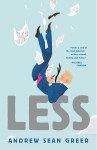
‘Less’ by Andrew Sean Greer – Here is a gay guy novel even a non-gay guy can appreciate. That is because it is one of the most humorous novels I have read, and Greer’s type of humor is universal, a guy laughing at himself and those around him as they sometimes make utter fools of themselves with their outrageous behavior.


‘Convenience Store Woman’ by Sayaka Murata – This is a well-done enjoyable novella about someone who doesn’t usually get the credit she deserves, an upbeat efficient convenience store woman.


‘Happiness’ by Aminatta Forna – Now that England has banned fox hunting, there are many urban foxes in London where our main character has come to study them. The foxes are frequently found prowling the garbage for food. By capturing more than just what is happening on the surface, Aminatta Forna achieves a depth that is missing from many novels.


Happy Reading!


´Those Who Knew’ by Idra Novey – The Never-Ending Battle Between the Left and the Right


´Those Who Knew’ by Idra Novey    (2018) – 248 pages


´Those Who Knew’ is a modern political drama about the never-ending liberal struggle against homegrown fascism, racism, and oppression.  It takes place on an unnamed island in the South which had been ruled by a ruthless dictator named Cato who had been propped up by a powerful northern country (US?).  A progressive movement, in part led by radical college students, had been successful in ousting Cato several years ago. One of the college student leaders, Victor, is now a Senator and may soon run for President.   

Lena is one of Victor´s ex-girlfriends.  She hears that Victor´s current girlfriend Maria P. has been killed after being run over by a bus.  Lena recalls a time when Victor almost choked her to death in his uncontrolled anger, and now she suspects that Victor perpetrated the death of Maria P.

´Those Who Knew’ is a politically intense and realistic story.  One of its many pleasures is its cast of offbeat characters. There is the elderly radical Olga who is Lena´s best friend and who runs a used bookstore as well as a marijuana business on the side.  There is also Victor´s brother Freddy who is a gay playwright. Lena´s current boyfriend Oscar is from the North and likes to cook meals and desserts for his friends.

The author Idra Novey relies on diverse means of telling her story, and these changes in approach and tone kept this reader enthused.   The chapters are usually very short, and the story is told from the points of view of various characters. Also the narration takes several forms including entries from Olga´s makeshift log and short scenes from Freddy´s plays.  The variety of narrators and narrative forms keeps one interested in the proceedings.  

The progressives here are fighting against the slick well-organized corruption and oppression of the rich and powerful.  The progressives are a motley unruly crew of offbeat individuals, but isn’t that usually the case? Those who believe in personal freedom usually practice personal freedom in their own lives, while the fascists who wish to limit the lives of others usually live limited oppressive lives themselves.

One of the continuing problems for the Left is that some of their own trusted leaders can turn ruthless and authoritarian as they become enamored of their own power. 

The battle between liberalism versus fascism has become more intense as fascism has spread again over large parts of the world.   After World War II, most of the world realized that the next war could destroy life on Earth, so they took moderate steps to prevent that from happening.  However today world leaders seem to have forgotten the 60 million people who were killed in World War II, and now all Hell is breaking loose again.

´Those Who Knew’ takes place on an unnamed island, ¨this fascist-hearted country of ours¨, but this island represents our entire world.


Grade:   A+


‘Love is Blind’ by William Boyd – Love is Blind, but Not Deaf

‘Love is Blind’ by William Boyd (2018) – 369 pages

‘Love is Blind’ is the good-natured story of Brodie Moncur, a young man from Scotland who has a great ear for tuning pianos. This gift takes him to Paris where he tunes the pianos for the famous concert pianist John Kilbarron, “the Irish Liszt”. At the same time Brodie is tuning pianos, he falls madly in love with Kilbarron’s lover Lika Blum.

This rollicking tale takes place during the early days of the twentieth century in various locales including Edinburgh, Paris, St. Petersburg, Nice, and the Andaman Islands. This is a light-hearted adventure yarn not to be taken all that seriously. Even though piano tuning is usually not considered adventurous, I would still call ‘Love is Blind’ an adventure novel.

I have read several of William Boyd’s previous works. I was tremendously impressed with his first two novels that I read, ‘A Good Man in Africa’ and ‘The Ice Cream Wars’. Boyd seems to specialize in high-spirited adventure stories in exotic locales. Over the years I have read a few more of his novels and always prick up my ears when I hear he has a new one out but do not always get around to reading it, but this time I did make room for ‘Love is Blind’ in my reading routine.

This time around, William Boyd kept me entertained for the full length of the novel with humor and adventure, but I guess I was looking for something more than entertainment. For me, ‘Love is Blind’ lacked intensity and depth.

At the heart of the novel is the clandestine romance between Brodie and Lika and its complications. They must sneak around behind the backs of the pianist Kilbarron and also his brother Malachi. For one thing I did not find the romance between Brodie and Lika convincing. They meet and instantly fall totally in love for no good earthly reason. Perhaps that is true to real life, but in a novel there must be compelling reasons for a love affair to happen.

I realize there is a difference between a fiction being light-hearted and humorous and a fiction being intense and deep. Perhaps a writer must stay on the surface in order to keep things light. I just think that depending on the dexterity of the writer, it should be possible to be both amusing and intense. But maybe I am wrong.


Grade :     B


‘Modern Gods’ by Nick Laird – An Outstanding Vivid Story about Religion and Family in Ulster, Northern Ireland and New Ulster, New Guinea


‘Modern Gods’ by Nick Laird (2017) – 308 pages

‘Modern Gods’ is a relatively unheralded novel which finally came to my attention, and it proved to be outstanding on reading.

Sometimes it doesn’t work for a poet to write fiction, but here it works perfectly. This is the most expressive meaningful novel I have read in a long time. The wording and the sentences are just exquisite and exact. Every sentence is well thought out to convey precisely what each person is thinking and feeling at that time, and each person is delightfully their own soul.

Much of ‘Modern Gods’ is about the interactions and complications and logistics of the Donnelly family from a small town called Ballyglass in Ulster in Northern Ireland, written in such a way that I could easily relate to this cast of characters. Just as in any family the individual members have different traits and desires and locales even though they are related. There is the never married Liz who ventured far away from home to become an academic in New York and then there is the dutiful stay-at-home daughter Alison who has two little kids and who is marrying her second husband and then there is the younger son Spencer in his twenties who is carrying on his father’s real estate business.

Liz lugged her rucksack up the stairs, and set it on the bed beside one of her old exercise books. She flicked through it and felt a great rush of sadness. There is such pathos in childish handwriting, especially one’s own. Time had this terrible habit of creeping up and pistol-whipping you on the back of the head.”

Nearly every sentence in ‘Modern Gods’ is that good.

Liz is returning to her parents’ home in Ballyglass from New York on the occasion of her sister Alison’s second marriage to a solid local guy Stephen. Their parents are pleased to have the family all together again, and the wedding will be a joyous celebration. However in contrast to this warm family story,there are also in the early chapters short sections dramatically relating a mass Halloween shooting that took place at the Days End pub in Londonderry.

After the wedding, Liz is headed off to New Guinea for the island of New Ulster to be the presenter for BBC for a documentary of a new religion which has started up among the native people there led by a native woman named Belef.

Ultimately ‘Modern Gods’ is about the beneficial and pernicious effects that religion can have on people all around the world from Ulster in Northern Ireland to New Ulster in New Guinea. I am going to borrow some exceptionally good lines from Carlo Gebler of the Irish Times in a review for ‘Modern Gods’ (with proper acknowledgment) which to me fully capture the theme of this novel:

Whether you’re from Ulster or New Ulster, you face the same problems as a human being: one, you hurt others and two, you die, and with both of these it is necessary to make some sort of accommodation and that’s the function of religion.”

Aren’t those the two basic human problems, we hurt others and we die?

So not only is ‘Modern Gods’ a rich family story, it tackles the thorny issue of religion. It goes beyond just telling a story to having psychological and philosophical depth.

Here’s an interesting fact. Novelist/poet Nick Laird is married to novelist Zadie Smith.


Grade:    A+

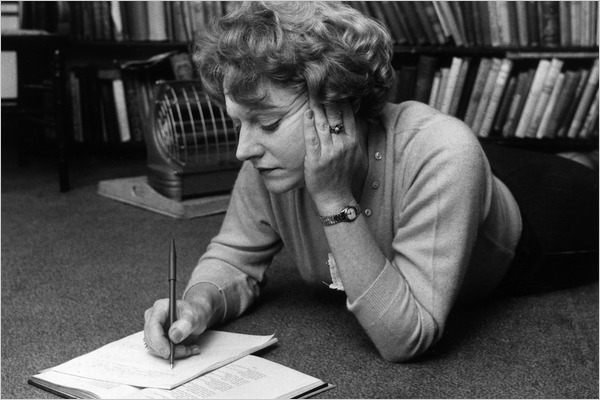
Muriel Spark – One of my Favorite Fiction Writers of the 20th Century (and 21st)


Muriel Spark

Born:  February 1, 1918         Died:  April 13, 2006

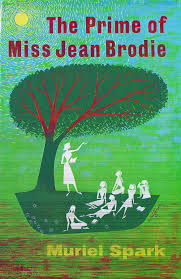
This is a good time to write about Muriel Spark because we are still in her centenary year. With her economy of style, she was the master of the sparkling witty yet meaningful novella. I have been a great fan of her work since even before I became devoted to literature, having read ‘The Prime of Miss Jean Brodie’ in my college Contemporary Literature class.

One’s prime is elusive. You little girls, when you grow up, must be on the alert to recognize your prime at whatever time of your life it may occur. You must then live it to the full.”

Spark’s descriptions of her characters were not always kind. Take this one from ‘Jean Brodie’ which does finish with a bit of poignancy:

Mary Mcgregor, lumpy, with merely two eyes, a nose and a mouth like a snowman, who was later famous for being stupid and always to blame and who, at the age of twenty-three, lost her life in a hotel fire,”

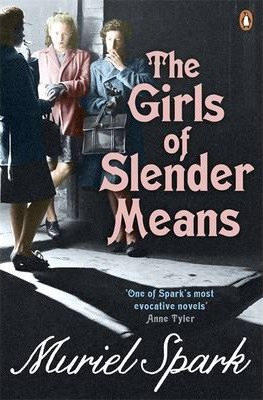
Her most famous novel ‘The Prime of Miss Jean Brodie’ is indeed a fine, fine novel, but it is not my favorite Muriel Spark novel. My favorite is ‘The Girls of Slender Means’. It also deals with a group of girls, but now they are very young women just out of high school living in a youth hostel in London. It begins with this excellent sentence:

“Long ago in 1945 all the nice people in England were poor, allowing for exceptions.”

The young women have one Schiaparelli dress gown between them, and they take turns wearing it on dates. Later there is a fire.

Spark was born and spent her childhood in Edinburgh, Scotland, but later she lived in London, Rhodesia, New York, and Italy. Graham Greene recognized her talent early on and financially supported her when she was a young struggling writer. She wound up writing 22 novels in all.

Reading Muriel Spark novels is the ideal way for a person to slide into literature as the novels are all novella length and easy to relate to. Spark is sometimes called a Catholic novelist, but I was brought up a dyed-in-the-wool Protestant and that did not interfere at all in my appreciation of her work.

Just about anything can happen in a Muriel Spark, and it isn’t always realistic. However it always does make a kind or cruel point. ‘The Abbess of Crewe’ is about the head nun of a convent secretly recording the conversations of all the other nuns a la Watergate. ‘The Ballad of Peckham Rye’ is about a London neighborhood beset by a Scottish migrant who wreaks havoc. Spark is one writer who was able to come up with a totally different plot for every short novel she wrote.

This is Spark’s particular genius: the cruelty mixed with camp, the lightness of touch, the flick of the wrist that lands the lash.” – Parul Sehgal, The New Yorker

I am going to finish with a list of some of the Muriel Spark novels that I personally have admired:

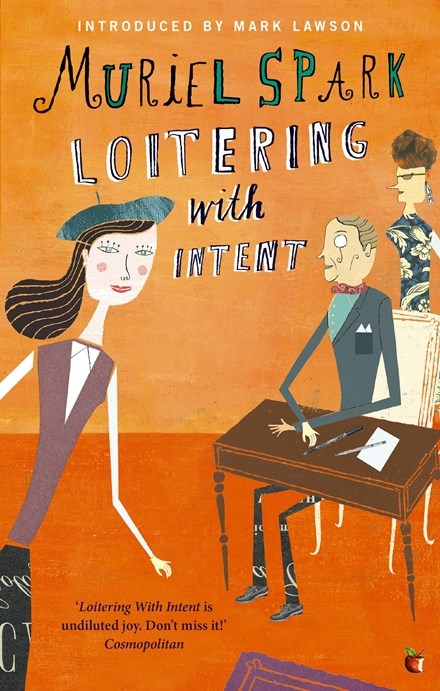
Loitering With Intent”

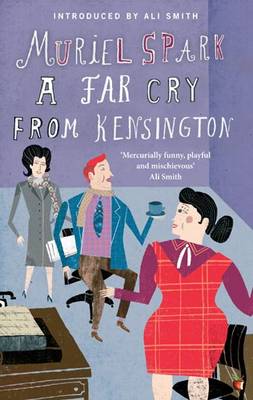
A Far Cry from Kensington”

The Girls of Slender Means”

The Public Image”

Symposium”

Aiding and Abetting”

The Prime of Miss Jean Brodie”

The Ballad of Peckham Rye”

I am quite positive there are some wonderful ones that I have missed.


‘Act of Passion’ by Georges Simenon – The Repulsive Doctor


‘Act of Passion’ by Georges Simenon (1947) – 217 pages Translated from the French by Louise Varese

‘Act of Passion’ is written from the point of view of a younger middle-aged man, a doctor, on trial for the murder of his young lover. It is an admission of guilt, and it is quintessential Georges Simenon but even more nasty and vile than most.  .

Simenon is psychologically astute on how the humans in his stories misbehave.

They can behave terribly yet we perfectly understand them and their reasons for doing so.

Although several characters in the previous novels of Georges Simenon which I have read have been abhorrent, the doctor Charles Alavoine who first-person narrates ‘Act of Passion’ is by far the most repulsive Simenon character of all. He beats up his young lover Martine with whom he is having an affair on the side, and he gives as his justification that he wants to beat the bad out of her and return her to her innocent girlhood. Ultimately he murders her by beating and the novel is the account he gives after his trial.

I suppose Simenon’s reason for writing a novel about this evil doctor is that such men do exist and this is real, but I am not sure that is sufficient. It is too honest and squalid to be uplifting.

The doctor’s wife Armande is too perfect in everything she does. “Do you realize how discouraging that can be? It is like being married to your schoolmistress.” He feels the need of deceiving her as sordidly as possible, so he finds Martine who is a big young blonde with a vulgar smile. Martine is a professional, has been with a number of men.

The doctor’s affair with Martine continues. He claims he loves Martine but wants to return her to her innocent girlhood state by beating the bad out of her.

I was not ashamed. I was no longer ashamed of my outbursts, my fits of violence, because I knew now that they were a part of our love, that our love, just as it was, just as we wanted it to be, could not have existed without them.”

Ultimately he beats her up so hard she dies. His wife Armande testifies in his defense at her trial.

I must admit that I was repulsed by this doctor and this novel. Perhaps the novel is a study in how men, even doctors, can become violent with their wives or girlfriends and thus the story is worthwhile, However this guy’s justifications for his murderous behavior sickened me

I can usually separate my reactions to a horrible and violent story about wicked people from my judgment of its literary quality, but this time I can’t. This is sordid.


Grade :    B-
 

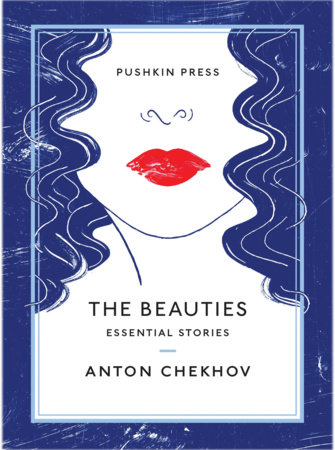
‘The Beauties’ – Essential Stories by Anton Chekhov


‘The Beauties’ Essential Stories by Anton Chekhov (1880-1904) – 218 pages     Translated from the Russian by Nicolas Pasternak Slater


I am pretty sure that I had read all or nearly all of these stories before, but as someone who loves good fiction I like to return to the stories of Anton Chekhov from time to time. Besides these are all new translations of the stories by Nicolas Pasternak Slater.

Slater does a fine job of capturing the poignancy in each of these stories. All of these stories are beautiful and affecting; they are from Anton Chekhov after all.

I would like to concentrate on one story, ‘About Love’, in particular which moved me greatly. It is about a guy who is ‘adopted’ by a husband and wife to be their very good friend. It is this guy who has been adopted who is telling the story.

First there is a sentence which frames the story.

There is only one indisputable truth that has been told about love, and that’s ‘This is a great mystery.”

So the husband and wife invite this guy into their house as a good friend to both of them, but soon the wife realizes there is a strong bond and attraction between her and this male friend, and the male friend realizes it too. But neither wants to hurt her husband.

When I came to town, I could always tell from her eyes that she’d been expecting me; and she herself would confess that right from early morning she’d had sort of a special feeling, and guessed that I would come. We spent a long time talking or saying nothing, but we didn’t admit that we loved one another – timidly, jealously, we kept that secret. We were afraid of anything that might reveal that secret to ourselves.”

Circumstances bring them together frequently, and they both realize that they were meant for each other. That over the years they never go beyond just being great platonic friends makes the story even more moving. Finally the husband and wife move away.

Some might claim that not much happens in this story, but that they restrain themselves for the sake of not hurting the husband despite their strong feelings for each other only makes the story more intense.

Chekhov frequently uses a device that seems almost a natural one for telling a story. Two friends are discussing a mutual acquaintance. This seems like the perfect way to get introduced to the traits, peculiarities, and foibles of a character. We all have strong opinions about our friends.

This is a strong starter collection because the stories for which Chekhov is famous are here. Chekhov captures the essence of each of his characters, and the stories are always true to his characters.

The stories are compassionate, warm, understanding, and kindly. In other words they are just the opposite of the writing of Georges Simenon except for the understanding part.

I want to end with two quotes about Chekhov and his art.

Chekhov is a hero to many writers. He was so immensely skilled at revealing character – and describing life – without sentiment, without judgmental-ism, and ostensibly without the least show of self. It’s his sense of the ridiculousness of human life that intrigues, because we aren’t sure what to take from it. Maybe we are tragic because we are ridiculous. Or perhaps it’s the other way round.” – Lynne Truss, author

He saw the world and the human condition with absolute clarity and no sentimentality. He did not believe in any god (and was baffled by intelligent people who did). He refused to judge. He changed the way we wrote and thought. He was a very complex, flawed, kind man.” – William Boyd, author


Grade : A+