Archive for the ‘Book Reviews’ Category

‘Spring’ by Ali Smith – A Slapdash Effort


Spring’ by Ali Smith   (2019) – 340 pages

‘Spring’ did not work for me at all. It has all the ingredients of an Ali Smith novel but does not meld into a coherent whole. It is a slapdash effort.

This novel did not work for me even though I certainly agree with Ali Smith on most of her opinions of Brexit and Donald Trump. Ali Smith and I would agree that something has gone terribly wrong with our societies, and that this wrongness is imbedded in our current online world.

‘Spring’ begins with a rant. While reading the first few pages of ‘Spring’, I almost gave up on the novel due to its incoherence. I actually wish I had quit the novel. However I did not have anything else pressing to read so I gave ‘Spring’ another try starting from the beginning again. Ultimately I made it through the entire novel.

There are two main strands of the plot in ‘Spring’ which are united in what I consider haphazard fashion. The first strand is about Richard Lease who is working on a film project about the weeks that the writer Katherine Mansfield and the poet Rainer Maria Rilke spent in the same Swiss town in 1922. Even though the two did not even meet each other in real life and were unaware of each other’s presence, the movie producer wants to turn it into a great love story.

In Smith’s previous novel ‘How to Be Both’, these obscure references to the artistic and literary past delighted me but here they seem almost gratuitous.

The second strand of ‘Spring’ is about Brittany Hall who works in an IRC, an Immigrant Removal Center. Conditions for the immigrants at this place are atrocious. The people locked in there are called “deets” for detainees. The place resembles a prison.

I did not know that now England had a problem of mistreating its new immigrants. I thought that only the United States was mistreating its immigrants.

We want you to know you have full access to your information – you and anyone who shadows you.”

One day Brittany hears about a schoolgirl named Florence who somehow got past security and has somehow shamed the director into cleaning all the toilets at the Center. I suppose that this young girl could count as an instance of the literary device magical realism, but it all seemed rather makeshift.

Soon Brittany, Florence, and another woman are off to Inverness in Scotland, and somehow they pick up Richard along the way. How this all happens did not make any sense at all to me. I doubt if it was supposed to make sense. I suppose the author meant this trip to Inverness to be a whimsical juxtaposition of the two plot strands but to me it just seemed absurd.

In baseball parlance, Ali Smith’s ‘How to Be Both’ is a home run, and her ‘Spring’ is a strike out.


Grade:   C
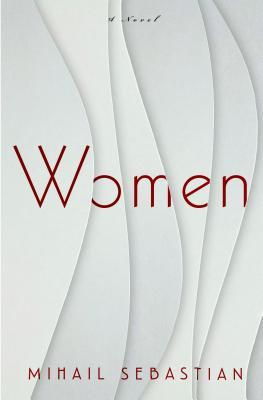
 

‘Women’ by Mihail Sebastian – Foolish Love Affairs


‘Women’ by Mihail Sebastian   (1933) – 186 pages                 Translated from the Romanian by Philip O Ceallaigh

‘Women’ relates the frivolous love affairs of Romanian medical student Stefan Valeriu. It is the frivolousness of these love affairs that makes them seem so modern. The affairs are not intense or fraught with feelings as we seem to associate with romance in the olden days. Instead they are light and playful.

‘There haven’t been very many women in my life. But there have been a few. As many as any man of average unattractiveness might have, when he acts kindly and knows when to insist. I’m not boasting, as I know any number of acquaintances of mine, taller and darker and better looking, who have had ten times the number of “conquests”.’

There are Renee, Odette, Maria, and Arabela among others.

I suppose an aspiring doctor would have no problem finding available gals at a vacation resort in the Alps even back in the olden days. A couple of these available gals happen to be married to tedious husbands.

What makes ‘Women’ stand out are the beautiful evocative sentences. I expect that the translator Philip O Ceallaigh had much to do in making ‘Women’ so readable for a modern audience.

‘In all this, the sound of Stefan Valeriu’s own breathing is one more detail, no more trivial or essential than a squirrel leaping or that grasshopper perched on the toe of his boot, believing it to be a stone. It’s good to be here, an animal, a creature, a nobody, sleeping and breathing on a two meter patch of grass under a common sun.’

My compliments to the writer and to the translator for these lines.

In the last chapter, Stefan meets Arabela who gets him to abandon his medical career to become part of a music act traveling throughout Europe.

‘I sat at the piano and looked at Arabela and told myself, as I did every evening, that she wasn’t beautiful and couldn’t sing, and then accompanied her earthy voice with the same astonishment and profound peace, and it made me so melancholy, like ten slim fingers combing through memory and forgetfulness.’

These are bright and sunny stories about intriguing and exasperating women, and I will be looking to read Mihail Sebastian’s other acclaimed novel ‘For Two Thousand Years’ soon.


Grade:    A


‘I’m Fine and Neither Are You’ by Camille Pagan


‘I’m Fine and Neither Are You’ by Camille Pagan (2019) – 254 pages

This is probably the first time I ever selected a book of fiction to read based solely on its clever title. This is not a wise strategy.

I would call ‘I’m Fine and Neither Are You’ an example of Mom Lit, the family version of Chick Lit.

Penny is a Mom who is trying to do it all, raise two kids while working a full time job while her husband Sanjay is a stay-at-home Dad supposedly writing a book and taking care of the house and family. Besides that, Penny does face a severe crisis in that her best friend Jenny, also a young wife and mother, dies of prescribed opioid poisoning.

We never do find out the city where all this takes place in because I suppose Penny is Every Mom, and place is not important to the story.

Sanjay is a rather hapless Dad as most Dads tend to be. While his wife Penny is working a fulltime professional job and doing most of the work taking care of the children, Sanjay contemplates writing his book and practices with the makeshift band he is part of.

Penny realizes that her marriage is terribly lopsided so she comes up with a fix-our-marriage project which involves each making a to-do list for the other.

I suppose part of my problem with this novel is my own attitude because I find this family situation rather trite and over-familiar, yet what could be more crucial and tremendously important than bringing up children? Perhaps I should not be writing this novel off as women’s fiction.

However, despite her best friend’s death, Penny in ‘I’m Fine and Neither Are You’ is so relentlessly upbeat that she shares all the tropes of Chick Lit.

By the end of ‘I’m Fine and Neither are You’, everyone – her husband, her female boss, her male co-worker, her deceased friend’s husband, her father, and herself – all behave perfectly. That is simplistic and unrealistic.


Grade:   C+


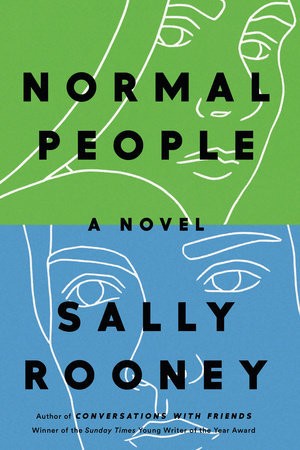
‘Normal People’ by Sally Rooney – Marianne and Connell


‘Normal People’ by Sally Rooney (2019) – 288 pages


There is no sophomore slump or sophomore jinx here. Sally Rooney’s first novel, ‘Conversations With Friends’ is very good; her second novel ‘Normal People’ is even better.

Marianne answers the door when Connell rings the bell. She’s still wearing her school uniform, but she’s taken off the sweater, so its just the blouse and skirt, and she has no shoes on, only tights.

Oh, hey, he says.

Come on in.

She turns and walks down the hall. He follows her, closing the door behind him.

These are the first lines of ‘Normal People’. In short declarative sentences, Sally Rooney gets the reader to care about these two high school seniors, Marianne and Connell.

Marianne lives in a white mansion in the small western Ireland town of Carricklea. Connell’s mother works as a cleaner at the mansion. Both Marianne and Connell are at the top of their class in schoolwork. It’s true that Marianne is the smartest person in the school, but she has no friends.

She exercises an open contempt for people in school. She has no friends and spends her lunchtime alone reading novels. A lot of people hate her.

Connell is also one of the top students, but he is very popular. He is the star of the school football team. He also reads a lot during his spare time.

“Of course, he pretends not to know Marianne in school, but he didn’t mean to bring that up. That’s just the way it has to be. If people found out what he has been doing with Marianne, in secret, while ignoring her every day in school, his life would be over.”

In the beginning, these two could almost be from your high school. While seniors, Marianne and Connell discover they have an almost natural attraction for each other. Later they both decide to go to Trinity College in Dublin.

Most of ‘Normal People’ takes place during their college years. In college, Marianne thrives on the academic life and is no longer the friendless soul but she still has trouble reconciling her traumatic early years.

There’s always been something inside her that men have wanted to dominate, and their desire for domination can look so much like attraction, even love. In school the boys had tried to break her with cruelty and disregard, and in college men had tried to do it with sex and popularity, all with the same aim of subjugating some force in her personality. It depressed her to think people were so predictable.”

Connell finds it difficult being away from all of his high school friends and his mother Lorraine. Connell and Marianne break up only to make up time and time again.

Sally Rooney has made the decision for this novel to not use quotation marks to denote spoken conversation lines. I believe that is a good strategy here, because quotation marks would have detracted from the naturalness of their interactions and would have given their spoken words an artificial stagy quality.

In short sentences, simply and directly, Sally Rooney captures the way things go for Marianne and Connell in the last year of high school and during those wild early years of college.


Grade:   A


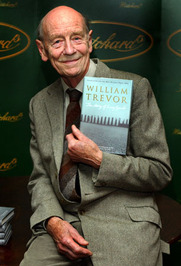
William Trevor – One of My Favorite Fiction Writers


William Trevor

Born:  May 24, 1928        Died:  November 20, 2016


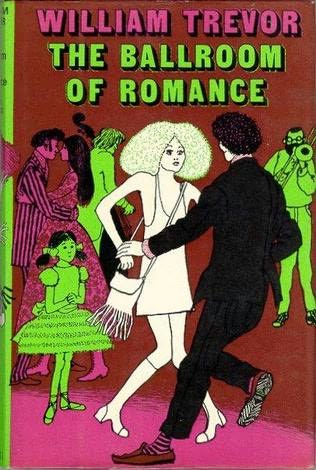
I first read William Trevor back in 1977. I started with one of his short story collections, ‘The Day We Got Drunk on Cake’ I believe it was. As that title implies, these were lively yet subtle sociable stories about men and women getting together or breaking up or just hanging around side by side. Immediately Trevor became one of my favorites, and I devoured his work in subsequent years. There were the short story collections including ‘The Ballroom of Romance’, ‘Angels at the Ritz’, ‘Lovers of Their Time’, and ‘Beyond the Pale’. Finally I got the courage to try one of his novels, ‘Elizabeth Alone’, and found that he excelled in that form also.

Trevor, in his writing, is comfortable telling the stories of both men and women. He captures the joy and pain in individual lives in a short number of pages. Here is Wuilliam Trevor on being a writer:

By the end, you should be inside your character, actually operating from within somebody else, and knowing him pretty well, as that person knows himself or herself. You’re sort of a predator, an invader of people.”

Although William Trevor was born in Ireland as a Protestant, he set many of his early stories in England where he worked for many years.

I have continued to read William Trevor for a long time, decades. I have come to find that over the years his writing changed. His early stories are usually lively, happy, full of incident, sociable, and frequently take place in England. However beginning with the 1980s I found his work to become more sad, more sparse, more serious, more rural, and more likely to take place in Ireland. Whereas he wrote ‘The Ballroom of Romance’ in 1972 and he wrote ‘Death in Summer’ in 1998, these titles are indicative of the changes in his approach to fiction.

I’m very interested in the sadness of fate”. – William Trevor

I actually prefer the early William Trevor to the later William Trevor. I found this sad sparseness creeping into his work which used to be so vibrant and alive. The later William Trevor is still very good, but it is not at all like the early William Trevor.

If you have only read the later William Trevor, I strongly recommend that you pick up one of his early short story collections like ‘The Day We Got Drunk on Cake’ or ‘The Ballroom of Romance’ or ‘Angels on the Ritz’ or ‘Lovers of Their Time’, and if you can’t stand short stories then read the novel ‘Elizabeth Alone’. I believe you will be pleasantly surprised.

I get melancholy if I don’t write. I need the company of people who don’t exist.” – William Trevor

You really must read either early or later William Trevor.


‘A Perfect Hoax’ by Italo Svevo


‘A Perfect Hoax’ by Italo Svevo (1929) – 101 pages                         Translated from the Italian by J. G. Nichols

I read ‘Confessions of Zeno’ by Italo Svevo many years ago, and I was much impressed with that wonderful modernist psychological novel which James Joyce had praised. Since then I have looked for other works by Italo Svevo to read, and that is how I came upon ‘A Perfect Hoax’.

‘A Perfect Hoax’ is a pleasant little self-parody of Italo Svevo’s own writing career but not much more than that. It is not a major work.

The main character Mario Samigli from Trieste is a writer who has not had much of a career. His novels have sold only a few scattered copies in Italy. Now he is in his sixties and spends his time looking out the window watching the birds which he feeds.

Bread was of course offered to the two sparrows, because they exist so that human kindness can be offered on the cheap.”

The only writing that Mario does now are the short fables he pens about these birds which he reads to his ailing brother.

Then his so-called friend, traveling salesman Enrico Gaia, plays a cruel hoax on old Mario. Gaia tells Mario that a German publisher passing through read one of Mario’s early novels and was so impressed that he wants to translate the novel into German and sell it throughout the German-speaking countries.

Gaia’s words go straight to Mario’s head. At last he has been discovered! All those years he has struggled as a writer, and now at last he finds success!

When his book was published in German, the wonder throughout the city and the whole nation would be all the greater because it was unexpected.”

Mario is a victim of self-delusion, a malady to which would-be writers are particularly susceptible.

Italo Svevo’s career as a fiction writer parallels Mario’s except for one notable exception. While working as a bank clerk Svevo wrote a few novels which received little attention from Italian critics or readers. However Svevo did have one reader who made all the difference. That was James Joyce. When Svevo’s ‘Confessions of Zeno’ was first published in 1923, it received little fanfare, but later Joyce championed it and helped to have it translated into French and published in Paris where critics praised it extravagantly.

If you are going to read Italo Svevo, read ‘Confessions of Zeno’ which many including myself consider a masterpiece. ‘A Perfect Hoax’ has no such claims or pretensions. It is only a pleasant little read, but there’s nothing wrong with that.


Grade:    B-


‘Spring’ by David Szalay – A Would-Be Romance


Spring’ by David Szalay (2011) – 259 pages

David Szalay has a new novel, ‘Turbulence’, coming out in June, but I was so impressed with his previous collection of stories, ‘All That Man Is’, that I couldn’t wait and decided to read his novel from 2011, ‘Spring’, right now.

All of the stories in ‘All That Man Is’ centered around young men making or not making their way in this modern world, and I found each story engaging, insightful, and eloquent.

There are writers of historical fiction, romance, science fiction, and mystery, but there are few writers who can articulate this maddening modern world we now live in. David Szalay is one who can take on modern life today, and I value him for that.

‘Spring’ is about a would-be romance between a young man and a young woman, James and Katherine, in London, but outside factors like Katherine’s ex-lover Fraser keep getting in the way. James had made a fortune in the dot.com boom of the late nineties but has lost it in the bust, and now he’s working on a shady horse racing scheme with his pals in order to recoup a little of the money. Katherine works in a reception desk in a hotel where she earlier had met her ex, Fraser, who makes a living as a photographer taking pictures of celebrities on the sly.

In ‘Spring’, Szalay captures nearly every nuance of the interaction between James and Katherine from a nice outing in Morroco to Katherine’s indifference when she starts things back up with her old boyfriend. One time James calls Katherine and he can hear noises that makes him suspect there’s a man in her room. Sadly that reminded me of an episode in my own past.

I suppose ‘Spring’ could be described as an anti-romcom as James presses forward to get closer to Katherine but is met by her seeming lack of enthusiasm. ‘Spring’ is more realistic than a romance by capturing every twist and turn of this harrowing relationship or non-relationship between these two.

We also get the spurious results of the whole horse racing scheme which adds some light humor to this entertainment. Szalay captures what it must be like for young guys and gals to live in London now and how they get together or don’t get together.

England is quite far along in recognizing David Szalay as a perceptive writer, but the United States has not really discovered him yet. I will be waiting for ‘Turbulence’ to arrive in June.


Grade:    A-


‘Arturo’s Island’ by Elsa Morante – A Masterpiece Only a Female Could Have Written


‘Arturo’s Island’ by Elsa Morante (1957) – 370 pages                    Translated from the Italian by Ann Goldstein

Once in a great while I stumble upon a unique masterpiece, and this time it is ‘Arturo’s Island’. It is a beautifully-written moving one-of-a-kind novel. Although there are clues that ‘Arturo’s Island’ takes place after World War II, the story seems to occur outside of time in a place of legend, of myth.

The story begins with the stark simplicity of a fairy tale. It takes place on the remote island of Procida in the Bay of Naples near Italy. As you can see from the picture below, the actual Procida Island is built up with a multitude of structures. However in the novel you get the impression that it is nearly deserted. Arturo is born in the castle called Casa de Guagliano which for centuries had been a monastery but has recently been occupied by a woman-hating old man named the Amalfitano. Arturo’s mother died the night he was born. Arturo’s main caregiver as a baby is Silvestro, a male servant. There are no women living in the castle. Arturo grows up quite wild and free on the island, worshiping his father Wilhelm who goes off on his own on mysterious trips and comes back only occasionally. Arturo’s best friend is his dog Imacolatella.

When Arturo is fourteen, his father brings back a wife called Nunziata. Nunziata is only sixteen, and she acts more like a big sister to Arturo than a mother. Nunziata does her best to be a good mother, but Arturo resents her for intruding on his man’s world. He has had little or no interaction with females up until then.

It is in depicting this teenage girl Nunziata that the writer Elsa Morante really shines. Nunziata arrives like a breath of fresh air into Arturo’s all-male world, although he doesn’t appreciate her at the time. Nunziata is charming, beguiling, enchanting, appealing. ‘Arturo’s Island’ is special because it is written from a female’s point of view. Thus it captures the inherent qualities of a female and how a female views men.

Procida Island Marina

There are types of stories which women excel in because women are more observant of other people than men are. Whereas men are more action oriented and stay on the surface, women can go deeper and capture the nuances of human relationships.

But above all, I was impressed with the graceful elegance of Morante’s writing in ‘Arturo’s Island’. Elsa Morante has captured an isolated world on this remote island of Procida and she brings back meanings that apply to us all. I won’t forget this one.

‘Arturo’s Island’ is a must-read that only a female could have written


Grade:   A+


‘The Traitors Niche’ by Ismail Kadare – A Comedy of Beheadings


‘The Traitors Niche’ by Ismail Kadare (1978)  – 200 pages      Translated from the Albanian by John Hodgson

Ismail Kadare of Albania is one of those writers I keep coming back to because I get a lot out of his novels. ‘The Traitor’s Niche’ is no exception.

‘The Traitor’s Niche’ is a historical novel and a laugh riot that takes place in the early nineteenth century when Albania was still part of the brutal Ottoman Empire. The Ottoman rule was harsh to say the least, and in the main square of Constantinople they kept what was called a Traitor’s Niche where just the head of a leader who had rebelled against the empire was displayed to the public. Whenever a new rebellion was quashed the head of its leader would replace the head that was currently displayed. ‘The Traitor’s Niche’ is the story of the beheading of one such rebel leader Black Ali, the transfer of his head to the square in Constantinople, and the care and grooming of the head to keep it in shape for public display.

The blade of destiny had harvested its crop, and it was there on the table, this white cabbage from the gardens of Hell.”

Not only were the Ottoman rulers constantly quashing uprisings; they also made harsh attempts to strip or erase their conquered people of their national identities. Kadare calls this stripping of identity Caw-caw, and the Ottomans used several methods to achieve this goal. Weddings are one occasion where communities celebrate their roots, so the Ottoman rulers would come up with diabolical ways to debase, distort, or entirely eliminate the wedding rites of these subjugated people.

Another Ottoman goal was to reduce their various conquered peoples’ languages down to what Kadare calls Nonspeak:

Words had been expunged from dictionaries, rules of grammar and syntax had gradually been erased until they vanished from use, and finally the letters of the alphabet were rubbed out.”

So among all the fun and mischief of the beheadings and the care and grooming and display of these severed heads, Kadare makes some serious points about the destruction of a people’s culture and language by a conquering empire.

That is what I like most about Ismail Kadare, his mixture of the profane and the sacred. Not many writers have the ambition or the wherewithal to deal with an entire nation’s identity and still be humorous.


Grade:   A


‘Instructions for a Funeral’, Stories by David Means


‘Instructions for a Funeral’ stories, by David Means   (2019) – 189 pages

There are two ways to look at the title ‘Instructions for a Funeral’. One way is to say ‘What a sad gloomy title’. The other way is to remark that David Means is so assured of his skills to interest and entertain us with his stories he can even stick his collection with this dismal title. I will let you know later which of these ways applies to me.

Except for ‘Fistfight, Sacramento; August, 1950’ which is an absolute gem of a story, I preferred the stories in this collection which were less dense and overcrowded. These less dense stories were in the last half of the collection starting with ‘Instructions for a Funeral’ which is another superb story.

Perhaps the most applicable example of a story in the first half of the collection which I feel is over-written is ‘The Chair’, the third story in the collection. In this story, an at-home caregiver father reflects on his wife and on his son whom he is watching as the five year old boy heads toward a dangerous retaining wall. In this story the sentences are long and the paragraphs are long and it was difficult for me to maintain interest.

But overall I felt these stories were well done, fine examples of what can be done with a story today. A few of the stories share themes. Some are stories about men who are stuck in halfway houses or mental hospitals or mission houses, down-and-out men. Also there is a recurring theme of an older man watching a younger man make his own earlier mistakes.

I probably would have left out the two entries that were fragments or not-stories, one which contains three separate reflections on fatherhood in four pages, and one which contemplates Raymond Carver and Kurt Cobain. I would also have lost the five-page introduction called ‘Confessions’.

As far as the gloomy title goes, I think that David Means is just carrying on the time-honored tradition of titling the book after the best story in the collection which happens to be ‘Instructions for a Funeral’. In this story a man realizes his own position in this world is quite precarious and so he writes down detailed instructions for his own funeral. Since the story contains instructions rather than reflections it avoids the pitfalls of being too self-reflective. The story is humorous in its own way.

When I first approached this collection, the stories seemed to be overcrowded and exhausting, the writing seemed to be over the top, overwritten. However by the last story, I felt that perhaps other writers’ stories might be too sparse. A lot goes on in these stories; that’s a good thing.


Grade:    B+


‘Antigo Nick’ by Sophokles – A Spiky Irreverent Translation of the Ancient Greek Tragedy Antigone


‘Antigo Nick’ by Sophokles (441 BC) – 44 pages Translated by Anne Carson

This is not you grandma’s translation of Antigone.

Anne Carson does not approach this ancient drama with undue reverence. King Kreon arrives on the scene riding in his powerboat, his ship of state. The translation of the ancient play alludes to Samuel Becket, Berthold Brecht, Virginia Woolf and others. And the words of the play are turned into spiky even whimsical mostly unpuncuated modern prose.

but of course there is hope look here comes hope

wandering in

to tickle your feet

then you notice your soles are on fire

a wise word

if evil looks good to you

some god is heading you on the high road to ruin”

But I’ve learned to trust the Canadian Anne Carson.

Words bounce. Words, if you let them will do what they want to do and what they have to do.” – Anne Carson

Carson knows what she is doing, especially with these ancient plays. I have read a lot of her poems and other stuff, most of it unclassifiable and brilliant.

For someone who is just beginning to discover Anne Carson, I would recommend two of her works, ‘Autobiography in Red: A Novel in Verse’ and ‘The Beauty of the Husband: A Fictional Essay in 29 Tangos’.

I watched a performance of ‘Antigo Nick’ with Anne Carson playing the role of ‘Chorus’ on You Tube as well as read the play. ‘Antigo Nick’ is probably not the first place to begin to discover Anne Carson, but even with the translation’s quirkiness it captures the spirit of the play.

Here is the set-up of the play. The two brothers of Antigone and Ismenes have fought on opposite sides in the Thebes civil war and now both are dead. King Kreon has ruled that one brother Eteokles will be honored and given a full burial; the other brother Polyneikes will lie unburied on the battlefield and be prey to scavenging birds and worms. Antigone on her own decides to bury Polyneikes against the King’s wishes. The King finds out about it and decides that Antigone must be buried alive as punishment for her disobedience.

It’s Friday afternoon

there goes Antigone to be buried alive

is there

any way

we can say

this is normal

rational

forgivable

or even in the widest definition just

no not really

If I can convince even one person to investigate the work of Anne Carson, I will feel I have accomplished a great deal.

I write to find out what I think about something.” – Anne Carson

Not knowing what one is doing is no prohibition on doing it. We all grope ahead.” – Anne Carson


Grade: A-


‘Shell’ by Kristina Olsson – Australia in 1965: The Sydney Opera House and the Vietnam War


‘Shell’ by Kristina Olsson    (2018) –  249 pages

How would you write a novel about a building, even if it happens to be a spectacular building?

There are two main characters in ‘Shell’. Pearl Keogh is a reporter for a major newspaper in Sydney. Axel Lindquist is a Swedish technician who works in designing and in making glass, and has come to Australia to work on projects related to the Sydney Opera House.

Architect Jørn Utzon from Denmark designed the one-of-a-kind Sydney Opera House. In 2003, Utzon received the Pritzker Architecture Prize, architecture’s highest honor. The Pritzker Prize citation read:

There is no doubt that the Sydney Opera House is his masterpiece. It is one of the great iconic buildings of the 20th century, an image of great beauty that has become known throughout the world – a symbol for not only a city, but a whole country and continent.”

As one of the most popular visitor attractions in Australia, more than eight million people visit the site annually, and approximately 350,000 visitors take a guided tour of the building each year.

The novel ‘Shell’ takes place in Sydney in 1965 and 1966 when the Sydney Opera House was way, way over budget and was extremely controversial. Jørn Utzon left the project in February, 1966.

Pearl Keogh is most concerned about her two younger brothers whom she has not seen in a long time due to her family falling apart after their mother died. Now they are of an age where they could be drafted into the Australian army which the government has decided will fight alongside the United States forces in Vietnam. Pearl participates in demonstrations against Australia’s entry into the Vietnam War. When her newspaper finds out about this, she is relegated to the women’s section of the newspaper.

First off, I must say that I totally agree with Pearl’s sentiments about the Sydney Opera House and the Vietnam War. The Sydney Opera House is a spectacular building, although I have never seen it in person. The United States had no good reason to fight in Vietnam, and Australia did not either. Both countries wound up losing the war.

However I found ‘Shell’ to be a study in heartfelt didacticism. What is missing is lightness and humor. It is strident in its politics. The author is more interested in her argument than her story. Her characters are not well-grounded.

We have the two characters Pearl and Axel. Of course at some point they must meet and get together. A large amount of the fun of a novel would be how they happened to meet. However the author Kristina Olsson skips all that, and the first time we see the two together they are already in bed.

Rather than full-fledged humans, the characters come across as stick figures to represent the author’s points of view.

Many attempts are made in the novel to capture the wonders of the Sydney Opera House. However they wind up being mostly polemical over-writing.

One surface sand-blown and ancient, another imprinted with wire net. Urgency tapped at his shoulders. And fear: the underbelly of art. The thought reverberated in his head: if the final piece revealed anything of this place, of these people, it would reveal just as much of its maker.”

‘Shell’ could have been more down-to-earth and genial toward its main characters. As it is there is too much tiresome abstract generalization.


Grade: B-


‘Godsend’ by John Wray – A California Girl Joins the Taliban

Godsend’ by John Wray (2018) – 228 pages

‘Godsend’ is the story of a young woman named Eden Sawyer living in Santa Rosa, California who decides to go over to Afghanistan to fight with the Taliban. This is the year before 9/11 in 2000.

In real life shortly after 9/11, a young American guy named John Walker Lindh was apprehended as he was fighting along with the Taliban against the US forces who had only recently arrived. He is still in prison. There were rumors that there was also a young American woman also fighting for the Taliban, but these rumors were never confirmed.

Our story starts out in California, and Eden Sawyer is a young college student. She is a Muslim convert who can speak Arabic. Her father is a professor of Islamic studies at Berkeley and her mother is a forlorn drunk. They do not live together. Eden has been interested in Islam for several years and attends the local mosque frequently to participate in religious services. There she meets a boy named Decker whose family is from Pakistan. They both are devout to the Islamic religion.

Eden and Decker decide to go to Pakistan together. On the plane flight there, Aden tells another passenger that she wants to see Afghanistan, because it’s “a place ruled by believers. A country full of people living by the word of God.” First they will attend a madrassa for further religious instruction, and ultimately they will join a Taliban unit operating in Afghanistan. Eden cuts her hair off and disguises herself as a boy in order to join the Taliban. She must constantly fool all the men of the Taliban into believing she is a boy.

John Wray is a talented writer, and he convinces us readers that this all could have happened, no matter how far-fetched it originally sounds. Many of the details regarding joining a madrassa, etc. are taken from what we do know of John Walker Lindh.

My problem is that converting to Islam and joining the Taliban in Afghanistan is about as far removed from my current circumstances as one can get. I usually pride myself on getting interested in any subject as long as the writing is proficient, but I found my interest flagging here as Eden interacts with these bearded turbaned men especially after they all start carrying machine guns. Of course their lives as Mujahideen are rough and primitive. It didn’t help that these men’s world view was even further right-wing than American Christian Evangelicals. That I was able to plow through this novel at all is a testimony to the talent of John Wray as a writer.


Grade: B-


‘The Atlas of Reds and Blues’ by Devi S. Laskar – A Mixed Family in the Well-To-Do Atlanta Suburbs


‘The Atlas of Reds and Blues’ by Devi S. Laskar (2019) – 258 pages

‘The Atlas of Reds and Blues’ opens with a woman lying bleeding on her concrete driveway, shot by a policeman who is a member of a tactical police force unit raiding her family’s suburban house. The woman’s entire life flashes before her eyes as she searches desperately for that one inciting incident that led to this brutality.

The unnamed narrator (called only Mother) lives with her family in a rich suburb of Atlanta, Georgia. She and her blonde-haired blue-eyed globe-trotting husband have three young daughters of school age. Mother’s parents came to the United States from India before she was born. Neither Mother nor any of the daughters is considered white by their suburban neighbors.

Today, the Middle Daughter gets in Mother’s car after school – in tears, sobbing that her new classmate won’t invite her home. “Annette said her mother won’t let her play with black people outside of school.“ Middle Daughter’s shoulders slump forward in her seat. Everyone in the first grade is invited to the special premiere of The Bee Movie at the Buckhead Mansion of Annette’s famous athlete uncle – everyone but her.”

I could have told Mother that some of the cruelest and most racist white people in the United States live in the rich suburbs. This is Atlanta and thus “Southern white-sheeted suburbia”.

It is not an economic thing as Mother and her family are very well off financially. Her blonde-haired husband has a professional job where he travels around the world on business nearly all the time. The prejudice against Mother and her three daughters is strictly a race thing.

The family would have been much better off in a university community where these types of mixed marriages are quite common and there is a much higher degree of tolerance and acceptance of diversity. I at least hope that these type of humane communities still exist within the United States.

The story of ‘The Atlas of Reds and Blues’ is told in many short chapters as Mother’s entire life flashes through her mind. Her happy time at the University, her years working as a reporter, her marriage and then her family.

The novel is a quick read as most of the chapters are very short. ‘The Atlas of Reds and Blues’ gets high points for originality as I have not encountered this unusual situation in a novel before.

I brought a lot of resistance to appreciating this novel at first because of certain cutenesses in the narration, but by now all resistance has dissipated.


Grade : A-


Some Humorous Fiction Written in the 2000s


Here is a look on the lighter side. A tragic world is no fun to contemplate, so instead here are some humorous or amusing fictional works all written in the 2000s.

‘Less’ by Andrew Sean Greer (2017) – Andrew Less had written a couple of novels that didn’t sell well at all. His publisher stages ‘An Evening with Andrew Less’, and no one shows up. This type of humor is universal, a guy laughing at himself and those around him as they sometimes make utter fools of themselves with their outrageous behavior. Andrew Less doesn’t take himself or his writing too seriously, and that’s what makes this novel so damn funny.

‘The Old Romantic’ by Louise Dean (2011) – “You never imagine your husband will get a thing for an embalmer and an outsize one at that – that’s one thing you don’t imagine.” This novel is a dark wicked joy.

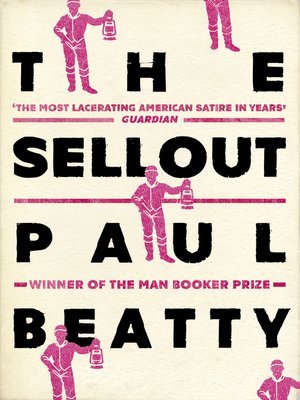
Sellout’ by Paul Beatty (2015) – Our hero in ‘Sellout’ belongs to a group which some of its members show up every other week to argue with other members who show up every other month about what exactly bi-monthly means. ‘The Sellout’ is driven by a quest for the banned most racist episodes of the ‘Our Gang’ series, the ones that have never been shown on television.

‘Firmin’, the Adventures of a Metropolitan Lowlife by Sam Savage (2006) – This is the tale of a four-legged bookstore rat who was born in a nest made of a shredded copy of Finnegan’s Wake, then learns how to read, and becomes amazingly literary.

The Forensic Records Society’ by Magnus Mills (2017) – I could have mentioned any of Magnus Mills’ novels starting with his first, ‘The Restraint of Beasts’, but all of his deadpan fiction is a laugh fest. ‘The Forensic Records Society’ takes you to a record store back when the current music was hugely important in the 1960s and 1970s.

‘Knots’ by Gunnhild Øyehaug (2012) – There are 26 stories in ‘Knots’, each a comical take on the relations between men and women. These are rude and sometimes crude stories written from a woman’s point of view. In one story the umbilical cord between a mother and her son cannot be cut by any means.

A Horse Walks into a Bar’ by David Grossman (2014) – Here is an entertaining little novel about a stand-up comedian which is also one of the themes of ‘The Marvelous Mrs. Maisel’ which I have been watching on the TV.

‘Wittgenstein Jr.’ by Lars Iyer (2014) – The students in a philosophy class call their instructor Wittgenstein Jr. in fun and partial derision. The instructor is a cheerless soul. This is a class of students who are obsessed with their deranged teacher.

‘Mirror, Shoulder, Signal’ by Dorthe Nors (2016) – Sonya is a Danish woman in her forties who lives alone now, and that is just fine with her. ‘Mirror, Shoulder, Signal’ is light and amiable and amusing, a pleasant interlude from all the more vexing problems of today.

‘Honeydew’ by Edith Pearlman (2015) – ‘Honeydew’ is a collection of stories guaranteed to put a smile on your face. The stories were not written with the sole purpose just to be funny, but they will keep you amused.

‘The Amalgamation Polka’ by Stephen Wright (2006) – I am eagerly looking forward to the next novel by Stephen Wright even though he has not published since 2006. I have read all four of his works. His fiction is darkly comic and funny, but, even better, Wright’s outlook makes you think and feel. ‘The Amalgamation Polka’ is a pre-Civil War extravaganza, and like all of Wright’s work, unique.

‘Golden Hill’ by Francis Spufford (2017) – Here is another novel that was not specifically written to be humorous, but is delightfully amusing the entire way. It takes place in colonial New York around 1746.

‘The Tragedy of Arthur’ by Arthur Phillips (2011) – This is a wild and woolly story about how an unknown play about King Arthur written by William Shakespeare shows up in Minneapolis. The entire verbatim play is included which is mighty presumptuous of Arthur Phillips. Of course the fictional Arthur Phillips says of Shakespeare, “If it didn’t have his name on it, half his work would be booed off the stage.”


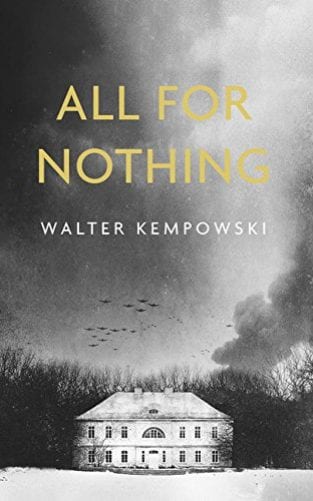
‘All for Nothing’ by Walter Kempowski – “Now that Everything was going down the Drain”


‘All for Nothing’ by Walter Kempowski (2006) – 343 pages Translated from the German by Anthea Bell


‘All For Nothing’ is a magnificent atmospheric novel of the last months of World War II from the point of view of the East Prussian Von Globig family, Their estate is peaceful at the start, but they can hear the distant shelling of the Russian infantry advancing farther and farther into Germany. The near-rural setting is almost idyllic but the tension builds gradually as the shelling gets louder and closer each day. The question is: When should they evacuate?

He placed the empty stamp album on top of the logs and watched as the eagle slowly caught fire and then sank into ashes. Watching it disappear, like the Germany of the good old days.”

The once-rich Von Globig family lives in a stately manor house called the Georgenhof. The father Eberhard is away in Italy serving the German army as an officer in supplies. Left in the Georgenhof are his beautiful and winsome wife, Katharina, and their fair-haired, inquisitive twelve-year-old son Peter who plays with his train set and his microscope. Running the household is Auntie, an older woman relative from Silesia. Working under Auntie are two Ukranian maids, Vera and Sonia, and a young Pole Vladimir who does the necessary work outside.

Various travelers stop by the Georgenhof, most from the East fleeing from the Russians. They are welcomed, tell their stories, stay a short time and move on further west. Katharina also secretly listens to BBC broadcasts which tell of the attacks on Germany from the West. She hears the following report on Konigsburg:

Burnt-out granaries, a flight of steps with the banister rail rising from the rubble, and of course the ruins of the cathedral and the castle. The British had done a thorough job, you couldn’t deny that. A lovely city, but finished now.”

The folks at the Georgenhof are mostly apolitical, but their fanatic busybody neighbor Drygalski is an ultra-Nazi who constantly watches them with suspicion. Katherina must always keep a watchful eye out for him. For Drygalski and other Nazis, there was no crime more heinous than sheltering a Jew even for one night.

Later all the folks living at the Georgenhof must leave, joining the mass exodus of German people heading west just in front of the Russian army. It is far from an orderly evacuation with many deaths along the highways and roads.

After devoting many years of his life to documenting and collecting the personal observations of thousands of Germans in regard to World War II, Walter Kempowski wrote this vivid wonderfully constructed final masterpiece of a novel. Here is an excellent summary of the dramatic life of Walter Kempowski.

There is a musical quality to the individual sentences which makes them a pleasure to read. In spite of or because of the frightfulness of the events which are occurring. ‘All for Nothing’ is a powerful work of art that captures, in authentic detail and with compassion, the evacuation nightmare for the German people of those last days of World War II.


Grade : A+


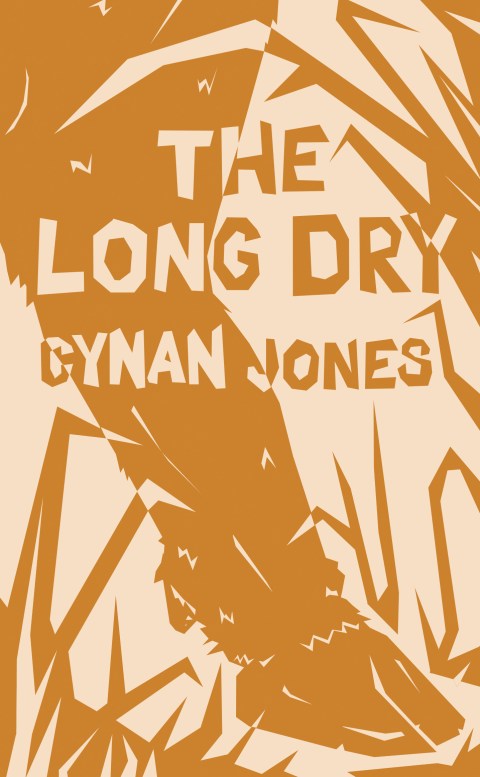
‘The Long Dry’ by Cynan Jones – Life and Death on the Farm


‘The Long Dry’ by Cynan Jones (2017) – 117 pages

This month is the Wales Readathon hosted by Paula Bardell Hedley at Book Jotter. (Twitter hashtag #dewithon and/or #walesreadathon). By a rare coincidence I recently completed ‘The Long Dry’ by Cynan Jones from Wales so I am posting this review as part of the Wales Readathon.

‘The Long Dry’ is a fatalistic Welsh farm novel. Everything about life and death on the farm is a struggle.

I did not realize there were still any heavy-duty farms on the English island, but apparently in Wales there is. The Welsh seem to make it a point of honor that they are nothing like the English.

A typical sad scene is when a cow on the farm tries to give birth to a calf that is in the wrong position for birth, a breech birth. The calf is born dead. No one is sadder than a cow which has lost her calf. However the calf’s twin is born alive and OK. The farmer moves on.

In order to appreciate ‘The Long Dry’, you must slow down your reading to a slow crawl. Otherwise you will not appreciate the loaded meaning that went into each sentence. In that sense this novel is like poetry.

Another cow about to give birth wanders off the farm. The section of the novel named ‘The Sedge’ is told from the cow’s point of view.

Later, the cow got too hot, so she got onto her feet again and she could feel the calf moving inside her. She lifted her tail and let out a long wet pie. Then she went on. By now she was hanging her head when she walked and just ambling.”

A later sad scene is when the veterinarian has a conversation with the young daughter Emily while he put the family’s old dog Curly to final sleep.

It’s a medicine that will make his heart go slower, and slower, and then it will stop.” He didn’t have to say that it wouldn’t hurt the dog because of the way he said this thing..

Like when it stops raining?” she said. Nothing had ever moved him more in his life than the beautiful questions of children.

Yes. Like when it stops raining.”

These lines are beautiful but sad as most of the novel is. More than anything, ‘The Long Dry’ is about death. Reading it is both daunting and exhausting.

‘The Long Dry’ reminded me of my own upbringing on a dairy farm near Sparta, Wisconsin where I spent the first eighteen years of my life. I never amounted to much of anything as a farm boy. Perhaps it was all the work that was to be done on the farm as I was known as a lazy kid. Or perhaps it was the trips to the slaughterhouse in our light blue pickup truck with two young male calves in back. On a dairy farm, most of the young male calves are quickly disposed of as veal meat. I was sensitive. Two things you don’t want to be on a farm are lazy or sensitive.

What is missing from ‘The Long Dry’ is the humor. What I remember most now about my days on the farm are the humorous occasions. There were a good share of light moments mixed in with the pain and strain of living and dying.

Perhaps another novel by Cynan Jones will cover the lighter side of life on the farm.


Grade:    B+


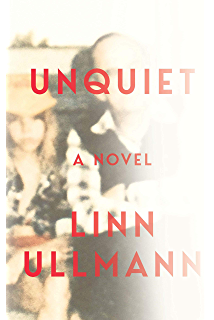
‘Unquiet’ by Linn Ullmann – Life With Father


‘Unquiet’ by Linn Ullmann (2015) – 388 pages                              

        Translated from the Norwegian by Thilo Reinhard

To my mind there is no question that ‘Unquiet’ is a memoir rather than a novel as it has been labeled. It is an account of Linn Ullmann’s memories of her famous father Ingmar Bergman and to a lesser extent her mother actress Liv Ullmann who starred in ten Bergman movies.

I went through a long Ingmar Bergman phase during which I watched many of his movies. I found that each of his movies had a depth that I hungered for. My favorite of his movies is ‘Smiles of a Summer Night’ which was based on Shakespeare’s ‘Midsummer Night’s Dream’ and which Bergman made fairly early in his career. I watched and was impressed by many other of his movies.

In 1965, Bergman made a movie called ‘Persona’ with a new actress, Liv Ullmann, as one of the stars. Bergman and Liv Ullmann soon began a relationship. Bergman was 48, and Ullmann was 27. Linn Ullmann, born in 1966, was Ingmar Bergman’s ninth and youngest child. The nine children had five different mothers.

Bergman and Liv Ullmann only stayed together unmarried until 1969 at which time they separated. After that the child Linn lived with her mother but stayed at her father’s summer home at Hammars on the island of Faro for one month each summer during her childhood.

“The girl dreads being away from the mother, but looks forward to visiting the father, everything that is this place, the house, the island, her room with its flowery wallpaper, Ingrid’s cooking (Ingmar has a new wife or girlfriend by now), the moons and the stony beach and the ocean stretching green and gray between the father’s island and the Soviet Union.”

All of this factual background is in ‘Unquiet’, and why they call this memoir a fiction I will never know. We get childhood memories of Linn’s visits to the island. Later as Ingmar Bergman gets old, he and Linn decide to record conversations that she and her father have where she asks him questions about his career and his life, and parts of these conversations are transcribed verbatim in ‘Unquiet’.

She: We were talking about girls, about your tremendous fondness for women.

He: I believe that much of my professional life has revolved around my tremendous fondness for women.

She: In what way have women influenced your…

He interrupts her, leans forward.

He: In every conceivable way, my heart.

Ingmar Bergman and Linn Ullmann

Ullmann is quite discreet in her memories, discreet to the point where this memoir is not entirely fascinating. There is no doubt in my mind that Ingmar Bergman was a genius as a film director, but that does not make his pottering around as an old man particularly interesting.


Grade :    B-


‘Bunner Sisters’ by Edith Wharton – A Bleak Naturalistic Novella of the 1890s


‘Bunner Sisters’ by Edith Wharton    (1892,1916) – 95 pages

‘The House of Mirth’, ‘Ethan Frome’, and ‘The Custom of a Country’ were wonderful, but I found ‘Bunner Sisters’ to be a sad excuse for a novella. The emphasis should be on the word ‘Sad’.

There is a reason that ‘Bunner Sisters’ was written in 1892 and several magazines rejected it at that time and it was not published until 1916. Hermoine Lee, in her introduction, mentions “the unflinching grimness” of the work. Yes, I agree.

In the late 1800s, the fiction of Emile Zola had a profound effect on the literary world.  In such novels as ‘L’Assommoir’, ‘Germinal’, and ‘Nana’, he started a new literary genre of extreme realism called naturalism.  With ‘Bunner Sisters’, Wharton wrote her own naturalistic novella suffused with pessimism in regard to the lower classes, especially its single women.

In ‘Bunner Sisters’, the older sister Ann Eliza and the younger sister Evelina live together in a shabby New York City neighborhood in the 1890s. The two sisters are beyond what was usually thought of as marriageable age. They keep a small shop selling artificial flowers and small hand-sewn articles for women, and they barely scratch out a living.

Ann Eliza decides to get Evelina a clock for her birthday with money she has saved, and that is when their real troubles begin. Enter the clock maker Herbert Ramy. He is a German, and he seems quite capable with clocks. Soon he starts coming around to the sisters’ house. At first Ann Eliza thinks he might be interested in her even though Evelina is the one who has had boyfriends before. Then Ann Eliza realizes that Evelina has her eyes and heart set on Mr. Ramy and decides to forgo her own possibilities in favor of her younger sister.

Did I mention that to the sisters Mr. Ramy sometimes looks sick with a dull look in his eyes and in need of care? The sisters figure he’s just a bachelor who doesn’t take good care of himself, but later we find out the real reason Mr. Ramy looks sick.

Things proceed as expected. I won’t divulge any more of the plot.

Edith Wharton usually wrote of the upper classes, but in this case she went slumming. Things were bad enough for poor people without Wharton embellishing their problems. Charles Dickens showed the severe effects of poverty on English youth and families, and here Edith Wharton shows the severe effects of poverty on American adult single females, especially if they let the wrong man take advantage of them. At least Dickens usually had an upbeat ending for his poor souls.

‘Bunner Sisters’ is a bleak read without any redeeming glimmer of hope at the end.


Grade:   C-


‘The Long Take’ by Robin Robertson – A Poetic Noir Novel on Los Angeles after World War II


‘The Long Take’ by Robin Robertson (2018) – 227 pages


This atmospheric and expressive poem of a novel ”The Long Take’ takes place in Los Angeles and San Francisco in the years 1946 thru 1953. Our man Walker, born and raised in Nova Scotia, went to fight on the European front in World War II. He was one of the soldiers who was in the D-Day landing force and battled the Nazis across France. In other words he saw the very worst fighting. Now he, unlike so many others, has returned physically intact and winds up in Los Angeles where he gets a job as a reporter.

However he is still haunted by his war memories.

Naked soldiers dead on the beach, clothes blown off by an anti-tank mine. I was staring at their crew-cuts washed flat by each wave, then the hairs springing back up.”

After the war Walker travels by train from New York to Los Angeles in search of a job. In Los Angeles, Walker finds a seedy but clean rooming house to board in and heads downtown for the night.

Six blocks of fairground, spilling out on the street: eyes

red as tail-lights, servicemen, longshoremen, oilmen,

Chinese, Japanese, Negroes, Filipinos, Mexicans, Indians,

even Hindus and Sikhs; streetcars, automobiles,

horns going, the panhandlers, streetwalkers, kids rolling drunks,

scuffles down the alleyways,; saloon doors,

swinging open to jukebox music

and a gash of laughter;

police cruisers,; the call of hot dog sellers,

whispers from the pimps and the whores,

the dealers; the cops out on the corners,

the soldiers and sailors, their whistles, shouts,

broken bottles, reefer smoke, beer and sweat

this was the city.“

As you can see, ‘The Long Take’ is a narrative poem with evocative imagery that captures both the horrors of war as well as the crazed free spirit of Los Angeles after the war Alongside the skid rows and the seedy sections of Los Angeles, the movie makers are filming the classic noir movies: ‘Night and the City’, ‘He Walked by Night’, ‘The Big Combo’, etc., etc.

Not only are the movies here noir; the suggestive writing of Robin Robertson is also noir:

“”And he noticed a girl over by the jukebox, dancing

on her hind legs,tipping her toes like a cat

at the end of a rope.”

By 1953, they are tearing down old Los Angeles to put up parking lots.

The blade sign reading MASON – HOME OF MEXICAN FILMS

was being levered off the brick but this was once

the Mason Opera House, where Isadora Duncan danced

in front of fifteen hundred, according to the old guy watching,

and Sarah Bernhardt played – what? – forty, fifty, years ago.

As the sign came free of the wall and fell,

he turned and walked away.”

If a novel is written as a narrative poem and it is not too difficult for me to follow, it usually winds up being one of my favorite novels, combining both the delights of fiction and poetry. That is the case with the Booker shortlisted ‘The Long Take’.


Grade:    A