Archive for the ‘Book Reviews’ Category

Some More Fiction Writers Who Were Too Good to be Forgotten


Here are some more fiction writers whom I consider just too good for us to forget about them.


Henry Handel Richardson (Real Name: Ethel Florence Lindesay Richardson) (1870 – 1946) She chose a male nom de plume, because woman fiction writers weren’t accepted in her time. The trilogy ‘The Fortunes of Richard Mahony’ (comprising the novels: Australia Felix, The Way Home and Ultima Thule), which is based on her traumatic but colorful early years and her childhood family in Australia, is up there as one of the finest works of fiction in English ever written.

Her Must-Read Fiction: The Fortunes of Richard Mahony, The Getting of Wisdom
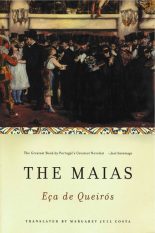
José Maria de Eça de Queirós (1845 – 1900) He was the first of Portugal’s great triumvirate of literary virtuosos: Eca de Queirós, Fernando Pessoa, and Jose Saramago. He had a wicked sense of humor. Himself a Portuguese diplomat, he wrote the following: “The number of dolts, dullards and nincompoops who represent us overseas is enough to make one weep. This really is a most unfortunate country.” But you can tell by his writing that he loves Portugal and especially its women.

His Must Read Fiction: The Maias, The Relic, The Sin of Father Amaro
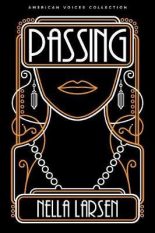
Nella Larsen (1891 – 1964) She worked as a nurse and a librarian in New York, but Nella Larsen got caught up in the Harlem Renaissance of the 1920s, and she wrote and published two short novels and a few short stories. Then she went back to being a nurse. She died in obscurity, but her work has now achieved the status of classic and is taught in many literature courses. I have read all of her fiction and consider it wonderful. ‘Passing’ was probably the first novel ever to deal with being of mixed race in the United States. I was moved by the efforts of Heidi Durrow to get a proper gravestone for Nella Larsen which you can read about here.

Her Must-Read Fiction:  Passing, Quicksand, The Short Fiction of Nella Larsen

Theodore Dreiser (1871 – 1945) If you have ever watched the great classic movie ‘A Place in The Sun’ starring Elizabeth Taylor and Montgomery Clift and Shelley Winters, you are familiar with Theodore Dreiser’s work. That movie is based on Dreiser’s novel, ‘An American Tragedy’. Who can ever forget the scene in the movie where he rows his fiancée out to the middle of the lake and then pushes her out of the boat into the water, knowing she cannot swim? All because he had found a beautiful new love from a rich family. Some critics found Dreiser’s work crude and rude, but I have found his fiction to be vivid and powerful.

His Must-Read Fiction:  Sister Carrie, The Financier, An American Tragedy
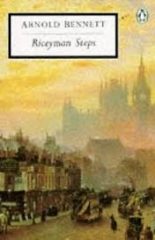
Arnold Bennett (1867 – 1931) – He wrote the best novel ever about a second-hand bookstore, ‘Riceyman Steps’. To the Bloomsbury Group including Virginia Woolf, Arnold Bennett was considered one of the Old Guard whose work was so prosaic that they were rebelling against it. However from my later vantage point I recommend Bennett’s work for its fine eye for detail and his strong empathy for the lower classes.

His Must-Read Fiction: Riceyman Steps, Anna of the Five Towns, The Card, An Old Wives Tale

Jean Stafford (1915 – 1979) – She was seriously injured and facially disfigured when she was 23 in a car accident in 1938. The reckless, angry, and intoxicated driver was the mentally unstable poet Robert Lowell whom she would soon marry and 8 years later divorce. She suffered from alcoholism and depression for much of her life. After publishing only three novels, all of which won critical acclaim, she wrote only short stories, many of which were published in the New Yorker. Of her work, ‘The Mountain Lion’ is my favorite.

Her Must-Read Fiction: The Mountain Lion, The Catherine Wheel, The Collected Stories of Jean Stafford

Francois Mauriac (1885 – 1970) – In early Mauriac, Evil is so attractive and Good is so smug that a winner is by no means assured. After those early novels, in 1928 Mauriac turned to Christianity and Catholicism with a vengeance, and the critical consensus was that he then stacked the deck in his fiction in favor of Good, and that his work weakened due to his new-found religious fervor. However one of his novels that I most admire, ‘The Vipers’ Tangle’, was written in 1933 after his conversion. One of the qualities that make Mauriac’s earlier fiction so appealing is how he depicts the life of Evil as quite delightful, just like it is in real life.

His Must-Read Fiction: The Desert of Love, Thérèse Desqueyroux, Flesh and Blood, Vipers’ Tangle


Here and here are two earlier lists of writers who wrote some mighty fine fiction.
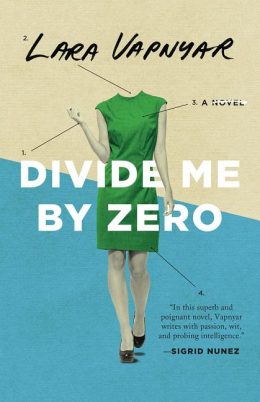
‘Divide Me by Zero’ by Lara Vapnyar – Of Mathematics and Lovers


‘Divide Me by Zero’ by Lara Vapnyar (2019) – 354 pages

‘Divide Me by Zero’ starts out strong. I thought I was going to love this novel.

And then wasn’t life itself a perfect dark comedy too, with its journey to an inevitable tragic ending interspersed with absurd events providing comic relief?”

Each chapter of ‘Divide Me by Zero’ starts with a handwritten note from an in-progress mathematics text book. That was fine with me because long ago in 1970, I graduated from the University of Wisconsin-Madison with a BA in Mathematics. In my younger days, I was considered somewhat of a math prodigy. However my downfall came when for my sophomore year in college I signed up for a Contemporary Literature course to fulfill my Humanities requirements. We read James Joyce, T. S. Eliot, Ernest Hemingway, F. Scott Fitzgerald, etc. Unfortumately I had to drop the course when I couldn’t make it through ‘Absalom, Absalom’ which is probably the densest of all William Faulkner novels. However by that time I was so enamored of literature that I took the course over again. This time we were assigned ‘Light in August’ by Faulkner, and I was able to complete it successfully and actually enjoyed it. I did stick to completing my math major figuring that was the better way to ensure my financial future, but my main passion had become literature.

So ‘Divide Me by Zero’ should have been a good fit for me, combining as it does both mathematics and fiction.

The first third of ‘Divide Me by Zero’, the part that takes place while our narrator Katya still lives in Russia during the late 1980s and 1990s, could be entitled ‘Perestroika and the Sexual Revolution Come to Russia’. Throughout the entire novel Katya expresses an enthusiasm and openness for sex reminiscent of the early stages of the sexual revolution here in the States during the 1960s and 1970s.

After going through a couple of boyfriends in Russia, Katya and her new husband Len emigrate to the United States.

In seventeen years of my marriage, I have spent 330 happy days with Len and 6,240 days ranging from desperartely unhappy to simply uncomfortable. I wonder if this math is terribly sad or if this is how most marriages work.”

One of the nice features in the novel is when the author injects notes to the reader interrupting the narrative such as the following:

Note to a cynical reader, I was twenty then, I didn’t know a whole lot about how life works!”

I found these occasional notes meaningful and fun.

However the novel is mostly the story of Katya’s long history of relationships with various men, with the only novelty being her upbringing in Russia. I felt that there was little that was original or noteworthy in these encounters that hasn’t already been done in countless divorce novels.

In the last 60 pages, Lara Vapnyar switches gears, shortens the chapters, and devotes these pages to Katya’s mother’s last days with cancer. These pages are poignant and sad but not particularly original either.


Grade:    C+


Get To Know William Hazlitt

Although little remembered today, William Hazlitt is considered one of the finest arts critics and essayists in the history of the English language. In his published writings, he reviewed drama, literature, and art. He lived from 1778 to 1830 and was friends with such literary figures as Samuel Taylor Coleridge, William Wordsworth, John Keats, Percy Bysshe Shelley, and Stendhal. All of the quotes which I use in this article are from William Hazlitt.

Books let us into their souls and lay open to us the secrets of our own.”

If I have not read a book before, it is, for all intents and purposes, new to me whether it was printed yesterday or three hundred years ago.”

Sometimes the talent of recognizing genius in other writers is as important as being a genius oneself.  Hazlitt is probably the most reliable critic of William Shakespeare ever.

Among Hazlitt’s works are ‘Characters of Shakespeare’s Plays’, ‘A View of the English Stage’, ‘On the English Poets’, and ‘On the English Comic Writers’. Two of his most famous books of essays are ‘Table Talk’ and ‘The Plain Speaker’.

Man is the only animal that laughs and weeps; for he is the only animal that is struck with the difference between what things are, and what they ought to be.”

There was a major scandal in the life of William Hazlitt. In 1819 Hazlitt was unable to pay the rent for his family, so his wife left him taking their son. On his own at age 42, Hazlitt rented a couple of rooms in London from a tailor named Micaiah Walker. Walker’s 19 year old daughter Sarah would serve Hazlitt his breakfasts, and soon Hazlitt became infatuated with her. Then Hazlitt’s infatuation turned into an obsession. Hazlitt, wanting to marry Sarah, asked his wife for a divorce which was no easy matter at that time, but his wife finally agreed to a Scottish divorce which would allow him to remarry.

Meanwhile another lodger named Tomkins came along, and Sarah also became romantically involved with him. When Hazlitt found out, he became intensely jealous and suspicious of Sarah. Hazlitt alternated between passion, rage and despair.

Love turns, with little indulgence, to indifference or disgust: hatred alone is immortal.”

In order to determine Sarah’s real character, Hazlitt persuaded an acquaintance to take lodgings in the Walkers’ building and attempt to seduce Sarah. The seduction appeared to be succeeding although ultimately did not.

Hazlitt told his tale of romantic woe to his friends and anyone else who would listen. He even wrote a novella, ‘Liber Amoris’, which was a thinly disguised fictional account of his personal romantic woes. This novella was panned more for moral reasons than on aesthetic grounds. I plan to read and review it here soon.

Let me end with a few additional quotes from William Hazlitt:

Any one may mouth out a passage with theatrical cadence or get upon stilts to tell his thoughts. But to write or speak with propriety and simplicity is a more difficult task.”

We are never so much disposed to quarrel with others as when we are dissatisfied with ourselves.”

The love of liberty is the love of others; the love of power is the love of ourselves.”

He will never have true friends who is afraid of making enemies.”

Prejudice is the child of ignorance.”

The art of conversation is the art of hearing as well as of being heard.”

Look up, laugh loud, talk big, keep the color in your cheek and the fire in your eye, adorn your person, maintain your health, your beauty, and your animal spirits.”


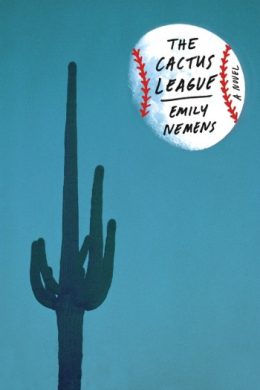
‘The Cactus League’ by Emily Nemens – A Dramatic Fun Baseball Novel for Adults


‘The Cactus League’ by Emily Nemens (2020) – 272 pages

Like many young boys, I was a huge baseball fan from about age ten to fourteen. I knew the name and batting average or earned run average of every player on every club and had a huge baseball card collection. I was such a fan of baseball that I would actually listen to the game on the radio if it wasn’t on TV.

Most baseball novels are written for kids like I was or overgrown adult kids who still love baseball. They are simplistic, innocent, suffused with hero worship, and concentrate mostly on the actual play on the baseball field, They are nostalgic, male-centric.

‘The Cactus League’ is different. The author Emily Nemens knows that baseball is much more than the game and the players on the field, and her novel deals with many of the behind-the-scenes circumstances that are going on. Her novel covers all of baseball: the players, the baseball wives, the coaches, the managers, the agents, the groupies, the other hangers-on, the new rising stars, the falling stars, the owners, the washed-up. Even the concession stand workers at the park.

It takes place in Scottsdale, Arizona where the Los Angeles Lions do their spring training each year before the regular season begins. A lot of players are invited to try out for the team during spring training, but only a select few will actually make the team. Those select few pretty much have it made, while the others will get sent back to a minor league club where they will get a subsistence wage.

In a lot of ways, baseball players are like other men. Some of them are dummies, some of them are mad, some of them are suspicious, shallow, arrogant. Some are so driven they’ll just about forget there’s a woman in the room, even if she’s dressed up sexy or screaming her lungs out, even if she’s the mother of their children. But the difference separating ballplayers from everyone else is that they care about something tremendously, and have since they were little.”

In many ways, ‘The Cactus League’ deals with the social etiquette of the entire baseball subculture. Emily Nemens has a dramatic way of presenting these baseball stories from a more complex sophisticated angle than most baseball novels dare. Since all of the stories are interconnected, together they form a novel.

Sometimes when the baseball wives are not busy with shopping and restauranting, they will come to the game to watch their husbands play.

That row, usually reserved for the more senior baseball wives, a line of skinny white women with too much makeup and fake-looking hair, is empty.”

The Los Angeles Lions do have a superstar named Jason Goodyear who makes millions in product endorsements as well as an exorbitant salary. No wonder so many women – baseball groupies – hang out at the park to entice these men, much to the indignation of the baseball players’ wives.

They look familiar, but he’s not sure if it’s because he’s seen them before or if it’s because they look like every dolled-up divorcee in town.”

Even a superstar can have problems and get into trouble, and then we get an owner’s lament:

No, he definitely has not heard their $150 million dollar investment had a run-in with the law.”

‘The Cactus League’ is a vivid fun baseball novel for adults by an obviously talented writer.


Grade:    A


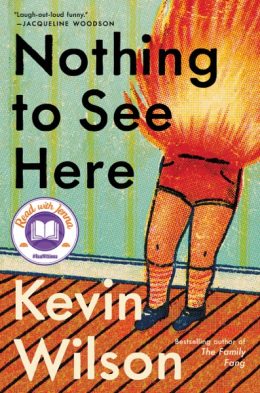
‘Nothing to See Here’ by Kevin Wilson – Preposterous


‘Nothing to See Here’ by Kevin Wilson (2019) – 254 pages


‘Nothing to See Here’ has a preposterous plot. Our female narrator Lillian is taking care of 10-year old twins Bessie and Roland who automatically catch on fire. Yes, the two kids spontaneously combust when they get upset. The fire does not hurt the kids themselves, but it can start furnishings and buildings on fire. Thus they must be watched constantly and carefully.

Of course this is absurd (Why doesn’t the kids’ clothing start on fire?), but somehow the plot seems to work.

My experience with listening to audio books rather than reading has been varied. I give up on a lot of audio books that I lose interest in or I just don’t follow the story well enough. (But I also frequently give up on novels that I’m reading.) I find I have the most success in audio with novels that have well-defined plots, and my greatest audio success was probably ‘News of the World’ by Pauline Jiles. ‘Nothing to See Here’ also worked well as an audio book. Sure the plot is preposterous, but it is clever and well-defined.

In this novel Kevin Wilson has, as I mentioned, a female narrator. Wilson pulls this off well as we become involved in her story.

Lillian is from a poor family, but her good grades get her into an elite college. At college she meets a girl named Madison who is from a rich and renowned family. They become best friends, so when Madison gets into trouble and is about to be kicked out of school, Lillian takes the fall for her instead after Madison’s father offers to pay Lillian some money.

Lillian could have been successful if she had stayed in college, but since she was kicked out, she works at a Tennessee Save-A-Lot store.

About twelve year’s later Madison calls up Lillian to ask if she will take care of her step kids. By this time Madison has married a Senator whose wife has died and who has these twin kids who spontaneously combust. Lillian agrees to do this, and that she does so is nearly as preposterous as the twins’ catching on fire.

Madison and her husband are more concerned about their political family image than about the welfare of these two kids, so they offload their kids on Lillian.

They were me, unloved, and I was going to make sure that they got what they needed. They would scratch and kick me, and I was going to scratch and kick anyone who tried to touch them.”

Perhaps because ‘Nothing to See Here’ is a rather simple story with a simple point, it does work in the audio format despite the plot being preposterous.


Grade:   B


‘Processed Cheese’ by Stephen Wright – “Well, reality is not as real as it used to be.”


‘Processed Cheese’ by Stephen Wright (2020) – 392 pages

Who would want to read a novel entitled “Processed Cheese” except for one or a dozen random mice? I would. There is no modern writer whose novels I await with more happy anticipation than Stephen Wright.

One could read ‘Processed Cheese’ solely for its demented humor. One could also read ‘Processed Cheese’ for its devastatingly deep insights into today’s over-cluttered money-crazed world. ‘Processed Cheese’ is a mad look into the United States in free fall.

The main subject of ‘Processed Cheese’ is money, what it can buy, and what it does to people who have it. MisterMenu is a multi-billionaire who lives with his wife in a penthouse apartment fifty-two stories above the street. He keeps huge canvas bags of his money around him, because they make him feel good. One afternoon his wife MissusMenu gets angry with him for screwing around with one of his several female friends, and she tosses one of the bags of money out of the window.

The bag of money falls on this flat-broke guy Graveyard who is out looking for a job. As soon as he recovers from the impact, Graveyard takes the bag of money home to his small apartment and to his girlfriend Ambience, who works in a toll booth.

Graveyard and Ambience go on a buying spree. At first, it’s just small stuff.

They liked snacks. All things salt and sugary. They had SnookerChips. They had BangoNuts. They had CheesySubs. They had ToastedPepperWhackers. And FruityPatooties. And LoopyCrisps. And FudgieWudgiePugies. Their favorite. A cookie inside a cookie.”

But soon Graveyard and Ambience move on to buying bigger things. Of course they buy a brand new giant 103″ HootchieCootchie flat screen TV. Soon their small apartment is crowded with deluxe packages of new merchandise from boutique shops. Stephen Wright has a lot of fun with all these product names. Ultimately they buy a brand new car, “The HomoDebonaire 3000. Top of the line. Runs on sunshine and fresh breezes. It’s greenly green.” Wright does make fun of how advertisers use people’s environmental concerns to sell their products.

Graveyard also buys guns including a MadderRose114 with moonscape sites and an insect-shell finish. Also a HyperSniperM98 bolt action with a CosmicHiBeam scope and adjustable check piece, of course. He gets his ammo at the BulletBoutique.

Graveyard’s attitude toward his cell phone is quite similar to mine.

Graveyard had a what-me-worry? relationship with his cell phone. He would never have even bought the damn thing if he hadn’t been told repeatedly by friends and utter strangers he absolutely had to own one of the irritating devices in order to participate fully in the modern carnival. He didn’t care. He could be in or out.”

Of course MisterMenu wants his big bag of money back.

At first it all seemed cartoonish. It felt like Stephen Wright is sacrificing empathy for his characters and coherence in his story for humor. It took me awhile to come to the conclusion that this comic strip of a novel is a brilliant study of our modern so-called society.

I trust Stephen Wright. I have read all of Stephen Wright’s novels. I trust he will ultimately provide a supremely meaningful narrative. And he does here.

But some essential ingredient had gone missing from his life, something lighter than air that had helped elevate the leaden chain of days you drag behind you like an anchor.”

Many of Wright’s riffs on various facets of contemporary society hit home for me. Of course there’s all that fun about buying stuff. Then there are set pieces about Graveyard and Ambience visiting a garish casino, visiting their relatives who still live out in the boondocks, internet dating sites, etc. Stephen Wright is a perceptive observer of the way things are today.

Yes, ‘Processed Cheese’ is a cartoon, but isn’t much of modern life cartoonish?


Grade:    A


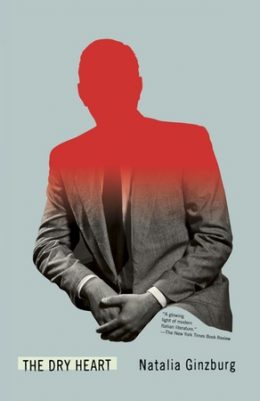
‘The Dry Heart’ by Natalia Ginzburg – “I Shot Him Between the Eyes.”


‘The Dry Heart’ by Natalia Ginzburg (1947) – 88 pages              Translated from the Italian by Frances Frenaye

‘The Dry Heart’ has a dramatic opening as a woman confronts her husband of four years:

I shot him between the eyes.”

Yes, in this short novella an unnamed woman tells the entire circumstances from the time she first met her husband Alberto until this final shot. This is an unsentimental angry account of how she came to shoot her husband.

At the beginning our unnamed young woman is living a lonely isolated life in a boarding house room and working as a school teacher.

When she meets Alberto who is somewhat older than her, she imagines how wonderful it would be to be married and have a house of her own.

When a girl is very much alone and leads a tiresome and monotonous existence, with worn gloves and very little spending money, she may let her imagination run wild and find herself defenceless before all the errors and pitfalls which imagination has devised to deceive her.”

Alberto seems like a nice enough guy, but she doesn’t delude herself into believing she is in love with him.

A girl likes to think that a man may be in love with her, and even if she doesn’t love him in return it’s almost as if she did. She is prettier than usual and her eyes shine; she walks at a faster pace and the tone of her voice is softer and sweeter.”

Nor does she fool herself into believing Alberto is in love with her.

Before we were married, when we went for a walk or sat in a cafe, Alberto enjoyed my company even if he wasn’t in love with me.”

Alberto does tell her that there is another woman whom he has been in love with for years, but he couldn’t marry her because she was already married. But finally Alberto does ask our young unattached woman whom he doesn’t love to marry him.

Soon after they are married anyway, Alberto begins taking unexplained business trips for weeks at a time, and our young wife begins to suspect that he is seeing this married woman friend again.

I won’t go into any further detail on this simple plot.

– Natalia Ginzburg –

I write about families because that is where everything starts, where the germs grow.” – Natalia Ginzburg

‘The Dry Heart’ is impressive in that it avoids all sentimentality and is written in a restrained personal style. Natalia Ginzburg wrote in a genre that was known as neorealism which she called “a way of getting close to life, of getting inside life, inside reality”.

‘The Dry Heart’ raises the question, why don’t more wives kill their husbands?


Grade:    A


Alice Adams – One of my Favorite Writers of the 20th Century


Alice Adams

Born:  August 14, 1926                Died: May 27, 1999

A lot of my reading in the 1980s and 1990s centered around two Alices and an Anne – Alice Munro, Alice Adams, and Anne Tyler. They were probably my three favorite contemporary writers at the time, each of them brilliant and dependable in her own way. Anne Tyler was solely a writer of novels, Alice Munro wrote mainly long short stories, and Alice Adams wrote both novels and stories.

Whereas Alice Munro’s stories are expansive, Alice Adams’ stories are compact. Her long-time editor Victoria Wilson said of Alice Adams’ writing thus:

She was sort of a magician, she managed to give you a dimensional quality of people and place and situation in a very, very condensed amount of space. You’d be reading three simple sentences and have the whole resonance of a person.”

As I went about writing this article, I was quite gratified to find out that a 508-page biography of Alice Adams, ‘Alice Adams – Portrait of a Writer’ by Carol Sklenicka has just recently been published. Not many fiction writers warrant a 508-page biography, and Alice Adams is one. Thus I had no lack of material for this article.

What makes her writing special?

Adams got stuck in an unhappy marriage at a young age and was divorced in her early thirties. She had one son from the marriage and never remarried although she had a number of intimate relationships with men. One of her main themes in her fiction is women searching to find ways to live lives free of controlling relationships. Divorce is usually a positive event in her work. She was born in North Carolina but lived most of her adult life in San Francisco. From a young age she knew she would be a fiction writer, worked hard at her craft, and made a lot of friendships among other writers.

Her first novel was not published until she was forty.

I think I probably am a good example of life begins at forty – I’m forty-eight – [Those eight years after forty] have all been a vast improvement. I began to come together after a long period of floundering.”

In her work she explores ways that her characters can break free of those things that can deprive them of their individual freedom. A story of hers first got published in the New Yorker in 1969, and she ultimately had 26 stories published there.

No one wrote better about the tangled relations of men and women or about the enduring romance of friendship,” said Fran Kiernan, an editor, who edited her New Yorker stories for 10 years, beginning with ”Beautiful Girl” in 1977. ”She was a great romantic, with the highest expectations of life. As a writer, she was unfailingly wise.”

Where to start with the author Alice Adams?

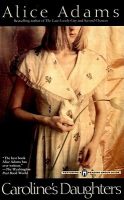
For me, the first novel that I read of Alice Adams was ‘Listening to Billie’.  Several other novels by other writers have evocations of Billie Holiday singing live in her prime in the 1930s and 1940s, and ‘Listening to Billie’ probably outdoes them all. That novel got me started and I wound up reading quite a few of her novels including ‘Families and Survivors’ and ‘Caroline’s Daughters’ as well as several of her story collections. If you are more interested in stories than novels, read the collection ‘Beautiful Girl’ or ‘Return Trips’.

A Quote about her

What Adams accomplishes in a rather slim, two-hundred-page novel is a representation of the complicated story of a main character’s movement toward strength and independence over a thirty year period in which virtually all the details come together in a mosaic of contemporary American life.” – Bryant Mangum discussing Adams’ novel ‘Families and Survivors’

Quotes from Alice Adams herself

I really have no imagination at all, just a terrific memory.” She took real people and events from her own life and transformed them into fiction. This made for some interesting and strong, sometimes irate, reactions to her work.

But, Jack, you know I don’t care for plot at all!” Adams’ work is very much character-driven rather than plot-driven.


‘Lives Other Than My Own’ by Emmanuel Carrère – When Bad Things Happen to Good People


‘Lives Other Than My Own’ by Emmanuel Carrère (2009) – 243 pages       Translated from the French by Linda Coverdale

Is this book a memoir or an autobiographical novel? I’ve seen it called both. Carrère writes with such verisimilitude that I usually equate with the telling of facts. For me, that is not a particularly good thing as I much prefer fiction to non-fiction, the reasons for which I will not go into here.

However Emmanuel Carrère is one writer for whom I pay attention even to his non-fiction. Notice that even the famous French translator Linda Coverdale will translate his books.

‘Lives Other Than My Own’ is Carrère’s personal reaction to two tragedies.

One of the tragedies is the tsunami tidal wave caused by an Indian Ocean earthquake on December 26, 2004 that killed about 280,000 people, mostly in Indonesia and Sri Lanka. Carrère and his family happened to be vacationing in Sri Lanka at that time, and they escaped unscathed. However a French couple which are their friends lose a four year-old daughter who was swept away in the giant wave.

The wave carried away her future along with her past.”

Carrère is quite eloquent in describing the devastation of this mother and father. As my mother used to say, “life goes on for the living”.

At least the deaths in the tsunami were quick and relatively painless deaths. The next death that Carrère discusses is a death due to cancer, a slow and painful death. His wife’s younger sister dies at age 33 of a recurrence of the cancer she had as a child.

This woman was a French judge, and a secondary theme of this book seems to be the handling of bad debts, debtors, and creditors by the courts. Altogether too much time and effort in the book is spent in explaining the intricacies of French consumer law.

Most people who have lived long enough have experienced a few personal tragedies during their lives, someone in their family or a close friend dying or becoming gravely ill at a relatively young age. “I can’t go on; I will go on.” Carrère deals with the two families’ grief in a heartfelt and empathetic manner.

Every day for six months I deliberately spent several hours at the computer writing about what frightens me the most on this earth: the death of a child for her parents and the death of a young woman for her husband and children. Life made me a witness to these two misfortunes, one right after the other, and assigned me – at least that’s how I understood it – to tell that story.”

Here Carrère is plain-spoken with little artistic embellishment. It does not always make the most interesting reading, but his heart is always in the right place, and he makes sure you know that.


Grade:    B


‘Gargoyles’ by Thomas Bernhard – A Doctor’s Rigorous Unsentimental View of His Patients and His Neighbors


‘Gargoyles’ by Thomas Bernhard (1967) – 208 pages             Translated from the German by Richard and Clara Winston

‘Gargoyles’ is a rigorous accounting of people’s lives rather than a sentimental accounting.

Our narrator in ‘Gargoyles’ is a young man who accompanies his doctor father on his rounds. The doctor sees the sometimes ugly truth in his patients’ lives. He sees people get sick and die close up, and sometimes it’s their own fault. He sees people’s families during these rough times in their lives and sees the breaking points within the family. In his village many of the men are cruel and spend all day drinking in the bar and then come home to beat their wives and children. These men are frequently anti-Semitic. There are two doctors in his town and the only Jew in town, Bloch, has “relieved the other doctor of the lasting shame of having to treat a Jew by consulting my father”. Now Bloch is one of the very few men in town in whom the doctor can confide.

‘Gargoyles’ begins with a senseless barroom murder of one of our doctor’s patients.

All these long drinking bouts end badly,” my father said. “And in this region a high percentage of them end in a fatality. The innkeepers’ own wives are often the victims.”

This doctor is familiar with the underside of townspeople’s lives, not the false fronts people put forward but the reality. There is the daughter-in-law who has only scorn for her mother-in-law and barely speaks to her.

Her daughter-in-law had always hated her. It had started as spontaneous dislike at their first meeting and had grown ever stronger over the years. “My son doesn’t dare to love me any more because of the way his wife hates me.” And by now, Frau Ebenhöh said, she was “crushed” by the more and more revolting stories her daughter-in-law concocted about her.

Another patient is a father who is depressed about his son’s slowness in school. The doctor is even willing to confront the difficulties in his own family. The doctor’s wife died five years ago when his son was 16 and his daughter 13, and he has now noticed that his daughter has become increasingly sullen and uncommunicative.

Among cheerful people who take life easily she was wretched. Pleasant surroundings irritated her. A bright day plunged her into still deeper melancholia.”

The doctor tries to instill in his own son this rigorous sense of reality.

I found the doctor’s words to his son to be brilliant, some of the deepest and most meaningful passages in all of literature. That is the first third of the novel.

However then the doctor and his son visit another patient, the Prince Saurau of Hochgobernitz in his castle. The Prince goes into a long deranged rant which is sustained over many pages. This rant is difficult to follow perhaps because it is so deranged. The actual German name for this novel was not ‘Gargoyles’ but instead was ‘The Derangement’ which is a much more meaningful name.

Over half of this novel ‘Gargoyles’ is taken up with this insane rant by the Prince Saurau. I must say this diatribe is for the most part incoherent and nearly impossible to follow. Because of this long, long incomprehensible rant I would not recommend ‘Gargoyles’ to readers who are new to Thomas Bernhard. Bernhard is one of my very favorite writers, but the last one hundred pages of ‘Gargoyles’ are extremely difficult to follow. ‘Gargoyles’ is one of Bernhard’s early novels, and in my view he had not yet perfected his techniques for getting deeply inside people and society.

I can strongly recommend at least four Thomas Bernhard novels which unlike ‘Gargoyles’ are complete successes. Those novels are ‘Extinction’, ‘The Loser’, ‘Woodcutters’, and the short novel ‘Wittgenstein’s Nephew’. Thomas Bernhard is one of the most original distinctive novelists of the twentieth century, and I would strongly recommend you read his works, but save ‘Gargoyles’ for later after you have developed some familiarity with his method.

In ‘Gargoyles’ Thomas Bernhard has succeeded all too well in capturing this rant of a deranged man. Most of the rant is incomprehensible to a reader, and I don’t think it is only to just this one reader.  But be sure to read one of the other Bernhard novels that I recommend above.


Grade:    B


‘Eleanor Oliphant is Completely Fine’ by Gail Honeyman – The Reclamation of a Woman


‘Eleanor Oliphant is Completely Fine’ by Gail Honeyman (2017) – 325 pages

‘Eleanor Oliphant is Completely Fine’ is a phenomenon. Why do I say this? The main gauge I use to determine a book’s popularity is the number of holds it has on it in the Hennepin County Library system. Hennepin County contains all of Minneapolis, Minnesota as well as many of its largest suburbs. The number of holds are the number of people who are waiting in line to check the book out. Currently ‘Eleanor Oliphant is Completely Fine’ has 510 holds on 90 copies of the book. This is comparable to the number of holds there would be for a brand new novel by a famous author. Yet ‘Elizabeth Oliphant is Completely Fine’ is a first novel written way back in 2017. Only such phenomenons as ‘Gone Girl’ have these kind of numbers after three years. And best of all, ‘Elizabeth Oliphant’ qualifies as substantial literature.

The fictional character Eleanor Oliphant and I shared a similar problem. We were both standoffish. Both of us went about our business quite competently but avoided other people as much as possible. Eleanor had much better reasons for her standoffishness than I ever did. You will have to read the novel to find out her reasons. Eleanor has built a psychological wall around herself which effectively keeps most other people out. Eleanor has poor social skills and unrealistic expectations.

I had no one, and it was futile to wish it were otherwise. After all, it was no more than I deserved. And, really, I was fine, fine, fine.”

For me, I gave off these vibrations to others indicating that “If you really knew me, you wouldn’t like me.” I kept myself at a distance from others as does Eleanor.

This is the story of a young woman awakening from her standoffish life.

Your voice changes when you’re smiling, it alters the sound somehow.”

‘Eleanor Oliphant is Completely Fine’ is refreshing because it contains something you don’t find often in modern fiction, a good man. A good man is hard to find in modern novels or stories. At times like these, it is difficult to remember that there are still any decent people in the world. Raymond is a positive force in this novel.

I suppose someone could argue that the story in ‘Eleanor Oliphant’ is not very sophisticated. I do not see sophistication as a necessary or even desirable attribute of literature. Rather I see stating situations as simply and clearly as possible as one of the hallmarks of good literature, and that Eleanor Oliphant does.

‘Eleanor Oliphant’ is a poignant and affecting story.


Grade:   A+


‘Topics of Conversation’ by Miranda Popkey – Over the Edge

‘Topics of Conversation’ by Miranda Popkey (2020) – 205 pages


Not everyone is immediately repulsed by tenderness as I am.”

‘Topics of Conversation’ is an edgy novel, perhaps a little too edgy for its own good.

The main idea of the novel is that this unnamed woman relays memorable conversations she has had with usually other women over 17 years (from 2000 to 2017). We are given such sketchy scant information about our narrator that she remains a shadowy figure, a near mental case. There is very little evidence of her maturing. This reader did not develop any empathy for this woman’s situation. She definitely is not a role model and seems almost self-loathing.

There is little comfortable continuity in our narrator’s living circumstances. Neither our narrator nor her husband are fully developed. All we learn about John is that he is nice to her, and she disdains men who are nice to her. She instinctively hates kindness.

The conversations are more interesting than the circumstances of our narrator’s life which seem often so outrageous and edgy as to defy any normal interest in her.

The novel does raise some provoking and scandalous questions. Is it possible that a married woman today might want to have sex with a stranger, a man? Is it possible that a woman today might have such disdain for her husband because he treats her too nice, and thus she goes out and picks up a strange (in more ways than one) man at a hotel bar? Popkey raises these questions that others do not dare raise in this #MeToo era.

In one conversation, a woman friend tells about how she admitted to her husband that she had an affair with a man, but that she had made up the affair to get out of the marriage. At that point our unnamed narrator observes that “beneath the first premise of our friendship was the understanding that we were, both of us, bad people.”

At one point, one of the women talking raises the question that if men leave their families and little children to go off on their own all the time, shouldn’t women be able to do the same thing. To me this question is over the edge, but I suppose that mine is just a male point of view.

Some of the conversations are quite meaningful; others not so much. In one chapter, our narrator watches a lengthy You Tube video of a woman describing being at a party where the famous incident of author Norman Mailer stabbing his wife Adele occurred in 1960. In some chapters our female narrator attempts to relate the conversation to her own situation, but in the Mailer chapter not so much, and I wondered how this gross incident related to anything at all.

Many of the individual sentences in ‘Topics of Conversation’ are strong and insightful, but the novel as a whole fails to cohere. These somewhat sporadic conversations force the novel to be necessarily episodic.

Perhaps if the narrator had been given a name and a more solid, understandable. and less edgy life situation, she could have sustained my empathy and interest throughout this short novel, but unfortunately that did not happen.


Grade: C+


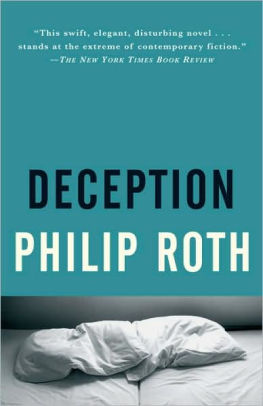
‘Deception’ by Philip Roth – Sketchy at Best


‘Deception’ by Philip Roth (1990) – 202 pages

‘Deception’ is a novel that consists entirely of dialogue, most of it between a man named Philip and his mistress. Their trysts and their conversations take place in a room in London that Philip has rented to get the privacy he needs to write his novels.

There are not even “He said” or “She said” openings, so we don’t even know for sure who is saying which lines, although the context of the words usually does indicate one or the other. The mistress is usually talking about her home and her husband who is also cheating on her. Philip is usually quiet while he listens to her or otherwise he is making political or boorish or misogynist or racist against black people or above all self-centered comments. Philip is opinionated.

Philip Roth published this novel in 1990, the same year he married his longtime companion Claire Bloom. Roth was set to give the name of Claire to the wife who Philip is cheating on in ‘Deception’. However Claire Bloom saw this use of her name as “nasty and insulting” and Roth finally relented. Their marriage only lasted about four years. Bloom soon after wrote a memoir in which she portrayed Roth as a self-centered misogynist.

I found the dialogue between Philip and his mistress completely lacking in charm or romance with Philip constantly using the F-word to describe their physical relationship. Also I did not think Roth did a very effective job of capturing how a woman would speak.

There is also a subplot about Philip’s affairs with two young Czech women, also told in dialogue only, which for me did not coalesce into a coherent narrative.

In his boorishness, Philip does make some valid points as an author that other writers are too polite to make.

As though it’s purity that’s the heart of a writer’s nature. Heaven help such a writer! As if Joyce hadn’t sniffed at Nora’s underpants. As though in Dostoyevsky’s soul, Svidrigailov never whispered. Caprice is at the heart of a writer’s nature. Exploration, fixation, isolation, venom, fetishism, austerity, levity, perplexity, childishness, et cetera. The nose in the seam of the undergarment. Impurity.”

Anyhow I was quite disappointed with ‘Deception’ up until about the last thirty pages when Philip’s cheated-upon wife confronts him. At this point we get the real subject of the novel which is writers’ use of their own autobiography or their own imagination in the fiction they write.

I write fiction and I’m told its autobiography, I write autobiography and I’m told it’s fiction, and since I’m so dim and they’re so smart , let them decide what it is or isn’t.”

These last thirty pages do not entirely redeem the mess that comes before, but at least they brighten things up a little with some relevant observations.

I have read some meaningful and worthwhile novels by Philip Roth including ‘The Ghost Writer’, ‘American Pastoral’, and ‘The Plot Against America’; however ‘Deception’ is not one of them.

If you want to appreciate Philip Roth as a writer and as a person, don’t read ‘Deception’.


Grade:    C+


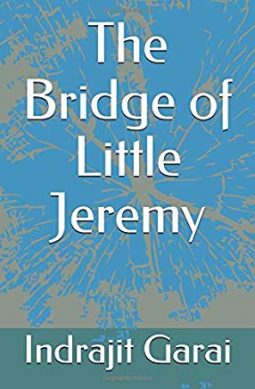
‘The Bridge of Little Jeremy’ by Indrajit Garai – A Boy and His Dog Along the Banks of the Seine in Paris


‘The Bridge of Little Jeremy’ by Indrajit Garai (2019) – 367 pages

Some of the best stories are far-fetched and require a suspension of disbelief. ‘The story of ‘The Bridge of Little Jeremy’ surely is improbable, but this story is told in a direct and sincere manner which makes reading it a pleasure. Along the way, we get delightful scenes of pleasant Parisian ambiance and street life.

Jeremy is a 12 year old boy, almost 13, and he is the first-person narrator of this story. He lives with his mother in an old, old apartment which was passed down through several generations and is near the Seine River in Paris. They are within walking distance of several of the Parisian landmarks as well as a few of the bridges that cross the Seine. Now they may lose the apartment for failure to pay inheritance taxes, and his mother might wind up in prison.

Jeremy is truly a precocious boy. He can already sell his own paintings through a dealer with a shop near the Seine. He has had one surgery for his bad heart but requires another as soon as they can afford it.

One day as Jeremy is exploring his apartment building he discovers an underground vault in which there is what looks to him like a valuable old painting which has been slightly damaged by dampness, and he sets about restoring it himself. Of course there is a story behind this painting.

Jeremy’s dog Leon is also one of those amazing dogs you will only find in fiction.

The boy and his dog spend a lot of their time walking along the Seine. Here they gaze upon an impromptu music festival:

At eight in the evening, the sun is still beating down harshly, but the heat doesn’t bother those singers and dancers on the boat going over the river with their colorful banners. The festival is going on around the Ile Saint Louis too, and from our isle, with its shape of a vessel and all these people singing and drinking and dancing everywhere, looks like a huge discotheque cruising through the wakes of the Seine.”

When I was in my twenties, I took a two semester night extension course on the history of art which had a profoundly beneficial effect on my life. When discussing the Impressionists, our instructor made sure that we did not overlook or underrate “the merely pleasant”. Since then I have associated Paris with “the merely pleasant” which might amount to a walk along the Seine or any other river for that matter.

So ‘The Bridge of Little Jeremy’ is a fantastical tale with a light touch and with charm, beauty, and almost magic.


Grade:    A


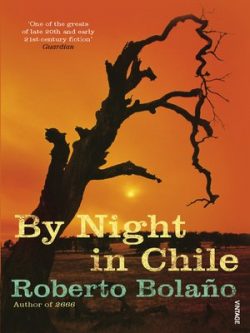
‘By Night in Chile’ by Roberto Bolano – Silence in the Face of Evil


‘By Night in Chile’ by Roberto Bolano (2000) – 118 pages        Translated from the Spanish by Chris Andrews

I was getting somewhat tired of reading too much simplistic fiction where the good guys or gals contend with the bad guys or gals, and everyone is sharply defined. I wanted something more difficult, more ambiguous. So I read ‘By Night in Chile’ by Roberto Bolano, a challenging author that I have enjoyed before.

For one thing, the entire novel is one long paragraph, and there are no convenient stopping points for the reader. For another, the main character in the novel who tells the story, a literary priest, is not someone that Bolano wants us to applaud or approve of but is instead someone we readers are supposed to deplore and reject. Finally, the story is somewhat difficult to follow and understand, so I had to do a lot of research as I was reading just to follow the story. So it was a challenging read, and that is just what I wanted.

The entire novel is a deathbed confession by this literary Chilean Jesuit priest, Father Sebastian Urrutia LaCroix. Early on, Father Urrutia prefaces his words by saying:

One has a moral obligation to take responsibility for one’s actions, and that includes one’s words and silences, yes, one’s silences, because silences rise to heaven too, and God hears them, and only God understands and judges them, and so one must be very careful with one’s silences.”

Yes, silence in the face of evil is the sin we are dealing with here. We are confronted with the Chilean dictator General Augusto Pinochet. Pinochet came to power in Chile in a United States backed coup that overthrew the democratically elected socialist government of Salvador Allende and ended civilian rule in Chile. During Pinochet’s and the military’s time in power, 2279 people were murdered by the military government, 31,947 people were tortured, and 1312 people were exiled. During this time Bolano himself was arrested, and though he was not tortured himself, he could hear the cries and screams of others being tortured.

‘By Night in Chile’ is Bolano’s critique of the Catholic Church and the Chilean literary establishment for standing by and allowing Pinochet and the military to murder and torture so many Chilean people. In one scene Father Urritia attends a literary soiree in a prominent lady’s house, and one of the other attendees searching for a bathroom opens the wrong door and witnesses someone being tortured in the house while they are talking about literature upstairs. On his deathbed, Father Urrutia makes the convenient excuse for not speaking out against this torture by saying he “would have been able to speak out but didn’t see anything [and] didn’t know until it was too late.” Sure, sure.

‘By Night in Chile’ is a challenging read in more ways than one.


Grade:     B+


‘Other People’s Love Affairs’ by D. Wystan Owen – Stories Which Will Move You, If You Are Willing To Be Moved


‘Other People’s Love Affairs’ by D. Wystan Owen (2018) – 209 pages

I did not realize until now that anyone was still writing stories with this much depth and perception and feeling anymore. The stories in ‘Other People’s Love Affairs’ by D. Wystan Owen remind me of the stories of William Trevor and Elizabeth Taylor, both of whom are now gone. If you like either of those two writers, you will probably like these stories of D. Wystan Owen.

These stories go deeper into the circumstances and the psyches of their main characters than most stories do. People in them almost connect but not quite, and we readers are moved just as we would be in real life.

The power of an individual short story is that an event in our lives can reflect our entire life situation. Thus by concentrating on the details of this one event we can nearly entirely understand this person’s hopes, setbacks, hesitations, strengths, and weaknesses.
All of the stories take place in the town of Glass, a small English town on the southeastern coast. These love affairs are not what we typically call love affairs but rather off to the side.

In the story “A Bit of Fun” a widower revisits the cinema called the Princess where, as a teenager, he had trysts with an older married woman who confessed, “My husband isn’t any good to me, Gerald.” These trysts were a long time ago, but he recalls them vividly after his wife dies.

Perhaps the quality that gives these stories their emotional power is their subtlety. When two people almost connect because one person feels more strongly than the other, there may be sadness. One technique that Owen uses in several of the stories is to tell both sides of a relationship. The poignancy and the emotion for us readers develop when one person feels more strongly than the other.

In the title story, two women have been living together for many years when one of them dies. The woman who remains discovers that in the will she has been left everything to her except for the roll-top desk which was left to a local male bar owner. She is quite curious about this connection she did not know about and seeks to find out more.

In “Virginia’s Birthday” a small nightclub owner has had a lady singer perform there for years and years as his club has slowly lost its business and now may have to close. The story is told in the alternating perspectives of both the nightclub owner and the lady singer, and as it turns out the connections between these two people are much deeper than we originally suspected.

By the end of these stories you might shed a tear for the subtle but eloquent plight of its main characters or you might have a smile of recognition. What more can a story do?


Grade:    A+


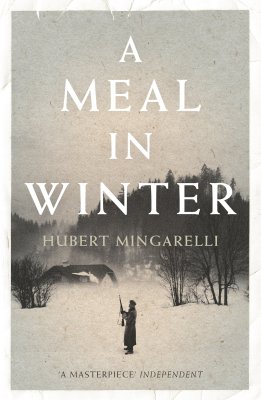
‘A Meal in Winter’ by Hubert Mingarelli – A Provocative Novel of World War II


‘A Meal in Winter’ by Hubert Mingarelli (2012) – 138 pages Translated from the French by Sam Taylor

Why do people read Holocaust literature when there are so many more pleasant things to read about? Because some of us want to face the worst there is in human beings, the bottom dregs of atrocious human behavior and perhaps somehow deal with it. It is just not possible to sweep the deaths of over six million people under the carpet and pretend it never happened.

In ‘A Meal in Winter’ three German soldiers who are in Poland are sent out on a harsh cold day in winter to hunt for Jewish people who are hiding and to bring any that they find back to their camp. They specifically requested this mission of their base commander because otherwise they would have had to stay in camp and shoot the Jewish people who were already captured.

We explained to him that we would rather do the hunting than the shootings. We told him we didn’t like the shootings; that doing it made us feel bad at the time and gave us bad dreams at night. When we woke in the morning, we felt down as soon as we start thinking about it, and if it went on like this, soon we wouldn’t be able to stand it at all – and if it ended up making us ill, we’d be no use to anybody. We would not have spoken like this, so openly and frankly to another commander. He was a reservist like we were , and he slept on a camp bed too. But the killings had aged him more than they had us.”

They do capture one Jewish person who is hiding in the woods. One of the soldiers notices an embroidered star on the winter hat that the Jew is wearing.

Because if you want to know what it is that tormented me, and that torments me to this day, it’s seeing that kind of thing on the clothes of the Jews we’re going to kill: a piece of embroidery, coloured buttons, a ribbon in the hair. I was always pierced by those thoughtful maternal displays of tenderness.”

Then to pass the rest of the day they go into an abandoned house of which there were many in Poland during the German occupation. The three soldiers will spend the rest of the day in the house since they have done their duty already by capturing a Jew. They lock up the Jew in the pantry and then start a fire in the furnace of this bitterly cold house by breaking up some of the furniture.

They decide to prepare a makeshift meal with whatever food they can come up with. Another Polish guy shows up at the house as they are preparing this meal. In order to get enough fire to heat the meal properly they must burn more and more of the furniture.

This novel is a strong attempt to watch this atrocity from the viewpoint of the perpetrators. Some of the perpetrators were gung-ho with the German high command; others may have been only reluctantly following orders.

This is a simple but moving story.


Grade:   A


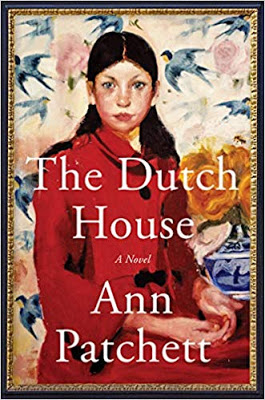
‘The Dutch House’ by Ann Patchett – This Old House


‘The Dutch House’ by Ann Patchett (2019) – 337 pages

Again I found out that not every work of fiction is meant for every reader. There are extreme differences in taste and in interests from author to author and from reader to reader. The reading of fiction is a very subjective activity.

Sometimes a particular novel is just not suited for an individual reader. Unfortunately that is the case of ‘The Dutch House’ for me. And I should have known. Just by the title alone I could have known that one of the main characters in the novel would be the Dutch House itself, and I am just not that much into real estate.

‘The Dutch House’ is the life story of mainly two children, brother Danny and sister Maeve, who live with their father in a spectacular old house built by a Dutch businessman named VanHoebeek in the 19th century. The furnishings of the house are elaborate including portraits of the VanHoebeeks which hang on the wall in the drawing room. The entire third floor of the Dutch House is taken up with a ballroom.

The mother of Danny and sister Maeve was in the convent training to be a nun when she got married, and she couldn’t stand the ostentation of living in the Dutch House so she took off for India to help the poor people there, leaving her two children and their father behind.

Enter the wicked stepmother, Andrea, and her two daughters Norma and Bright.

My daughters are none of your business.” Her face was burnished with the energy it took to hate us, the energy it took to convince herself that every wrong thing that had happened in her life was our fault.”

A lot of things happen in this novel, but the focus always remains on the Dutch House. Even in one of the scenes that pass for high drama here, a character is not too busy or involved to note that the crown molding on the ceiling of one of the rooms in the Dutch House is called egg-and-dart. Admittedly this house is of superior crafting, but these kind of details rather bored me to distraction.

There are a few nice scenes in the novel. I particularly enjoyed the scene where Danny first meets the woman he would later marry, Celeste, on a train.

Even though ‘The Dutch House’ is an account of the entire lives of these two characters Danny and Maeve, three of the other characters are the housekeepers and nanny who worked in the Dutch House when the two were little. The focus is always on that old house.

Rather than a suspenseful or brilliant story, this is more a steady workmanlike account of these two people’s lives along with a few of the people they meet along the way. I thought there was going to be high drama involving the wicked stepmother, but that story line is dropped with no resolution until near the end of the novel.

I did not find ‘The Dutch House’ compelling, but it is kind of my own fault for choosing this novel to read in the first place.


Grade:   B-


The Top 12 List of the Best Fiction I Have Read in 2019

Now that you have all been overstuffed by the glut of ‘Best of Year’ lists of late, I am here to offer you the list of my twelve favorite fiction reads of 2019.

This year I did things a little differently. In other years I have limited my favorite reads to include only fictions written since 2000, because I did not want the vulnerable new works to be overshadowed by old classics that I chose to read or re-read. However this year the older works which I most enjoyed are quite obscure and I do wish to highlight them so I am including them in my Top 12 list. As always the works are arranged in most favorite to 12th most favorite order.

‘Arturo’s Island’ by Elsa Morante (1957) – It is a beautifully written moving one-of-a-kind novel. Although there are clues that ‘Arturo’s Island’ takes place after World War II, the story seems to occur outside of time in a place of legend, of myth. Elsa Morante has captured an isolated world on this remote island of Procida and she brings back meanings that apply to us all. I won’t forget this one.

‘A Season in the Life of Emmanuel’ by Marie-Claire Blais (1966) – Here is an original spirited black humor novel about family life on the farm. The novel does to the farm family what Joseph Heller did to World War II in Catch-22. No writer makes outrageous fun of farm families anymore. I suppose why this novel struck such a chord with me is that it brought back memories of my own childhood and teenage days on the farm, but the novel is great anyway. Take my word for it.

All for Nothing’ by Walter Kempowski (2006) – All For Nothing’ is a magnificent atmospheric novel of the last months of World War II from the point of view of the East Prussian Von Globig family, Their estate is peaceful at the start, but they can hear the distant shelling of the Russian infantry advancing farther and farther into Germany. The near-rural setting is almost idyllic but the tension builds gradually as the shelling gets louder and closer each day. The question is: When should they evacuate?

The Long Take’ by Robin Robertson (2018) – ‘The Long Take’ is a narrative poem with evocative imagery that captures both the horrors of war as well as the crazed free spirit of Los Angeles after the war. Alongside the skid rows and the seedy sections of Los Angeles, the movie makers are filming the classic noir movies: ‘Night and the City’, ‘He Walked by Night’, ‘The Big Combo’, etc., etc.

Night Boat to Tangier’ by Kevin Barry (2019) – ‘Night Boat to Tangier’ is the story of two fading Irish gangsters, best friends, in their early fifties, Maurice and Charlie. Charlie has a severe limp; Maurice has lost one of his eyes. Maurice and Charlie started dealing dope in high school. I fully expect this one will be a movie soon.


‘Disappearing Earth’ by Julia Phillips (2019) – Two young girls disappear on the remote Russian peninsula of Kamchatka. Julia Phillips totally captures the spirit and the emotions of these people in this remote place so that this reader felt they could be living next door to him.


‘A Different Drummer’ by William Melvin Kelley (1962) – Here is a major rediscovery, a novel that has been totally neglected for decades. It is written in the open magnanimous humorous spirit of Mark Twain.


Normal People’ by Sally Rooney (2019) – In short declarative sentences, Sally Rooney gets the reader to care about these two Irish high school seniors, Marianne and Connell, who break up only to make up time and time again. Marianne is the smartest person in school but has no friends; Connell is a very popular star of the football team.


‘Olive, Again’ by Elizabeth Strout (2019) – Olive Kitteridge of the small town of Crosby, Maine is getting old but she is still a lively character who gets around town. She remarries at age 70. Having an old person near the center of your stories means you can deal with both life and death in them.


‘A Ladder to the Sky’ by John Boyne (2018) – A Ladder to the Sky’ is a captivating jaunty thriller about wicked literary politics. Our sole resourceful villain is one Maurice Swift, a man of limited talent who will stop at nothing to write a prize-winning literary novel. The hardest task for the talent-less is coming up with those succeeding novels after that first success.


‘Drive Your Plow Over the Bones of the Dead’ by Olga Tokarczuk (2009) – This is a novel about an old woman who has a love and passion for justice for animals, even the smallest creatures. She absolutely detests the killing of animals, especially by hunters. I can think of no other novel in which the main character’s reaction to events is so fierce and sharp.


‘The Tartar Steppe’ by Dino Buzzati (1940) – ‘The Tartar Steppe’ follows the life of a young soldier in such a clear and precise manner that it is as though it were etched in stone rather than written. It is about a soldier’s life, but its theme of time passing is universal. Life happened while we were waiting, and the years and decades went by before we knew it.


Happy Reading !


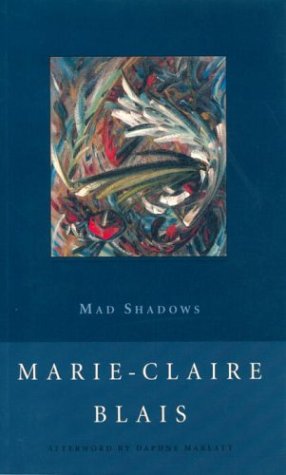
‘Mad Shadows’ by Marie-Claire Blais – A Fractured Fairy Tale


‘Mad Shadows’ by Marie-Claire Blais (1959) – 123 pages Translated from the French by Merloyd Lawrence

After reading ‘A Season in the Life of Emmanuel’, I wanted to read more, more, more fiction by Marie-Claire Blais, so now I have read ‘Mad Shadows’. ‘Mad Shadows’ was her first novel and was published in Canada when Blais was only 19 years old.

‘Mad Shadows’ is a gruesome cruel family story about a mother and her two children. It has the simple stark intensity of a fairy tale.

After the death of her husband, the mother Louise was left with her two children. She is proud and devoted to the point of obsession with her beautiful younger boy Patrice.

His mother caressed the nape of his neck with the palm of her hand. With a gentle slip of her all-too-supple wrist she could lower Patrice’s head to her bosom and hear his breathing more easily.”

However the mother considers her daughter Isabelle-Marie who is three years older than the boy to be ugly and not worthy of any attention at all.

Louise’s hand clutched the frail shoulder. Her nails pierced the skin. All her contempt for her daughter spurted like pus from her skin.”

The mother sends the daughter out to work in the fields while the mother dallies in the house with the boy. The daughter believes herself to be ugly and is insanely jealous of her brother.

There are two other characters in this cruel fairy tale of a novel. The mother Louise goes off for a short vacation and brings back this guy Lanz who she marries and who temporarily displaces her son for her attentions.

Later daughter Isabelle-Marie meets and marries the blind young man Michael who she thinks loves her as long as he cannot see her.

As in ‘A Season in the Life of Emmanuel’, some readers might find ‘Mad Shadows’ too extreme, too over-the-top, for their tastes. However the art or talent that I admire in the writing of Marie-Claire Blais is that she deals with powerful deep painful emotions and situations in a highly original way.

I am now hopelessly addicted to this writer, Marie-Claire Blais. I have one of her later novels (She is still producing novels), ‘A Twilight Celebration’, on my wish list for Christmas.


Grade:   A