Archive for the ‘Book Reviews’ Category

‘Perfection’ by Vincenzo Latronico – Perfect in Berlin in 2015?


‘Perfection’ by Vincenzo Latronico   (2022) – 134 pages                Translated from the Italian by Sophie Hughes

 

I had heard or read very little about Berlin since the Berlin Wall was torn down in 1989 and the city was reunited. ‘Perfection’ showed me that a lot has been going on in Berlin since then.

Berlin has become a hot spot for techies, young professionals who can work from their apartments and set up web sites for restaurants and other businesses that want a strong internet presence.

They were graphic designers and front-end developers and artists…”

The time of ‘Perfection’ is 2015 which was probably the height of this phenomenon as business internet sites are somewhat old hat by now.

Anna and Tom are two such young creative professionals, “a term even they found vague and jarring”. They have emigrated to Berlin from southern Europe as have many others with whom they bond. The first chapter of ‘Perfection’ describes their apartment in loving detail. Everything in the apartment is stylish and perfect from the sand-colored Berber rug to the hardwood floor boards to the luxuriant plants.

It would seem that Anna and Tom have achieved something close to perfection in their lives.

They spent all their time in plant-filled apartments and cafes with excellent WiFi. In the long run it was inevitable they would convince themselves that nothing else existed.”

However Chapter II of ‘Perfection’ begins with:

Reality didn’t always live up to the pictures.”

As Anna and Tom (The two names are always spoken together and never differentiated in the novel.) work on their two monitors in their lovely office, they sense a vague dissatisfaction.

over the course of the day, more out-of-place objects and signs of slovenliness would enter their field of vision, breaking their concentration.”

And Berlin changes. In the beginning, Berlin is “their main pastime. … In many ways it defined them much more than their profession did.” As more and more young techies arrive, Berlin goes through gentrification with resulting higher rents and higher prices throughout. Of course Anna and Tom can sublet their apartment for an exorbitant rental fee.

As Anna and Tom become more dissatisfied, they decide to sublet their apartment for six months and head to another young techie hot spot in Europe – Lisbon, Portugal where they appreciate the warmer weather.

But perhaps it is not their chosen city and occupation that are causing Anna and Tom to be dissatisfied. Perhaps Anna and Tom are just getting older.

The lengthy description of Anna and Tom’s luxurious apartment at the beginning of ‘Perfection’ would probably appeal more to New Yorker readers than to me, but after that ‘Perfection’ held my complete interest.

Besides, I did want to know what was happening in Berlin these days.


Grade:    A


The Ideal Man and the Not-At-All Ideal Man According to Jane Austen


I have been reading ‘Persuasion’ and came across the following passages which I think accurately describe the ideal man according to Jane Austen. In ‘Persuasion’, there are three of these men who might qualify to some extent, Captain Frederick Wentworth, Captain Benwick, and Anne Elliot’s cousin William Walter Elliot, Esq. However Anne’s father Sir Walter Elliot is definitely not one of Jane Austen’s ideal men, being described by Jane as “a conceited, silly father” and as quite vain about his aristocratic title of baronet.

But even Jane’s heroine in ‘Persuasion’, Anne Elliot, can make mistakes in her evaluations of the men who are around her. Here are Anne Elliot’s first thoughts on her cousin William Walter Elliot, Esq. :

[She] could not picture to herself a more agreeable or estimable man. Everything united in him; good understanding, correct opinions, knowledge of the world, and a warm heart. He had strong feelings of family-attachment and family honor, without pride or weakness; he lived with the liberality of a man of fortune, without display; he judged for himself in every essential, without defying public opinion in any point of worldly decorum. He was steady, observant, moderate, candid; never run away with by spirits or by selfishness, which fancied itself strong feeling; and yet, with a sensibility to what was amiable and lovely, and a value for all the felicities of domestic life, which characters of fancied enthusiasm and violent agitation seldom possess.”

However later Anne Elliot decides that Mr. Elliot is not the man for her:

Mr. Elliot was rational, discreet, polished, – but he was not open. There was never any burst of feeling, any warmth of indignation or delight, at the evil or good of others. This, to Anne, was a decided imperfection.”

Only near the end does Anne Elliot find out the awful truth about Mr. Elliot from her friend Mrs. Smith:

Mr. Elliot is a man without heart or conscience; a designing, wary, cold-blooded being, who thinks only of himself; who for his own interest or ease, would be guilty of any cruelty, or any treachery, that could be perpetrated without risk of his general character. He has no feeling for others. Those whom he has been the chief cause of leading into ruin, he can neglect and desert without the smallest compunction. He is totally beyond the reach of any sentiment of justice or compassion. Oh! He is black at heart, hollow and black.”

Anne Elliot’s first impressions of her cousin Mr. Elliot were badly wrong. But these three passages combined do give us an indication of the type of man who is best suited for Anne Elliot and probably Jane Austen. There is still one other man whom I mentioned above who is perfectly suited for Anne Elliot.

Later we get the opinion of Anne Elliot (with words provided by Jane Austen) on what good company is:

My idea of good company, Mr. Elliot, is the company of clever, well-informed people who have a great deal of conversation; that is what I call good company.”

Jane Austen was never shy about sharing her strong opinions, some very positive and some very negative, about her characters with her reader audience.


‘The Unfinished Harauld Hughes’ by Richard Ayoade – a Documentary on the Life of the Playwright / Screenwriter / Poet


‘The Unfinished Harauld Hughes’ by Richard Ayoade     (2024) – 182 pages


The novel ‘The Unfinished Harauld Hughes’ begins with the funeral of Harauld Hughes, noted English playwright, screenwriter, and poet. The ostensible writer of this story wants to produce a documentary on Harauld Hughes. Elsewhere this novel has been described as “Pinteresque” since apparently there are many parallels between the fictional life of Harauld Hughes and the real life of Nobel Prize-winning playwright, screenwriter, and sometime poet Harold Pinter. I did not know much about Harold Pinter until I read the Wikipedia biography of him just now,

What we get in this novel is a supposedly comic pastiche of various people relating their experiences with Harauld Hughes as the would-be documentary maker interviews them. His first wife Felicity Stoat who was an actress in his early plays and later a screen actress has already died. His second wife is Lady Lovilocke.

She the daughter of an aristocrat, and Hughes a man of mixed ancestry, his wild hair, ‘born in Wales no less’.”

The novel also includes lines from Hughes’ plays and poems. The problem with including these quoted excerpts is that the reader doesn’t know if the lines are written as intentionally bad to be part of the parody. I did not find any lines in the poems particularly meaningful.

Occasionally the humor in the novel worked for me, especially on the quite humorous asides:

The next time I saw Harauld was six years later, at a poetry recital in honor of some of the poems T. S. Eliot thought of writing, but ultimately decided not to.”

Anyhow, after Harauld Hughes left his first wife and took up with Lady Lovilocke, he gave up stage play writing and switched to the more lucrative screenwriting.

Hughes’s marriage to Stoat which lasted from 1953 until its official dissolution in 1980, was unhappy, distant, and creatively productive; his marriage to Lady Lovilocke was happy, close, and seemed to put his creativity into endless abeyance.”

A few years after hooking up with Lady Lovilocke, Hughes takes on the task of writing a screenplay for a movie called ‘O Bedlam O Bedlam!’. Apparently the movie had a ridiculous plot for a serious artist and never gets made and virtually ends Hughes’ career as a writer.

There is talk of the differences between movies and stage plays:

In the cinema all seats cost the same, more or less – sometimes it’s a few quid more for extra leg room – but one expects a comparable experience throughout the auditorium. Different story in theatre. It can sometimes cost ten times as much to sit near the front as compared to the cheap seats in the balcony. And that’s because it’s worth it.”

And there are insights into art itself:

And what else is art but an attempt at high quality thought? But even to make such an assertion is to open oneself up to the derision of imbeciles.”

Overall, I found some of the lines in the novel quite funny and some of the insights clever, but ultimately the lines from the poems and from the stage plays of Harauld Hughes did not really speak directly to me, so I failed to see why anyone would consider him a literary genius.


Grade:     B


‘Adam and Eve in Paradise’ by Eca de Queiros – A Re-Imagining of the Bible Story


‘Adam & Eve in Paradise’ by Eca de Queiros (1897) – 60 pages   Translated from the Portuguese by Margaret Jull Costa


Whenever I get a chance to read another fiction by Eca de Queiros, the author whom Jose Saramago called Portugal’s greatest novelist, I take it. That this translation was just released this year and is by that wonderful translator Margaret Jull Costa is an additional treat.

Whereas in the Bible the Garden of Eden is described as a delightful place, here, in the version by Eca de Queiros, it is at first a quite frightful place:

All of Eden was covered in flocks of vultures and crows, because of so many animals dying of hunger and thirst, there was an abundance of rotting meat.”

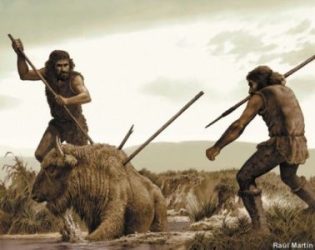
What Eca de Queiros is doing is incorporating what the scientists of the 19th century had learned about early times such as dinosaurs, the discovery of fire and weapons into the Biblical story.

At first, when Adam, the Father of Mankind, leaves the other primates behind in the trees and descends to the ground, he is still a hairy beast, “a truly alarming sight”. Whereas our cousins the orangutans stayed in the trees eating fruits and vegetables, the humans came down from the trees into Paradise where they learned to kill and eat other animals and go to war against other tribes of humans. Who actually is better off?

Only later, Adam “became truly human, and thus simultaneously sublime and absurd”.

Things really change when the woman Eve, our Venerable Mother, appears. Instead of Eve being created from Adam’s rib, here she just shows up.

In this version, it is Eve who discovers fire and later figures out to first cook the raw meat that they eat and to use fire to heat their cave.

Ah how sweet it was, that penetrating warmth, drying the cold dew from his skin and filling his craggy home with golden light from the Sun. More than that, it delighted and enchanted his eyes, sending him into fertile reveries, in which, inspired, he saw the shape of arrows, hammers with handles, curved bones for catching fish, serrated stones that cut through wood! And Adam owed those creative moments to his strong wife.”

And Eve is also the consoler-in-chief.

It was Eve who laid the foundation stones on which Humanity was built.”

Perhaps the biggest difference between this story of the Garden of Eden and the biblical story is that the Bible version portrays Eve eating the apple from the Tree of Knowledge and then offering the apple to Adam to eat as a very negative act which introduced sin into the world. In the Eca de Queiros version this act is seen as much more positive.

And in persuading Adam to share that Transcendental Apple, she very sweetly and slyly convinced him of the advantages, the happiness, the glory, and the power that Knowledge brings! This allegory written by the poets of Genesis reveals to us with splendid subtlety the great work that Eve carried out in those painful years in Paradise.”

At the end of this novella God tells Adam and Eve, “you are now irredeemably human”.


Grade:      A


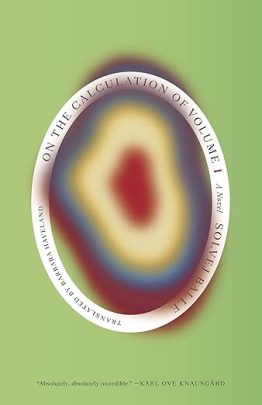
‘On the Calculation of Volume (Book 1)’ by Solvej Balle – The Groundhog Day Phenomenon


‘On the Calculation of Volume (Book 1)’ by Solvej Balle (2020) – 161 pages          Translated from the Danish by Barbara Haveland


I wondered why this somewhat clumsily titled novel had become so popular. Then I found out it was the Groundhog Day novel.

In the movie “Groundhog Day”, Bill Murray has his Groundhog Day repeat itself over and over for comedic effect. It is a movie that is difficult not to like.

In ‘Groundhog Day’, the repeats of the day are played for laughs, for comedy. In the novel ‘On the Calculation of Volume I’, Tara Selter is very serious about the many repetitions of her day.

Wife and husband Tara and Thomas Selter run their antiquarian book buying and reselling business as T & T Selter. They specialize in 18th century illustrated works. On a trip to Paris to buy more old books, Tara burns her hand on an old space heater. After that she finds to her horror that she is stuck in that same day, November 18.

…everything that was going on around me was happening exactly as it had the day before, it was a replica of the day I already had stored in my memory.”

Somehow she is able to change the pattern of that day enough so that she can return home to find that her husband Thomas is not stuck in this same day. For him and everyone else the days keep advancing as always.

There are lengthy descriptions of Tara’s thoughts on her repeating day which did not, for me, make for interesting reading.

We could discern no clear pattern and this bothered me. I wanted to find a pattern and break it but instead we discovered too many unknowns for us to comprehend the mechanics of the day. There were gray areas and unanswered questions.”

My basic problem with this phenomenon is that her husband Thomas and the rest of the world are moving on, while Tara is staying in the same day. So for Tara, Thomas is doing the same things he did on her first November 18, However Thomas himself has different events and experiences in each new day that he has. How can Thomas be in two places at the same time?

That’s what we encountered: patterns and inconsistencies, two worlds trying to merge.”

And what about season changes. How can the seasons not change for one person while the seasons change for everybody else?

It seems to me that time can only stand still for everybody or not at all. This day repeating itself for only one person makes no sense to me.

Since the whole concept of a day repeating itself over and over for only one person while the rest of the world continues to move on from new day to new day did not make sense to me, Tara’s thoughts about this phenomenon seemed pointless and tiresome, and these thoughts were almost the entire novel.

I will not be reading the other six volumes that Solvej Balle plans to publish about this repeating day of Tara Selter.


Grade:     C-


‘Eurotrash’ by Christian Kracht – A Road Trip by Christian and His Mother


‘Eurotrash’ by Christian Kracht     (2024) – 190 pages      Translated from the German by Daniel Bowles


Autofiction is fiction that blends details of the author’s own life into a story.

In ‘Eurotrash’, Christian Kracht picks up his mother from her home in Zurich, Switzerland and they travel around Switzerland, mainly by taxi. His mother is in her eighties, and although she is now living on her own with the help of a housekeeper, she had previously been committed to the Winterthur Psychiatric Hospital where she spent her eightieth birthday.

She drank from her cup and looked at me. Her eyes were the eyes of my mother and at the same time the eyes of an insane old woman.”

The Christian Kracht in the novel does not have a good opinion of his own family. His grandfather was a Nazi SS man during the Hitler reign and was unrepentant after the war. His mother had been locked up in an insane asylum. His father liked to show off to others his wealth and power.

And I wondered whether my entire family fed off the humiliation of others, whether they defined themselves through an elitism that was merely the air of a middle class wanting to ascend to the upper class, afraid of nothing more than its own proletarian background.”

If I were to choose one word to describe Christian’s attitude in ‘Eurotrash’, it would be “mordant”. He has a wry somewhat caustic view of his family and himself.

My goodness, this life, what a perfidious, sordid, miserable melodrama it was.”

And Christian also has a cynical attitude toward Switzerland itself.

This country, Switzerland that is, didn’t even exist until the English invented it at the end of the eighteenth century, she had said, until it was captured on postcards, as a panorama. as a sight, as a view…that’s when the Swiss saw how easily money could be made from their pleasant vistas, which until then they hadn’t found to be anything special, but if foreigners wanted to pay for them, why not.”

And then there is Christian’s sardonic view of the places he and his mother travel to on their road trip.

I had always hated Geneva, that dreadful, phony, ice-cold Protestant city, full of poseurs and braggarts and bean counters. Calvingrad is what we’d always called Geneva. I preferred Zurich a hundred thousand times more.”

But as the road trip progresses, a warmth develops between this son and this old woman, his mother, with all her obvious mental and physical problems.

I have had my problems reading autofiction in the past. It is not one of my favorite genres. But ‘Eurotrash’ is an exceptionally good autofiction, perhaps because its ambitions aren’t so high, just a road trip with a son and his mother.


Grade:    A


Selected Stories by John O’Hara – Slices of Life from the Not-So-Recent Past


Selected Stories by John O’Hara – 303 pages


Which renowned writers will remain read after they are gone, and which of these writers will fall by the wayside?

Version 1.0.0

John O’Hara published around 247 stories in The New Yorker from 1928 to 1967. This is still a record for the magazine. O’Hara’s stories definitely captured their era and were modern and up-to-date back then, but how do they hold up as lasting literature?

To find out what life in the United States was really like in the 1930s and the 1940s and the 1950s, the stories of John O’Hara are as good a place as any to go. His stories go way back in the Prohibition era and continue up to the Kennedy era. O’Hara was especially strong on dialogue. He captured the way people talked back then with a great amount of accuracy.

Here is an example of O’Hara’s dialogue from the story “The Moccasins”:

He walked with them to the car. “Tracy, I would like to say one thing to your sister.”

My guess is you’ve said too much already. I probably ought to punch you in the nose, if I knew what this was all about.”

You don’t, and anyway don’t try it,” said Doc. He spoke to Mary. “Just remember one thing. You don’t have to walk through moccasins for it.”

What’s he talking about?” said Jack?

Who cares?” said Mary.

In the story “The Doctor’s Son’, there is a diphtheria epidemic. The doctor goes to the various bars – Irish, Hungarian, and Polish – to treat sick patients who all come to the bar to see the doctor. Diphtheria must have been a severe communicable illness that people died from, but that wouldn’t stop the bar owner from passing a bottle around to both the sick patients and the well people at the bar to drink from. We also get the derogatory names they used for other groups of people besides themselves.

There are the mild jokes of the time:

You know that joke: we can’t afford a Ford.”

Most of these stories are ten or less pages long. That is one of the qualities I like about these stories. O’Hara just presents the scenes as are without a lot of preliminary explanation or ending summary. We go quickly in and out of these people’s situations without a lot of messing around.

John O’Hara captured American life at the time. He wrote with a great deal of verisimilitude about the way people talked and acted in his era. Is that enough? Perhaps, perhaps not.


Grade:    B+


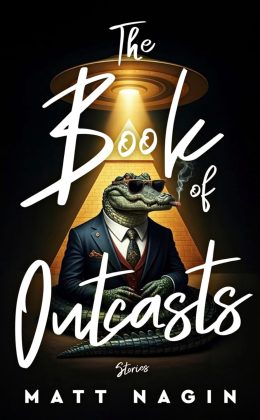
‘The Book of Outcasts’ by Matt Nagin – Wild Stories for This Demented Time


‘The Book of Outcasts’, stories by Matt Nagin   (2025) – 243 pages


Outcasts. The outcasts in these stories include a severe gambling addict, a serial wandering husband, a shopaholic, several loan deadbeats, a mommy’s boy, a failure (One story is simply entitled “The Failure”), and a pair of evil twins on the internet named Nagin.

But always look on the bright side. Even the most gruesome stories here, even the one about being eaten alive by twenty crocodiles, are told with a comical mischievous undertone. It is the direct straightforward quality of the writing that make these stories work, as well as the undercurrent of dark humor which is always there.

In the story “Valley of Darkness”, gambling addict Sam is so desperate for money that he sells his baby daughter Lucy to a Baby Pawn Shop in order to get money to gamble. At the Baby Pawn Shop, the babies are kept in cages, and if Sam doesn’t pay the money with steep interest back within six months, his baby daughter will be sold to the highest bidder. Outcasts, indeed.

In the doppelganger story, “Nagin vs. Nagin”, our “hero” justifies himself:

All would have been lost had I not broken into this house, stolen his manuscript, slept with his wife and beaten him to the punchline—a necessary evil—a matter of survival in a cruel, barbarous world. It was war. And in war a man had to do what was necessary to achieve victory!”

All of the stories in this collection are imaginative, well written and a pleasure to read. Perhaps my favorite story is “Get Your Implant”. In this story, many of the people around James are getting AI (Artificial Intelligence) implants in their brains.

Face it James. I’m a better version of myself. You’ll be one too once you get your implant.”

People who only had their lame human brains were useless and put in detention camps. James refuses to get an implant and joins Cerebral Freedom Fighters.

Why would employers hire someone without memory of everything in human history? Without the capacity to execute lightning quick decisions with perfect reliability? Without an intelligence no mortal can match? Why accept that liability? I sat there looking at my hands, feeling like an alien.”

Considering the direction things are headed now, this is an all too likely scenario. No one with an AI implant has any empathy or concern for anyone else besides themselves; in other words, Trump World.

There is a wild energy surging through these stories, and despite the desperate extreme circumstances and the characters’ outlandish frenetic actions, the stories are playful and ring true as a bell.


Grade:    A


‘Three Days in June’ by Anne Tyler – The Ex-Husband Returns


‘Three Days in June’ by Anne Tyler       (2025) – 176 pages

Anne Tyler is one of the main writers who got me attracted to fiction in the first place back in the early 1970s. After I read a couple of her novels, I went back and read everything she had written up to that point. Now, every few years, I return to one of her delightfully realistic novels, and I still get the same thrill I had gotten from them in the beginning.

As far as I know, every Anne Tyler novel takes place in Baltimore. Baltimore has become rather a mythical place for us readers where the residents are rather oddball but usually quite engaging.

How we handle day-to-day life as we go through it, with its disappointments and its pleasures, that’s all I want to know,” – Anne Tyler, a Guardian interview

In ‘Three Days in June’, the daughter of Gail Baines is getting married in a very traditional wedding after the pandemic. I’m not sure that recent weddings have returned to the traditional form. The “three days” in the title are the day before the wedding, the day of the wedding, and the day after the wedding. Each day gets one chapter.

Gail’s ex-husband Max comes up for the wedding and stays with Gail. This would be unusual except in an Anne Tyler novel. Max is one of Tyler’s typical oddball-but-likeable male characters, scruffy and hapless but good-hearted. He brings a stray animal shelter kitten with him. Max is “the kind of man who would never ever in his life knowingly harm another person”.

What is exceptional about ‘Three Days in June’ for an Anne Tyler novel is that its theme is marriage infidelity, not Max’s but Gail’s.

Why had I, who truly loved my husband – at least in the on-again-off-again, maybe-maybe-not, semi-happy way of just about any married woman – broken apart my whole world for a man I never really knew? But maybe that was just it: I hadn’t known him. There are times when that can be the strongest draw of all.”

As always, Anne Tyler brings a light touch to this story of marital unfaithfulness which is probably why she is underrated. Anne Tyler is never in her writing obscure. All of her fictional situations are as clear as a bell.

Perhaps the best style of all is no self-conscious style.


Grade:   A


‘To Save the Man’ by John Sayles – A Misguided School for Native American Students


‘To Save the Man’ by John Sayles   (2025) – 320 pages


Much of the historical novel ‘To Save the Man’ takes place at the Carlisle Indian Industrial School in Carlisle, Pennsylvania. This school actually did exist and had all Native American students from its founding in 1879 until its closing in 1918.

The student body was made up of young high school age boy and girl students from native American tribes from across the United States. Each tribe spoke their own language and were very different from each other, differences the white people did not recognize. Lakota, Pawnee, Blackfoot, Shawnee, Pueblo, Kiowa, Comanche, Ojibwe, Navajo, Apache, Sioux, Dakotah, Choctaw, Lakota, Ottawa, Potawaami, Mohawk, Oglala, Cheyenne, Arapaho.

This military-like school was founded by Captain Richard Henry Pratt. Perhaps he started out with good intentions, to assimilate these young native Americans into the dominant white society by training them. However the methods at the school were heavy-handed. The first thing they did at the school was cut the boys’ hair off so they looked more like white boys. They were made to look like white students as much as possible. The Carlisle students were punished if they spoke their native language. Captain Pratt’s motto for the school was “To save the man, we must kill the Indian”.

This novel traces the day-to-day lives of a few of these native American students at the school as they live in the dorms and attend their classes. The students are given new names to replace their tribal names. There is Antoine, Clarence, Grace, Trouble (short for Make-Trouble-in-Front), Wilma, and Lizzie.

The novel takes place in 1890 which was a momentous year in native American history. Cheated by white people out of most of their land, the tribes were forced on to reservations where they were forced to depend on the United States government for their food which usually arrived late and was of extremely poor quality. Their people were going hungry, nearly starving. Some of the white people (including L. Frank Baum who wrote ‘The Wizard of Oz’) called for “the total annihilation of the remaining Indians”.

Meanwhile, some of the tribes were practicing the Ghost Dance which they believed would reunite the living with spirits of the dead, bring back the buffalo, end white westward expansion, and bring peace, prosperity, and unity to Native American peoples.

Though we are few in number now, soon the ghosts of all our people who ever walked the earth will join us, driving before them herds of buffalo and fine horse -”

These Ghost Dances made the whites, who had most of the guns, extremely nervous.

When the Carlisle student Clarence hears that his old tribal leader Sitting Bull has been murdered by white people, he hops on a train which takes him back to his reservation at Wounded Knee. South Dakota. By the time Clarence gets there the Wounded Knee Massacre has occurred in which nearly 300 Lakota people were killed by soldiers of the United States army. Also 25 United States soldiers were killed.

Meanwhile at the Carlisle school, an epidemic of the white people’s disease scarlet fever has begun.

‘To Save the Man’ is the dramatic re-telling of these critical events in United States history – the Carlisle School, the Ghost Dances, and the Wounded Knee Massacre. I have been an admirer of the fiction of John Sayles from the beginning. John Sayles is also an excellent independent movie director of such movies as ‘The Return of the Secaucus 7’, ‘Matewan’, and ‘Lone Star’. In both his fiction and his movies, Sayles dramatizes often little-known incidents or situations in United States history.

The terrible treatment of our native American tribes is another shameful episode in United States history.


Grade:    A


‘An Awfully Big Adventure’ by Beryl Bainbridge – Stella Joins a Theater Company


‘An Awfully Big Adventure’ by Beryl Bainbridge     (1989) – 205 pages


Beryl Bainbridge writes a novel about a theater troupe. What could be better?

In ‘An Awfully Big Adventure’, fifteen year-old Stella Bradshaw gets a job working as an assistant stage manager for the Liverpool Repertory Company in 1947. This is long, long before the movement, and I’m sure if someone were to write this sex comedy with dark edges today, Stella would have to be at least eighteen.

Most authors today would portray a fifteen year old girl as a fragile innocent in this dangerous world. Instead Beryl Bainbridge refreshingly portrays our main character Stella as a fifteen year old girl who can take care of herself.

The director of the play, Meredith, knows just what happens inside these theater troupes.

Not for the first time he thought how monotonous it was, this unerring selection of inappropriate objects of desire.”

Speaking of inappropriate objects of desire, Stella falls hard in love with Meredith.

When he spoke to her she could scarcely hear what he said for the thudding of her lovesick heart and the chattering of her teeth. Often he told her she ought to wear warmer clothing.”

Stella has fallen for Meredith in a full-on crush, but she can’t figure out why he is more interested in the other stagehand Geoffrey.

While at the theater, Stella gets some first-hand explicit lessons in sex education from some of the males she comes in contact with. She also sees the sexual undercurrents which swirl through all of the people who are there at the theater. The sexual activity among and with the theater people shades this young-girl-growing-up comedy with its darker aspects.

There are also affairs between the other actors and actresses. The actress Lily says about one of these affairs:

He doesn’t want her,” squealed Lily, “because he’s got her. He’ll soon change his tune if he thought she’d lose interest. They’re all the same. You tell her from me.”

And then then there is the arrival of Irish lead actor P. L. O’Hara who is to take on the Captain Hook / Mr Darling role in their Christmas production of Peter Pan. O’Hara is a famous actor now middle-aged, a rogue known to have slept with many of the actresses of his time.

He had the audience in the palm of his hand,” he cried. How they hated him. Those flourishes, those poses, that diabolical smile…the appalling courtesy of those gestures.”

A community theater group is an ideal setting for a Beryl Bainbridge dark comedy. Bainbridge had her own experiences working in the theater, and ‘An Awfully Big Adventure’ is a fine theater novel.


Grade:   A


Deep Thoughts about our Current Human Situation


These thoughts came to me as I was reading a fascinating novel from last year, ‘The Son of Man’ by Jean-Baptiste Del Amo, which was a very thought-provoking fiction for me.

First let’s think about humans in their primitive state. Humans are omnivorous animals which means they often eat meat. Besides eating fruits and vegetables, the human males killed animals to provide food for their families. Sometimes the men had to fight other men in order to get the food they needed. Since humans are social animals, they formed tribes. The men in one tribe often fought the men in another tribe over land and hunting rights. So men were aggressive animals capable of many kinds of obtrusive behavior and misbehavior.

Human females were more closely tied to perpetuating the human race, thus were a more civilizing influence. However the women did appreciate their mates’ aggressive behavior since it provided for their family.

Later these battles between tribes escalated into wars between nations which were a frequent occurrence throughout history.

Now we will jump to 1945 which was a pivotal year in human history. That was the year the German concentration camps were fully exposed. We found out the full extent of the depravity of which human aggression was capable. That was also the year of the whole-city-destroying atomic bombs which soon led to the even more devastating hydrogen bombs.

As long as humans remembered the terrible events of World War II, they tried to curb their primitive aggressiveness to prevent World War III. For eighty years, they were largely successful.

Now today it is 2025, and World War II is a distant memory. A lot of that pent-up male aggression is coming back. Leaders like Vladimir Putin and Donald Trump are aggressive in their behavior and their misbehavior, and many of the people in their countries admire them for that. This aggressiveness is likely to lead to another major war, but we now have faint memories of that last major war.


‘The Rest is Memory’ by Lily Tuck – The Nazi Murder of Catholics in Poland during World War II


‘The Rest is Memory’ by Lily Tuck    (2025) – 116 pages


In ‘The Rest is Memory’, author Lily Tuck focuses on an aspect of the Holocaust that hasn’t gotten as much attention as it should, the German Nazi murder of Catholics in Poland during World War II. It is estimated that the Germans killed between 1.8 and 1.9 million non-Jewish Polish civilians during World War II.

In October 1940, Poland was divided between Russia and Germany.

The concept of Poland, Hitler announced, would be erased from the human mind.”

Hitler in a speech said, “our strength lies in our speed and our brutality…Poland will be depopulated and settled with Germans.”

The novella ‘The Rest is Memory’ focuses on just one of the victims, a fourteen year-old girl named Czeslawa Kwoka who was murdered by the German Nazis in Auschwitz.

One of the other prisoners at Auschwitz was ordered to take pictures of the other inmates. He took more than 40,000 photographs of the men, women, and children interned at Auschwitz. One of the pictures he took was of 14 year-old Czeslawa Kwoka which is on the cover of ‘The Rest is Memory’.

She loves to play jacks and she is good at it. She can pick up all ten jacks at once. The trick is to throw the ball up high to have enough time.”

Before Czeslawa and her mother were arrested, Czeslawa’s father and other men from the village have already been rounded up and shot and buried by German soldiers in Roztocze Forest.

When they arrive at Auschwitz, one of the first things the guards do is chop off all of their hair.

“My hair was blond,” Czeslawa tells Krystyna. “A golden blond, my mother called it. It came down nearly to my waist.”

The behavior of the guards at Auschwitz goes beyond just bad into the sadistic and sick. Primo Levi described the Auschwitz Commandant Rudolf Hoss as “a coarse, stupid, arrogant, long-winded scoundrel, who sometimes blatantly lies”.

There is no doubt how ‘The Rest is Memory’ will end.

Curiously, on March 12, 1943, the day Czeslawa is put to death, just as it had on the day she arrived on December 13, 1942, it begins to snow at Auschwitz.”

And now, in 2025, we have a new wave of fascism sweeping across the world. Considering what happened in Poland over eighty years ago, the Catholic Church and all Catholic church members should be in the forefront of the fight against this new wave of fascism.


Grade:   A


‘Dear Dickhead’ by Virginie Despentes – A Provocative Raunchy Dialogue by Email


‘Dear Dickhead’ by Virginie Despentes (2022) – 292 pages       Translated from the French by Frank Wynne


As I was looking for more fiction translated by Frank Wynne, I came across ‘Dear Dickhead’. Since one of the things I like about Frank Wynne is that he seems to pick books to translate that are off the well-beaten path of modern fiction, I decided to read ‘Dear Dickhead’. This could be interesting.

This novel is written as a modern email exchange between Oscar and Rebecca. Rebecca occasionally starts her email to him with ‘Dear Dickhead’ and it is not always used affectionately.

Tell your sister I googled her name but couldn’t find anything. I’m guessing she’s married and she’s changed her name. Give her my love. As for you drop dead.”

Oscar is a writer who got singled out for accusations by Zoe, a woman they both know.

I am the focus of hatred for half the population of the country.”

Occasionally in the novel we also get an email from Zoe.

When Oscar commiserates with Rebecca about his problems, she is not always sympathetic.

You’ve had a string of scandals – take me, for example, now I don’t really care, but how many times have you humiliated me in public, talking about my amazing tits? That kind of thing doesn’t cut it anymore.”

However Rebecca does offer some helpful advice to Oscar.

The correlation between men’s alcohol consumption and their being assholes is underestimated.”

Oscar laments how things have changed.

We assumed that women were happy. I grew up in a world where it seemed that turning a guy on was the best thing that could happen to a woman.”

Oscar expresses his problem with the dating world.

Long story short, the women I find attractive are the ones who don’t want anything to do with me.”

Women do come up for criticism too. After his sister Corinne tells Oscar that she dates girls, he says:

I know what girls are like. They’re ruthless when it comes to losers. And back then being a lesbian was worse than being a loser – lesbians had no right to exist. In the cage fight of traditional femininity, she couldn’t even get her gloves on.”

Rebecca’s verdict:

Obviously you don’t fall in love with someone just because they’re a particular gender. You fall in love, period.”

That verdict may be a little too far out for me.

Besides the discussion of the male/female predicament, large parts of ‘Dear Dickhead’ are about drug use and quitting drugs and Narcotics Anonymous. Having little use for drugs (except alcohol) myself, I was less interested in the parts of the novel relating to their experiences with cocaine, crack, heroin, etc.

While ‘Dear Dickhead’ was discussing the modern sex situation it seemed quite interesting and insightful.


Grade:    B


‘Morning and Evening’ by John Fosse – The Beginning and the Ending of the Life of Johannes


‘Morning and Evening’ by John Fosse  (2000) 107 pages                  Translated from the Norwegian by Damion Searls


This short novella has only two chapters. One depicts the birth of the Norwegian fisherman Johannes, and the other depicts the death of Johannes as an old man.

“More hot water, Olai.”

First we have his father Olai waiting in the kitchen as the midwife Anna helps Olai’s wife Erna deliver the newborn baby Johannes in the bedroom.

Whenever the author Jon Fosse writes about what one of his characters is thinking inside their head, Fosse doesn’t stop for periods in his writing. Our thoughts pile in on top of each other without stop. That is why they call it a stream of consciousness, the thoughts keep flowing non-stop. But when Fosse writes scenes of characters interacting, Fosse’s writing takes a more traditional form.

As expectant fathers are, especially those from Olai’s time eighty years ago, he is tense about the outcome of the birth.

The birthing is successful, and Olai gets the baby boy he wanted, Johannes. Anna the midwife says “Yes, he has taken his place in life now.”

After this first birth chapter, Fosse, in this short novella, immediately switches to the final day in the life of Johannes.

The old man Johannes wakes up one morning feeling lighter than usual. He walks down to the bay and meets his old fishing partner Peter who has been dead for several years.

“There’s Peter standing right in front of him now, alive, but isn’t Peter dead? didn’t Peter die a long time ago, didn’t he?”

Later, as Johannes is walking back to his house, he passes his youngest daughter Signe on the road.

Signe, Signe, don’t you see me, he says, and Johannes is seized with deep despair, because Signe cannot see him.

Signe, Signe, Johannes says.”

When Johannes finally has Signes’ attention, Signe responds.

Signe says

You too, you hung on for so long, you were so tough, but even you had to, she says.

Father, father, father, she says.

Poor old father, Johannes, she says.”

By focusing only on the birth and the death of Johannes and avoiding all the complicated stuff in between, Jon Fosse has created a poignant little novella. It probably would also have worked well as a play, except for the problems of actors portraying a newborn and a dead person.


Grade:    A


‘Stone Yard Devotional’ by Charlotte Wood – An Atheist Woman Living in a Catholic Convent in Australia


‘Stone Yard Devotional’ by Charlotte Wood    (2023)      293 pages


We never find out what specific events in her life drove this unnamed atheist woman to seek refuge in a Catholic convent for nuns in the Australian outback.

You do not announce on Facebook that you, an atheist, are leaving your job and your home and your husband to join a cloistered religious community. I mean you could, and it might be a better way than I chose which was not to announce anything to anyone. People were wounded. Very wounded.”

The convent she chose was near where she grew up as a child. ‘Stone Yard Devotional’ is written as a diary of the time when this unnamed woman spent in the religious retreat. At the beginning she certainly is skeptical of Catholicism and mentions the some 9,000 children who died in Ireland’s church run homes for unwed mothers.

Annette may be right about the unnaturalness of our living here in the way we do.

But then, I reflect, there’s probably something sick about the way most people live.”

During her time at this convent, there are three major visitations. The first is a huge mouse infestation. The nuns trap and poison the mice, but the mice just keep multiplying and get into their food and bedding.

A dreadful discovery: birds are eating the poisoned mice. We have found five dead magpies and a southern boobook (must be an Australian bird)”

The second visitation is that of the dead Sister Jenny whose bones are only now being returned after she was murdered in Thailand several years ago.

The bones of Sister Jenny are accompanied by Sister Helen Parry, the third visitation, who grew up and attended high school with our diarist. Sister Helen was an outcast in high school but is now known as a strong advocate in the Church. Our diarist was one of the many students who shunned and treated Helen poorly in high school. Now, as an adult, Helen has learned to get by fine without others’ approval and therefore is powerful.

Because of those high school days, our diarist has a sense of guilt. Sometimes it is much less difficult to forgive someone else for some perceived wrong they have done to you than it is to forgive yourself for some wrong you have done to someone else.

I’m not praying for her forgiveness,” she said. “I’m trying to find a shred of it in myself.”

An issue with the diary form is that it may seem like the diarist is only writing for her own benefit rather than for an audience. I did have that problem somewhat here when a scene was being related but I had lost attention several sentences ago.

Somehow I think that women will relate more to this woman’s story than will men. For one thing, there is only one male character who is rather peripheral.

But ‘Stone Yard Devotional’ does deal with some important issues including self forgiveness, and the novel presents them well.


Grade:    B+


‘Kairos’ by Jenny Erpenbeck – Ecstasy and Misery in East Berlin


‘Kairos’ by Jenny Erpenbeck    (2021) – 294 pages                                Translated from the German by Michael Hoffman


Hans and Katharina – their eyes meet on a bus in East Berlin in 1986, and they fall in love.

They were both on the 57 bus at exactly the right moment.”

Katharina is 19, and Hans, a somewhat famous writer, is 53 and married with a family. What could possibly go wrong? Her mother and her friends are skeptical, but Katharina is entirely swept off her feet. Hans’ wife Ingrid is busy with their son Ludwig, so Hans and Katharina have plenty of opportunities to be together and sleep together.

Despite nearly everyone’s doubts about this May-December relationship, for the first half of ‘Kairos’ the love affair between Hans and Katharina seems idyllic.

But reality intrudes eventually, and this idyll comes upon some very rough times. As ecstatic as the first half of the novel is, the misery of the second half exceeds the ecstasy.

There are times when Hans is busy nearly all the time with his wife and son, so Katharina spends more time at the theatre where she now works. There is a young man named Vadim who has shown some interest in her. They gradually get closer and they have sex one time.

Later Hans discovers a scrap of paper buried on her desk which she wrote describing the feeling she had when Vadim kissed her breasts for the first time. After he reads the note, Hans will never forgive her, calls her a whore. But Katharina hangs on desperately to what was once their love. She allows Hans to use her in sadomasochistic ways (“Yes, she wants him to hit her.”), but he will still not forgive her for that one night. Hans records his thoughts about her on a cassette several times.

You deserve to go to hell for tossing our miracle in the shit.”

The backdrops for this less than idyllic romance are the final years of East Germany, the fall of the Berlin Wall, and the reunification with West Germany. There are many tidbits about German history, especially music and philosophy, that I found quite interesting but were ultimately overshadowed by the intense personal suffering.

As a reader, I felt that ‘Kairos’ could have been shortened to good effect. Both the ecstasy and the agony seemed to drag on for too many pages. Too many scenes between Hans and Katharina seemed repetitive.


Grade:    B


‘Road Ends’ by Mary Lawson – Even the Family of a Bank Manager can be Dysfunctional


‘Road Ends’ by Mary Lawson       (2013) –  311 pages


Well, I finally did it, and I’m very happy that I did. I have now read all four of the consequential novels written by Canadian/English author Mary Lawson.

Although Lawson has lived in England a long time, all of her novels take place in Canada, her childhood home. The Cartwright family of ‘Road Ends’ live in the small town of Struan in northern Ontario, but the daughter Megan does move to London, England where much of the novel does take place.

Megan is the glue that holds the large family in Canada together. When Megan decides to begin a life of her own in London, her Cartwright family falls apart. Megan makes an outstanding success of herself in London, but she still gets worrisome reports from back home.

Megan gets a letter from her father saying that her mother Emily is expecting another baby.

Her mother wouldn’t be able to cope. The place would be utter chaos.”

After the birth of her eighth baby, mother Emily’s only interest is the newborn baby, and she neglects everything and everyone else. Four year-old Adam must fend for himself.

Edward, the father, a successful bank manager, is rather a cold fish at home.  Usually he is immersed in his own reading and tries to avoid disturbances from his large family. When a neighbor tells the oldest son Tom who lives at home how helpful Edward was at the bank, Tom muses,

Dr. Jeckyl and Mr. Hyde, Tom thought bitterly. Maybe he should make an appointment to see his father at the bank. That way he might get ten minutes of his time.”

Son Tom has his own problems which prevent him from helping his family much. His best friend has committed suicide after a drunk driving incident killed a young girl. Maintaining one’s sense of well-being when faced with the vicissitudes of every day life is more difficult than one would think. However at home when Tom sees his little brother Adam wandering around the house going hungry, Tom does open a can of beans for him.

Here is a novel that can make the everyday life in a small town seem dramatic, important, and meaningful. There are not many authors who can write a long vivid novel that maintains one’s total interest and enthusiasm throughout. Mary Lawson has now written four of them.


Grade :    A


‘Animalia’ by Jean-Baptiste Del Amo – Messy Life and Unpleasant Truths on a French Pig Farm


‘Animalia’ by Jean-Baptiste Del Amo      (2016) – 371 pages              Translated from the French by Frank Wynne


‘Son of Man’ by Jean-Baptiste Del Amo was my best read of 2024. His novel ‘Animalia’ is even better. This is a profound well-written novel to read if you can stand the disgusting truth.

Before getting into my review, I want to give you a bit of my background which fits quite closely with this novel. I was born on a dairy farm in Wisconsin where we also kept pigs and chickens.

My mother was the one who chopped off the heads of chickens which we ate for our dinners. She had a real talent for it; she never missed with the axe. After its head was cut off, the chicken would go flying around for a minute or so. As a kid, I could barely stand to watch this. Later I never attempted to chop the head off of a chicken myself, but I ate and still eat a fair amount of chicken. Somebody has to raise them and slaughter them. I figured out quite early on that wasn’t me, and I was no farmer.

‘Animalia’ takes place on a pig farm in southwestern France. Although the setting is rural, ‘Animalia’ is no pastoral. Pigs are birthed, fed, and raised only to be slaughtered in their prime. And the conditions are disgustingly messy. Jean-Baptiste Del Amo captures this all in its revulsion.

But I suspect that Del Amo, like me, is not a vegetarian. The nature of humans is to eat meat.

If in Animalia the humans behave no better than animals, it is because basically we are animals.” – Ian Sansom, The Guardian

The story in ‘Animalia’ is divided into two time frames. The first are the years before and during World War I from 1898 and 1917. These are the early years of the family pig farm in which the mother of the young girl Éléonore runs the pig farm and their family with an iron hand. The father has some illness and doesn’t help out very much. Even back in those early days the raising and slaughtering of pigs was disgusting enough. When a sow gives birth to a litter, the runts in the litter must be weeded out and disposed. With the father disabled, the mother brings in Éléonore’s cousin Marcel to help on the farm. Éléonore falls in love with him, the one positive thing in her life.

The second time frame is over sixty years later, the year 1981. Éléonore is still on the pig farm, an old woman. Her sons have transformed the family pig farm into an industrial pig farm. At least on the family pig farm, the pigs could run around and make their messes outside. On the industrial farm the pigs are locked up in small pens inside, so they can’t run around and lose valuable weight. This does cause grossly unsanitary conditions inside, and the stench is nearly unbearable.

Occasionally Joël wonders whether it was the piggery that made monsters of them, or their monstrousness that infected the farm.”

Although, as I said, ‘Animalia’ deals with some quite disgusting truths about pigs as well as the human animals, the writing by Jean-Baptiste Del Amo is impressive and profound throughout. This is a deeply felt, deeply imagined novel. ‘Animalia’ recalled for me the ugly naturalism of Emile Zola in Zola’s coal mining novel ‘Germinal’. For me, Del Amo sometimes surpasses Zola in depth.

‘Animalia’ is a novel that can stand proudly up there with the classics of literature.


Grade:    A


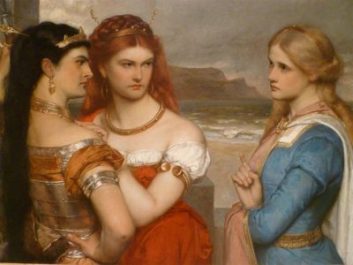
Re-Reading King Lear – The Three Daughters


‘King Lear’ by William Shakespeare            (1606) 


I had read ‘King Lear’ a long time ago. I still remembered the main plot, the old King Lear dividing up his kingdom between his daughters. He asks his three daughters which of them loves him most. His two older daughters, Goneril and Regan, flatter him with outpourings of great love for him while his youngest daughter Cordelia says nothing out of the ordinary. Lear gets angry with Cordelia and takes away the portion of the kingdom he was going to give her and splits it up between the two older daughters. Then trouble ensues.

As flies to wanton boys are we to th’ gods; they kill us for wanton sport.”

Soon after his two eldest daughters receive their inheritance, their kingdoms, they both cast King Lear out into the stormy night. King Lear’s Fool goes with him.

Fool: This stormy night will turn us all to fools and madmen.”

The method I used this time for King Lear was to first read the play using the Folger Shakespeare library version which has an explanation or elaboration accompanying nearly every line of the play. Once again I realized that I would require all of these notes to fully understand the various facets of the play. Then, after I had thoroughly read the play with all of the notes, I was able to listen to the entire play on audio and enjoy it.

Soon into my effort, I realized that the first time around I had almost totally missed the subplot involving the bastard son Edmund of Gloucester who is one of the main villains in the play along with Goneril and Regan. Thus I paid special attention to the Edmund story this time around. Somehow it almost seems that Shakespeare blames Gloucester’s fooling around and having an illegitimate son for Edmund’s misbehavior. Apparently Edmund is quite good looking, since both Goneril and Regan want to take Edmund as their lover, much to the displeasure of their husbands.

As in all of Shakespeare’s tragedies, good does not triumph in the end as both King Lear and his good daughter Cordelia wind up dead.

After closely studying both ‘Hamlet’ and ‘King Lear’, which do I prefer? Of the two plays, I prefer ‘Hamlet’. ‘Hamlet’ has the two characters, Polonius and Hamlet himself, who are capable of deep thought and thus have more insight into the terrible things that are happening around them. In ‘King Lear’ whatever wisdom there is comes from either fools or madmen. Granted that, although mixed in with both the Fool’s clever banter and the madmen’s ravings, there are deep truths; it is sometimes difficult to tell which is which.

I suppose ‘King Lear’ could be read as a cautionary tale. Don’t divide up your fortune between your heirs while you are still around.