Archive for the ‘Book Reviews’ Category

‘Going to Meet the Man’ by James Baldwin – A Fearless Artist


‘Going to Meet the Man’, stories by James Baldwin (1965) – 249 pages


I wanted to read more James Baldwin, and I had read a lot of good things about his collection of stories, ‘Going to Meet the Man’. It did not disappoint.

These are deep stories with an acute and often angry understanding of the predicaments of his characters. One theme in each of these powerful stories is our refusal to really know other humans and to accept our differences.

The subjects of these eight stories are wide-ranging, and whatever the subject that James Baldwin takes on, he approaches it with an insightful humane intelligence.

It’s always been like that, people always try to destroy what they don’t understand – and they hate almost everything because they understand so little.”

The early story ‘The Outing’ is about a church outing when the members of the church and a few others take a boat trip up to Bear Mountain where they would spend the day. Since it is a church outing the pastor Father James preaches to those who came along.  Johnnie, the son of the Deacon of the church, is attracted to his male friend David. David is more interested in the girl Sylvia who is an upstanding member of the church than in Johnnie. Neither Johnnie nor David has committed to the church, thus they are both unsaved. Can this almighty God forgive Johnnie’s “sin”?

I found this story to be powerful and caused me to eagerly read the following stories.

These lines from the story “Previous Condition” resonated with me:

Acting’s a rough life, even if you’re white. I’m not tall and I’m not good looking and I can’t sing or dance, and I’m not white; so even at the best of times I wasn’t in much demand.”

Many of the stories confront the racial prejudice which the characters must contend with, being a black person in the United States. There is justifiable anger in the shabby and sometimes much worse treatment these characters face every day. However in the story “This Morning, This Evening, So Soon”, our main protagonist escapes to Paris where racial attitudes are different.
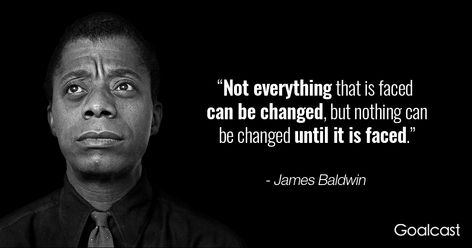
 

In “Sonny’s Blues”, one man finds his escape through music:

For, while the tale of how we suffer, and how we are delighted, and how we may triumph is never new, it always must be heard. There isn’t any other tale to tell, it’s the only light we’ve got in all this darkness.”

‘Going to Meet the Man’ finishes with the devastating title story depicting the lynching of a black man in a small southern US town, told from the harsh view of the white deputy sheriff who is overseeing the proceedings.

There has been a James Baldwin revival lately, and the compelling stories in ‘Going To Meet the Man’ are strong examples of his eloquent insight into daily life.


Grade:    A
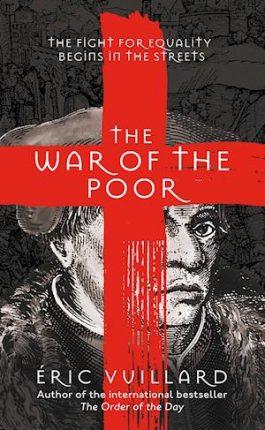


‘The War of the Poor’ by Eric Vuillard – “You cannot serve both God and Money.”


‘The War of the Poor’ by Eric Vuillard   (2019) – 79 pages               Translated from the French by Mark Polizzotti


When someone writes a book propping up the kings, queens, and aristocracy of the past, we call that history. However if someone attempts to explain a major peasants’ revolt that occurred in the 16th century, then do we call that fiction? The German Peasants’ War of 1524 and 1525 was Europe’s largest and most widespread popular uprising prior to the French Revolution of 1789.

The German Peasants’ War was a revolt against both the aristocracy and the Catholic Church which through its doctrine and practices bolstered the aristocracy. The religious leader of this revolt was the German preacher and theologian Thomas Müntzer.

Why the God of the poor was so strangely always on the side of the rich, always with the rich. Why his words about giving up everything issued from the mouths of those who had taken everything.”

At first the Protestant reformer Martin Luther supported Müntzer, but when Müntzer’s sermons started to inflame the peasants into revolt Luther turned against him.

The Catholic Church services in the Middle Ages were in Latin which very few people in Europe could understand, and the Bible, untranslated, was also in Latin. In ‘The War of the Poor’ author Vuillard traces reformers like John Wycliffe who translated the Bible into English.

And as the icing on the cake, his most terrifying idea of all, he (Wycliffe) preached the equality of all human beings.”

Martin Luther translated the Bible into German.

When the sermons and the Bible became things ordinary people could understand, then religion became more personal and thus more susceptible to logic. The poor began to question the King’s and the Church’s authority over their wretched lives.

There are no fictional characters or events in ‘The War of the Poor’. Here is an example of why ‘The War of the Poor’ would be treated as fiction:

Thomas Müntzer must have blazed white-hot during those days. He must have gone off like a firecracker, bellowed his faith and brought to bear misery, rage, despair, and hope.”

This kind of colorful zippy conjecture would never do in the staid non-fiction world.

This book is a scant 79 pages. What there is of it is very good. I wish there were more. I would like to see a fuller depiction of the life of Thomas Müntzer. He seems to be a fascinating pivotal figure in European religious and social history.


Grade:    A-


In Praise of the Negative Review, but Only if It is Honest


Today nearly every newly published book is sent off on its bright cheery way with its glowing encomiums on the back cover and sometimes even on the front cover. The readers are already aware of the book’s existence through various on-line lists of What To Read This Month.

Then we get the warm-hearted reviews who first point out all the wonderful aspects of this book and perhaps add some quite mild criticisms near the end of the article. Most of us surfeited users of the Internet will never get to that end of an article anyway.

Thus the minds of we readers are filled to overflowing with Books to Read, yet we are given next to no guidance as to Books to Not Read.

When every book is marketed and discussed as the next ‘Pride and Prejudice’ or the next ‘War and Peace’, it really becomes difficult for a potential reader to separate the wheat from the chaff.

In the olden days thirty years ago, there were curmudgeonly critics who were known not to like much of anything. Their negative sometimes nasty reviews would be fun to read if only to imagine their impact in spoiling the hopes and dreams of the books’ publishers. Since these, usually guys, didn’t like much of anything or only one narrow favorite genre of book, these curmudgeons weren’t very helpful for the readers either.

I guess what it comes down to is that if a reviewer likes everything, then it’s about the same as not liking anything, not very helpful. An occasional negative review would restore some balance.

Most of the books I don’t particularly like, I give up on and quit reading and I won’t ever review a book I haven’t entirely read, so the majority of books I complete get positive reviews. However there are still degrees of liking which is why I use an ABC rating. Unfortunately publishers seem to feel that a grade of B is a death-knell for a book.

Basically my opinion has nothing to do with the actual quality of a book, but I am still entitled to my opinion.

Of course if you or I write a negative review, there is a chance we could be wrong, God forbid. Imagine some poor fool of a reviewer criticizing and tearing apart ‘Pride and Prejudice’ over 200 years ago.

But there’s nothing wrong with sticking one’s neck out once in awhile either.

‘Disgraced’ by Ayad Akhtar – A Devastating Play


‘Disgraced’, a play by Ayad Akhtar  (2012) – 96 pages


‘Disgraced’ has probably had the most stage productions of any play in the last ten years. It is about time that I got to it. In the absence of any live performances these days, I read the play which also works for me. Most of my experiences with Shakespeare have been through reading.

The words and the actions of ‘Disgraced’ are as clear as a bell. There is no mistaking their import. There is no attempt to soften the play’s devastating impact on the audience.

Here are words of the author, Ayad Akhtar, regarding ‘Disgraced’:

I aspired to accomplish with this structure a kind of shattering of the audience, after which they have to find some way to put themselves back together.”

The play is one act, four scenes. All scenes take place in the fashionable New York apartment of married couple Amir and Emily. Amir is an American-born corporate attorney who has renounced his Muslim background and is awaiting his promotion to partner in his law firm. His wife Emily is a white Christian and an artist who is fascinated with Islamic art and tradition. I won’t go into the details of the play since I don’t want to blunt its force on those who have not seen it yet, but let’s just say the play is about the severe trials and tribulations of this well-to-do couple in the United States of today.

The play’s sharp brutal directness is probably responsible for the overwhelming success of ‘Disgraced’. Ayad Akhtar speaks of his play as “something that is so troubling, so multivalent, that the people in the audience cannot easily answer or release the questions that the piece has raised for them.”

Ayad Akhtar, again:

I want the audience to be so fully identified with a protagonist who acts out in an understandable but tragically horrifying way, that no matter what text you put on top of it, it doesn’t change his humanity.”

Despite some spirited criticism from some Muslim viewers of the play, I would still recommend you see or read the play in order to draw your own conclusions.


Grade:   A



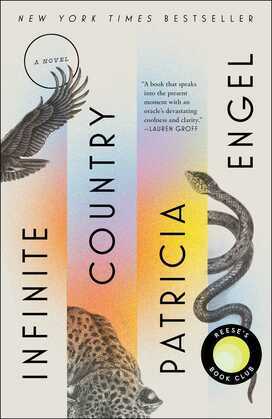
‘Infinite Country’ by Patricia Engel – A Family Trapped between the United States and Colombia


‘Infinite Country’ by Patricia Engel  (2021) – 191 pages


‘Infinite Country’ is a novel of a family from Colombia coming to the United States to make a new life for themselves. Over the years there have been many novels of families immigrating to the United States, and these books have usually been upbeat, optimistic, and hopeful. However ‘Infinite Country’ is a tragic story about a family torn apart by United States harsh attitudes and cruel policies. This family would have been much better off staying in Bogota despite Colombia’s ongoing problems. Colombia is troubled, but the United States may be even more troubled.

Last year I read Phil Klay’s ‘Missionaries’ about the disastrous effects of the United States inserting itself into the Colombian situation. Patricia Engel does not cover that part of the story but instead paints a vivid picture of a family trapped between Colombia and the United States.

When you get to the United States, nobody will understand you. I don’t mean just the language. It’s a country of strangers. It will be another kind of sentence. But one that as an immigrant you can’t escape.”

Colombians Mauro and Elena have three children named Karina, Nando, and Talia. Nando and Talia were born in the United States and are thus United States citizens. The father Mauro gets kicked out of the United States and cannot return. Elena decides to send her youngest Talia, a toddler, back to Colombia.

Now Talia is 15, and she gets into trouble. Talia is sentenced to a religious reform school after pouring a pot of hot cooking oil on the head of a guy who had used that same hot cooking oil to scald and murder a stray cat.

Bogota, Colombia

Talia escapes from the reform school and goes on the run, trying to get to Bogota and her father so she can catch a flight to the United States and her mother and the rest of her family. She has the following dialogue with Aguja who is a young guy who gives her a ride on his motorcycle.

I have a flight to catch.”

Where to?”

The United States.”

Why?”

My mother lives there with my brother and sister. They’re waiting for me.”

Aren’t you afraid?”

Of what?”

Over there people walk into schools and buildings with weapons and kill everyone. They are not even guerrilla or paramilitary. Just regular people. What are you going to do when you’re out shopping and some gringo points a machine gun at your forehead?”

I don’t think it’s any worse than here. Just different.”

‘Infinite Country’ is the intense story of one family’s plight stuck between two nations, told in short sharp sentences.


Grade:    B+

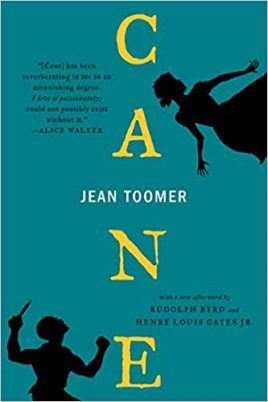
‘Cane’ by Jean Toomer – The Devil was Already in Georgia

‘Cane’ by Jean Toomer   (1923) – 160 pages


‘Cane’ stunned me. It contains scenes which are so real that they never make it into fiction. ‘Cane’ surveys the hard and dangerous lives of the people of this Georgia neighborhood in the 1920s without getting sentimental. Thus the writing comes across as authentic and honest.

A young man from the North is visiting a black neighborhood in the South in Georgia. There are poems scattered among the stories, but all of the writing, even the prose, has a slow rhythmic cadence. The writing here is so atmospheric and compelling, you must read these stories and poems slowly to capture their full resonance. In his own words, Jean Toomer is “shapin words t fit m soul.”

In the first section of ‘Cane’, the stories depict the lives of six women, five of them black and one of them white, all of them doomed. The stories each are titled by the woman depicted – Karintha, Becky, Carma, Fern, Esther, and Louisa. Actually the story about Louisa is called “Blood-Burning Moon” and is probably Jean Toomer’s most famous story. You will never read anything more intense than the eleven pages of this story.

Men are apt to idolize or fear that which they cannot understand, especially if it be a woman.”

In each of these stories, there is a contrast between the loveliness of the natural surroundings and the ugliness of the plights that these people must contend with.

God Almighty, dear God, dear Jesus, do not torture me with beauty. Take it away. Give me an ugly world…There is a radiant beauty in the night that touches…and tortures me.”

In the final section we get the long story ‘Kabnis’ which tells directly of this young man who has traveled South to teach but must confront the horrors of rural Georgia. This story comes directly from Jean Toomer’s own experiences.

His friends remind Kabnis what he’s gotten himself into. The “land of cotton” has a legacy of slavery, and not much has changed since then. Black people are targeted just for being black. Danger is always present. His friends keep quiet about racial atrocities so they don’t become the next victims themselves. Asking too many questions is dangerous. By the end of the story, Kabnis is physically scared of getting lynched himself.

Throughout ‘Cane’, the atmosphere recalls the eerie silence in which the black community is forced to live, keeping quiet about lynchings and threats.


Grade:   A


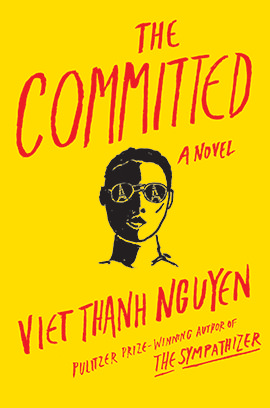
‘The Committed’ by Viet Thanh Nguyen – The Sympathizer in Paris

‘The Committed’ by Viet Thanh Nguyen (2021) – 345 pages

It doesn’t happen very often. With his first audacious novel in 2015, Viet Thanh Nguyen immediately rose to the very top echelon of United States fiction writers. It told the story of the Vietnam War from the perspective of a fictional Vietnamese double agent known as the Sympathizer whose viewpoint we in the United States had not encountered before. Then following that success, in 2017 Nguyen published ‘The Refugees’, a powerful collection of stories about a few of the over 600,000 Vietnamese people that had to be evacuated from Vietnam after the United States lost the war.

Now we have ‘The Committed’. After having spent some time in the United States after having been evacuated there, the Sympathizer returned to Vietnam where he was immediately sentenced to a harsh re-education camp. Now it is the early 1980s, and he has wound up in Paris. There were quite a number of Vietnamese people who came to Paris back in French colonial times.

He decides to become a capitalist; in other words he is dealing drugs to left-wing intellectuals in Paris. He becomes a gangster, a capitalist gangster.

As he wanders the streets of Paris selling drugs, he is disguised as a Japanese tourist with a camera because no one cares about or notices a Japanese guy taking pictures. He is haunted by the ghosts of the two men he has killed, Sonny and the crapulent major.

Wherever he goes, the Sympathizer is “the most cynical person in the room”. As most of us true cynics are, he is most cynical of his own motives.

Being conversant with the writings of the famed French theorists, he enjoys contrasting their high ideals with the brutal conditions many of the people in French Indochina had to contend with under French colonial rule. Here he replies to Rousseau:

“Thank you, Jean-Jacques!…I learned to love confessing and have never stopped acknowledging my crimes of violence, torture, and betrayal, all of which our French masters had taught us through the violence and torture they had inflicted on us as they betrayed their own ideals.”

His scathing insights all developed from his early years living in Vietnam. For an engraving on a proposed statue of Ho Chi Minh, he suggests the following:

“Now that we are the powerful, we don’t need the French or the Americans to fuck us over. We can fuck ourselves just fine.”

If you like to have everything that you believe in confronted by hard logic, you will definitely like ‘The Committed’.

“I am through with your Western philosophies and beliefs and ideas and systems! Your Catholicism! Your colonialism! Your capitalism! Your Marxism! Your communism! Your nihilism too! I am not a nihilist, for I believe in something – I believe nothing is sacred! Life is full of meaning! And I am full of principles!”

‘The Committed’ is a novel of compelling ideas. It is a wicked political novel disguised as a humorous crime story.

“When it comes to crime stories, I think any crime writer who’s any good understands that the individual crimes are nowhere near as serious as the crimes of the state and crimes of corporations and crimes of the powerful,” Viet Thanh Nguyen said in an interview.

Every group of people throughout history has at some point committed atrocities against other groups of people. Perhaps, instead of recognizing our common humanity, we could be recognizing our common inhumanity. This is one of Viet Thanh Nguyen’s main points, and the more that I consider it, the more this point seems to be valid.

Grade :   A

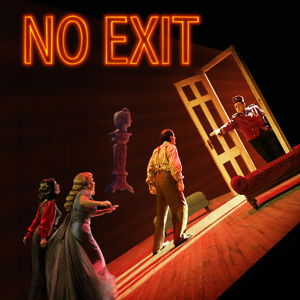
‘No Exit’ – Enjoying Jean-Paul Sartre

‘No Exit’, a play by Jean-Paul Sartre (1946) – 46 pages

Are you intimidated by Jean-Paul Sartre? I used to be terribly intimidated by this French philosopher, playwright, novelist, screenwriter, political activist, biographer, and literary critic Jean-Paul Sartre, the only person ever to turn down the Nobel Prize in Literature. I remember a long time ago trying to figure out what existentialism is. I never did figure it out, but the Ortega y Gasset sentence ‘I am myself plus my circumstances’ pretty well sums it up for me. I knew that Sartre was also a novelist, but although I was reading every other famous and deep novelist, I was too intimidated by Sartre. I figured his fiction would be way too abstract and metaphysical for me.

However when I finally did turn to Sartre’s fiction in the early 1990s, I got a pleasant surprise. His fiction was very easy to follow and was entirely engaging for me. I read the first novel ‘The Age of Reason’ of his ‘Roads to Freedom’ trilogy and was so captivated that I immediately read the other two novels ‘The Reprieve’ and ‘Troubled Sleep’. Later I would read his excellent short novel ‘Nausea’.

Never mind his philosophy; Jean-Paul Sartre wrote great fiction.

‘No Exit’ is the first play of Sartre’s that I have read. After reading the play. I watched two separate performances of the play including the 1962 movie.

‘No Exit’ takes place in Hell. In the play, Hell is a sitting room with three sofas. One man and two women know that they have arrived in Hell. They don’t know each other, but together they try to figure out what they each did while they were alive that got them sentenced to Hell. Since this is Hell, they wonder when the torturer will arrive, but the torturer never shows up. However sitting around and talking about their past lives, they get on each other’s nerves and they wind up yelling and screaming at each other. They finally figure out that they are each other’s torturers, and the play ends with the famous line “Hell is other people”.

After discovering Jean-Paul Sartre, I went on to read some of the fiction of his wife Simone de Beauvoir who was also a mighty fine novelist. Two of her works I can recommend are ‘The Mandarins’ and especially ‘When Things of the Spirit Come First’.


Grade:    A


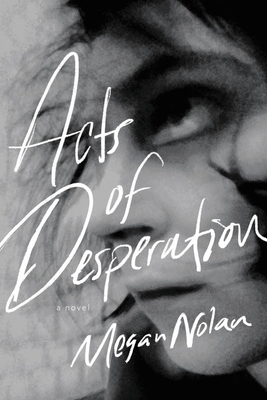
‘Acts of Desperation’ by Megan Nolan – Looking Back at Her Affair Seven Years Later

‘Acts of Desperation’ by Megan Nolan (2021) – 279 pages

‘Acts of Desperation’ is not a novel that you read for pleasure. It is a sad disturbing read. However its mercifully short chapters keep you reading. One hopes, for the author’s sake, this is not autofiction.

Ciaran was the first extremely good looking guy our unnamed first-person female narrator has dated.

“It was a strange experience for me going out with someone so objectively attractive. In public, I was split between taking childish pleasure in it and feeling terrified that people looked at us and were puzzled by the discrepancy.”

However Ciaran, handsome as he is, is a cold fish. All of her friends secretly or not-so-secretly hated him and thought he was bad for her. That should have been the tip-off for her not to get involved with him. However she likes the idea of this attractive guy as her boyfriend. Also Ciaran is still hung up on his old long-time girlfriend, Freja.

With “his natural coldness”, the best that Ciaran can do with her friends and relatives was to be “passably convivial”. Other times he is worse.

“I had chosen someone who was by nature indifferent and made it my project to make him love me.”

It is not like her life was perfect before she met Ciaran. She was into cutting herself and starving herself to lose weight already since she was an adolescent. When she started going to bars, she would get real drunk and pick up men for sex.

This is confessional self-obsessed fiction on the order of our Scandinavian writer Karl Ove Knausgaard. If you like his work, you will probably like ‘Acts of Desperation’. I must admit that I am not a fan of Knausgaard’s work, after having to struggle through ‘My Struggle’.

Interspersed among all the short chapters about her oppressive two-year affair with Ciaran are short chapters she has written from her new home in Athens, Greece seven years later. She is looking back at this terrible time trying to gain some perspective from a distance.

At the novel’s end our female narrator seven years later wonders, “What would I think about, now that I wasn’t thinking about love or sex?”

Grade:    B

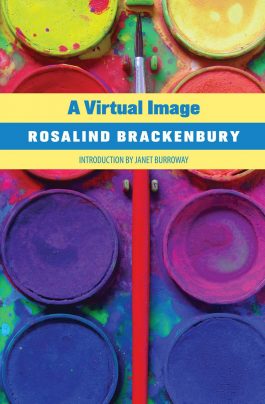
‘A Virtual Image’ by Rosalind Brackenbury – A Road Trip to France

‘A Virtual Image’ by Rosalind Brackenbury (1971) – 187 pages

In ‘A Virtual Image’, young English woman Ruby Smith is driving by car from England to southern France to meet her best friend since childhood, Anna Parrish. Both have just broken up with their boyfriends, and they are now each on their own enjoying the freedom of the open road.

They are to meet at a summer outdoor art colony run by a French husband and wife on a farm.

“And, Thomas,” she said: “Of course he’s the most marvelous painter. But somehow the thing for me here is the atmosphere. You know, there are so few places in the world that are really congenial. And they are such a marvelous couple. So complementary. Almost enough to make one think marriage isn’t such a bad idea after all.”

However when Ruby arrives, Anna has already left. Ruby must track her down.

In many ways ‘A Virtual Image’ is the quintessential early 1970s novel. The early Seventies were the bright dawn of the New Feminism. Women were just starting out to discover and treasure their independence from men. The women speak of self-realization. When Ruby does hook up with the young man Caley, there is a noticeable lack of the cynicism which would come later.

“Beside me he sits, a person I hardly know but who persuades me in the movement of his hands and the rise and fall of his voice, and in a hundred small gestures, that he will tell me something, change the way I am.”

‘A Virtual Image’ is kind of a road map for a romance between an independent woman and a guy who can handle her independence.

“Out of such things, out of the prosaic and the glib, I felt companionship grow, and our ease with each other; so that it was no longer necessary to talk all the time about Anna and explain all our actions in terms of our search for her.”

It is easy to tell who the guiding light for ‘A Virtual Image’ is. It is Virginia Woolf brought into the 1970s. I am no expert on the style of Virginia Woolf, but I have read ‘To the Lighthouse’ and ‘ Mrs. Dalloway’. We are always aware of what is going on in the mind of the main protagonist who is Ruby. We view events mostly through her eyes and insights, although occasionally there are abrupt unannounced shifts in the perspective to Caley or Anna.

The sentences and the paragraphs in the novel tend to be longer than those we get today. The novel was written before the “less is more” style became predominant.

Despite finding the ending somewhat melodramatic and over the top, I enjoyed ‘A Virtual Image’ throughout and found the scenes quite vivid.

Grade:  B

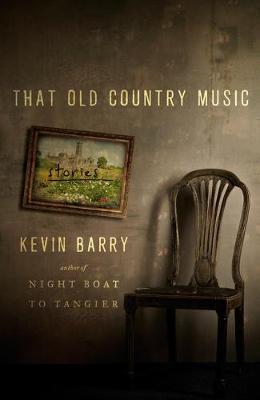
“That Old Country Music” by Kevin Barry – Amusing and Poignant Irish Stories


That Old Country Music”, stories, by Kevin Barry (2021) – 191 pages


It is still March and still Reading Ireland Month (barely), so here is Kevin Barry. In ‘That Old Country Music’, he writes stories about the Irish people as we have always heard them to be and as I expect they really are.

There are certain writers who just happen to be virtuosos of the short story. Anton Chekhov, Elizabeth Taylor, John Cheever, William Trevor, Alice Munro, George Saunders, etc. When you read a collection of their stories, you know that nearly every one of those stories is going to move you in some way. I believe it is now time to add Kevin Barry to this list.

In the humorous story ‘Who’s-Dead McCarthy’, the main character is always the first to tell everyone about the ones who have recently died. No matter where we are from, I’m sure most of us have known a guy who is all too willing and pleased to report the misfortunes of someone else to those who are around him.

He shook his head with a blend that spoke curiously of tragic fate and happy awe.”

As is often the case in short story collections, my favorite story is the first one, ‘The Coast of Leitrim’. Seamus Ferris has fallen hard for a Polish girl, Katherine Zeilinski, who works in the cafe down in Carrick. However when she falls for him and they become a couple, he is tormented by his own happiness.

Seamus Ferris could bear a lot. In fact already in his life he had borne plenty. He could handle just about anything, he felt, shy of a happy outcome.”

Lines like this show an acute awareness which puts you on this writer’s side no matter where he decides to take the story.

He had refused happiness when it was presented to him in the haughty form that he had always craved.”

Of course Kevin Barry is a strong novelist as well. He is a writer who recognizes that life isn’t always or often straight lines. Even though I have no Irish ancestors and have never been to Ireland, I could relate to every one of the stories in this collection. It helps that most are amusing as well as poignant.

The bottom line is that in capturing Irish human nature, Kevin Barry captures our human nature, wherever we are from.


Grade:   A


‘Klara and the Sun’ by Kazuo Ishiguro – A Solar-Powered Artificial Friend


‘Klara and the Sun’ by Kazuo Ishiguro (2021) – 303 pages


It’s the not-so-distant future, and artificial friends (AFs) for children are for sale. Klara is one of these AFs in the store waiting to be sold. She has been in the store awhile, and there are already newer B3 models of artificial friends with more advanced features. One day the store manager puts Klara in the sunny storefront window, and Klara, being solar-powered, really brightens up. Young girl Josie who is walking by with her mother has gotta have this Klara for her own friend.

Josie is a rather sickly girl, but she has been “lifted” by artificial genetic editing, so she is eligible for college. However the boy she plays with, Rick, has not been “lifted”. Klara tries her best to be a good friend to both of them.

At Josie and her mother’s home, Klara must also contend with Melania Housekeeper who apparently is a Slovenian machine.

And AF. Your big plan. If it make Miss Josie worse I come dismantle you. Shove you in the garbage.”

Since the story in ‘Klara and the Sun’ is told in the first person by Klara, it is a fine balancing act for Kazuo Ishiguro to make Klara not sound too stilted or mechanical, yet not altogether human.

In ‘Klara and the Sun’ all of the people carry around an “oblong” which apparently is a well-advanced version of the cell phone. This got me to thinking about the next generation of cell phones today. For these next cell phones, the default for all phone calls will probably be to film all participants on the call. If you don’t want your live picture shown to the other participants, you must figure out the setting for not filming yourself. There may be plenty of times you may not want to have other people watching you while you are on the phone.

Who knows what other changes, probably not all of them good, await us in the future generations of our machines?

Ishiguro pays attention to the musical quality of all of his writing, the rhythms of his words and sentences as well as the silences between them. More writers should pay attention to these properties.


Grade:   A-


‘The Glorious Heresies’ by Lisa McInerney – A Blunt and Sleazy View of the Irish Crime Scene


‘The Glorious Heresies’ by Lisa McInerney   (2015) – 389 pages


I am fond of Irish novels with a shaggy plot. When I read Irish fictions, I like them wild and crazy and funny and poignant; ‘The Glorious Heresies’ sure fits all those categories. It is a wonder, a glorious wicked novel, a wild Irish crime story written from the point of view of the criminals. It was about time I read this novel from the “arse end of Ireland”.

I’ve read other wild Irish fiction, dark comedies with brutal honesty about sex and drugs and crime, but ‘The Glorious Heresies’ is the first that I’ve read that was written by a woman. It is refreshing to get a woman’s angle on some of these demented matters.

You get the full impact of this crazy stuff with the criminals, the drunks, the drugs, the prostitutes, and the church on the women folk. For the male writers, the whole scene is more or less just a black comedy. With Lisa McInerney it’s more poignant and dramatic, and she accomplishes this without sacrificing the humor. ‘The Glorious Heresies’ tells the blunt candid truth without sentimentality.

Jimmy shook his head. Cowardice is nobody’s darling. So much of a man was stripped away when notice was given of his demise; it was no surprise to see them cry and beg and empty their bladder all over their shoes, but it was an ugly thing. What use was a man who couldn’t stand up straight to face his mortality?”

Jimmy Phelan is the brutal crime boss. He has set up his long lost mother Maureen with an apartment which is in what used to be one Jimmy’s houses of prostitution. She has just killed an intruder, a guy who was still expecting to find prostitutes there.

Jimmy liked to allow room for maneuver in his daily schedule, but “Clean up after your mother offs someone” was a much more significant task than he’d ever have thought to factor in.”

The prostitute that the guy was looking for, Georgie, no longer has a house but must fend for herself out on the street.

Jimmy hires the hapless drunk Tony Cusack to clean up his mother’s apartment. Tony’s fifteen year old son Ryan sells drugs for a dealer who gets his drug supply from Jimmy. Ryan has a girlfriend Karine D’Arcy whose parents are totally disgusted with Ryan and his family.

And then there is the talk.

Who told you I was the sentimental type? Said J.P., mildly.

Yeah, that’s a mistake I made, for thinking there was still a man in there underneath the bullshit.”

Phelan turned. He backed Tony up against the wall.

No one talks to me like that.”

Of course, it being an Irish novel, there must always be The Church.

It’s just, you know, the Christians might be daft but they’re trying to do the right thing.”

‘The Glorious Heresies’ is actually the first book of a trilogy; the second novel titled ‘The Blood Miracles’ has already been published, and the third titled ‘Rules of Revelation’ is due to be published this coming May.

This is probably my favorite kind of novel, so merciless it’s humorous. It is filled with uproarious cynicism.


Grade:    A


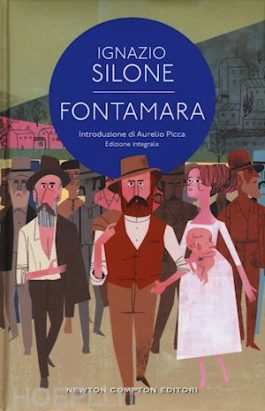
‘Fontamara’ by Ignazio Silone – A Powerful Anti-Fascist Italian Novel


‘Fontamara’ by Ignazio Silone   (1934) – 240 pages            Translated from the Italian by Harvey Ferguson II


‘Fontamara’ holds important lessons for today since fascism is more of a threat today than at any time since World War II. ‘Fontamara’ brings to light the rise of fascism in Italy during the late 1920s and early 1930s.

The fame of Ignazio Silone rests mainly on his two early novels ‘Fontamara’ and ‘Bread and Wine’. These two novels were among the first anti-Fascist novels and were hugely popular, influential, and well-lauded. His later works never achieved the acclaim of these earlier works. However, based mainly on these two novels, he was nominated for the Nobel Prize ten times although he never won the prize.

In ‘Fontamara’, the wealthy landlords are in league with the politicians and the banks and the lawyers to make the lives of the poor farmers a living Hell.

The new government is in the hands of a gang of bandits. They call themselves bankers and patriots, but they’re bandits without any respect for the old-time small landowner.”

In the area in southern Italy known as Fontamara, there is a stream that provides the water for irrigation which sustains all the poor farm families who have worked this land for centuries. The current government of the area then passes a law to divert this stream to the estate of a local rich landowner Don Carlo Magna.

At least one thing was clear: new laws were coming out every day in favor of the rich landowners. But only the old laws that were in favor of the peasants were being abolished. The ones that were unfavorable remained.”

The poor farmers knew from experience they could get no help or advice from the Church which would deliver them from the wickedness of the rich and imperious.

The local government always takes the side of the rich landowners against the poor farmers. The land in the Fucino basin which the poor farmers have worked for centuries is redistributed to the rich landowners who have the necessary capital to develop it.

Every word and gesture from these gentlemen reeked of trickery.”

However there were also poor people who backed this criminal autocratic government of the rich.

Men in black shirts…They were poor people too. But they formed a special class of poor people…Too weak and cowardly to stand up to the rich and the authorities, they preferred to serve them so they could rob and oppress the others – the peasants, tenants, and small landowners. They have always been in service of whoever gives the orders, and they always will be…They were the so-called Fascists.”

Once again we are faced with too many nations where their governments have been taken over by criminals who are working on behalf of the rich. The last rise of fascism resulted in World War II. Who knows what will happen this time?


Grade:    A


Playful and Astute Words about Life and Literature from Margaret Atwood


I just happened to stumble onto all these fascinating quotes from Margaret Atwood. It’s been awhile since I have found such meaningful yet often humorous words, and I want to share them with you. If the quote is from one of her books, I indicate the source.


About Life in General

“If you’re not annoying somebody, you’re not alive.”

“How could I be sleeping with this particular man…. Surely only true love could justify my lack of taste.”

“I’m not sure which is worse: intense feeling, or the absence of it.”

“Stupidity is the same as evil if you judge by the results.” – ‘Surfacing’

“And yet it disturbs me to learn I have hurt someone unintentionally. I want all my hurts to be intentional.” – ‘Cat’s Eye’

“There’s more than one way to skin a cat, my father used to say; it bothered me, I didn’t see why they would want to skin a cat even one way.” – ‘Surfacing’

“The facts of this world seen clearly are seen through tears.”

“If we were all on trial for our thoughts, we would all be hanged.” – ‘Alias Grace: A Novel’

“Oppression involves a failure of the imagination: the failure to imagine the full humanity of other human beings.” – ‘Second Words: Selected Critical Prose’

“I’ve never understood why people consider youth a time of freedom and joy. It’s probably because they have forgotten their own.” – ‘Dancing Girls’

“Men and women are not “equal” if “equal” means “exactly the same.” Our many puzzlements and indeed unhappinesses come from trying to figure out what the differences really mean, or should mean, or should not mean.”

“You can think clearly only with your clothes on.” – ‘The Handmaid’s Tale’

“Forgiving men is so much easier than forgiving women.” – ‘Cat’s Eye’

“If he wants to be an asshole, it’s a free country. Millions before him have made the same life choice.”

“I hope that people will finally come to realize that there is only one ‘race’ – the human race – and that we are all members of it.”

“The desire to be loved is the last illusion. Give it up and you will be free.” – ‘Selected Poems II (1976-1986)’

“Men are afraid that women will laugh at them. Women are afraid that men will kill them.”

“The fabric of democracy is always fragile everywhere because it depends on the will of citizens to protect it, and when they become scared, when it becomes dangerous for them to defend it, it can go very quickly.”

“Better never means better for everyone… It always means worse, for some.” – ‘A Handmaid’s Tale’

“Don’t let the bastards grind you down.” – ‘A Handmaid’s Tale’

About Literature

“A word after a word after a word is power.” – ‘Spelling’, a poem

“In the end, we’ll all become stories.” – ‘Moral Disorder’

“Show me a character totally without anxieties and I will show you a boring book.” – ‘Margaret Atwood: Conversations’

“Poetry is where the language is renewed.”

“It’s a feature of our age that if you write a work of fiction, everyone assumes that the people and events in it are disguised biography — but if you write your biography, it’s equally assumed you’re lying your head off.”

“I read for pleasure and that is the moment I learn the most.”

“Everyone thinks writers must know more about the inside of the human head, but that’s wrong. They know less, that’s why they write. Trying to find out what everyone else takes for granted.”

“Once you publish a book, it is out of your control. You cannot dictate how people read it.”

“More of your brain is involved when reading than it is when you watch television… because you are supplying just about everything… you’re a creator.”

“You need a certain amount of nerve to be a writer.” – ‘Writing with Intent: Essays, Reviews, Personal Prose: 1983-2005’,


There are hundreds more, but it’s time to move on.


‘Tamburlaine Must Die’ by Louise Welsh – The Other Elizabethan Playwright


‘Tamburlaine Must Die’ by Louise Welsh  (2004)  – 140 pages


‘Tamburlaine Must Die’ is the English playwright Christopher Marlowe’s own fictional account of his last days up until the day he was killed in an ale house in Deptford on May 30, 1593. He was 29 years old.

The novella starts at the home of Marlowe’s patron Thomas Walsingham who allows Marlowe to stay at his home outside London to work on his plays. Then Marlowe travels to London where events get quite hectic for him

The era of Queen Elizabeth I was a time when religious crimes such as heresy and blasphemy were treated as civil crimes with exceedingly harsh punishments including torture and death. Christopher Marlowe was not one who was shy or careful about what he said or even wrote especially during and after one of his trips to one of the many London ale-houses. He frequently was in trouble with the authorities.

Christopher Marlowe has an “adventurous nature”.

Now Marlowe is in trouble with the Privy Council of Queen Elizabeth. He is accused of committing heresy, of being an avowed atheist who caused others to convert to his beliefs, and of posting a scurrilous threatening bill on the door of the Dutch church signed “Tamburlaine” which happens to be the name of one of his plays.

I found some of the scenes in this novella quite well done, especially when Marlowe talks over his plight with the old gaoler in Newgate prison he knew from the first time Marlowe was locked up. Another scene has the following sharp dialogue:

You seem to find yourself in some small difficulty, Master Marlowe.”

It is a fact of my profession. Theatre is built on difficulties.”

The theatre of life also?”

It is so for all men.”

Perhaps,” he smiled, a brotherly smile, sympathetic yet with no illusions about my character, “but most men’s troubles are of a mundane nature. They lack money or have upset their wife. You are in danger of losing your life.”

However ‘Tamburlaine Must Die’ is too often too sensational and way over the top. We go from bloody incident to bloody incident with few quiet moments in between them. There is scarcely little about how Christopher Marlowe came to write those plays which are still performed over 400 years later – ‘Doctor Faustus’, ‘Tamburlaine’, and ‘Edward II’ among others.

It is difficult to keep track of all the side characters that are introduced too quickly and then are gone from the novella.

There is more sword play than word play in ‘Tamburlaine Must Die’.


Grade:   C


‘One Hand Clapping’ by Anthony Burgess – Used Car Salesman to Quiz Show Champion


‘One Hand Clapping’ by Anthony Burgess (1961) – 218 pages

My reason for reading ‘One Hand Clapping’ is fairly subtle. I saw that it had been turned into a failed play in 2017, and I figured if someone would go to all the trouble of turning a 1961 novel into a play 56 years later, that novel must be pretty good. I was looking for an excuse to read Anthony Burgess again anyhow. It turned out that I was correct in my reasoning.

‘One Hand Clapping’, written in 1961, gets the 1960s off to an uproarious and provocative start.

‘One Hand Clapping’ takes place in 1961, back in the Dark Ages when you could only see TV shows in black-and-white and all TV programming came to your home over the air through the antenna on top of your house. This was the era of the quiz shows Twenty-One and The $64,000 Question, both of which we later found out were rigged.

In ‘One Hand Clapping’, out 23 year-old narrator Janet works shelving and price marking goods in a grocery store. Her 27 year-old husband Howard is a used-car salesman. They are a quite ordinary couple who live in Bradcaster (Manchester, England) until one day Howard is selected to appear on the TV quiz show ‘Over and Over’. Howard does have one skill that is useful for a quiz show contestant, a photographic memory.

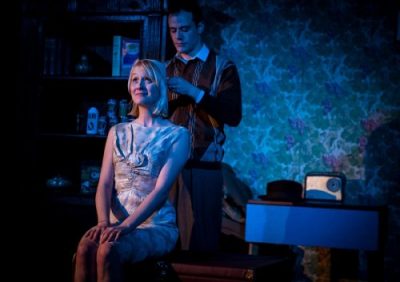
A scene from the play ‘One Hand Clapping’

Janet is a down-to-earth young woman with a lot of practical and intuitive sense. Howard is a far bit impulsive. On his first night after his resounding victory on the quiz show, he has an accident with one of his boss’s cars, a Bentley, from the used car lot. Of course his boss is angry with him, and Howard tells him off and gets fired.

With his quiz show winnings, Howard has grand pretensions and becomes a patron of the arts by funding aspiring poet Redvers Glass. When Howard asks the poet to recite a few of his poetic lines, Glass replies with some lines that Howard, with his photographic memory, immediately recognizes are from the classic poem ‘To His Coy Mistress’ by Andrew Marvell.

Here are a few lines the poet writes for Howard:

But we saw England delivered over to the hands of

the sneerers and sniggerers, the thugs and grinners,

England became a feeble-lighted moon of America“

The Americanization of England was feared by the English in the early 1960s. But of course the British Invasion a few years later led by the music of the Beatles as well as many other groups flipped everything around, and the United States teenagers were imitating everything English.

‘One Hand Clapping’ takes some sharp, crazy turns, some of them gruesome, but all in good fun. It takes an adept writer to pull this off, and Anthony Burgess does.


Grade:    A


‘Walking’ by Thomas Bernhard – Walking and Talking and Thinking


‘Walking’ by Thomas Bernhard (1971) – 86 pages              Translated from the German by Kenneth J. Northcott

Yes, ‘Walking’ is a novel about walking. Our narrator used to go out walking with his friend Karrer on Mondays and walking with his friend Oehler on Wednesdays. However now that Karrer went mad and is confined in the Steinhof asylum, our narrator goes out walking with Oehler on both Mondays and Wednesdays.

Oehler is the ultimate depressive and a depressing companion.

The whole process of life is a process of deterioration in which everything – and this is the most cruel law – continually gets worse, says Oehler.”

Not only is Oehler forever gloomy, but also he has some quite obnoxious opinions and attitudes.

Anyone who makes a child, says Oehler, deserves to be punished with the most extreme possible punishment and not to be subsidized.”

The centerpiece of ‘Walking’ is when Oehler relates the incident where Oehler and Karrer are out walking together and go to the Rustenschacher’s store. Karrer has his ”terrible collapse” at the store.

While in the store, Karrer complains about the shoddy merchandise calling some pairs of trousers on display “Czechoslovakian rejects”. Of course the sales clerk who happens to be the store owner’s nephew defends their merchandise, and they get into a loud argument.

This scene at the store is so outrageous it is almost comic as Oehler relates it, if it wasn’t for the fact that this is when Karrer gets carted off to the psychiatric ward. This is a frequent technique of Bernhard’s, to make a scene so outrageous and gruesome, it becomes almost comic to picture these people doing these things.

So now our narrator is stuck walking with the depressing Oehler twice a week who keeps saying these grim things.

All people fill their heads without thinking and without concern for others and they empty them where they like, says Oehler. It is this idea that I find the cruelest of all ideas.”

Not much else happens in this novella.

I have read a lot of Bernhard, and I find in much of his work, gloomy as it may be, that there is ultimately a sense of redemption. In fact he has over time become one of my favorite authors. Novels of his that I especially like are ‘Extinction’, ‘Woodcutters’, ‘The Loser’, and ‘Wittgenstein’s Nephew’.

However I did not get much of this sense of redemption in ‘Walking’ which is an early work of Bernhard.


Grade:    B


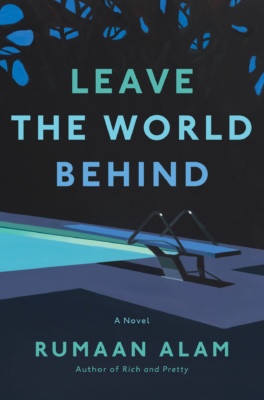
‘Leave the World Behind’ by Rumaan Alam – The Four Scariest Words


‘Leave the World Behind’ by Rumaan Alam (2020) – 256 pages


Here is my candidate for the scariest sentence, the four scariest words, in the English language: “The future is uncertain”.

I would feel better if I just knew what was happening.” Amanda looked toward the hall, could hear the plash of water in the bathtub. These words were not true, but she did not know that.

‘Leave the World Behind’ starts out with a family traveling from New York City to the outer reaches of Long Island looking for a week long escape from the city. The family is made up of father Clay who is a professor, mother Amanda who is an office manager, and their 16 year old son Archie and 13 year old daughter Rose. The family has rented a beautiful house with pool in a near-deserted part of Long Island just for a week.

Everything is fine at first, but the family’s situation soon turns from idyllic to ominous. Daughter Rose spots a herd of thousands of deer congregating in the woods. A flock of pink flamingos land in the swimming pool. All of the other birds are unnaturally quiet.

The animals,” Danny continued. “They know something. They’re spooked.”

The couple who are the actual owners of the vacation house, G. H. and Ruth, show up bringing word of a massive blackout across Manhattan from which they are escaping by going to their house. Clay and Amanda are of course reluctant to have them stay, since they paid to have the house all to themselves for a week.

Whenever the focus shifts to one or another member of the family or one of the house owners, the author lets us know what they are really thinking which is often cynical or disparaging of one of the others.

And then all of them are shaken by the Big Noise.

Not a bang, not a clap. More than thunder, more than an explosion…It was noise big enough to alter forever their working definitions of noise. You’d cry if you weren’t so scared.”

The atmosphere of impending doom looms closer and more oppressive, but we don’t know what it is. ‘Leave the World Behind’ provokes that feeling that one must have the second he or she is the victim of a fatal accident. “Why did this happen to me? Why did I let this happen to me?”

Ruth did understand. Everyone understood. This was what everyone wanted, to be safe. This was the thing that eluded every single one of them.”

Or maybe the four scariest words are “The future is certain”, since we all know what is going to ultimately happen to each of us.


Grade:   A-


‘Au Bonheur des Dames (The Ladies’ Delight)’ by Emile Zola – aka ‘The Ladies Paradise’ – Part II


‘Au Bonheur des Dames (The Ladies’ Delight)’ by Emile Zola (1883) – 421 pages     Translated from the French by Robin Buss


Part II:   Octave and Denise

Poster of Emile Zola by Manet

Octave Mouret designed every feature of the department store Au Bonheur des Dames as an “amorous seduction” of its female customers. First there are the dazzling displays to put the merchandise in the best possible light. Then certain items are put on sale below cost to get the women into the store. The departments are arranged so the customers must traverse through many tempting displays to get to the merchandise they actually came for.

He made an absolute rule that no corner of Au Bonheur des Dames should remain empty; everywhere, he demanded noise, people, life…because life, he said, attracts life, breeds and multiplies.”

Then there is the liberal return policy because “you can always return it to us if you don’t like it”.

Octave is not ruthless or predatory but uses his charm and good looks to captivate women.

And the dresses were in this sort of chapel raised to the worship of women’s beauty and grace.”

Into this tremendous shopping emporium comes lowly Denise Baudu, the young woman just arrived in Paris from a small French town. At first she is not allowed near the cash registers and thus gets no commissions. Her job is to straighten and rearrange the clothes after the customers have messed them up. She is not particularly attractive, but there is something about her that Octave can’t resist. In his notes in preparation for writing this novel, Emile Zola described Denise as thus:

Octave making a fortune through woman, exploiting woman, speculating on her coquetry and, at the end, when he triumphs, finding himself conquered by a woman who did it without trying, who conquered him by the sheer power of her femininity. Create her: a superb specimen combining grace and uprightness.”

When Octave begins to take an interest in Denise the other envious employees begin to gossip, “they still chattered, because of the itching of the tongue that ravages any meeting of men and women.”

One of the joys of reading Zola is how accurately he comprehends the way the various people within an organization deal with their jobs. This is true for the women as well as the men.

I probably should have read Pot-Bouille (recently translated as ‘Lesson in Love’) first, since that novel in Zola’s Rougon-Macquart series tells the story of Octave Mouret during his early days. However ‘Au Bonheur des Dames’ works just fine as a stand-alone novel itself.


Grade:    A