It looks like the site is working fine. If there are any problems, please explain in a comment.
Deborah
2 Dec
It looks like the site is working fine. If there are any problems, please explain in a comment.
Deborah
29 Jul
My husband had quite a community of friends here. I’m sure some of you may be interested in reading Tony’s obituary. The long version is posted here:
https://neptunesociety.com/obituaries/golden-valley-mn/anthony-spors-12464052
Take care.
24 Jul
I was going to respond to each message, but I quickly realized there were too many! Rest assured I have read them all and will be checking back to the site frequently to make sure future messages are seen and all is in order. It is heartwarming to see all the love posted here.
Deborah
22 Jul
I am Deborah, Tony’s wife, and I was the one who wrote the previous post here. I want to let you all know that Tony passed away at 1:00 PM on July 21st. He had a series of cardiac events, and then other problems arose. At first the doctors had hope, but too much went wrong. He was unconscious for the last fifteen days. I want you all to know that Tony truly valued his readers here. He enjoyed writing this blog as much as he ever enjoyed anything! All of you were much appreciated. I am going to keep this blog live on the internet as long as I can, so his reviews can continue to be appreciated.
What I have learned is that congestive heart failure is sly and tricky. Men and women experience a wide array of symptoms. Some complain that they have a bad cold; others are dizzy or nauseous, and yet others simply find themselves making extra trips to the bathroom. Often the symptoms are quite mild … until they are deadly. If you find yourselves experiencing strange changes that don’t quite make sense, especially after the age of 65, don’t shrug them off. Take action and get your heart checked out!
1 Jul
‘The Cafe With No Name’ by Robert Seethaler (2023) – 191 pages Translated from the German by Katy Derbyshire
 Sometimes the simplest plot for a novel is the best.
In ‘The Cafe With No Name’, Robert Simon opens a cafe in Vienna. It serves alcohol; it’s what we would call a bar and grill. Simon operates the cafe for about ten years. The novel consists of vignettes about the owner, the people who work at the cafe, and its customers.
How can you write a novel about Vienna without at least some scenes along the Danube River? You can’t. When their troubles get too much for them, the residents of this neighborhood often go for walks along the Danube.
Every cafe or restaurant or bar has a fascinating history. Each could have its own interesting story. I am going to show only one example from ‘The Cafe With No Name’, and then I expect you will want to read this novel.
We begin with a conversation between a patron of the cafe, the professional wrestler Rene Wurm, and the cafe owner and operator about the waitress Mila:
“I am, Simon, I’m a good man, aren’t I?”
“You never know for sure, but I think so.”
“Yes, I am. And I want to prove it to her. But first I have to find out if she likes me. You’ve got the cafe, you know how these things go.”
“What things.”
“With women!” Rene exclaimed. “Things with women, for God’s sake.”
On the advice of Robert Simon, Rene gets the courage to approach the waitress Mila and ask her if she would like to go for a walk in the park.
“Yes, I think I would like to, Rene,” she said, and no matter how often he thought back to that moment later in life, he could never say what threw him more off balance that day: Mila’s small hand on his shoulder or the incredible fact that she hadn’t laughed in his face.”
At one point Simon himself has a potential girlfriend. She tells him,
“When I was young a fellow said to me, my dear fräulein , I know you’re too beautiful for me, but I’ll give it a try anyway – will you go to the pictures with me? What an idiot. Did you send him packing? No, I married him. I never understood men, but I like having them around me.”
‘The Cafe With No Name’ is a low-key understated look at life’s disappointments and sad stuff and how we cope with them, as well as the small joys in each day. The cafe isn’t all that successful, but it does have its share of drunks and crazies.
Robert Seethaler does not make the mistake in his novel of making his human characters better than humans usually are.
Grade: A
24 Jun
‘Theory and Practice’ by Michelle de Kretser (2025) – 175 pages
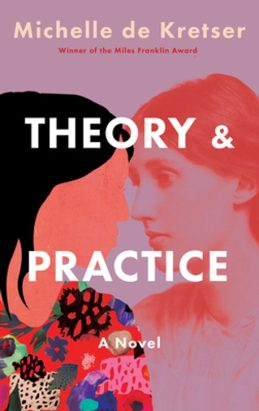 Although on the cover it says that ‘Theory and Practice’ is a novel, I kept getting the feeling that much of what was written came from the author’s own life. This novel often has the feel of verisimilitude like a memoir. Perhaps that is due to the woman narrator of the novel telling her story as a memory from her time in Melbourne, Australia in 1986.
Only near the end of the novel do we find out that our narrator’s name is Cindy. She is originally from Sri Lanka and now working on her graduate thesis in Melbourne, Australia and is an ardent feminist. She is writing her thesis on the works of Virginia Woolf, her idol and hero. Virginia Woolf’s picture hangs above her bed which she calls the Woolfmother.
“No other writer has meant as much to me as Woolf.”
“A lot of Woolf’s most subversive thinking about women comes in pretty straightforward prose.”
Besides the novels, our narrator reads the extensive diaries of Virginia Woolf for her thesis. Everything is fine until our narrator comes across one particular entry. At one point Leonard Woolf, Virginia’s husband, invites E. W. Perera from Ceylon, now Sri Lanka, to their home. In her diary Virginia calls Perera “the poor little mahogany-colored wretch”. Virginia then referred to him as having “the same likeness to a caged monkey”.
Although our narrator already knew that Virginia Woolf was a terrible snob and was unforgivably rude about colonials, she takes severe offense of Virginia’s disparagement of her fellow countryman. E. W. Perera is a much honored name in Sri Lanka, because he was able to convince the British to halt their colonial “Shoot on Sight” martial law on Ceylon in 1917.
Our narrator moves her Woolfmother picture from its honored place above her bed to the living room.
While our narrator is writing her thesis, she begins an affair with a guy named Kit who is the steady boyfriend of her friend Olivia. She is so compatible with Kit that she finds out that despite modern feminism, terrible jealousies still arise between women due to their affairs with men.
“But every day, under every aspect of my life, Olivia ran like a stream. In this world only one of us two could be happy. Why shouldn’t the bluebird of happiness fly my way?”
While writing her thesis, she encounters constructionist theory which was the widely prevalent literary theory of the 1980s.
“Artists used to think about art through art. Now they think about it through theory.”
“Theory had taken book, essay, novel, story, poem, and play and replaced them with text.”
I share the narrator’s disdain for constructionist theory as I have tried to read these obtusely-written volumes of literary theory, and have found them to be useless in a true understanding of literature.
Grade: A-
19 Jun
‘Solo Faces’ by James Salter (1979) – 220 pages
 The minimalism trend in fiction has come and gone but I still admire it. Why write twenty words when you can write the same thing in ten words? Or, for that matter, why write 350 pages when you could have written it all in 220 pages?
For a subject as austere, rigorous, and cold as French Alps mountain climbing this minimalist approach which James Salter uses seems a good fit.
“The climbing was harder than he’d dreamed. The snow had to be cleared from holds. Higher up, there was ice, a slick, unyielding ice that could not be completely chopped away. His hands were cold. He was breathing on his fingers, clenching and unclenching, trying to warm them.”
Mont Blanc in France is the highest mountain in all of the Alps and in western Europe. There are several dangerous peaks in the Mont Blanc complex which attract climbers such as Vernon Rand who is the main protagonist in ‘Solo Faces’. During the novel Rand, as he is called, scales or attempts to scale several of these peaks.
“A great mountain is serious. It demands everything of a climber, absolutely all. It must be difficult and also beautiful, it must lie in the memory like the image of an unforgettable woman. It must be unsoiled.”
This is the way men wrote about women back in the 1970s, and the mountain climber Rand is very much a man’s man. Rand has that mountain climbing compulsion, ready to risk his life in order to conquer a peak.
‘Solo Faces’ starts out in California with a scene of Rand repairing house roofs which seemed to be an appropriate occupation for someone whose avocation is mountain climbing. Soon he leaves his job and his girlfriend without explanation to head out for the French Alps.
“You’re prepared for everything,” he told them. “If your foot slips you have your hand. You never try something unless you’re sure you can do it. It’s a question of spirit. You have to feel you’ll never come off.”
After Rand rescues two other climbers, he becomes quie famous in France. When Rand goes to Paris, several women are interested in him.
“One woman is like another. Two are like another two. Once you begin there is no end.”
More 1970s attitude.

There are so many harrowing extremely close calls in ‘Solo Faces’, one can only assume that to be a mountain climber in the French Alps, one would either have to be crazy or have a death wish.
‘Solo Faces’ definitely makes you feel the thrill and the danger of mountain climbing.
Grade: A
17 Jun
‘Heart, Be At Peace’ by Donal Ryan (2024) – 194 pages
 ‘Heart, Be At Peace’, like its 2012 predecessor ‘The Spinning Heart’, has twenty-one separate voices, each with their own chapter, telling the story. In ‘The Spinning Heart’, Ireland, including this neighborhood centering around Bobby and Triona Mahon, faced a severe economic downturn. In ‘Heart Be At Peace’, Ireland has recovered. It is 2019 and the people in this neighborhood are doing quite well economically, but Ireland is beset by a new terrible problem. Many of the young people are taking cocaine and other drugs.
“Do you want your child born into a world ruled by those scumbags? No, Bobby. Do you want them pushing drugs on your children? No, Bobby.”
This is a fairly tight community of neighbors. Each of these 21 voices embellishes this Irish story from their own angle, only knowing what they themselves saw and heard. Some of the voices, especially the older people and the young hoodlums, speak in heavy Irish dialect, while a female lawyer and a female accountant speak a more formal modern Irish. At first the whole picture is quite confusing but it becomes clearer as more voices speak.
‘Heart Be At Peace’ is rather a demanding novel to read. It is difficult to keep track of twenty-one separate persons especially when they are usually called by their first names or nicknames. Each of these voices adds bits and parts to the overall plot like a jigsaw puzzle, and eventually the main plots and themes of ‘Heart, Be At Peace’ reveal themselves.
There is a group of young men, “Augie Penrose and the three musketeers he carries around in his car, Pitt, Braden, and Dowell” who are shamelessly driving around and dealing drugs to young people nearly out in the open. Even the police seem to leave them alone.
“So no one will do anything about this whole place going to shit because if Augie and the boys weren’t poisoning the place then someone else would be, is that it?”
Donal Ryan reveals his own unusual technique in ‘Heart, Be At Peace’ when one of his voices, a convict who is writing his own novel while in prison, says:
“I composed a series of monologues. I gave each speaker a unique voice. … And when I had the language leashed, the characters were suddenly beyond my control. They were crazy! The things they said and did. The wild joy I felt. The rightness of it all.”
Usually when a writer has a chorus of voices telling the story, the voices are given multiple chances to have their say. Here each voice gets only one opportunity to speak.
Grade: B+
10 Jun
‘Mutual Interest’ by Olivia Wolfgang-Smith (2025) – 317 pages
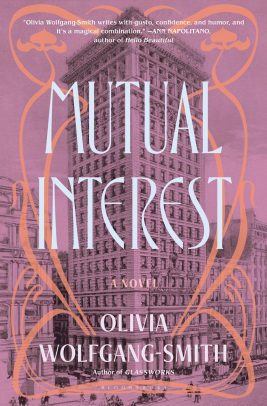 I read ‘Mutual Interest’ with a smile on my face the entire time. Each sentence is witty and wonderful, delicious. I admire each one of Olivia Wolfgang-Smith’s sentences; I know there is going to be something in each one to engage my mind.
In this lively novel, it is 1900 in New York City, and after a couple of short affairs with other young women, Vivian, 24, decides to get married to a man approaching 45 years old named Oscar. However her marriage plan is not the usual.
“…after listening to Oscar rattle on for half the evening, she was fairly confident in his queerness. (How heartbroken he would have been, to know how easily she saw his secret soul!) With such a man there would be, Vivian reasoned, no need to bother each other.”
Their marriage would turn out to be mutually beneficial. For Oscar,
“Gone were the monikers like “horticultural gent” and “Mr. Washed-Out”; silenced were the rumblings he was a queer and a failure and a hopeless hayseed. Everything was drowned out by the possibility of a romance,…”
Besides,
“How many men did he know who regularly visited their wives’ bedrooms? Were there any above the age of forty-five? Oscar had already reached the all-purpose excuse of middle age!”
Then there is another younger entrepreneur named Squire Clancy. Oscar sells soaps; Squire sells candles. Vivian decides the two businesses are compatible. Besides Vivian quickly detects that Squire is also gay.
There is broad physical humor when Vivian stealthily pushes Squire into the walrus pool at the aquarium, and there is more sophisticated humor when Vivian follows through with her plot to marry Oscar and to bring Squire in to keep all three of them content, safe, and financially secure.
Oscar is practical; Squire is creative. Together their business, Clancy & Schmidt, is successful. Meanwhile Vivian continues to have short flings with other women.
“Vivian had found a way to make marriage work for her; she had won a game, she thought, that these girls were terrified to play.”
The second part of ‘Mutual Interest’ transpires ten years later, still in New York City. World War I has begun, and the Panama Canal has opened. Due to the complementary skills of Oscar and Squire, and especially due to the organizing skills of Vivian, the business Clancy & Schmidt has become hugely successful. Squire has moved into Vivian’s and Oscar’s house and sleeps in Oscar’s now double bed, leaving Vivian the time and the freedom to hunt and find various short-term female lovers.
As I mentioned before, I loved the sentences in ‘Mutual Interest’. Can a sentence be delicious? I asked Google. Here is Google’s AI Overview:
“No, a sentence cannot literally be delicious. The word “delicious” is used to describe something that is pleasantly or favorably tasting or having a pleasing smell.”
Google AI apparently has not read ‘Mutual Interest’ by Olivia Wolfgang-Smith. ‘Mutual Interest’ is a novel of marvelous exquisite, yes delicious, sentences.
Olivia Wolfgang-Smith is a fiction writer whom I was fortunate to discover with her first novel ‘Glassworks’ which was my favorite read of 2023. ‘Mutual Interest’ is another winner.
Grade: A
3 Jun
‘Persuasion’ by Jane Austen (1818) – 236 pages
 Jane Austen’s ‘Persuasion’, like ‘Pride and Prejudice’ and ‘Sense and Sensibility’, is all about finding a suitable husband for the daughter and a suitable wife for the son. What could be more important than that?
The focus of ‘Persuasion’ is on Anne Elliot, the middle daughter of Sir Walter Elliot who is described as “a conceited silly father” who is excessively proud of his title as baronet. The older daughter Elizabeth is her father’s favorite, “very handsome and very like himself”. The younger daughter has already married, so Anne is left at home, ignored by the rest of her family even though she is most helpful to the people around her. She is 27 years old and unmarried.
When Anne was twenty, she had been courted by a Captain Frederick Wentworth.
“He was, at that time, a remarkably fine young man, with a great deal of intelligence, spirit, and brilliancy; and Anne, an extremely pretty girl, with gentleness, modesty, taste, and feeling.–Half the sum of attraction, on either side, might have been enough, for he had nothing to do, and she had hardly anybody to love; but the encounter of such lavish recommendations could not fail. They were gradually acquainted, and when acquainted rapidly and deeply fell in love.”
Captain Wentworth proposed to Anne. But of course Anne’s father didn’t believe that Captain Wentworth was good enough for the daughter of a baronet like himself, and her best friend and mentor Lady Russell opposed the match and persuaded Anne to break off the engagement.
Now it is seven years later and now Captain Wentworth has returned from his ship at sea to spend some time in his old neighborhood. Anne meets him while visiting their neighbor.
“His cold politeness, his ceremonial grace, were worse than anything.”
Anne is a young woman of sharp opinions of those around her but she would never say them out loud. It’s like she has a finely tuned scale that she uses to measure the precise qualities and worth of the people she knows. One suspects that these are the opinions of Jane Austen also.
 “Mr. and Mrs. Musgrave were a very good sort of people, friendly and hospitable, not much educated and not at all elegant.”
“Charles Musgrave was civil and agreeable; in sense and temper he was undoubtedly superior to his wife (Anne’s sister Mary).”
The readers know exactly where Anne and probably Jane Austen stand with each character. No one escapes the precise, often critical, judgments of Anne Elliot or Jane Austen, except Captain Wentworth.
27 May
‘The Director’ by Daniel Kehlmann (2023) – 331 pages Translated from the German by Ross Benjamin
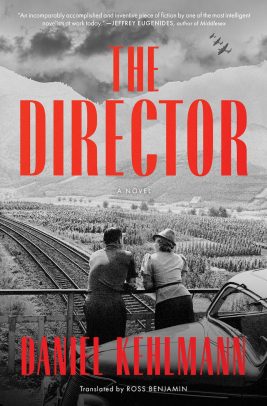 ‘The Director’ is a novel about making movies under the worst possible circumstances, in Nazi Germany during World War II. It centers on G. W. Pabst who had already achieved world fame for the movies he directed in the 1920s and early 1930s. He was the director who discovered Greta Garbo and Louise Brooks.
Pabst and his family had already fled Germany for the United States in 1933. He hoped to continue his career. When G. W. Pabst arrives in Hollywood, he is praised profusely by nearly everyone. Then he is handed a script, “A Modern Hero” and was told this would be his first American movie. Pabst reads the script and tells them the script isn’t very good. They tell him “Yes, it is”. He films the movie, and it bombs.
In 1939 Pabst and his family go back to Austria, then called Ostmark, for what is supposed to be a short stay to visit his ailing mother. However while they are visiting, Germany invades Poland, starting World War II. The Pabst’s cannot leave.
The caretaker in the house where the Pabst family and his mother live during this time is a full-fledged Nazi who has total disdain for Pabst and his family even though Pabst is not a Jew. The caretaker insults and spies on the Pabst family and reports their activities to Berlin. Hitler’s cruelty gave all of his followers permission to be as cruel as they want to be.
“Politeness was interpreted as weakness; he had been back in Germany long enough now to know that.”
In his various vignettes, Daniel Kehlmann covers many aspects of this creative family’s forced return to an cruel authoritarian dictatorship that they both absolutely detest. Separate chapters are written from the father’s, the mother’s, and the son’s point of view.
At one point Pabst is assigned to be an assistant to the woman director Leni Riefenstahl, famous for her Nazi propaganda movies. Riefenstahl got her start as an actress in Pabst’s movies, but now the Nazis have given her complete control over him. Riefenstahl is also an actress in this movie. He is supposed to give Riefenstahl advice on saying her lines. He tries, but she is quick to take offense.
“Let it go, he thought, remember she can put you in a camp.”
The extras used in this picture are concentration camp inmates.
The author Daniel Kehlmann gives us several different vantage points from which to watch this family who are stuck in Germany during World War II. First there is the famous director himself G. W. Pabst who hates what the Germans are doing but paradoxically finds that he has more freedom to make the movies he wants in Germany than he had in the United States. Then there is his wife Ilse who has difficulties handling the fact that they are constantly being watched by the German authorities and other informers. Then there is the son Jacob who wants to fit in with the other boys his age and wears his Hitler Youth uniform to fit in as do all the boys.
In one chapter we have a sort of prisoner of war (according to the New York Times, English novelist P. G. Wodehouse) watching the grand opening of one of the movies Pabst directed in Germany during the war, ‘Paracelsus’.
‘The Director’ is another engaging novel by Daniel Kehlmann especially for those interested in the making of movies.
At one point someone questions how Pabst could make movies under these Nazi circumstances.
“But don’t you find it strange, Pabst, that we’re making a movie like this in the middle of the apocalypse? Such a…work of art?”
“You say that as if it’s a bad thing.”
“More like a strange thing.”
“Times are always strange. Art is always out of place. Always unnecessary when it’s made. And later, when you look back, it’s the only thing that mattered.”
Grade: A
22 May
‘The Singularity’ by Dino Buzzati (1960) – 127 pages Translated from the Italian by Anne Milano Appel
 No, ‘The Singularity’ was not written via artificial intelligence (AI). Instead it is about a machine produced by a group of scientists and mathematicians which has the intelligence and comprehension of a human.
“The machine will read our thoughts, create masterpieces, reveal the most hidden mysteries.”
“And what if one day the automaton’s way of thinking eschewed your commands and acted on its own?”
“It’s what we’re hoping for. It would mean success. Without freedom what kind of spirit would it be?”
“And what if, with a soul like ours, it becomes corrupt like us? Could action be taken to correct it? And with its awesome intelligence wouldn’t it be able to deceive us?”
These are all good questions still today. I believe the writer Dino Buzzati was quite prescient in raising these issues already back in 1960. If a machine can comprehend like a human, could it become dishonest and unprincipled like some humans become? So far we only hear the so-called positive side of artificial intelligence, yet there are so many ways it could be used dishonestly.
In ‘The Singularity’, the head scientist working on this machine models it after his dead wife Laura whom he loved. In his first attempt at building the machine he puts all the good qualities of Laura into it. However he finds the machine is still lacking something.
“On the whole it was her, but something was still missing, the mark, the mysterious essence that makes each of us unique in the world.”
Laura was killed in a car accident when she was trysting with her lover while her husband, the mad scientist, was working on his machine. The scientist, still in love with his dead wife, comes to this conclusion.
“For it to really be Laura, we had to include the venom, the lies, the cunning, the vanity, the pride, the insane desires, everything that made me suffer so much.”
So far with the Global Positioning System (GPS) we have seen a quite positive use of artificial intelligence to help us get where we want to go. Beware in the future there could be some very negative, even wicked, uses of artificial intelligence.
Grade: A
20 May
‘The Maid’s Secret’ by Nita Prose (2025) – 320 pages
 ‘The Maid’s Secret’ is a fun, if not deep, read.
The lively plot, especially that involving the Fabergé egg, is quite contrived and far-fetched, but that didn’t matter. I suppose that the plot being incredibly unlikely is part of the fun. It’s full of life and emotion and true to its heartfelt feelings.
When it comes to fiction. rare is it for me to defend or even notice best sellers. My interests are usually more literary than that. I suppose I am that terrible thing, a literary snob. And yet,…
I somehow found and much enjoyed Canadian writer Nita Prose’s first Molly the Maid novel, ‘The Maid’. It has now been adapted into a movie by Universal Pictures, starring Florence Pugh.
In the well-written ‘The Maid’s Secret’, Molly has a fiancee now, Juan Manuel, who is a pastry chef at the hotel. Juan is such a wonderful person he falls into the unbelievable category. That didn’t matter to me either.
The television hosts Beagle and Brown are at the Regency Grand Hotel where Molly works. Molly has been promoted to the position of Head Maid and Special Events Manager, but she is still the same old level-headed Molly. Beagle and Brown have brought their Hidden Treasures show to be filmed at the hotel. Molly has an old shoe box of knick-knacks for them to evaluate on their show. Most of them are worthless, of sentimental value only. But, wouldn’t you know it, buried at the bottom of the box is a jeweled egg. Beagle and Brown determine that it is a Fabergé egg with a minimum value of at least five million dollars.
Molly is such a hit on television, she becomes an instant reality TV star. The phrase “I’m just a maid” becomes the country’s top catchphrase. A film crew follows Molly and Juan Manuel around for a few days.
Of course this is silly stuff, but Nita Prose has a light touch which makes this story enjoyable to read. This light touch reminds me of Agatha Christie or Anne Tyler or even Jane Austen herself. For me, these Molly the Maid novels are like a vacation from my more heavy duty reading.
The chapters alternate between Molly with the Fabergé egg in the present and the story of her deceased gran, grandmother, Flora Gray in the past. Flora Gray’s story is told through her locked diary which she had kept especially for Molly. Molly learned some of her most important life lessons from her gran Flora Gray. Here is Flora polishing silver:
“With a bit of elbow grease, the tarnish was eradicated. Real life is never that easy – the filth is much harder to wipe away.”
Flora’s parents want her to marry the son of one of their business competitors while Flora falls in love with the son of their butler.
I realize that these Maid novels are far, far from Dostoevsky. Even I can see that they lack depth. However Nita Prose writes about likable characters in lively plots that keep moving, so I give her a break in the profundity department.
Of course there is a grand finale, the wedding.
Grade: A
17 May
 Carys Davies has just won the Ondaatje Prize for her novel ‘Clear’ for writing that “best evokes the spirit of a place”.
I am a huge fan of Carys Davies’ fiction.
Here are three links to my reviews of her work.
‘Clear’ – A novel of Scotland
‘The Mission House’ – Traveling to India
‘West’ – Hunting for dinosaur bones out west in the United States
Happy Reading!
13 May
‘Gliff’ by Ali Smith (2025) – 274 pages
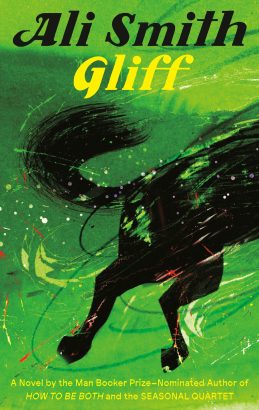 In ‘Gliff” the two young girls Briar and Rose are left on their own. Briar, the older sister, is around 13 while Rose is around 11. Briar tells the story.
Here is an example of how the sisters Briar and Rose talk to each other:
Then she said,
Bri. What actually is trust?
Eh, I said. It’s you know.
I don’t, she said.
You trust me, yeah?
First tell me what it is, then I’ll tell you, she said.
Their mother had to leave and is working in another country. Later we learn that their mother was fired from her job for being a whistle blower pointing out the dangers of the chemical that they were making at the weed killer factory where she worked. She has become a UV – an Unverifiable – and thus not welcome in her home country anymore.
“A whistleblower means someone who tells the truth about something when other people don’t want anybody to tell the truth about it.”
Though the daughters have done nothing wrong themselves, they are now Unverifiables too. At first they live on canned food in their old house. Later they move into a communal house with a group of other Unverifiables.
Gliff is the name of a horse that the sisters save from the abattoir and they take into their house (which I had difficulty picturing).
The various strands of this fable or allegory never congealed into a reasonable plot for me. The parts of ‘Gliff’ seemed scattered and disjointed almost to the point of incoherence. There is the story of the two young sisters living on their own with the horse ‘Gliff’ staying in their house. Then suddenly the sisters are living in a communal housing arrangement with other Unverifiables. And then we have the scenes five years later when Briar is more grown up which made even less sense to me.
Supposedly there is some relationship between Orwell’s ‘Brave New World’ and ‘Gliff’, but I could not find any similarities beyond the ominous threats that the modern technologies pose to our human community. Instead of having adults confronting an authoritarian world as in ‘Brave New World’, in ‘Griff’ we have children which leads to an over-simplication and a certain naivety.
I would like to read a coherent novel about why with all our supposedly wonderful new technology such as the world-wide web and cell phones, so many countries are once again descending into dictatorships just as they did before World War II. Ali Smith does point out the ease which these new systems provide for authorities to keep surveillance on their people, However ‘Gliff’ is just too diffuse and perhaps too naive to effectively address the problem.
Grade: C
8 May
‘Rosarita’ by Anita Desai (2025) – 94 pages
 Have you ever wondered what your parents did, how they behaved or not, and what type of persons they were when they were young adults?
In ‘Rosarita’, a young woman Bonita from India travels to Mexico to learn Spanish. As she is sitting on a bench in the hot sun in San Miguel, an old woman approaches her and claims she knew Bonita’s mother Rosarita. This does not seem possible to Bonita because as far as she knew, her mother never traveled to Mexico. Besides this old woman who approached her seems rather crazy and won’t leave her alone.
But the old woman does know certain details about Bonita’s mother that cause Bonita to wonder if she is possibly telling the truth. The old woman takes Bonita to a place where Rosarita had lived for a time in an art commune. It turns out that her mother had been an artist before she married a strictly conventional Indian businessman back in India.
I started reading the fiction of Anita Desai back in the 1980s with her novel ‘Clear Light of Day’. She was one of the few writers from India I had read at that time. She became one of my “go-to” writers. I have always enjoyed her work. Desai’s works have been shortlisted for the Booker Prize three times. Her daughter Kiran Desai is also a novelist, and Kiran’s novel ‘The Inheritance of Loss’ won the Booker Prize in 2006. Anita Desai is now 87 years old.
In an interview in the Guardian Anita Desai speaks of her attachment to Mexico. India and Mexico are in the same position geographically, close to the Equator with a warm tropical climate. They also both were colonized but later achieved independence.
“But the invitation is to a lecture organized by the cultural wing of the embassy, regarding a connection between the artists of the Mexican revolution and Indian artists of the freedom movement and Partition.”
I was expecting more of a resolution in the end of ‘Rosarita’ than there was. But maybe that is the way it usually is. We never do find out the full truth about our parents’ young lives, only a shadow of the truth.
Grade: B
6 May
‘Ordinary Grace’ by William Kent Krueger (2013) – 307 pages
 In my search for good fiction from all around the world, I wound up missing a great fiction in my own backyard. I am now making amends for my error. You may not be familiar with the name William Kent Krueger. Neither was I until very recently.
Apparently William Kent Krueger, a Minnesota writer, has been turning out well-received crime novels for a long time, usually involving private investigator Cork O’Connor. Since I don’t generally follow crime writing, I had not heard of his work. In 2013, Krueger published a stand-alone mystery novel, ‘Ordinary Grace’, which I totally missed since my attention was elsewhere. Over the years, this novel has gained in reputation until it captured the attention of even me. Later I found out it had won the Mystery Writers of America’s Edgar Award in 2014 for the Best Novel of the Year.
‘Ordinary Grace’ is a small-town Minnesota novel that takes place in 1961, and the main protagonist is 13 year-old Frank Drum. I happened to be 13 years old that same year so I could identify with many of its references such as the hot rods and the song Del Shannon’s “Runaway” and President Kennedy and also the prevailing upbeat spirit of the novel.
Frank Drum’s father is a Methodist minister who preaches for three churches in the area, so the family’s Sunday mornings are filled with church services. His mother sings at these churches.
“Oh, when she sang she could make a fence post cry.”
This is a good example of the analogies that Krueger uses to draw us readers in. Later we have “farm families who in most aspects of their public life were as emotionally demonstrative as a mound of hay”.
Also in the family are his older sister Ariel and Frank’s stuttering little brother Jake.

The Minnesota River
I won’t get into the central mystery in this novel at all, leaving that for the reader to discover. Instead I will discuss the place of mysteries in the broader category of literature. When a mystery is not formulaic and deals with life as it is lived, it has the potential to become great literature. When the characters are fully developed and finely drawn and the plot is involving and believable, a mystery can reach the highest levels. ‘Ordinary Grace’ has all these attributes. This crime novel is outstanding literary fiction.
Above all ‘Ordinary Grace’ captures small-town Minnesota life which is probably a lot like life elsewhere.
Grade: A
29 Apr
‘Twist’ by Colum McCann (2025) – 239 pages
“It still astounded me that nearly all our information travels through tiny tubes at the bottom of the ocean. Billions of pulses of light carrying words and images and voices and texts and diagrams and formulas, a flow of pulsating light. In tubes made from glass.”
 Fiber-optics is a fascinating little-discussed subject, the glass cables which span the world’s oceans and make the vast transfers of data on the internet possible. Satellites get all the publicity, but transmitting information via satellite is expensive and slow. Nearly all internet communication is done via fiber-optic glass cables on the bottom of the seas.
“The tubes are tiny. They are hollow. They weigh nothing. All they carry is light. I can’t presume to explain this.”
Most of the novel ‘Twist’ takes place on a ship that is sent out to repair these vital glass cables.
An underwater mudslide on the Congo River gains all kinds of debris as it moves along. This debris has damaged some of these underwater glass cables. Where the Congo meets the Atlantic, the power of the river current has created a canyon so deep in the Atlantic that divers cannot go to the bottom of the ocean where the cables lay, so they must use remote devices and grappling hooks to reach the cables.
Our narrator, Anthony Fennell, is a journalist who wants to do a story about the repair of these communication cables. John Conway, the captain of this cable repair ship, allows our narrator to stay aboard the ship on this repair mission.
But just how much of this internet traffic is helpful or valuable? Much of the traffic on the world-wide web is worthless and in many cases even harmful. Gossip, lies, conspiracy theories, character assassinations. Some sources suggest that as much as 30% to 40% of all data transferred across the internet is pornography.
“In my cabin, I allowed myself to descend again into the rabbit hole of the web, a tumble into the worst part of ourselves.”
“It was filthy and it was wrong and, like everyone else, I was consuming it willingly.”
Even the captain of the repair ship has very mixed opinions about the internet.
“And we’re just putting the ends together so people can ruin one another… Everything gets fixed, and we all stay broken.”
Later we find out just how conflicted the captain is.
This is a fascinating subject. However the main characters in this novel, who are the repair ship captain snd the captain’s actress girlfriend Zanele and the journalist narrator, did not really come alive for this reader.
Grade: B
22 Apr
‘Flesh’ by David Szalay (2025) – 353 pages
 Ever since I read ‘All That Man Is’ in 2016, I have been keenly interested in the career of writer David Szalay. I read a couple of his earlier novels, waiting for his next big one that I was confident he would produce. Now ‘Flesh’ has arrived.
‘Flesh’ begins with the fifteen year old Istvan living with his mother in an apartment in Hungary. A neighbor lady, forty-two years old, initiates a sexual affair with the boy. Later in a confrontation with the lady’s husband, he is suspected of pushing the husband down the stairs causing her husband’s death. He spends time in a young offenders institution.
This is the first of many twists and turns in Istvan’s life. Later he volunteers for the army in the hopes of redeeming his reputation. He is sent to Iraq where he winds up with a good conduct medal.
After the army, he has an instance of self-sabotaging behavior punching a door and severely hurting his hand. Then he goes to London where he first works the door of a strip club. He then saves the life of a man who is the owner of a security agency who hires Istvan as a guard and driver based on his military experience. The meteoric rise of Istvan begins. He spends a lot of his time driving the owner’s wife around.
There are angles here about physical sexual attraction that are not at all sentimental. That is probably why the novel is called ‘Flesh’. It’s his flesh that he can’t escape, that brings him back to the human.
‘Flesh’ captures a life: the good things, the really good things, the not-so-good things, the bad things, the wonderful things, the terrible things. It is all there, this man’s life in plain unadorned language. I’m impressed. This causes me to reflect on my own life which has also contained all these things.
So much of the success and failure in this man’s life is just happenstance. Things happen. Isn’t that true for most of us?
Most writers tend to tip the scales in favor of their main protagonist or protagonists. However the writer David Szalay strives for complete objectivity rather than subjectivity. He is meticulous in describing events and doesn’t take sides. He doesn’t assign blame or praise, just states the facts of each situation even if they cause his main character to look bad. This is a refreshing somewhat unique approach to writing fiction.
‘Flesh’ is the novel I have been waiting for from this writer.
Grade: A
 Tony's Book World
Recent Comments