“The Cry of The Sloth” by Sam Savage
Archive for the ‘1’ Category
16 Oct
Funny Fiction – An un-Bleak List
 Starting at 12 years old, I began reading Mad magazine. Every issue had the “What, Me Worry?” kid, Alfred E. Neuman, on the cover with his gap-toothed smile. Every issue of Mad magazine contained “assorted rubbish from the usual gang of idiots”, which was the publishers’ slogan. There were other humor magazines such as “Crack’d”, “Sick”, and “Panic”, but Mad was always consistently the funniest. I was so dedicated to Mad, I’m sure the magazine shaped my entire attitude toward life. They still sell Mad magazine but most places that sell magazines are way too respectable and reputable to carry something so smart, creative, and anarchic as Mad magazine.
Today, we also do have “The Onion”, a fake newspaper with outrageous headlines like “Pepsi to Cease Advertising”. Most of the articles in The Onion are more relevant than those in the real newspapers. I’ve noticed that after the first few humorous pages, “The Onion” has some of the best reviews anywhere.
After college I mostly switched to humorous novels instead of humor magazines.
Kimbofo at Reading Matters recently listed the ten bleakest novels ever. Most of these novels were very dark. Now, as an antidote, I will print my personal list in no particular order of the funniest novels ever.
- Lucky Jim by Kingsley Amis an English college riot
- Confederacy of Dunces by John Kennedy Toole Masterpiece of “slob” literature
- Catch-22 by Joseph Heller Military forces awry
- Gulliver’s Travels by Jonathan Swift Travel to some very unusual places
- At Swim-Two-Birds by Flann O’Brian A wild Irish tale
- Candide by Voltaire an eternal French optimist
- Don Quixote by Miguel de Cervantes “a hopeless romantic” or “romantic and hopeless”?
- Cold Comfort Farm by Stella Gibbons Way down on the farm
- The Good Soldier Schweik by Jaroslav Hasek the funny side of World War I
- The Groves of Academe by Mary McCarthy Why is college so funny?
- Pictures from an Institution by Randall Jarrell Is humor academic?
- Oblomov by Ivan Goncharov a lazy Russian aristocrat
- Scoop by Evelyn Waugh outlandish African news reporting
- Firmin – Adventures of a Metropolitan Lowlife by Sam Savage autobiography of a literary rat
- The Apprenticeship of Duddy Kravitz by Mordecai Richler Young man on the make in Montreal
As you can see, no writer appears on this list twice. Which writer came closest to appearing twice? It probably would be Evelyn Waugh whose “The Loved One” is a fall-down hilarious putdown of the funeral business. Honorable mention also goes to Peter De Vries who wrote many humorous novels including “The Tunnel of Love” and *The Tents of Wickedness”.
I’m sure there are some great humorous novels I’ve missed. I want to know what I’ve missed. What humorous novels should I also include?
13 Oct
Two Novels by Hans Fallada
“Little Man, What Now?” by Hans Fallada, translated by Eric Sutton
“Every Man Dies Alone” by Hans Fallada, translated by Michael Hofmann
These two fine novels by Hans Fallada could well serve as bookends describing the Nazi era in Germany. “Little Man, What Now?” was published in 1932, the year before Hitler took full power in Germany. “Every Man Dies Alone” (in many places, called “Alone in Berlin”) was written in 1946, the year after Hitler committed suicide, and World War II ended.
“Little Man, What Now” describes the young marriage and early family life of Johannes Pinneberg and his wife Bunny. Although they have to struggle to get enough money to make ends meet, this young couple is quite happy due to the strong attraction between them. In both novels, Fallada is very good at describing happily married couples. Bunny can’t cook, and Johannes wastes money on these grand gestures like buying a big dressing table for his wife while they rent and live in a hovel, but due to their strong affection for each other, they get along just fine, even after they have the baby. Later they face enormous difficulties which they face because they have each other. One of Fallada’s major strengths as a novelist is describing everyday life of ordinary people in an accurate and intense way.
Johannes works as a salesclerk in a men’s clothing store for most of the novel, and he barely makes enough money for him and Bunny and baby to get by. But they are helped by several eccentric people around them, and in many ways “Little Man, What Now?” is a playful, happy novel about this young family.
Where are the Nazis in “Little Man, What Now?” They are around. Anti-Semitism is everywhere in the streets. The Nazis are on the rise. In the novel, there is only one minor character Lauterbach who is a young Nazi. He works with Pinneberg on one of Johannes’ early jobs. Lauterbach is proud of his Nazi badge, and every night he and his Nazi friends go out in the streets harassing Jews and getting into street fights with them and anyone else they don’t like.
But for much of the book, “Little Man, What Now?” is a pleasant family story centering on the young husband and wife. Hollywood grabbed the story up quickly, and by 1933 “Little Man, What Now?” was already a movie.
The scene in “Every Man Dies Alone” is completely different, a nightmare. Berlin in 1940. Now the Nazis have totally taken over. All of the exotic eccentric people have disappeared from Berlin. Everyone is in fear that their Nazi neighbors will report them to the Gestapo and then they too will be dragged away to prison. Groups of Nazi neighbors living in the same apartment house as the Quangels, the main characters of this novel, terrorize the life and apartment of an elderly Jewish woman who lives there. Her husband has already been sent away to a concentration camp. If anyone else is friendly toward or tries to help this woman, they too will be reported and hauled away by the Gestapo.
The story in “Every Man Dies Alone” also centers on a married couple, this time a middle-aged couple called Otto and Anna Quangel. They are a quiet couple until their only son “Ottochen” gets killed on the Russian front during World War II. Then Otto starts writing notes with messages denouncing the Nazis and leaving them anonymously in public buildings where people can find them. His wife is in on this futile campaign and completely supports her husband in his efforts. The Quangels are another strong supportive couple, but here there is nothing to be playful about. There are Nazis under every toadstool in Berlin terrorizing their neighbors in the early 1940s. One of the many strengths of this novel is that it paints a very clear picture of the oppressive life of ordinary people in Berlin during the Nazi era. Until now, we did not know how terrible life was for the average Berliner during the Nazi era. Of course, these Germans suffered less from the Nazis than millions of other people throughout Europe.
“Every Man Dies Alone” is a powerful novel. I consider it the best book I’ve read this year so far. I will remember details from this novel long after I forget the whole stories of other novels I’ve read this year. “Little Man, What Now” is also a very good novel, but it does not have the intensity of “Every Man Dies Alone”. Hans Fallada put his heart and soul into his last book, and he died in 1947, the year after it was written.
Over the past few years the world has discovered or re-discovered many European novelists from this terrible era – Joseph Roth, Stefan Zweig, Irene Nemirovsky, Irmgard Keun, and now Hans Fallada. What a spectacular group of writers!
Will an era like the Nazi era ever happen again? Given human nature, I expect it will. I don’t think it will have the same trappings as the Nazis did or the same slogans or symbols. It will try to sell itself as something completely new and different. It will probably occur in a completely different place. But it will have one thing in common with the Nazis. There will be street gangs beating up and harassing the people they don’t like, and the police and government authorities will not only condone it; they will encourage it.
11 Oct
Thank You for Sam Savage, John Self
One of the book sites I always read is John Self at http://theasylum.wordpress.com/ because it is a great place to get new leads for wonderful works of fiction. Last year John Self at Asylum introduced me to Sam Savage. Sam Savage happens to be a novelist from my former beloved hometown of twenty one years, Madison, Wisconsin. Based on John Self’s review, I read Savage’s “Firmin, The Adventures of a Metropolitan Lowlife”, a story about a rat which was one of the highlights of my reading in the year 2008. Apparently now nearly everyone knows that Asylum is one of the best book places on the Internet. I have just received Sam Savage’s new novel, “The Cry of the Sloth – The mostly Tragic Story of Andrew Whitaker being his collected, final, and absolutely complete Writings”. Now if only I can read and review “The Cry of the Sloth” before John Self does.
So now this virtually unknown book blogger, me, is hitching his wagon to John Self, one of the stars of the Internet book world. Shameless.
7 Oct
Re-Evaluations – Graham Greene and William Faulkner
A long time ago, I read “The Power and the Glory” by Graham Greene. For some reason, I hardly remember why, I disliked it and wrote it off as a spy novel, a thriller, a best seller. So for the next many years I avoided reading Graham Greene while reading just about every other literary writer in the world. Then finally about five years ago, after having read some good things about “The End of the Affair” and “A Burnt-Out Case”, I decided to read these novels. This time I really appreciated Greene’s straightforward style. There was nothing flashy about his writing, but he had these wonderful plots that kept me completely involved. But the real turning point was reading “Brighton Rock”, an early Greene novel. I loved this story about these young punks driving around Brighton, England. This was the best novel I had read in years. So for the next few years, I read nearly everything Graham Greene wrote. Every book by Greene I read captivated me. Now, unfortunately, I’ve run out of Graham Greene novels to read.
As a child, I was not interested in literature at all. The only books I really appreciated as a boy were “Tom Sawyer” and “Huckleberry Finn” by Mark Twain. At college, even though I was majoring in mathematics, I decided to take a course in Contemporary Literature. One of the books we were assigned was “Absalom, Absalom” by William Faulkner. This over 400 page novel is notorious for containing some of Faulkner’s most convoluted page-and-a-half long sentences. No matter how hard I tried, I could not get through this novel. I had to drop the Contemporary Literature course, because of “Absalom, Absalom”. The next semester, I again enrolled in Contemporary Literature. This time “Light in August” was the Faulkner novel on the reading list. “Light in August” was much more reasonably written without the long run-on sentences, and I actually enjoyed reading it. I completed the Contemporary Literature course successfully. After that, William Faulkner was my favorite author. I read and enjoyed most of Faulkner’s novels in the next few years after that.
A few months ago, after having not read Faulkner for many, many years, I decided to listen on my drives to and from work to the audio CD of “Light in August” which I still considered William Faulkner’s finest novel. This time the novel just completely hit me the wrong way. This time all of Faulkner’s deep and dark ponderings and reckonings about the possibility that his character Joe Christmas might have “mixed” blood seemed like little more than ill-disguised racism to me. I suppose one could excuse Faulkner because he wrote these novels in the 1930’s in the deep South. But already by the 1930s, there were many people who had more progressive racial attitudes. And I am not about to forgive Faulkner for these Southern attitudes and their deliberate ignorance, after these have done so much damage to the United States during the last ten years.
Have any of you had your opinion of an author drastically change? Please let me know.
5 Oct
Four Plays by Euripides
Grief Lessons – Four Plays by Euripides
Translated by Anne Carson
As far as we know, the beginnings of literature were the classical Greek dramas from about 2500 years ago. The first famous Greek playwright whose work has survived was Aeschylus, followed by Sophocles, then Euripides. Euripides competed in 22 of the annual Athenian dramatic competitions and won the competition five times. I suppose these dramatic competitions were the classical Greek equivalent of the Booker, and like the Booker, not only Greeks were allowed to compete. Euripides was from northern Africa. Although Euripides wrote many, many plays, only 19 of his plays have survived.
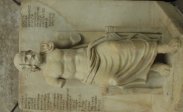 In these classical Greek plays all the many gods have super-human powers, but have the same emotions, the same passions, the same lusts and jealousies as humans, frequently with disastrous consequences for the humans. These gods frequently take the human shape and form. Also there are the humans, and finally there are those who are a mixture of both, being offspring of both a god and a human. These part humans / part gods are the most interesting and tragic ones of all. They have some super-human powers but have all the weaknesses of people.
Theseus : “My advice is endure it. No mortal is untouched by changes of luck, no god either – if poets tell the truth. Don’t gods sleep in one another’s beds? Don’t they throw their fathers into chains and take their power? But all the same they occupy Olympos, they hold on, criminals or not. Will you protest your fate, when gods do not? Leave Thebes then, follow me to Athens.”
The preceding is from Euripides’ play “Herakles” as translated by Anne Carson. The tone is straightforward, clear as a bell, and easy to follow. Anne Carson translating classical Greek is one of those select group of reliable translators including Gregory Rabassa for Spanish, Richard Wilbur for French, Constance Garnet and David Magarshack and Pevear / Volokhonsky for Russian, and Michael Hoffman for German. These translators always select strong works of literature to translate and then get the tone and the story exactly right. I have read many classical Greek plays translated by Anne Carson, and have enjoyed them very much. Anne Carson is also an excellent poet of her own work, including “An Autobiography of Red- A Novel in Verse”. Usually I don’t read most prefaces to works of literature, but Anne Carson’s I do, high praise indeed.
In these Euripides plays, there is the eternal question “Why does God or the gods let terrible things happen to good people?” Perhaps because the Greek gods intermingle with the people so freely and take human form, they probably lead to more dramatic possibilities than the ones in our own religions. That may be one of the reasons that these Greek plays are a high point of world literature. The only works comparable are Shakespeare’s plays. Each of these plays take about an hour to read.
Classical Greece was a high point of literature, yet I have found little from the Roman Empire to compare. I’ve read Virgil’s Aenead and the Satyricon, yet found these works wanting as drama. Can anyone name a work from the Roman empire that they treasure as literature?
30 Sep
Short Attention Span Theater – Rosamond Lehmann
Short Attention Span Theater is where a theater group takes an over three hour long production of Hamlet and cuts it down to five minutes by only performing the highlights. For me, the Internet is one giant Short Attention Span Theater. Sadly, I very rarely read an entire blog entry; instead scan for the highlights. .. which is impossible. This is why I keep my own blog entries short. (It is not because I’m lazy).
From time to time, I’m going to have short blog entries regarding some of my favorite authors which will only feature the highlights. These entries will be called “Short Attention Span Theater”. These short entries do not mean that I will not deal with these same authors in depth later. Here goes.
Rosamond Lehmann (1901 – 1990) – She wrote some wonderful, incredible novels including “The Ballad and the Source”, “Invitation to the Waltz”, and “Dusty Answer” – all three of which I enjoyed even more than the novel she is most noted for, “The Echoing Grove”. Whenever I go into a used book store, I look for novels by Rosamond Lehmann, and if I don’t find any, the store goes down a peg in my opinion. Her style? She was England’s answer to Jean Rhys, whenever Jean Rhys was away from England. The Thirties and Forties had many quirky woman writers including Jean Rhys, Irngard Keun, Irene Nemirovsky, and Dawn Powell. If you like any of these writers, you will probably like Rosamond Lehmann.
Let’s have a Rosamond Lehmann revival.
29 Sep
“The Fall” by Simon Mawer
“The Fall” by Simon Mawer
“The Fall” is a novel about mountain climbing. Here is the setup.
Guy Matthewson is an expert brave mountain climber, ie. a wonderful person. Guy is a bit of an enigmatic chap too. Guy, by divine right, meets and beds pretty young women Diana and Caroline who happen to be wonderful people too. Guy’s son, Jamie Matthewson, is also an intense, courageous mountain climber, perhaps even a bit more enigmatic than his father. Jamie’s best friend, Rob Demar, climbs mountains with Jamie, is not quite so courageous and expert and enigmatic, but both Jamie and Rob meet and bed pretty young women Eve and Ruth, wonderful in their own right.
And so it goes. You get the picture. This novel is what best sellers are made of. This story is told with no humor, no sense of irony, very little pathos. The novel alternates between the time of Guy which is the early 1940s and the time of Jamie which is the mid-1960s. Much of the novel takes place in Wales and Scotland as well as the Eiger mountain in the Alps.
Perhaps I’m the wrong person to be reviewing this novel about mountain climbing. Most of the few accidents and injuries I’ve suffered have been the result of excessive caution rather than any sense of derring-do.
Simon Mawer is a very smooth writer, perhaps too smooth for his own good. There are no rough edges here, except in the rocks on the mountains. The novel is well constructed. Everything is just a little too facile.
As a potential best seller, I would give this novel an A; as a screenplay for an exciting action-adventure movie (which I wouldn’t want to see), this novel gets an A; as literature, this novel gets a C-.
While reading this novel, I kept thinking about Thomas Bernhard, the German writer. Most of his novels were about losers. Yet he could describe a scene where one of his characters is putting their shoes on over their dirty socks more interestingly than this novel could make climbing the Eiger.
 Tony's Book World
Recent Comments