‘The War of the Poor’ by Eric Vuillard (2019) – 79 pages Translated from the French by Mark Polizzotti
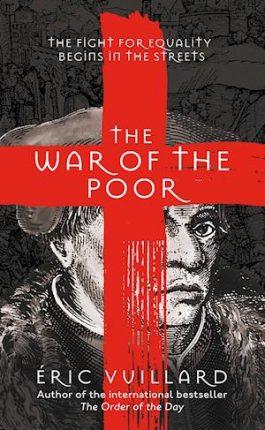 When someone writes a book propping up the kings, queens, and aristocracy of the past, we call that history. However if someone attempts to explain a major peasants’ revolt that occurred in the 16th century, then do we call that fiction? The German Peasants’ War of 1524 and 1525 was Europe’s largest and most widespread popular uprising prior to the French Revolution of 1789.
The German Peasants’ War was a revolt against both the aristocracy and the Catholic Church which through its doctrine and practices bolstered the aristocracy. The religious leader of this revolt was the German preacher and theologian Thomas Müntzer.
“Why the God of the poor was so strangely always on the side of the rich, always with the rich. Why his words about giving up everything issued from the mouths of those who had taken everything.”
At first the Protestant reformer Martin Luther supported Müntzer, but when Müntzer’s sermons started to inflame the peasants into revolt Luther turned against him.
The Catholic Church services in the Middle Ages were in Latin which very few people in Europe could understand, and the Bible, untranslated, was also in Latin. In ‘The War of the Poor’ author Vuillard traces reformers like John Wycliffe who translated the Bible into English.
“And as the icing on the cake, his most terrifying idea of all, he (Wycliffe) preached the equality of all human beings.”
Martin Luther translated the Bible into German.
When the sermons and the Bible became things ordinary people could understand, then religion became more personal and thus more susceptible to logic. The poor began to question the King’s and the Church’s authority over their wretched lives.
There are no fictional characters or events in ‘The War of the Poor’. Here is an example of why ‘The War of the Poor’ would be treated as fiction:
“Thomas Müntzer must have blazed white-hot during those days. He must have gone off like a firecracker, bellowed his faith and brought to bear misery, rage, despair, and hope.”
This kind of colorful zippy conjecture would never do in the staid non-fiction world.
This book is a scant 79 pages. What there is of it is very good. I wish there were more. I would like to see a fuller depiction of the life of Thomas Müntzer. He seems to be a fascinating pivotal figure in European religious and social history.
Grade: A-
–



Recent Comments