‘The Fawn’ by Magda Szabo (1959) – 285 pages Translated from the Hungarian by Len Rix
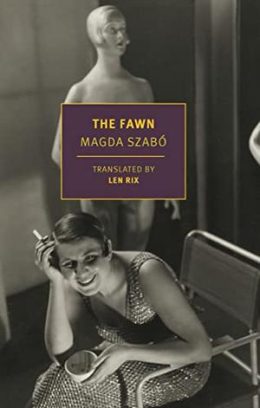 In ‘The Fawn’, our narrator Eszter descends from an aristocratic Hungarian family. However due to her sickly lawyer father’s frequent illnesses, he stays at home and does not practice law. Thus the family lives in reduced circumstances with Eszter’s mother making a little money by giving piano lessons to children in the neighborhood. Eszter as a child has to do the housework that her mother would ordinarily do, but the family remains poor.
One of the neighbor girls who takes piano lessons from Eszter’s mother is Angela. Angela’s family is well-to-do, and she is a beautiful child. Eszter hates her instantly.
“I have loathed and hated Angéla from the moment I first saw her. Even when I am dead, if there is any life after death, I shall hate her still.”
The story in ‘The Fawn’ takes place in those turbulent years during and after World War II when first Germany invaded Hungary, and then the Russians attacked and defeated the Germans, and then the Russians remained in Hungary, and Hungary became a satellite state of the Soviet Union.
As ‘The Fawn’ progresses, our narrator Eszter grows up and becomes a famous Hungarian actress in Budapest.
One tool which is very helpful in ‘The Fawn’ and that I wish more novels today would do is a list of the main characters at the beginning with a short description of their place in the novel.
Despite Eszter’s success as an actress, she retains her childhood hatred of Angela. When Eszter finds out that Angela is living in Budapest with a husband and that Angela’s husband is translating a Shakespeare play into Hungarian, you might imagine what happens next.
One of the aspects of ‘The Fawn’ that stood out for me is that the narrator of the novel, Eszter, is not a good person. It seems to me that in our more recent novels, the narrator, especially a female narrator, is assumed to be and usually is a very fine person. I found it refreshing having to deal with a narrator who is morally ambiguous at best.
That is the mark of a talented writer to me, that they don’t just try to get by with the good natures of their characters. The New York Review of Books must think the same way, since ‘The Fawn’ is the fourth Magda Szabo novel they have made available to us.
Grade : A-


Recent Comments