‘The Director’ by Daniel Kehlmann (2023) – 331 pages Translated from the German by Ross Benjamin
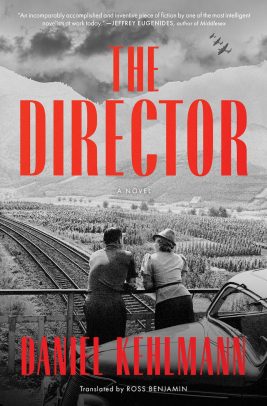 ‘The Director’ is a novel about making movies under the worst possible circumstances, in Nazi Germany during World War II. It centers on G. W. Pabst who had already achieved world fame for the movies he directed in the 1920s and early 1930s. He was the director who discovered Greta Garbo and Louise Brooks.
Pabst and his family had already fled Germany for the United States in 1933. He hoped to continue his career. When G. W. Pabst arrives in Hollywood, he is praised profusely by nearly everyone. Then he is handed a script, “A Modern Hero” and was told this would be his first American movie. Pabst reads the script and tells them the script isn’t very good. They tell him “Yes, it is”. He films the movie, and it bombs.
In 1939 Pabst and his family go back to Austria, then called Ostmark, for what is supposed to be a short stay to visit his ailing mother. However while they are visiting, Germany invades Poland, starting World War II. The Pabst’s cannot leave.
The caretaker in the house where the Pabst family and his mother live during this time is a full-fledged Nazi who has total disdain for Pabst and his family even though Pabst is not a Jew. The caretaker insults and spies on the Pabst family and reports their activities to Berlin. Hitler’s cruelty gave all of his followers permission to be as cruel as they want to be.
“Politeness was interpreted as weakness; he had been back in Germany long enough now to know that.”
In his various vignettes, Daniel Kehlmann covers many aspects of this creative family’s forced return to an cruel authoritarian dictatorship that they both absolutely detest. Separate chapters are written from the father’s, the mother’s, and the son’s point of view.
At one point Pabst is assigned to be an assistant to the woman director Leni Riefenstahl, famous for her Nazi propaganda movies. Riefenstahl got her start as an actress in Pabst’s movies, but now the Nazis have given her complete control over him. Riefenstahl is also an actress in this movie. He is supposed to give Riefenstahl advice on saying her lines. He tries, but she is quick to take offense.
“Let it go, he thought, remember she can put you in a camp.”
The extras used in this picture are concentration camp inmates.
The author Daniel Kehlmann gives us several different vantage points from which to watch this family who are stuck in Germany during World War II. First there is the famous director himself G. W. Pabst who hates what the Germans are doing but paradoxically finds that he has more freedom to make the movies he wants in Germany than he had in the United States. Then there is his wife Ilse who has difficulties handling the fact that they are constantly being watched by the German authorities and other informers. Then there is the son Jacob who wants to fit in with the other boys his age and wears his Hitler Youth uniform to fit in as do all the boys.
In one chapter we have a sort of prisoner of war (according to the New York Times, English novelist P. G. Wodehouse) watching the grand opening of one of the movies Pabst directed in Germany during the war, ‘Paracelsus’.
‘The Director’ is another engaging novel by Daniel Kehlmann especially for those interested in the making of movies.
At one point someone questions how Pabst could make movies under these Nazi circumstances.
“But don’t you find it strange, Pabst, that we’re making a movie like this in the middle of the apocalypse? Such a…work of art?”
“You say that as if it’s a bad thing.”
“More like a strange thing.”
“Times are always strange. Art is always out of place. Always unnecessary when it’s made. And later, when you look back, it’s the only thing that mattered.”
Grade: A


Posted by JMN on May 27, 2025 at 10:51 PM
Pabst’s comment about art being always out of place is beautiful. Thank you for this good review.
LikeLiked by 1 person
Posted by Anokatony on May 28, 2025 at 3:29 AM
Hi JMN,
Thank you, I thought those lines were valuable too.
LikeLiked by 1 person
Posted by Janakay | YouMightAsWellRead on May 27, 2025 at 10:51 PM
I noticed this one when I was browsing in Barnes & Nobles the other day; being aware of your fondness for Kehlmann I thought it might soon be making an appearance on your blog! (I haven’t yet tried Kehlmann, but I did acquire a copy of Tyll, after our previous discussion). Do you read The New York Review? The most current issue (dated June 12) has a nice 3-4 page essay about the novel. The current New Yorker also has a paragraph in its “Briefly Noted” column, so unsurprisingly Kehlmann’s latest is getting some buzz! The novel’s very topical for our troubled times, don’t you think? I was just reading a news account of the artists who refused/were comfortable, performing at Kennedy Center after its MAGA make-over. As for Pabst himself, I know little about his actual career, but I have the impression that it never recovered from his work in Germany. I find this interesting, given that Leni Riefenstahl seems to have largely escaped the consequences of her own activities.
LikeLiked by 1 person
Posted by Anokatony on May 28, 2025 at 3:28 AM
Hi Janakay,
Of the two, ‘Tyll’ and ‘The Director’, though both are very good, for me ‘Tyll’ was the finer novel. Of course ‘Tyll’ had a subject, the Thirty Years War from long ago, that doesn’t immediately appeal to modern readers, but this allowed Kehlmann to use his talents fully.
Yes, for ‘The Director’ there is the unfortunate tie-in with modern US Times. We might be seeing a lot of the best movie directors leaving here as well.
Leni Riefenstahl comes across quire negatively in ‘The Director’. She was the Nazi director who could put other directors in concentration camps.
LikeLiked by 1 person
Posted by Lisa Hill on May 28, 2025 at 1:31 AM
I like the sound of this, interrogating the ethics of engagement with a loathsome regime.
A film about Riefenstahl made an appearance at the German Film Festival here but the trailer showed her in denial and obviously unrepentant, and I was just not in the mood for that.
LikeLiked by 1 person
Posted by Anokatony on May 28, 2025 at 3:36 AM
Hi Lisa,
Have you ever watch Riefenstahl’s ‘Triumph of the Will’? I did, and it certainly glorifies Hitler and the other Nazis. She lived to be 101 and always claimed that she knew nothing about the Holocaust which seems highly unlikely.
LikeLike
Posted by Lisa Hill on May 28, 2025 at 6:28 AM
I’ve seen bits of it in a doco about her.
There’s an awful lot of Germans ‘who knew nothing about the Holocaust’ considering the industrial scale of it.
LikeLiked by 1 person
Posted by Anokatony on May 28, 2025 at 3:04 PM
I agree, willful ignorance, and I have German ancestors myself.
LikeLiked by 1 person
Posted by Lisa Hill on May 29, 2025 at 4:06 AM
I have a dim memory that my father had a German cousin, though I have not the faintest idea how she fitted into the picture since that side of my family is ‘proper English’, stout yeoman traceable in the same place for hundreds of years. Until my great grandfather married a French woman (who may have been Belgian) there’s nobody very interesting at all. It would have been interesting to know if she had any influence on British cuisine Chez Hill, but that whole family was long dead by the time I was old enough to wonder about that.
LikeLiked by 1 person
Posted by Anokatony on May 29, 2025 at 5:01 AM
I suppose there are a fair number of Australians with English convict ancestors.
LikeLike
Posted by Lisa Hill on May 29, 2025 at 8:22 AM
Indeed there are, and Irish convicts too. But just as in America, free settlers soon put a stop to transportation and some states proudly proclaim that they never had any convicts at all.
There used to be argy-bargy about how they were convicted only of petty crime or theft to feed a starving family versus criminal records that suggest otherwise (such as sedition in the case of the Irish), but now there is so much angst about the (sometimes violent) dispossession of the Indigenous people that those distinctions seem to have diminished.
History is never really the settled thing that we thought it was when we learned it at school…
LikeLike
Posted by Cathy746books on May 28, 2025 at 12:33 PM
I just bought this last week. I love all Kehlmann’s books.
LikeLiked by 1 person
Posted by Anokatony on May 28, 2025 at 3:02 PM
Hi Cathy,
The book that got me started on Daniel Kehlmann was his book of stories, ‘Fame’, back in 2010.
LikeLike
Posted by Cathy746books on May 28, 2025 at 3:28 PM
Yes, I loved it!
LikeLiked by 1 person